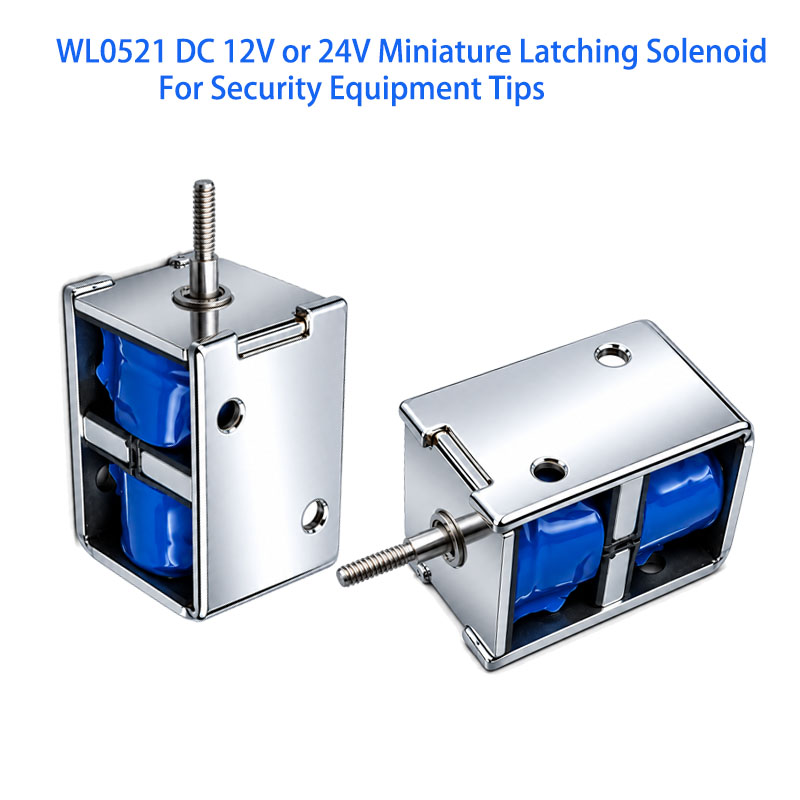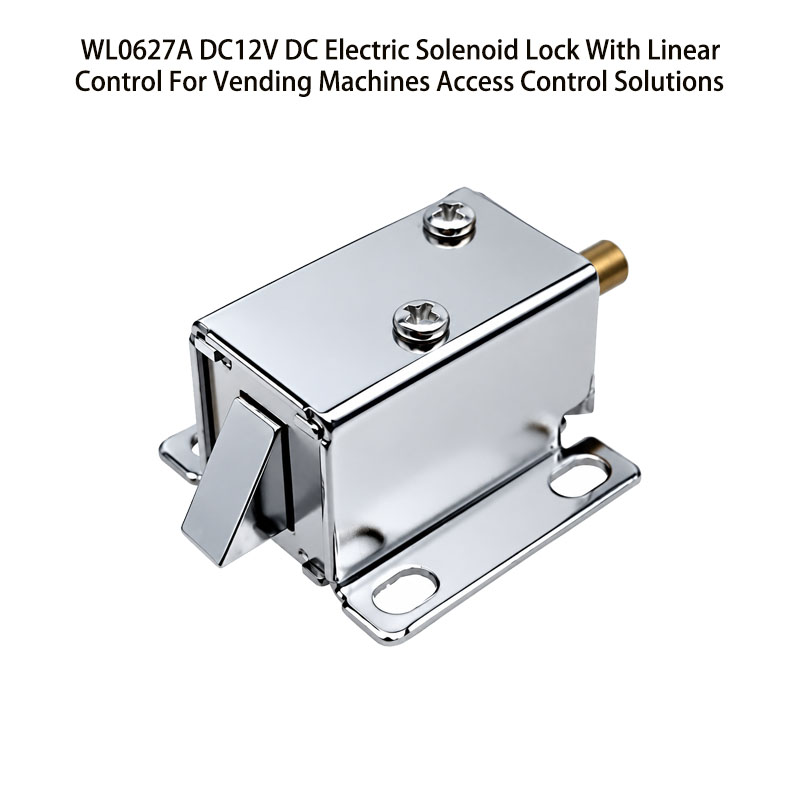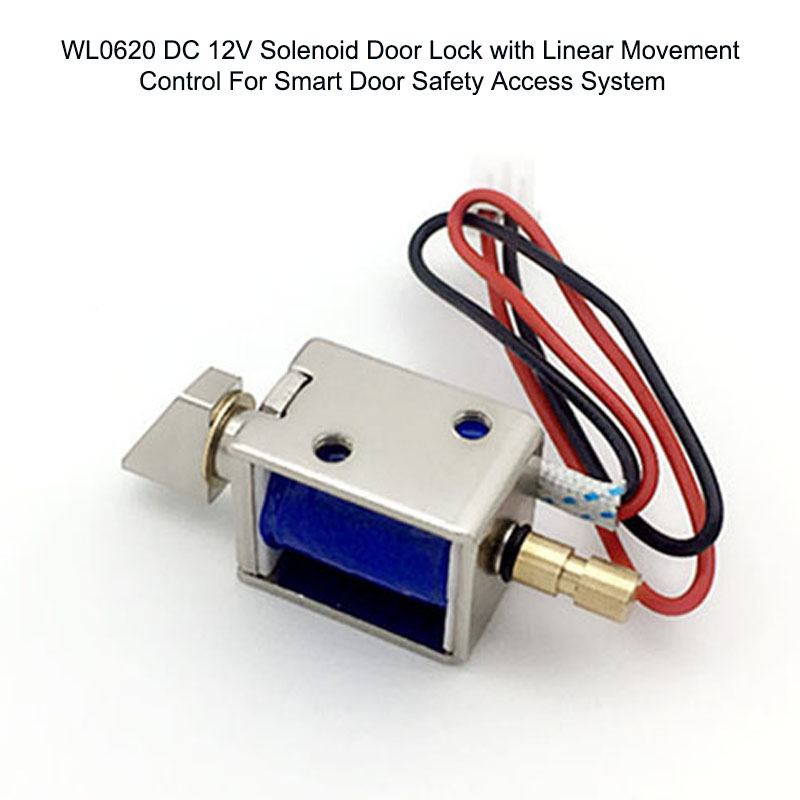
Introduction to DC Solenoid Movement and it is application
DC solenoid movement devices are a necessary constituent of contemporary industrial automation, cars, medical appliances, security systems, and electronic equipment. Many machines need reliable linear motion to actuate valves, open/mechanically lock, operate switches, or power mechanical mechanisms. The widely used apparatus for this motion generation is the DC solenoid.
A DC solenoid is the electromagnetic instrument that transforms electrical energy into mechanical movement. A copper coil with current in it will create a magnetic field. This magnetic field will attract the movable iron plunger. Movement of the plunger could actuate an outside mechanism.
The principle of action is quite simple, but there are many engineering aspects, like magnetic field strength, resistance of the coil, voltage, air gap, plunger material, and mechanics involved in practical application.
Well-designed linear push-pull solenoid allows you to get quick response, compact installation, reliable operation, and controllable mechanical movement in many applications.
In this paper we are going to analyze how magnetic fields control DC solenoid movement, how electromagnetic force appears, and how it influences solenoid performance. Also, we will examine the application of DC solenoids in modern industries.
1. What Is a DC Solenoid?
A DC solenoid is an electromagnetic actuator used to produce mechanical movement from a DC power source.
The basic construction usually consists of the following parts:
Copper coil. Insulated copper wire is wound around the bobbin to create a magnetic field.
Plunger—the movable ferromagnetic metal core moving along the axis.
Magnetic housing. Metal housing, which provides a magnetic circuit and focuses the magnetic flux.
Spring return system. This type of DC solenoid has the spring return system, which returns the plunger to the initial position after de-energization.
Bobbin. The insulation component which supports the copper winding.
Connections. Electrical connectors for linking to the DC power source.
The current passing through the coil creates a magnetic field. This field attracts the movable plunger into a zone of magnetic field attraction, creating the linear movement.
When the power supply is switched off, the spring in spring-return types returns the plunger into the initial position, or the plunger can be moved back to the initial position by external mechanical force.
A DC linear push-pull solenoid uses this electromagnetic force to produce linear mechanical movement.
Depending on the construction, a DC solenoid can actuate pulling motion, pushing motion, or a bidirectional one.
2. How Is the DC Solenoid Motion Controlled by Magnetic Fields?
The magnetic field is the main controller of the solenoid’s motion.
When current is running through the copper winding, it generates the magnetic field. A magnetic field interacts with the ferromagnetic plunger, creating the attraction force.
Four steps of the process are distinguished.
First Step. Flow of the Current Through Coil
When DC voltage is applied to the solenoid, current starts to run through the copper winding.
In the steady state mode, the current is determined by the applied voltage and the resistance of the coil.
According to Ohm’s Law:
V=I*R
Where:
V = Applied voltage.
I = Electric current.
R = Resistance of Coil.
Thus, for example, the 12V DC solenoid with the resistance of 12 ohms at the steady-state mode will draw one ampere.
The electrical energy fed to the coil produces the magnetic field of the actuator.
Second step. The coil-induced magnetic field
Current flows through the winding creating the magnetic field in the coil.
The magnetic field intensity depends on the number of turns and electric current.
The formula of magneto-motive force (MMF):
MMF=N*I
Where:
N = Number of turns of coil
I = Current of electricity.
MMF = Magneto-motive force.
Magnetic excitation depends on the number of turns or current intensity.
But coil design must provide a compromise between the magnetic and electrical performance, size, power consumption, and heat generation.
Third Step. Movement of the plunger due to magnetic attraction
When a magnetic field occurs, the ferromagnetic plunger acts on electromagnetic force.
The plunger moves towards the end where the magnetic circuit has lower resistance, and usually it is where the air gap between the plunger and magnetic pole decreases.
Magnetic flux distribution changes depending on the plunger movement.
In most traditional designs of DC solenoids, electromagnetic force increases while approaching the energized pole.
That is why force at the start and end of the stroke is usually different.
Fourth step. Actuation of external mechanical appliance
The plunger transfers its movement to the external object using the shaft, connecting rod, or other mechanical coupling.
The actuator movements can be used to:
Switch valve.
Unlock a lock.
Push the mechanical element.
Pull the coupling link.
Open/closed electrical switch.
Actuating an automated appliance.
This is the process when the electrical signal is transformed into mechanical motion by the DC solenoid.
3. What Affects the Magnetic Force of a DC Solenoid?
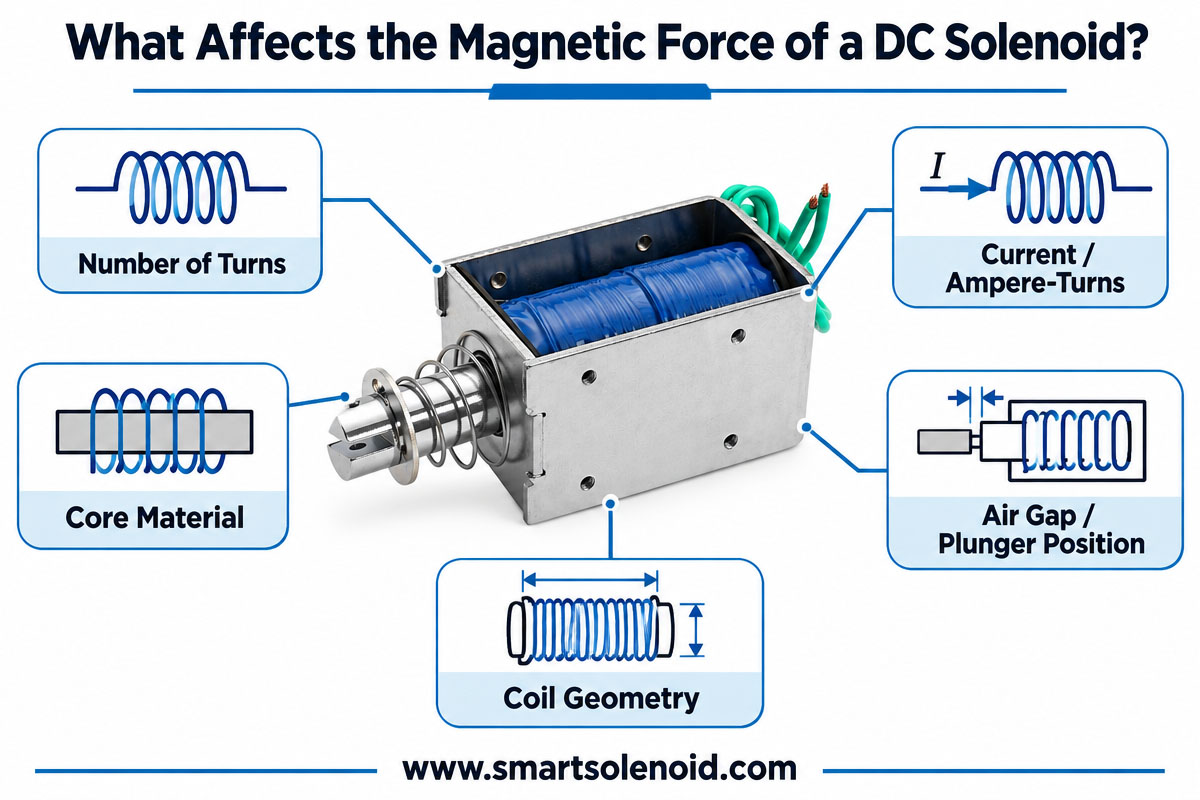
Magnetic force is one of the most essential characteristics in selecting the DC solenoid.
A linear push-pull solenoid must be able to produce adequate force in order to overcome external force, spring resistance, friction, and any other mechanical resistance for the needed stroke.
Force depends on several factors.
3.1 Coil Current
Magnetic excitation directly depends on the current in the coil.
The larger the current—the stronger the magnetic field—and thus the greater the electromagnetic force (unless the magnetic circuit is saturated).
But more current means additional heating.
Therefore, engineers must select the right value of the current depending on the force, period of work, coil temperature, and duty cycle.
3.2 Turns of the Coil
The number of turns of the coil affects the magnetic field created by the coil.
More turns mean more magnetomotive force, but it also requires more space and higher electrical resistance.
Therefore, in the construction of the winding diameter of the copper wire, the space available for the winding, operating voltage, and output force should be taken into account.
3.3 Air Gap
Air gap is the distance between the movable plunger and magnetic pole.
It strongly affects the magnetic reluctance of the magnetic circuit.
In general, the bigger the air gap, the less magnetic force it becomes possible to generate.
The shorter air gap between the plunger and the magnetic pole, the more electromagnetic attraction.
3.4 Magnetism of plunger material
Efficiency of the magnetic circuit depends on the magnetic properties of plunger material and housing.
Proper magnetic permeability and saturation characteristics can be reached due to proper choice of soft magnetic material.
Moreover, material must provide high mechanical strength, good corrosion and wear resistance, and good manufacturing properties.
3.5 The diameter of plunger and area of pole
The magnetic pole area determines the force of the actuator.
When the magnetic circuit conditions are favorable, then the force of the actuator depends on the pole area.
But the increase in diameter of the plunger affects the size of the whole actuator and moving mass.
The engineers should provide the magnetic construction, taking into account the size available and the required mechanical force.
4. Effect of Voltage and Duty Cycle on the DC Solenoid Performance
Two main electrical characteristics in DC solenoid design are voltage and duty cycle.
4.1 Operating Voltage
The operating voltage will determine how much current is supplied to the coil, considering the resistance of the coil.
Considering the resistive DC coil in steady-state mode:
I=V/R
The electrical power can be calculated by using the following formula:
P=V*I
For example, the 24V coil with a resistance of 48 ohms will consume 12 watts under the steady-state mode.
The coil is inductive so that the current does not increase immediately at the start of the activation. The current increases with time because of electrical characteristics of the coil and magnetic circuit.
Such transient behavior is very important while designing fast response solenoid systems.
4.2 Duty cycle
Duty cycle is the percent of time the coil is activated in the operation cycle.
Typical duty cycle designs are as follows:
10% duty cycle—design intended for a short time of operation.
25% duty cycle—good for occasional operations.
50% duty cycle—for frequent activation with sufficient cooling.
100% duty cycle—for continuous activation of the coil within thermal limits.
Engineers must make careful selections of the diameter of copper wire, the resistance of the coil, insulation materials, and thermal design for the continuous work of the DC linear push-pull solenoid.
Excessively high temperatures destroy the coil insulation and reduce reliability.
Pulse-Width Modulation (PWM) can be used in certain applications. High initial activation current can produce great start-up force, and then low holding current can help to save power consumption and heat generation.
5. Various types of motion of DC solenoids
DC solenoids are intended to accomplish various kinds of mechanical movement, depending on the application.
5.1 Pull-type Solenoid
A pull-type solenoid draws the plunger into the coil or magnetic case when the coil is energized.
When power is disconnected, a spring returns the plunger to its original position.
Some typical applications are locking devices, release mechanisms, and mechanical switches.
5.2 Push Type Solenoid
A push-type solenoid is meant to move in an outward direction when powered.
The mechanical and magnetic structure of the solenoid are designed to make sure that pushing motion is achieved.
Solenoids are used in dispensing equipment, positioning equipment, automated equipment, and mechanical actuators.
5.3 Spring Return Solenoid
The spring return solenoid provides motion due to power in one direction, while returning motion is produced thanks to a spring in another direction.
This kind of solenoid is highly used as a result of its simplicity and easy controllability.
5.4 Latching Solenoid
A latching solenoid consists of a specially manufactured magnet or structure with magnets so that the mechanism remains in its position after the electric pulse is switched off.
Continuous power consumption can be reduced since the actuator doesn’t require the electric power to remain in its place.
5.5 Two-way Solenoid
A bidirectional solenoid is designed to provide a bidirectional motion in a proper condition with the help of a dual coil or some other kind of magnetic construction.
A two-way solenoid is useful for cases when two positions need to be controlled but not necessarily with the assistance of a return spring.
Proper design depends on the movement, frequency of operation, available power, and mechanical construction.
6. Main applications of DC solenoids in present industries
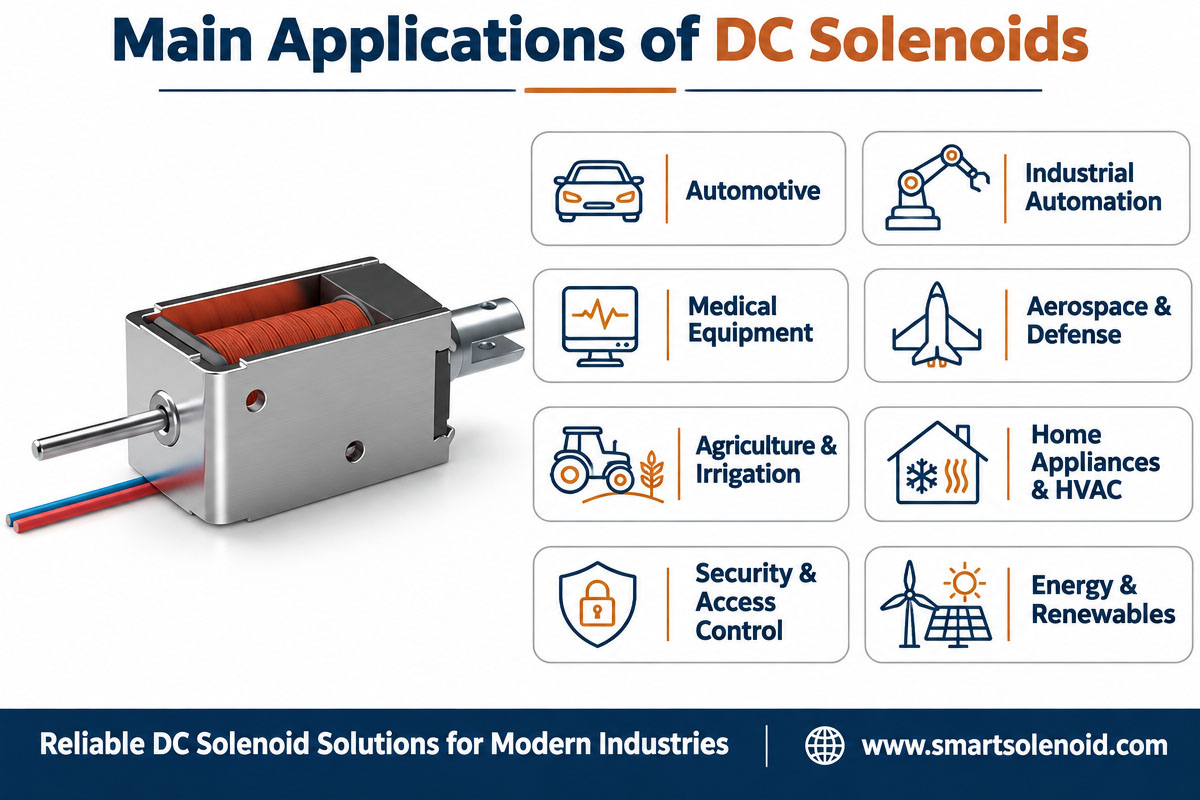
Many industries use DC solenoids because of an easy translation of electrical signals to the mechanical ones.
6.1 Industrial automated equipment
In the course of industrial automated equipment, the solenoids are utilized for mechanical lock operation, valve controls, switch activation, and part positioning.
A linear push-pull solenoid provides the motion for automated machinery, production equipment, and material handling equipment.
Small size and quick reaction make the solenoids perfect in cases of space and operating speed restriction.
6.2 Automotive equipment
Solenoids are often used in different mechanical and electrical systems of automakers.
Some typical examples are:
Locking and unlocking mechanism of the door.
Control mechanism of the transmission.
Control mechanism of fuel and fluids.
Actuator of an automobile.
Control of the seat.
Releasing device.
The solenoids in automobiles have to endure vibrations, changes of temperature, humidity, and repetitive cycles of operation.
6.3 Medical apparatus
Compact electromagnetic actuators are usually required in cases of fluid control and mechanical operations of the medical apparatus.
The applications include valve control, sample handling, dispensing devices, and automatic medical equipment.
The designers should take into consideration the noise of the solenoid, operating temperature, reliability, and longevity of the product.
6.4 Locking systems and security systems
Electromagnetic actuators are used in electric locks and access control systems for releasing or locking mechanical locking systems.
A solenoid may be fail-safe or fail-secure depending on its design.
A linear push-pull solenoid can be designed according to your force, stroke, and electrical specifications.
6.5 Household appliances and commercial equipment
DC solenoids are widely applied in vending machines, coffee machines, washing machines, office equipment, and automatic dispensing systems.
Simplicity of electrical operation enables the usage of the solenoids in cases when the product has to be activated mechanically many times.
6.6 Equipment used outdoors and agriculture
Solenoids can be used to operate valves, release devices, and other mechanical parts of the outdoor and agricultural equipment.
For such purposes one has to take into account dust, moisture, vibration, corrosion, and operating temperature.
Usage of proper solenoid housing materials and surface finishing enables the increase in longevity.
7. Selection of the correct DC solenoid
It’s essential not only to match the operating voltage when choosing the solenoid.
One should evaluate the mechanical and electrical specifications before purchasing a particular kind of solenoid.
The following parameters are particularly important.
7.1 Operating voltage
Specify the voltage (5V, 12V, 24V, etc.).
7.2 Required force
Provide the minimal pull or push force at the actual working position.
7.3 Stroke Length
Specify the stroke length (2 mm, 5 mm, 10 mm, or 15 mm).
7.4 Working time
Indicate whether the operation is to be intermittent or continuous.
7.5 Operation frequency
Give the required number of operations per minute, hour, or day.
7.6 Installation size
Give the maximum size for the installation, the mounting hole diameter, and the plunger diameter.
7.7 Return System
Whether the application needs a spring return, an external return, or powered movement in both directions.
7.8 Environmental factors
Take into consideration temperature, humidity, vibration, dust, and chemical corrosive environments.
7.9 Estimated Service Life
Mechanical Cycle Life: 100,000; 500,000; 1 million.
If you can provide a 2D drawing, 3D modeling, or even a sample, it will be very helpful to our engineers.
If you have some OEM projects, it will be better to use a custom-made linear push-pull solenoid than the standard actuator.
8. Why Is a Custom DC Solenoid Design Important?
The standard solenoids are appropriate for most general applications. However, some manufacturers of industrial and electronics equipment may have some special requirements.
For example, the project that requires the solenoid with the voltage of 24 V DC, stroke of 5 mm, force of 20 N, 100% duty cycle, and a maximum installation diameter of 25 mm.
A standard solenoid can fail to meet these requirements.
The custom linear push-pull solenoid enables optimization of the following parameters:
Coil Winding and Resistance
Structure of Magnetic Circuit
Plunger Diameter and Materials
Stroke Length and Output Force
RETURN CHARACTERISTICS AND SPRING FORCE
Dimensions of Housing and Mounting
Operating Voltage and Current
Duty Cycle and Temperature Performance
Surface Treatment and Corrosion Protection
Such customization allows better integration of the solenoid into the end product of a customer.
For customers who are manufacturing the products, cooperation with an experienced solenoid supplier from the first stage can save a lot of design time, enhance compatibility, and help in a more efficient manufacturing process.
9. Why Choose Weilong as your DC Solenoid Manufacturer?

Since 2007, Weilong Intelligent Technology (Dongguan) Co., Ltd. has been specializing in solenoids and inductor coils.
We provide customized electromagnetic actuator solutions for industrial automated equipment, automotive equipment, medical devices, security systems, and other OEM applications.
Manufacturing capacity:
Metal stamping and tooling.
Plastic injection molding.
CNC machining.
Winding of the coil of the copper wire.
Assembly of the solenoid.
Testing and performance assessment.
Our manufacturing capacity allows us to control the major manufacturing processes and to customize the products for customers.
Our engineers are going to evaluate every project and establish the required voltage, current, force, stroke, duty cycle, installation dimension, and operating environment.
Our company produces different electromagnetic components, among which there are DC linear solenoids, tubular solenoids, rotary solenoids, latching solenoids, and custom inductor coils.
That is why we can produce solenoids according to the specified mechanical and electrical requirements but not standard products.
So for a reliable linear push-pull solenoid, we can develop a solution for a customer.
Our quality management and our products are ISO 9001, IATF 16949, CE, RoHS, and REACH certified.
For customers who are developing an automotive part, industrial equipment, medical device, or electronic locking device, Weilong is willing to cooperate with you for evaluation of your technological requirements and provide a manufacturing solution.
Contact Weilong Intelligent Technology to discuss your customized DC solenoid project.
Website: https://www.smartsolenoid.com/ Email: [email protected]
10. FAQs
Q1. How does a DC solenoid produce mechanical motion?
The mechanical motion is produced because the electrical current flows through the copper coil of the solenoid, generating a magnetic field. This magnetic field attracts a ferromagnetic plunger. So this way the linear motion is generated.
Q2. What is the difference between a DC solenoid and an AC solenoid?
The former one works with direct current, and the latter one works with alternating current. Besides, there can be differences in their coil designs, magnetic structures, and electrical properties. DC solenoids are usually used in battery-powered devices and in the control systems.
Q3. What affects the pulling force of the DC solenoid?
There are such factors as coil current, winding turns, magnetic materials, air gap, pole area, and plunger position. Besides, the actual output force depends on the external load and mechanical friction.
Q4. Can a DC solenoid push and pull?
Yes, because different types of mechanical and magnetic designs allow such possibility. The ordinary spring return design usually provides movement in one direction and the return movement by the spring in the other. There are bidirectional designs providing a powered movement in both directions.
Q5. Is it possible to run the DC solenoid continually?
Of course, but the DC solenoid can be designed in such a way as to be able to operate with a 100% duty cycle. However, the coil is to be correctly designed in order to be able to control the temperature and to stay within the thermic limitations.
Q6. How to increase the force of the DC solenoid?
It is possible to increase the force by means of such factors as optimization of coil current, winding turns, magnetic materials, pole area, and magnetic circuit geometry. However, increasing the force has to be balanced with coil temperature, electrical power consumption, and installation space.
Q7. What is the normal lifetime of a linear push-pull solenoid?
The lifetime depends on mechanical structure, operating frequency, electrical conditions, load, temperature, and quality of materials. DC solenoids could be designed for hundreds of thousands or even for more than one million operating cycles depending on the application. The actual performance has to be checked for the certain application.
Q8. Can Weilong produce custom DC solenoids?
Yes, because our company specializes in customized electromagnetic products.
Operating voltage, current, force, stroke, coil winding, dimensions, mounting structures, and duty cycle can be designed according to the customer’s requirements.
Q9. What information is required for a DC solenoid quotation request?
The customer has to provide operating voltage, required force, stroke distance, duty cycle, operating frequency, installation space, environmental conditions, and order quantity. Drawings or reference samples will be helpful during the engineering evaluation.
11. Summary on DC Solenoid Movement and its Application
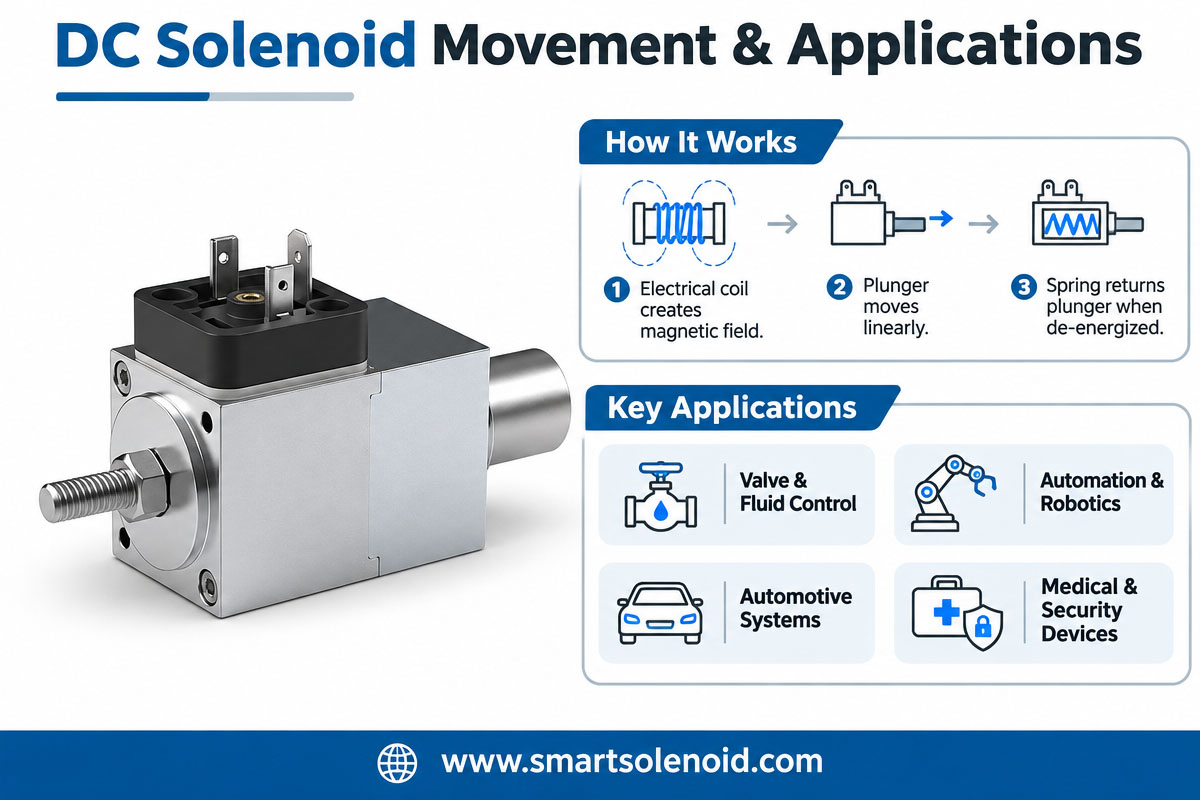
DC solenoids work according to magnetic field theory. The DC solenoid can provide reliable linear motion for different mechanical and electronic applications by translating electrical currents to electromagnetic forces.
It is possible to choose an appropriate actuator according to magnetic field strength, coil winding, air gap, plunger materials, operating voltage, and duty cycle.
A correctly designed linear push-pull solenoid can provide a fast response, mechanical motion, small size, and long life.
Development of a custom solenoid is often the most adequate solution for an OEM manufacturer having unique requirements in terms of force, stroke, voltage, or installation.
Weilong Intelligent Technology has long-time experience in the manufacturing of electromagnetic components. We are ready to support you in your next project in DC Solenoid and Electromagnetic Actuator.
Contact us to find the way to make electromagnetic actuator requirements into a manufacturing solution.