
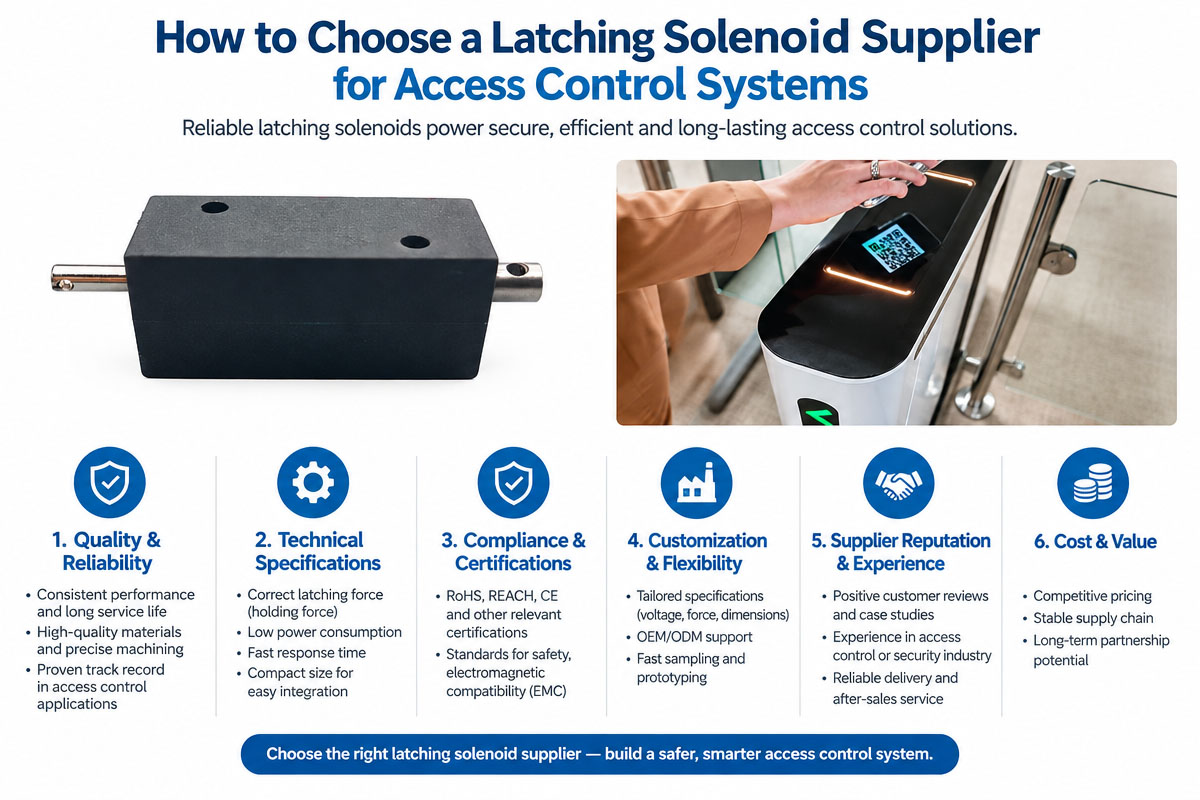
Introduction to Latching Solenoid Supplier selection
Electromechanical actuators are required in access control systems to lock, unlock, release, and secure doors and mechanisms. The particular type of an electromechanical actuator that is very effective for such applications is the latching solenoid since it can retain a desired position without any power supply.
But choosing the right solenoid is not simply finding the one with the desired voltage and size.
In the case of the access control system manufacturer, smart lock developer, security equipment company, and OEM engineers, the choice of the latching solenoid supplier will directly affect the energy consumption, reliability of the locking, life span of the product, security performance, and manufacturing consistency.
Even a good-performing solenoid in a prototype test may have problems after hundreds of thousands of operations. Eventually, an access control system can fail due to lack of strength, wrong duration of pulse, excess wear and tear of the mechanical part, lack of tolerance control, and unstable magnetic retention force.
As a consequence, both buyer and engineer should take into account not only the latching solenoid itself but also its supplier from the viewpoint of technical capabilities. Here is what you need to know:
1. Understand How a Latching Solenoid Works
A typical solenoid requires electrical energy in order to generate magnetic force, and it can also be operated using a constant power supply.
However, the latching solenoid works in a different way.
It is intended to remain in a predetermined position when the electrical pulse ends. Permanent magnets, magnetic circuits, springs, or another mechanical arrangement is used in order to help keep it in place.
The plunger or armature moves with an electrical pulse. We can stop the movement and keep the mechanism without energizing the coil permanently.
Another pulse with an opposite polarity in the case of bistable design changes the state of the solenoid.
Such a principle of functioning can have an important advantage for access control systems: low energy consumption.
The electrical power is necessary only when changing the state of the solenoid and not throughout the whole period when the product is locked or unlocked. Battery-powered locks, cabinet locks, parcel lockers, hotel locking systems, electronic safes, and other access control devices can benefit from that.
An experienced latching solenoid supplier should know the details of the principle and help to determine if this type of device is right for your particular locking mechanism.
2. First of all, define latching solenoid for the access control application
Do not begin with the selection of a solenoid and voltage size.
Begin with the mechanical function.
What exactly has to move with the solenoid?
For instance, the solenoid can actuate the following:
– LATCHING PIN
– LATCH LEVER BOLT
– Pawl
– Trigger mechanism
– Interlock devices
– Locking Mechanism for the Cabinet
– Assembly, door release
The necessary solenoid depends on the load of the whole mechanism.
Engineers have to define operating voltage, required stroke, required force, installation space, pulse duration, anticipated cycle life, environmental conditions, direction of locking, and mechanical load before contacting a latching solenoid supplier.
If possible, also provide drawings or CAD data of the locking mechanism.
The more the supplier knows about your application, the easier it is to find engineering problems that may appear before prototype production.
3. Calculate the latching solenoid force and stroke requiredfor the project need
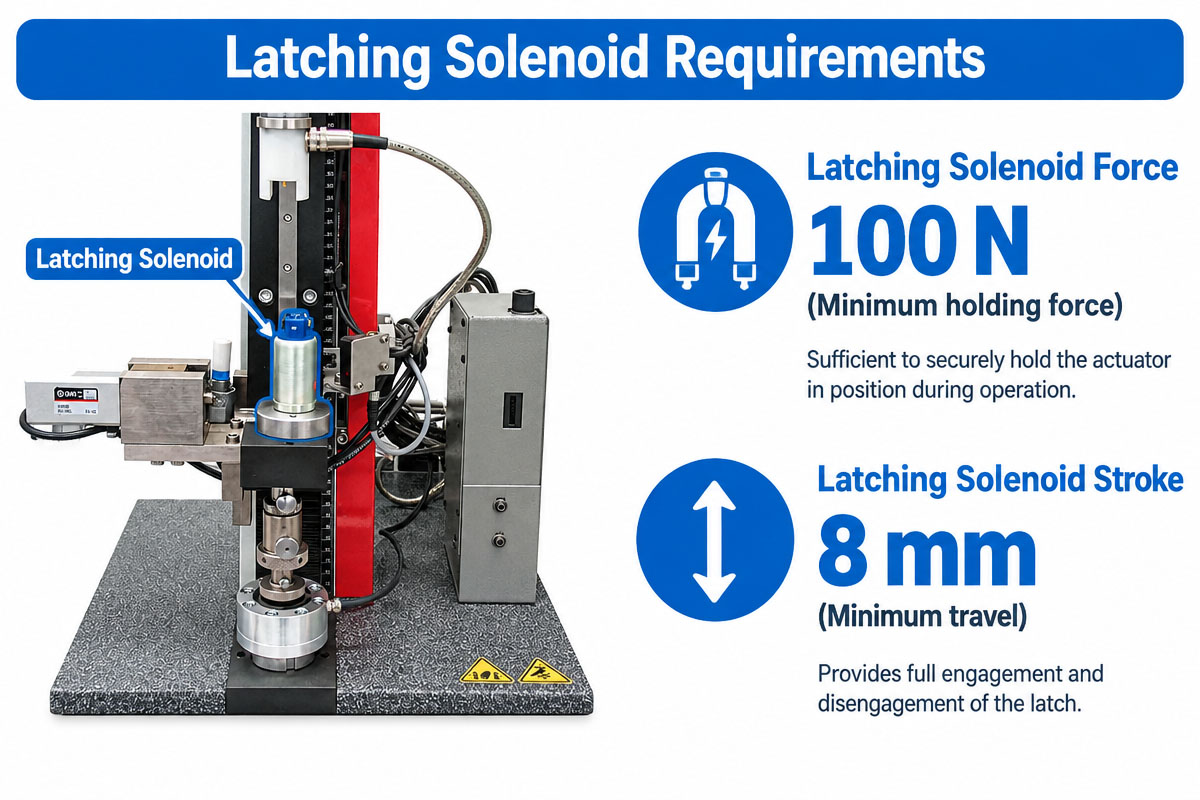
The two most important criteria in selecting a latching solenoid are force and stroke.
It is a common mistake to define only the required force.
For example.
Required Force – 15 N.
This information is not complete since the force generated by the solenoid depends on the position of the plunger.
Another useful specification may be:
Working stroke: 5 mm. Required force: 15 N.
The engineers have to calculate the force required to overcome the resistance of the latch, spring, linkage, friction, and other loads during the movement.
Additional margin can be required.
If possible, obtain force versus stroke data from your latching solenoid supplier. The maximum force value listed in the catalogue is not necessary; the one you will obtain with the full stroke of your application.
For the access control systems, the adequate initial force is important since the actuator has to reliably disengage or engage the mechanism in operational conditions.
4. Testing the latching solenoid holding performance
It is not just a matter of moving the mechanism.
It has to reliably hold the desired state.
That means that latching or holding properties of the design have to be considered by engineers.
The questions to ask are
What is the holding force?
Does it depend on mechanical tolerances?
How sensitive is it to air gaps?
What happens during vibration?
Can any external mechanical loads change the state accidentally?
What is the influence of temperature on holding performance?
What if the mechanism does not reach the end of the stroke?
These questions are especially important for security products.
A good latching solenoid supplier should be able to distinguish the actuation force from the holding force and explain their relationship with the locking mechanism.
Do not consider the solenoid as a separate element. It has to be analyzed as a part of the whole lock assembly.
5. Checking of Pulse Voltage, Current, and Duration
Latching solenoids are operated with the help of short electrical pulses.
A control pulse has to provide the sufficient energy to move the plunger in a desired manner. But unnecessary long pulses may cause energy wasting and heating up of the coil.
Engineers have to specify:
Voltage: e.g., 4.8 VDC, 5 VDC, 6 VDC, 12 VDC, or 24 VDC
Current: the current provided by the control circuit or battery
Pulse duration: how long the coil is energized during each operation
Polarity: Is polarity reversal necessary to switch between states?
Operating frequency: how often the access control system is going to lock/unlock.
The control electronics and the solenoid have to be considered as a whole.
If the product is battery powered, then current becomes especially important. If the solenoid requires too much pulse energy, it reduces battery life or needs a bigger power supply.
An experienced supplier is able to optimize the winding of the coil and magnetic circuit for the client.
6. Consideration of Battery Life and Low Power Operation
One of the reasons why engineers choose latching solenoids in access control systems is energy efficiency.
Imagine an electronic lock that is locked for 23 hours 59 minutes each day but changes its state a few times.
Using constant electrical power just for locking may be inefficient.
With the help of the latching mechanism, the energy requirement can be reduced greatly since energy is used mainly during actuation.
That makes latching technology interesting for:
– Smart locks are battery-powered.
– Electronic cabinet lock
– Parcel lockers
– Storage Solutions
– Mobile security equipment
– Hotel locks
– Furniture locks
– Access control terminals
Request the information about the electrical parameters from a latching solenoid supplier in order that your engineers would be able to estimate the energy required for each operation.
Battery life should be estimated in the real working conditions, not on the basis of the nominal voltage.
7. Evaluation of Fail-Safe and Fail-Secure Requirements
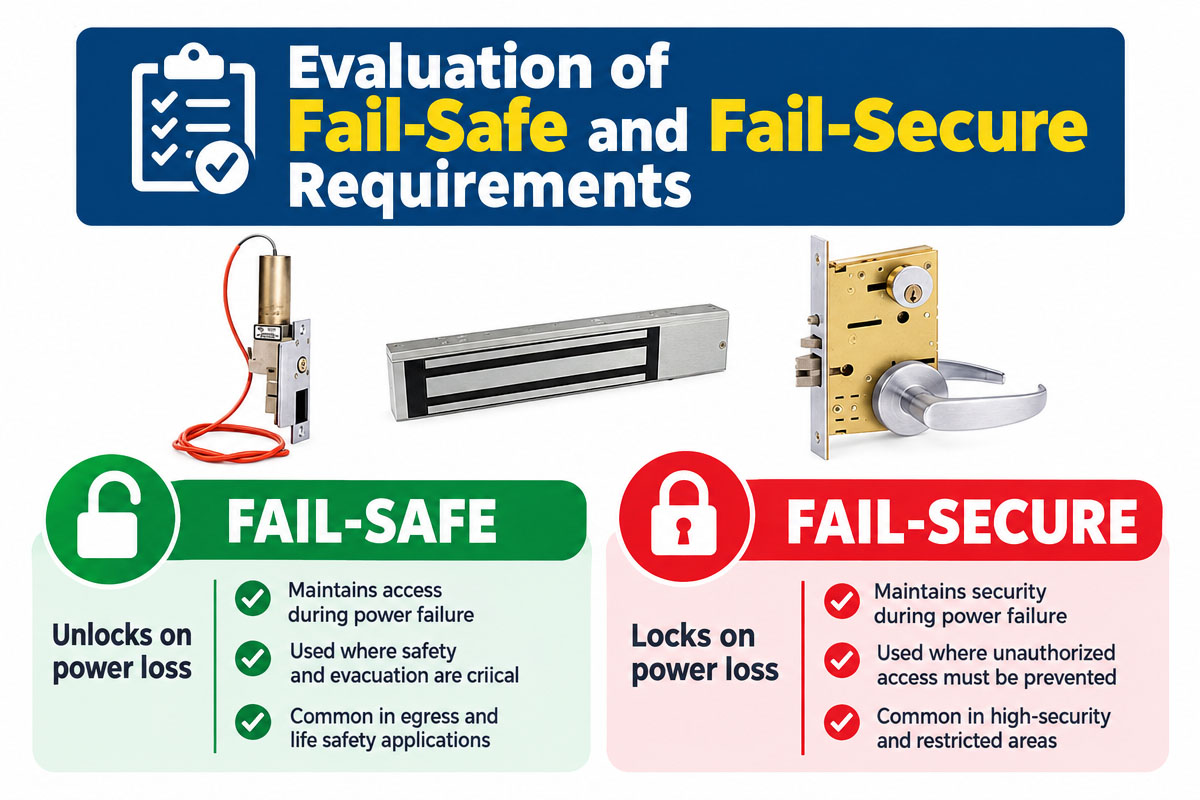
Access control engineers have to make a decision about what to do in the case of the loss of electrical power.
It can depend on product architecture, applicable requirements, emergency strategy, and mechanical lock design.
It is possible to design the system in such a way that the mechanism will be secure when there is no electrical power, or it has to work differently for certain particular applications.
In this regard, the latching solenoid has an important feature—its mechanical state is not necessarily changed when there is no electrical power.
It can be good, but that means that system designers have to consider carefully the situation when there is no power.
The latching solenoid supplier has to clarify the required operating logic and work with the OEM engineering team in order that the actuator’s behavior will be consistent with the mechanical design.
Always verify safety-related or code-related decisions at the complete-system level.
8. Assessment of Cycle Life and Mechanical Durability
Access control products during their service life are used thousands or even hundreds of thousands of times.
Applications that are used often can require more.
Therefore, a successful prototype does not guarantee long-term reliability.
Ask the supplier how they have checked the lifespan of the product.
Important variables are
– Stroke
– Voltage applied
– Duration of pulse
– Load
– Frequency of operation
– Heat
– Alignment mechanical
– Method of Return
– Environmental conditions
A supplier of latching solenoids should be able to consider the effect of plunger materials, surface treatment, mechanical guidance, stops, springs, and assembly tolerances on operating life.
Life testing should simulate the actual application of the client as much as possible rather than testing the solenoid under unrealistically light laboratory load.
9. Consider Noise and User Experience
Access control systems are usually installed in hotels, offices, hospitals, residential buildings, smart homes, or other places with the noise problem.
The product may work fine but be perceived as poorly designed. As a noisy metallic click every time the door or cabinet is unlocked.
Noise of the solenoid can be affected by:
– Velocity of plunger impact
– Mechanical stops
– Clearances
– Force of spring
– Design of lock mechanisms
– Mounting apparatus
– Resonance housing
If low noise is an important factor, then specify this requirement from the early stages of designing.
An experienced latching solenoid supplier may suggest mechanical modifications, cushioning, plunger geometry, spring characteristics, or changes in electrical drive pulse.
Eventually, noise has to be measured with the solenoid in the whole access control system.
10. Consider Latching Solenoid Size & Mechanical Compatibility
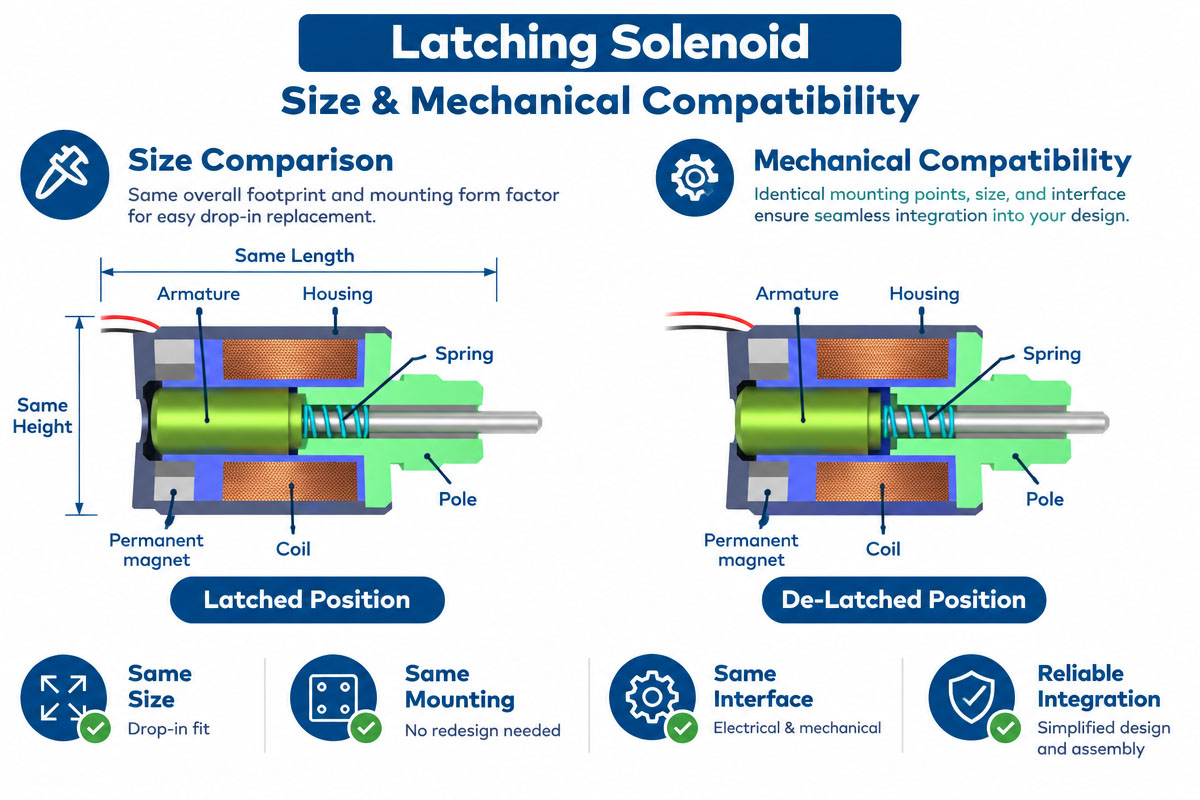
The latest generation of access control products requires a small size and better integration.
A smart lock has everything in a small enclosure, which could include the motor or solenoid, batteries, wireless communications module, sensors, circuit board, mechanical lock, and user interface.
It creates very tight space constraints.
Specify before choosing the solenoid:
Max size
max width
Max height
Plunger orientation
Mounting points
Exit direction of the wires
Location of connector
Stroke available
Connecting linkages
A 3D model of the available envelope will help the supplier to come up with a better solution.
A good supplier should take into account the installation and assembly requirements as well as the ability of the electromagnetic actuator to produce sufficient force.
11. Consider Customizing the Latching Solenoid
Standard latching solenoids are a way to save time in development and generally the best choice when there is an existing model that fits the requirements.
Access control mechanisms, however, are sometimes subjected to unique mechanical requirements.
Customizing might be necessary for:
Electromotive force
Coil resistance
Stroke Force
Retention Force
Plunger geometry.
Shaft length
Spring back
Mounting holes
[brackets
Wire length
Connectors.
Noise performance
Overall dimensions
When selecting the latching solenoid supplier, find out what features can be customized and if the company has resources to develop new products.
The customization should be done for valid engineering reasons. Unnecessary modifications of the existing design can increase costs and validation time.
12. Evaluate Manufacturing Consistency and Quality
Prototypes’ performance is important, but manufacturing consistency is equally crucial.
The supplier can have five very nice engineering samples but cannot produce 50,000 consistent parts.
Ask how the critical parameters of the manufacturing process are controlled.
They may include:
Coil resistance
Torque curves
Dimensions
Plunger operation
Magnetic retention performance
Electric insulator
Actuating performance
Spring characteristics
A professional latching solenoid supplier should have a documented quality management system for incoming material inspection, production, assembly, and final inspection of products.
The purchasing department should also discuss traceability and engineering change control with the suppliers. Changes in materials, springs, coil wire, surface treatment, and manufacturing process can affect performance.
In access control products, the manufacturing consistency can be as important as the initial design.
13. Discuss the latching solenoid. Performance under the Environmental Conditions
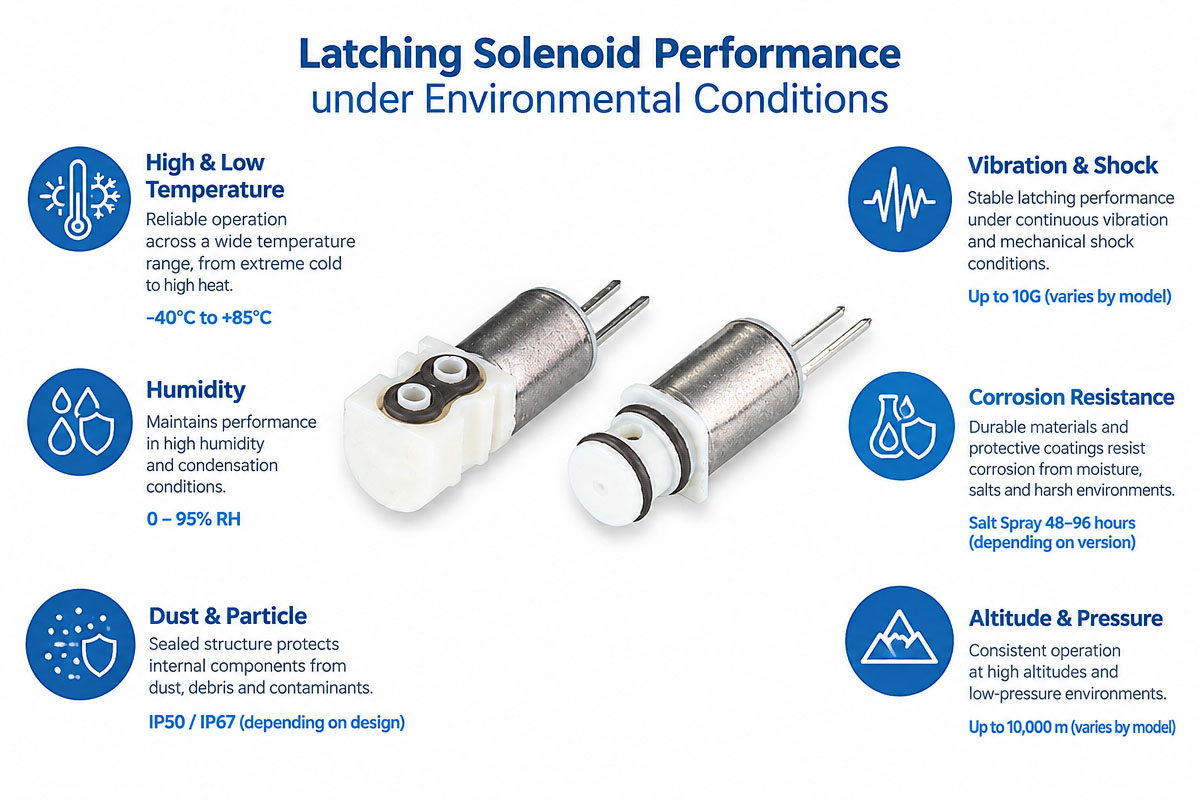
The environmental conditions might vary considerably for access control systems.
An indoor hotel lock is different from an outdoor access terminal or industrial cabinets.
Engineers should ask themselves:
Min/max temperature
Humidity
Dust
Humidity
Corrosion
Shock
Mechanical shock
In case of extreme conditions, materials and surface treatment must be selected appropriately.
However, environmental protection should be evaluated both on the component and system level.
For example, the solenoid itself might provide very little environmental protection; the rest would be provided by the access control enclosure.
Don’t think that the general purpose actuator will work equally well everywhere; discuss the real installation environment with the latching solenoid supplier.
14. Evaluate Prototypes & Engineering Support
Supplier communication can be a very important factor in the speed of development for OEM development projects.
The best process is a collaborative process.
The typical process of development could be:
Requirements -> technical review -> solenoid selection -> sample -> system testing -> modification -> validation -> pilot production -> mass production.
Throughout this process, there could be problems that were not obvious from the original specifications.
Maybe the first force was insufficient. The pulse was too short. The impact noise of the plunger was too high. The mounting bracket allowed some misalignment. A lock spring requires more force.
A professional latching solenoid supplier should help to diagnose the root causes and offer practical solutions.
Fast sample delivery is useful, but fast engineering support can be even more valuable.
15. Do Not Compare Unit Price; Compare Total Cost
The purchasing team is always concerned with price.
A cheap solenoid, however, can create problems further, and it can be costly.
Let’s consider the total cost of:
Product redesign
Engineering time
Delay of launch
Stringent inspection standards
Assembly problems
Field failures
Warranty claims
Replacement workers
Customer Complaint
Supply interruptions
In access control systems, actuator failure can be critical because it will prevent the user from accessing the system or locking it.
Thus, the good latching solenoid supplier should be evaluated by quality, engineering capabilities, manufacturing consistency, delivery, technical support, and price.
16. Send Full RFQ to Supplier
A detailed RFQ makes the evaluation of suppliers much easier.
Instead of writing:
We need a 12V latching solenoid for a smart lock. Please quote.
Provide technical details such as:
Application: Electronic access control lock
Operation mechanism
Type of solenoid: bistable or latching
Voltage: DC 12V
Available current: 1.5 A max
Stroke: 6 mm
Required force: 6 mm, 10 N
Pulse duration: 200 ms
Operations: 50 per day
Target life: 500,000 cycles
Operating temperature: -10°C to 60°C
Max dimensions are 35x25x20 mm.
Preferably low noise
Volume: 100,000 units/year
Also provide drawings, CAD models, pictures, videos, or mechanism diagrams, if available.
This will give full understanding of the requirement to the supplier’s engineers and enable them to recommend a suitable standard or custom solution.
Final Checklist for Selecting a Latching Solenoid Supplier
Before starting to work with a supplier on an access control project, make sure:
Does the solenoid produce the required force at the real stroke?
Is the latching or holding force enough for the mechanism?
Does the coil match the required voltage and current?
Does the required pulse width match the control electronics?
Has the solenoid been validated for the target lifetime?
Is the mechanical design suitable for the available installation space?
Is the low noise requirement supported?
Do we know the temperature and environmental conditions?
Are critical parameters adaptable?
Does the supplier have control over the production and quality?
Is it possible to get engineering samples for application testing?
Is the supplier going to support the project from prototypes to mass production?
17, Conclusion
Selection of a latching solenoid for an access control system is a cooperative effort of mechanical engineers, electronics engineers, the purchasing department, and the solenoid manufacturer.
Voltage and size are just a beginning.
The final access control product will be reliable only if the force at the actual stroke, holding performance, pulse duration, power consumption, mechanical integration, noise, lifetime, and environmental conditions are considered.
So, the right latching solenoid supplier should not be just a component supplier. The supplier should be able to understand the locking mechanism, assess technical requirements, provide meaningful test data, support prototype development, and assure consistent quality during mass production.
For OEMs and access control manufacturers, involving the supplier early in the design process reduces technical risks and shortens development time.
Develop a detailed specification. Test the actuator in the actual locking mechanism. Test under real operating conditions. Select a supplier based on engineering capability and manufacturing reliability, not just price.
18. Frequently Asked Questions on Latching Solenoid Supplier
18.1 What is a latching solenoid used for in access control?
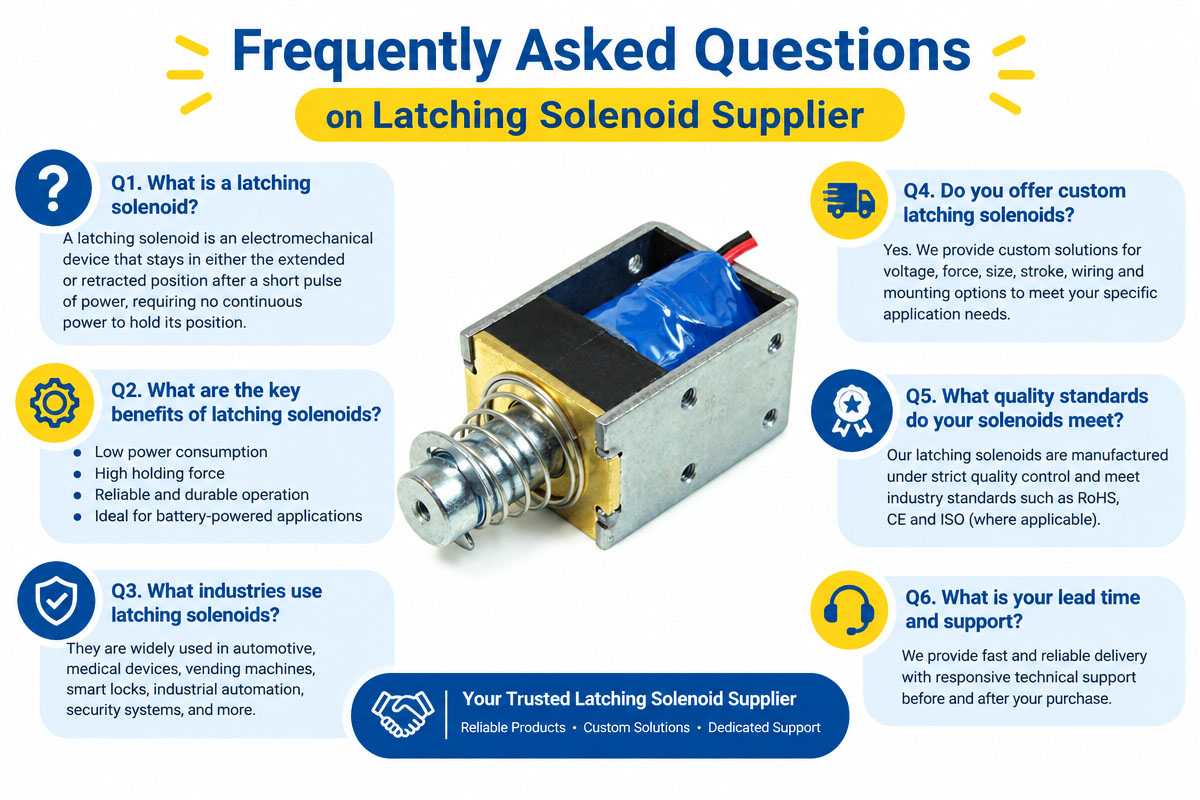
A latching solenoid can move a locking pin, latch, lever, bolt, or release mechanism and hold a defined state without a continuous power supply to the coil. That makes latching solenoids very useful for smart locks, cabinet locks, parcel lockers, electronic safes, and other access control products that consume less power.
18.2 What voltage is required for an access control solenoid?
The correct voltage is highly dependent on the system power architecture. The common values might be 5V, 6V, 12V, or 24V. Engineers should also consider voltage, coil resistance, pulse duration, force, and available energy.
18.3 What information should I give the latching solenoid manufacturer?
Supply voltage and available current Required force working stroke Pulse duration installation dimensions Operating temperature expected lifetime Mechanical load mounting requirements Annual quantity application information Drawings and CAD files are very helpful.
18.4 What is the difference between a regular solenoid and a latching solenoid?
A common solenoid often uses energizing of the coil to produce the force and requires a constant power supply to hold the energized position. Depending on the magnetic and mechanical design, a latching design can maintain the defined state after the electrical pulse ends.
18.5 How important is holding the force of a latching solenoid?
The holding force is very important because the actuator should maintain the required state when the electrical pulse stops. Engineers should assess the holding performance in combination with the lock mechanism, mechanical load, tolerance, vibration, and environmental conditions.
18.6 What is the lifetime of an access control latching solenoid?
There is no universal cycle life requirement for all applications. The required life should be calculated from the number of operations per day and target product lifetime. The solenoid should be validated under representative voltage, load, stroke, pulse, temperature, and operating frequency.
18.7 Is price the most important criterion in selecting your supplier?
Not necessarily. Price is important, but engineering capability, reliability, manufacturing consistency, quality control, technical support, lead time, and lifetime performance have a much bigger influence on the total cost of an access control product.


