Introduction to 12V DC Linear Solenoid
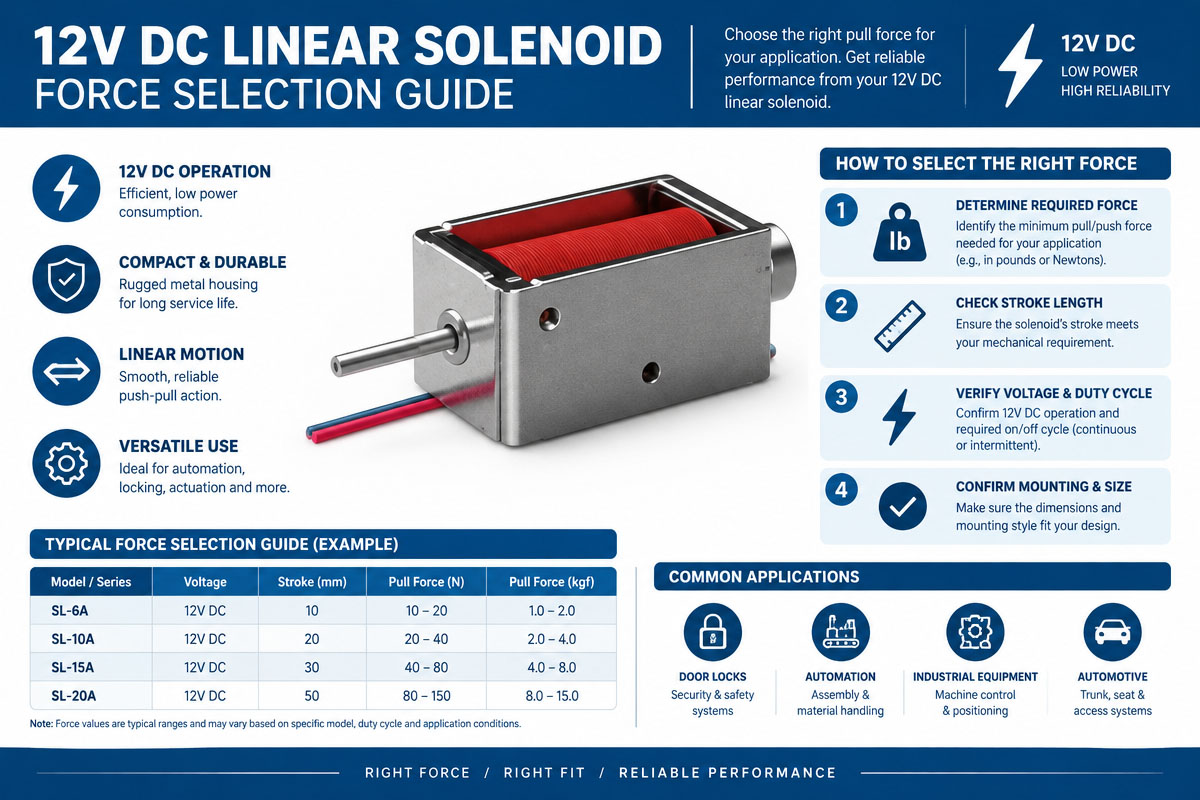
A 12V DC linear solenoid is an electrical component that transforms electrical energy into linear mechanical motion. It can move a plunger to perform various operations like opening/closing locks, latches, gates, switches, dispensers, valves, and other electromechanical devices.
However, choosing the proper solenoid is not only about finding a component labeled 12V DC. The force of the actuator is crucial and frequently misunderstood.
A solenoid of 20 Newtons does not mean it will provide such a force throughout the entire stroke. The electromagnetic force depends greatly on plunger position, air gap, coil power, temperature, and the mechanical structure of the actuator.
For instance, the actuator may appear powerful enough in a catalog on the basis of its maximal force characteristics, but it may fail to work after mounting because it lacks the power to start the load at the longer stroke.
Engineers and OEM buyers should consider force characteristics, as well as stroke, duty cycle, voltage, current, temperature, mechanical load, operating frequency, dimensions, and lifetime of the product.
This article provides guidance on selecting a 12V DC linear solenoid for an OEM application, as well as on what information should be provided by the manufacturer prior to making a decision.
1. How is force produced by a 12V DC linear solenoid?
A linear solenoid usually consists of a coil, a magnetic frame, fixed magnetic parts, and a movable plunger or armature.
Upon applying 12V DC power to the coil, electrical current creates a magnetic field.
The plunger is attracted by the magnetic circuit to the position with the minimum magnetic reluctance. That is the useful mechanical movement generated by the actuator.
Depending on the mechanical construction, the movement can be either pulling or pushing.
The key point for engineers here is that the electromagnetic force is not constant.
The plunger movement changes the magnetic air gap. It means that the available force can change significantly depending on the beginning and end of the stroke.
It is why engineers usually choose a 12V DC linear solenoid based on the force-versus-stroke characteristics, not the maximum-force value only. 、
2. The mechanical load as a basis
Find out what the solenoid needs to move before choosing it.
For instance, the actuator may be supposed to:
Remove the lock pin.
Lever
Pull a lever.
Shift a gate.
Flip a switch.
Repeat a spring.
Activate a dispenser mechanism.
Actuate a mechanical linkage.
Every application has its own load profile.
The whole movement should be calculated or measured by engineers in mechanical resistance.
The load may consist of:
Spring force. Springs generate increasing or decreasing resistance depending on the stroke.
Friction: Resistance from bearings, guides, seals, and sliding parts.
Gravity. Product orientation might increase or decrease the required force.
Linkage Geometry. Mechanical Advantage Varies During Motion
Acceleration. To get the mechanism moving fast, a force has to accelerate it.
Production tolerances. Actual assemblies may require more force than a perfect prototype.
The mechanical load profile should be the first thing to consider when choosing a 12V DC linear solenoid.
3. Comprehend Force versus Stroke
The force and the stroke should be considered together.
Let’s assume an application requires 15 N of force to move a mechanism at a 10 mm air gap.
The catalog suggests a solenoid that:
Max. force 30 N
At first glance, it seems to provide 100% force margin.
However, if the actuator produces only 8 N at a 10 mm stroke and reaches 30 N only at the end of the movement, it cannot reliably start the load.
That is why engineers should request a force-stroke curve.
A typical electromagnetic actuator may produce less force for a large air gap and much more force as the plunger approaches the fully actuated position.
So, when you specify a 12V DC linear solenoid, don’t say:
Force required: 15 N.
Say, rather:
Force initially required: 15 N at 10 mm stroke.
If applicable, include force requirements at intermediate and final positions.
4. Find the 12V DC linear solenoid required starting force
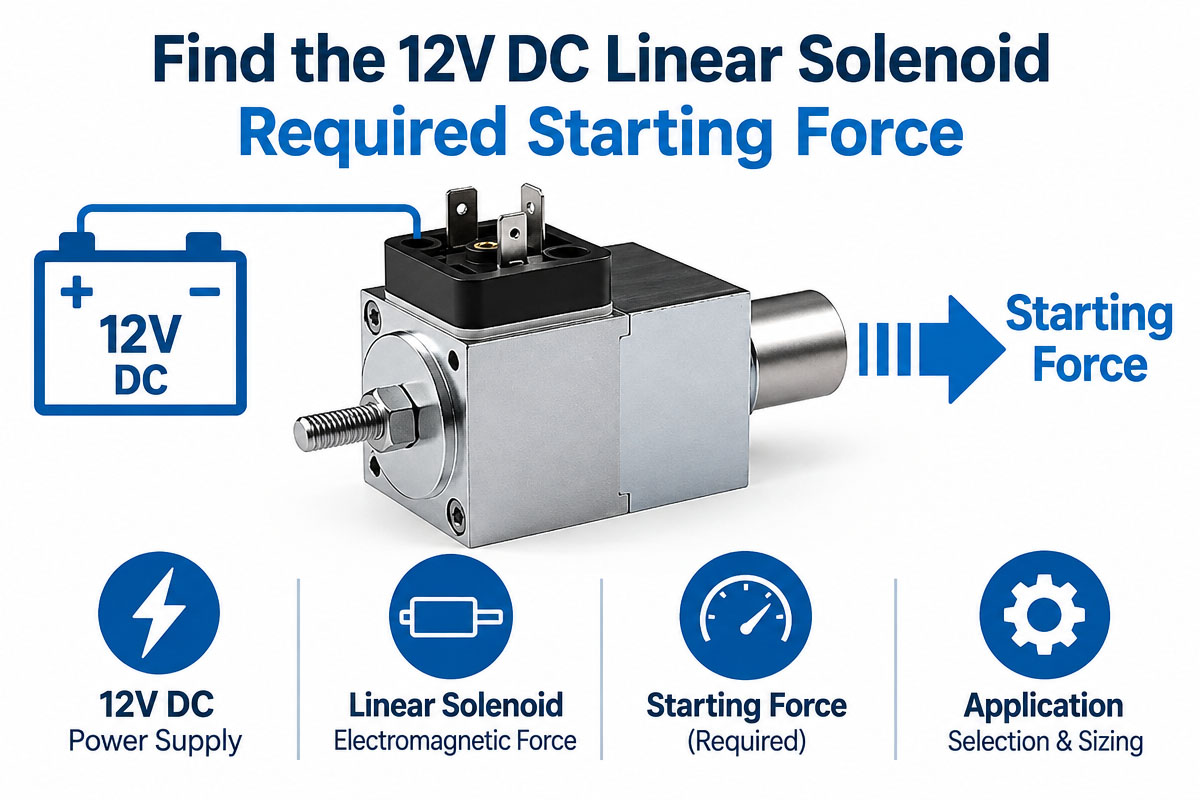
The most important point usually is the starting force.
The magnetic air gap may be quite large at the beginning of motion. It means the reduction of the available electromagnetic force.
At the same time, the mechanism may have to overcome static friction or spring preload.
Suppose that an industrial latch requires:
Stroke: 8mm
Start loading, mechanical 10 N.
Load: 7 N running
Final load = 12 N
The presence of a solenoid able to generate 20 N close to full engagement does not prove that it can overcome the initial 10 N load at 8 mm.
The linear solenoid, 12V DC, should produce enough force at the starting position.
Prototype testing under realistic mechanical loading is highly recommended.
5. Provide Sufficient Force Margin
Choosing an actuator with a rated force equal to the theoretical load has reliability issues.
Variations in real products.
Causes can be:
Variation of the supply voltage
Coil temp
Changes in friction
Spring sales
Mechanical alignment
Wear of components
Manufacture Tolerances
Dust or contamination.
An engineering margin can compensate for these variations.
However, there is no one margin that fits all applications. The right value will depend on the uncertainty, safety implications, operating environment, and quality of the load data.
Engineers should not just oversize the 12V DC linear solenoid but understand the worst-case load and worst-case available actuator force.
This leads to a more efficient and defensible design.
6. Overlooking the actual range of 12V supplies
You may see a product described as using 12V DC, but it might not actually be 12.00 volts.
The actual voltage may vary due to:
Battery drainage
Power supply margin
Voltage drop of wiring
Resistance of the terminals
Concurrent electrical loads
Charging requirements,
For example, a battery-powered product may operate over a useful range of voltages as opposed to one fixed voltage.
The solenoid is then tested at the lowest anticipated operating voltage.
A 12V DC linear solenoid that works fine at nominal voltage may not produce enough force when the voltage is lower.
OEM engineers should pass the minimum, nominal, and maximum operating voltage to the solenoid manufacturer whenever possible.
7. Resistance of Coil and Current Check
The voltage alone does not define the electrical characteristics of the solenoid.
Engineers are also invited to consider:
Resistivity of the coil
Initial current (I)
Energy consumption
Driver space capacity
Wire gage
Switching device classification
A coil with lower resistance may draw more current and create more electromagnetic force. However, it also puts a heavier load on the power supply and may produce more heat.
The control electronics should safely handle the solenoid load.
Peak current may be especially important for battery-powered equipment.
The battery might have sufficient energy stored but may not be capable of providing the required instantaneous current without a large voltage drop.
The electrical system and the 12V DC linear solenoid should therefore be designed and tested in combination.
8. Influence of Duty Cycle on Selection of Force
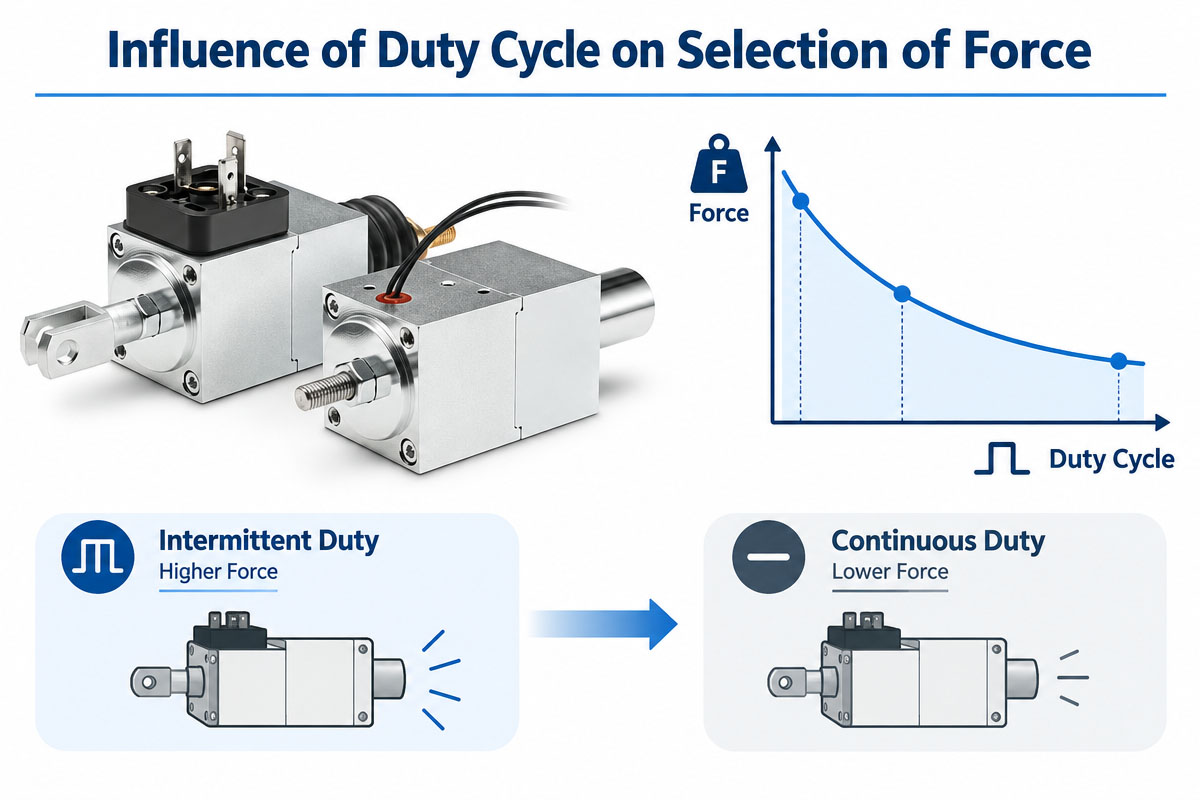
Duty cycle is the percentage of time the solenoid is energized during the total operating cycle.
For example:
ON time: 2 sec
OFF time: 8 sec.
Total cycle: 10 sec.
20% duty cycle
This is important information because electrical power creates heat in the coil.
To produce a strong force, a solenoid used for short pulses may need relatively high power. The same actuator can become hot if continuously energized.
In contrast, a continuous duty design may have to operate at lower power and thus generate less force for the same physical size.
When choosing a 12V DC linear solenoid, specify the actual ON/OFF times; do not just describe the application as “intermittent.”
The supplier can then evaluate force and thermal performance in combination.
9. Know Hot-Coil vs. Cold-Coil Performance
The electrical resistance of a solenoid depends on the temperature of its winding.
Resistance tends to increase as the coil heats up. It affects the current and therefore the electromagnetic performance on a fixed-voltage DC supply.
Thus, the response of a solenoid may be different after repeated operation than the first cycle from room temperature.
Engineers have to ask:
How much resistance does the cold tube have?
How much temperature rise is expected?
What is the force in hot working conditions?
What ambient temperature was the unit tested under?
For demanding OEM applications, a 12V DC linear solenoid should be rated at thermal equilibrium or representative worst-case temperature and not at just cold coil.
This is especially important when the force margin is small.
10. Consider the ambient temperature
Ambient temperature also affects the choice of actuator.
The conditions for a solenoid in a climate-controlled laboratory are vastly different from those for a solenoid installed inside industrial machinery.
High ambient temperature reduces the thermal margin for coil heating.
Low temperature affects:
Lubricants
Springs,
Friction, mechanical;
Elastomeric Materials
The surrounding device
The surrounding device provides the actual operating range, e.g.:
Operating temperature: -20 °C to +60 °C.
Then the solenoid manufacturer can decide if the coil, insulation, materials, and mechanical design are suitable.
11. Select Minimum Practical Stroke
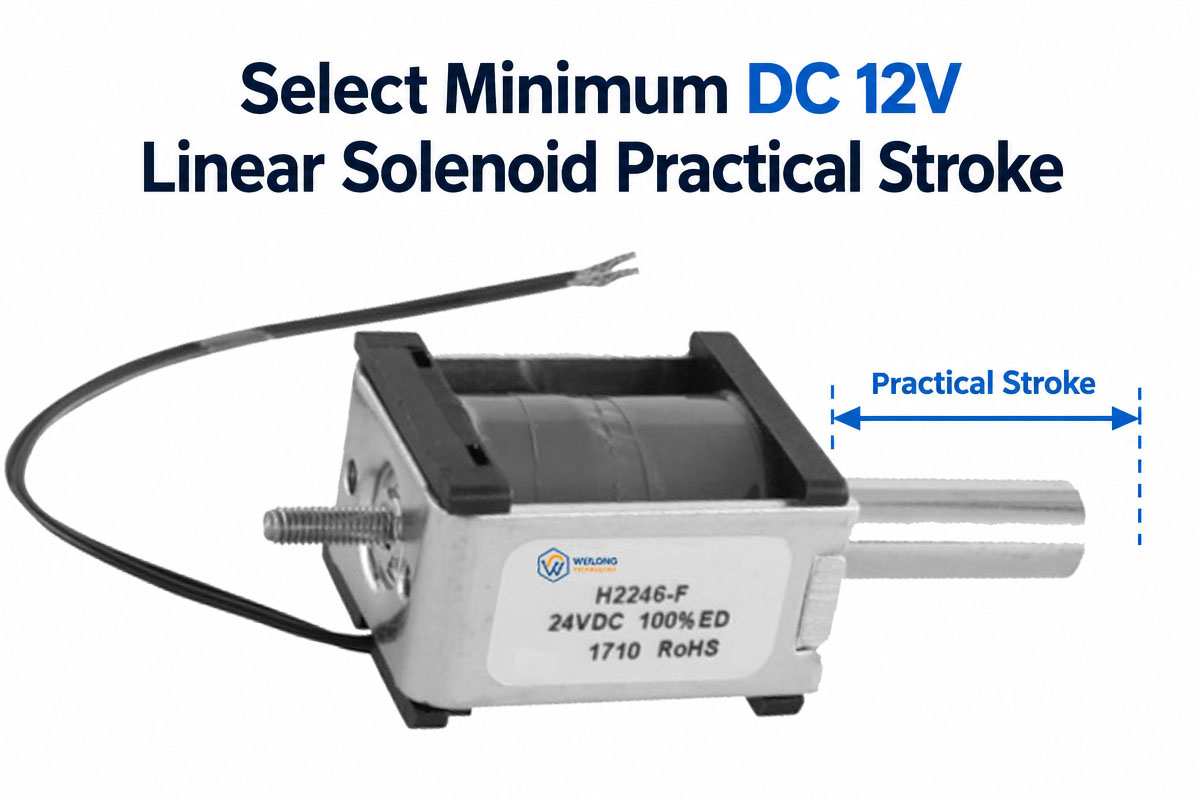
The higher the stroke, the harder it is to obtain a starting force, and the bigger the actuator has to be used.
So, OEM designers should minimize the unnecessary stroke.
A mechanism that needs 5 mm of stroke doesn’t have to be designed with 12 mm of stroke just for convenience’s sake—this will lead to unnecessary trade-offs.
“Review: ”
Mechanical movement required
Production tolerances
Allowance for Wear
Variation in assembly
Safety certificate
Select the smallest stroke that will give reliable service.
It can help to improve the force-to-size ratio of the 12V DC linear solenoid.
12. Push / Pull Configuration
Electromagnetic movement is generated naturally in many linear solenoids due to pulling the plunger towards the coil/magnetic circuit.
This movement can be transferred through the mechanical shaft to the pushing output.
So “Push” and “Pull” can be the way to define the direction of useful mechanical movement, rather than two completely different electromagnetic principles.
The OEM buyer should have a drawing that defines:
Direction of desired movement
Installation position
Load Connect
available space
Hit
Function return
This will let the supplier make recommendations regarding the right mechanical configuration.
13. Examine the return mechanism
A standard linear solenoid provides powered movement in one direction.
To return to the start position, it is necessary to use:
Spring into
Spring outside
Gravitation
Customer mechanism.
The return spring acts as a counterforce to the actuated movement.
So, the spring force has to be considered to calculate the electromagnetic force.
The harder spring can make the return faster or more reliable but will add to the required force of the 12V DC linear solenoid when actuated.
Hence, springs have to be designed for optimization, not chosen separately.
14. Analyze the response time
Fast actuation is required in some industrial applications.
The response time depends on:
Plunger weight
Stroke
Energy of coil
Power supply voltage
Mechanical stress
Spring tension (spring force)
* Friction
Driver circuitry
better acceleration, but higher impact velocity makes more noise and wear.
So, the fastest movement is not always the best option.
“Instead, specify the actual timing requirement.
For example:
Mechanical actuation required within 80 ms.
The supplier will be able to optimize the solenoid to a specific and measurable performance requirement.
15. Consider mechanical alignment and side load
Linear solenoids are designed primarily for axial movement.
The friction will increase, and the operating life will become shorter if the customer mechanism uses significant sideways force on the plunger.
The misalignment can also cause variations in the required actuation force.
During mechanical design: 1.
Keep the load in the axis of the plunger.
Avoid the unnecessary side loading.
If applicable, use external guides.
Allow the assembly tolerances.
Keep it from getting stuck during the entire stroke.
The poor mechanical alignment can not always be compensated for by the underpowered 12V DC linear solenoid.
Better mechanical integration is a better solution than choosing the bigger actuator.
16. Consider the DC12V Linear Solenoid cycle life
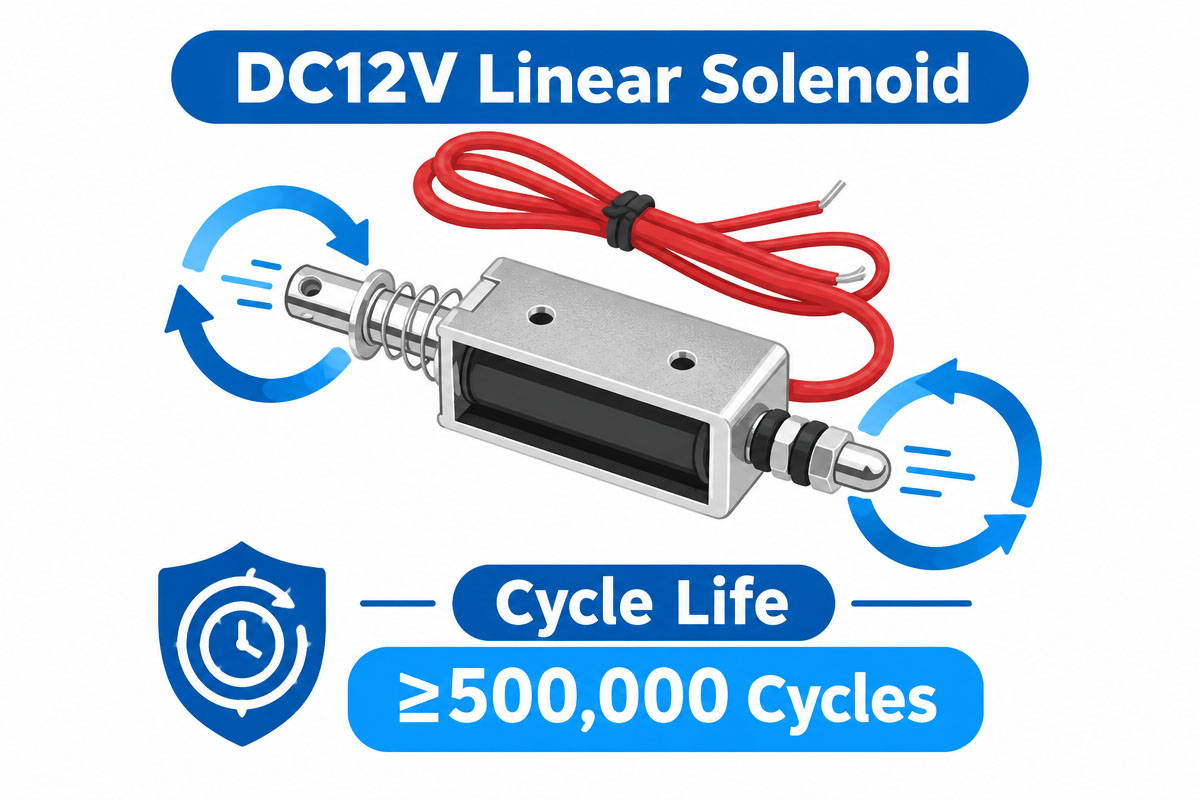
OEM buyers should specify the expected life of operation.
For example:
100 cycles per day x 365 days x 5 years = 182,500 cycles.
Industrial automation applications that operate every few seconds can need millions of cycles.
The factors that can influence the lifetime are
Mechanical shock
Plunger guide
Surface finishing;
Sideloading
Spring design
Temperature
Stroke
Frequency of operation
Corrupted
Ask the manufacturer how the life tests were done.
The cycle-life number without knowing the load, stroke, voltage, frequency, and temperature is of no engineering value.
17. Custom vs. Standard 12V DC Linear Solenoids
In case the application requirements are met, then the standard solenoid is typically chosen.
It can provide:
Reduced cost
Quicker samples
Existing tools
Rapid development time
Established production history
But the OEM equipment can have very specific requirements.
The customization options are:
Strength
Stroke
Coil Resistance: Coil resistance
Plunger shape
Length of shaft
Spring
Bracket for mounting
Lead wires
Junction
Overall size
Before designing a new 12V DC linear solenoid, try to adapt an existing magnetic platform.
A custom plunger, spring, bracket, or coil can reduce the tooling cost and development time by using an existing platform.
18. Testing of the Solenoid in a Real Environment
“Catalog data is a starting point, not an end point, for selection.
Where possible, test the engineering samples in the actual mechanism.
Validation should take into account:
Minimum voltage—does the actuator still perform its stroke?
Maximum load: Will it resist the worst mechanical resistance?
Hot condition. Is it still strong enough after repeated cycling?
Temperature extremes: Does it function within the specified operating range of the product?
Is the performance good enough after the number of cycles needed?
Mechanical tolerance: Do a number of assemblies work consistently?
Whenever it comes to production programs, test several samples, not just a prototype.
19. What to include in an RFQ for Buyers?
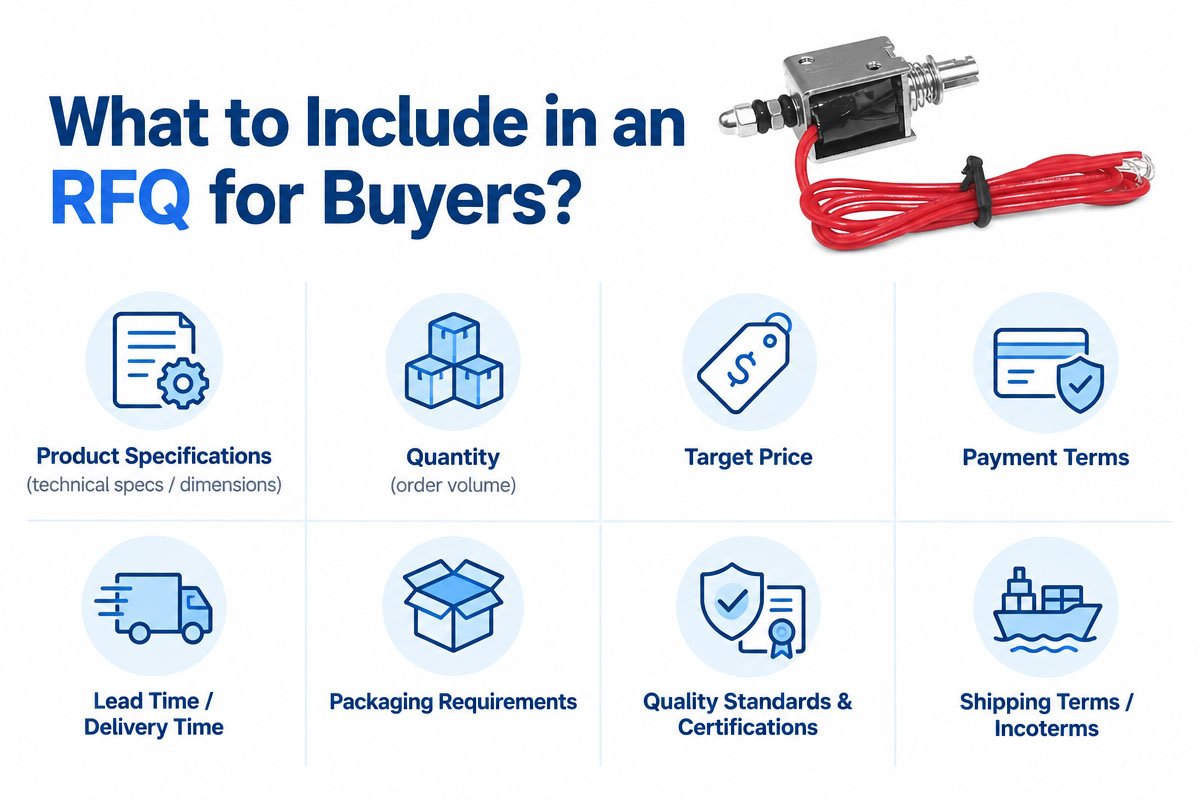
The more detailed RFQ, the faster the manufacturer can recommend a suitable solution.”
For example:
Product: Linear Solenoid DC 12V
Application: Industrial lock device
Action: draw
Nominal voltage: 12 VDC
Voltage Range: 10.5-13.5 VDC
Stroke required: 8 mm
Starting force: 15 N @ 8 mm
Final force: 25 N ON time: 1 sec OFF time: 4 sec
Frequency of operation: 12 cycles/minute
Operating temperature: min. -10°C, max. +60°C
Life span: 1,000,000 cycles
Space available: 45 × 30 × 25 mm
Annual quantity: 100,000 pcs
Include drawings, CAD files, photos, and load information where possible.
It will allow the manufacturer to examine the whole requirement and not just to choose a solenoid by the voltage.
Force Selection Checklist
Before making the final choice, check the following:
The required force is specified at certain stroke positions.
Maximum air gap. Starting force is sufficient.
Spring and friction loads are provided.
Engineering margin is more than sufficient.
“The minimum supply voltage was tested.
The power system is able to sustain the peak current.
Well defined duty cycle.
The hot-coil performance is taken into consideration.
Ambient temperature is within design limits.
Side loads are mechanically minimized.
The load includes the force of the return spring.
Response time is within the application requirement.
Operating life is proven.
Production tolerances are taken into account.
Samples were tested on the real mechanical element.
20. Final Words
One of the easiest ways to create an unreliable electromechanical design is to pick a 12V DC linear solenoid, considering the voltage and max force only.
Force and stroke have to be considered simultaneously.
The actuator has to develop enough starting torque at the maximum operating air gap to overcome springs and friction and to operate reliably as voltage, temperature, mechanical tolerance, and load conditions change.
Electrical requirements are equally important.
The OEM engineers have to consider the following aspects of the current coil resistance, power supply capability, duty cycle, temperature rise, and hot-coil performance.
The electromagnetic force has to be integrated mechanically to check if it is able to reach the load efficiently.
The most useful strategy for buyers is to allow the manufacturer to examine the full specification of the application, rather than to ask for a “12V solenoid.”
Specify the required stroke, force, voltage range, duty cycle, dimensions, environment, lifetime, and annual production volume.
The properly selected and tested 12 VDC linear solenoid will provide compact, fast, and reliable linear actuation over the life of the OEM product.
21 FAQs on 12V DC Linear Solenoids
1. What information should I send to a supplier when requesting a 12V DC linear solenoid?
Required force at given stroke positions, total stroke, minimum and maximum voltage, available current, ON/OFF time, operating frequency, dimensions, mounting, ambient temperature, expected cycle life, application description, and annual quantity. Drawing or CAD model of the mechanism is also very helpful.
2. What force should I put on a 12V DC linear solenoid?
Provide the force required on the actual working stroke, not just a maximum force number. Include spring force, friction, gravity, mechanical linkage loads, acceleration, and reasonable engineering margin. For example, it is more useful for a supplier to know “15 N at 8 mm stroke” than just asking for a “15 N solenoid.”
3. Why do two 12V DC solenoids have such varying force ratings?
Two 12V actuators can have different coil resistance, current, winding design, magnetic materials, plunger geometry, air gap, size, stroke, and duty-cycle ratings. The electromagnetic force is not only a function of the voltage. Buyers need to compare force vs stroke data and operating conditions.
4. To purchase a standard or a custom 12V DC linear solenoid?
Select a standard model that satisfies the requirements of the required force, stroke, voltage, dimensions, duty cycle, temperature, and life for the application. Select the customization when the standard product can’t satisfy a critical need. Often it is cheaper to adapt an existing platform than to design a brand new actuator.
5. What question should I ask the supplier about the force rating?
Ask at what stroke position the force was measured. Ask if the value is for cold- or hot-coil performance. Ask what voltage was applied and what duty cycle was assumed. If possible, ask for force vs. stroke data. These details will make supplier comparisons much more meaningful.
6. How do I compare quotes from different solenoid manufacturers?
Ensure that all suppliers are quoting against the same stroke, force position, voltage range, duty cycle, lifetime, dimensions, environmental conditions, wires, connectors, annual quantity, and testing requirements. A lower quote can mean a very different level of performance.
7. What samples should an OEM buyer test before mass production?
Engineering samples testing in the real mechanism. Pilot-production samples testing made with the intended production materials and processes after the design is finalized. Before approving volume production, test force, stroke, minimum voltage, hot operation, temperature, noise, life, and mechanical fit.
8. How to select a reliable 12V DC linear solenoid supplier?
Look beyond the per-unit price. Assess the supplier’s knowledge of force vs. stroke behavior, coil and thermal design, duty cycle, mechanical integration, life testing, customization, quality control, and mass-production consistency. A good supplier should be able to analyze your application and tell you why the solenoid they are recommending will work in your conditions.