Flapper Actuator Solenoid for Industrial Control Systems
High Performance Flapper Actuator Solenoid Supplier
Flapper Actuator Solenoid for Ink Control Equipment
Reliable Flapper Actuator Solenoid Manufacturer Guide
Flapper Actuator Solenoid for Fluid Control Systems
Precision Flapper Actuator Solenoid for Ink Machines
Flapper Actuator Solenoid for Industrial Control Systems
High Performance Flapper Actuator Solenoid Supplier
Flapper Actuator Solenoid for Ink Control Equipment
Reliable Flapper Actuator Solenoid Manufacturer Guide
Flapper Actuator Solenoid for Fluid Control Systems
Precision Flapper Actuator Solenoid for Ink Machines

WL0625 Custom Flapper Actuator Solenoid Manufacturer Solution

The Flapper Actuator Solenoid is a compact electromagnetic motion actuator intended for precise switching and flow control applications. It converts electrical energy into mechanical motion through electromagnetic force. This gives the attached flapper valve or other control devices fast and accurate reaction.

This actuator is suitable for industrial automation, printing equipment, ink control systems and fluid management and provides stable operation, long service life and configurable operating parameters. Engineers can configure a voltage rating, stroke length, pulling force, mounting style, connector and duty cycle of the actuator according to specific application requirements.

Flapper Actuator Solenoids are an important part of modern intelligent equipment with precise electromagnetic control. They have the following advantages: fast response time, compact form factor, energy efficiency and high repeatability.

Custom Flapper Actuator Solenoid Product Overview

The Flapper Actuator Solenoid is a special type of precision electromagnetic actuator for automated control applications. It consists of a coil assembly, magnetic plunger, return spring, housing, and mechanical interface to produce controlled motion. Customized DC voltage versions of the actuator are available to meet different force, stroke, and mounting requirements. The compact construction makes this actuator suitable for equipment with limited space, and durable materials ensure reliable operation during repeated cycles. The Flapper Actuator Solenoid is designed to provide high efficiency, precision, and reliability for industrial applications such as ink control, fluid control, and automation systems.

How Does a Flapper Actuator Solenoid Work?

Step 1. Electrical Activation

Supplying a DC voltage to the coil generates current and a magnetic field.

Step 2. Creation of the magnetic force

The magnetic field produces an attractive force between the coil and magnetic core.

Step 3. Linear Motion

Movement of the plunger inside the solenoid tube produces controlled linear motion.

Step 4. Movement of the Flapper

The movement of the plunger results in opening, closing, or changing the position of the valve or other control mechanism.

Step 5. Taking Action

The plunger and flapper return to the initial position due to the spring or other mechanical structure when power is off.

This simple but reliable principle of operation allows fast switching, precise control, and long-time operation of the automated equipment.

Key Features of the Flapper Actuator Solenoid

Flapper actuator solenoids have the following advantages for industrial applications. The electromagnetic construction is compact with fast response, stable force output, and reliable repeatability. The actuator can be configured according to specific application requirements in terms of voltage rating, stroke length, pulling force, mounting style, and connector. The high-quality coil winding and precise machining of parts ensure uniform operation in continuous operation mode. The rugged construction ensures resistance to thousands of operation cycles, and optimized magnetic circuits increase efficiency and lower power consumption. Their compact size and flexible construction make them the perfect choice for applications that require precise mechanical movement.

Custom Flapper Actuator Solenoid Product Video

Custom Flapper Actuator Solenoid Product Detailed Display

Custom Flapper Actuator Solenoid Datasheet

Brand Weilong Technology Model Number WL0625
Rated Voltage (V) DC 3–48V Rated Power (W) 3-6 W
Work Model Flapper Type Design Holding Force (N) 30 Gf
Stroke (mm) 2.5 MM Reset Time(s) 30 Ms
Service Life 300 Thousand Times Certification CE, RoHS, ISO9001
Material Carbon Steel Housing with Zinc-Plated Coating Lead Wire Length (mm) 200
Install Style Adjustable Screw Tolerance of Dimension ± 0.1 MM
Water-proof None Insulation Class F 155 Cel. Degree
Hi-Pot Test AC 600V 50/60Hz 2s Non-excitation Holding Force 0
Working Temperature -10°C-100°C Duty Cycle 1-100%
Thread Depth (mm) / Payment Term TT, or LC at Sight
Sample Order Yes. Warranty 1 Year
MOQ 500 pcs Supply Ability 5000 pcs per week
Delivery Time 30 Days Port of Loading Shenzhen

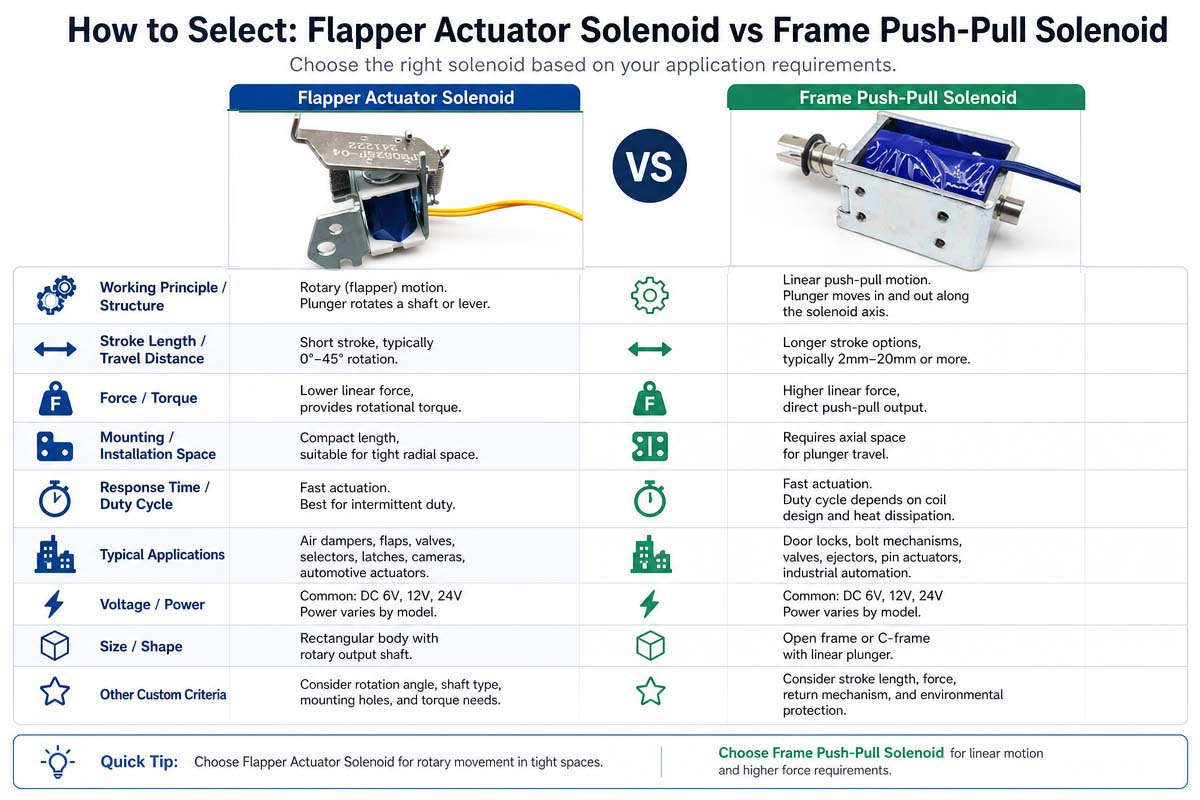
Flapper Actuator Solenoid vs. Flame Push-Pull Solenoid Selection Guide

Flapper Actuator Solenoid VS Flame Push-Pull Solenoid Selection Guide

Comparison Flapper Actuator Solenoid Flame Push-Pull Solenoid
Motion Type Designed for flapper mechanism control Direct linear push/pull movement
Application Ink control, valves, fluid systems Locks, automation, mechanical movement
Movement Optimized for small controlled motion Higher direct force output
Structure Compact integrated design Larger tubular structure
Control Accuracy Higher for switching applications Better for mechanical loads
Installation Specialized mounting General-purpose mounting

1. Flapper Actuator Solenoids Used When

✓ Requires Accurate Flapper Control ✓ Limited Space Requirement ✓ Requires Fast Switching ✓ Fluids or Ink Control Application

2 Select Push-Pull Solenoid If: (don’t know

✓ Requires Higher Mechanical Force ✓ Longer Stroke Required ✓ Prefers Direct Linear Motion

Choosing the right one will depend on the application force, stroke, installation space, and operating environment.


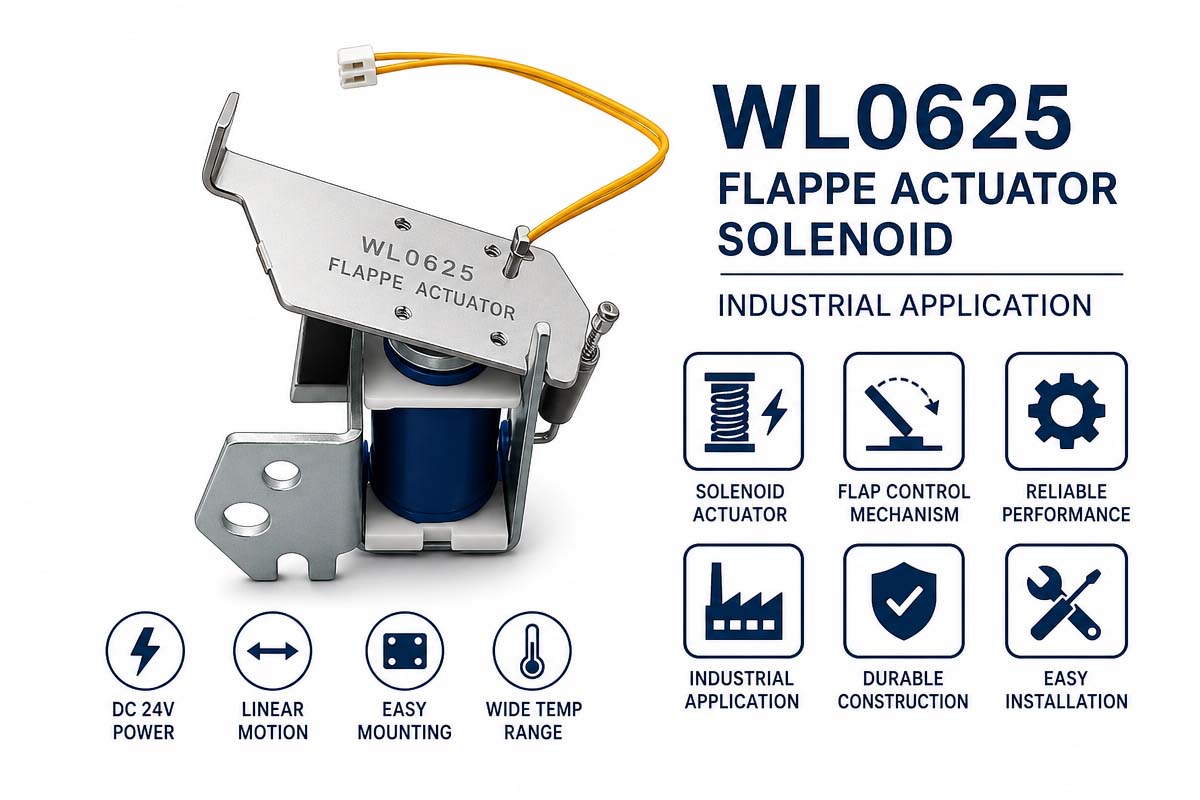
Custom Flapper Actuator Solenoid Industrial Application

WL0625 Flapper Actuator Solenoid Industrial Application

Industries that require precise switching and controlled mechanical movement use flapper actuator solenoids widely.

1. Ink control devices

One of the fastest-growing applications of the flapper actuator solenoid is industrial printing equipment. The actuator controls the ink flow, cleaning, and dispensing operations. The rapid response and repeatability improve the printing accuracy and minimize the material waste.

2. Fluid Control Systems

The actuator can control small valves and flapper mechanisms in water, gas, and chemical control systems. Thanks to its small size, it can be incorporated in confined spaces.

3. Medical Devices

The medical devices require precise and reliable control of mechanical movement. Analytical instruments, laboratory devices, and fluid control devices use flapper actuator solenoids.

4. Industry automation

The flapper actuator solenoids are used in automation systems for switching, positioning, and mechanical control functions that require fast electromagnetic response.

5. Intelligent Equipment

Small solenoid solutions for automation and improved user experience are beneficial for modern intelligent devices.

Flapper actuator solenoids replace traditional mechanical controls in many industries because of their reliability, customization options, and long service life.

Why Is the Flapper Actuator Solenoid Popular in Ink Control Equipment?

Due to the increasing need for accurate, rapid, and repeatable ink control in printers, flapper actuator solenoids are becoming increasingly popular in ink control equipment.

Modern printers require precise ink flow, cleaning, and delivery. Mechanical solutions tend to be slow and require more maintenance.

The Flapper Actuator Solenoid offers:

Fast Switching Performance

Accurate Ink Control

Small Install Footprint

Extended Lifespan

Minimal Maintenance.

In industrial printing, even a slight error in ink control can affect the quality of the output product. The electromagnetic actuator provides reliable operation, which increases the accuracy of printing.

Furthermore, the customizable design of this actuator enables equipment manufacturers to integrate the solenoid into the printer architecture.

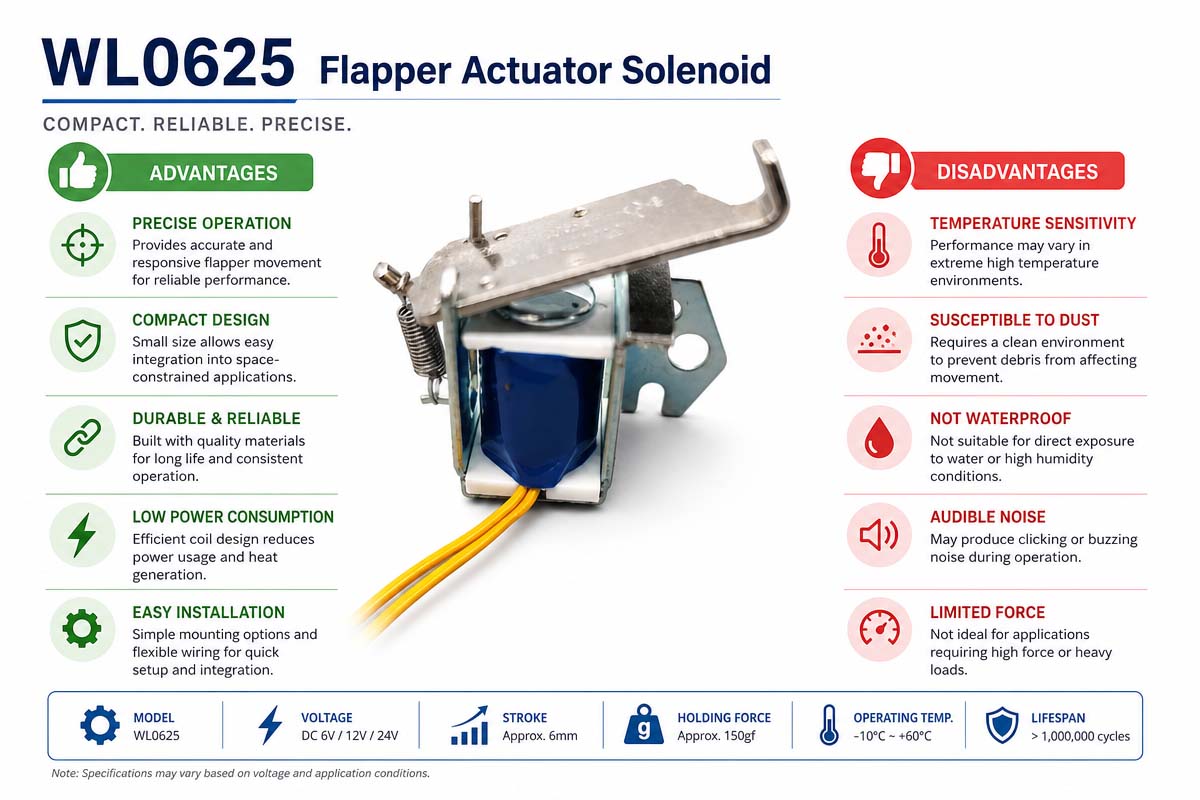
Custom Flapper Actuator Solenoid Advantage and Disadvantage

WL0625 Flapper Actuator Solenoid advantage and disadvantage

Flapper Actuator Solenoid Advantages

Compact design

It is ideal for compact machinery with little installation space.

Fast Response

Due to electromagnetic activation, it has fast switching performance.

Easy to Control

It can be directly controlled by electrical signals.

Highly Reliable

Its mechanical design requires little maintenance.

Configurable

Manufacturers can change the voltage, force, stroke, and mounting design.

Flapper Actuator Solenoid Advantages and Disadvantages

Limited Stroke Motion

Most solenoid actuators have limited strokes when compared to motors.

Heat Production

Operation throughout the day can cause heat accumulation, which needs dissipation.

Fixed Motion Profile

Generally, solenoids are simple on-and-off switches, unlike servo systems.

Reduced Force during Stroke

When the position of the plunger changes, the magnetic force reduces.

However, despite these disadvantages, Flapper Actuator Solenoids are excellent actuators for applications that require simple and rapid electromagnetic control.

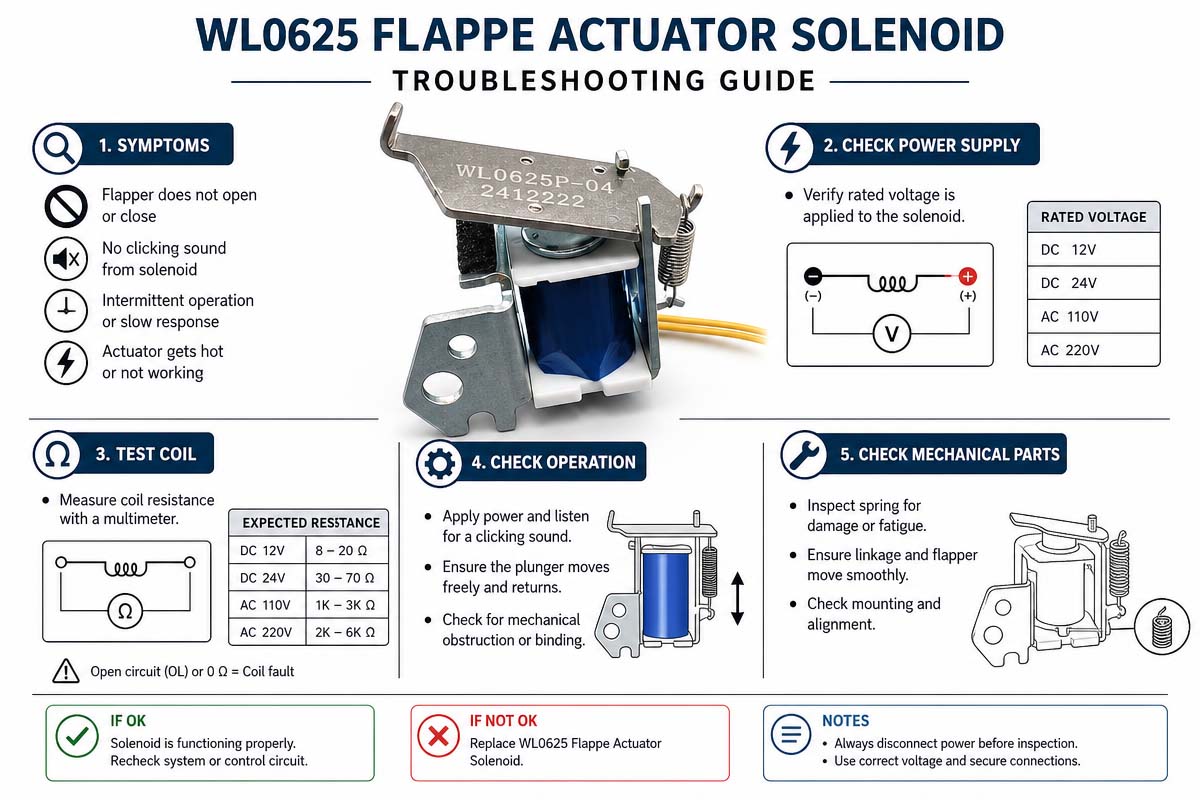
Flapper Actuator Solenoid Troubleshooting Guide

WL0625 Flapper Actuator Solenoid Troubleshooting guide

Problem 1: The solenoid does not move.

Possible Causes:

Incorrect supply voltage.

Damaged Coil

Obstruction Mechanically

Solutions:

Inspect the power supply. (k)

Measure the resistance of the coil.

Inspection of Plunger Action

Problem 2: Actuation With Low Force

Possible Causes:

Low voltage

Overloading

Magnetic Gap Problems

Solutions:

Check Operating Voltage

Reduce Mechanical Resistance

Check assembly accuracy.

Problem 3: Overheating

Possible Causes:

High Duty Cycle

Incorrect Voltage

Poor Heat Dissipation

Solutions:

Reduced Operation Frequency

Correct Voltage Selection

Improved Installation Environment

Problem 4: Noisy Operation

Possible Causes:

Loose Parts

Mechanical Action

Poor Installation

Solutions:

Mount Structure Check

Improved Damping Design

Correct product selection and maintenance can significantly improve the reliability of actuators.

Five Mistakes to Avoid When Using a Flapper Actuator Solenoid

There are several technical forums and troubleshooting tips about five mistakes to avoid using a flapper actuator solenoid.

1. Replacing the Solenoid Prematurely
The most common mistake with flapper actuator solenoids is thinking that there is something wrong with the solenoid and replacing it. Actually, there might be another part of the mechanism that fails to operate properly. There can be various reasons for that, such as a vacuum leak, a bad relay, or malfunctioning of the switch. However, the problem usually lies in the fact that the flapper does not move due to rust or lack of lubrication. So, before replacing your solenoid, check that your flapper moves freely by hand and that the entire mechanism works fine.

2. Improper Installation and Mechanical Alignment Not Being Checked
Another common mistake people make is ignoring installation and mechanical alignment of the flapper actuator solenoid. It is necessary to ensure that the arm of the flapper and the plunger rod are properly connected. Otherwise the solenoid cannot be activated since there will not be enough room for the plunger rod to make it move. One more mistake related to installation is placing the flapper on one side of its mounting frame rather than dividing it between two sides of the frame. Such a mistake can prevent the flapper from being rotated properly.

3. Ignoring Ground Problems
The majority of solenoids’ problems are related to electricity and not burnt coils. For example, the most common mistake is bad grounding. In some cases, the ground wire is pressure connected to the body of the solenoid, and it gets loose with time due to vibrations causing problems with the electrical circuit. The other mistake people make with the solenoid is placing the wire terminal in an incorrect position, which causes a short circuit in the solenoid. It leads to burning out the fuse and loss of power supply to the mechanism. Checking of all connections and ground points is a must.

4. Mistreating Solenoid Actions and Noises
If the solenoid is making loud noises when it is activated, then the noise is a sure sign of malfunction, but often it is not recognized until it is too late. The buzzing noise shows that the solenoid is misadjusted and it does not seat properly. As a result, it starts to heat up, and the coil burns. The solenoid might work for some time, but in this state it will not operate for a long time. Adjustment is crucial, so make sure that the solenoid is adjusted in such a way that the flapper barely touches during activation, and hence the buzzing noise disappears.

5. Neglecting Basic Maintenance Procedures
The users do not always perform basic maintenance procedures. Lubrication is often necessary in the case of the flapper actuator solenoid since the linkage between the parts might seize up. For example, the actuator arm of the exhaust flapper can be rusty and stuck because of lack of use. You can restore its functionality without replacing the solenoid.

5 Frequently Asked Questions on Flapper Actuator Solenoid

1. What Is a Flapper Actuator Solenoid?

A flapper actuator solenoid is an electromagnetic actuator that controls the operation of a flapper mechanism in valves, fluid control systems, and automation equipment. The solenoid gets power to create a magnetic field to move the plunger to actuate the flapper for controlling air flow, liquid flow, or mechanical positioning.

2. How does a Flapper Actuator Solenoid work?

The Flapper Actuator Solenoid is an electromagnet actuator. The coil is powered with direct current, which creates a magnetic field within the solenoid. It moves the plunger, which is attached to the flapper and moves it by attraction or repulsion. In case of deactivation, the flapper moves back to its original position through the mechanical or return spring force.

3. What are the major uses of Flapper Actuator Solenoids?

Flapper actuator solenoids are widely used in various applications, including automatic valves, HVAC systems, medical equipment, fuel control systems, water dispensers, coffee machines, pneumatic control devices, and fluid control equipment.

3. What are the major uses of Flapper Actuator Solenoids?

The following key parameters should be considered for selecting flapper actuator solenoids: operating voltage, stroke length, actuation force, duty cycle, response time, mounting dimensions, environmental requirements, and lifetime. The solenoid must be powerful but with limited space and power availability.

5. What are the Advantages of Flapper Actuator Solenoids?

Rapid response, compact size, reliability, low maintenance requirement, and simple electrical control are the major advantages of flapper actuator solenoids.

How to Choose the Right Flapper Actuator Solenoid?

To choose the proper flapper actuator solenoid, you should understand its electrical and mechanical requirements.

1. Identify application requirements

First, you should define the environment and the purpose of the operation:

And what will the solenoid control?

Is it an opener, a closer, a switch, or a positioner?

How many times will it operate?

The design of the actuator depends on the application.

2. Choose the Right Voltage

The usual voltage options are

DC 5V DC 12V DC 24V

The selected voltage should be compatible with the power supply and control system of the equipment.

3. Verify Required Force

The actuator force should be sufficient to move the flapper mechanism.

For instance:

Required force to open

Mechanical friction

Spring-back force.

Safety buffer

4. Stroke Length Verification

The stroke is the distance that the plunger moves.

The longer stroke may allow additional movement but usually requires a larger solenoid size.

5. Consider Duty Cycle

The duty cycle affects heat generation and the service life.

If you require continuous operation, then you should choose the solenoid with the higher duty cycle and better heat management.

6. Consider Environment Factors

Consider Environment Factors: Humidity Temperature:

Humidity Temperature

Dust exposure

Corrosive environment

Choose the appropriate materials and protection levels.

7. Choose the Reliable Manufacturer

The professional manufacturer should provide:

Engineering support, prototyping, testing, and customization Quality control production capabilities

The right Flapper Actuator Solenoid will give you the right combination of performance, reliability, cost, and integration needs.

Common Mistakes in the Design of Flapper Actuator Solenoid

1. Wrong Calculation of Force

Many engineers choose a solenoid based on static force, ignoring friction, spring-back force, and mechanical resistance.

2. Ignoring Heat Generation

Excessive power can lead to overheating and decreased product life.

3. Improper Selection of Stroke Length

A too-large stroke increases size and power consumption, and a too-small stroke prevents the flapper from moving fully.

4. Poor Mechanical Alignment

It can cause additional friction and reduce actuator efficiency.

5. Forget About Duty Cycle

Proper thermal design is required for frequent operation.

6. Lack of PrototPrototype testing in real working conditions before mass production will help avoid performance problems. performance.


Get A Free Quote Now

Contact Form

Related Products

Related News

Scroll to Top

Get A Free Quote Now !

Contact Form
If you have any questions, please do not hesitate to contact us.
Weilong Solenoid Company Culture
