Rotary Solenoid Feature and application

Rotary Solenoid Guide: Types, Working Principle & Uses

24V Rotary Solenoid for High-Speed Packaging Automation
Electric Rotary Solenoid for Industrial Automtation Machine
High Torque Rotary Solenoid for Industry Use
High Torque Rotary Solenoid Motor Applications
DC Rotary Solenoid Actuator for Smart Systems
Solenoid Rotary for Industrial Motion Control Use
Compact 90 Degree Rotary Solenoid Overview
Rotary Solenoid Valve Working Principle Explained
Bistable Rotary Solenoid Applications in Automotive Systems
WL0623 bistable rotary solenoid
Rotary Solenoid Feature and Application

Chapter 1: What Is a Solenoid That Turns

When electricity passes through the coil of a rotary solenoid, it causes a limited angle of rotation. When the
electricity passes through the coil of a rotary solenoid, a magnetic field causes an instant turn of the output shaft to
a certain angle. When the electricity goes off, the solenoid either goes back to its original position via a spring
return mechanism or, for bistable solenoids, stays in place.  

Key Difference Between Rotary Solenoids and Motors

Feature Rotary Solenoid Electric Motor
Motion Limited-angle rotation Continuous rotation
Control Simple ON/OFF Requires controller
Response Milliseconds Slower acceleration
Positioning Fixed angle Requires encoder


Chapter 2: The Most Common Types of Rotary Solenoids

There are a number of solenoids used depending on the amount of torque and motion needed.

  1. Rotary Solenoid with a Spring Return

When the electricity supply to the solenoid is cut off, it immediately returns to its original position.

Some of its common uses include:

Locks used for machines

Shutters

Industrial gates

  1. Rotary Solenoid with Two Positions (Latching)

It stays in place even when the power supply to the solenoid has been cut off. This means it saves a lot of power.

Some of its common uses include:

Security systems

Battery-powered tools

Smart devices

  1. Rotary Solenoid with a Helical Groove

It makes use of a helical cam mechanism to convert linear electromagnetic forces to rotational motion.

Chapter 3: Some of its advantages include

  1. Smooth rotation

More torque output

It can be controlled to a certain angle


  1. Rotor / Armature  

The rotor transforms magnetic energy into rotary motion that rotates.

  1. Magnetic Case  

The case is magnetic, thus improving the torque and magnetic efficiency.

  1. Spring to Return  

This is for spring return solenoids, which return the rotor to the original position when the power supply is switched off.

  1. Shaft and Bearings  

This transmits the rotary motion to the outside load while ensuring smooth and stable motion.

Chapter 4: How a Rotary Solenoid Works

The operation of the solenoid is quite simple:

The coil allows the flow of electrical current into the coil.

The coil generates a magnetic field.

The magnetic field rotates the rotor.

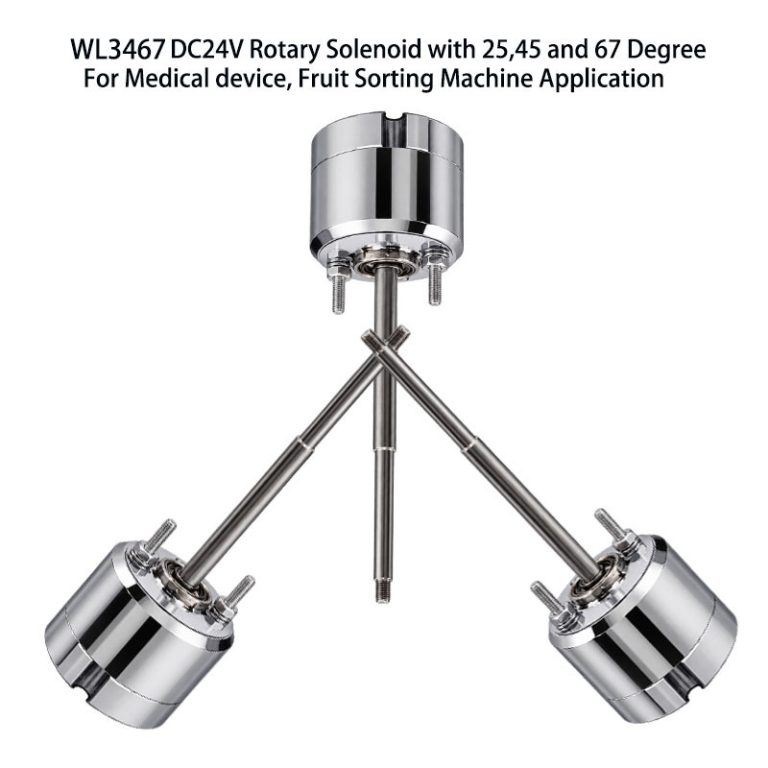
The rotor rotates to an exact angle, such as 25°, 45°, or 90°.

When the electrical current is switched off:

The spring returns the rotor to its original position, or

A bistable mechanism holds the rotor in place.

This technology allows you to react fast and accurately set the angle without using complex control mechanisms.

Chapter 5: Why More and More People Are Using Rotary Solenoids

There are numerous reasons why rotary solenoids are becoming the preferred choice for modern automation.

  1. Very Quick Response  

It can respond within milliseconds, thus suitable for fast response automation.

  1. Easy to Use  

It uses simple DC ON/OFF control, thus no need for complex motor control.

  1. Strong and Small  

It is suitable for equipment that lacks enough space since it has high torque in small size.


  1. Very Accurate and Repetitive

This angle of rotation is fixed, ensuring that it is in the same location at all times.

  1. Efficiency in Energy

Bistable rotary solenoids do not require power at all times, ensuring that there is efficiency in energy.

  1. Very Reliable

Rotary solenoids can be used for millions of cycles because motors do not have many moving parts.


Chapter 6: What Rotary Solenoids Can't Do

Though rotary solenoids have some positive attributes, they also have negative attributes.

  1. Angle of Rotation is Limited

Rotary solenoids can only rotate up to 90°, as well as 15°.

  1. Need for constant power

Rotary solenoids require power at all times, especially those that use a spring return.

  1. Making Heat

Rotary solenoids might generate heat after long hours of use.

  1. Speed control is limited

Rotary solenoids can only move in one way; they cannot move at different speeds.

Chapter 7: Common Uses for Rotary Solenoids

Rotary solenoids play a significant role in many businesses.

Automation in Industry

Gates for sorting

Diverter systems

Systems for positioning

Robotic tools

Systems for Cars

Control of HVAC dampers

Systems for locking transmissions

Locks for seats

Tools for Medicine

Analyzers for diagnosis

Systems for processing samples

Control of fluids and valves

Tools for the Office

Copy machines and printers

ATM shutter systems

Machines that handle cash

Access Control and Security

Locks that work with electronics

Gates with turnstiles

Safety interlock systems

Chapter 8: Rotary Solenoid Datasheet (Typical Specifications)

Below are common specifications for industrial rotary solenoids.

Parameter Typical Value
Rated Voltage DC 12V / 24V
Rotation Angle 15° – 90°
Response Time 10–50 ms
Holding Torque 0.1 – 5 Nm
Duty Cycle 10% – 100%
Service Life >1 million cycles
Protection Level Up to IP65
Mounting Flange or threaded

Custom parameters such as
voltage, torque, rotation angle, and shaft design
 can be tailored for specific applications.

Chapter 9: How to Pick the Best Rotary Solenoid

In order to select the right rotary solenoid, there are various technical aspects that have to be taken into consideration.

  1. Angle of Rotation

Some of the commonly used angles are:


15°

30°

45°

60°

90°

  1. Need for Torque

Find out how much torque is required to rotate the load.

  1. Voltage of Operation

The commonly used voltage is:

DC 12V

24V DC

Custom Voltage

  1. Duty Cycle

Make the choice depending upon how often you want to operate and how much heat is required to be dissipated.

  1. Design of Mounting and Shafts

Design aspects to be taken into consideration are:

Diameter of the shaft

Mounted on a flange

Direction of Load

  1. Conditions in the Environment

Check:

Weather

Dust-proof

Moisture-resistant

Working with an experienced manufacturer ensures that the right choice is made.

Chapter 10: Final Thoughts

A rotary solenoid is an excellent way for you to get fast, accurate, and repeatable limited angle rotary motion. Although rotary solenoids cannot replace motors for rotary motion, their simple design, fast response time, small size, and reliability make rotary solenoids an excellent choice for use in automation, cars, medicine, and security.


At Weilong, we provide custom rotary solenoid solutions that guide you from design and development through mass manufacturing to ensure that your application performs at its best.

Common Questions (FAQ)

Q1: What are the angles available with rotary solenoids?

15°, 30°, 45°, 60°, and 90° are some of the commonly used angles. However, specific angles are also available.

Q2: Can rotary solenoids hold position even if power is not supplied?

Yes, bistable or latching rotary solenoids are available.

Q3: What are the commonly used voltages with rotary solenoids?

Most rotary solenoids are designed to work with DC 12V or DC 24V. However, the voltage levels can also be changed according to specific needs.

Q4: How long do rotary solenoids last?

High-quality rotary solenoids have the capacity to last more than one million cycles.

Q5: When is the best time to use a rotary solenoid instead of a motor?

When you want to use a rotary solenoid, use one.

When quick response is required

When rotation is required by a limited angle

When easy turn-on and turn-off is required

When space is limited

Scroll to Top

Get A Free Quote Now !

Contact Form
If you have any questions, please do not hesitate to contact us.
Weilong Solenoid Company Culture
