High Torque Rotary Solenoid 90 Degree Solutions
90 Degree Rotary Solenoid Working & Uses
Precision 90° Rotary Solenoid for Automation
Compact 90 Degree Rotary Solenoid Overview
ndustrial Automation with 90° Rotary Solenoid
Durable 90 Degree Rotary Solenoid Explained
High Torque Rotary Solenoid 90 Degree Solutions
90 Degree Rotary Solenoid Working & Uses
Precision 90° Rotary Solenoid for Automation
Compact 90 Degree Rotary Solenoid Overview
ndustrial Automation with 90° Rotary Solenoid
Durable 90 Degree Rotary Solenoid Explained

WL0432 New Rotary Solenoid 90 Degree Guide

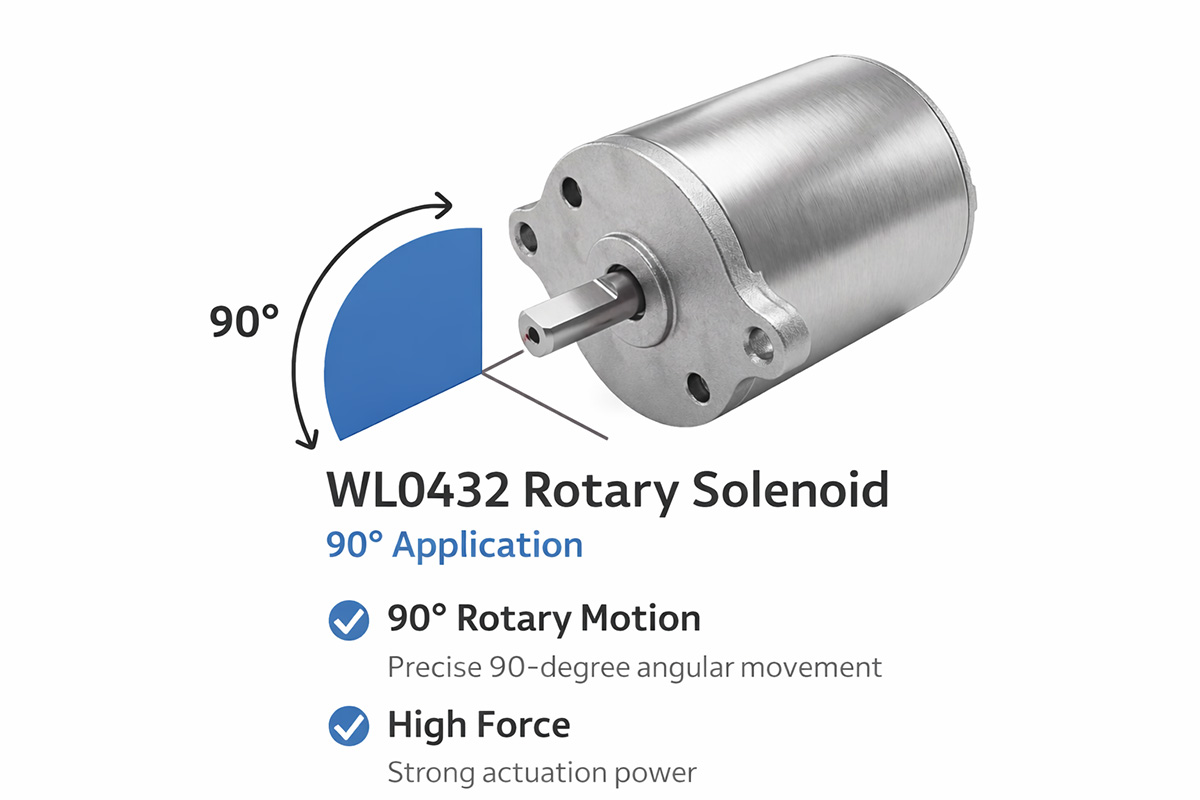
The Rotary Solenoid 90 Degree is a device for converting electrical energy into rotational energy. Rotary solenoids generate rotational movement with the use of magnetic forces, while linear solenoids provide linear output movements.

Current flowing through the coil generates a magnetic field interacting with the internal rotor or armature, thus causing it to turn through the predetermined angle of 90° precisely. Once the power source is cut off, the return springs or reverse polarity rotates the armature back to its original position.


Key Features of WL0432 Rotary Solenoid 90 Degree

A 90-degree rotary solenoid is compact and reliable in terms of angular output control, providing fast response time. Besides, it supplies a stable level of torque and is able to reproduce positions repeatedly, making it suitable for automation systems. Usually, such components are durable and require low maintenance and repair costs.

They operate within cycles with high frequency and are characterized by various voltage and torque capabilities. In addition, most models feature automatic return springs that enable shaft configuration adjustment. Moreover, being simple in construction, these devices ensure accurate and smooth operation. Besides, due to their fixed rotation capability, there is no need for complex mechanical systems.

WL0432 Rotary Solenoid 90 Degree Product Overview

The structure of a rotary solenoid 90 degree generally includes a coil, a stator, a rotor (armature), a shaft, and a return spring. The rotation process is achieved due to the generation of the magnetic field that rotates the rotor through 90° and results in mechanical output. These components are available in various forms and shapes with diverse characteristics.

Specifically, they vary in torque, size, and type of power supply (AC or DC). Advanced models allow customization of shaft configuration, protection against environmental impact, mounting configuration, etc. They can be successfully employed in automation and locking systems requiring reliability and precision of movements.

WL0432 Rotary Solenoid 90 Degree Video

Rotary Solenoid 90 Degree Detailed Discription

WL0432 Rotary Solenoid 90 Degree Datasheet

WL0432 Rotary Solenoid 90 Degree Datasheet

Brand Weilong Model Number WL0432
Rated Voltage (V) DC 12V ,18V or 24V Rated Power(W) 40–80 W
Work Model Rotation Holding Force (N)  150 —– 300 GF
Rotating Angle From 25, 45, 60 or 90 degrees Working Duty 25%
Service Life 500 Thousand Times Certification CE, RoHS, ISO9001,
Material Carbon Steel Housing Lead Wire Length (mm) 200
Install Style screw Tolerance of Dimension  +/-  0.1 MM
Water-proof  None Insulation Class B
Hi-Pot Test AC 600V 50/60Hz 2s Non-excitation Holding Force 0
Working Temperature -10°C-100°C Duty Cycle 1-100%
Thread Depth(mm) / Payment Term TT, or LC At Sight
Sample Order Yes Warranty 1 Year
MOQ 1000 PCS Supply Ability 5000 pcs per Week
Delivery Time 30 Days Port of Loading shenzhen


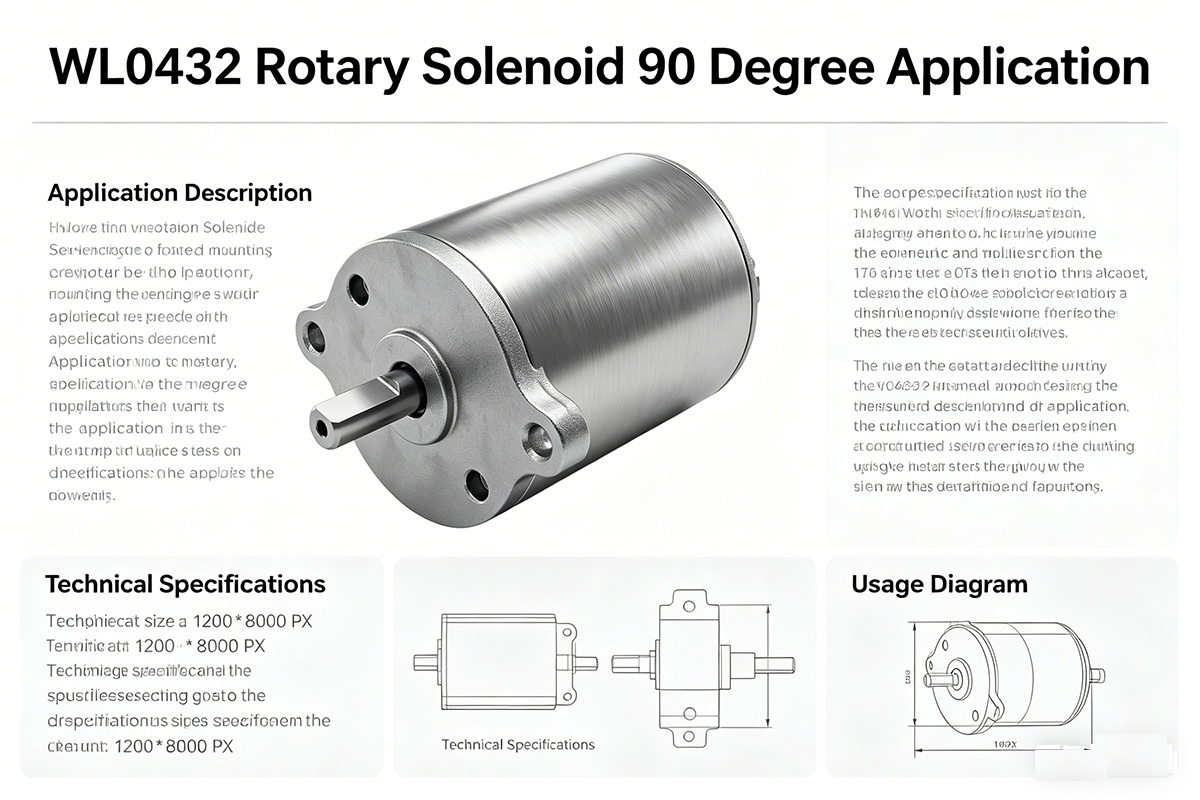
WL0432 Rotary Solenoid 90 Degree Application

WL0432 Rotary Solenoid 90 Degree Application

As it is obvious from their features, a rotary solenoid 90 degree is widely applied across various industries and facilities due to their ability to generate a controlled rotational motion with a high level of accuracy and reliability. They are extensively employed in automation systems to sort parts, control valves, and position objects on manufacturing lines.

Due to their fast reaction speed, these devices are used in automated manufacturing facilities, as they are able to rotate 90° repetitively. Additionally, such elements can be found in locking and safety mechanisms, electronic doors, and other security devices where reliable rotation is required to lock and unlock something.

In addition, they are used to ensure safe and accurate operation of medical equipment for liquid flow control and diagnostic purposes. Moreover, The rotary solenoid 90 degree is extensively utilized in the automotive industry, HVAC systems, and actuators. What is more, office machines like printers and copiers contain solenoids that perform rotation to manipulate paper.

Advantages and Disadvantages of Rotary Solenoid 90 Degree

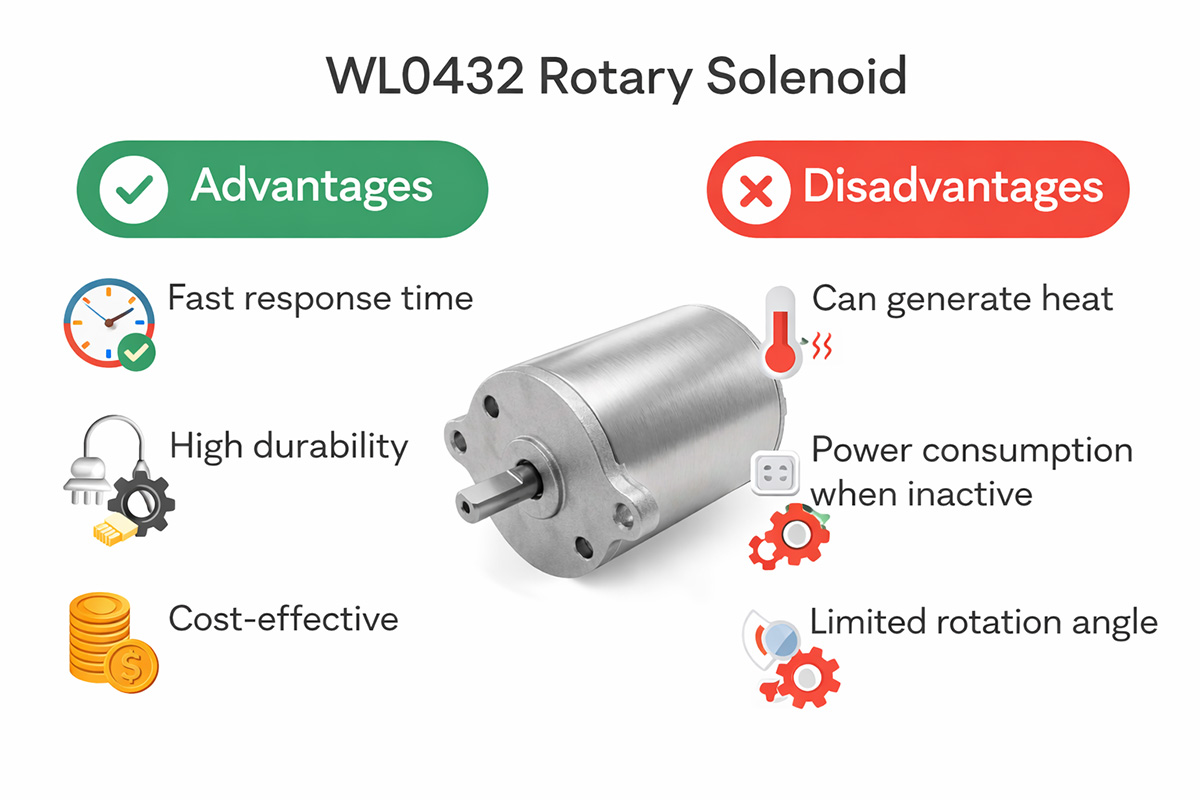
WL0432 Rotary Solenoid 90 Degree Advantage and DisadvantageRotary Solenoid 90-Degree Advantages

The first major advantage offered by 90-degree rotary solenoids is their ability to produce precise and repeatable angular movement without additional mechanical components. Since it is highly compact, the component can easily fit into confined spaces. Also, it ensures fast response times and reliability of use that allows the component to operate constantly in industrial facilities.

Furthermore, the component requires minimal maintenance and is designed for durability. Another advantage worth mentioning is that rotary solenoids consume fewer resources since they do not require any energy at all until being energized. Being based on the fixed rotation angle, it does not require sensors and controllers to guarantee performance consistency.

Rotary Solenoid 90 Degree  Drawbacks

However, 90-degree rotary solenoids have some limitations. First, the range of rotation angles is limited to 90° making them less flexible in comparison with motor-driven devices. Besides, the amount of torque produced is limited, so it may not be sufficient in heavy industrial applications. Continuous use of the solenoid in some cases might lead to excessive heat generation.

Additionally, these solenoids might require additional elements like return springs or drivers in order to control and reverse their movement. Due to the specific design, such solenoids might cost higher compared to simple linear solenoids.

Solenoid troubleshooting guide for Rotary Solenoid 90 degree
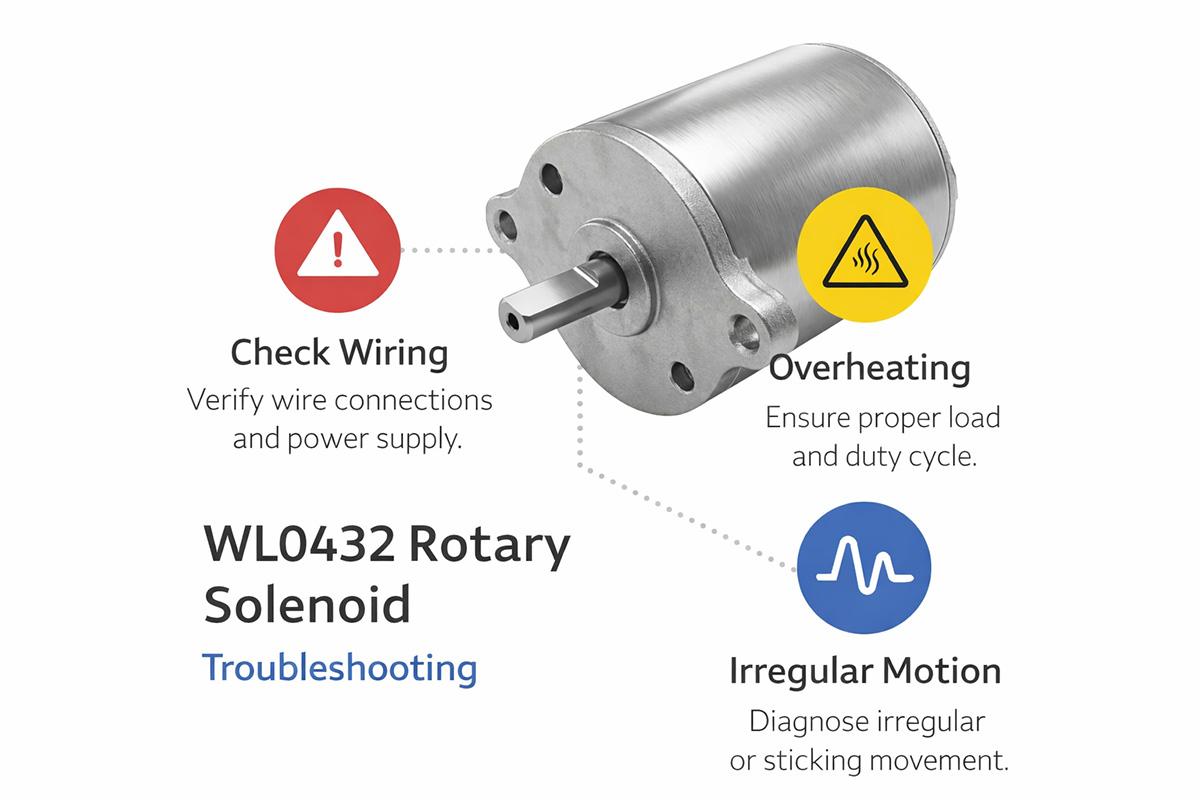
WL0432 Rotary Solenoid 90 Degree Trouble Shooting Guide

1 Does the solenoid turn?

Causes:

There is no power supply or the voltage is incorrect.

The coil burnt out.

Poor or loose connection

Circuit failure

Answer:

Measure the voltage supplied.

Examine all terminals and connections.

Find out whether the resistance is correct (open circuit indicates a burnt out coil).

Control the output voltage of the driver circuit or control board.

2. Weak rotation or incomplete rotation.

Possible causes:

Not enough voltage or current.

Overload (excessive torque).

Internal wear or partial magnetic failure

Dust and other contamination in the air gap

Answers:

Ensure the appropriate voltage and current ratings.

Reduce the load or choose another model.

Clean the inner components.

Inspect magnetic and/or armature parts for any signs of wear

3. Slow response or long action time

Possible causes:

Insufficient voltage

The coil overheated

Duty cycle is too high according to the parameters

Mechanical friction

Answers:

Monitor the power supply.

Cool the solenoid down or reduce the duty cycle

Lubricate the moving parts if required.

Properly designed driver circuit

4. The solenoid is excessively heated.

Possible causes:

Continuous energization of the unit (working over the limit of its duty cycle).

Excessive voltage supply

Insufficient air circulation

Worsening coil insulation

Answers:

Use the solenoid within its duty cycle (only occasionally).

Check the voltage rating

Ensure proper airflow or heat dispersion.

Replace the coil if the insulation deteriorates.

5. No return to neutral position

Causes:

The return spring is broken or weakened

Foreign material obstructing the operation

Residual magnetism

Misalignment

Answers:

Replace or repair the return spring.

Remove any obstructions.

Demagnetize the unit if necessary

Align the shaft properly.

6. Noise or vibration

Possible causes:

Loose mount

Internal wear

Malfunction of the shaft

Impact-type operation

Answers:

Retighten the screws that keep the mount intact.

Check all internal components for any signs of wear.

Ensure proper alignment during installation

Soundproofing material if necessary.

7. Operation in bursts

Some possible reasons:

Unstable power supply

Loose connections or poor soldering

Driver circuit malfunction

Thermal overload triggering

Answers:

Ensure proper and stable voltage supply.

Examine soldering and connections

Control signals.

Monitor the duty cycle.

8. Coil burnout

Possible causes:

Excess voltage

High duty cycle exceeding ratings

Bad heat dispersion

Short circuit

Answers:

Apply the appropriate rated voltage and current.

Use additional protection: a fuse and driver.

Ensure proper cooling

Repair or replace the coil

✅9.  Some useful hints for avoiding failures

Always use the units within the rated voltage and duty cycle.

Select the appropriate torque margin (+30-50%)

Keep the solenoid clean.

Stable power supply and properly chosen driver circuits

Periodic maintenance and troubleshooting


FAQs Of WL0432 Rotary Solenoid 90 Degree

1. What is a rotary solenoid 90 degree?

A rotary solenoid 90 degree does not operate similarly to a common motor. Unlike the latter, which rotates infinitely, a rotary solenoid is an actuator that produces reciprocating rotary motion through a preset angle range (up to 90 degrees).

2. What is "Bi-Stable"? What is "Spring Return"?

The key difference lies here:

  • Bi-Stable (Magnetic Latching): Such models retain the last position without power. Power is consumed solely during the brief moment when switching direction occurs. Positive (+) or negative (-) pulses are required to make the shaft rotate clockwise or counterclockwise.
  • Spring Return (Single Winding): These solenoids include an internal spring mechanism that brings the shaft back to the starting position after turning off the electricity. To keep a 90° position, continuous power consumption is needed.
3. Is installation of "External Stops" required?

Indeed, in almost all top-performing bi-stable. In contrast to regular motors, certain rotary actuators do not have internal mechanical stops. That’s why external stops are required to determine starting and finishing angles. Rubber bumpers are typically used in this role.


4. How does a rotary solenoid 90 degree work?

The principle of functioning of such an actuator is based on the interaction between electromagnets rather than mechanics. There is a permanent magnet incorporated into the rotor part. If you energize the coil, an electromagnet will arise and cause the rotor magnet to flip to the opposite pole

5. Why should I choose it instead of pneumatic or motor solutions?

Here are the main benefits:

  • Speed – Very fast (rotation from 0° to 90° can occur in around 30 ms).
  • Efficiency – The Bi-Stable does not consume any energy while retaining the position; it just needs power during the brief pulse for switching.
  • Space – Offers maximum power in a very small case (30mm × 30mm in the Kendrion CDR series).
6. What torque and power specifications should be expected from my device?

Specifications may depend on dimensions, however, if we take the above mentioned Kendrion CDR series of actuators as an example, then:

  • Rotation – 90° ± 3°
  • Voltage – 24 V DC
  • Torque – ~0.2 N·cm at the start (maximum 0.5 N·cm at the end)
  • Duty cycle – Usually intermittent duty (15% ED)
7. How to drive a bi-stable rotary solenoid?

Not as simple as powering a solenoid with two leads. You will need a two-way drive circuit (H-bridge). Since a 90-degree rotary solenoid requires switching polarity to move, a drive circuit should switch positions. For example, Takano produces special driver boards for rotary solenoids.


8. Is there an option to know when the 90° rotation is accomplished?

Yes, of course. Manufacturers offer optional Hall effect sensors for such purposes to check the position of the shaft without additional external components.


How to Choose a Rotary Solenoid 90 Degree

WL0432 Rotary Solenoid 90 Degree Datasheet

Choosing the right rotary solenoid 90 degree requires analyzing several important parameters to ensure effective operation of the component.

First, you should take into account torque capacity, which should be sufficient for rotating your load, including friction and external resistance. Otherwise, the choice of inappropriate solenoid might result in failure or poor operation.

Next, you should consider the power supply and operating voltage. As there are various rotary solenoids with various power ratings, you should choose the one that fits your system perfectly. Furthermore, you should pay attention to the requirements of the solenoid duty cycle, since they determine continuous operation or cyclical nature.

It is important to take into consideration the importance of response time, especially in terms of automation systems performing fast tasks. In addition, it is critical to consider the angle tolerance, thus ensuring the positioning of the application.

Then, it is necessary to think of weather-related aspects of your application. You should opt for solenoids with dust-resistant or watertight casings. If your task implies exposure to extreme heat or cold, temperature resistance is required.

Besides, compatibility of your equipment is also crucial, including mechanical specifications like mounting configuration, shaft design, and space availability. A compact design should be preferred for installations with limited space. Finally, you should also consider customization options and reliability of the supplier.


Get A Free Quote Now

Contact Form

Related Products

Related News

Chapter 1 : Introduction on Solenoid Vs. Electromagnetic Coil Electromagnetic technology plays a significant role in modern automation industry, electronics, […]

Chapter 1: Introduction of Solenoid Design A solenoid is an electromechanical device that converts electrical energy into linear motion through […]

Scroll to Top

Get A Free Quote Now !

Contact Form
If you have any questions, please do not hesitate to contact us.
Weilong Solenoid Company Culture