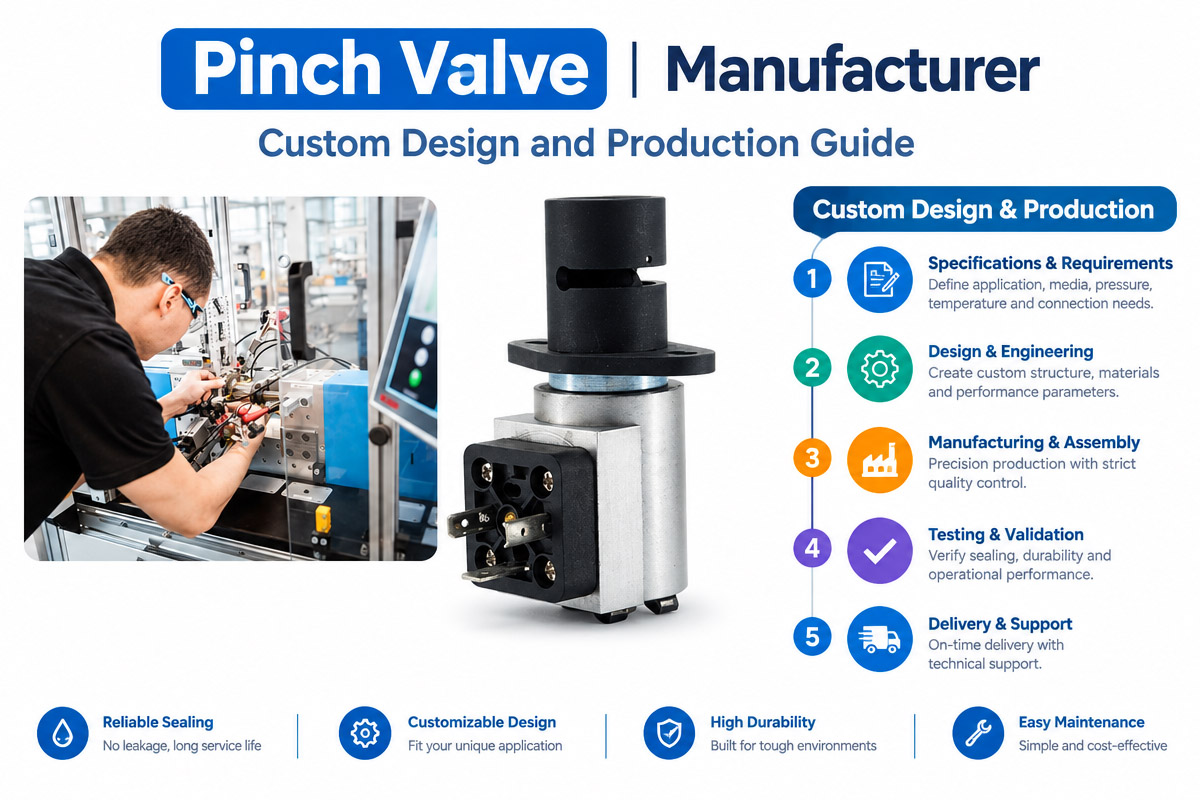
Introduction to Pinch Valve Manufacturer
A pinch valve is an excellent way to control the flow of liquid or gas by mechanically squeezing the flexible tubing without coming into contact with the substance. The working principle of the valve can help to reach a number of benefits in various types of equipment and fluid control products, including medical devices, laboratory equipment, diagnostic devices, food industry equipment, dispensing machines, industrial automation, etc.
However, a catalog valve might not be enough for OEM machinery manufacturers.
Factors that could affect the valve design include size, tube material, pressure and closing force required, flow requirements, system voltage, available space, cycle life, noise, and available power.
In case of special requirements, it could be reasonable to cooperate with the experienced pinch valve manufacturer and create a customized solution that could provide better performance.
For successful creation of a custom pinch valve, not only is the size of the housing changed, but also the actuators, the tubing, the mechanical geometry, the electrical requirements, the thermal requirements, the tolerances, and the lifetime of the valve should be designed as a single unit.
Engineers and purchasers designing and purchasing pinch valves for assembly in OEMs should consider information contained in this manual.
1. Pinch Valve Working Principle
1.1 Pinch valve – The flexible tube is squeezed to control the flow.
In regular valves the fluid normally flows through the internal chambers. So the fluid stays in the tube. To restrict or halt the flow, you can mechanically compress the tube against a fixed element or counter mechanism.
When the tube is released from the squeezing force, it returns to its original position and begins to allow fluid to flow through.
1.2 The pinch valve can be designed in the following configurations:
– normally open valve
– Closed valve usually
– Two-way valve
1.3 Three-way valve
– 1 tube
– Multi-tube valve
Actuators can be electromechanical, for example, solenoid. A solenoid can give the required force to open or close the tubing.
Another reason to choose this technology is the easy fluid path.
The tubing and actuator should be understood as having performance that affects each other.
2. Why would I want to use pinch valves on my OEM equipment?
One of the advantages of a pinch valve is isolation of liquid.
Since the controlled medium is confined within the tubing, the valve actuator itself does not need to contact the fluid.
This is useful when you encounter:
– Liquids (Sensitive)
Chemical
- Medical Fluids
- Samples from lab
- Food-related liquids
- Cleaning solvents
Could also simplify the fluid path, as tubing replacement could take the place of the primary wetted surface on your valve.
But the valve’s performance relies heavily on the tubing.
For this reason, the tubing information should be provided to the pinch valve manufacturer in the first phase of design, not after the valve is designed.
3. Begin with the tubing specification
The tube is the main part of the valve.
Important parameters for tubing are
Outer diameter—the physical size that will fit in the pinching mechanism.
Inner diameter—determines fluid path available.
Wall thickness has a big influence on the amount of force required to crush the tube.
Material influences flexibility, resilience, chemical compatibility, and tube life.
Hardness—a harder tube may need a significantly bigger closing force.
Tolerance—variation in dimension can affect the need for closing force.
The materials of the tubing are application-dependent and may include silicone and flexible elastomer.
The same valve will act quite differently on two tubes of the same dimensions but of different hardness or other properties.
So the manufacturer of the pinch valve with experience should request actual samples of the tubing to test the prototypes when it is possible.
4. Describe the normal operation of normally open or normally closed
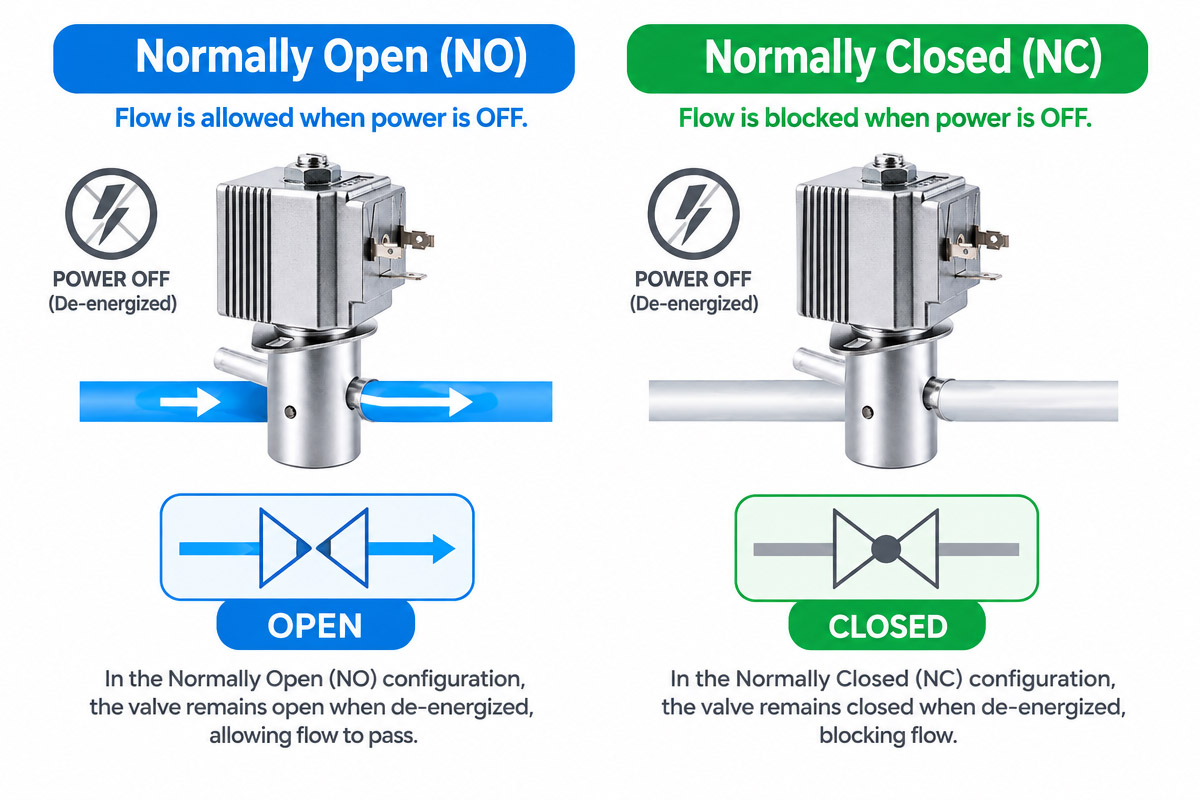
Another basic decision that must be made is what should be the normal state of the valve.
The pinch valve is normally open, allowing flow when the actuator is off and compressing the tube when energized.
The valve is normally closed and opens a fluid passage when the valve is actuated.
The right configuration is highly dependent on the logic and risks of your equipment.
For example, engineers can pose such questions:
– What happens if the power supply goes out?
Does the fluid flow stop automatically?
– How long is the valve open?
– How long does it take?
– Which state has the lowest power consumption?
– Is it battery operated?
These questions can affect actuator choices, spring design, coil power, and thermal performance.
Hence, without knowledge of the equipment’s normal state, the manufacturer cannot begin the customization process.
5. Determine Required Pinching Force
The valve shall be capable of producing adequate mechanical force to compress the selected tube fully to obtain the required shut-off characteristics.
The force required will depend on:
Material of pipes.
Diameter outside
Wall thickness
Dureza
Internal pressure.
Pinch geometry
heat
Tube life
The force will be too small to create a partial flow passage.
But it doesn’t mean that the right way is to employ the maximal possible force.
Too much compression will put more mechanical stress on the tube, higher power consumption, impact, and possible tube failure.
The aim is to achieve efficient compression of the tube without excessive mechanical loading.
The experienced manufacturer of pinch valves will be able to analyze real tubing and optimize parameters such as the force of the actuator, the geometry of the pinching, the stroke, and the mechanical stops.
6. Pressure and flow requirements
The supplier should know more than the dimensions of the valve.
Supply information like
Working pressure
Maximum pressure
Discharge rate
Liquid or gaseous type
Direction of flow
Diameter of tube
Heat
Required shut-off performance
If the tube pressure is higher, then more mechanical force is required to ensure a good shut-off.
The choice of tubing will be dictated by flow requirements.
A small valve ID will help you to build a compact valve, but it will limit the flow your application might allow.
Custom projects, pinch valve manufacture, and OEM fluid system engineers should consider flow, pressure, tubing, and valve geometry altogether.
7. Select Operating Voltage and Power
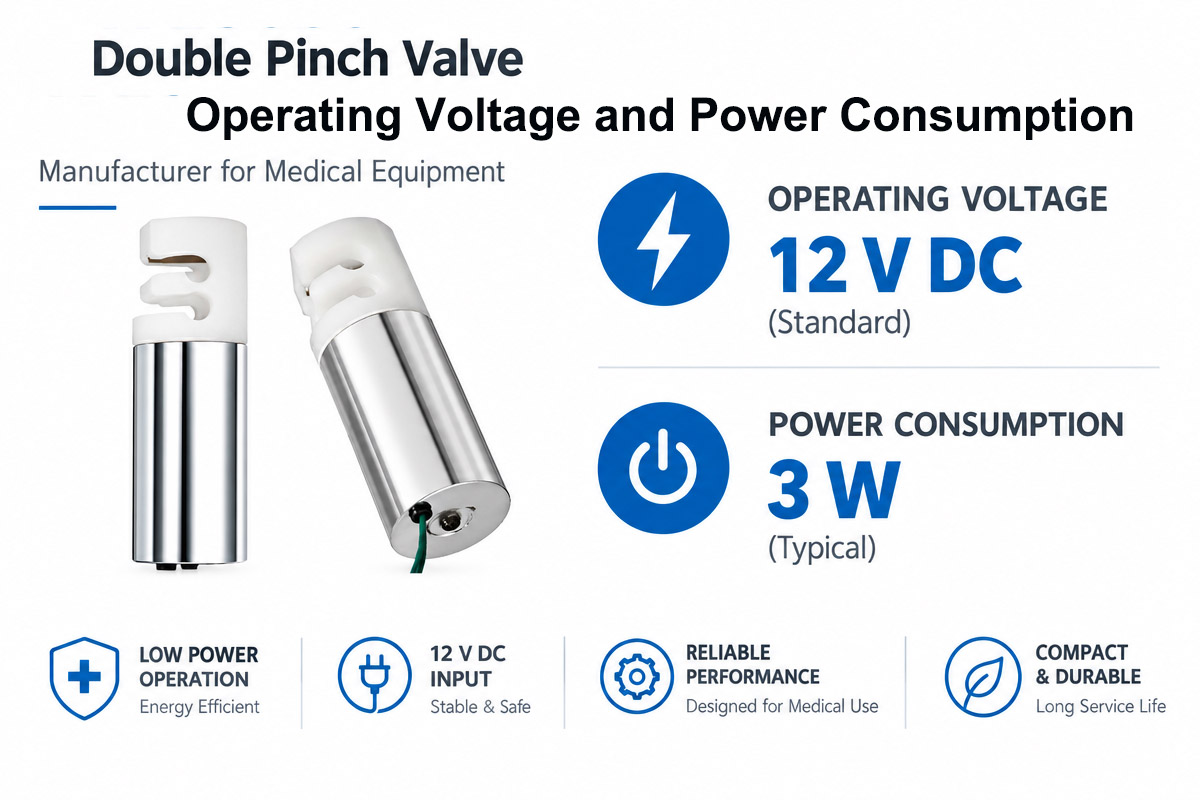
Usually the electromagnetic pinch valve is integrated in the DC power supply.
Available operating voltages:
5 V DC, 6 V DC, 12 V DC, and 24 V DC.
Custom coil design allows for other voltages.
But voltage is not the only electrical quantity.
Engineers also have to specify:
Maximum current at hand
Resistance of the coil
Permissible power consumption.
Pulse mode
OFF time.”
Operating frequency
Control procedure.
If a valve is compact and needs a lot of force, it needs a lot of instantaneous power. Especially from thermal performance if it is kept energized for a long period of time.
Custom pinch valve manufacture will be able to tailor coil winding and mechanical geometry to the available electrical power.
This is especially helpful for battery and portable equipment.
8. Duty Cycle and Temperature Rise Evaluation
The duty cycle is proportional to the solenoid temperature.
Now, let’s look at two valves with similar actuators.
Valve A opens for 1 sec every minute.
Valve B energized for 30 min.
So they have different needs for heat altogether.
The RFQ should contain actual ON and OFF times, not just “intermittent operation.”
For example:
ON time: 3 sec.
OFF time: 12s
Cycle: 15 sec.
Duty cycle: 20%
It is the responsibility of the pinch valve manufacturer to specify coil temperature based on actual or worst-case operating conditions.
Temperature can affect the coil but also the tube and surrounding equipment.
This consideration is especially important in the small enclosure, where heat dissipation is limited.
9. Think Tube Life
The tube fails a lot earlier than the actuator (can last millions of cycles).
So tube life and valve life should be considered separately.
Multiple compressions result in such outputs:
– Tube deflection
– Tiredness
– Rupture
- Loss of elasticity
- Compression, constant
- Changes to the reopening routine
The reopening routine depends on the material, hardness, temperature, pressure, pinch geometry, and frequency of the cycle.
If possible, the prototype life test should be carried out with actual production tubing in case of high-cycle application.
You have to ask the manufacturer if they are testing on the customer-specified tube or just some generic lab tube.
This could provide more useful information about the actual performance of the system.
10. Optimization of Mechanical Geometry for Pinching
Mechanical geometry has a large impact on the performance of the valve.
The geometry and location of the pinching element define the way how the force is transferred to the tubing.
Among the engineering parameters, there are:
Contact width
Contact point
Tubes rack
Travel restrictions ·
Location of mechanical stop
Alignment of goals
– The tube is fixed.
Stress can be concentrated at the narrow point of contact. The wider the contact, the larger the travel or force required.
Optimal geometry is dependent on the tubing.
In the case of custom development, a pinch valve manufacturer can optimize this interface for the OEM’s tubing rather than adapt the application to the generic mechanical interface.
11. Take into account the tube loading and replacement
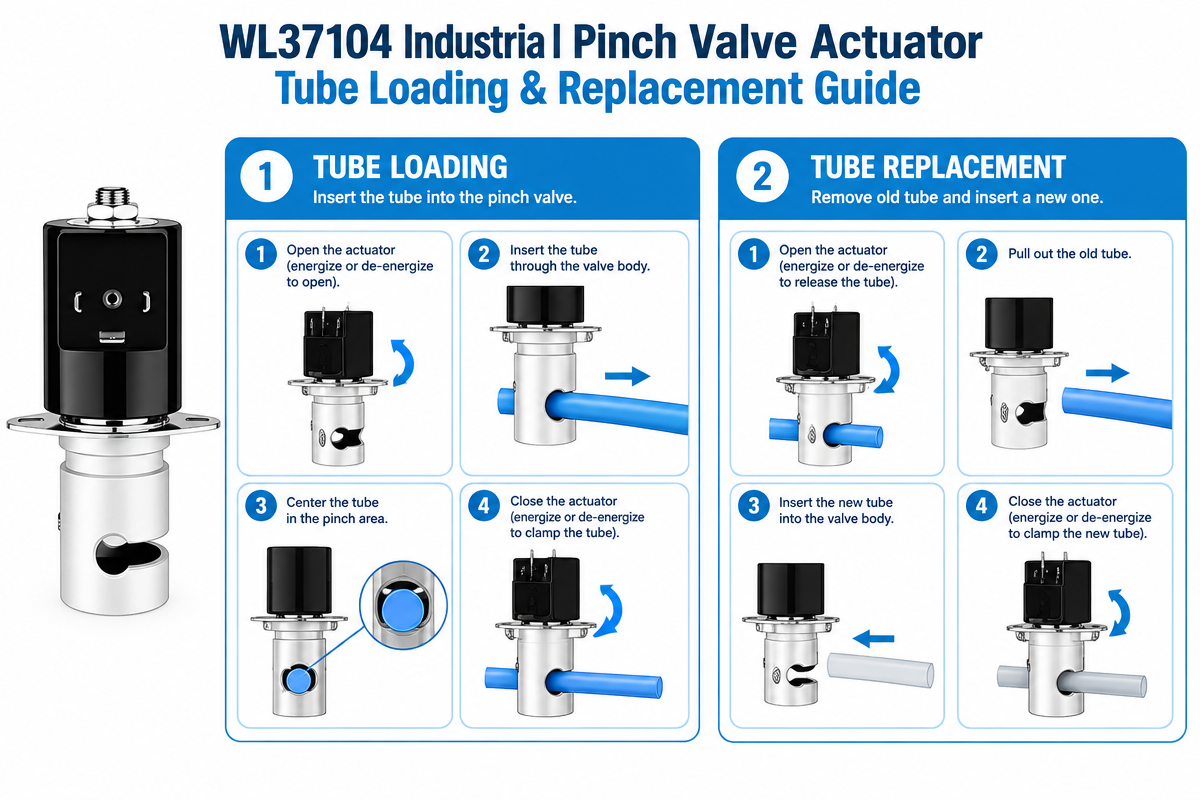
Where equipment uses disposable tubing sets, tube loading may become an issue.
What does the engineer need to find out?
How is the tube loaded
Does the operator need any tools?
Is the wrong loading of the tube possible?
When should the tube be replaced?
Is the tube correctly loaded?
Is it possible that the tube will fall off during operation?
Can you reach the valve?
The valve operates well in the laboratory, but the problems may occur because of the operator’s difficulties in tube loading.
Prototype development of medical, laboratory, and serviceable equipment has to take human factors into account.
The manufacturer of pinch valves may modify the housing, cover, slots, or retaining features in order to make tube loading easier.
12. Noise reduction and shock absorption
The armature operates and stops. The electromagnetic actuator makes a click noise.
Noise is acceptable for industrial equipment but not in:
- Medical devices •
- Laboratory equipment
- Office furniture
- Diagnostic equipment
- Bedside equipment;
- Consumer goods
The noise may be generated either by the actuator, housing, or impact in the pinching mechanism.
Possible solutions:
- Improved control of actuator speed, damping, change of mechanical stops, reduction of clearances, and improved mounting.
When noise is an issue, the pinch valve manufacturer must set the specification before completing the mechanical design.
Finally, the noise has to be measured in the complete equipment, including the valve, since the housing amplifies or reduces the noise.
13. Pinch Valves: Standard or Custom
Sometimes the best option is to select a standard valve that meets the application requirements.
Advantages:
- Savings on the development cost
- Higher sampling rate
- Available tools
- Shorter qualification period
- Developed manufacturing technologies
- Custom valve becomes more attractive when requirements include:
- Tube size • Tube material.
- Electrical potential
- Closing force
- Residential·
- Mounting method
- Connector
- Cable length
- Default state,
- Installation dimensions
Noise level
- The manufacturer of the pinch valve has to be asked whether there is a platform that can be modified while developing a new platform.
Development of a bracket, coil, wire, connector, or pinching element may be cheaper than the development of all the components from scratch.
14. Engineering validation and prototype building
The prototype has to be tested prior to the production.
A typical development process may involve:
Sampling. Testing. Modification. Validation. Application requirements. Engineering review and concept.
Engineers of the OEM have to test the prototypes under the actual conditions of the tube and fluid system.
Validation may include:
Functional testing: does the valve open and close properly?
Shutoff testing: Is it providing the required flow shutoff?
Pressure testing: Is it capable of operating at the max system pressure?
Voltage testing: Is it capable of operating at the min supply voltage? Does it operate at the max supply voltage?
Temperature testing—Is the performance the same across the required range?
Life testing: what will be the life of the valve and tube during repeated cycling?
Noise testing: does it meet the acoustics requirements of the equipment?
It is highly recommended to test the custom valve in the equipment.
15. Design for mass production
You can adjust the prototype manually. Hand-tuning in production design is not possible.
Valve has to operate consistently under normal manufacturing variation.
A good pinch valve manufacturer has to consider the manufacturability of the design early in the development.
The main factors are
- Consistency of the coil winding
Spring allotment
- Actuator travel length
- Housing dimensions •
- Component positioning pinching
- Material tolerances
- Manufacturing Process
- Repair methods
- Inspection knowledge
- Design determines which dimensions and performance parameters are critical for the operation of the valve.
They can be better controlled in manufacturing. Other dimensions can be provided with practical tolerances.
This approach provides valve uniformity without increasing manufacturing costs.
16. Tooling and Pilot Production
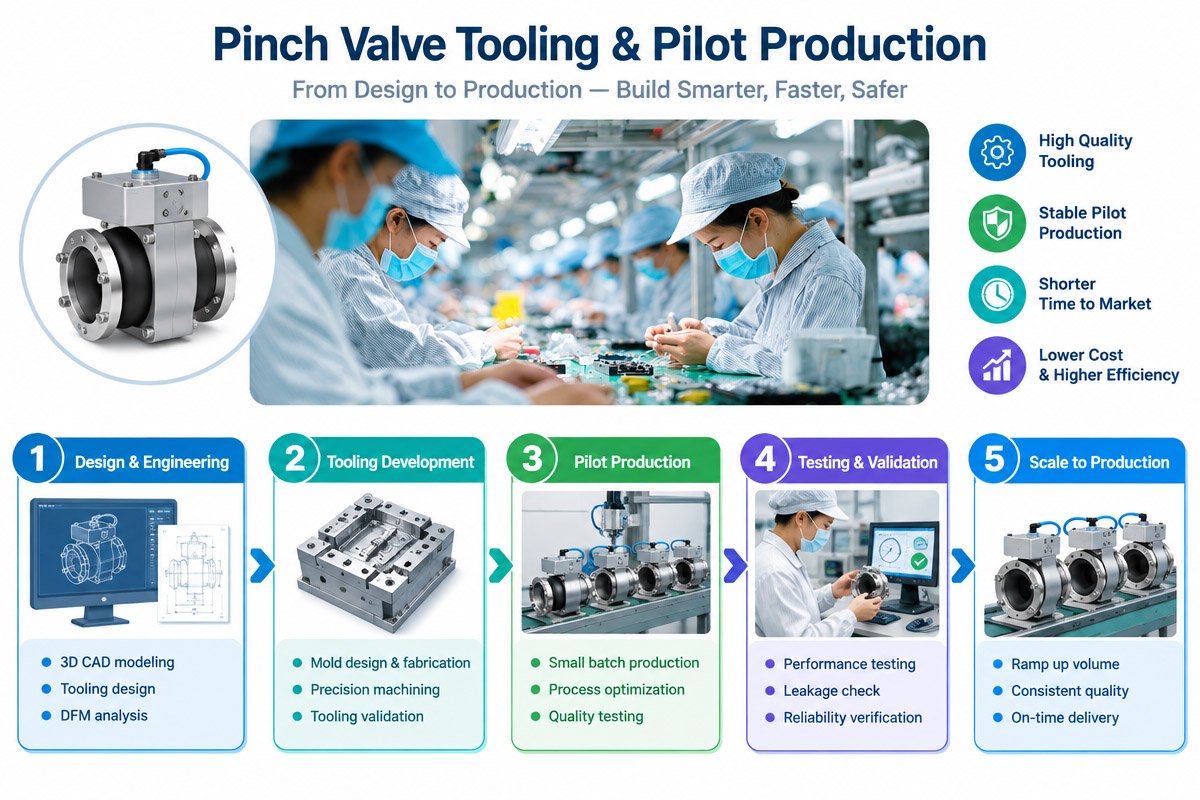
Depending on the construction and production volumes, some custom valves require specialized tooling.
Options for tooling:
Injection molding dies
- Metal stamping dies
- Machining jigs
- Coil winding jigs
- Assembly jigs
‐ Functional testing jigs
Gauges for inspection
The buyer has to verify the cost and ownership of the tooling prior to the order of the production quantities.
Once the production tooling is ready, the pilot run has to be performed prior to the full-scale production.
The OEM will receive the pilot samples as the evidence that the manufacturing process ensures the performance of the prototype valve.
Pilot production has to be performed by the pinch valve manufacturer for the verification of the assembly procedures, inspection, production cycle time, and process capability.
17. Requirements of the quality control
Quality control must focus on the performance-related parameters of the valve.
The important properties, according to the design, are
Coil resistance
Operation current
- Valve travel
- Pinch posture
- Measurements
- Properties of Spring
- Electrical insulation
- Operation of opening and closing
- Integrity of wire and connector
- The buyer may request lot traceability and defined change control procedures for critical OEM applications.
The pinch valve manufacturer must have a procedure for non-conformity management and for preventing unauthorized changes to materials or processes.
This requirement is particularly important where thousands of valves have to perform in the same way in the customer’s equipment.
18. Evaluation of the supplier, not just the valve
Performance of the supplier is a crucial factor for the success of the OEM project.
When selecting the manufacturer, the buyer has to consider the following factors:
- Engineering capabilities.
- Control of fluids
- Solenoid design knowledge.
- Customization experience
- Prototype development support
- Testing capacity
- Quality systems
- Production capacity
- Response times
Communication
- Configuration Management
- Reliable supply
The purchaser has to find out whether the supplier is capable of testing the tubing of his equipment.
A good pinch valve manufacturer understands the relationship between tube properties, electromagnetic actuation, mechanical design, and manufacturability.
Engineering capability is particularly important when the equipment faces problems during the development.
19. Total costs of the project in comparison
Price per unit is important, but OEM buyers have to consider the total cost of the project.
It consists of:
Engineering fee
- Hardware
- Examples 3
- Validation.
- Cost per unit.
- Assembly costs
- Authentication
- Tube life time
- Product failures
- Warranty provision
- Field service
- For example, a cheap valve that dramatically reduces the life of tubing will become more expensive in the finished product.
Moreover, a valve that is difficult to load will increase the assembly or service time.
The best sourcing decision is the marriage between the purchase price and performance, reliability, manufacturing consistency, and support.
20. Develop a complete request for quotation
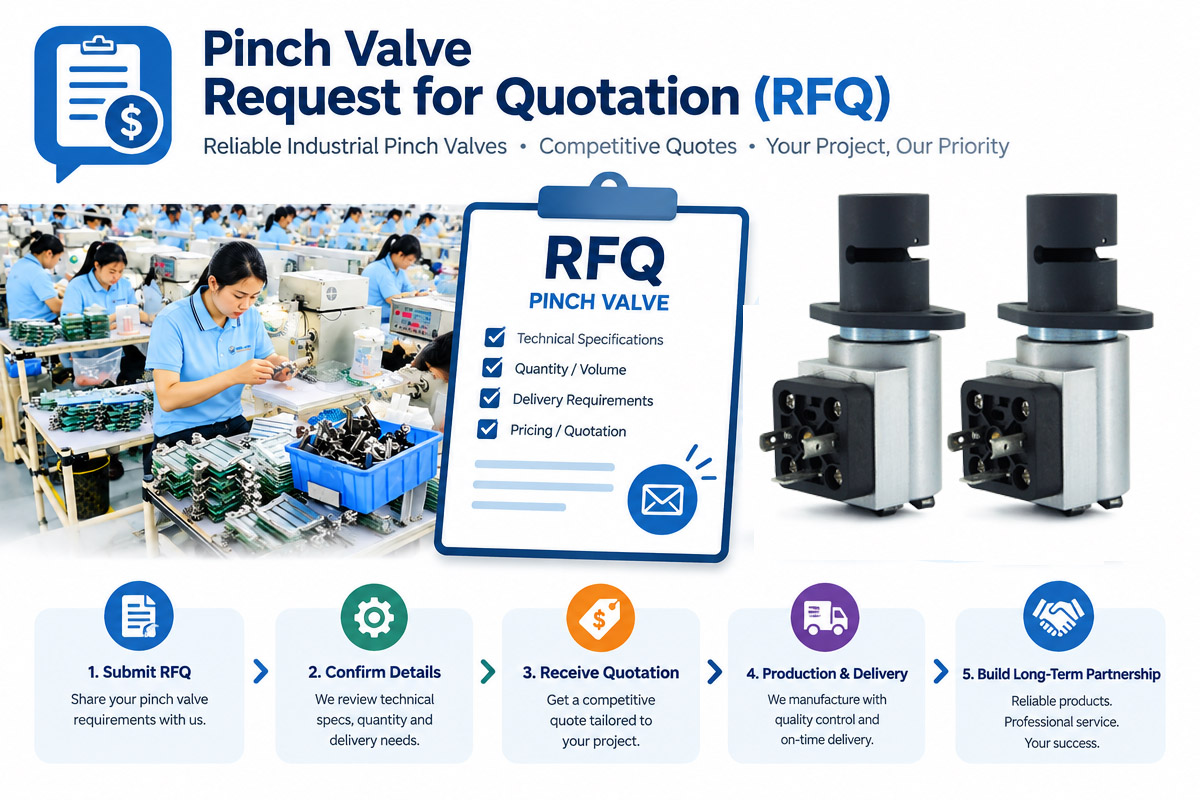
A detailed RFQ will help the supplier to provide the proposal.
Example:
Application: Laboratory fluid analyzer
Valve type: Pinch valve normally closed
Tube material: Silicone
Tube OD: 4 mm
Tube ID: 2 mm
Operating pressure: 1.5 bar.
Max. pressure: 2 bar
Voltage: 24V DC. Time ON: 5 s.
OFF time: 15 sec
Expected lifetime: 500 000 cycles
Operating Temperature: 5° – 50°C
Available space: 40 x 30 x 25 mm.
Noise: Low noise selected
Yearly quantity: 100,000 pcs.
Samples of tubing, drawings, CAD files, flow requirements, and photos of the equipment are recommended.
A detailed RFQ will allow the pinch valve manufacturer to estimate the viability, to propose an existing design or the custom solution, and to quote precisely for the development and production costs.
21. Custom Pinch Valve Development is More Than Choosing a Voltage and Tube Size.
The tubing is an integral part of the valve system. The closing force and operating life depend on the material, hardness, wall thickness, dimensional tolerance, internal pressure, and long-time compression properties.
Electric and mechanical components are equally important.
Voltage, current, duty cycle, actuator force, temperature rise, closing geometry, default state, installation space, noise, and manufacturing tolerances should be considered together.
OEM buyers need a pinch valve manufacturer that can provide the whole process from the initial application assessment and tubing evaluation to prototype development, testing, tooling, pilot production, and long-term mass production.
The best results are normally achieved through the involvement of the manufacturer early in the process, providing actual tube samples and realistic operating requirements, and validating prototypes in the finished equipment.
Custom pinch valve development can provide reliable fluid isolation, compact integration, consistent operation, and a production-ready solution customized for OEM applications, taking into account the requirements of the engineering and manufacturing.
22. Pinch Valve Manufacturers FAQs for Buyers
1. What information do I have to provide to a pinch valve manufacturer for a custom quote?
Outside diameter, inside diameter, wall thickness Operating pressure, maximum pressure, voltage Available current normally open or normally closed requirement Duty cycle expected life Installation dimensions temperature range, yearly quantity, target production date Would highly recommend actual tube samples.
2. Can the pinch valve manufacturer provide a design around my existing tubing?
Yes. In many OEM projects, it is better to design around the customer’s existing tubing, as the tubing change impacts the entire fluid system. The manufacturer has to consider the dimensions, material, hardness, pressure, closing force, and life cycle of the tubing before selecting the valve design.
3. What is the minimum order quantity of a custom pinch valve?
MOQ depends on the degree of customization, tooling cost, production process, and manufacturer. Switching to the existing valve platform allows reducing the MOQ compared to a brand-new design. Separate inquiries have to be made on the prototype MOQ, pilot-production MOQ, and regular production MOQ.
4. How much does Custom Pinch Valve Tooling cost?
“Tooling costs are dependent on the design. Simple modification may be just an assembly jig or special metal part, but the new housing requires injection molds, stamping tools, and special test jigs. The buyer requests the itemized quotation with costs broken down to tooling, engineering, samples, and production units.
5. How do buyers compare two pinch valve manufacturers?
Not just price per unit. Compare” and “Make sure that both suppliers are quoting on the same tubing, pressure, voltage, duty cycle, life, dimensions, materials, test requirements, and yearly quantity. Also compare engineering capabilities, sample lead time, tooling cost, production capacity, quality controls, and technical responsiveness.
6. Which samples should I approve before mass production?
First, conduct functional and application testing on the engineering samples. After the design and production tooling are completed, pilot production samples should be approved using the production process. They have to be tested with the real tubing, pressure, voltage, temperature, and operating cycle before volume production.
7. What quality documents/test data should I ask for from an OEM buyer?
Depends on the application, but useful information is dimensional inspection, coil resistance data, functional test results, pressure or shutoff testing, life test results, material information, and production control documentation. The buyer should concentrate on the data related to the traits impacting the final equipment.
8. How to reduce the cost of a custom pin valve?
Use an existing valve platform whenever possible. Standardize wires and connectors. Avoid unnecessary dimensional tolerances. Specify only the closing force and stroke that are actually needed. Involve the supplier early in the design of the equipment. Good pinch valve manufacturers have the expertise to simplify the actuator, housing, mounting, or assembly without compromising performance.