Chapter 1: Introduction of AC vs. DC Push-Pull Solenoid
AC or DC A push-pull solenoid is an essential actuator in many spheres of activity, including industry, home appliances, automobiles, etc. Millions of devices’ proper work relies on this mechanism of converting electricity into mechanical motion. However, when engineers and technicians choose the proper type of AC or DC push-pull solenoid, some questions always appear: What is the difference between AC and DC? AC vs. DC Push-Pull Solenoid? What are the pros and cons? What criteria should one consider while selecting a certain product type? And what are some common mistakes and how to avoid them?
In this review, as a 20-year experienced solenoid manufacturer, we would like to explain the detailed information about all the peculiarities of the discussed devices. You will learn about their structure and functioning, advantages, disadvantages, practical application, purchase recommendations, and pitfalls in acquiring and answer some FAQs. After reading this blog, you will have a perfect roadmap for making a confident choice between AC or DC push-pull solenoids.
At first, let us formulate our main idea. The main distinction between AC and DC push-pull solenoids lies in their power supply and operating principles. From this moment onward, numerous differences in performance, pros and cons, and applicable fields appear. DC push-pull solenoids operate under DC voltage sources, while AC models work with AC voltage sources.
For understanding the peculiarities and benefits of the solenoids’ operation, it is important to examine their structure and work principle in detail.
Chapter 2: Product Structure and Work Principle: The Core Concept
2.1: Common Structure (Almost Same) of AC or DC Push-Pull Solenoid
Three key elements remain the same for DC and AC push-pull solenoids:
– Fixed Iron Core (Stator): made of soft magnetic material in order to strengthen the magnetic field;
– Movable Iron Core (Plunger): built with the use of soft magnetic materials and performs reciprocating movements creating pushing or pulling forces;
– Coil: the part of the mechanism that generates a magnetic field under the influence of electric current.
Under electrical influence, a solenoid forms the electromagnetic field and pulls the movable iron core to itself. Then, when there is no voltage in the system, the spring restores the movable core to its initial state. All particular features of the designs depend on the nature of the power supply.
2.2: Work Principle: The Key Feature of AC or DC Push-Pull Solenoid
2.2.1: DC Push-Pull Solenoid:
The connection to the DC power supply provides a direct current flow through the coil, which results in a stable magnetic field formation. As a result, there appears to be an attraction of the fixed core, and the movable core comes into its place. When the voltage source stops its work, the magnetic field disappears, and the restoring spring takes back its initial place. This attraction is linear and stable because the electric current and the magnetic field are constant.
2.2.2: AC Push-Pull Solenoid:
The solenoid receives the alternating current supplied by AC sources (50 Hz or 60 Hz voltage). Because of this phenomenon, the polarity of the magnetic field changes every half-cycle; due to hysteresis and eddy currents in the movable core, the magnetic field attracts the movable core. So, in spite of polarity changes, the field always performs the required work. Thus, there appears to be some kind of vibration in the core.
Chapter 3 Pros and Cons of Each Device: Application and Practical Usage

In the following part, we consider the differences between the devices and show how each type of solenoid applies to the situation.
3.1 DC Push-Pull Solenoids: Precision Start-stop Control at a High Frequency
3.2 Main Features (4 Main Points)
3.2.1 Fast Response Rate & High Frequency Work: The magnetic field in a DC solenoid emerges immediately. There is no need to wait for the polarity change. The response time varies between 10 and 50 milliseconds. Thus these types of solenoids can be useful when the switching process is frequent, like solenoid valves used for controlling automated equipment or servos in the braking systems.
3.2.2 Reliable and Stable Functioning: DC solenoids are able to switch between the two stable states: attraction (active state) or non-active state (restoration). No vibrations, buzz, or possibility of failure caused by polarity changes. Stable operation makes it possible to use these actuators in critical equipment: medical equipment, measuring tools, etc.
3.2.3 Accurate Control: The intensity of the magnetic field and thus attracting power directly depend on the voltage and current supplied. Parameters like PWM (Pulse-Width Modulation) allow controlling attraction and thus performing true push or pull actions by changing the polarity of the current (by using an H-bridge).
3.2.4 Easy and Simple Drive System: The drive is rather straightforward to make. It does not require a rectifier or other components. One just needs to connect a DC power supply, transistor, and flyback diode. This feature allows for lower production costs of this solenoid.
3.3 Main Disadvantages (3 Key Points)
3.3.1 Restricted Power Supply & Need for Rectification: In most cases, there is a standard AC supply available. In the case of a DC power supply, additional components are needed to provide rectification and stabilization of the voltage.
3.3.2 Generation of Heat under Constant Current Flow: In DC solenoids, the current flows continuously under a constant voltage. It means that resistive heating becomes inevitable. If the current is powerful or the stroke is long enough, overheating is quite probable. Thus, there appears to be a need for cooling of the solenoid.
3.3.3 Sensitiveness to the Change in DC Voltage: Force depends on the voltage intensity directly. Thus when there is low voltage, it causes weaker attraction, but high voltage leads to heating.
Chapter 4: AC Push-Pull Solenoids – Useful, durable, and built for continuous duty
4.1 Key Features (Four Points)
4.1.1 Simplicity of the Power Supply Circuit
The most important advantage of AC solenoids is a direct plug into mains AC power, e.g., 110 V / 60 Hz or 220 V / 50 Hz. No rectifier, additional power supply, or batteries are necessary for their operation; only a wire and a switch. This makes equipment design simpler and cheaper and gives you more freedom to allocate space in the control panel. AC solenoids are predominant in household appliances and machines.
4.1.2 Excellent Suitability for Continuous Duty Operation
In a split second, the AC current goes to zero. As a result, during each half-cycle, the coil has a period of “cooling off.” This behavior significantly lowers the average heat generation compared to a similar-rated DC solenoid. Therefore, AC solenoids are naturally suited for continuous duty without any additional cooling measures.
4.1.3 Adaptive to Variations in Main Voltage Frequency
The AC solenoids can operate at the standard line frequency (50 / 60 Hz) and withstand the usual voltage deviations present in mains networks. They comply with national power standards without any adjustment.
4.1.4 High Inrush Force for Instant Pull-In
When energized, a high inrush current flows in the coil of an AC solenoid, as this is the moment of maximum air gap. Thus, a high inrush magnetic field (a “kick”) is generated to help overcome static friction or an initial mechanical load. Once closed, the current drops to its lower holding value.
4.2 Major Drawbacks (Four Points)
4.2.1 Slow Response: Unsuitable for High-Frequency Operation
4.2.2 Unlike DC, the magnetic field has to build from zero with each half-cycle. This lag slows down AC solenoids, resulting in a comparatively slow response time (50 – 100 ms). This type is not recommended for rapid, high-frequency start-stop operations, e.g., fast-acting valves and precision positioning.
4.2.3 Audible Buzzing and Vibrations
During energization of an AC solenoid, its core vibrates twice per line frequency (100 or 120 Hz). The effect is particularly visible in quiet areas, such as recording studios, operating rooms, or luxury smart homes. Such buzzes occur when the supply voltage is low or the mechanical load is light.
4.2.4 Complex Control and Higher Cost
It’s difficult to control speed or force in an AC solenoid. Lowering the voltage would cause an excessive loss in torque. The power regulation requires expensive and complicated phase control circuitry, such as zero-crossing detectors or triacs, making it both costly and risky to design.
4.3 More Sensitive to Installation and Alignment
Proper alignment of the solenoid during installation is critical. The slightest misalignment, dust contamination, or mechanical wear prevents the core from closing. In this case, the current does not fall below its holding level, resulting in possible overheating and coil burnout.
Chapter 5: Scenario AC or DC Push-pull Solenoid Application Comparison (“How To Choose”)
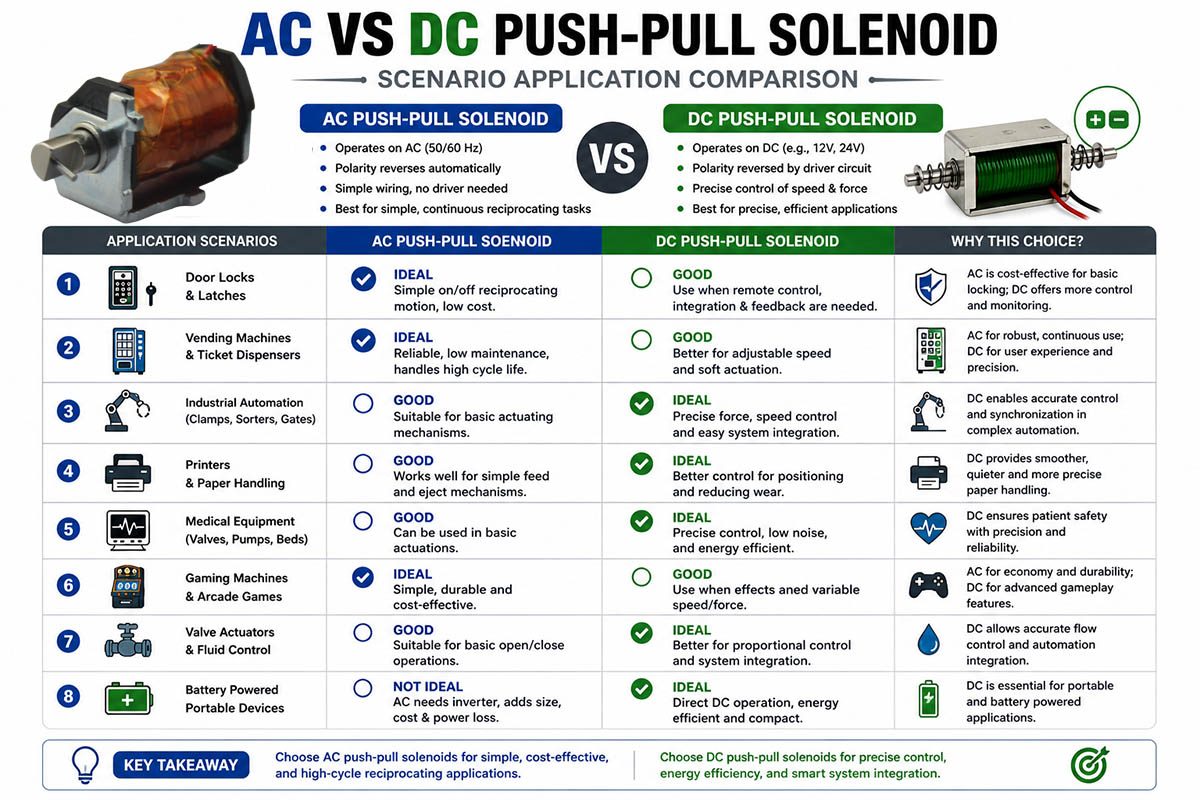
5.1 Select a DC Push-Pull Solenoid for
– High frequency actuation: Automatic production lines, robots (pick and place), or other fast sorting equipment.
– Precision force or position control: Medical infusions or 3D printers.
– Portable battery-operated or low-voltage appliances: Automotive locks, electronic toys, or portable security locks.
– Quiet environment: Record studio, hospital room, or luxury home.
– Small form-factor designs when you don’t want to mount a bulky AC rectifier.
5.2 Select an AC Push-Pull Solenoid for
– Continuous duty: Diverters on conveyor belts, long-term holding of valves or other components, and vending machine mechanisms.
– Household appliances: Locks on washing machine doors, dishwashing machine detergent dispenser, or microwave oven interlock switch.
– Directly powered by mains: Conveyor brake controlled by mains, large pneumatic valves, or industrial machinery interlocks.
– Low-cost AC-only solution: When installing a dedicated power supply is too expensive. Examples are applications requiring high inrush force, e.g., opening of a locked valve or movement of heavy mechanical linkages from a dead stop position.
Chapter 6: How to Purchase a AC or DC Push-pull Solenoid and Common Mistakes to Avoid (Read Me!)
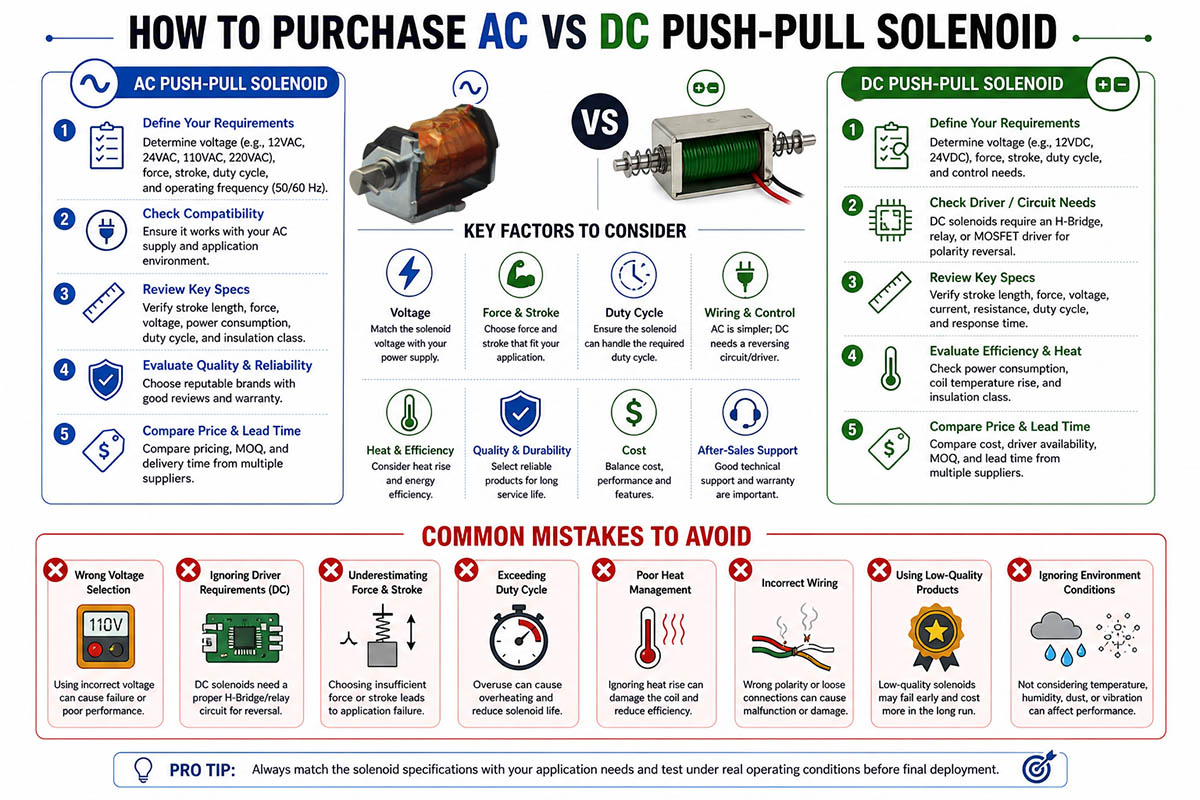
6.1 Key Skills for Efficient Procurement
To begin with, you need to know your power supply. There is nothing negotiable about it. Have you got a DC power supply? Then order a DC Push-pull solenoid. Otherwise, if you have mains only and cannot install the rectifier, you will need an AC solenoid.
Set Your Duty Cycle: Do you need the solenoid on for several minutes, hours, or continuously? Then an AC solenoid might be preferable for a 100% duty cycle unless you plan to cool the solenoid effectively. Otherwise, consider DC.
Response Time: Do you expect quick action (<20 ms)? Then the choice is clearly DC. If you’ll do with 50 – 100 ms, AC could suit your requirements.
Noise Tolerance: If your device should run in silence, AC solenoids are ruled out due to buzzing. Then opt for DC.
Calculate Force and Stroke: Refer to the manufacturer’s force-stroke curve to ensure that at your stroke value (not necessarily at zero gap), the solenoid provides enough holding force.
6.2 Common Mistakes of Purchasing
“Cheap Coil” Syndrome: Low-quality aluminum or thin magnet wire leads to high resistance and overheating and eventually coil burnout. The wire in the coil must be 100% pure copper with high-temperature insulation (Class F or H).
6.3 Ignoring Power Quality:
DC: Unregulated, oscillating voltage results in force variations and overheating. You should have a constant power supply.
AC: Feeding the AC solenoid with a modified sine wave power supply or generator results in loud buzzing, vibrations, and rapid failures.
Unnecessary Over-Specification: A solenoid with a 50 N force is two times more expensive than a 25 N one. Be careful not to overestimate required force or speed.
Overlooking the Spring Force: Remember to include the return spring force in your calculations. Buy additional springs, as they are common wear-out parts.
Neglecting Mechanical Assembly Details: Proper alignment is vital for an AC solenoid. Angular mounting causes vibrations, buzz, and coil overheating.
Chapter 7: Frequently Asked Questions (FAQ)
Q1: Why is my DC push-pull solenoid overheating in a few minutes?
A: Most likely, you’re operating your solenoid beyond its capacity. Here are the options:
– Make your control circuit more sophisticated by introducing intermittent duty (e.g., one second “on” and five seconds “off”).
– Mount a heatsink or a small fan to dissipate excess heat.
– Lower the applied voltage if the current exceeds the nominal value.
– Increase the continuous power rating of the coil or replace it with an AC solenoid.
Q2: Why does my AC or DC Push-pull solenoid buzz and vibrate loudly?
A: Typically, it’s due to three factors:
– A shorted shading coil turn (the ring on pole faces). Replace the solenoid.
– Low voltage or instability in mains. Verify and stabilize supply.
– Incorrect mounting or core contamination. Clean and align the mating surfaces of the fixed and moving cores.
Q3: Would it be possible to feed a DC push-pull solenoid from an AC source?
A: No. It will quickly overheat, fail to draw in, and will probably burn out. Apply a diode bridge for converting the AC to DC voltage.
Q4: Is it possible to power my AC solenoid using a DC source?
A: No. Current through the AC solenoid will be limited by its impedance at line frequency. On DC, however, the coil’s very low resistance leads to excessive current and burning.
Q5: Which lasts longer: AC or DC solenoid?
A: Depending on correct operation, the lifetime of both exceeds a million cycles, yet the reasons for failure are different:
– DC solenoids usually burn out the coil as a result of an improper duty cycle.
– Failure of AC solenoids is caused by mechanical wear or breaking of the shading coil. Optimize your choice: DC for high cycle rate and precision, AC for holding.
Q6: What is a “shading coil” on an AC solenoid?
A: A shading coil is a single turn made of thick copper conductor (or a copper ring) mounted in a pole face. Its job is to create a phase-shifted secondary magnetic field that suppresses buzz. If the ring breaks, your solenoid will emit intense vibrations and buzz.
Chapter 7: Conclusion and Final Recommendation
There is no universal choice between DC and AC push-pull solenoids. It all depends on the requirements of your application.
– If you require quick response (<50 ms), high-frequency cycling, silent operation, precise force control, and a stable DC power source, then your choice should be a DC push-pull solenoid.
– If you require continuous duty operation, good thermal dissipation, a strong inrush force, tolerance for buzzing, and can accept a slower response, then an AC push-pull solenoid is what you need.
Apply purchasing skills to save your money from unnecessary mistakes. Take care of quality and pay attention to the specified duty cycle. This guide is intended to make your choice efficient and confident. Choose the most appropriate push-pull solenoid for your automation, appliances, or automotive projects.
If you have a specific application or questions, please, please email us for the solution.