Chapter 1: Introduction to Custom DC Push-Pull Solenoid
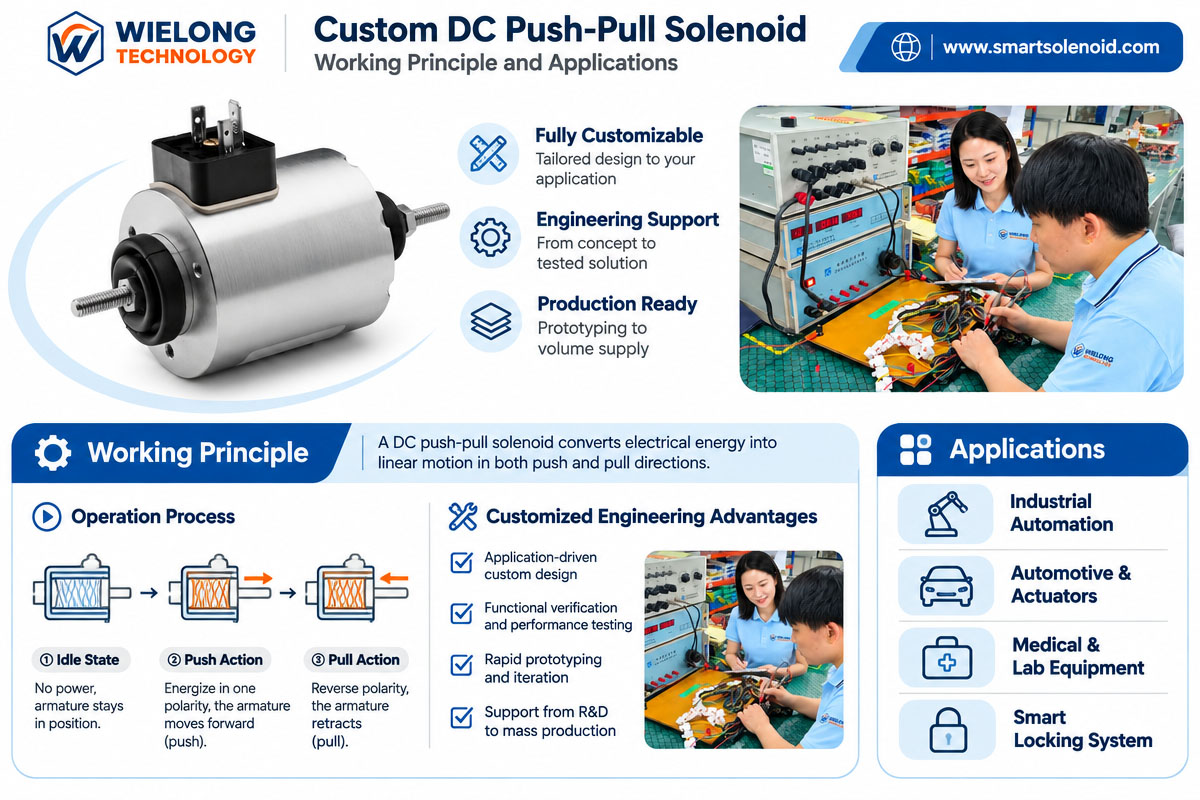
Custom DC push-pull solenoids are indispensable components of modern automation, electronics, and industrial mechanisms. Of all types of electromagnetic actuators, one of the most used is the DC push-pull solenoid. The custom DC push-pull solenoids are made according to the particular specifications in accordance with the requirements for the voltage, stroke, output force, mount dimensions, and operating cycles of the device.
As opposed to standard products, the custom-made solenoids can help equipment designers get the perfect combination of mechanics and electrical parameters. The solenoids are mostly used in automatic locks, vending machines, medical devices, industrial mechanisms, office automation, and electronic mechanisms.
Nowadays the manufacturers strive to develop new, smaller, faster, and more efficient electromagnetic actuators, and the demand keeps growing.
The topic of this article covers the working principle, construction, types, parameters, applications, and advantages of a custom DC push-pull solenoid. Moreover, we will see how we can help the customers with application-specific electromagnetic solutions.
Chapter 2: Custom DC Push-Pull Solenoid Definition
The custom DC push-pull solenoid is the electromagnetic actuator converting direct-current electrical energy into short-range linear mechanical motion.
Typical construction consists of: Copper coil magnetic frame Moveable iron plunger Return spring (if required) Mounting parts.
When DC voltage is applied to the coil, it creates an electromagnetic field. This field attracts the movable plunger, moving it into position of minimal magnetic reluctance, and the mechanical motion results.
The motion can actuate locks, valves, switches, and other mechanical mechanisms.
Note that the regular single-coil solenoid provides electromagnetic attraction in one direction. The back motion is generated by a spring, gravity, or external mechanics, while special design is needed to get bidirectional electromagnetic action.
Basic Components:
- Coil of copper—generates a magnetic field when powered;
- Movable iron plunger—makes mechanical motion;
- Magnetic frame—directs magnetic flux through the actuator;
- Spring return—returns the plunger into the initial position in case of a spring-return-type design.
- Mounting bracket—fastens the solenoid to the mechanical equipment.
- Electrical leads—connect the actuator to the power source.
The arrangement of these basic components defines the operating parameters of the solenoid.
Chapter 3: Custom DC Push-Pull Solenoid Working Principle
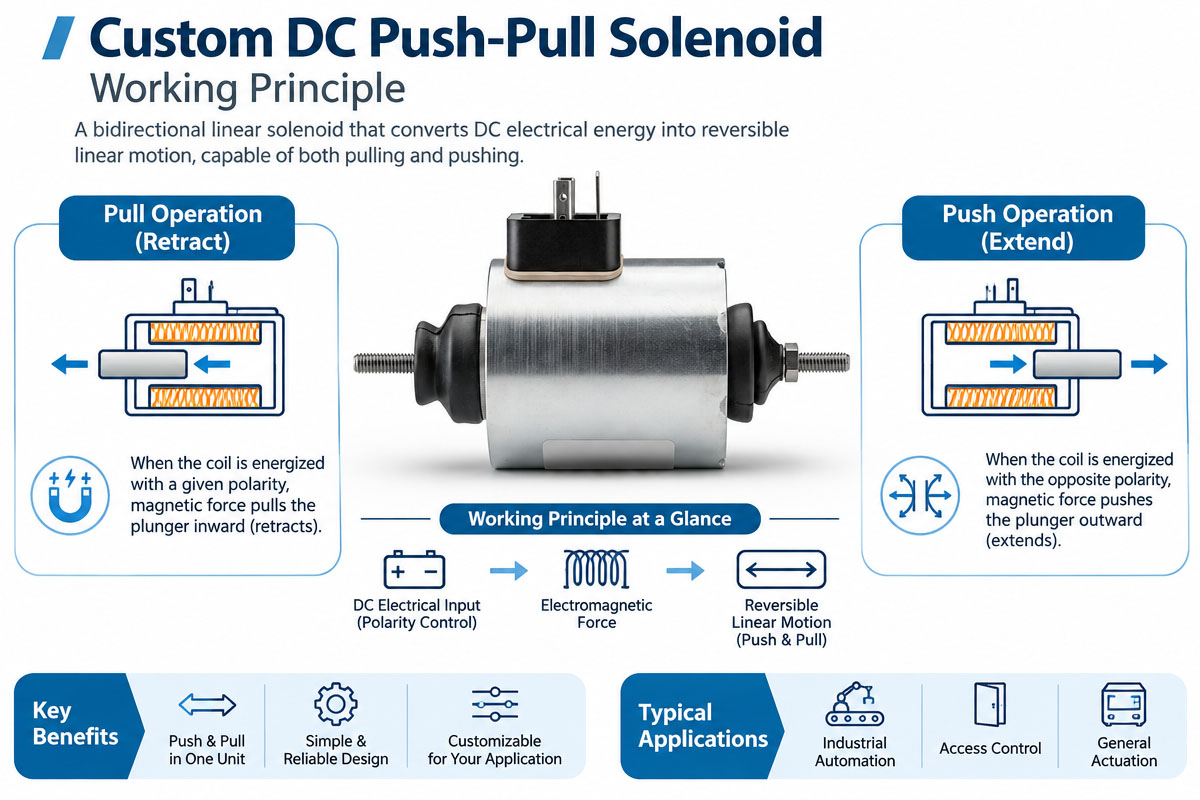
The custom DC push-pull solenoid works according to the laws of electromagnetism and magnetic attraction.
The electric current in the coil generates the magnetic field attracting the magnetic plunger into the magnetic circuit.
Conceptually simplified drawing of a DC solenoid with a coil, moveable plunger, and the direction of the movement. Real construction and movement depend on the particular design.
Step 1: Excitation by Electric Current.
When the copper winding is connected to the DC voltage supply, the electric current flows through it.
The magnitude of current is defined by voltage, resistance, temperature, and the current control system.
Step 2: Magnetic field formation.
The electrified coil generates magnetic flux in the magnetic circuit.
There is the force attracting the plunger to close the magnetic air gap.
Step 3: Moveable Plunger Motion in Line.
The plunger starts to move if electromagnetic force overcomes the spring force, friction, and external load.
The arrangement of the actuator determines whether the solenoid would pull or push a mechanical device.
Step 4: Mechanical Action.
Then the solenoperates, controlling the mechanical mechanism you need.
It can open the valve, release the lock, flip the switch, etc.
Step 5: The Reverse Motion.
When you disconnect the power, the electromagnetic attraction disappears.
In a spring-return design, the return spring returns the plunger into its starting position.
The working principle of the custom DC push-pull solenoid is applied for control of mechanical motion electrically at high speeds without using a rotary engine.
Chapter 4: Custom DC Push-Pull Solenoid Types
Several kinds of actuators can be applied depending on particular needs.
4.1 Push Type DC Solenoid
A push-type solenoid is designed to produce outward motion. The mechanism of the solenoid determines this feature.
This type is widely used in ejection mechanisms, dispensers, and release systems.
4.2 DC Solenoid, Pull Type
When powered, the pull-type solenoid attracts and pulls the plunger inside.
It is used for locks, latches, switches, and control mechanisms.
4.3 Open Frame DC Solenoids
Open frame solenoids have a relatively simple construction and a wide range of compact types.
They are commonly used in vending machines and automated devices, as well as in office equipment.
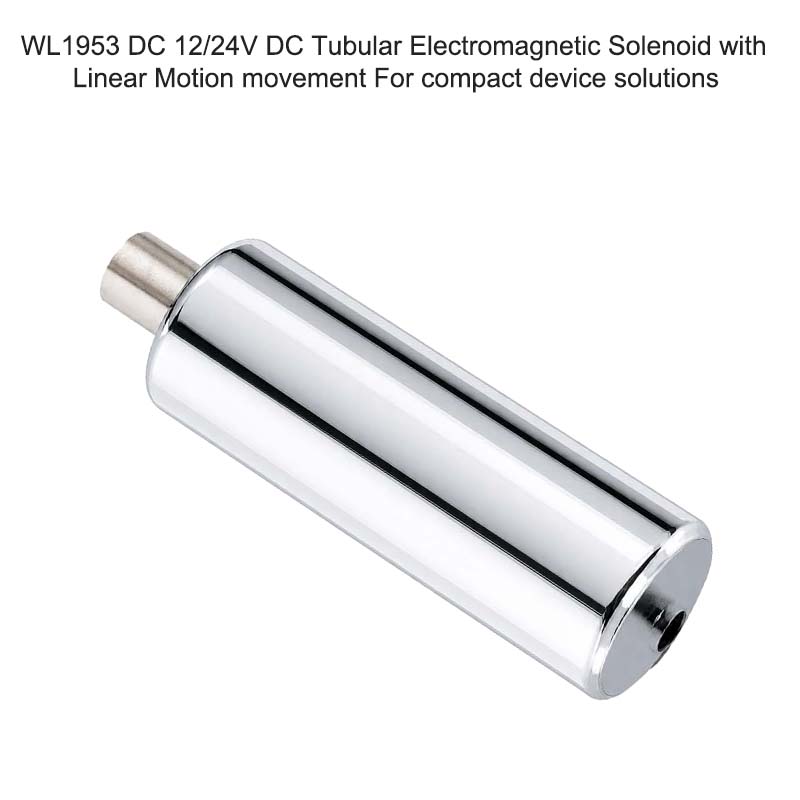
4.4 DC Solenoid Tubing
The cylindrical housing of tubular-type solenoids can protect mechanically and control magnetic flux.
These solenoids are designed for controlled axial motion applications.
4.5 DC Solenoid, Latching
A latching solenoid is a solenoid using magnetic or mechanical locking to retain a particular position of the plunger without constant power from the coil.
This kind allows decreasing the consumption of energy in cases where the actuator has to remain in a certain position for a long period of time.
Selection of an appropriate custom DC push-pull solenoid depends on force, direction of the movement, duty cycle, dimensions, and power consumption.
Chapter 5: Important Technical Specifications
Choosing a suitable solenoid requires evaluating several electrical and mechanical parameters.
| Parameter | Description |
| Rated voltage | Designed DC operating voltage, such as 5V, 12V, or 24V |
| Stroke length | Required linear travel of the plunger |
| Actuation force | Available force at a specified plunger position |
| Duty cycle | Permitted energized time relative to the operating cycle |
| Coil resistance | Electrical resistance of the winding |
| Power consumption | Electrical power consumed during operation |
| Response time | Time required to achieve the specified movement |
| Operating temperature | Acceptable environmental and coil temperature conditions |
| Mounting dimensions | Mechanical interface with the equipment |
Force-Stroke Relationship
The force of a solenoid depends on the position of the plunger.
Usually the conventional designs have larger electromagnetic forces with a decrease of the air gap. So the solenoid that exerts the force sufficient near the end of its stroke doesn’t generate the same force near the beginning.
Instead of the single value of the maximum force, it is recommended to consult the manufacturer’s force-stroke relationship.
Thermal Performance and Duty Cycle:
The custom DC push-pull solenoid also has to be chosen according to the period of operation.
The continuous-duty solenoids are intended to be energized during long time periods. The intermittent-duty actuators have to have enough time for cooling.
Heating of the coil depends on the current, resistance, ambient temperature, and mounting conditions, and cooling.
The proper specification of the duty cycle is crucial for reliability.
Chapter 6: Custom DC Push-Pull Solenoid Applications
The custom DC push-pull solenoids are highly popular in different industries, providing compact and electronically controlled linear motion.
6.1 Industrial Automation
These solenoids control the mechanisms of the mechanical stops, positioning, interlock, and release mechanisms in the industrial machinery.
Due to the simplicity of the electrical control, these actuators are used in repetitive processes in the machine.
6.2 Electrical Door Locks
Solenoids are used in locks, access devices, and cabinet locks.
The plunger fires up electrically and engages or disengages the locking mechanism.
6.3 Vending Machine
Vending machines use electromagnetic actuators to release the product, count money, and release mechanically.
The custom DC push-pull solenoid can be developed according to the available installation dimensions and required force.
6.4 Medical Devices
Solenoid actuators can be used in some medical device mechanisms, such as latches, positioning, and automated dispensing systems.
The applications require additional documentation, cleaning procedures, and tests for reliability.
6.5 Vehicles Electric Devices
DC solenoids are used in vehicle door locks, actuators, and other electromechanical controls.
The car design has to withstand vibration, temperature changes, and difficult conditions.
6.6 Office Automation
Printers, document handling equipment, and other automated machines use solenoids to operate the paper movement, latches, and positioning.
6.7 Smart Home Appliances
Solenoids are used to operate the electrically controlled locks, mechanical releases, and other home appliances.
6.8 Packaging Machines
Packaging machines can use solenoids to operate the gates, stops, and small mechanical actuators.
These actuators have quick response times, which makes them suitable for short movements.
Chapter 7: Custom DC Push-Pull Solenoid: Advantages and Disadvantages
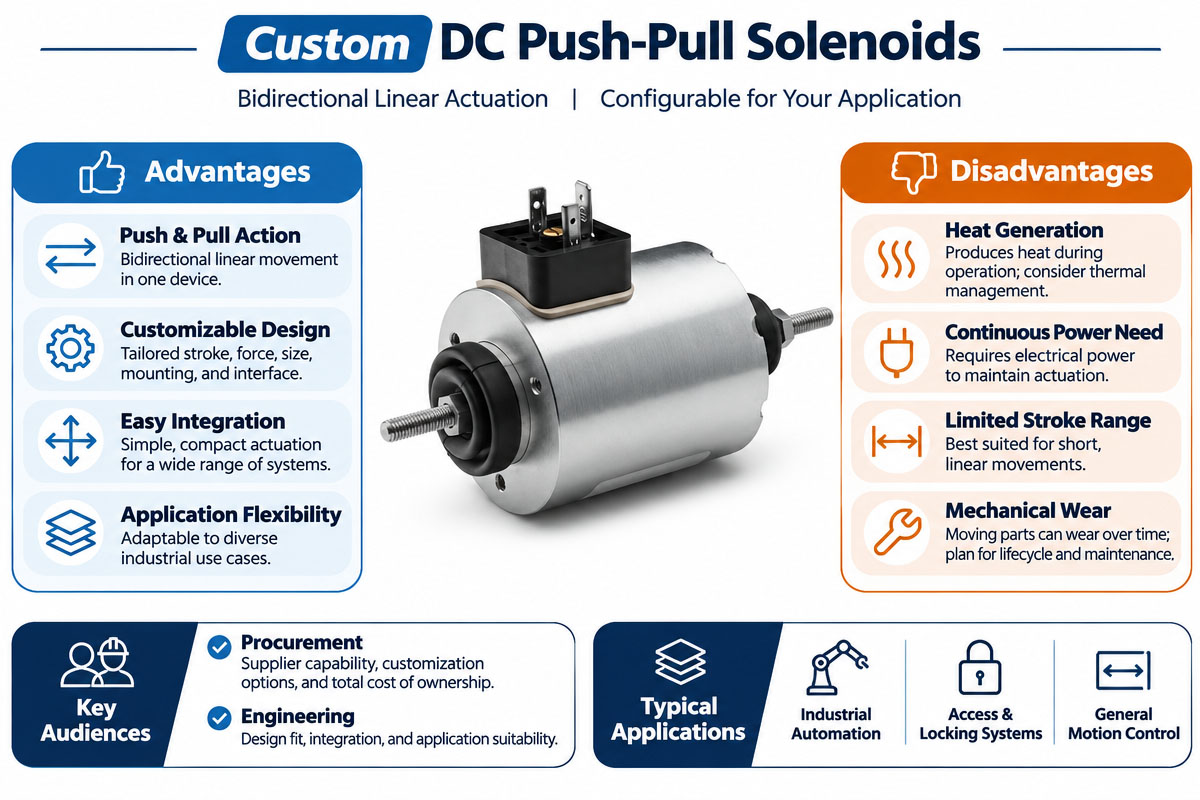
The custom DC push-pull solenoids provide several advantages over the usage of the usual actuator, which may not fulfill the equipment requirements.
Customizable mechanical dimensions—the solenoid can be developed according to the available installation space.
Force-specific application—parameters of the coil and magnetic circuit can be optimized for the particular stroke and loading.
Compatible voltage—the winding can be developed according to the DC supply.
Quick action—properly powered solenoids produce quick mechanical motion.
Easy control—electrical control is achievable by suitable switching and controllers.
Flexible mounting—the mounting brackets, plunger connections, and electrical leads can be modified for your application.
All these features are highly helpful for the OEM.
Chapter 8: Custom DC Push-Pull Solenoid vs. Standard Solenoid
| Feature | Custom DC solenoid | Standard DC solenoid |
| Operating voltage | Selected for the application | Fixed catalog options |
| Stroke length | Application-specific | Standard dimensions |
| Output force | Optimized for required load | Based on catalog design |
| Mounting structure | Customizable | Predetermined |
| Electrical connection | Custom lead or terminal options | Standard configuration |
| Development time | May require prototyping | Often shorter |
| Initial cost | May include engineering or tooling | Usually lower initial development cost |
Standard solenoids can be economical when their specifications already meet the application.
However, custom designs can provide a better mechanical fit or more appropriate force and thermal performance for specialized equipment.
Chapter 9: How to Choose a Proper Custom DC Push Pull Solenoid
Before the selection of the custom DC push-pull solenoid, it is necessary to define the actual operating requirements.
9.1 Operating Voltage
Check the available DC voltage and its tolerance.
The coil shall be able to operate safely under the expected electrical conditions.
9.2 Stroke Required
You measure how far it travels to perform a certain action.
The available force must be adequate along the entire useful stroke, especially at the start position.
9.3 Force Load
You need to calculate the force required to overcome the external load, spring force, and the friction force. Use a proper engineering factor of safety.
9.4 Cycle duty
You need to know how long the solenoid is energized during each operation and the frequency of operations.
For instance, if the actuator is energized for two seconds and deenergized for eight seconds, it operates with a 20% duty cycle during the operation cycle.
9.5 Environmental Conditions
Ambient temperature, moisture, dust, vibration, and all other relevant safety and regulatory conditions should be considered.
9.6 Mechanical Integration
You need to check the positions of the mounting holes, the dimensions of the plunger, available space, and connecting methods.
Providing the manufacturer with such information will ensure the best customization of the actuator for the intended equipment.
Chapter 10: Frequently Encountered Problems and Their Solutions
Even a good design can lead to the poor performance if the conditions of operation are out of specifications.
10.1 Solenoid Overheated
Overvoltage, excessive energizing time, a poor cooling system, and an inappropriate duty rating can lead to overheating of the coil.
It can be solved by choosing a continuous duty design, reducing the holding current where possible, and improving thermal management.
10.2 Not Sufficient Pulling Force
The reasons for such problems can be the large air gap, low current, friction, and inadequate calculation of the force load.
Checking of the force-stroke curve and mechanical alignment will help to determine the reason for the problem.
10.3 Slow Response
Slow response is caused by insufficient driving voltage, high load, mechanical friction, and driver circuit characteristics.
10.4 Plunger Gets Stuck
Contamination, misalignment, damage to the surface, and excessive side loads can impede the plunger from moving.
Regular inspection and proper mechanical mounting can improve the reliability.
Chapter 11: Custom DC Push Pull Solenoid Manufacturing Process
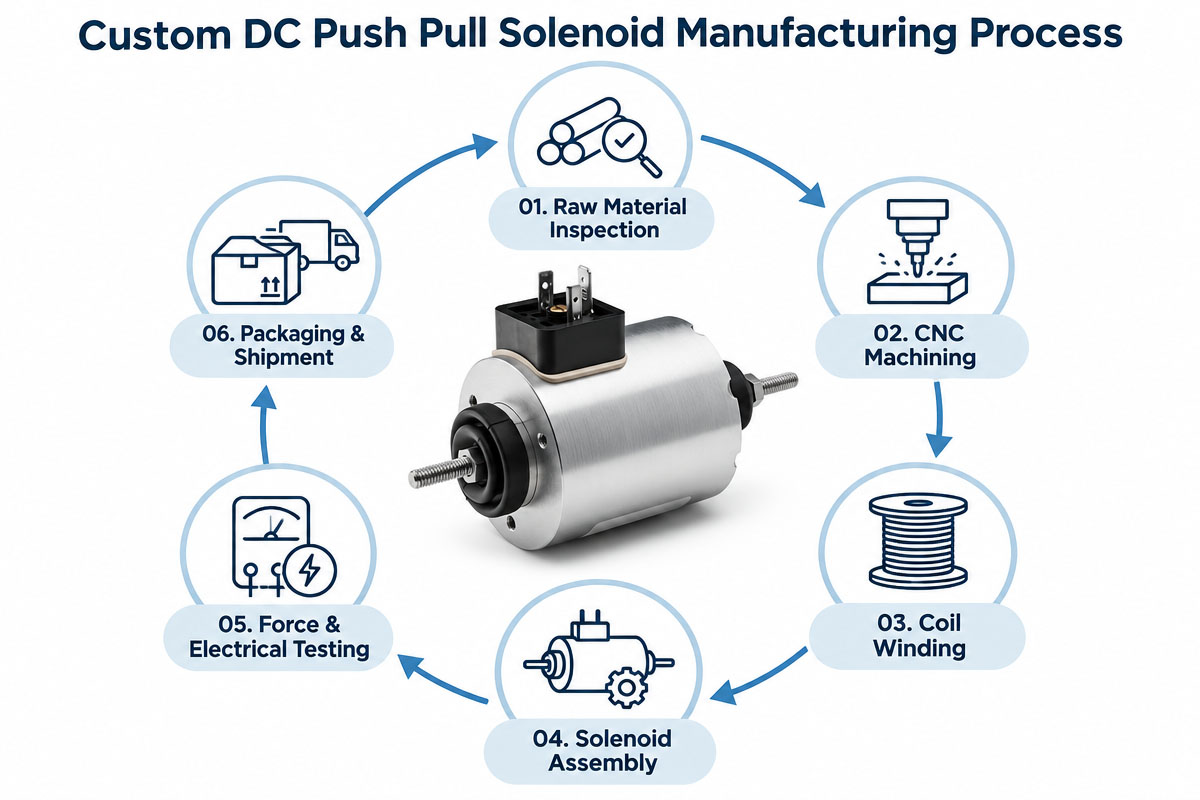
Manufacturing of the custom DC push-pull solenoid involves several steps.
Requirement analysis: Engineers define the voltage, force, stroke, duty cycle, dimensions, and operating environment.
Electromagnetic design: Coil winding, magnetic circuit, and plunger design depend on the performance goals.
Prototype manufacturing: Prototype samples are produced to confirm their electrical and mechanical performance.
Performance testing: The key parameters tested are the coil resistance, force of actuation, stroke, response time, and temperature rise.
Design Optimization: If the test proves underperforming of the actuator, the design is optimized.
Mass production: Production starts after the design is approved. The process and quality controls are defined.
For the solenoids operating in frequent-cycle or high-temperature environments, the testing under actual working conditions is particularly important.
Chatper 12: Weilong: Custom DC Push Pull Solenoid Solutions
Choosing a good solenoid supplier is a vital part of the product development process of OEM manufacturers and industrial equipment designers.
For those customers who need customized DC push-pull solenoid solutions to fit their equipment, we can offer Weilong as a supplier of contact.
For the Custom DC Push-Pull solenoid project of Weilong, the customer shall provide the operating voltage, stroke length, actuation force, duty cycle, mounting space, and operating environment.
Technical specifications can also give you a chance to know whether you can use a standard design or you need a custom one.
Customization Requirements to Discuss With Weilong
| Customization item | Customer requirement |
| Voltage | 5V, 12V, 24V DC, or another specified voltage |
| Stroke | Required linear movement in millimeters |
| Force | Required force at specified stroke positions |
| Duty cycle | Continuous or intermittent operation |
| Structure | Push, pull, open-frame, or tubular |
| Mounting | Bracket, holes, or custom mechanical interface |
| Connections | Wire leads, connectors, or terminals |
| Quantity | Prototype and expected production volume |
Such technical specifications will allow negotiating the feasibility, samples, and price with Weilong.
For long-term OEM projects, the prototype testing under actual operating conditions should be conducted before final product approval.
Editorial Note: The published article will add Weilong’s manufacturing-specific capabilities, certifications, factory facilities, and production experience once it is confirmed.
Chapter 13: The Future of DC Solenoid Technology
The development of automatic equipment still creates the demand for compact and reliable electromagnetic actuators.
Important engineering trends will include magnetic circuit design improvement, reduced holding-power requirements, and advanced electronic drive technologies.
For example, the pulse-and-hold control technology can apply the higher initial current for the actuation and lower holding current where the mechanical load permits.
This technology can reduce the energy consumption and heating of the coils in proper application.
Another important trend is the miniaturization since equipment manufacturers want to get smaller components that will generate enough force and reliability.
In the custom solenoid design process, the attention will be paid to optimization of the size, performance, thermal properties, manufacturing cost, and lifetime.
Chapter 14: FAQs (Frequently Asked Questions) on Custom DC Push-Pull Solenoid
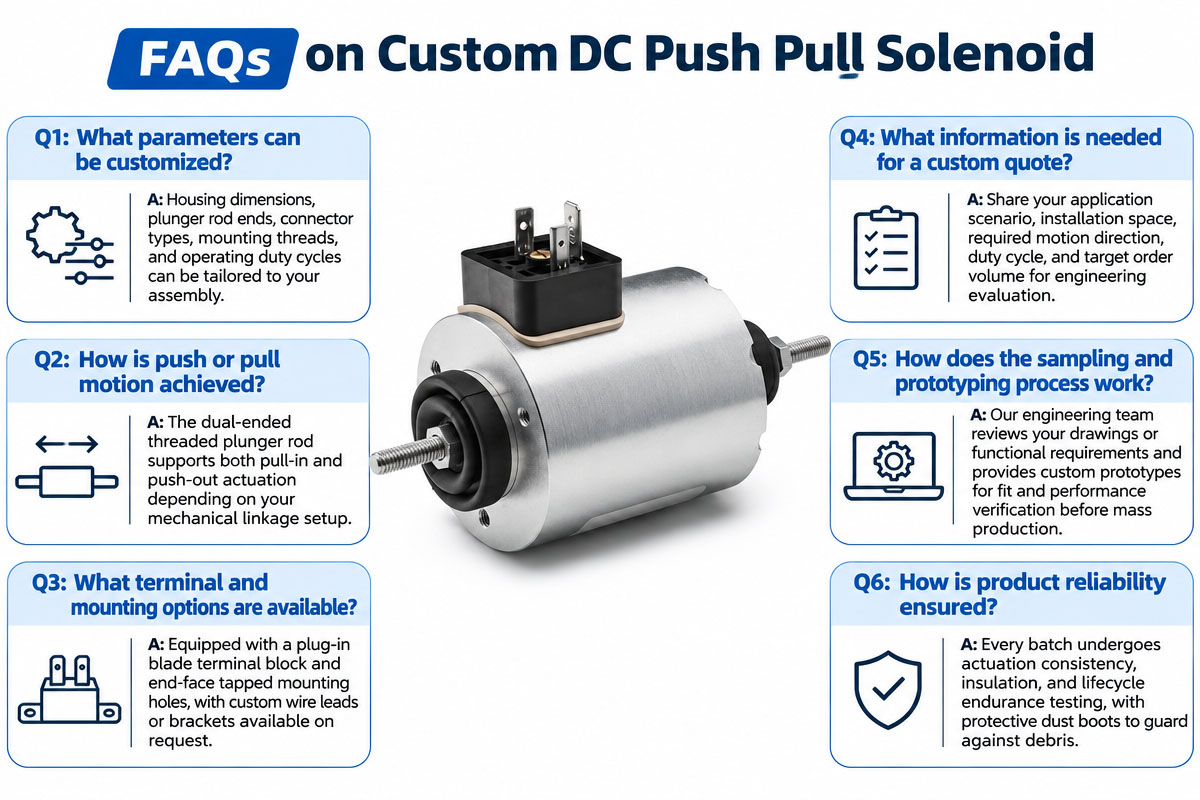
FAQ 1: What is a custom DC push-pull electromagnet?
A custom DC push-pull solenoid is an electromagnetic linear actuator specially designed for a particular voltage, stroke, force, size, and operating requirements. It converts electrical power (DC) into mechanical power to operate equipment mechanisms.
FAQ 2: How does the DC push-pull solenoid work?
During the DC current flow through the coil, it generates the magnetic field that attracts the movable plunger. The generated motion drives a mechanical device. The conventional designs usually use a spring to restore the plunger when the power is removed.
FAQ 3: What is the difference between a push solenoid and pull solenoid?
A push solenoid has an outward mechanical action, and a pull solenoid has an inward pull action. The real motion is determined by the magnetic circuit and mechanical design.
FAQ 4: What Voltages Are Custom DC Solenoids Available In?
Standard solenoid voltages are 5V, 12V, and 24V. Other voltage ratings are possible if it is technically feasible due to custom coil design.
FAQ 5: Can the DC push pull solenoid be used continuously?
Yes, if the solenoid is specially designed and rated for continuous operation at the intended voltage, ambient temperature, and cooling conditions. Continuous energization of the intermittent duty solenoids is not recommended without proper engineering validation.
FAQ 6: What determines the strength of a DC solenoid?
The force of the solenoid depends on the current in the coil, the design of the magnetic circuit, the position of the plunger, the air gap, the core material, and the mechanical load. The force is not constant during the stroke.
FAQ 7: Why Does a DC Solenoid Become Hot?
Overvoltage, excessive energizing time, high ambient temperature, insufficient cooling, and wrong duty cycle can all lead to the solenoid overheating. Proper thermal and electrical design is required.
FAQ 8: Can Weilong Customize a DC Push Pull Solenoid?
You can contact Weilong to discuss the voltage, force, stroke, mounting dimensions, and production volume you require. Technical review and sample testing will prove the viability of the custom design.
Chapter 15: Conclusion
A custom DC push-pull solenoid is a highly versatile electromagnetic actuator that provides the controlled linear motion for various applications.
The performance of the solenoid depends on the proper selection of voltage, stroke length, actuation force, duty cycle, magnetic design, and mechanical design.
Custom solenoids are very useful when standard parts do not meet specific installation or performance requirements.
Weilong can be a starting point of finding a suitable DC solenoid solution for OEM manufacturers negotiating project specifications.
The proper selection of the actuator and verification of the actuator performance in actual working conditions are important for reliability in industrial automation, electronic locks, vending machines, and special mechanical equipment.
Contact Weilong to discuss your custom DC push-pull solenoid needs and request a technical evaluation of your project.