mall Solenoid Lock for Automation Devices
Compact Electric Lock for Industrial Doors
Small Solenoid Lock for Smart Lock Systems
Industrial Small Solenoid Lock Solutions
Compact Solenoid Lock for Secure Equipment
mall Solenoid Lock for Automation Devices
Compact Electric Lock for Industrial Doors
Small Solenoid Lock for Smart Lock Systems
Industrial Small Solenoid Lock Solutions
Compact Solenoid Lock for Secure Equipment

WL0627 Small Solenoid Lock for Access Control Use

A small solenoid lock is an electrified lock that functions thanks to the electromagnetic force produced by the electric current that makes the magnetism move a plunger and open the lock. The magnetic field generated by the flow of electricity displaces the plunger/bolt that opens the lock.

Despite being small-sized, small solenoid locks can be widely used in various installations. They are especially suitable to be used with cabinets, lockers, vending machines, and automated equipment. The vast majority of such locks work at a low voltage, i.e., 6V DC, 12V DC, or 24V DC.


🔹 Key Features of Small Solenoid Lock

The first feature of a small solenoid lock is a small size that allows for convenient installation in compact spaces. Moreover, they have fast and reliable operation. In addition to the above-mentioned qualities, small solenoid locks are energy-efficient and can work safely.

Such locks tend to be very durable and can work efficiently for a very long period of time without failure or malfunction. Small solenoid locks can be operated manually to be unlocked if necessary.

In addition, they are easy to integrate into electronic and robotic systems thanks to a straightforward structure and configuration.

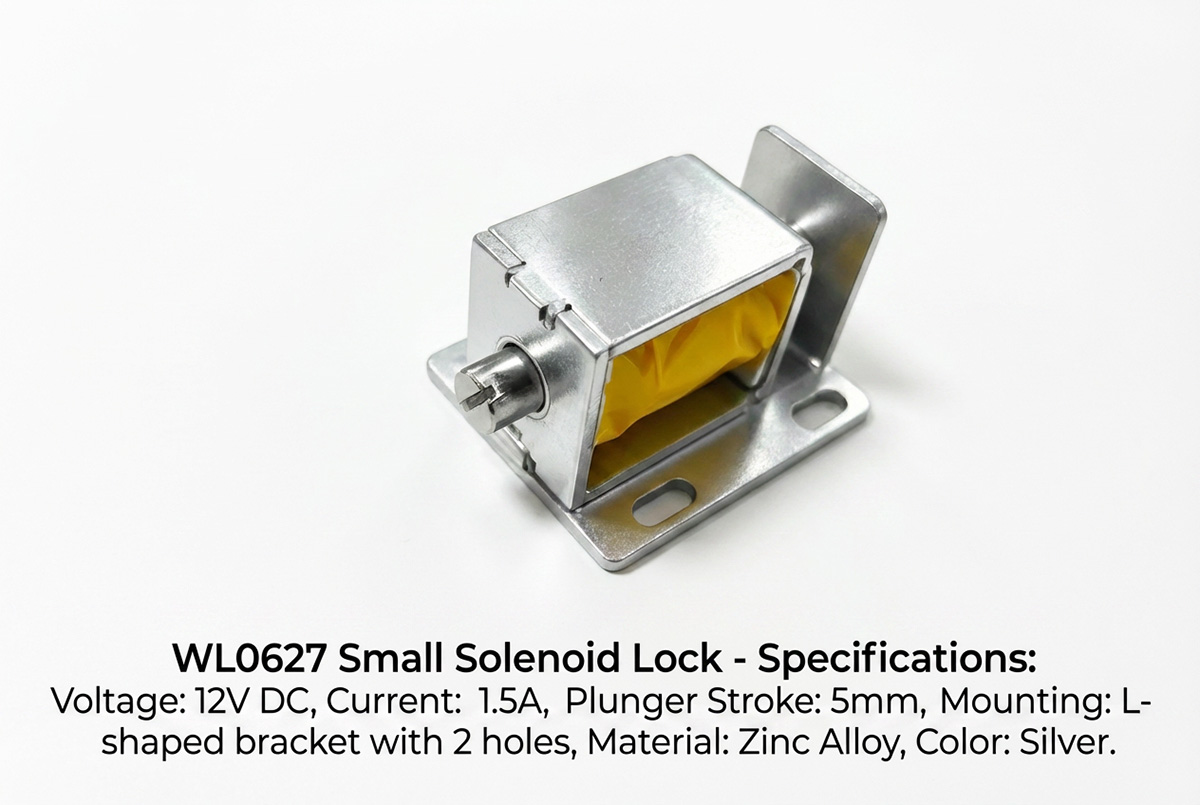
WL0625 Small Solenoid Lock Product Overview

There are several basic parts that make up the structure of a small solenoid lock. It usually consists of a coil, a plunger, springs, and housing.

Specifications:

Voltage: 6V DC, 12V DC, 24V DC

Force: customizable

Operation mode: fail-safe or fail-secure

Materials: metal housing

Optional characteristics:

Manual override

Plunger sensor

Environmentally resistant design

Custom mountings

WL0627 Small Solenoid Lock Video

WL0627 Small Solenoid Lock Detailed Display

WL0627 Small Solenoid Lock Data Sheet

Brand Weilong Technology Model Number WL0627
Rated Voltage (V) DC 12 V or 24 V Rated Power (W) 5–8 W
Work Model Push-Pull Type Holding Force (N)  100 GF
Stroke (mm) Customized Reset Time(s) 20 S
Service Life 300 Thousand Times Certification CE, RoHS, ISO9001,
Material Carbon Steel Housing with Zinc Coating Lead Wire Length (mm) 200
Install Style Mounted Screw Holes Tolerance of Dimension  +/-  0.1 MM
Water-proof  None Insulation Class F 155 Degree 9 Cel. )
Hi-Pot Test AC 600V 50/60Hz 1 s Non-excitation Holding Force 0
Working Temperature -10°C-100°C Duty Cycle 15 %
Thread Depth (mm) / Payment Term TT, or LC At Sight
Sample Order Yes Warranty 1 Year
MOQ 500 pcs Supply Ability 5000 pcs per Week
Delivery Time 30 Days Port of Loading shenzhen

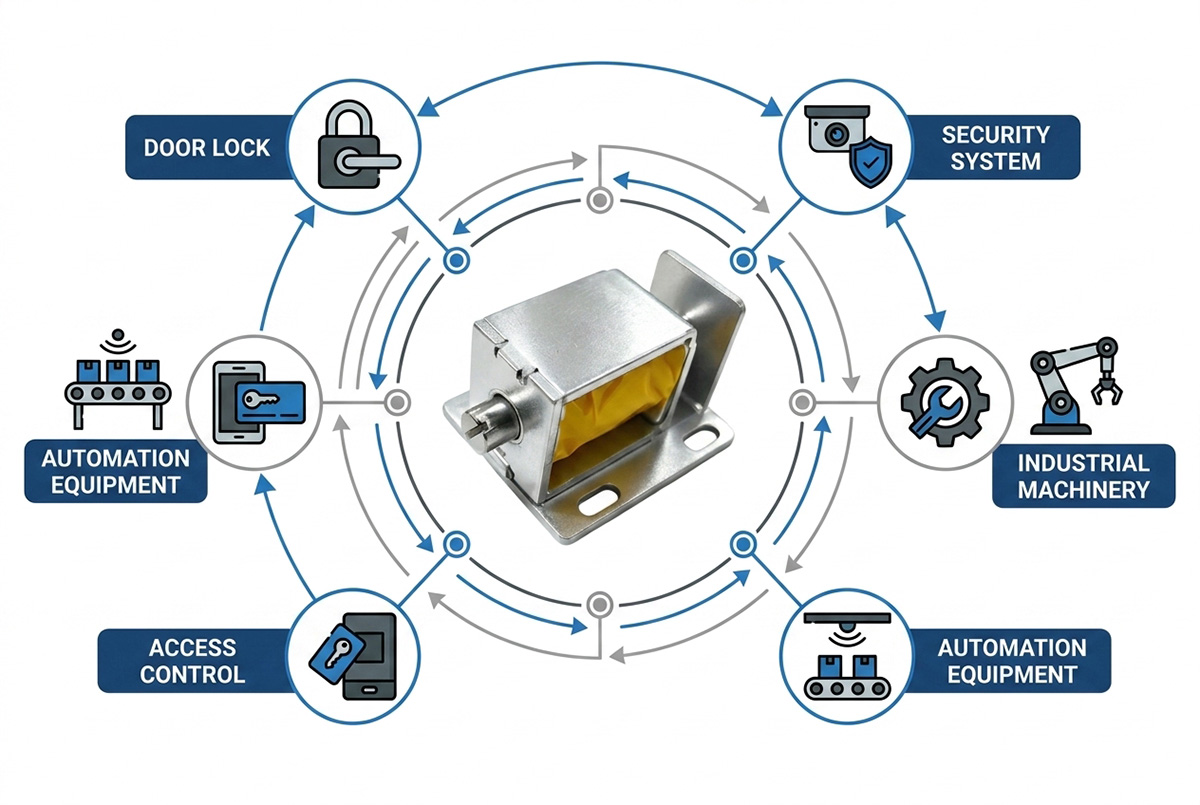
WL0627 Common Applications of Small Solenoid Lock

Small Solenoid Lock Industrial Application

A small solenoid lock, known for their great reliability and compact design, find widespread use in various industries. One of the most common applications of small solenoid locks is the security of cabinets and lockers.

They can be installed into vending machines for access management and device maintenance and modification. Small solenoid locks can also be installed into lockers to provide remote opening functionality.

A small solenoid lock is widely used in industrial automation and robotics as a means to control access to the enclosures of automated devices.

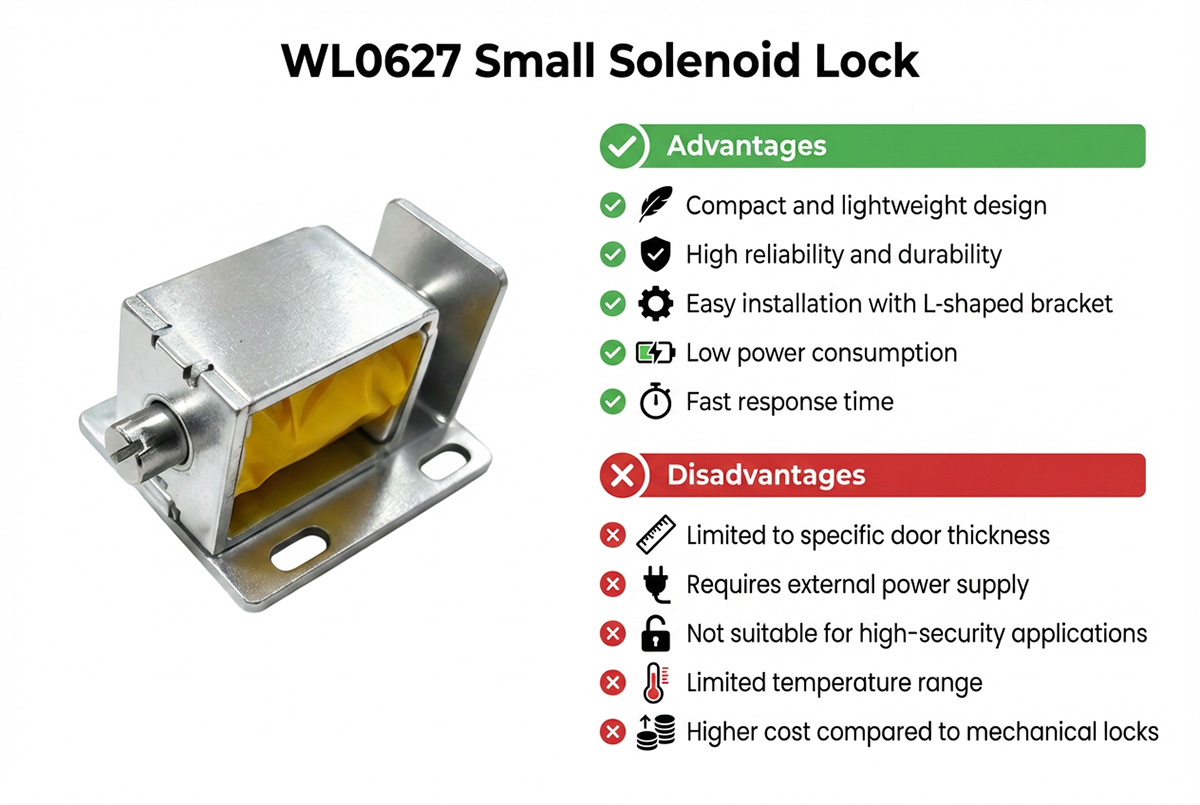
Advantages and Disadvantages of Small Solenoid Lock


Small Solenoid Lock Advantages:

Small solenoid locks feature various benefits that can convince a person to choose this particular lock for his project. First of all, their small sizes and light weights enable small solenoid locks to fit into confined spaces. They are characterized by reliable and quick operation and few mechanical elements.

These locks work efficiently since they are based on low-voltage DC electricity. Moreover, small solenoid locks can be configured easily and can be integrated with a variety of control options (RFID, keypad, etc.). They are also capable of functioning as fail-safe and fail-secure types of locks.

Small Solenoid Lock Disadvantages:

On the other hand, there are some cons to using small solenoid locks. First of all, the constant energization causes overheating. Second, these locks are weaker than others, as the holding force is not so high. Small solenoid locks need a stable supply of power in order to work efficiently. Dust and moisture can negatively affect these locks’ performance.

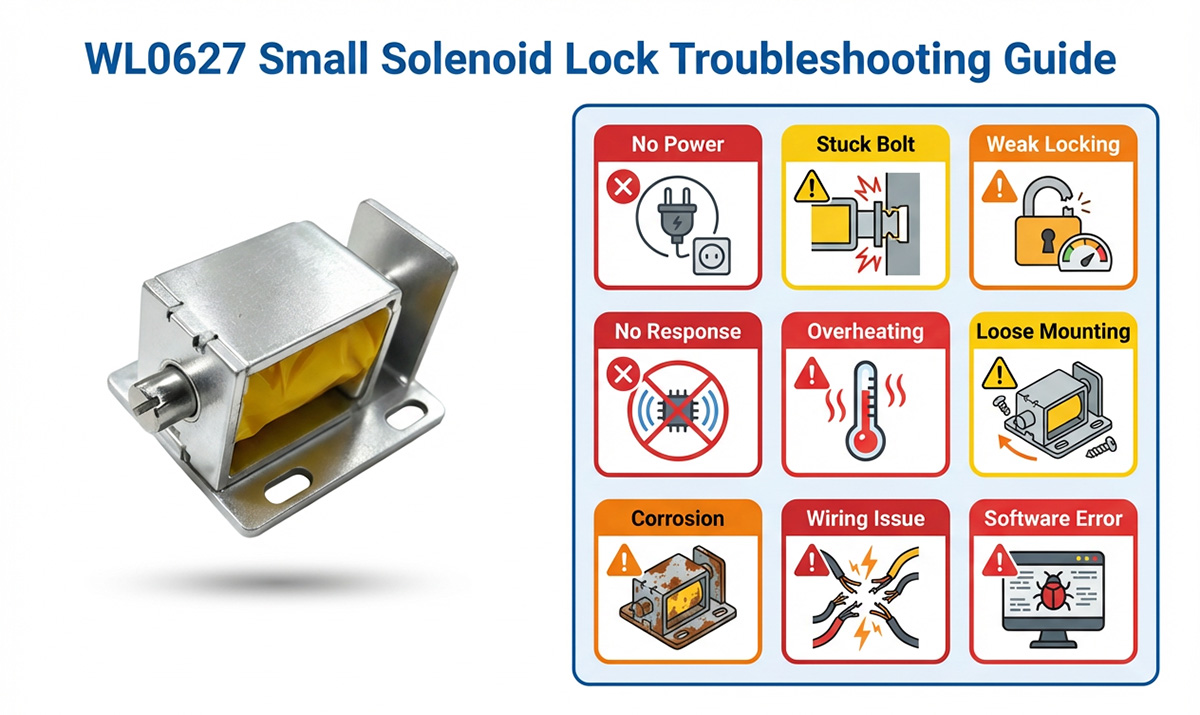
Troubleshooting of Small Solenoid Lock

WL0627 Small Solenoid Lock Troubleshooting Guide

Small solenoid locks come in various designs and find their application in many fields such as cabinets, intelligent lockers, vending machines, or access control systems. The malfunction of those devices can be caused by different reasons—from faulty electronics to contamination with dust or high humidity.

1) Solenoid does not engage (not moving)

Possible causes:

– No power supply provided

– Inappropriate voltage

– Broken cable, loose wires

– Coil burnout, open circuit

– Bad control signal from relay, PCB, etc.

Suggested solutions:

– Check necessary input voltage (DC 6V, 12V, or 24V depending on requirements)

– Inspect wiring, test connection with a multimeter

– Test coil resistance (infinite reading means the coil is not working properly)

– Inspect control circuitry (relays, MOSFETs, etc.)

2) Buzzing noises but no lock engagement

Possible causes:

– Low current (voltage drop)

– Stuck plunger

– Dirt inside the housing

– Spring fatigue

– Jamming

Suggested solutions:

– Provide necessary power supply

– Cleaning by blowing or washing with alcohol

– Make sure the plunger is aligned properly

– Change worn springs or any damaged parts

3) Overheating

Possible causes:

– Non-pulsed energization

– Overvoltage

– Poor thermal conductivity

– Coil insulation degradation

Suggested solutions:

– Use pulse modulation, PWM, or timer control

– Check whether power supply voltage matches nominal one

– Choose a better-performing solenoid with higher duty cycle

4) Locked up solenoid (will not release)

Possible causes:

– Residual magnetism

– Mechanisms are worn out

– Rust or corrosion

– Improper installation position

Suggested solutions:

– Implementing non-magnetic spacer or using demagnetizing method

– Lubricating mechanism with machine oil

– Replacement of corroded components

– Proper reinstallation of the lock

5) Too weak engagement force

Possible causes:

– Low current

– Large air gaps between components

– Coil aging

– Inappropriate solenoid model

Suggested solutions:

– Boost power (within normal operating range)

– Reduce the plunger stroke distance

– Use a solenoid with greater pulling force

– Adjust mounting position and alignment tolerances

6) Intermittent performance

Possible causes:

– Loose connections

– Unreliable power supply

– Contamination with dirt or dust

– Coil failure

Suggested solutions:

– Tightening connectors and sockets

– Providing more reliable, stable power source

– Adding flyback diode

– Replacing an aged solenoid

7) Environmental effects

Common causes of malfunction:

– High humidity results in corrosion

– Dirt and dust can cause obstruction

– Overheating due to high temperature

Suggested solutions:

– Using an IP-rated sealed solenoid

– Applying an anti-corrosion coating when necessary

– Adding protection cover

Short diagnostic procedure

– Measuring voltage at the contacts

– Testing coil resistance

– Manually testing plungers for smoothness

– Listening for any strange noises during activation

– Monitoring temperature changes after the cycle


Industrial practice tips

– Always use flyback diodes to protect control circuitry

– Do not keep energized continuously unless otherwise specified

– Preferred: use DC solenoids for smoother performance

– Use push/pull type solenoids according to requirements

– Regular maintenance prevents about 80% malfunctions


FAQs Of Small Solenoid Lock

1. What kind of voltage is required by small solenoid locks?

Usually, these locks are supposed to work at 12V DC voltage. However, 6V DC and 24V DC are also available.

2. Is it safe to use the constant energization mode?

It depends on the specific solenoid lock. Using the constant energization mode is not advisable due to potential overheating. You are advised to use pulse mode instead.


3. What is the difference between fail-safety and fail-security locks?

Fail-safe locks automatically unlock when the power goes out. Fail-secure locks stay locked in this situation. You will have to choose depending on your needs.

4. Are small solenoid locks strong enough?

Yes, but only for moderate security. They are suitable to use for protecting lockers, cabinets, and vending machines.

5. How to interface an Arduino or PLC with small solenoid locks?

Generally, small solenoid locks can be controlled by these systems via relay drivers.

6. Why is the solenoid lock hot?

Solenoid locks always produce heat because of the current flow in the coil. The excessive heat generation indicates that there is a problem either with power or voltage.


7. Can a small solenoid lock be installed outdoors?

Yes, as long as there is additional protection against dust and moisture.

8. What kinds of problems can cause malfunctioning?

Problems include voltage insufficiency, coil malfunction, plunger obstruction, or wrong position of the lock parts.

Choosing the Right Small Solenoid Lock for Your Project

Step #1—Define the Application Scenario

First of all, define what you need to protect and how you plan to install the lock. Consider the following:

Cabinets, lockers, vending machines, kiosks, or device enclosures?

Outdoor or indoor usage?

High-duty or low-duty operations?

👉 For example, vending machines require a more durable lock than drawers do.

Step #2 – Choose Fail-Safe / Fail-Secure Lock

This step is one of the main criteria to consider when choosing a small solenoid lock.

– Fail-Safe: power off => unlocked

It is used as a safety lock in emergency situations

– Fail-Secure: power off => locked

It is used for security purposes when locking cabinets or lockers

👉 Generally, fail-secure is preferred for industrial equipment to ensure proper working of safety mechanisms.

Step #3 – Inspect Voltage & Power Requirements

It is important to inspect the requirements regarding voltage and power to determine the appropriate solenoid lock. Possible voltage values include:

– 6V DC

– 12V DC

– 24V DC

👉 Make sure your controller is capable of working with it.

Step #4 – Evaluate Holding Force & Stroke Length

It is necessary to evaluate these two important solenoid lock parameters:

– Force: the value shows how strong the lock is.

– Stroke length: the value indicates how far the plunger moves.

👉 For large heavy doors, more force is needed than for light plastic enclosures.

Step #5 – Consider Mounting Dimensions & Configuration

It is required to measure mounting dimensions:

-Length, Width, Height

-Mounting hole position

-Direction of plunger motion (pull/push)

👉 It is necessary to pay special attention to the compactness and dimensions.

Step #6 – Evaluate the Heat Generation & Management

Solenoid locks generate heat, so it is important to manage it properly to avoid overheating problems. To accomplish this task, it is recommended to follow the tips below:

– Do not use constant energization

– Use pulse control or another mode

👉 If constant use is needed, you can choose:

– Duty-cycle lock or

– Add pulse control mechanism to your project

Step #7 – Consider Protection Requirements

The conditions in which the solenoid lock will operate have to be considered:

-Temperature range

-Dust resistance, Water Resistance (IP rating)

-Rust resistance

👉 Industrial applications and outdoor usage require IP65 protection or higher.

Step #8 – Determine Required Security Level

Depending on the application scenario, there are different security level requirements:

Low duty: drawers, small lockers

Medium duty: lockers, kiosks

High duty: industrial machinery and equipment

👉 Don’t forget that small solenoid locks have low-to-medium security levels.

Step #9 – Consider Extra Features

Consider adding extra features:

-Manual override

-Feedback signals (plunger detector)

-Anti-tampering design

-Low noise

👉 The systems with feedback signals perform much better.

Step #10 – Ensure Compatibility

It is essential to make sure that your small solenoid lock will be able to work properly with your control system.

Microcontrollers (Arduino, ESP32, and others), PLC system, access control, keypads, RFID readers

👉 Consider:

– Pulse or constant energizing?

– Response time

🔹 Small Solenoid Lock Selection Checklist

Here is a checklist to review before buying your solenoid lock:

Voltage compatibility with your system

Fail-Safe / Fail-Secure lock correctness

Appropriate force for your application

Compact enough and fits the space for installation

Suitable duty-cycle

Environmental protection

🔹 Pro Selection Tips (Industry Insight)

For most industrial projects, a small solenoid lock will look like this:

– Fail-secure 12V DC

– Manual override + feedback

– Pulse control (0.5-1 sec)


Get A Free Quote Now

Contact Form

Related Products

Related News

Chapter 1 : introduction of Electromagnets vs Electric Motors Among the most widely used electromagnetic devices in industrial automation, consumer […]

Chapter 1 : introduction of Electromagnetic solenoid All the modern homes are equipped with dozens of household appliances that need […]

You wake up in the morning and grab a drink from your refrigerator. Next, you take a shower and drive […]

Scroll to Top

Get A Free Quote Now !

Contact Form
If you have any questions, please do not hesitate to contact us.
Weilong Solenoid Company Culture
