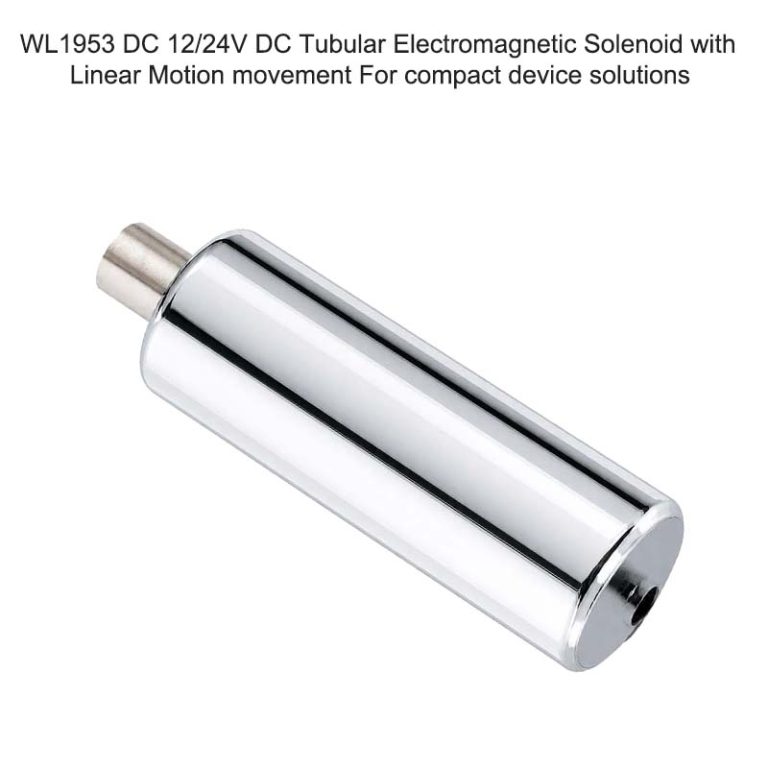
Tubular Solenoid Feature and application

Tubular Solenoid Guide: Types, Working & Applications

DC Tubular Electromagnetic Solenoid for Medical Devices
24V Tubular Solenoid for Smart Medical Device System
Compact Tubular Solenoid for Precision Motion Control
Tubular Electromagnetic Solenoid for Access Control Guide
Compact Tubular Pull Solenoid for Industrial Automation
Tubular Solenoid Push Pull for Medical Equipment Design
Metering Valve Solenoid vs Standard Solenoid Valve
Industrial Metering Solenoid Design and Manufacturing
Energy Efficient Tubular Actuator Technology Guide
Heavy Duty Tubular Linear Solenoid Manufacturer
Mini Tubular Push-Pull Solenoid for Precision Control
Mini Tubular Solenoid Applications in Automation System
Heavy Duty 12V Push Pull Solenoid for Industry application
Industrial Tubular Solenoid for Automation Systems
Durable Metering Pump Solenoid for Industry
High Force Magnetic Push Pull Solenoid Unit
1 2
Tubular Solenoid Feature and Application

Introduction

A tubular solenoid is a small electromagnetic device with a cylindrical or tubular shape. The tubular shape enables it to produce a lot of force in a straight path while using minimal magnetic energy.


Tubular solenoids use a lot of magnetic flux, provide protection for internal parts, and can be used for long durations compared to normal solenoids.


This makes tubular solenoids suitable for use in CNC, medical, intelligent locks, vending, automotive, and industrial applications.

Chapter 1: What is a tubular Solenoid ?

A tubular solenoid is an electromagnetic device that uses electrical energy to generate motion in a straight line.


When an electric current passes through a cylindrical casing, it produces a magnetic field, enabling movement of the plunger in the axis direction, hence creating a push or pull action.


Common Types of Tubular Solenoids


  • Push Tubular Solenoid: Produces a pushing motion when energized
  • Pull Tubular Solenoid: pulls objects towards its center
  • Push-Pull Tubular Solenoid: enables bidirectional movement
  • Self-Locking Tubular Solenoid: locks in position without needing power at all times


Depending on the specific requirements of the application, tubular solenoids can use either AC or DC power.

Chapter 2: The Structure of a Tubular Solenoid

A tubular solenoid is usually made up of a few parts.


  1. The Coil Assembly

The coil is made up of high-quality copper wire, designed to produce the highest resistance possible in order to act quickly.

For high temperature resistance, the insulation class will be up to Class F or Class H.


  1. Plunger (Armature)

The plunger is made of soft magnetic material that has high permeability. This allows the magnetic movement to occur smoothly and rapidly.

Special surface treatments help in reducing friction and wear.

  1. Spring for Return

The return spring will be used when the power goes off. It will return the plunger to its original position.

It is a compromise between the rapidity of the response and the output.

  1. Housing for the Magnetic Tube

The cylindrical steel enclosure will house the internal parts and will help in concentrating the magnetic flux. This will help the electromagnetic system perform better.

  1. End Caps and Parts for Guides

This will ensure that everything is properly aligned. It will help in controlling the stroke and will reduce the vibrations when the machine is in operation.

Chapter 3: How a Tubular Solenoid Works

A tubular solenoid works on the electromagnetic principle.

When the switch is closed and the power is turned on, the current will flow through the coil.

The current will produce a magnetic field inside the tube.

The magnetic field will attract the plunger towards the core of the coil.

This will produce a linear movement.

The return spring will push the plunger back when the switch is closed.

Since the tubular solenoid has a closed magnetic circuit, this will provide

  • A more efficient
  • A quicker response time
  • A steady and reliable output of force

Chapter 4: Why Tubular Solenoids Are Getting More Popular in Industry

There are many reasons why tubular solenoids are becoming more popular in modern equipment.

  1. A lot of power in a small space


The cylindrical magnetic design enables them to deliver a lot of power in a small space. This is good for small devices.

  1. More Magnetic Efficiency

The magnetic circuit is closed so there is no magnetic leakage. Therefore, they are more efficient than open frame solenoids.

  1. Works quietly and smoothly

The magnetic circuit is closed so there is no leakage. Therefore, they are more efficient than open frame solenoids.

  1. Longer lifespan

Dust and moisture are not exposed to the inside parts. Therefore, they last longer than other solenoids.

  1. Simple to change

The voltage level

The length of the stroke

The output force

The duty cycle

The type of connector

The type of mounting


Chapter 5: Benefits of Tubular Solenoids

  1. High Force-to-Size Ratio

Tubular solenoids have the capacity to deliver a lot of power in small spaces.

  1. More Magnetic Efficiency

Tubular solenoids are more efficient than open frame solenoids since there is no leakage.

  1. Works quietly

Tubular solenoids are quiet since there is no leakage.

  1. Long Life

Tubular solenoids are long-lasting since there is no leakage.

  1. Customization that is flexible

Tubular solenoids have different types of connections and mountings.

Chapter 6: What Tubular Solenoids Can't Do

Tubular solenoids have various challenges despite their good aspects.

  1. More expensive to make

The design is more complicated and requires more materials and labor to make them.

  1. Problems with heat dissipation

This enclosed structure is able to hold heat, thus it is important to be cautious about how many times it is used.

  1. Short Stroke Length

Tubular solenoids normally have shorter stroke lengths in comparison to certain types of open frame solenoids.

  1. Hard to keep up with

It might be more challenging to do repairs at the site since it is enclosed.


Chapter 7: Tubular Solenoid Datasheet (Typical Specifications)

Typical technical specifications may include:

Voltage: 6V / 12V / 24V DC
Stroke Length: 2 mm โ€“ 20 mm
Force Output: 1 N โ€“ 100 N
Duty Cycle: Intermittent / Continuous
Response Time: 10 โ€“ 100 ms
Insulation Class: F / H
Operating Temperature: -20ยฐC to +120ยฐC

Specifications vary depending on
model and customization requirements
.

Chapter 8: How to Use Tubular Solenoids

Tubular solenoids are commonly used when there is a need to ensure that the device is small in size and reliable.

Automation in Industry

  • Mechanisms used in sorting
  • Positioning systems
  • Open/close valve
  • Mechanical locking systems
  • Systems used in cars
  • Systems used in locking doors
  • Transmission systems
  • Air and fuel systems
  • Devices used in health sector
  • Diagnosis tools
  • Fluid control systems
  • Medical equipment that is portable
  • Smartphones and smart gadgets
  • Intelligent locks
  • Selling machines
  • Intelligent home devices

Chapter 9: Picking the Right Tubular Solenoid

In picking the right tubular solenoid, there are certain things that need consideration.

  1. Power Supply and Voltage

Pick the right voltage, such as 12V DC or 24V DC.

  1. The Force Needed

Find out how much force is necessary.

  1. Length of Stroke

Ensure that it is enough.

  1. Duty Cycle

Find out if it is intended to run at all times.

  1. State of the environment

Think about the temperature, humidity, dust, and vibration.

  1. Limitations in Size and Mounting

Look at the space in which it is mounted and the way it is mounted.


Troubleshooting Tubular Solenoids inChapter 10 Issue: Solenoid is not working.

Possible reasons:

  • No power source provided
  • Wire in coil is broken
  • Incorrect voltage provided


Solution:

  • Verify power source is provided.
  • Verify resistance in coil.

Issue: Solenoid is not working well.

Possible reasons:

  • Incorrect voltage provided
  • Too much weight placed on it


  • Pollution in the magnetic gap

Solution:

  • Verify that the voltage is correct.
  • Verify that parts inside are clean.

Problem:

It is getting too hot.

Possible reasons:

  • Too much duty cycle
  • Outside temperature is too high


Solution:

  • Provide intermittent duty types.
  • Provide better cooling.

Issue:

Response is too slow.

Things that could be causing it:

  • Weak spring in the return
  • Mechanical blockage

Solution:

  • Verify tension in the spring.
  • Verify parts are aligned.

Chapter 11: Questions and Answers (FAQ)

1 What types of tubular solenoids can you purchase?

Push solenoid

Pull the solenoid

Push-pull solenoid

Self-locking tubular solenoid

Depending on how it is being used, it can be operated by AC or DC power.


  1. Why do people like using tubular solenoids in factories?


Tubular solenoids are best used in factory automation, automotive, medical, and intelligent device applications. This is because of its high force-to-size ratio, magnetic efficiency, smooth operation, quiet running, long life, and custom capabilities.


  1. Can tubular solenoids be changed?


Yes, it can be changed. The changes may include stroke, force, voltage, style, connectors, insulation, and surface treatment.


  1. How long do tubular solenoids usually last?


A tubular solenoid can operate for as long as 1 to 5 million cycles or even longer if it is properly designed and used.


  1. What are some of the common problems that tubular solenoids usually exhibit, and how do you solve these problems?


Does not operate

Does not operate well

Too hot

Slow response

Check power supply.

Check continuity of coil.

Check if voltage is appropriate.

Check tube and plunger for cleanliness.

Check return spring.

Check to see if everything is properly aligned.


  1. How do I select the appropriate tubular solenoid for my application? ย 

Things to Consider

Voltage/power supply

Force/stroke

Duty cycle

Continuous or intermittent operation

Environmental considerations

Temperature

Dust

Vibration

Space arrangement

Mounting arrangement

Chapter 12: The End

Tubular solenoids are high-performance electromagnetic devices that can be used in situations where a small size, a lot of force, smooth motion, and long life are necessary.

Although they may be more expensive to purchase than open frame solenoids, many modern industrial applications prefer to use tubular solenoids because they are efficient, long-lasting, and reliable.

Weilong offers full services for developing tubular solenoids, from engineering design to mold development and mass production. This ensures that customers worldwide receive high-quality, custom-made products.


Scroll to Top

Get A Free Quote Now !

Contact Form
If you have any questions, please do not hesitate to contact us.
Weilong Solenoid Company Culture