

Chapter 1: Introduction
Because of their high force, robust structure, and flexible installation, frame push-pull solenoids are commonly used in industrial automation, access control systems, automotive equipment, vending machines, medical devices, and mechanical control applications.
The selection of the right frame push-pull solenoid manufacturer icrucialnt to ensure the reliable performance of electromagnetic motion. An experienced frame push-pull solenoid manufacturer can offer you customized frame-type solenoids, including the processes of engineering design, magnetic optimization, prototype development, testing, and mass production.
This guide will discuss design principles, manufacturing processes, application benefits, and main considerations in choosing a custom frame push-pull solenoid manufacturer.
Chapter 2: What is a push-pull frame solenoid?
A push-pull frame solenoid is a kind of electromagnetic actuator that is designed to create linear motion in two directions, push and pull. Unlike tubular solenoids with a cylindrical housing, the frame-type solenoids feature open-frame construction, which provides flexibility in mounting, excellent heat dissipation, and high mechanical strength.
The main components are
Coil (electromagnetic)
Housing, metal frame
Magnetic piston
Spring comes back.
“Assembly of core”
Mounting holder
Electrical connectors
The coil generates a magnetic field when DC voltage is applied, which in turn exerts force on the plunger. The actuator can make either push movement, pull movement, or push-pull movement depending on the design.
An experienced frame push-pull solenoid manufacturer designs the actuator based on the requirements of force, stroke, voltage, duty cycle, and installation condition.
Chapter 3: How a Frame Push-Pull Solenoid Works?
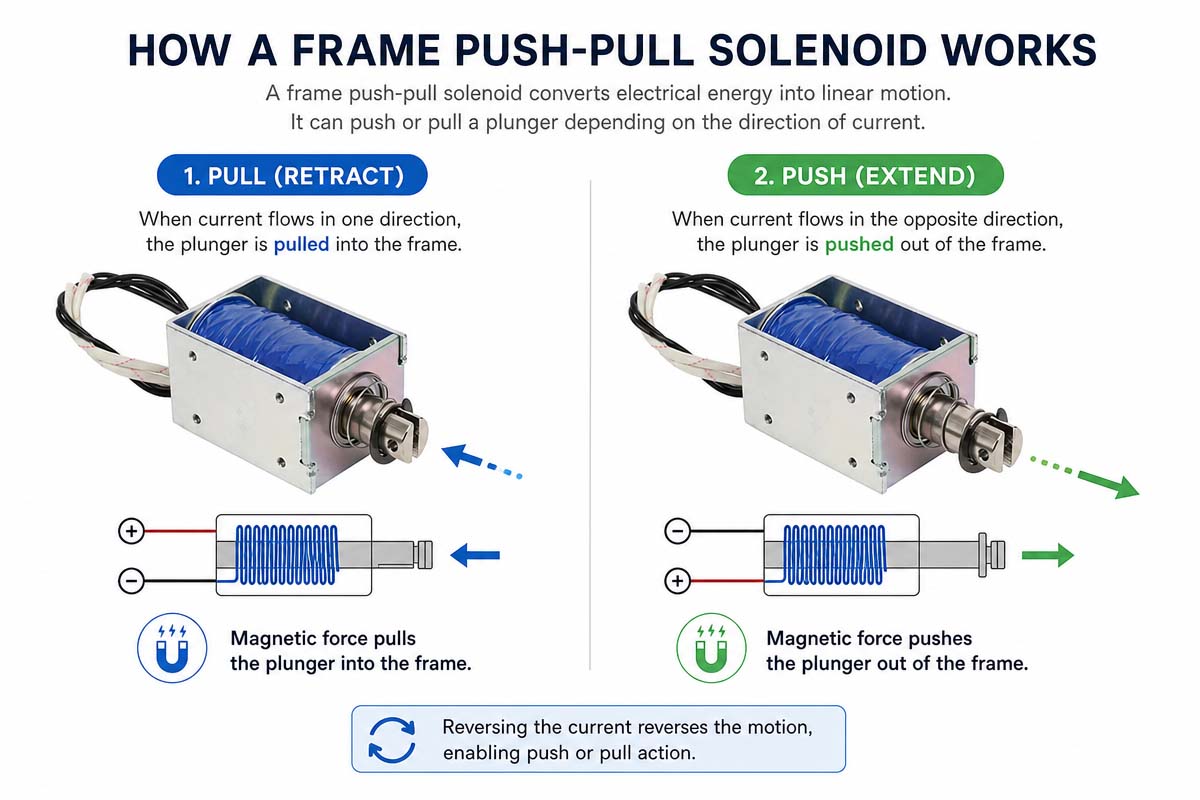
A push-pull frame solenoid works by electromagnetic conversion.
With current flowing through the coil, it generates a magnetic field around the electromagnetic core. As a result, the magnetic field pulls the plunger and creates a linear motion.
The design of the coil winding and the structure of the magnetic circuit affect the mechanical output:
Design of coil winding
Structure of magnetic circuit
Thickness of air gap
Plunger material
Spring force
Operating voltage
The open frame structure enables the efficient circulation of magnetic flux and seamless integration into mechanical systems.
Professional frame push-pull solenoid manufacturers use magnetic analysis and performance testing to optimize:
Force initiale
Having power
Stroke duration
Response ratio
Energy efficiency
Chapter 4: Design Process of Custom Frame-Type Solenoid
4.1 Analysis of application requirements
The first step in designing a custom solenoid is to analyze the application requirements of the customer.
The engineers analyze the following:
Working voltage
Thrust force needed
Pulling force needed
Stroke length
Duty cycle
Space available
Environmental conditions
Life expectancy
—for instance.
Automation equipment may require high force and rapid response.
The security devices may require small size and reliable locking.
Continuous operation of industrial machines may be required.
An experienced frame push-pull solenoid manufacturer will design the solenoid, taking into account the complete application environment.
4.2 Optimization of Magnetic Circuit
Performance of the solenoid depends on its magnetic system.
The major design features are
Design of the coil
The coil determines:
Power usage
Magnetic strength
Temperature rise
Stability in operations
The engineers improve:
4.3 Wire diameter.
Turn number of winding
Resistance of coil
Insulation design
4.4 Design of Plunger
The plunger affects:
Pull force
Movement speed
4.5 Mechanical stability
Good-quality magnetic materials improve performance and reliability.
Frame Structure
The metal frame has the following features:
Mechanical help
4.6 Heat radiation
Flexible installation
Protection of internals
Chapter 5: Main Feature of Frame Push-Pull Solenoid
High Output Force
Frame-type solenoids generate high electromagnetic force for demanding industrial applications.
Easy Installation
The open frame design allows for flexible installation and integration into various mechanisms.
Great Heat Dissipation
The exposed structure has better thermal performance compared to the enclosure’s design.
Options for Custom Stroke and Force
Manufacturers can customize the following:
Stroke length
Driving force
Traction force
Voltage.
Drilling holes
Connector design
Long life
Properly designed frame solenoids can work for hundreds of thousands of cycles.
Chapter 6: Frame Push-Pull Solenoid Manufacturing Process
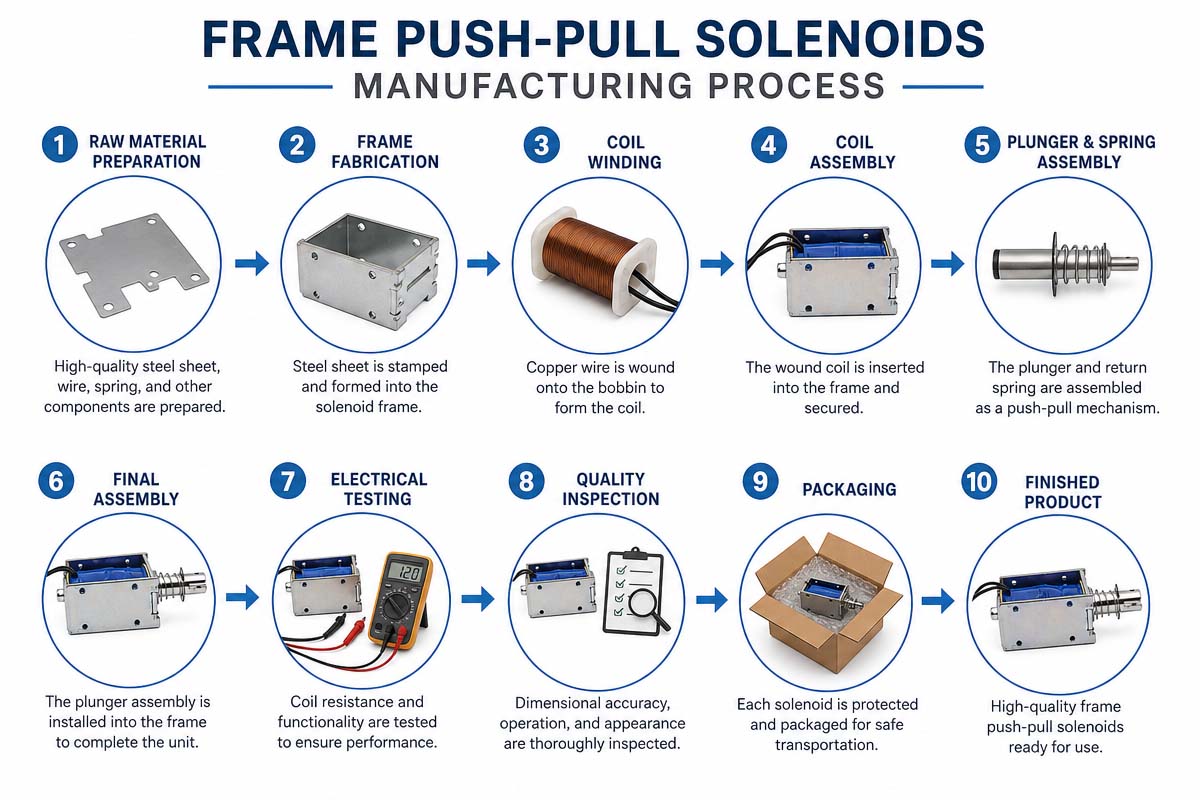
Engineering Development Step 1:
The manufacturer creates the following:
Product drawings
3D Model (3.0 MB)
Magnetic simulation
Specifications of the prototype.
Verification of design ensures that the product meets its performance requirements.
Step 2: The Coil Winding Process
Automatic winding machines: control systems
Wire tension
Winding accuracy
Coil size
Regular resistance
Consistent coil production guarantees reliable electromagnetic performance.
Step 3: Making the Metal Frame
Frame components are produced using the following processes:
Stamping metal.
CNC milling
Surface treatment
Precision forming
The mechanical parts are well constructed.
Step 4: Assembly Process
The assembly process includes the following operations:
Coil mounting
Core building
Plunger fitting
Spring installing
Frame repair
The manufacturers inspect every production stage.
Step 5: Performance Testing
Quality testing includes the following:
Voltage testing
Current measurement
Resistance testing
Force testing
Stroke measurement
Life cycle testing
An experienced frame push-pull solenoid manufacturer ensures that every product meets the customer requirements.
Chapter 7: The Application of Frame Push-Pull Solenoid
Due to their high precision and high efficiency, compact installation, and rapid response performance, frame push-pull solenoids are extensively used in industrial automation equipment and electromechanical control systems. Unlike traditional tubular solenoids, the frame solenoids have an open-frame design, which allows them to be installed in customized mechanical equipment, effectively dissipate heat, and have fast and repeatable stroke performance.
Industrial Automation Equipment
The frame push-pull solenoids are used in various mechanical devices for industrial automation equipment. For example, they can be used in positioning, clamping, indexing, and feeding mechanisms that need rapid operation. Thanks to the high repeatability of movement, fast response performance, and precise movement control, machines can accurately position a workpiece and operate the clamp fixtures or a release mechanism in assembly lines.
Medical and Laboratory Devices
Frame push-pull solenoids are widely used in medical devices and equipment where the accuracy of control is essential. They are used in fluid control systems, sample handling equipment, valve control units, and other diagnostic devices. Their precise movement and low energy consumption provide stable performance.
Automotive Applications
Many automotive components use frame solenoids for the control of mechanical parts. This type of solenoid can be applied in various automobile equipment such as control systems, door locking mechanisms, seat adjustment systems, charging equipment, transmission-related devices, and others. Automotive equipment usually requires parts resistant to vibration, heat, and other environmental conditions.
Security and Access Control Systems
Various security and access control systems require actuators that can perform the quick locking and unlocking function of the device. For example, electric locks, automatic doors, ticket gates, security devices, etc., use frame push-pull solenoids because they can provide strong initial force and precise movement.
Office Automation and Consumer Devices
Frame push-pull solenoids are widely used in consumer devices, such as printers, scanners, vending machines, POS terminals, and smart devices, where actuators perform such functions as paper feeding, cutting, opening, and mechanical positioning. Due to the open-frame design of the solenoids, the whole device is small-sized, while the performance of its electromagnetic part is good.
Robotic Grippers and Inspection Systems
This type of solenoid is very useful for industrial robots and equipment of smart manufacturing. They are used in various automated equipment such as robotic grippers, automatic sorting machines, inspection equipment, and assembly tooling. They can provide a fast response time and accurate control of the repetitive movements of mechanical parts.
Selection of Frame Push-Pull Solenoid
When choosing a frame push-pull solenoid, one should take into account many parameters of the device, such as operating voltage, stroke length, push/pull forces, duty cycle, installation space, response time, expected lifespan, etc. Custom design allows optimizing a solenoid according to the needs of each application.
Chapter 8: Advantages of Selecting a Professional Frame Push-Pull Solenoid Manufacturer
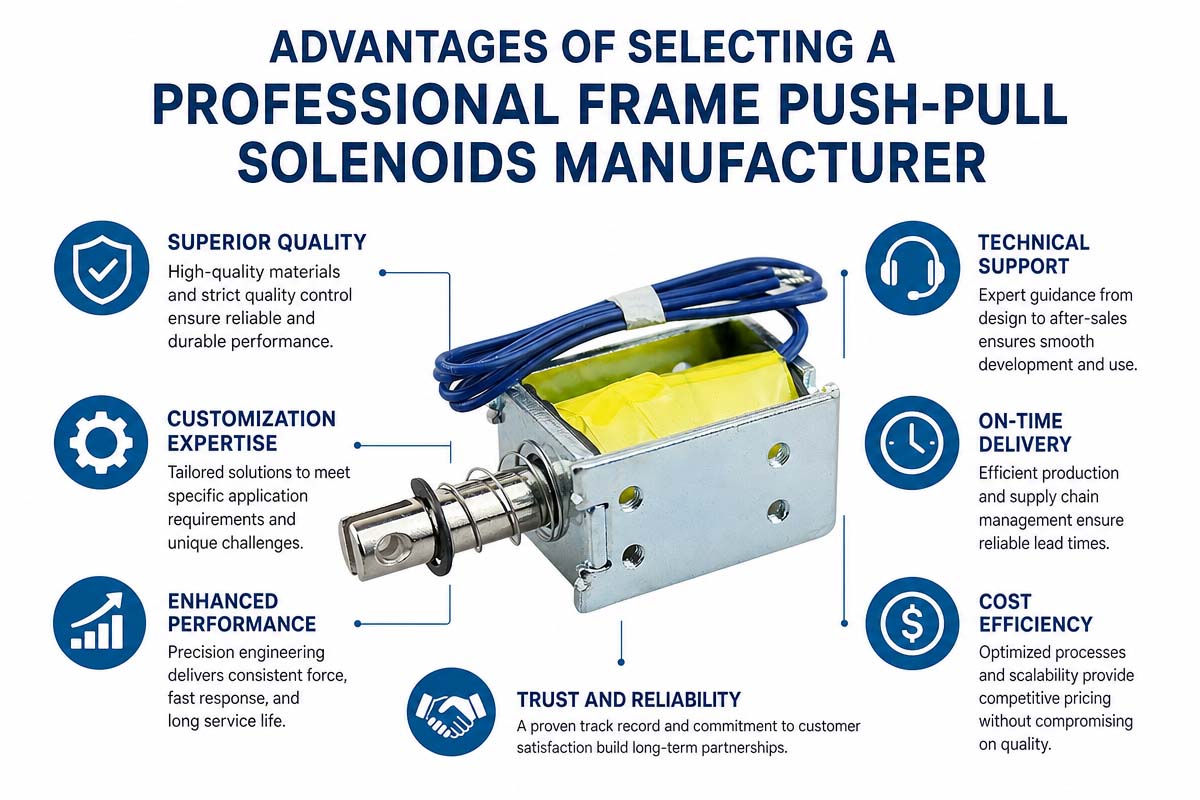
Custom Engineering Assistance
What can the professional manufacturer offer:
Magnetic design assistance
Mechanical optimization
Prototype design
Application testing
OEM Manufacturing Capability
Manufacturers support the following:
Custom products
Small batch samples
Large-scale production
Special specs
Quality Assurance
Professional production includes the following:
Material inspection
Production process control
Electrical testing
Reliability testing
Cost Effectiveness
Experienced manufacturers reduce costs by:
Optimization of design.
Automated manufacturing
Efficient use of materials
Chapter 9: How to Choose the Right Frame Push-Pull Solenoid Manufacturer?
Assessment of Technical Experience
A qualified supplier shall have the experience in:
Electromagnetic designs
Coil production
Mechanical engineer.
Development of industrial actuators
Confirmation of Production Capacity
Main production capacities include:
Coil-winding machines
Metal stamping
CNC milling
Assembly production
Testing facilities
Checking Customization Capability
A supplier shall assist with:
Special voltages
Different force requirements
Different mounting structures
Different operating conditions
Quality Management Review
Search for:
Quality certificates
Inspection systems
Reliability test capability
Traceability of production
Chapter 10: Advice to Avoid Common Mistakes in Choosing a Frame Push-Pull Solenoid Manufacturer
Choosing the right frame push-pull solenoid manufacturer is an essential step for engineers, OEM buyers, and equipment manufacturers. The wrong manufacturer can result in poor force performance, overheating, quality variations, delay in lead time, and unexpected development costs. Both the technical capabilities and production reliability of a manufacturer need to be evaluated by the buyer before purchasing the product.
1. Do Not Choose Frame Push-Pull Solenoid Manufacturer Based on Unit Price Alone
It is possible to choose the most inexpensive frame push-pull solenoid manufacturer, but the quality of the product might be unacceptable because the manufacturer will use cheaper materials (e.g., worse magnetic materials, wires, springs, or coatings). Compare the technical specification, quality management systems, tooling cost, sample cost, manufacturing cost, and lifetime of the product before ordering.
2. Make Sure the Frame Push-Pull Solenoid Manufacturer Can Provide a Customized Design
In many cases, the dimensions, force, voltage, stroke, mounting holes, terminals, and return spring must be customized. One of the common mistakes when choosing a manufacturer is choosing a company that can only produce standard models without sufficient engineering capabilities. It is necessary to make sure that a qualified frame push-pull solenoid manufacturer can optimize the magnetic circuit, coil, plunger, housing, spring, and mechanical structure for the specific application.
3. Define Push and Pull Forces Precisely
Frame push-pull solenoids are intended to move the plunger linearly in two directions, but it is possible that the forces needed for pushing and pulling are different. The customer should specify the required force at a certain stroke, voltage, temperature, and duty cycle. Never choose a manufacturer based on the maximal or initial value of force. Request the force-stroke curve from the supplier.
4. Take Into Account Operating Duty Cycle and Thermal Performance
Another common mistake is forgetting about the operating duty cycle of a frame push-pull solenoid. An intermittent solenoid might overheat if it is operated continuously. Before ordering the product from any manufacturer, define what kind of duty operation is required (10%, 25%, 50%, or 100%). The supplier should estimate the temperature rise of the coil and advise you on what wire size, resistance, and other parameters you need.
5. Inspect the Quality Control and Testing of the Product
The qualified manufacturer should have specified procedures for material inspection, coil winding, assembling, measuring the electrical characteristics of the product, and evaluating its force, stroke, and other parameters. Ask if it is possible to get the inspection report or custom test procedure for your application. An ISO-certified manufacturing process and internal testing laboratory can give you additional assurance for industrial applications.
6. Inspect Manufacturing and Tooling Capabilities
Frame push-pull solenoids require precision metal components, plastic parts, coils, springs, and assembled magnetic circuits. A manufacturer with in-house or controlled by him tooling, stamping, injection molding, CNC manufacturing, coil winding, and assembling capabilities can provide you with better dimensional control and quality assurance.
7. Check Sample and Mass-Produced Product Consistency
While the prototype might be very good, the mass-produced products can be less consistent. Before accepting the supplier, ask him how he controls the production consistency. The sample approval should include the dimensional measurement, force measurement, voltage measurement, temperature test, noise test, and life-cycle test if it is required.
8. Consider the Lead Time and Stable Supply of the Products
Do not concentrate only on the sample delivery time. Ask the manufacturer about tooling development time, sample delivery time, manufacturing time, minimal order quantity, monthly capacity, and backup manufacturing. A reliable frame push-pull solenoid manufacturer should be able to support your development and stable supply of the product.
Chapter 11: Future Trend of Frame Push-Pull Solenoid
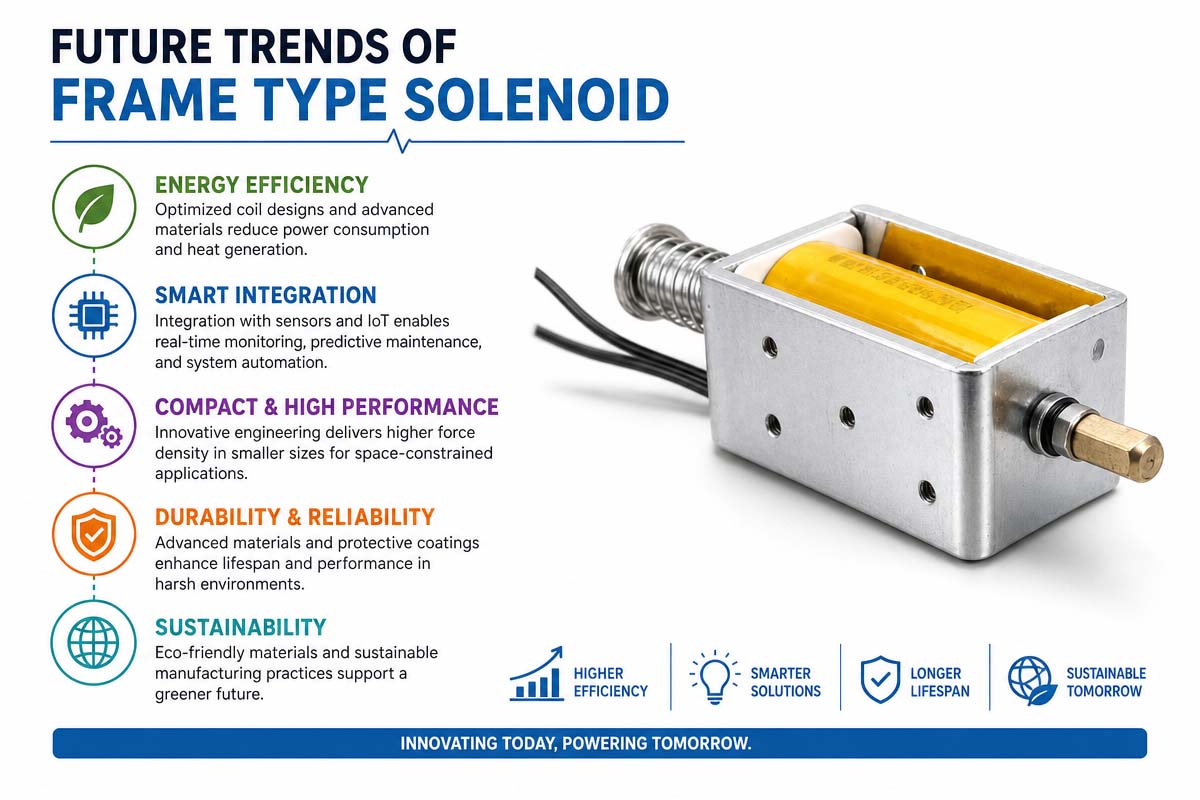
The demand for efficient electromagnetic actuators keeps growing for industrial automation and intelligent equipment.
The future trends in frame push-pull solenoid design are
Increased force/volume
Decreased size of the actuator
Reduction of energy consumption
Increased durability
Integration of smart actuators
Performance of frame solenoids in industrial applications will keep improving due to advanced manufacturing technology.
Chapter 12: Summary
Selection of the right frame push-pull solenoid Manufacturers are essential for customized electromagnetic motion development.
For many years we have been supporting our customers with frame-type solenoid applications, starting from design analysis and magnetic optimization to prototype testing and mass production.
Custom frame push-pull solenoids with professional engineering capability, advanced manufacturing processes, and strict quality control provide reliable performance to automation, automotive, medical, security, and commercial equipment industries.
Chapter 13: FAQ of Frame Push-Pull Solenoid Manufacturers
1. What is the Frame Push-Pull solenoid manufacturer?
Frame Push-pull solenoid manufacturer is a professional supplier of frame-type electromagnetic actuators, which offer customized force, stroke, voltage, and mechanical structure for industrial applications.
2. Can the push-pull solenoid frames be custom made?
Yes. Frame solenoids can be customized according to application requirements like size, voltage, force output, stroke length, mounting design, and connector options.
3. What are the advantages of frame-type solenoids?
The frame-type solenoids offer advantages like high force output, flexible installation, good heat dissipation, strong mechanical structure, and reliable long-term operation.
4. In which sectors are frame push-pull solenoids used?
It is widely used in industrial automation, automotive systems, medical equipment, security devices, vending machines, and commercial equipment.
5. How to choose a reliable frame push-pull solenoid manufacturer?
Choose a supplier with solid engineering experience, custom design capability, production equipment, testing facilities, quality control systems, and OEM manufacturing experience.


