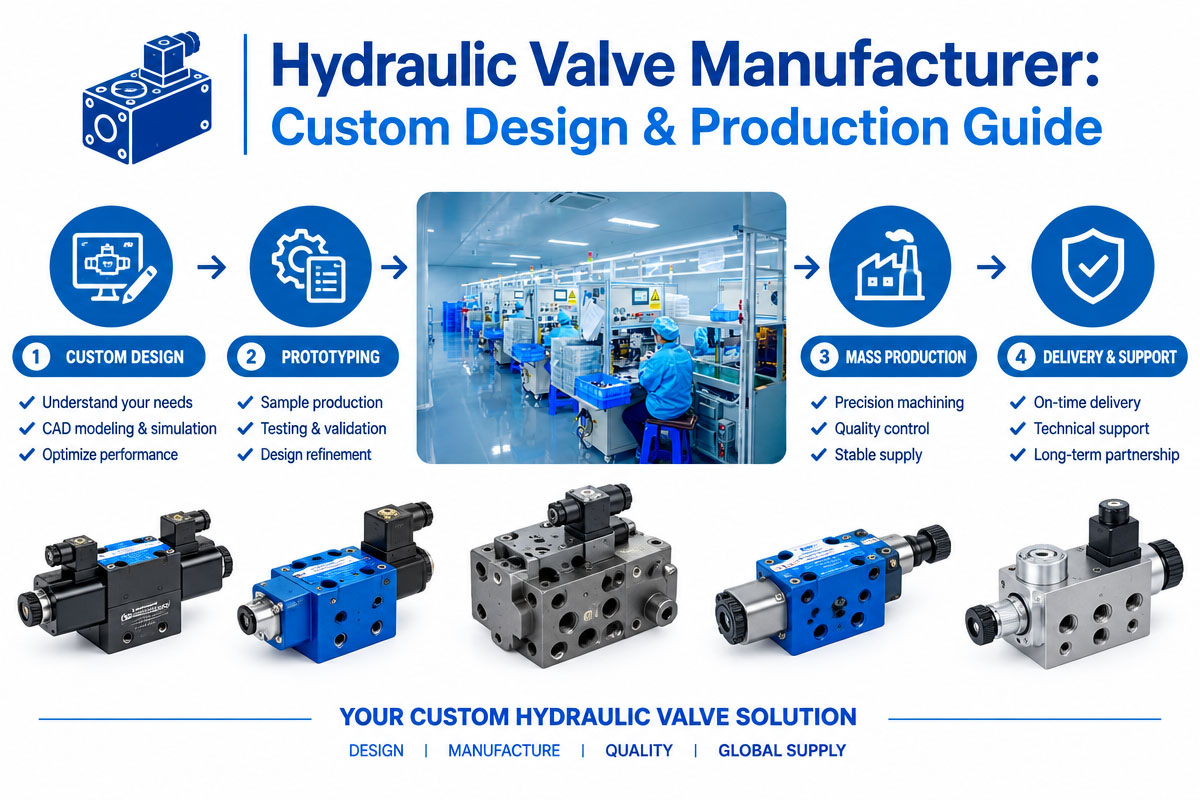
Chapter 1: Introduction of Hydraulic Valve Manufacturer for Design & Production Guide
Choosing the right hydraulic valve manufacturer can be very important for OEMs, engineers, equipment manufacturers, and procurement professionals of any industry.
Not everyone realizes that valve design can impact the pressure control, actuator movement, reaction time, energy consumption, reliability, and even performance of the hydraulic equipment.
For normal applications the ready-made valve is enough; however, some systems need customized sizes, pressure ranges, flow ranges, electrical requirements, special seals and mounting methods, and solenoid actuation.
In that case the experienced hydraulic valve manufacturer can offer a versatile approach in the design phase, prototyping, and mass production.
Below we review some of the key issues when sourcing custom hydraulic valves, starting from design requirements and materials, through electromagnetic actuation, prototyping, testing, quality control, production, and OEM cooperation.
Chapter 2: What is a hydraulic valve?
A hydraulic valve is a mechanical or electrical component that controls the hydraulic fluid inside a system.
Depending on the design of the valve, it regulates the direction of the fluid, its pressure, flow rate, or the hydraulic actuator operation.
The following kinds of hydraulic valves exist:
Control Valves (Directional)
Pressure relief valves
Pressure relief valves
Flow control valves
Check valves
Proportional valves
Cartridge valves
Hydraulic solenoid valves
There are many different operating mechanisms, including manual operation, mechanical, hydraulic, pneumatic, and electrical.
In automatic equipment electromagnetic solenoids drive the hydraulic valves. This allows for regulating fluid movement electronically and repeatedly.
The hydraulic valve manufacturer has to have knowledge about the hydraulic engineering and solenoid design for custom solenoid-operated valves.
Chapter 3: Why Choose a Custom Hydraulic Valve Manufacturer?
Standard hydraulic valves are for general applications, but the OEM equipment has its own specific mechanical and electrical requirements.
The custom hydraulic valve manufacturer can design the product based on the actual conditions of equipment operation, instead of adapting the equipment design to the valve.
Among the customization needs can be:
Custom sizes of valves
Special holes or threads for mounting
Different port configuration
Custom pressure and flow range
Specified response times
Special Sealant Composition:
tailored voltage
AC/DC operation
Different solenoid dimensions
Special configuration of connector or cable
Custom surface treatment
Heat-resistant materials
Small installation dimensions
The custom design can also allow optimization of the valve and actuator operation for the entire system, which is crucial in large-volume OEM projects.
Chapter 4: Important specifications to provide to hydraulic valve manufacturer
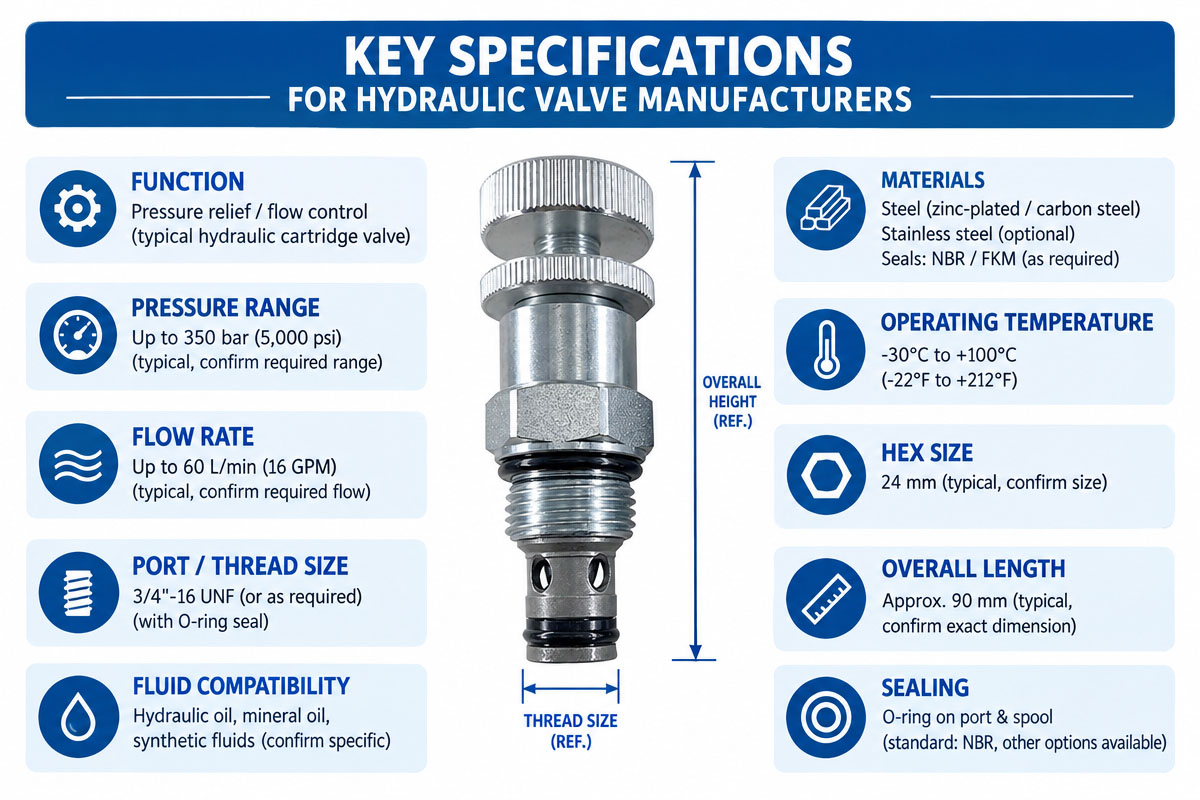
Before submitting a quotation request, the buyer has to collect as much technical information as possible. The full specifications will help the hydraulic valve manufacturer to determine the feasibility and to avoid wasted design iterations.
4.1 Medium hydraulic
Specify the working fluid for the system.
Some important data could be
Type of hydraulic oil
Viscosity of fluids
Fluid temperature
Requirements for fluid compatibility
Aggressive or corrosive media, if applicable
Material selection and seal design can depend highly on the hydraulic medium.
4.2 Working Pressure
The pressure is one of the key parameters in the hydraulic valve design.
We would like to know:
Operating Pressure
Minimum pressure
Maximum pressure
Temporary or peak pressure
“Need pressure holding capacity
The valve body, spool, seals, spring, ports, and other parts shall be designed according to the actual pressure conditions.
4.3 Rate of Flow
Flow requirements define the internal geometry of the valve and pressure drop.
The buyer shall provide:
Lowest flow.
Normal flow of
Maximum flow
Flow accuracy requirement
Acceptable pressure loss
The valve with too small flow capacity can limit the hydraulic system, while the valve with excess internal capacity can increase the physical size and cost.
4.4 Function of the Valve
State clearly how the valve should operate in the equipment.
For example:
Open and close the hydraulic circuit.
Change the direction of the flow.
Regulate actuator motion.
Maintain the pressure.
Release the pressure.
Flow regulation
Prevent backflow
Hydraulic circuit switches
A simple description of the application will help the hydraulic valve manufacturer to understand the principle of operation of the valve.
Chapter 5: Design of Hydraulic Solenoid Valve
The solenoid is one of the important components of the valve assembly, used in electrically driven hydraulic systems.
A solenoid is a device that converts electrical energy into mechanical motion. Upon actuation, it generates the magnetic field that produces electromagnetic force driving the plunger or armature. This movement operates the spool, poppet, or other valve mechanism.
The hydraulic valve manufacturer has to take into account the relation between the electromagnetic force and the hydraulic load.
Some of the key parameters of the solenoid are
Rated voltage.
Operating voltage range:
Resistance of coil
Present
Power usage
Duty cycle.
Electromagnetic force requirement
assault
reaction time
Temperature (ambient)
Requirements for thermal insulation
Service life expectancy
The EM force changes during the stroke. That is why it is better to estimate the force at the actual place of work, not only at the maximum value.
Chapter 6: Voltage and Power Requirements
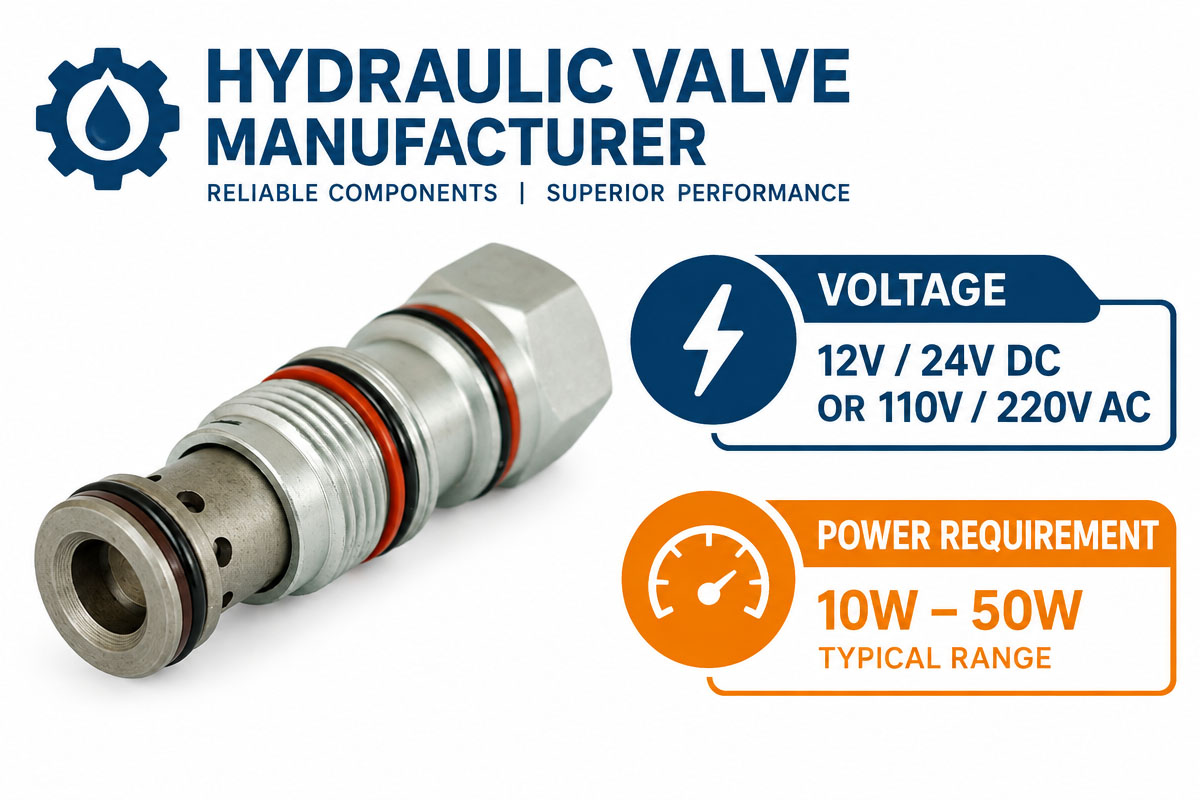
Some of the usual solenoid valve voltages are 12 VDC, 24 VDC, 110 VAC, and 220 VAC, but there are many other configurations for special equipment.
The hydraulic valve manufacturer has to check the complete electrical operating range, not just the nominal voltage for the OEM applications.
For example, the valve designated as 24VDC requires reliable operation within a specified range of voltage tolerance. Design has to consider coil heating, magnetic force, current variations, and control system.
The power consumption also becomes an issue in battery-powered or energy-sensitive equipment. The lower power coil will save the energy and heat generation, but the electromagnetic force still has to meet the working conditions.
Chapter 7: Mechanical design considerations
The mechanical integration is another important aspect in the custom hydraulic valve design.
The valve might be installed in a limited installation space. It is strongly recommended to provide the drawing, 3D model, or dimensional envelope.
The main mechanical parameters are
Total dimensions
Dimensions of port
Port thread
Mounting holes
Installation orientation
Diameter of the plunger or spool
CVA
Connector location
Direction of cable exit
Weight/
tolerance
If the installation space is limited, inform the hydraulic valve manufacturer in the beginning of the project. The compact dimensions can affect the internal hydraulic circuit, solenoid size, coil design, materials, and manufacturing process.
Chapter 8: Materials and Surface Treatments
Material selection is done depending on the pressure, temperature, fluid compatibility, corrosion resistance, mechanical strength, and production requirements.
Some of the common materials are
Stainless steel
Carbon steel.
Aluminum alloys
Brass.
Engineering polymers
Copper
Magnetic steels for electromagnetic devices
Dependent on the environment, there might be a need for surface treatment.
Some possibilities are:
Nickel plating
Zinc coating (g)
Black oxide
Passivation (chemistry)
Anodizing
Protective coatings
The right surface treatment has to be selected depending on the actual environment instead of choosing the most corrosion-resistant one.
Chapter 9: Sealing and leakage requirements
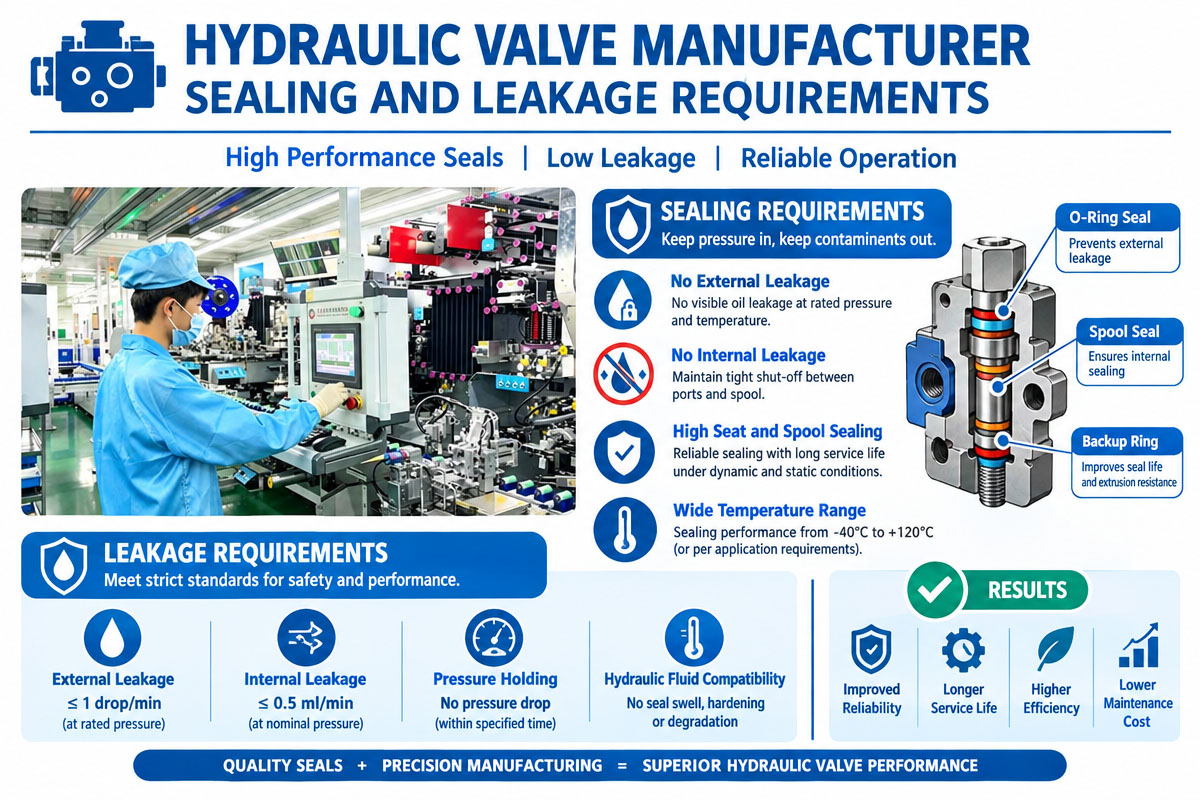
The hydraulic valve performance is important for the internal and external leakage.
The seal choice depends on the following parameters:
Hydraulic oil
Force
Temperature:
Valve capacity
Chemical compatibility
Life expectancy on duty
The hydraulic valve manufacturer has to consider the working fluid and temperature range along with the seal materials.
Depending on the application, the buyer can also specify the leakage limits or require a pressure holding test during the production.
Custom hydraulic valve prototype design
“[The] prototype development enables the engineers to validate the design before mass production.
The typical custom valve design process includes:
Check customer specifications.
Application evaluation
Check hydraulic requirements.
Mechanical design. 2.
Design of the electromagnetic actuator if necessary
Creating 3D models or engineering drawings
Creation of mockups
Functional testing
Review of test results
Redesign if necessary.
Approval of the final specimen
Starting the production
The professional hydraulic valve manufacturer has to clearly inform which specifications were validated by the engineering and which still have to be validated.
The prototype testing is especially valuable for applications with tight pressure, temperature, life, or dimensional requirements.
Chapter 10: Testing of the Custom Hydraulic Valve
The tests have to simulate the real operating conditions of the application.
Depending on the project, the tests can include:
Pressure Testing
The valve is tested at specified pressure conditions for checking the structural integrity and sealing performance.
Flow test
Flow rate and pressure drop can be estimated under specified operating conditions.
Leak test
Internal and external leakage is checked up to the required limits.
Electrical test
The testing of the solenoid operated valve includes:
Resistance of coil
Current usage
Power usage
Insulation resistance
Festigkeit der Dielektrik
Chapter 11: Electromagnetic performance
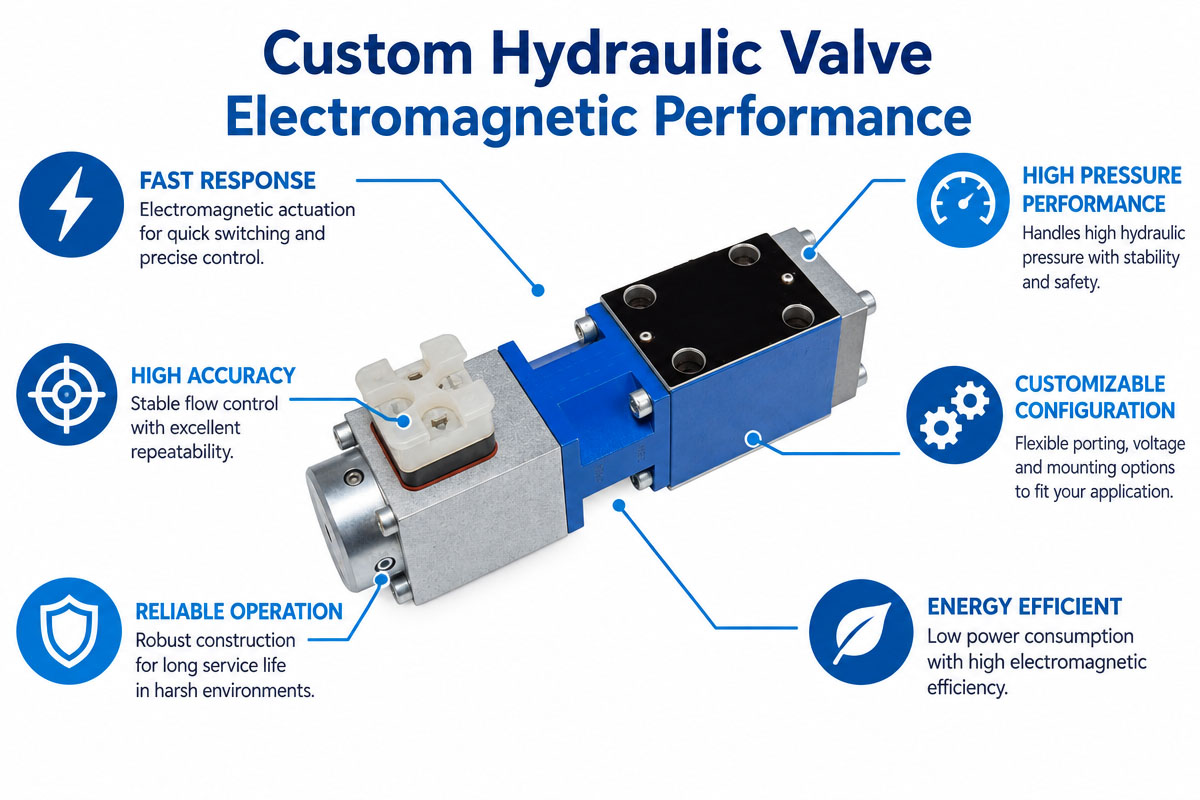
Temperature Test
The valve is tested at specified ambient or fluid temperatures to check the operation performance.
Life Test
The repeated operation is used for evaluation of the mechanical wear, solenoid performance, seal reliability, and lifetime.
The exact test plan will be determined depending on the application and customer specifications.
Quality control in the manufacture of hydraulic valves
The quality control has to be done not after the completion of the production process. “It has to be built into the whole manufacturing process.
A good hydraulic valve manufacturer can inspect the products at different stages.
Receiving Inspection (RI)
The materials and the bought-in components have to be verified according to the specifications prior to using them in production.
Machine inspection
The critical dimensions, tolerances, threads, ports, and surfaces have to be inspected during the machining.
Chapter 12: Assembly Inspection
Assembly procedures have to govern the component orientation, torque, sealing elements, springs, spools and coils and connectors.
Final functional test
The finished valves have to be tested according to the agreed inspection plan.
For OEM projects, the buyer can also ask for inspection reports, test records, material declarations, or certificates.
Important production capabilities to consider
The buyer has to think not only about the final product when choosing the hydraulic valve manufacturer.
Some of the useful manufacturing capabilities are
CNC machining.
Precision turning
Metal stamping
Injection molding
Coil, winding
Tool manufacturing
Component assembly
Surface treatment
Automated testing
Dimensional inspection
Chapter 13: Electromagnetic performance testing
It is much easier to communicate about the project information and to get better control of the custom components when one manufacturing organization provides several key processes.
For example, in the case of the hydraulic valve with the custom solenoid, the manufacturer might have to coordinate the valve body, magnetic circuit, coil, plunger, spring, seals, and final assembly.
OEM and production in volume
After approval of the prototype, the project goes to the production engineering stage.
At this stage the hydraulic valve manufacturer has to check:
Final drawings
Approved materials
Tolerances for production
Quality standards
Packaging.
Labeling
Inspection criteria.
Production volume
Delivery schedule
The consistency of the production becomes especially important in larger OEM projects. The manufacturing process has to be reproducible enough to produce the approved prototype in many production batches.
The supplier has to have a defined procedure for handling nonconforming components and quality feedback from the customers.
Chapter 14: Choosing the Right Hydraulic Valve Manufacturer
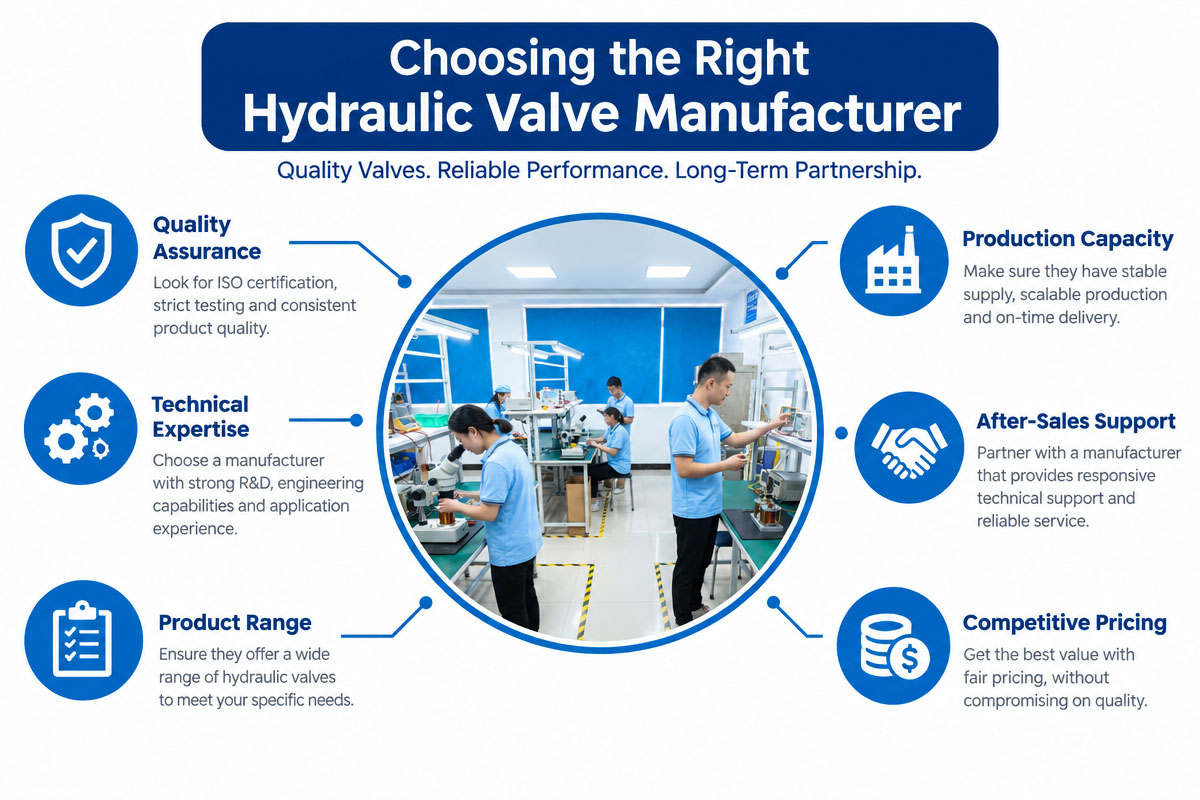
Buyers should pay attention to certain objective parameters while comparing different suppliers.
Capacity engineering
Is it possible to modify the design according to your pressure, flow, electrical, mechanical, and environmental parameters?
Production capability
Does the manufacturer have sufficient machining, assembly, coil winding, testing, and production capabilities?
“Customization experience”
Make sure that the supplier has similar customization experience in hydraulic, industrial automation, mobile equipment, medical, automotive, and other industries.
Quality System
Check the quality management system of the manufacturer and certifications.
Testing capability
Make sure that the manufacturer has the capability to perform the testing that is needed for your application.
Communication 6.
In order to develop a custom product, you need to communicate clearly. You should document all technical questions, drawings, sample feedback, and engineering changes.
Production capability
For OEM projects, make sure that the manufacturer will be able to support prototype quantities and production quantities.
Questions to ask prior to ordering from an OEM hydraulic valve manufacturer
Procurers and engineers may ask prior to ordering:
Could you produce the valve according to our drawing?
Do you offer customized hydraulic and electromagnetic design?
What are your pressure and flow ratings?
What voltages and coil configurations do you offer?
Yes, we can manufacture prototypes before the mass production.
What functionality tests will be performed?
The materials available are:
Could you meet our dimensional tolerances?
What is your standard production lead time?
What quality documentation do you provide?
What is the minimum order quantity?
OEM production support
These questions can help buyers to compare suppliers on their real project needs, not only price.
Chapter 15: Typical Process of Custom Hydraulic Valve Development
The six stages of OEM workflow can be distinguished.
Step 1 – Requirements Review
The customer provides drawings, specifications, application data, operating conditions, and expected quantities.
Step 2 – Engineering Review
The hydraulic valve manufacturer considers hydraulic, mechanical, electromagnetic, material, and manufacturing requirements.
Step 3 – Design & Quotation
The supplier develops the first design and provides technical and commercial data.
Step 4 — Prototype
Samples are manufactured and tested according to the agreed specifications.
Step 5 – Approval of design
The customer approves the prototype and approves any changes.
Step 6—Mass Production
After the final approval the supplier sets up the production control and produces the required quantity.
Such a process can help to reduce miscommunications and make sure that the production version is the approved design.
Factors Influencing Cost of a Custom Hydraulic Valve
The cost of a custom hydraulic valve depends on much more than the raw material cost.
These are the main cost factors:
Valve size
Materials:
Pressure Ratings
Complexity of machining
Number of components
Precision
Specifications of solenoid
Power of coils
Tooling requirements
Surface treatment
Tests
Production quantity
Packaging
Certification requirements
Customized prototypes cost more than the production parts since the costs of tooling, engineering, setup, and testing are divided among fewer pieces.
During the production programs, the optimization of unit price can usually be achieved after validation of the design and manufacturing process.
Chapter 16: Summary
The custom hydraulic valve project requires close cooperation between the buyer and the hydraulic valve manufacturer. The main aspects are hydraulic pressure, flow, valve function, dimensions, materials, sealing, electrical specification, electromagnetic force, operating temperature, life requirements, and testing.
Choosing the manufacturer that has engineering and manufacturing capabilities can ease the process of customization of OEM applications. Each stage of development, from initial design and prototype manufacturing to testing, quality control, and production, should be developed according to clearly stated technical requirements.
For the quotation, please provide application data, drawings or 3D models, hydraulic specifications, electrical specifications, environmental conditions, expected life, quantity, and testing requirements. The more complete the information is, the more accurately the hydraulic valve manufacturer can evaluate the project and develop a custom solution.
The target for the companies developing custom hydraulic equipment is the stable, manufacturable, testable, and application-specific valve, not only the lowest initial unit price.
Chapter 17: Hydraulic Valve Manufacturers – FAQs
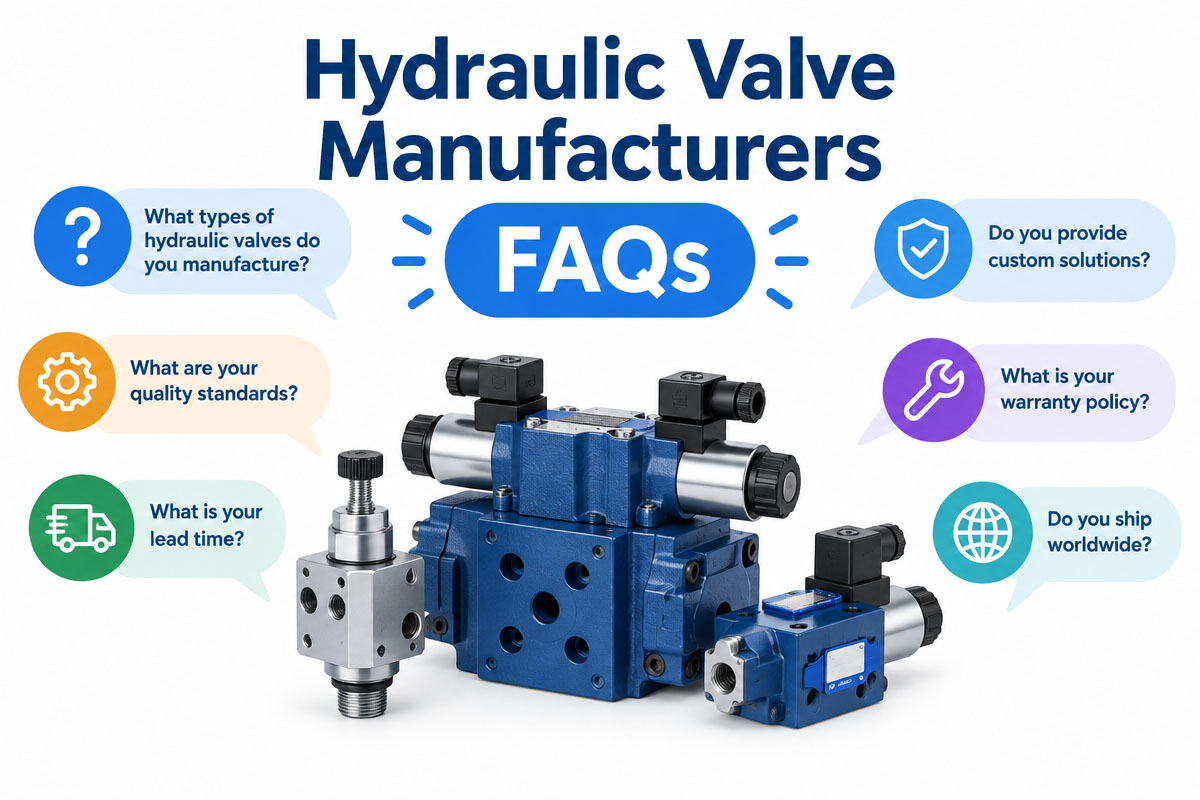
1. Could a hydraulic valve be fitted with a custom solenoid?
Yes. Electrically actuated hydraulic valves could be fitted with custom-designed solenoids that are designed according to the required voltage, stroke, electromagnetic force, response time, duty cycle, dimensions, and environmental conditions.
2. How long does it take to develop a custom hydraulic valve?
Development time depends on the complexity of design, tooling requirements, number of prototypes, testing requirements, and customer approval cycles. The simple customization takes less development time than the complete redesign of the hydraulic and electromagnetic system.
3. What tests are needed to be done on the custom hydraulic valve?
Testing can include pressure, flow, leakage, electrical performance, temperature, response time, and life-cycle testing, depending on the application. It is important to agree on test requirements prior to prototype manufacturing.
4. What is the difference between the supplier and the manufacturer of the hydraulic valve?
The supplier can source products from other factories. Hydraulic Valve Manufacturer controls engineering, production, assembling, and quality processes. The buyer should verify the real production capability of the supplier.
5. Could the hydraulic valve manufacturer support mass production of OEM?
Yes. Many manufacturers support the full OEM process from designing and prototyping samples to producing tooling, validating manufacturing processes, inspecting quality, assembling, packaging, and repeat manufacturing.
6. How can I optimize the cost of a custom hydraulic valve?
The cost can often be optimized by the use of appropriate materials, reduction of mechanical structure, elimination of unnecessary tolerances, optimization of solenoid design, choice of efficient manufacturing process, and increase of production quantity where appropriate.
7. Why is it important to test a prototype before mass production?
Prototype testing is needed in order to make sure that hydraulic, mechanical, electrical, and environmental requirements are met before mass production quantities are committed. Also, it helps to find design or integration problems.
8. What to look at while choosing a hydraulic valve manufacturer?
Review the engineering capability, manufacturing process, customization experience, testing capability, quality management, production capability, communication, lead time, and documentation capability.