Introduction to DC Linear Solenoid Actuator
A DC linear solenoid actuator is an electromagnetic device that converts electric energy into mechanical energy in a linear manner. It is commonly used for industrial automation, electronic locks, vending machines, medical equipment, and automotive components, among other applications that require the use of controlled linear movement.
For equipment builders and engineers, selecting the actuator is not only a matter of choosing the voltage or size. The performance of the actuator depends on factors such as the force, stroke length, response time, duty cycle, installation space, and environment of use.
The understanding of the working principle of the DC linear solenoid enables product designers to choose the right solution, increase equipment reliability, and save unneeded costs of development.
This article describes the working principle, main components, performance, industrial applications, and selection parameters of the mentioned electromagnetic actuators. Furthermore, we will present Weilong Intelligent Technology (Dongguan) Co., Ltd., which provides custom-made solenoid and inductor coils for OEM and industrial applications.
2. DC Linear Solenoid Acutoat—What Is It?
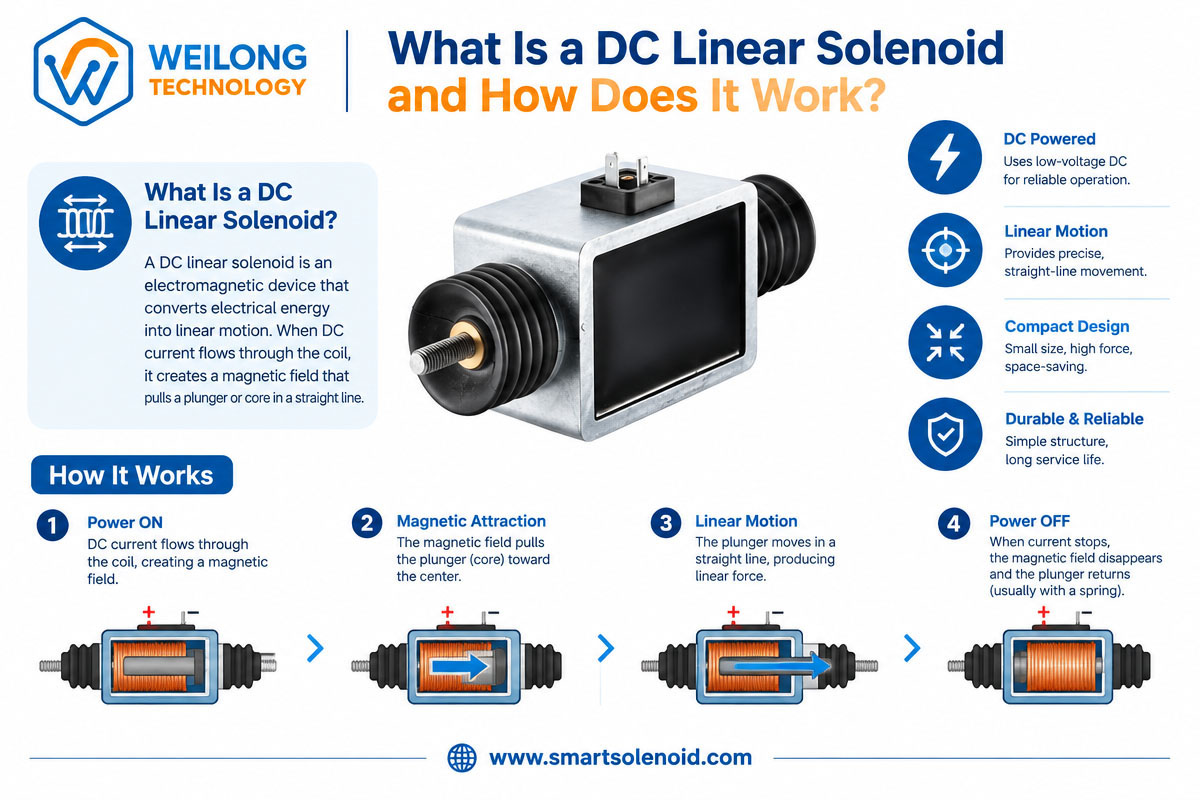
If the DC passes through the coil of the linear solenoid (the electromagnetic device), then linear movement is created. The actuator may be designed in order to pull in the plunger, push a mechanism out, or operate a mechanical linkage.
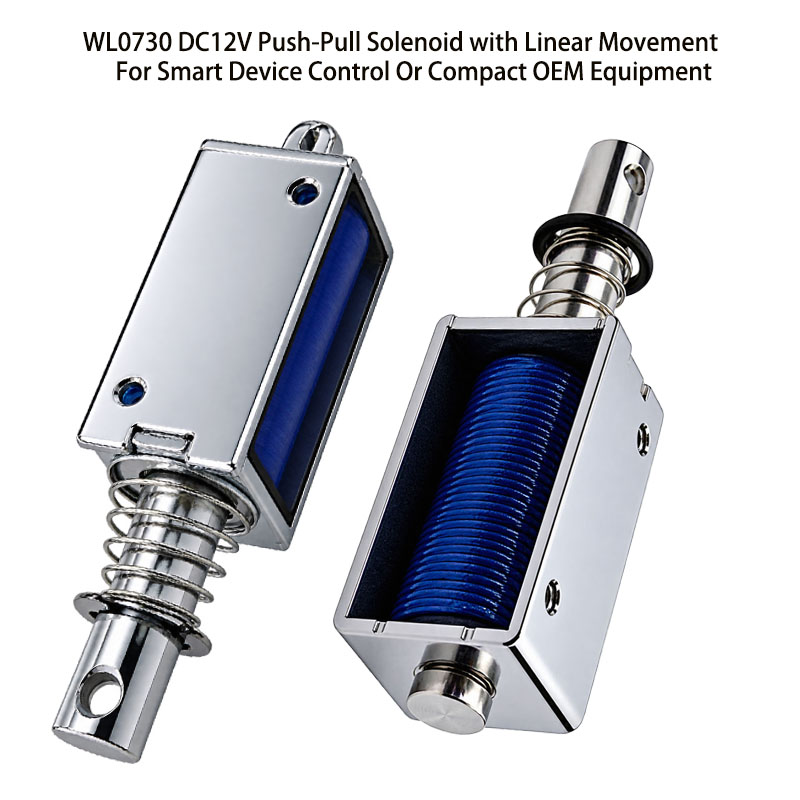
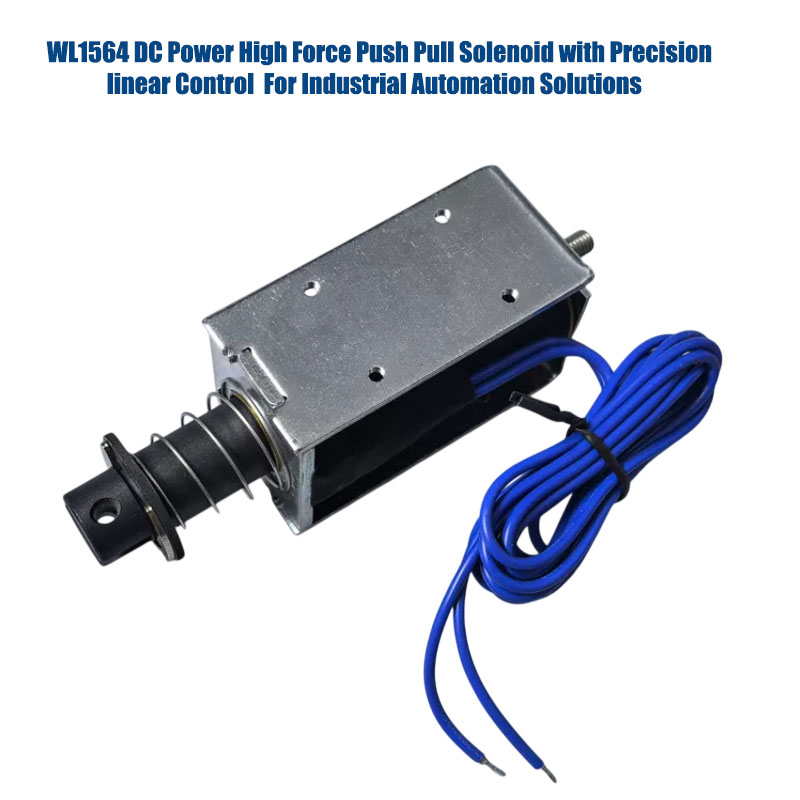
The main components are usually the coil, magnetic core or frame, movable plunger, housing or mounting construction, and optionally a return spring.
In case you pass electric current through the coil, you create a magnetic field. This field creates a magnetic force that moves the plunger to the position of the lower magnetic reluctance. Usually it takes place deeper within the energized assembly of the coil.
And then the plunger can move a latch, release a lock, open or close something, or move another mechanical component.
DC linear solenoids refer to a relatively simple way of generating the direct short movement compared to other motors and positioning systems. Compact design makes the solenoid particularly suitable for applications in which the mechanism moves between fixed points.
2.1 Varieties of the DC solenoids are:
- Tubular solenoids—cylindrical devices that are ideal for uses where the closed magnetic assembly is required.
- Open-frame solenoids—frame-type devices that can provide flexible mounting and straightforward integration.
- Push-type solenoids are designed to produce the push movement of a suitable mechanism.
- Pull-type solenoids are usually designed to pull the plunger when energy is applied.
- Spring-return solenoids—return to their initial position after removal of the power.
- Custom linear solenoid—customized for your force, stroke, dimensions, and electrical requirements.
Selection of the appropriate design is provided by the movement required, mechanical load, space available, and operating environment.
3. How Does a DC Linear Solenoid Actuator Work?
The working principle is based on electromagnetism. By means of magnetic force, a ferromagnetic plunger is moved as the result of electrical current creating the magnetic field.
The normal operating cycle includes the next steps.
3.1 DC Power Application:
After energizing the coil from the DC power source, the current passes through the winding. The current creates the magnetic field in the area of the coil and a magnetic circuit through the core, plunger, and other magnetic parts.
The current and magnetic field depend on the coil resistance, supply voltage, winding design, and temperature.
3.2 It Creates the Magnetic Force:
A magnetic circuit is specially created in such a way that the movable plunger would be attracted to the position with the lowest magnetic reluctance. The force depends on the flux, air gaps, materials, coil properties, and the plunger geometry.
In many traditional designs, the possible force increases once the plunger is in the fully attracted position. And hence, the force in the beginning and in the end of the stroke can be quite different.
3.3 The Plunger is Moving
The plunger moves its stroke and the mechanical component attached to the actuator. It can open a pin, shift the lever, open the valve, or perform any other mechanical operation.
Usable output force must be able to exceed the load, spring force, friction, and other mechanical forces throughout the movement.
3.4 Solenoid Returns To The Original Position
After removal of the power, the magnetic field dissipates. In the spring return design, the spring pushes the plunger back to its initial position.
There are some other designs depending on the external mechanical returning mechanism. Also, there is a latching solenoid that can keep its position without any power under some special conditions.
According to application safety requirements and operation cycle, the design of the returning mechanism should be selected.
4. What Are the Main Components?
The understanding of how a DC linear solenoid is assembled helps engineers estimate its performance and customize the actuator.
4.1 Electromagnetic Coil
The coil is created from the insulated wire, which wraps the coil bobbin or any other supporting structure. The diameter of the wire, the number of turns, the resistance, the insulation system, and the winding construction influence its electric consumption, magnetic performance, and temperature rise.
The coil, which can work for a short period of time, is not supposed to work continuously at the same voltage. 3.2
4.2 Frame and Magnetic Core
The magnetic core, yoke, and frame serve to guide the magnetic flux through the whole assembly. Materials, their geometry, and other aspects influence magnetic efficiency, mechanical strength, and overall size of the actuator.
Open frame construction allows for the provision of practical mounting options. And tubular construction is proper for cases when enclosed construction is necessary.
4.3 Movable Piston
The plunger serves for the transmission of the electromagnetic force to the target mechanism. Its performance depends on diameter, materials, finish, alignment, and travel distance.
Slow movement, inconsistent force, or mechanical sticking is caused by wrong alignment and excessive friction.
4.4 Spring Return
After the coil is de-energized, the spring returns the plunger to its required position. The electromagnetic force must overcome the spring force.
A too-powerful spring will decrease the net force, and a too-weak spring cannot guarantee reliability.
3.5 Housing and Mounting Construction
The housing or frame holds the entire magnetic assembly and allows the actuator to be mounted in the customer’s equipment. The mounting holes, brackets, terminal positions, lead wire direction, and overall dimensions can be customized during the custom development process.
5. Main Performance Indicators
Firstly, an engineer needs to specify the mechanical and electrical requirements of the application before selecting the DC linear solenoid.
5.1 The Power
The force represents the mechanical output of the actuator in a specific plunger position. It is measured in Newtons (N) or gram-force (gf).
Force requirements should be tested over the entire stroke of the actuator, not only at the fully retracted or fully attracted positions.
In the case of the spring return designs, the usable force should take into consideration the spring resistance and mechanical friction.
5.2 Stroke Length
Stroke is the distance the plunger travels during operation. A short stroke of the actuator is enough to release the latch. But a longer stroke of the actuator is needed to operate a linkage.
Lengthening of the stroke influences the actuator size, magnetic performance, response time, and power requirement. Hence, the force and stroke should be considered simultaneously.
5.3 Voltage and Current (Nominal)
Standard DC operation voltages are 5 V, 12 V, and 24 V. Other voltages can also be used.
A coil of the actuator should be created for the intended supply voltage and electrical operating conditions. Engineers should consider current consumption, resistance, power dissipation, and voltage variation allowed.
5.4 Duty Cycle
Duty cycle is the ratio of the time the actuator is energized compared to the time of the whole operation cycle.
Intended duty cycle actuators are designed to work for short periods of time with adequate cooling time. While a continuous duty cycle is created to be operated under specified operating conditions.
Do not suppose that the solenoid is acceptable for the continuous operation just because it worked properly during the brief test.
5.5 Lifecycle and Response Time
Response time shows the speed of completion of the whole movement by the actuator. The operation is dependent on the electrical characteristics, magnetic design, mechanical load, spring force, friction, and drive circuit.
Cycle life is the number of operating cycles of the device under the specified test conditions. The tests should be carried out at the intended load, stroke, voltage, temperature, and activation frequency.
6. Applications of the DC Linear Solenoids
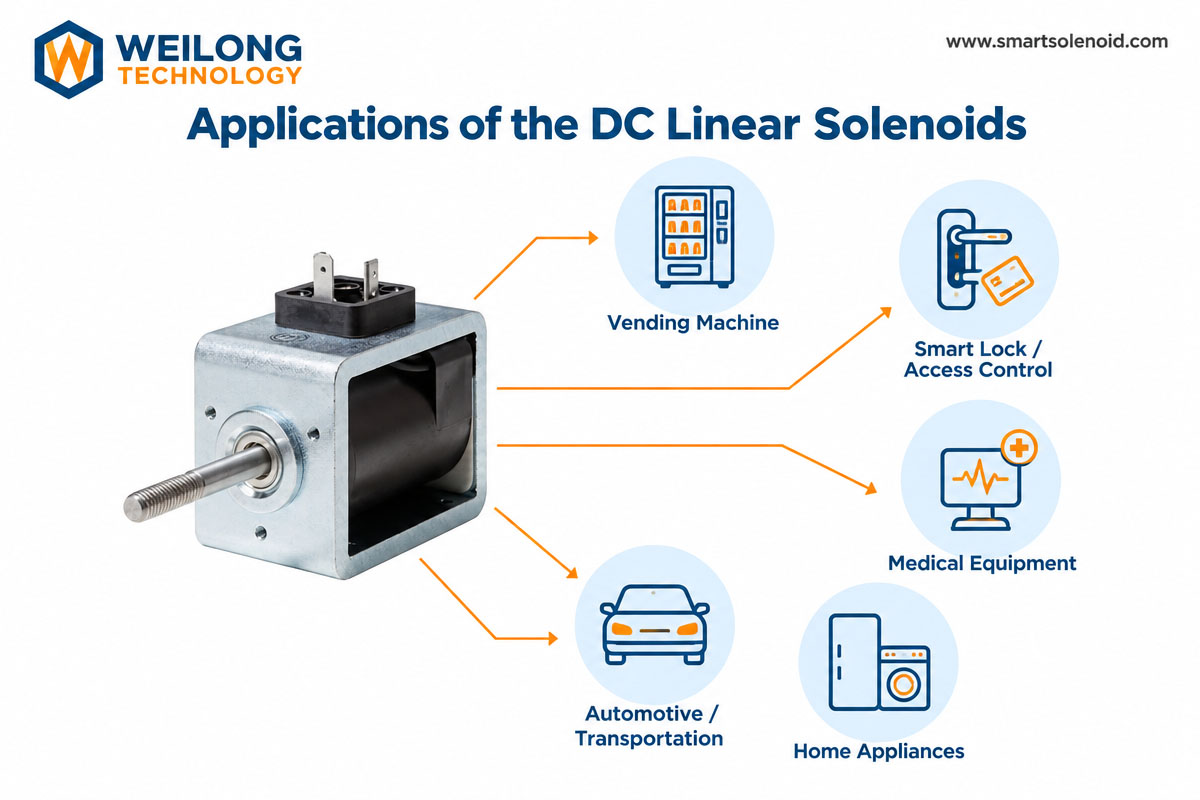
DC linear solenoids are widely applied in the various industries due to the fact that they provide compact electrically controlled linear movement.
6.1 Industrial Automation
Solenoids can be used to engage mechanical stops, position parts, release latches, or operate the feeders of the automatic equipment. They are useful for repetitive operations due to simplicity of control.
6.2 Electronic Locks & Access Control
Electromagnetic actuators are commonly used in locking systems to operate locking pins or unlock mechanisms. The designer should consider the needed force, the behavior of the mechanical return, power loss, and security requirements.
6.3 Vending & Dispensing Equipment
In vending machines and dispensing systems, DC linear solenoids are used for the dispensation of the products, control of the small mechanisms, or triggering of the mechanical action.
The selected actuator should be capable of operating at the required frequency and of withstanding the mechanical load of the dispensing mechanism.
6.4 Laboratory and Medical Equipment
Compact actuators are used in laboratory instruments, analytical equipment, and some medical devices. Such applications should comply with the requirements for noise, dimensions, operating temperature, and movement consistency.
Industry-specific safety and regulation requirements are important for equipment manufacturers.
6.5 Automotive and Transportation Equipment
Electromagnetic actuators can be used for the control of latches, adjusting mechanisms, and other electromechanical functions. Design considerations should include temperature variations, vibrations, operational cycles, and electrical transients.
6.6 Consumer and Business Equipment
Linear solenoids are helpful in printers, office equipment, intelligent devices, and other automated appliances to perform short movements without the need for large motorized assemblies.
Each application requires selection of the actuator according to actual load, movement, environment, and life span.
7. What Kind of DC Linear Solenoid Should You Get?
When choosing the right actuator, one should always consider all parameters of application and not merely choose a model according to voltage.
- Measure the force required. Measure the weight the plunger is supposed to move against, e.g., the spring’s resistance, friction, mechanical resistance, etc.
- Define the stroke. Measure the distance you want the device to move and determine the required force during starting, midpoint, and finishing the stroke.
- Describe the electrical power supply. State the rated voltage, allowable voltage range, maximum current, and power you can afford.
- Define the duty cycle. Measure the working and idle times.
- Verify the installation dimensions. Please state the maximum width, length, height, diameter of the plunger, mounting, and connection point.
- Define how the actuator should operate. If you need a pull, push force, spring return mechanism, external returning mechanism, or latching feature.
- Evaluate the environmental impact on the actuator. It is the temperature, dust, moisture, vibrations, corrosion, etc.
- Ask for technical validation. Ask your supplier to validate your proposed specifications. If needed, you can request the curve, sample, drawing, and test results.
When you clearly state the requirement, your vendor can propose a suitable actuator to avoid engineering changes again.
8. Custom DC Linear Solenoid Solutions at Weilong
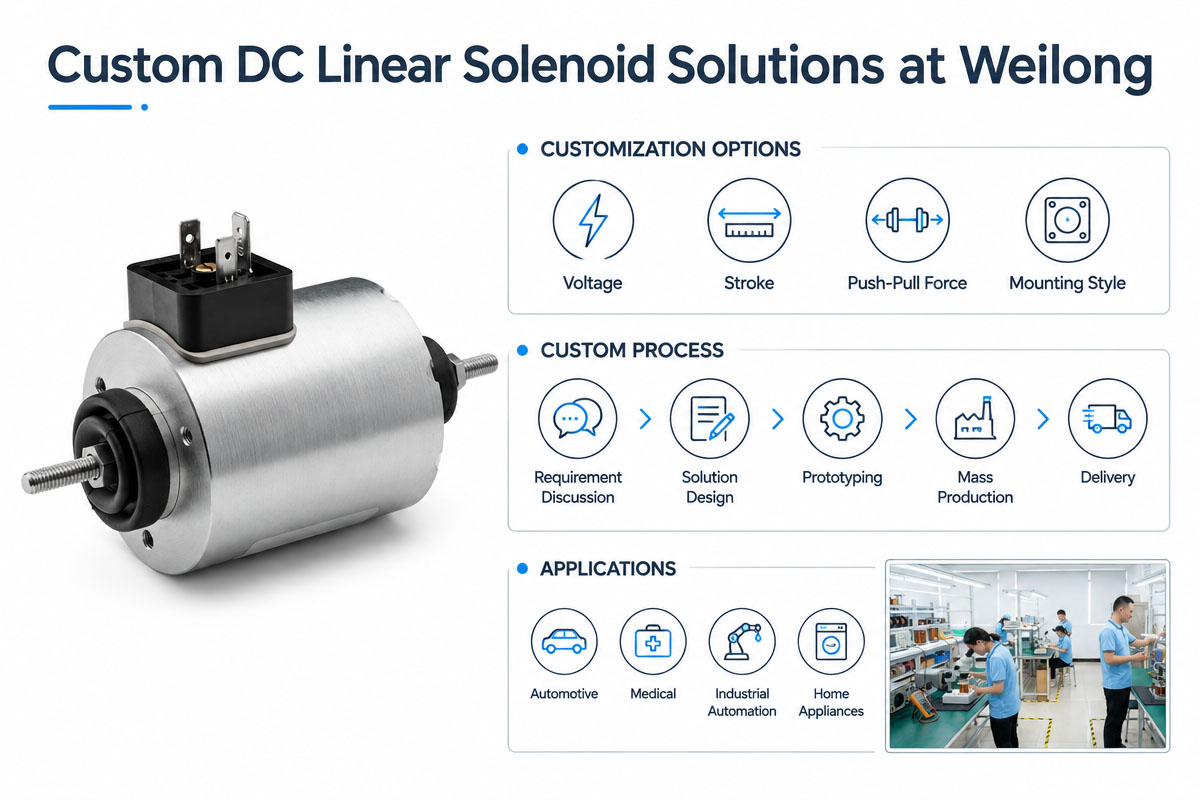
Weilong Intelligent Technology (Dongguan) Co., Ltd. is an experienced manufacturer of customized linear solenoids and inductor coils in accordance with specific requirements. Our company, established in 2007, manufactures electromagnetic devices for industrial purposes.
Unlike regular suppliers, Weilong designs customized DC actuators, taking into account your specific application.
It is manufactured using metal stamping, tooling, plastic injection molding, CNC machining, coil winding, assembling, and laboratory testing. We are able to design and manufacture custom solenoids in cooperation with our in-house capabilities.
Customizing Options
In accordance with the project, a custom solenoid for DC linear applications can be adjusted in terms of:
Stroke Length & Force
Rated voltage, current, and resistance of coil
Continuous or intermittent usage
Plunger diameter and mechanical construction
Overall Size and Mounting Arrangement
Features of the return spring
Lead wires, terminals, and mounting places
Finishing and materials
Work environment and annual output
Not all of them can be combined together into one product due to magnetic characteristics, available space, heat dissipation, and project costs.
From Requirement to Mass Production
The typical development process of a customized actuator is an application review, technical specifications validation, engineering design, manufacturing the prototype, measuring the performance of the actuator, and preparing for series production.
If available, the customers can provide us with the drawings or 3D models of your design, required force, stroke, voltage, duty cycle, installation dimensions, work environment, and estimated annual quantity.
On the basis of this information, the Weilong sales team arranges a technical review and invites our engineers in case of necessity.
Weilong has certified ISO 9001 and IATF 16949 quality management systems and related certifications (CE, RoHS, REACH, etc.) applicable for products and processes of Weilong. Confirm specific requirements and applicability to each project and final product configuration.
Working directly with a manufacturer can help OEM buyers with the design, prototype testing, and manufacturing of the product in advance of its development.
9. Why Cooperate with the Custom Solenoid Manufacturer?
If the application can be fitted with a standard actuator, this will be enough. But OEM devices often have limitations concerning the installation space, mechanical interfaces, force, stroke, or sequence of operations.
And the custom actuator is able to deal with this problem much better.
Prior to the series production, customers can cooperate with an experienced manufacturer in assessing the balance between force, stroke, power consumption, temperature increase, size, and price.
Technical consultations in advance can be especially helpful for the projects that demand non-standard mounting design, particular windings, return force, or cycle control.
Besides the price per unit, buyers must take into account such factors as the design capabilities of the manufacturer, the prototyping process, the quality control system, the constancy of production, and the possibility of future engineering changes.
10. Conclusion
A DC linear solenoid is a highly effective electromagnetic actuator for applications that require straight-line movement. It works because of the interaction between the coil, magnetic circuit, movable plunger, and mechanical return mechanism.
The proper actuator is dependent on the accurate determination of force, stroke, voltage, current, duty cycle, dimensions, work environment, and lifetime.
And in the case of OEMs, the custom design is likely to be a better choice for a project that doesn’t fit in standard solenoids in dimensions or performance characteristics.
Weilong Intelligent Technology (Dongguan) Co., Ltd. specializes in customization and manufacturing of customized solenoids for customers who need customized electromagnetic solutions.
Looking for a custom DC linear solenoid for your project? To get a proper design, contact Weilong with the required force, stroke, voltage, duty cycle, installation dimensions, and estimated quantity.
11. FAQs about DC Linear Solenoid Actuator
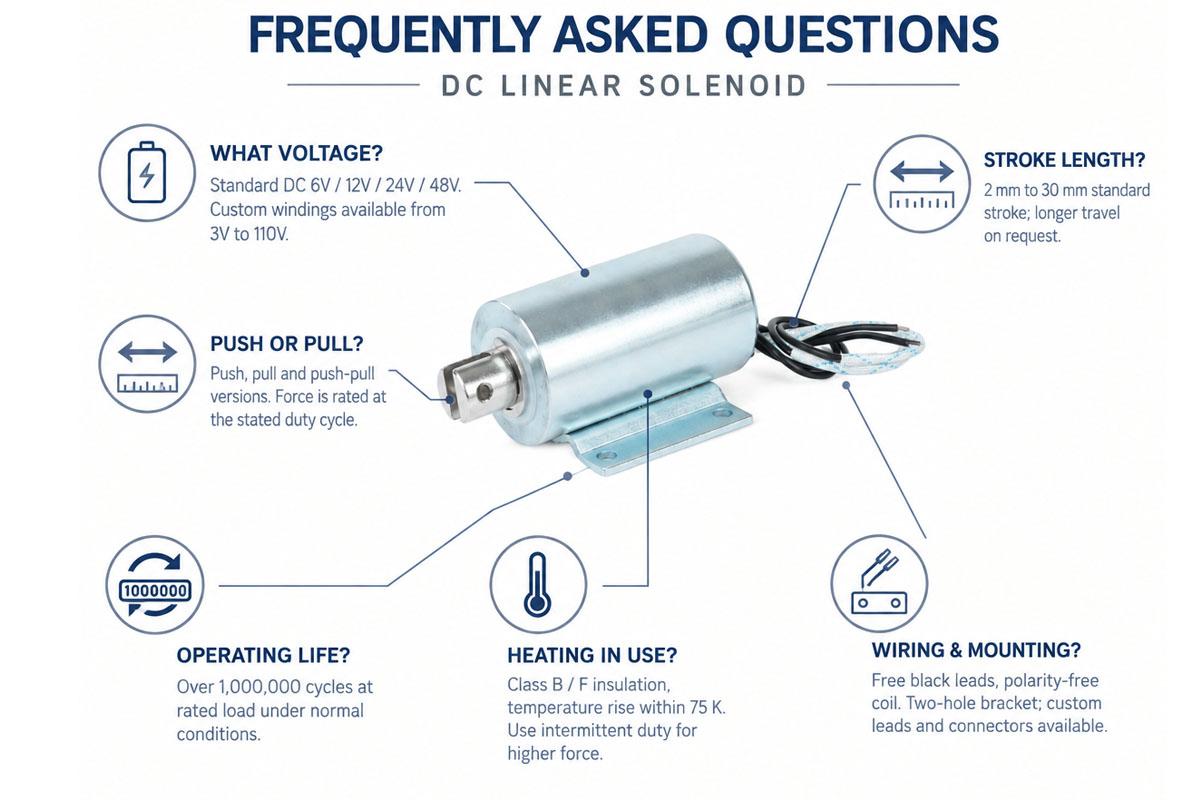
1. What is a DC linear solenoid actuator?
It turns the electrical energy into linear mechanical energy. It is used in applications including electronic locks, industrial automation, vending machines, dispensing systems, laboratory equipment, and mechanical releasing devices.
2. How does the linear solenoid provide motion?
It receives DC current into its coil and creates a magnetic field, which attracts the movable plunger. The movable plunger delivers force into the mechanism to which the actuator is installed. And after disconnecting the power the return spring returns the actuator to its original place.
3. How is a pull-type different from a push-type solenoid?
The pull-type solenoid is usually constructed to receive an inward pulling force when energized, while the push-type design generates an outward pushing force. The direction of generated force depends on the mechanical design and mounting of the actuator.
4. Can the DC linear solenoid work continuously?
Yes, if it is designed for continuous usage under specific voltage, ambient temperature, and mounting conditions. Intermittent duty models tend to overheat when continuously energized.
5. How to calculate the force generated by a DC linear solenoid?
Firstly, determine the external load. Next, calculate all forces needed to compensate for the resistance of the spring and friction. Then calculate the force required during different points in the stroke. The manufacturer must prove that the suggested actuator generates sufficient usable force.
6. Can I customize the stroke and force?
Yes, in most of cases. The manufacturer can change the magnetic circuit, geometry of the plunger, design of the coil, spring, and mechanical structure. Stroke and force parameters are interdependent. Thus, the changes must be assessed technically.
7. How is a tubular solenoid different from an open frame solenoid?
The tubular solenoid uses a cylinder-like design, while the open-frame solenoid is based on a frame design, which may provide some extra mounting possibilities and easier integration into some mechanisms.
8. What information do I need for obtaining the quotation for a custom solenoid?
Rated voltage. Required force. Stroke. Duty cycle. Operating frequency. Maximum size, mounting, environment, and target price. Prototype quantity. Estimated annual volume.
Furthermore, drawings, pictures, and 3D models could be helpful.
9. Does Weilong manufacture custom DC linear solenoids?
Weilong Intelligent Technology (Dongguan) Co., Ltd. specializes in designing and manufacturing custom solenoids and inductor coils. It provides coil winding, assembly, testing, metal stamping, tooling, plastic injection molding, and CNC machining. The feasibility of the project is determined by the technical requirements.
10. How can I get a sample from Weilong <www.smartsolenoid.com>?
Send us your technical specification and estimated production volume. The Weilong team is able to review the requirements, discuss feasibility, and advise you on the suitable prototype, tooling, and testing process.