High Force Push Pull Magnetic Solenoid
Push Pull Magnetic Solenoid for Automation
Compact Push Pull Magnetic Solenoid Uses
Durable Push Pull Magnetic Solenoid Unit
Fast Response Push Pull Solenoid Device
Tubular Push Pull Magnetic Solenoid Tech
High Force Push Pull Magnetic Solenoid
Push Pull Magnetic Solenoid for Automation
Compact Push Pull Magnetic Solenoid Uses
Durable Push Pull Magnetic Solenoid Unit
Fast Response Push Pull Solenoid Device
Tubular Push Pull Magnetic Solenoid Tech

WL4020 Industrial Push Pull Magnetic Solenoid Guide

The push pull magnetic solenoid is an electromechanical actuator device that changes electrical energy to linear mechanical motion using a coil of copper wire and a magnetically movable plunger or piston. It consists of a coil made of copper wire, a steel plunger, and a spring inside the metal enclosure.

The Push pull magnetic solenoid works by producing a magnetic field when the electric current flows through the coil windings. This magnetism either pulls or pushes the plunger in or out of the coil assembly.

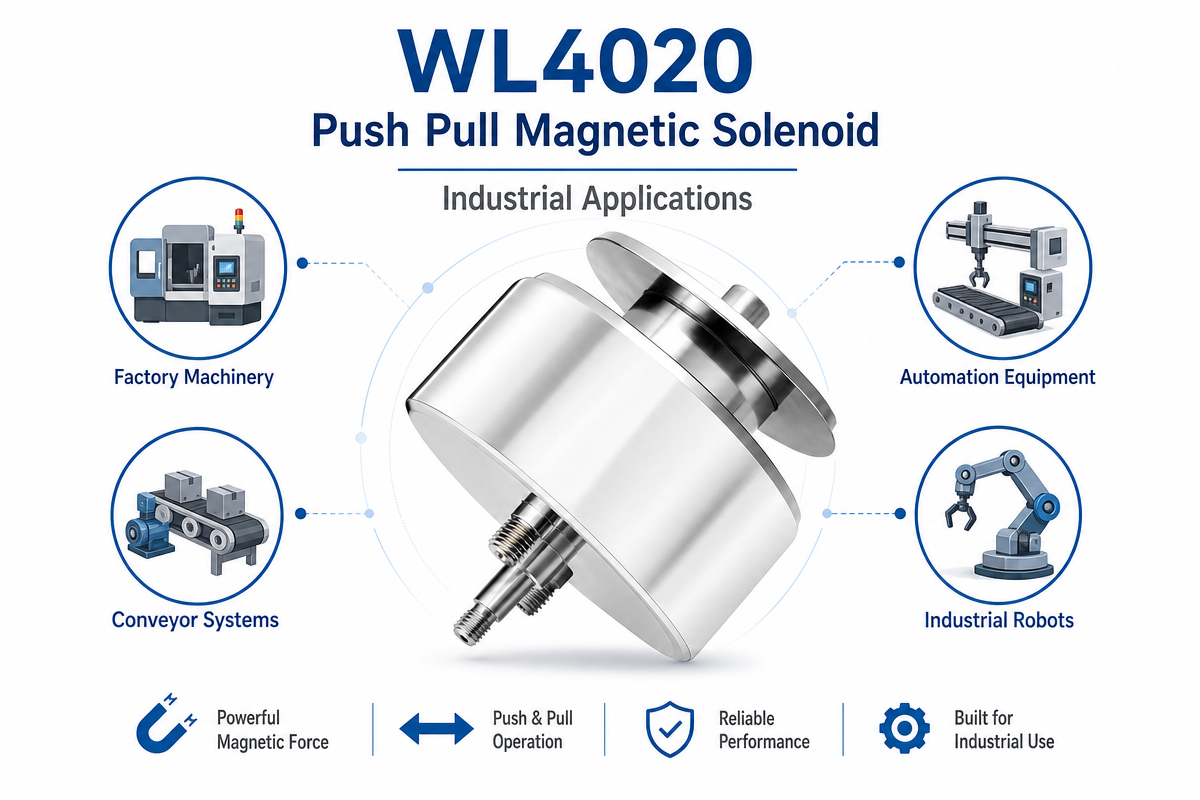
A push pull magnetic solenoid is widely used in industrial automation systems because of their small size, fast response time and constant force generation and long life. The typical applications include automation, vending machines, door lock mechanisms, medical devices, smart home equipment, textile machines and automobiles.

Customized push pull magnetic solenoids of any voltages, stroke lengths, force outputs, mounting types, and duty cycles are always available.

Key Features of Push Pull Magnetic Solenoid

The key features of push-pull magnetic solenoids are their compact structure, rapid response speed, and reliable linear motion generation. They feature a steady push-pull output, economical power usage, and extended operational lifetime. They have the advantage of being lightweight and straightforward to install and maintain.

Many different types of industrial solenoids can be offered based on customer requirements and industry standards. Various voltages, stroke lengths, lead wire types, mounting plates, and forces are available in common configurations. They perform well in high-frequency automation equipment.

industrial push pull magnetic solenoid Overview

The Push pull magnetic solenoid is compact electromagnetic devices capable of linear push or pull motion. They contain a copper wire coil, a steel plunger, and a return spring inside the metal case. With the application of voltage, the plunger moves rapidly in a highly accurate manner.

They have become widely used for their ability to provide rapid, steady, and precise linear motion. They are used for automation equipment, medical devices, vending machines, smart locker systems, packaging machinery, and automobile systems. There are different voltages, strokes, forces, and mounts in standard and customized types.

The push-pull magnetic solenoids possess such benefits as rapid response, stable operation, longevity, and economy of maintenance and are the best solution for modern industrial control applications.

custom push pull magnetic solenoid video

Stable Performance push pull solenoid detailed display

High force push pull solenoid Technical Data Sheet

Brand Weilong Technology Model Number WL4042
Rated Voltage (V) DC 12 V or 24 V, Rated Power (W) 20–30 W
Work Model Tubular Push-Pull Type Holding Force (N) 10-20N
Stroke (mm) 5-10 MM Reset Time(s) 30 ms
Service Life 100,000 shots Certification CE, RoHS, ISO9001,
Material Carbon Steel Housing with Zinc Plated Coating Lead Wire Length (mm) 200
Holding Force:  1.8 Kgs Tolerance of Dimension  +/-  0.1 MM
Water-proof  None Insulation Class F
Hi-Pot Test AC 600V 50/60Hz 2s Non-excitation Holding Force 0
Working Temperature -10°C-100°C Duty Cycle 1-100%
Working Duty 10%–30% Payment Term TT, or LC At Sight
Sample Order Yes Warranty 1 Year
MOQ 1000 pcs Supply Ability 5000 pcs per Week
Delivery Time 30 Days Port of Loading shenzhen

How Does a Push-Pull Magnetic Solenoid Work?

Push-pull magnetic solenoids convert electrical energy to linear motion. They consist of a copper coil and magnetic core wound inside the metal housing. When electric power is applied to it, the electric current flows through the coil windings.

It produces the magnetic field, attracting the steel plunger to the center of the coil. Depending on the magnetic design, it creates a push or pull movement on the plunger. The magnetic attraction releases once the power source stops applying electric energy, causing the return spring to push the plunger back.

The movement of the plunger can be used to lock, unlock, switch, eject, or control other mechanical components. The typical response time is very fast, at the millisecond level. The amount of force generated depends on the coil voltage, electrical current, stroke distance, plunger, and magnetic coil design.

The push-pull magnetic solenoids are normally controlled with the assistance of switches, relays, PLC control systems, or other microprocessor devices.

Tubular push pull magnetic solenoid application

Push Pull Magnetic Solenoid Industrial Application

The Push pull magnetic solenoid is widely applied in a variety of industrial and commercial products for controlling linear motion. The typical applications are in the automation machinery, including mechanical lock, sortation system, robotic arm, conveyor, and automatic door. The fast response makes them suitable for high-speed machines.

They can be found in vending machines and smart lockers as locking mechanisms. Compact and highly accurate solenoids can be found in a wide variety of medical equipment. They are also widely used in automobiles to operate fuel, transmission, or other electronic locking systems.

High-performance push pull magnetic solenoid can be found in coffee machines, printers, smart home equipment, and other household appliances as a switching and dispensing function. Push pull solenoids can also be found in textile machinery and packaging machinery for providing precise linear motion in repetitive applications.

Specialized push pull solenoids can be found in aerospace and military equipment for controlling aircraft landing gears or gun firing mechanisms.

Advantages and Disadvantages of Push Pull Magnetic Solenoid

Push Pull Magnetic Solenoid Advantage and Disadvantage

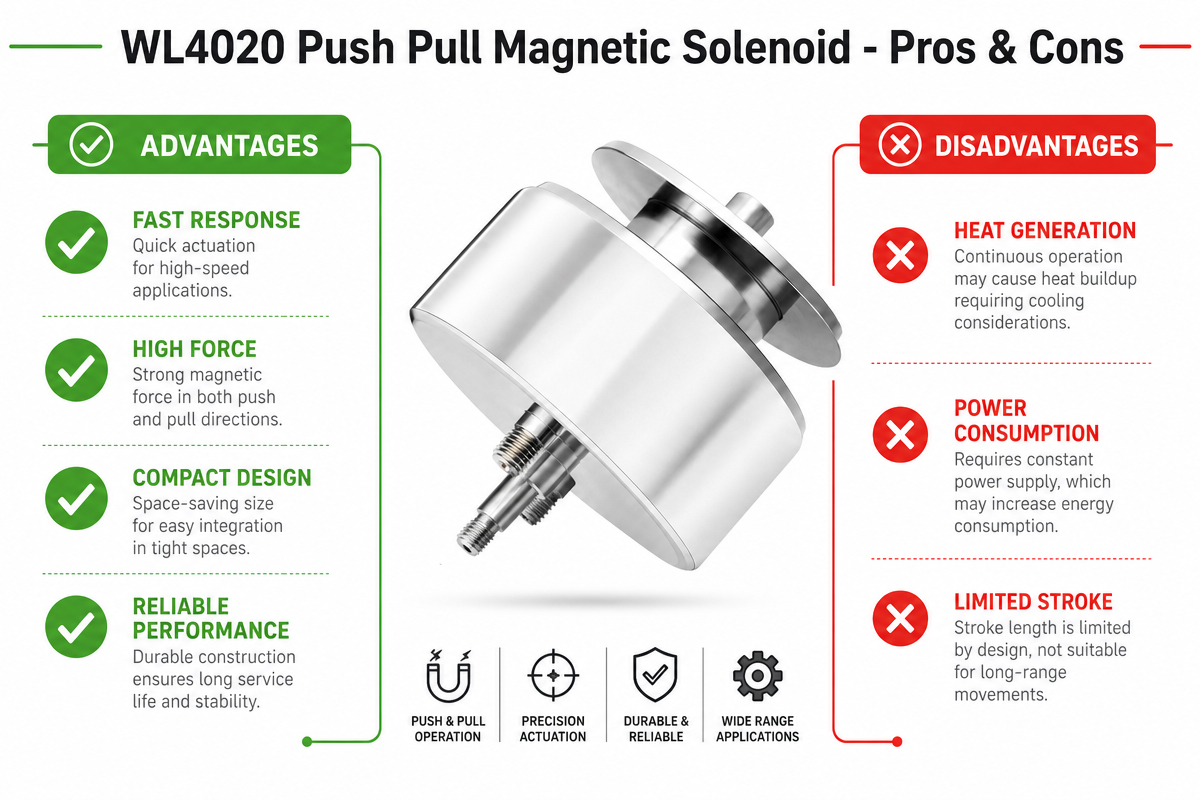
The push-pull magnetic solenoid offers a lot of benefits in many industrial automation control applications. One obvious benefit is their compact size, allowing them to fit easily into limited spaces. The other advantages include rapid response time, reliable operation, accurate linear movement, simplified construction, and low maintenance needs.

In addition to the above features, the push-pull magnetic solenoids provide a high level of versatility as they can be customized for various voltage, force, stroke, and mounting configurations. Cost-effectiveness is another benefit, as the solenoids are much more economical than other complex devices.

Low noise operation and high repeatability make them suitable for automated machinery and precision devices. There are several disadvantages as well, as the push-pull solenoids are heat-generating devices, leading to a reduced life span. Heat generation becomes even worse under high duty cycle conditions.

One significant disadvantage is the decrease of force output with increased stroke length, making it unsuitable for long-distance linear motion. Force generation of push-pull solenoids can be smaller than that of pneumatic and hydraulic systems for high force requirements.

Improper installation and mismatched voltage settings can cause overheating problems, resulting in poor performance and early failure. Proper selection and design play a major role in achieving good results.

The Troubleshooting Push Pull Magnetic Solenoid

Push Pull Magnetic Solenoid Troubleshooting Guide

Incorrect installation, voltage mismatch, overheating problems, or mechanical damages can lead to the failures of the push pull magnetic solenoids. Troubleshooting can help to overcome operational issues and extend solenoid life.

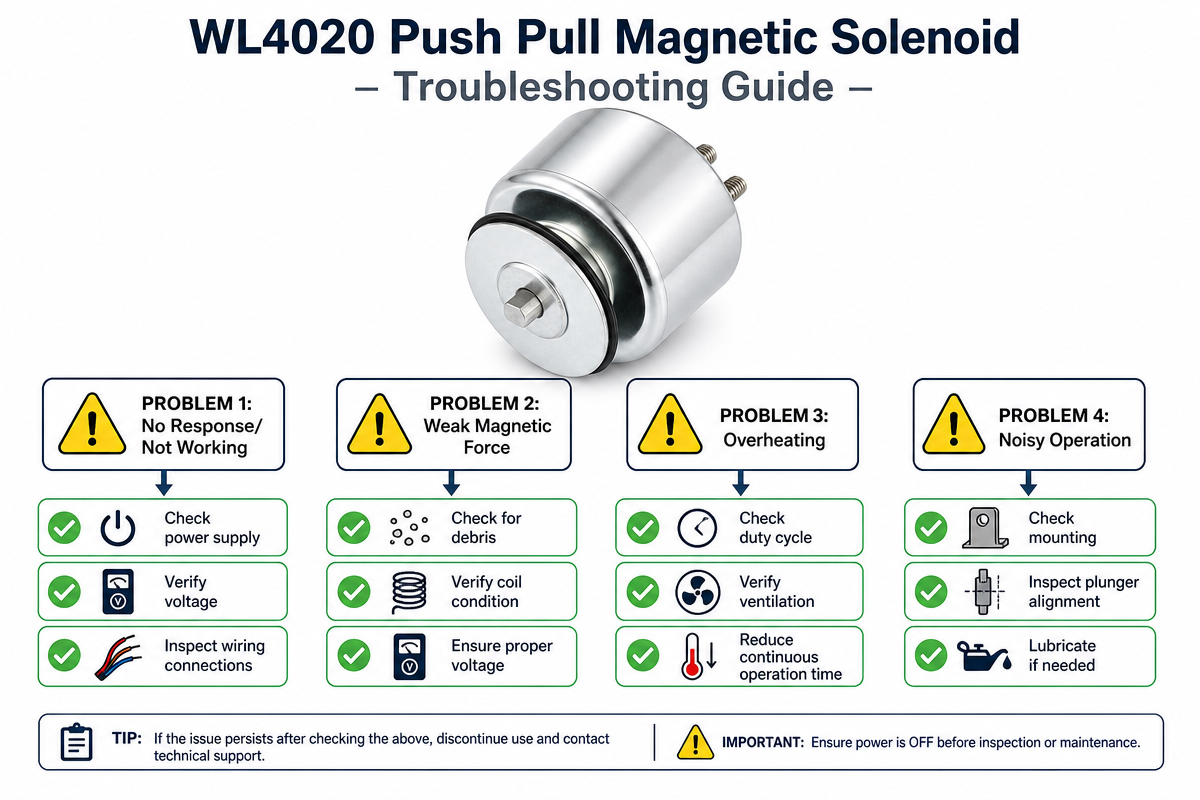
One of the most common problems associated with the push pull magnetic solenoids is the weak magnetic force output. Main reasons can be low input voltage, faulty coil winding, excessive stroke distance, and magnetic interference. First, check the input voltage and then the coil resistance.

Overheating is another issue with push pull magnetic solenoids. The continuous operation beyond the rated duty cycle leads to overheating issues. You need to solve the problem by decreasing the operating frequency, increasing the ventilation, or changing the solenoid duty cycle. Improper voltage selection may also lead to overheating problems.

Sticking and slow movements caused by dirt, rust, or mechanical damage may lead to malfunction of push pull magnetic solenoids. Lack of lubrication and bent elements also cause slow motion. By cleaning the internal parts and replacing the worn parts, it can be solved.

Improper installation and voltage mismatch may result in noise and vibrations. Check whether the mounting hardware is properly installed. For the burnt-out push-pull magnetic solenoids, it could be due to damaged coil winding, burnt lead wires or springs.

By measuring the resistance of the coil, you may find the coil fault. Fixing the burnt out part of the coil will restore its normal operation.

FAQs on Push Pull Magnetic Solenoid

1. What Does a Push Pull Magnetic Solenoid Do?

This is an electromagnetic device capable of converting electrical energy into linear motion. Industrial push-pull magnetic solenoids find applications in industry, vending machines, smart locks, medical equipment, packaging systems, textile machines, and vehicle lockings and control systems.

2. What is the Difference Between Push Type and Pull Type Solenoid?

Push-type solenoids push the object using outward movement, while pull types pull the plunger inwardly when energized. There are push-pull magnetic solenoids that combine both functions at once.

3. How Do I Select Correct Voltage for a Solenoid?

Voltage should match your power supply. Typically, the following voltages are available: DC 6, 12V and 24V. Using incompatible voltage results in overheating, insufficient magnetic forces, and reduced service life.

4. Why is my push pull magnetic solenoid overheating?

Possible reasons for heating include excessively high duty cycle, incompatible voltage, continuous energization, or poor heat dissipation. It is possible to eliminate heating problems by choosing the proper duty cycle.

5. What is the Service Life of Push Pull Magnetic Solenoids?

Depends on operating conditions, duty cycle, ambient temperature, and loads. High-quality industrial push pull magnetic solenoid can last hundreds of thousands of operation cycles up to millions of cycles.

6. Are Push Pull Magnetic Solenoids Customizable?

Most manufacturers offer custom manufacturing services, including the selection of appropriate voltage, force, stroke length, mounting brackets and connectors, waterproof or other specific construction designs.

7. What Affects Solenoid Force Output?

Such parameters as coil voltage, electric current, stroke, plunger material, and magnetic circuitry, along with temperature, are responsible for the output force. Shorter strokes generate more magnetic forces.

8. What is Push Pull Magnetic Solenoid Maintenance?

Periodic checking of lead wires, mounting screws, and action of the plunger. Dust and corrosion must be cleaned off. Operating at the proper voltage and duty cycle helps increase service life.

How to Choose a Push Pull Magnetic Solenoid?

Selection of an appropriate push-pull magnetic solenoid helps you gain maximum efficiency and life from the solenoid. Several factors have to be considered to find the best push-pull solenoid.

Type of voltage is the very first consideration. It requires checking the type of power supply available, whether AC or DC. Available DC voltages are 6V, 12V, and 24V.

The next step is calculating required force output. You need to consider both initial force and holding force. To ensure that your solenoid provides sufficient drive force, you have to know the load weight, friction, and mechanical structure.

The length of the stroke should be selected carefully. The greater the stroke, the weaker the force will be. That is why it is necessary to find the right balance between the two.

Duty cycle is the fourth factor to take into account. It affects the design of the coil, and solenoids can be designed for intermittent and continuous use.

Space and mounting configuration are two other parameters that should be considered when choosing solenoid types. Careful measurement of installation size is essential.

Environmental conditions should also be considered while selecting solenoids. High temperature, moisture, dust, vibration, or waterproof conditions may call for custom housings and materials.

Preventing the Most Common Mistakes in Packing a PushPull Magnetic Solenoid

Improper packing can damage push-pull magnetic solenoids during transportation or storage. To protect the products from potential damage,   proper packing procedures are required to prevent typical mistakes.

Too little inner protection is one of the most common mistakes in packing magnetic push-pull solenoids. Special protection of the solenoid’s plunger and lead wires must be considered since they are particularly vulnerable during transportation.

High humidity inside a transport box can result in corrosion or damage to coil insulations. Moisture-resistant materials and plastic sealing bags should be used to provide sufficient protection.

Inappropriate sizing of cardboard boxes is another mistake. In such situations, a product may shift and sustain damage during transport due to increased susceptibility to impacts. Correct box size and inner box dividers ensure better stability.

Excessive stacking of heavy objects may cause deformation of brackets or connecting parts. Fragility labels will improve product protection during transportation. Additional protective labels such as “Fragile,” “Handle with care,” and “Keep dry” will minimize risks.

Wooden cases and strong cartons should be preferred for the overseas transportation to prevent vibration during transport. Inspecting the quality of your packing prior to shipment can help avoid damages, complaints, and losses.


Get A Free Quote Now

Contact Form

Related Products

Related News

Scroll to Top

Get A Free Quote Now !

Contact Form
If you have any questions, please do not hesitate to contact us.
Weilong Solenoid Company Culture
