

Chapter 1: Introduction
Push-pull solenoids find extensive application in the automation industry, automotive systems, medical instruments, safety devices, vending machines, and intelligent control systems because of their compact design, quick responsiveness, and excellent linear actuation performance.
It is crucial for you to select the proper tubular push-pull solenoid manufacturer to get the reliable and customized electromagnetic actuator solution. A professional manufacturer can provide you with custom solenoid design, engineering optimization, prototyping, testing, and mass production services.
This guide covers basic information about the design, production, customization, performance, and selection of industrial tubular push-pull solenoids.
Chapter 2: What Is a Tubular Push-Pull Solenoid?
A tubular push-pull solenoid is an electromechanical actuator that is capable of converting electrical energy into mechanical linear movement. In comparison with a traditional frame solenoid, a tubular solenoid has a cylindrical structure and therefore is able to concentrate its magnetic field and produce force in a smaller volume.
The main components are
Winding of coils
Metal Housing
Magnetic Plunger
Spring-returnable
Guide tube
Electrical terminal
Magnetic Core Parts
When electric current goes through the coils, it creates a magnetic field and makes the plunger move in a linear way. The tubular solenoid can work with either pushing force or pulling force.
A professional tubular push-pull solenoid manufacturer will design all of these components based on specific stroke distance, force output, voltage, duty cycle, and working environment.
Chapter 3: How does a tubular push-pull solenoid work?
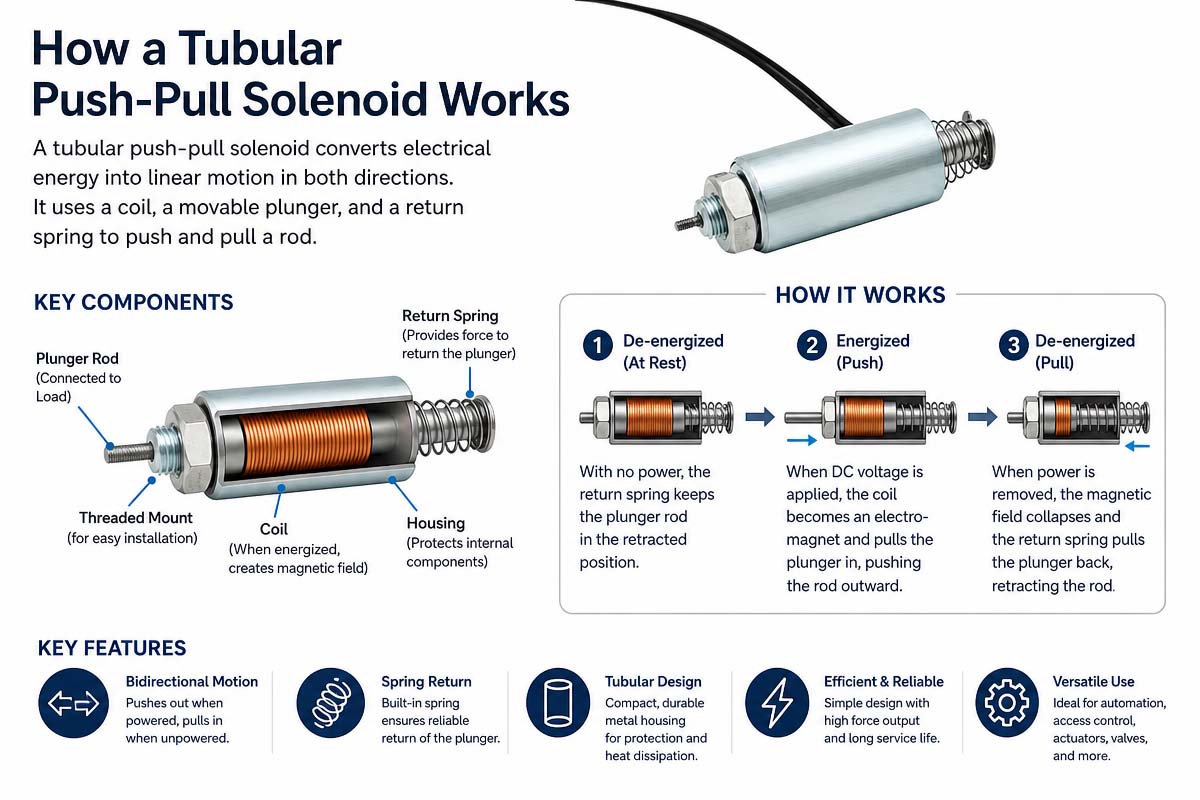
The principle of operation is based on electromagnetic attraction.
The DC voltage supplied to the coil generates the magnetic field, which draws the inner plunger to an optimum magnetic position.
The mechanical movement can be utilized:
For locking and unlocking devices
For controlling valves
Automated processes
Mechanical switches
Industrial locating systems
The performance of a tubular solenoid depends on:
Resistance of the coil
Number of turns in winding
Selection of magnetic material
Air gap design
Plunger Assembly
Stroke Distance
Operational Voltage
A professional tubular push-pull solenoid manufacturer will perform engineering simulations and performance testing to increase magnetic efficiency and mechanical reliability.
Chapter 4: Custom Tubular Solenoid The Design Process
4.1 Evaluation of Requirements
Custom solenoid design starts with an understanding of the application requirements.
The engineers investigate:
Voltage requirements (DC 5V, 12V, 24V, 48V, etc.)
Force requirements for push and pull
Stroke distance
Duty cycle
Installation space
Working temperature
Expected life time
Different types of solenoid structure are required for various applications. For example, an industrial automation system requires strong force output and constant work, while a smart lock application requires a compact size and low power consumption.
4.2 Magnetic Circuit Design
The magnetic circuit defines the characteristics of a tubular push-pull solenoid.
The main parameters for design are
4.3 Plunger material
High-quality magnetic material increases:
Pull force.
Magnetic efficiency.
Speed of response
Housing Type
The tubular housing provides:
Magnetization of the magnetic field.
Protective effect for mechanics.
Prevention of electromagnetic leakage
4.4 Coil Design
The optimization of the coil includes:
Choice of wire diameter
Density of winding
Controlling resistance
Thermal regulation
The design of a professional tubular push-pull solenoid manufacturer balances the force, power consumption, and heat generation.
Chapter 5: Key Features of Industrial Tubular Push-Pull Solenoid
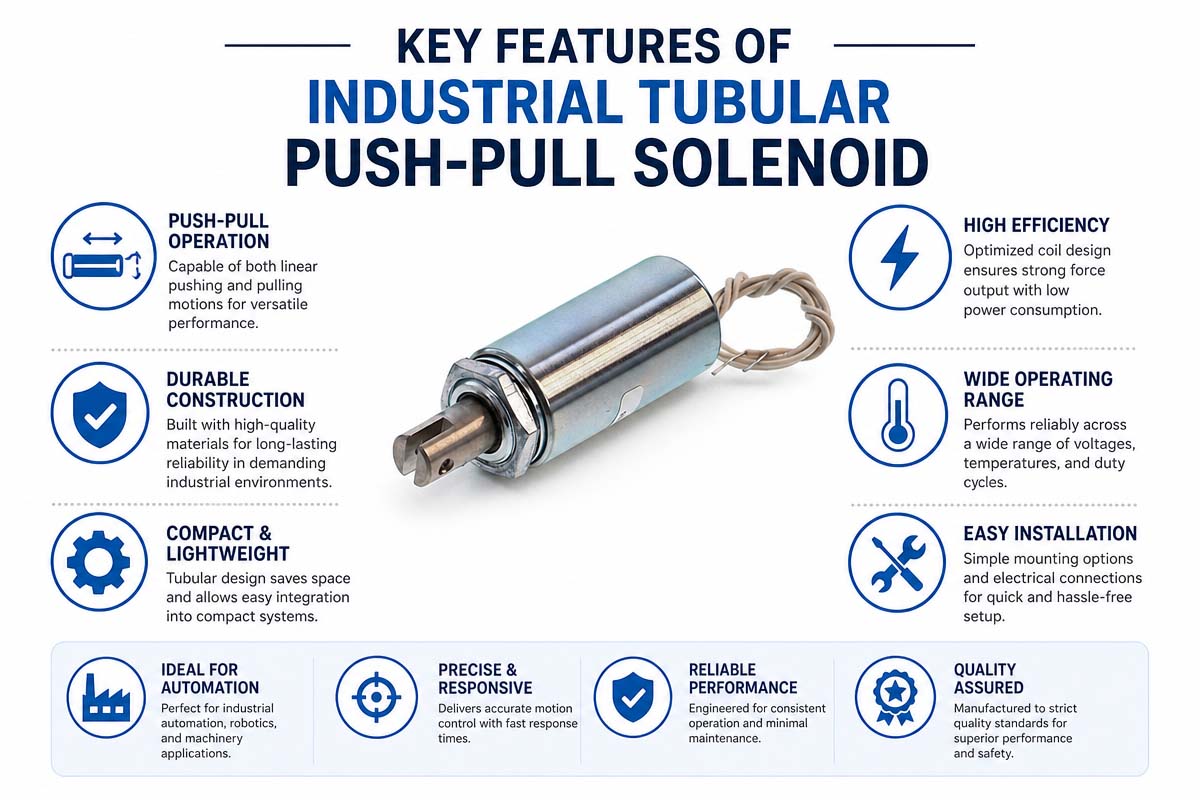
Compact Cylindrical Construction
The tubular design allows installation in a small space with high force output.
Fast Response Time
The optimized magnetic circuits provide rapid actuation and mechanical movement.
High Reliability
The industrial tubular solenoids are designed for:
Long operating life
Reliable performance
Constant production process
Custom Force / Stroke
The manufacturers can customize:
Stroke Distance
Holding Force
Pull-out Force
Pushing Force
Mounting System.
Chapter 6: Tubular Push-Pull Solenoid Manufacturing Process
Step 1: Design & Engineering
The manufacturer produces:
2D drawings
3D Models
Magnetic analysis
Specifications of the Prototype
The solenoid is meeting application requirements.
Design verification confirms the solenoid is meeting application requirements.
6.2 Coils Winding Manufacturing
The coil is manufactured using an automatic winding machine.
The controls include:
Number of turns
Tension of wire
Dimensions of the coil
Electrical Resistivity
Proper winding improves the consistency of the mass production.
6. 3: Manufacturing of the Metal Components
The tubular solenoid components are produced by precision stamping and CNC machining.
The manufacturing process includes:
Stamping
CNC Machining
Surface Treatment
Precision assembly
The mechanical reliability is provided by high-quality components.
6.4: Build and Test
The final assembly is produced from the following:
Coil installation
Plunger assembly
Spring installation
Housing assembly
The tests include:
Test Voltage 1
Force sensing
Stroke validation
Resistance testing
Life Cycle Testing.
Chapter 7: The Application of Tubular Push-Pull Solenoid
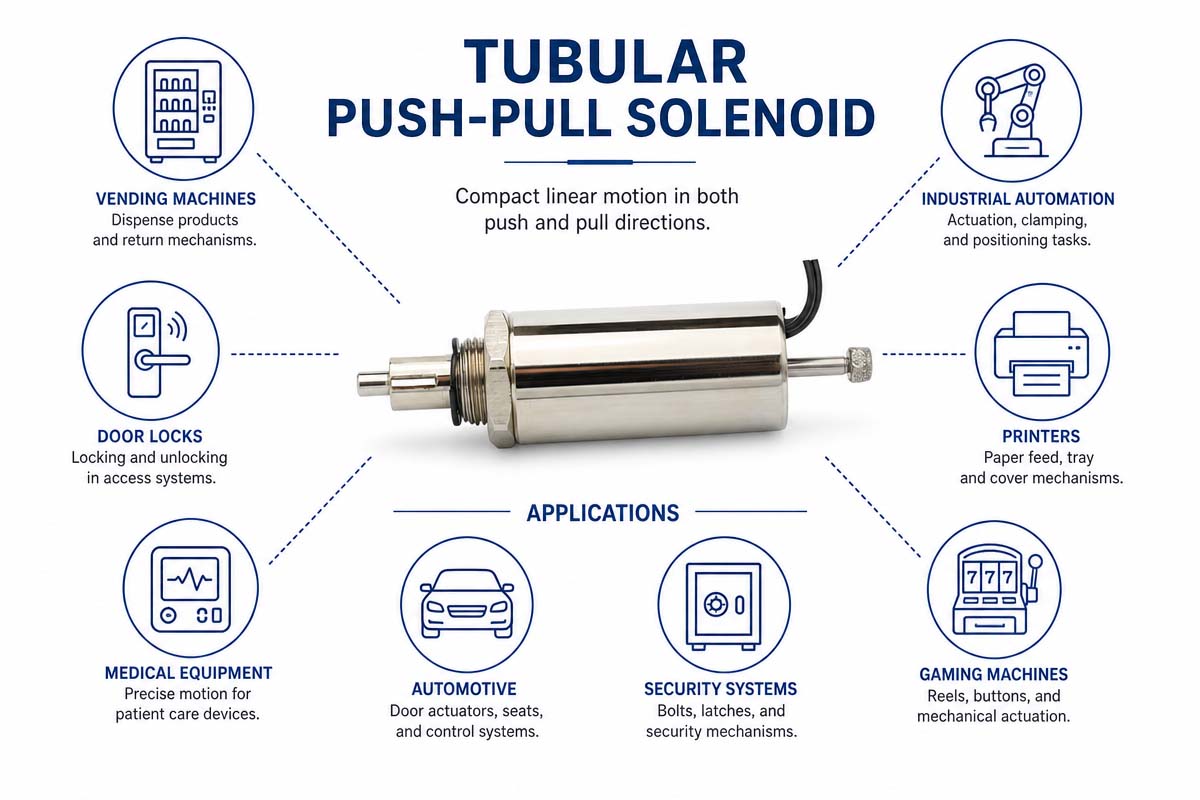
A tubular push-pull solenoid is a linear actuator that can generate linear motion by converting electrical energy into linear mechanical motion. The device can provide quick, reliable, and precise motion control and therefore is applied in automation equipment, medical devices, security equipment, automotive components, and other industries.
1. Industrial Automation Equipment
Industrial automation equipment is one of the popular fields where tubular push-pull solenoids are used widely. Modern industrial processes require precise and accurate motion control, which can be achieved with solenoids.
Such linear actuators can be applied in various industrial machinery, including machinery with locking mechanisms, positioning devices, material handling systems, and automatic feeding systems. Fast movement provided by the tubular solenoid ensures the efficient operation of these machines.
For example, in the operation of the packaging machine, a solenoid can control cutting blades, clamps, or sorting mechanisms due to its rapid linear movement.
Tubular push-pull solenoids differ from traditional motors and pneumatic actuators with simplicity of structure, low requirements for maintenance, and ease of integration into machines with compact size.
2. Medical and Laboratory Equipment
Precision and reliability are two of the key factors for success in medical and laboratory applications. Tubular push-pull solenoids can be integrated into all the equipment where precise mechanical movement is required, such as fluid control systems, testing instruments, and sample handling devices.
For example, in the process of testing in a medical analyzer, a solenoid can control valves, open and close channels, and control internal mechanisms. The compact size of this type of solenoid makes them suitable for installation in limited space.
Moreover, custom tubular push-pull solenoids can be produced with the needed specifications, such as voltage requirement, stroke distance, force output, and duty cycle, to meet particular application requirements.
For laboratory automation, repeatability and long lifetime of tubular push-pull solenoids ensure stable operation of these devices during continuous testing.
3. Automotive Applications
In the automotive industry, a wide variety of control systems use tubular push-pull solenoids. Such systems include vehicle locking systems, transmission mechanisms, fuel control devices, and special automotive devices.
For instance, tubular push-pull solenoids can be used to operate the mechanism of automatic locking in such a way that, by applying electricity to the solenoid, it extends and retracts the plunger. With the compact size of the device, its installation can be done easily, and with high durability, this solenoid can work for a long period of time.
With further development of the technology of electric vehicles and intelligent automotive systems, customized solutions for motion control are becoming more necessary.
4. Security and Access Control Systems
Security equipment requires fast and reliable locking and unlocking of mechanical structures. Tubular push-pull solenoids are widely used in electronic locks, access control systems, vending machines, and smart cabinets.
When the solenoid receives an electrical signal, it drives the plunger of the mechanism and locks or unlocks the structure. This provides a fast and reliable alternative to the conventional manual locking mechanism and improves the performance of the security system.
Because manufacturers can customize solenoid parameters such as force, stroke, and operating voltage, they can produce tailored solutions for security equipment.
5. Consumer and Commercial Equity
Many commercial devices require tubular push-pull solenoids for automated movement control. Applications include ticket machines, printers, POS equipment, coffee machines, gaming devices, and office automation equipment.
For instance, in POS receipt cutters, a solenoid drives the cutter mechanism to provide fast and accurate paper cutting. In the operation of a vending machine, solenoids control release mechanisms to provide reliable releasing of the product after payment confirmation.
Due to their small size and inexpensive construction, tubular push-pull solenoids are a good choice for manufacturing consumer goods.
6. Custom Industrial Solutions
One of the main advantages of tubular push-pull solenoids is the possibility to customize this device according to application requirements. Engineers can change the voltage of the coil, stroke distance, pulling force, pushing force, mounting structure, material of the plunger, and protection level.
For more sophisticated applications, manufacturers can provide customized solutions with features such as high-temperature resistance, low power consumption, high cycle life, and better efficiency of electromagnetic performance.
Chapter 8: Advantages of Working with a Professional Tubular Push-Pull Solenoid Manufacturer
Our Custom Engineering Capabilities
A good solenoid manufacturer is providing tailored solutions, taking into account:
Force Requirements
Installation Space
Electrochemical Properties
Mechanical Integration
OEM Production Support
Support from the manufacturer includes:
Prototype Samples
Small-Scale Production
Large-Scale Production
Customizing Products
Quality Control System
The quality of the manufacturing depends on:
Materials received inspection
Process Monitoring
Performance Tests
Reliability Verification
Cost Optimization
The experienced manufacturers achieve cost efficiency through:
Production Automation
“Improved processes”
Materials Optimization.
Chapter 9: How to Choose the Proper Tubular Push-Pull Solenoid Manufacturer?
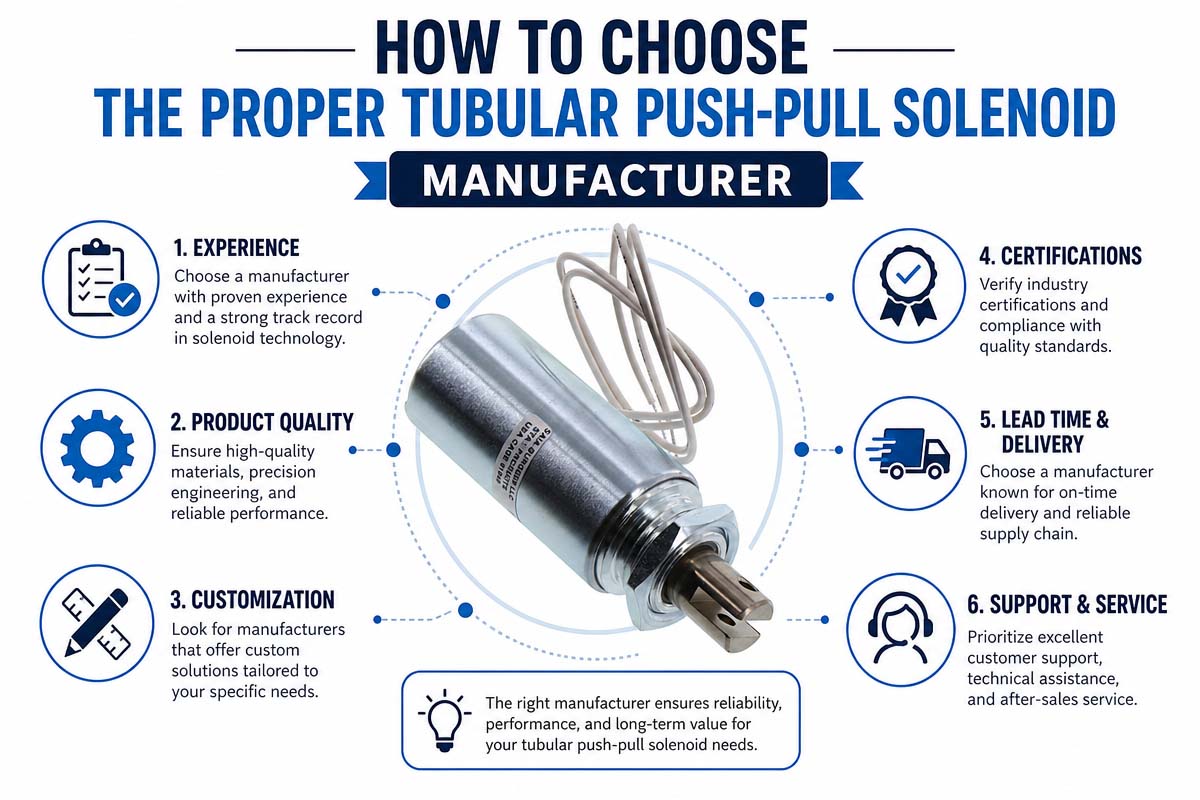
Verification of Technical Experience
Choose the supplier with the following experience:
Electromagnetics Design
Coil Production
Mechanical Engg.
Custom Actuator Design
Assessment of Production Capability
Features to Note Include:
Coil-Winding Equipment
CNC Manufacturing
Metal Stamping
Production Lines
Test Facilities
Ability to Customize
The manufacturer should have:
“Special Voltage”
Various Levels of Force
Special Mounting Options
Individual Stroke Requirements
Quality Standards for Reviews
A reliable manufacturer should have:
Management Systems of Quality
Inspection Procedures of Product
Reliability Testing Capability.
Chapter 10: Tips to Avoid Comment Mistakes When Selecting a Tubular Push-Pull Solenoid Manufacturer
Choosing the appropriate tubular push-pull solenoid supplier is critical for the quality and reliability of the products, their proper functioning, and cost-efficiency. However, many purchasers think only about the price and ignore some crucial aspects, thus buying poor-quality, underperforming, or expensive products. Below are some pieces of advice to help you select a reputable tubular push-pull solenoid manufacturer.
1. Do Not Choose the Cheapest Supplier
The common mistake is to choose the supplier of tubular push-pull solenoids offering the lowest price but ignoring other significant aspects, such as the technical characteristics and manufacturing quality.
The professional tubular push-pull solenoid manufacturer has to guarantee an appropriate balance between the price, quality, and performance of the solenoid. Purchasers should evaluate the solenoids in terms of specifications, manufacturing process, testing standards, and after-sales services rather than just the price.
2. Clarify Technical Competence and Experience in Custom Solenoid Manufacturing
Tubular push-pull solenoids are extensively used in automated equipment, medical products, security systems, vending machines, locking devices, industrial controls, etc. The applications often have different voltage and current requirements, force, stroke distance, operating cycles, etc.
The common mistake is to choose a supplier that offers only standard models and has no experience in product customization.
It is important to clarify whether the potential supplier can customize solenoids in terms of the following characteristics:
voltage and current requirements;
push and pull forces;
stroke distance;
shaft design and mounting structure;
spring return;
connectors and wiring;
special environment protection (waterproof solenoid).
The manufacturer, with engineering and tooling competencies, can develop a custom solution.
3. Study Solenoid Specifications Carefully
One of the main causes of purchase mistakes is that buyers do not clearly define their technical requirements. A reliable tubular push-pull solenoid has to be characterized by:
rated voltage (DC voltage requirements);
power consumption;
starting and holding force;
stroke distance;
duty cycle;
response time;
operating temperature range;
life expectancy.
For example, the solenoid intended for continuous operation is developed differently from the solenoid working in short-time mode. Thus, if you choose the wrong technical specifications, you will end up with a malfunctioning product.
4. Evaluate Manufacturing Capability and Quality Control
The reputable solenoid manufacturer should have full-scale production capabilities and quality control processes.
The buyer has to study whether the company has the following internal production processes:
coil winding and inspection;
metal stamping;
CNC machining;
injection molding;
assembly production;
testing laboratory.
ISO9001 or any automotive quality system certification of the manufacturer can also be a useful indicator of manufacturing competence.
5. Do Not Order Without Sample Evaluation
Another common mistake is ordering the product without sample testing. In spite of similar technical specifications offered by the manufacturer, performance of the product can differ depending on materials, coil design, and assembly precision.
It is very useful to test the samples before the beginning of mass production in terms of the following features:
force output;
stroke accuracy;
noise level;
temperature rise;
cycle life;
mechanical stability.
6. Study Production Capacity and Deliveries
Sometimes the manufacturer offers competitive pricing but cannot ensure sufficient production capacity for the large order. As a result, delayed delivery will negatively affect your work and obligations to your customers.
Before entering into cooperation, the buyer must find out:
monthly production capacity;
time necessary to produce samples and perform mass production;
materials availability;
process of planning and scheduling;
possible ways to accelerate the process for urgent orders.
7. Review Communication and Technical Support
Good communication with the supplier is crucial for the success of your project. A professional manufacturer has to provide technical feedback, drawing confirmation, testing results, and information on the production process.
Do not cooperate with manufacturers who give you quotations without any technical discussion. A professional engineering team can optimize the design and increase its performance.
Chapter 11: Future Trends in the Development of Tubular Solenoids
The industrial automation process continues to increase the demands for more compact, faster, and efficient electromagnetic actuators.
The future trends for tubular solenoids are
Increased Power Density
Reduced Power Consumption
Miniature Designs
Higher Durability Service Life
Actuator Integration with Smart Devices
The development of new manufacturing technology will improve the performance of the tubular solenoid for automation and intelligent equipment.
Chapter 12: Conclusion
How to Choose the Appropriate Tubular Push-Pull Solenoid The manufacturer helps companies to obtain reliable, customized, and cost-efficient electromagnetic motion solutions.
The well-experienced manufacturer provides full support for industrial tubular solenoid applications, including initial engineering design and magnetic optimization, prototyping, and mass production.
The customized tubular push-pull solenoids deliver reliable performance in the automation, automotive, medical, and intelligent device industries, thanks to professional design capability, advanced manufacturing processes, and quality control.
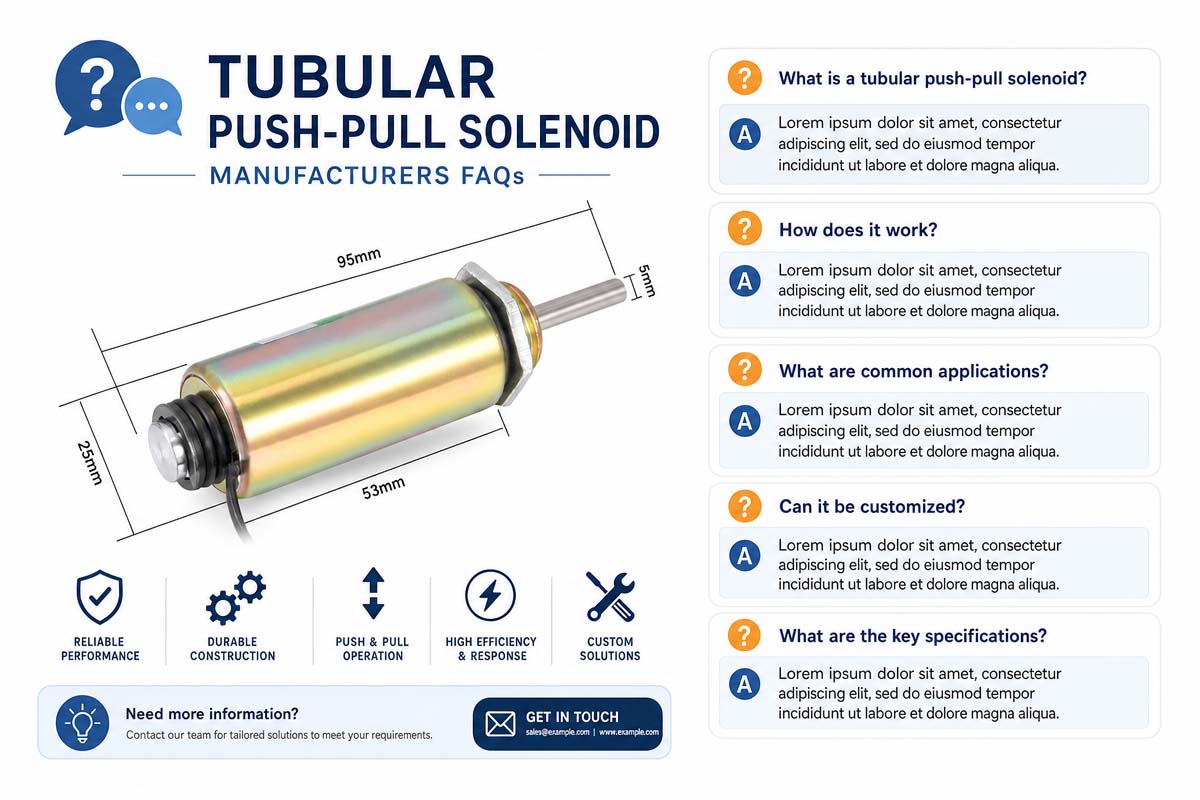
Chapter 13: Tubular Push-Pull Solenoid Manufacturers FAQs
-
What does a tubular push-pull solenoid Supplier provides?
The Tubular Push-pull solenoid manufacturer provides custom solenoid design, engineering, prototyping, production, and testing services for industrial applications.
-
Are tubular push-pull solenoids customizable?
Yes. Tubular solenoids can be customized according to voltage, force, stroke distance, size, mounting method, duty cycle, and application requirements.
-
Factors affecting the performance of tubular solenoid force?
Coil design, magnetic materials, plunger structure, air gap, stroke distance, and operating voltage are the factors affecting the force performance.
-
What is the service life of an industrial tubular solenoid?
The service life depends on the operating conditions, load, duty cycle, and design quality. If properly designed, the industrial tubular solenoids can operate hundreds of thousands of cycles.
-
How to Select a Good Tubular Push-Pull Solenoid Manufacturer?
Choose a manufacturer with strong engineering capability, production experience, testing equipment, OEM customization capability, and quality control processes.


