Fast Response Magnetic Push Pull Solenoid
High Force Magnetic Push Pull Solenoid Unit
Industrial Magnetic Push Pull Solenoid Solution
Compact Magnetic Push Pull Solenoid Device
DC Magnetic Push Pull Solenoid Solutions
Magnetic Push Pull Solenoid for Machines
Fast Response Magnetic Push Pull Solenoid
High Force Magnetic Push Pull Solenoid Unit
Industrial Magnetic Push Pull Solenoid Solution
Compact Magnetic Push Pull Solenoid Device
DC Magnetic Push Pull Solenoid Solutions
Magnetic Push Pull Solenoid for Machines

WL7042 Compact Magnetic Push Pull Solenoid Solutions

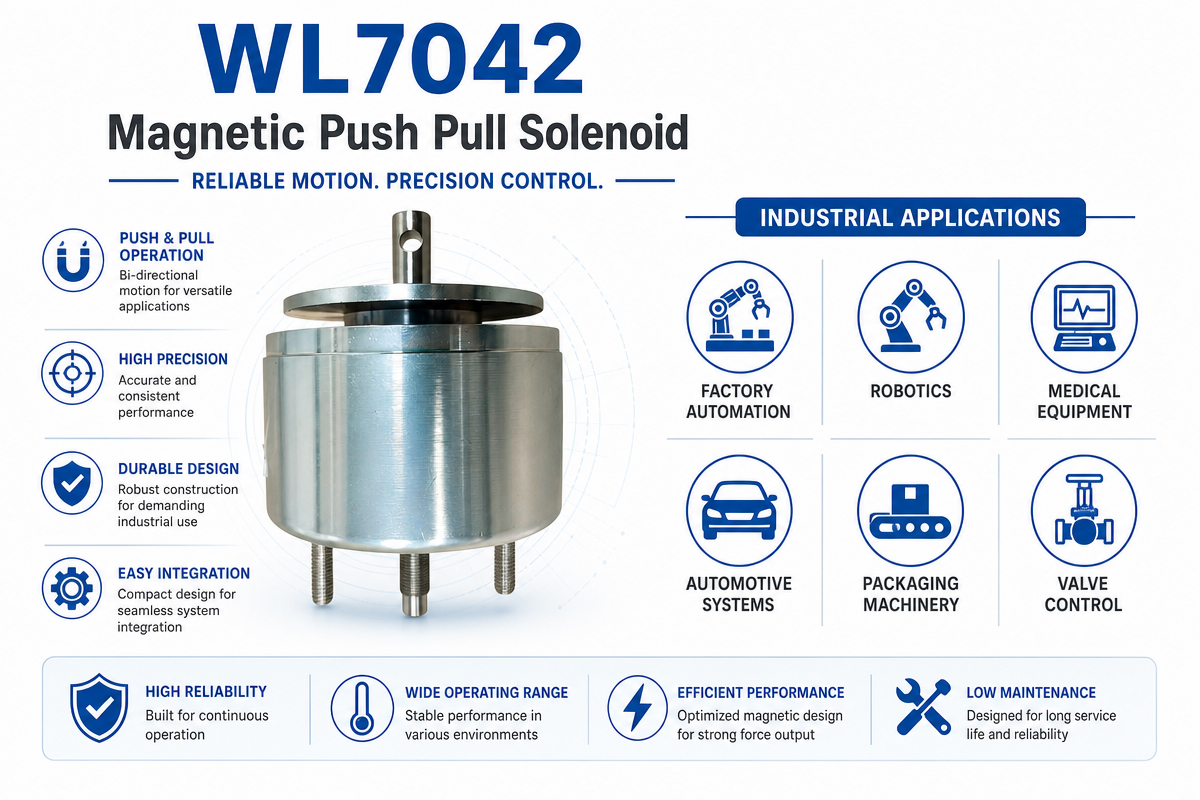
A magnetic push pull solenoid is an electromechanical device that converts electrical energy into linear mechanical motion. The coil generates a magnetic field with the flow of electric current. This attracts an iron plunger towards the center of the coil or pushes it away from there, resulting in a push or pull action. These kinds of solenoids are used for industrial automation, vending machines, medical devices, locking mechanisms, automotive devices and robotics.


Features of Magnetic Push Pull Solenoid

Magnetic push pull solenoids have compact size, energy-saving properties, and accurate control capability for linear motion. They can be used in industrial automation for fast response, minimal power usage, and strong magnetic force production. Magnetic push pull solenoids can be of the push type or pull type, continuous duty or intermittent duty. Their simple mechanism makes them easy to install and maintain.


Compact Magnetic Push Pull Solenoid Oveview

The magnetic push pull solenoid is a type of electromagnetic actuator that provides linear motion in industrial or other electronic equipment. Open frame type, tubular type, latching type, and custom designs are some common types of these solenoids. The standard range of voltages for them is 6V, 12V, 24V, and 48V DC. Important specifications of these solenoids are stroke length, force generation, duty cycle, response speed, and mounting dimensions. Magnetic push pull solenoids are popular for compact design, steady operation, and durable service life. Options such as waterproof, heat resistance, low noise, and customized wiring and connectors are available for special automation applications.

Compact Magnetic Push Pull Solenoid Video

Compact Magnetic Push Pull Solenoid Details Explain

Compact Magnetic Push Pull Solenoid Datasheet

Brand Weilong Technology Model Number WL7042
Rated Voltage (V) DC 12 V or 24 V or 48V Rated Power (W) 50–90 W
Work Model Tubular Push-Pull Type Holding Force (N) 20-30N
Stroke (mm) 5-20 MM Reset Time(s) 30 ms
Service Life 100,000 shots Certification CE, RoHS, ISO9001,
Material Carbon Steel Housing with Zinc Plated Coating Lead Wire Length (mm) 200
Holding Force:  1.8 Kgs Tolerance of Dimension  +/-  0.1 MM
Water-proof  None Insulation Class F
Hi-Pot Test AC 600V 50/60Hz 2s Non-excitation Holding Force 0
Working Temperature -10°C-100°C Duty Cycle 1-100%
Working Duty 10%–30% Payment Term TT, or LC At Sight
Sample Order Yes Warranty 1 Year
MOQ 1000 pcs Supply Ability 5000 pcs per Week
Delivery Time 30 Days Port of Loading shenzhen

How does a magnetic push pull solenoid work?

The working principle behind the magnetic push pull solenoid is electromagnetic. These solenoids are generally made of a copper coil, a moving plunger, a return spring, a housing, and a magnetic core.

When electric current flows through the copper coil, a magnetic field is created. The field attracts the plunger towards the center of the coil or repels it out of the coil. Depending on the design, the movement can be of push type or pull type.

When the source of electric power is switched off, the magnetic field disappears, and the return spring returns the plunger to its original position. The speed of movement and the magnitude of force depend on factors like voltage, current, stroke length, duty cycle, and material of magnetism. The magnetic push pull solenoid are the best choice for rapid, exact movements in automatic control systems.

Compact Magnetic Push Pull Solenoid Application

Magnet Push Pull Solenoid Industrial Application

The magnetic push pull solenoid has been widely used for many years for their accurate control of linear motions. These solenoids are extensively used for switching, locking, and positioning in industrial automation devices, such as sorting systems, packaging systems, textile machines, vending machines, and assembly lines.

Security devices such as door locks, locker machines, access control systems, and automatic doors use magnetic push-pull solenoids. Quick response time and compact size make them ideal for security purposes.

Medical devices such as diagnostic instruments, laboratory equipment, injection pumps, and automated testing equipment use these kinds of solenoids. Examples of uses in automotive applications are fuel control systems, transmission locks, valve control, and electronic actuators.

Solenoids are also found in many office automation devices like printers, copiers, cash registers, and automatic ticket vending machines.

In robotics and smart home devices, they are used for automatic switching and actuating purposes.

In conclusion, magnetic push-pull solenoids still have vital applications in modern-day automation and intelligent control systems due to durability, efficiency, and versatility.

Compact Magnetic Push Pull Solenoid advantage and disadvantage

Magnet Push Pull Solenoid advantage and Disadvantage

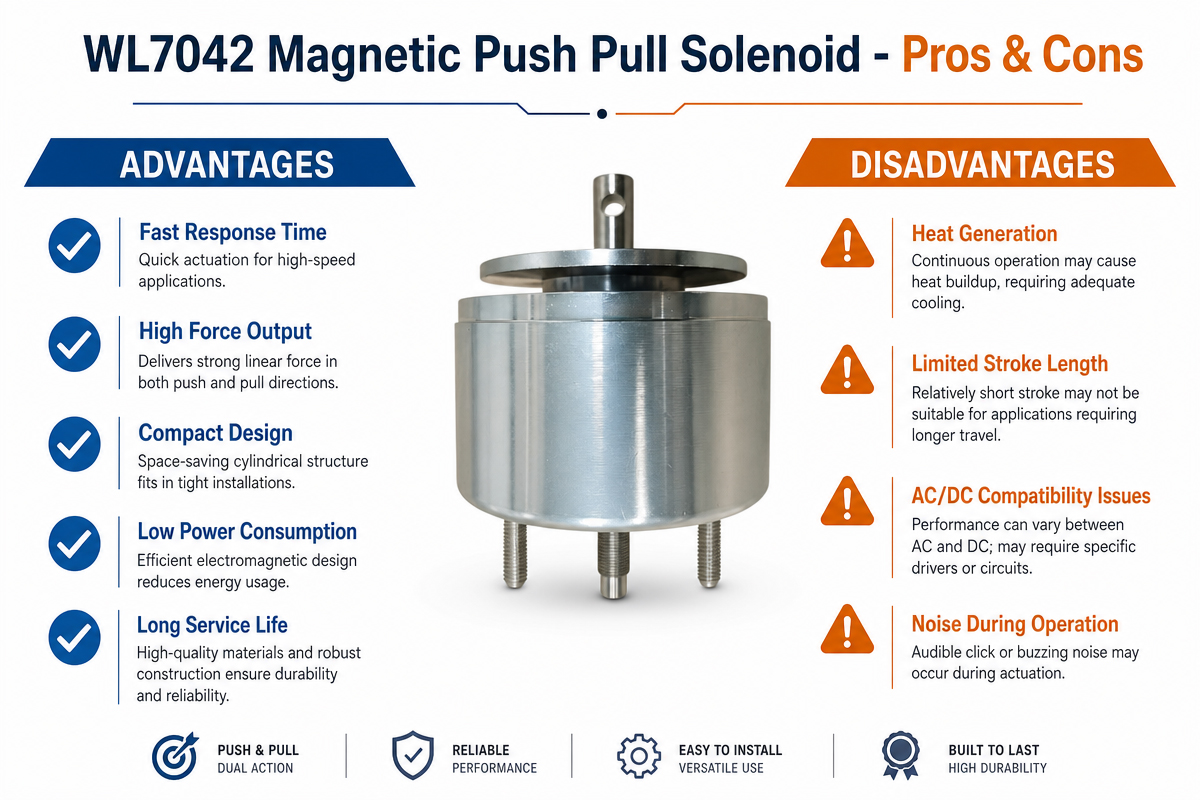
The main advantages of magnetic push-pull solenoids are their compact design, simplicity, reliability, and accuracy. Because of the compact design, magnetic push-pull solenoids are easy to incorporate in narrow places, while their simple design means minimal maintenance costs. Moreover, these kinds of solenoids are characterized by fast response times, strong linear motions, and precise control.

Moreover, they can be used for push mode or pull mode. Also, they are available in a wide range of voltages, strokes, and forces. Magnetic push-pull solenoids also have high durability and a long service life, provided that they are correctly designed and used within duty cycles.

The ability to be included in control systems is another advantage. Magnetic push-pull solenoids are widely used in automatic control systems because of high stability.

On the other hand, there are some disadvantages to using these kinds of solenoids. Insufficient cooling of magnetic push-pull solenoids can cause overheating and decrease coil longevity. Another disadvantage is that longer strokes significantly lower the force output. Sometimes, magnetic push-pull solenoids can produce noise during movement. Besides, these kinds of solenoids require stable electrical power sources.

Troubleshooting of Magnetic Push Pull Solenoid

Magnet Push Pull Solenoid Troubleshooting Guide

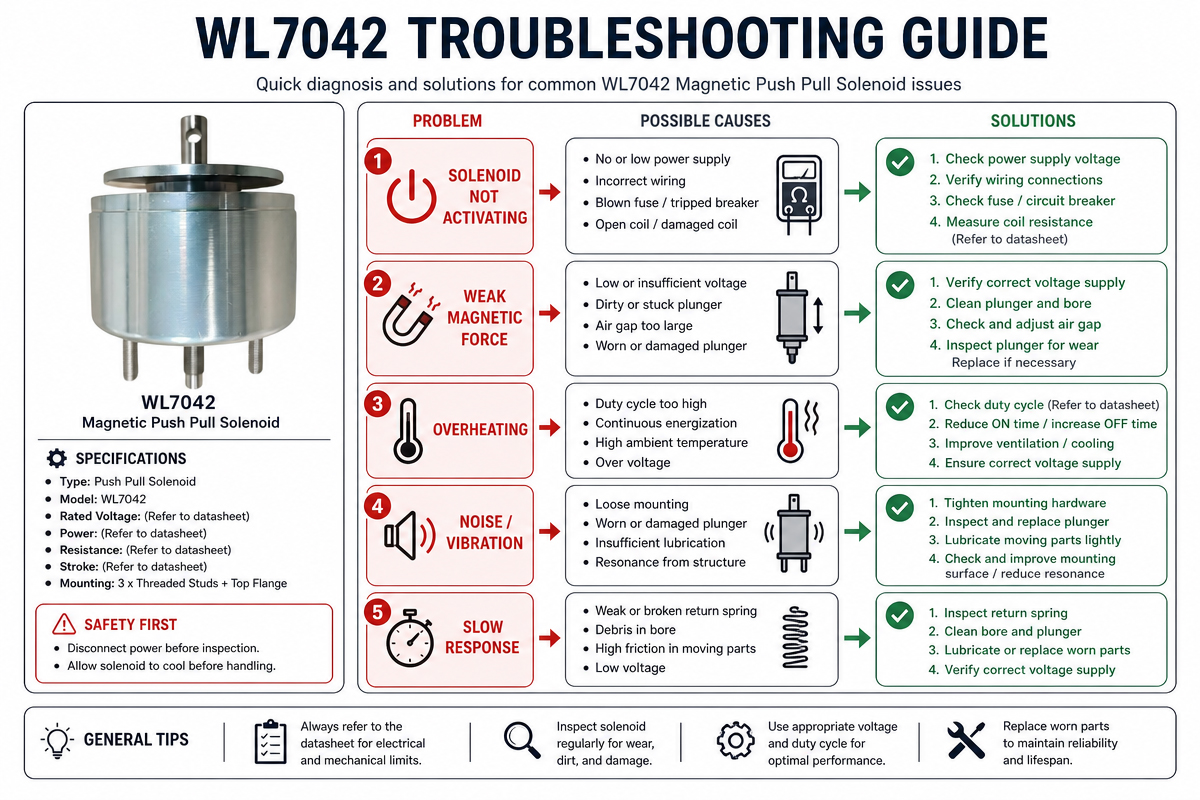
Many different reasons can cause problems with the functioning of a magnetic push pull solenoid. The first thing to check is voltage and connections in case the device doesn’t work. It is possible that either the connector was poorly installed, the wires were left unsecured, or there isn’t enough voltage to make it work.

Sometimes magnetic push-pull solenoids face the problem of overheating. The causes of overheating may include excessive energization above the rated duty cycle, an insufficient cooling system, or inappropriate voltage. To solve this issue, it is recommended to use a reduced duty cycle or cooling systems.

Reduced force output may indicate insufficient voltage or excessive stroke length. Other causes of this malfunction can include aged or corroded magnetic parts and a misaligned plunger.

Abnormal noise may mean that the mounting is loose, springs are damaged, or there is internal mechanical wear. Proper maintenance can help avoid those problems and increase reliability.

If the plunger gets stuck, you need to clean the inside of the solenoid. If coils or plungers are damaged, then replacing them should fix the problem.

Long-time workability and prevention of unexpected malfunctions of push-pull solenoids require appropriate maintenance and proper voltage selection and installation.


Magnetic Push Pull Solenoid Frequently Asked Questions

1. What is Magnetic Push Pull Solenoid?

A magnetic push pull solenoid is a type of solenoid that transforms the current into linear mechanical energy. When energized, it is capable of producing either a pulling or pushing action. They are widely used in industrial automation, locking devices, medical devices, and electronic appliances.

2. How does Magnetic Push Pull Solenoid work?

Electric current creates a magnetic field inside the coil of the solenoid, which pulls the movable plunger and provides linear movement. After deactivation of solenoid spring moves the plunger back to its place.

3. What are the main applications of Magnetic Push Pull Solenoids?

These solenoids have wide application in vending machines, door locks, medical devices, textile equipment, automotive, office automation systems, robotics, and other devices requiring quick and precise movement.

4. What voltages are available for Magnetic Push Pull Solenoids?

Push-pull solenoids can work under 6V, 12V, 24V, 48V DC, or other AC voltages according to needs.

5. What are the factors affecting force output of a solenoid?

Factors include coil voltage, coil current, stroke length, plunger construction, magnetic materials, and duty cycle. Short strokes produce stronger magnetic force.

6. Is it possible to use Magnetic Push Pull Solenoid continuously?

Only continuous-duty push-pull solenoids should be operated in continuous mode. Intermittent duty models shouldn’t be operated in this way, as coils will be overheated.

7. How to choose a suitable Magnetic Push Pull Solenoid?

One must think of force and stroke length required, voltage and duty cycle, ambient conditions, installation space, and temperature. Assistance of an experienced solenoid supplier will be beneficial.

8. What are the common problems of Magnetic Push Pull Solenoids?

Problems include overheating, reduced force output, plunger getting stuck, producing noise and broken coil. They can be prevented by maintenance and proper supply of voltage and duty cycle.

Magnetic Push Pull Solenoid Selection Guide

Selection of a magnetic push pull solenoid is important for efficient performance, longevity, and effective system operation. First of all, one should calculate the amount of force needed. The chosen solenoid has to be able to produce enough push or pull force.

The length of stroke is another important factor. Generally speaking, the longer the stroke, the weaker the force will be. Thus, finding the right compromise between these two parameters is essential.

One more important consideration is voltage and operating current. They have to match the voltage of the power supply, such as 12V DC, 24V DC and others.

An important parameter is the duty cycle. Continuous duty and intermittent duty differ greatly in terms of performance duration.

Environmental factors have to be taken into account in order to choose the right product. For example, when an application will be exposed to dust, moisture, vibration or heat, then a waterproof or high-temperature solenoid is preferred.

Finally, installation dimensions and mounting options have to be considered for easy integration with the equipment.

Response speed and noise level have influence on certain applications. In case of medical devices and office automation systems, fast-response and low-noise solenoids are preferred.

Other aspects that need to be discussed include plunger type, return spring, insulation quality and service life. Special applications that have particular dimensions or require higher forces or special connectors need custom-designed magnetic push pull solenoids.

Working with experienced manufacturers ensures optimal product performance and reduced cost in industrial automation systems.

How to avoid the comment mistake while  doing the magnetic push pull solenoid design

Avoid designing a load with insufficient force capacity.

Remember that continuous energization limits the duty cycle.

Ensure that the selected voltage matches the voltage of power source.

Do not choose overly long stroke lengths that weaken the magnetic force.

Select magnetic materials according to stable performance.

Make sure that a solenoid has proper ventilation for heat dissipation.

Wrong plunger alignment. Jamming and friction.

Choose the correct return spring force for smooth movement.

Dust and moisture protection (environmental protection).

Check mounting dimensions before final installation.

Continuous energization of intermittenduty solenoids leads to overheating.

Make sure that wire insulation is rated properly for temperature requirements.

Make sure that response speed is tested under operational conditions.

Corrosion resistance is needed for outdoor devices.

Work with specialized manufacturers for custom-designed solutions.

Get A Free Quote Now

Contact Form

Related Products

Related News

Chapter 1 : introduction of Electromagnetic solenoid All the modern homes are equipped with dozens of household appliances that need […]

        Chapter 1 :What is a Push Solenoid? A push solenoid is a type of electromechanical actuator […]

Scroll to Top

Get A Free Quote Now !

Contact Form
If you have any questions, please do not hesitate to contact us.
Weilong Solenoid Company Culture
