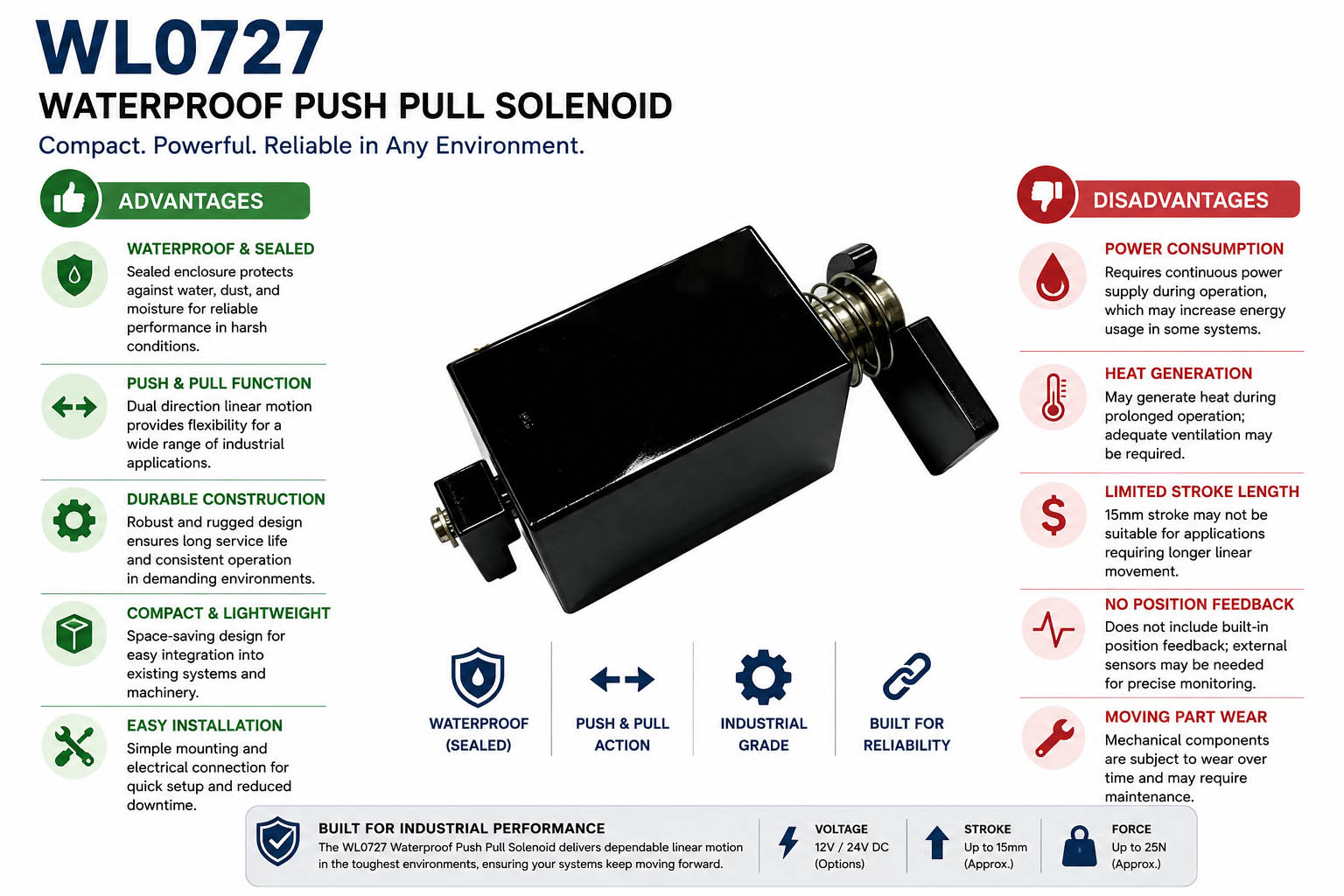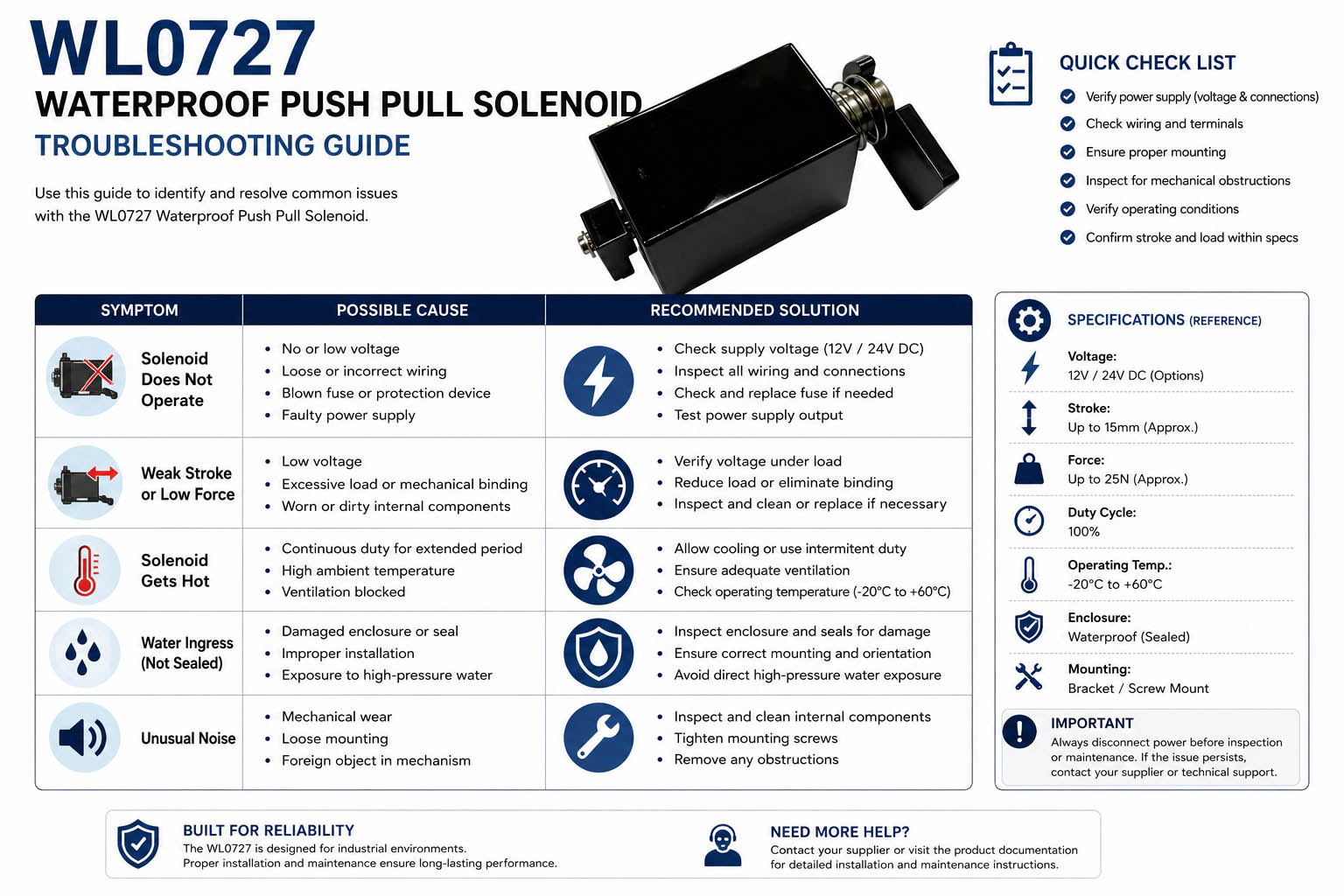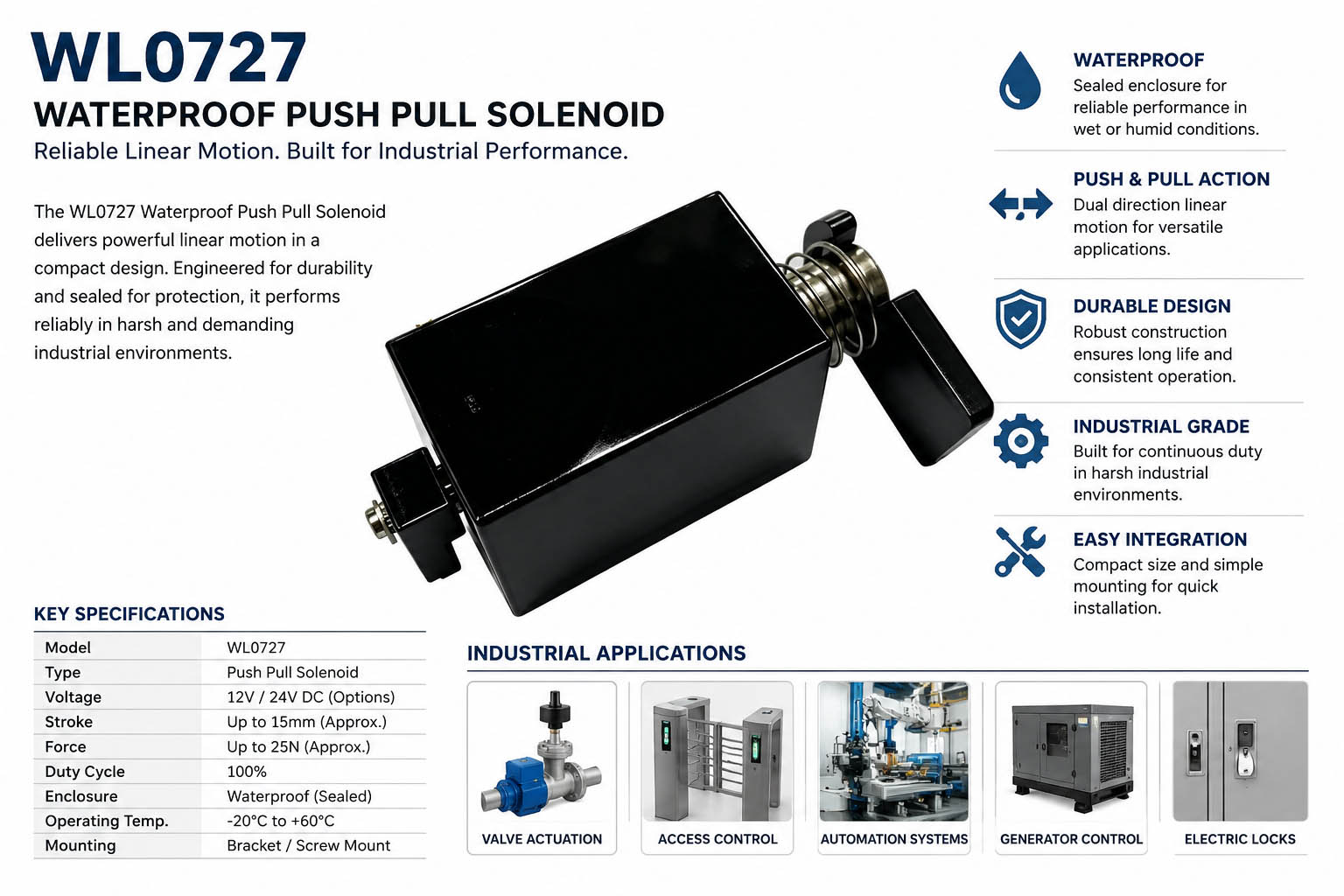
A waterproof push-pull solenoid is used in many industries where it is necessary to use reliable linear motion under wet or harsh environmental conditions.
In industrial automation, they are used to control gates, locks, valves, latches, and sorting systems. In water treatment plants waterproof solenoids are used to regulate the flow of water and monitor it. They are used in agricultural machinery to control irrigation systems, fertilizers, or other automated agricultural tools when they can be exposed to rainwater and humidity.
Waterproof push-pull solenoids are used in security devices to secure entrances, electric locks, and barrier gates. Also, they are used in marine applications to regulate hatches, locks, or navigational devices because they have water-resistant properties.
They are used in vending machines, automated kiosks, and ticketing systems to control dispensing or locking devices. Waterproof solenoids may be used in medical and laboratory devices that need reliable operation in sterile and humid environments.
They are used in transportation systems, alternative energy systems, and other outdoor electronic devices because of their reliability and durability. Waterproof solenoids can provide accurate motion control in any condition, which makes them a valuable component of modern industrial applications.
What Are the Challenges of Waterproof Push Pull Solenoid Design?
Designing a waterproof push pull solenoid is WAY more challenging than designing an ordinary one. This is because such a solenoid should not only be capable of generating push pull motion reliably, but it also has to have excellent watertight seals.
1. The Challenge of Movable Plunger Sealing
The main challenge of a push pull solenoid is the design of its plunger.
A push pull solenoid has a plunger that is supposed to move inside of the solenoid housing. And moving parts are always a potential route of entry for liquid.
Possible issues are:
- Leakage of water from plunger opening
- Friction from repeated operation of the seal
- Friction from waterproof sealing
- Decreased speed and force due to high friction
Engineering solutions include:
O-rings
Shaft seals
The thing is: better sealing means more friction and therefore decreased force of actuation.
2. Balancing Act Between Sealing and Force Output
A push pull solenoid produces a magnetic force which reduces the air gap between the solenoid plunger and the core made of iron.
When designing waterproof push pull solenoids, the following has to be considered:
- Added seals occupy some space
- Bigger air gaps are necessary
- Friction from seals opposes the force of action
Thus
- Pull force decreases
- Push force decreases
- Reaction slows down
These losses have to be balanced out during design.
3. Protection of Impermeable Coils
Coil of an electromagnetic solenoid is a highly moisture-sensitive element.
And if water gets inside:
- Insulation deteriorates
- Changes in electrical resistance
- Coil can short-circuit and burn out
Engineering protection measures include:
Epoxy coating
- Vacuum resin impregnation
- Waterproof bobbins
- Fully waterproof coil assemblies
The trick is: to ensure good heat dissipation and seal everything airtight.
4. Waterproof Cables Entry
One more potential source of leaks – is the entrance of a wire.
Problems are:
- Water can enter from cable gaps
- Damage from cable bending
- Degradation of the cable seal with time
Solutions are:
- Use of cable glands (waterproof)
- Over-moulded cables and wires exits
- Epoxy-coated wires
- Use of IP67 connectors
The vast majority of the waterproof solenoid failures are due to faulty sealing of the cable entrance.
5. Heat Dissipation Issues
An ordinary solenoid can cool off using heat transfer via its body.
However, in case of a waterproof push pull solenoid:
- Seals prevent air circulation
- Potting materials prevent heat dissipation
- The whole assembly is encapsulated thus cannot dissipate heat properly
Results are:
- Higher temperature of coil
- Reduced duty cycle
- Lowered efficiency
- Reduced service life
Engineers have to consider the following:
- Coil power requirements
- Wire size
- Materials used in construction
- Heat dissipation methods
-
Corrosion Resistance
Waterproof solenoid is corrosion resistant, however, being corrosion resistant does not automatically imply being waterproof.
These solenoids work outdoors where there can be
- Rainwater
- Salt spray
- Chemical substances
- Moisture
To resist corrosion, solenoids should contain materials which:
- Plungers of stainless steel
- Nickel plating of steel parts
- Galvanizing
- Powder coating
Choice of materials influences the final price of the product.
-
Smoother Operation
A push pull solenoid requires:
Not like the simple pull type solenoids:
- Plunger’s proper alignment
- Low-friction guidance system
- Return springs providing perpetual force
- Movement with no backlash
Seals of a waterproof solenoid can cause:
- Sideways pressure
- More friction
- Inconsistent wear
Result:
- Binding
- Decreased stroke
- Inconsistent forces
- Early breakdown
-
Getting Higher IP Classifications
Higher the IP class is – the harder it is to design a waterproof push pull solenoid.
| IP Rating |
Difficulty |
| IP54 |
Low |
| IP65 |
Medium |
| IP66 |
Medium-High |
| IP67 |
High |
| IP68 |
Very High |