

Chapter 1: Introduction
The holding electromagnet is one of the major magnetic devices that are utilized for reliably holding, positioning, clamping, locking, or retaining ferromagnetic objects. Holding magnets are used in industrial automation, material handling, security systems, doors, machinery, and electrical equipment. They are the simplest way to obtain a reliable magnetic force without the help of complex mechanisms.
Depending on the application’s requirements concerning the required holding force, voltage, dimensions, duty cycle, temperature characteristics, or installation, it is necessary to select the proper holding electromagnet manufacturer. The ready-made products may not always satisfy these requirements, especially when equipment producers need a small device or a special magnetic circuit.
A professional holding electromagnet manufacturer can create special holding magnets, DC electromagnets, permanent magnet assemblies, and magnetic hybrids depending on the application.
Chapter 2: What Is a Holding Electromagnet?
A holding electromagnet is an electromagnetic device that is designed to attract and hold a ferromagnetic object by means of an electric power supply.
A usual structure consists of:
Cooper coil
Iron or steel core
Shell of the magnet
Pole side
Bobbin/coil former
Electrical terminals.
Assembly on mount
When DC voltage is supplied to the coil, the magnetic field arises in it and goes through the core. The magnetic circuit channels the magnetic flux to the pole face. Thus, the attraction force occurs.
It depends on a lot of parameters, including coil parameters, magnetic material, air gap, pole-face geometry, voltage, current, temperature, and the contact area.
So, to get predictable magnetic performance, you should choose a qualified holding electromagnet manufacturer.
Chapter 3: How Does a Holding Electromagnet Work?
Its operation is based on the law of electromagnetic induction.
An electric current passing through the coil produces the magnetic field. A ferromagnetic core increases its density and directs it to the working surface.
When an iron or steel object approaches the pole face, the magnetic circuit is improved and the electromagnet starts attracting strongly.
3.1 The sequence of actions can be simplified as follows:
Electrical power → Coil forms the magnetic field → Magnetic flux in the core → Magnetic attraction → Object is held
When the power supply is turned off, the magnetic field vanishes and the object is released.
It is especially useful when you want to control the process of holding and releasing electrically.
Chapter 4: Holding Electromagnet vs. Permanent Magnet
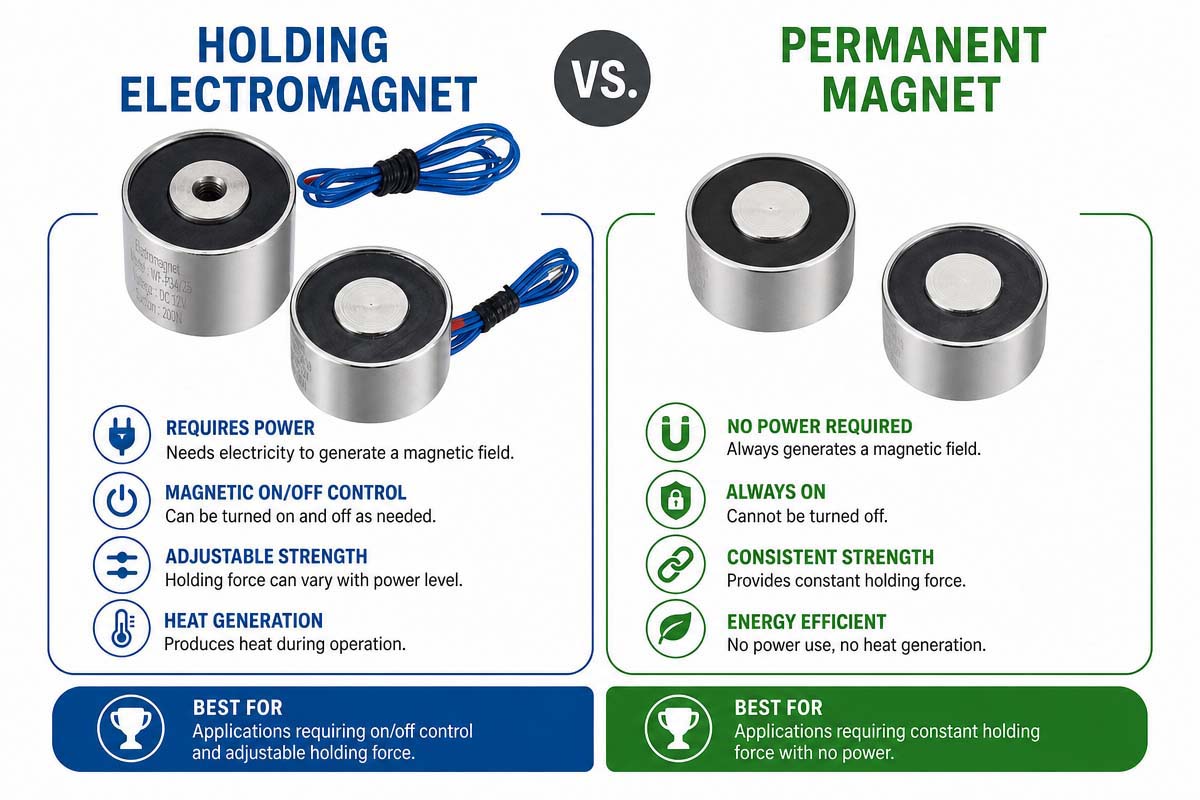
You can use either an electromagnet or a permanent magnet. Both will hold something. However, their operation differs.
4.1 Electromagnet Holding
To generate magnetic force, a holding electromagnet needs electric power to operate. Its main advantage is controllability.
The holding ability can be switched ON/OFF. So, electromagnets are really useful in automatic equipment, locks, industrial fixtures, and machine controls.
4.2 Permanent Magnet
A permanent magnet produces magnetic force without the necessity of continuous electricity supply. It provides long-term holding with the low consumption of electric power.
Permanent magnets are useful when the holding is permanent and no electrical switching is necessary.
4.3 Which One Should You Choose?
Your choice depends on the application.
4.3.1 You should choose an electromagnet when you require:
Switch ON/OFF electric
Automatic release
Programmable operation
Integrating with sensors or controllers
Special duty-cycle operation
4.3.2 You should choose a permanent magnet when you need:
Continuous magnetic holding
No regular supply of electric power
Simple mechanical structure
Low power consumption
When neither of the standard magnets satisfies your application requirements, you can order a special product from a professional manufacturer.
Chapter 5: Why Choose a Custom Holding Magnet?
There are a lot of designs of standard holding magnets, but industrial applications require special parameters.
Depending on the installation place, the required force, the operating voltage, and the mounting and working conditions, you can design a special holding magnet.
Important parameters for customization are
5.1. Hold-in Force
One of the key specifications is the holding force. The required force can vary from several Newtons to hundreds or even thousands of Newtons depending on the application.
It is impossible to calculate theoretically; the manufacturer should establish the force necessary for the operation.
5.2. Operating Voltage
Standard DC operating voltages are 5 V, 12 V, 24 V, and 48 V.
The coil design can be adjusted for the available power supply, taking into account the resistance, current, heat generation, and magnetic force.
5.3. Dimensions
The magnet may be installed in a special place.
It can be optimized by:
Height Width
Height
Diameter of pole
Mounting holes
Cable installation
Connector installation
5.4. Working Cycle
The coil design depends on the required duty cycle.
A magnet that operates continuously has different requirements concerning heat dissipation than a magnet that operates in short periods of time.
In continuous-duty applications, the coil resistance, the selection of copper wire, heat dissipation, and operating temperature should be controlled carefully by the manufacturer.
5.5. Operating Temperature
Industrial equipment can operate in hot or cold conditions.
The manufacturer should select the appropriate coil insulation, magnetic material, housing material, and manufacturing method depending on temperature requirements.
Chapter 6: Custom Permanent Magnets
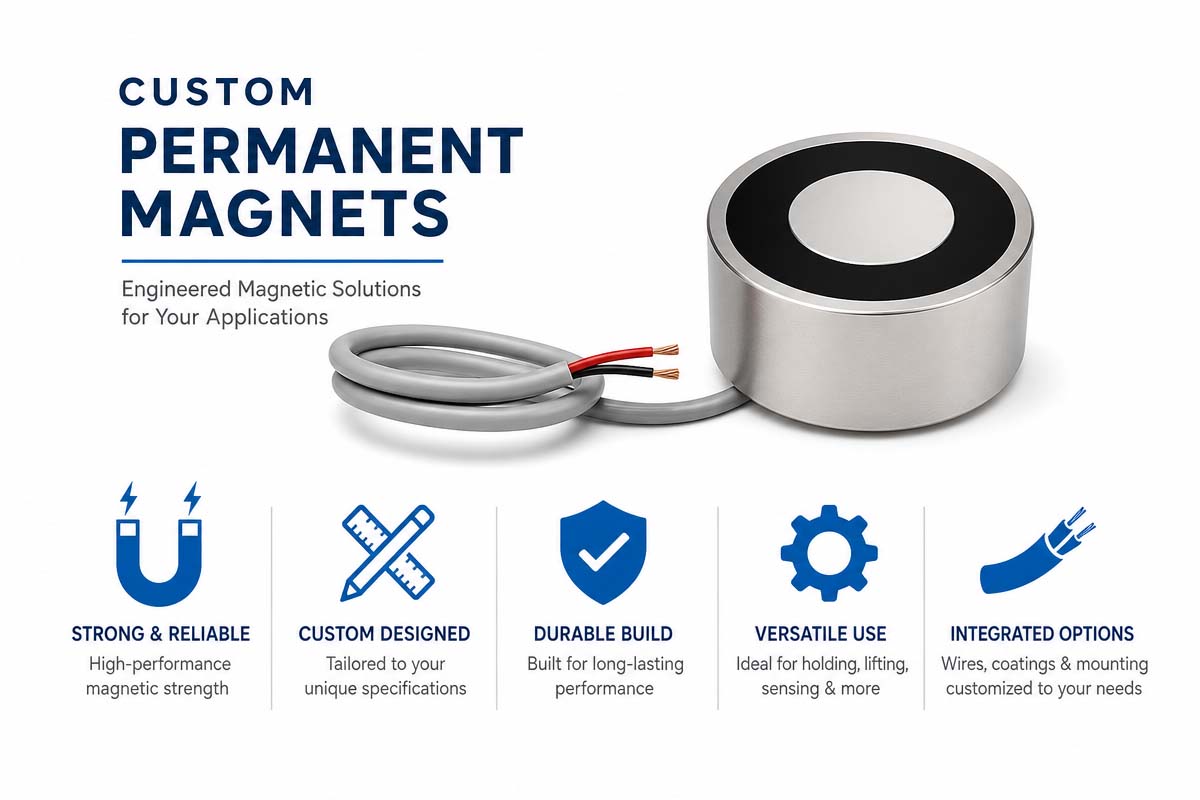
Also, manufacturers can design custom permanent magnets for applications where electromagnets are unnecessary, even when electrical power is unavailable.
The permanent magnet assemblies can be made of:
Neodymium
Ferrite
Samarium-cobalt
Alnico magnets
Different materials have different magnetic properties, temperature characteristics, cost, and mechanical properties.
For instance, neodymium magnets can be used when a high magnetic force is required in a small package because of the high magnetic energy density. Ferrite magnets are chosen when the cost is an important factor.
A special magnetic circuit can be provided by the combination of a magnet with steel plates, housing, pole pieces, or other components.
Chapter 7: Holding Electromagnet Application
Holding electromagnets are utilized in many industries.
7.1 Industrial Automation
Magnetic holding devices can be utilized in manufacturing and assembling for locating or holding metal parts in place, such as in automated machines.
Material Handling
A magnetic holding system can be used for lifting, positioning, or transferring of ferromagnetic parts.
Door & Access Systems
Electromagnetic hold devices can be installed in doors, cabinets, security equipment, and access-control systems.
Robotics
Special magnetic devices can be created to hold metal parts in place during automated processing by robotic equipment.
7.2 Fixtures for Manufacturing
A holding electromagnet is a simple method of holding steel parts during machining, inspection, assembling, or testing.
Medical & Laboratory Equipment
Special magnetic components may be designed for use in equipment requiring precise positioning and compact electromagnetic mechanisms.
7.3 Electrical Equipment
Holding electromagnets can be used in switches, relays, circuit-control equipment, and other electromechanical systems holding them in place.
Chapter 8: How to Select a Holding Electromagnet Manufacturer
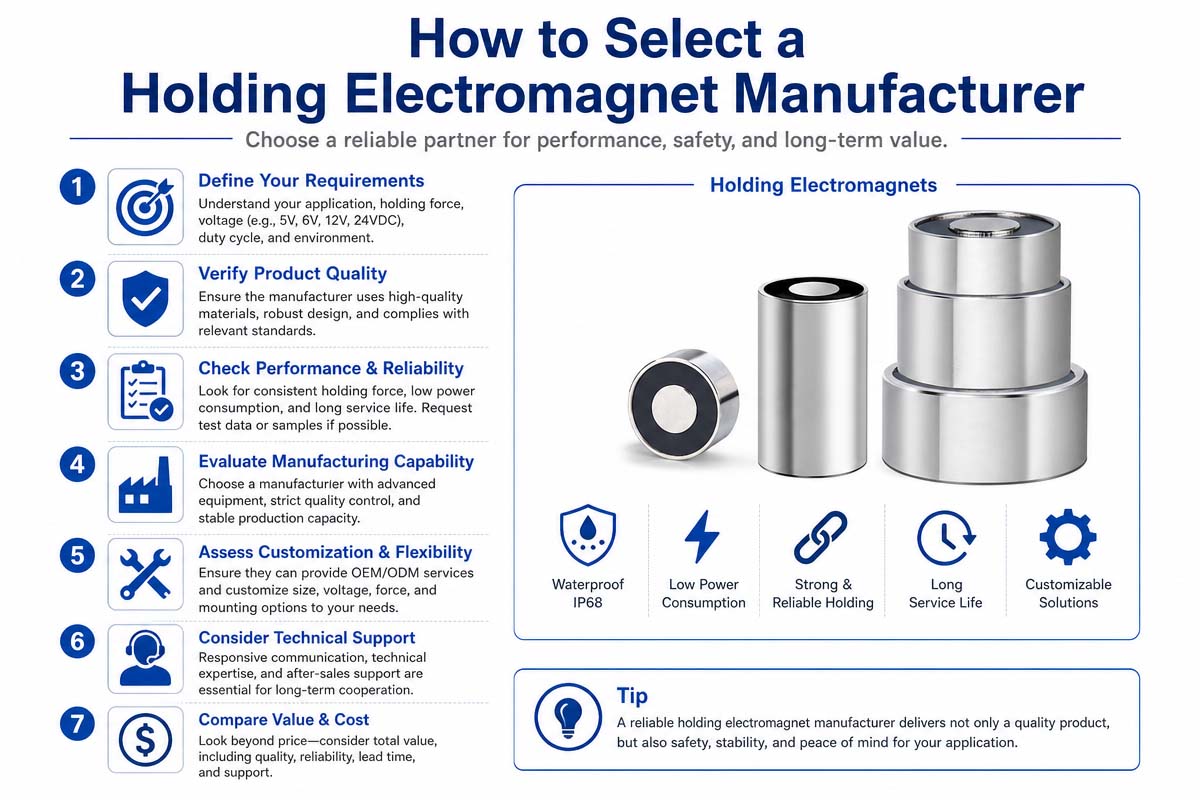
While choosing a manufacturer, you should take into account not only the unit prices.
Let’s have a look at some of the factors.
8.1 Engineering Skills
The good manufacturer should have knowledge of magnetic circuits, coil design, thermal characteristics, mechanical structure, and manufacturing tolerances.
8.2 Customization
If your application requires special dimensions or force, you should look for a manufacturer capable of developing custom products, not just producing standard ones.
8.3 Production Capability
Manufacturing capabilities can ensure better quality and fewer communication problems between different suppliers.
The relevant capabilities can be
Metal stampings
CNC machining
Plastic injection molding
Tool development
Coil winding
Magnetic assembling
Electrical tests
Testing of performance
8.4 Quality Assurance
Ask about quality management systems, inspection of incoming materials, production testing, and final inspection procedures.
For industrial applications, the consistency of performance in production batches is important.
8.5 Prototyping and Samples Support
The good supplier of holding electromagnets should be able to provide prototypes or samples before mass production.
With their help, you can check:
Holding force
Electric current use
Temperature rise
Compatibility
Reliability of operation
Electrophysical characteristics
Manufacturing Process of Electromagnet Holders
Chapter 9: The typical manufacturing process consists of several stages.
9.1 Magnetic circuit design.
The engineers establish the core and pole-face geometry, air gap, and magnetic material.
9.2 Coil design
The coil design depends on the voltage, resistance, current, power consumption, duty cycle, and magnetic force that are required.
9.3 Fabrication of components
Metal components can be stamped or CNC-machined, and plastic components can be injection-molded.
9.4 Coil Winding
The copper wire is wound on the bobbin according to certain parameters.
9.5 Assembling
All the components are assembled.
9.6 Electrical tests
They check voltage, resistance, current, insulation, and other electrical parameters.
9.7 Testing of magnetic characteristics
The finished product can be tested for holding force under certain test conditions.
9.8 Testing for reliability
According to the application, manufacturers can perform the tests of temperature, life cycle, vibrations, and other environmental conditions.
Chapter 10: Why Experience in Holding Manufacturer Is Crucial

An electromagnet’s performance depends not only on the coil but also on the magnetic circuit as a whole. The final holding force is highly sensitive to small changes in the magnetic circuit.
For instance, the magnetic performance of the magnetic circuit is susceptible to such factors as air gap, pole-face flatness, material selection, and machining accuracy.
An experienced electromagnet manufacturer may optimize the whole system and not just increase the power of the coil.
Such optimization may reduce unnecessary energy consumption, heat generation, and product size.
Chapter 11: Custom Magnetic Solutions for OEM Applications
Occasionally OEM clients may require a customized magnetic assembly beyond the standard magnets.
Here are examples of information that you may provide in order to choose a custom OEM supplier:
2D Design
CAD files 3D
Product samples
Technical specifications
Mounting dimensions
Force requirements
Description of application
Then the engineering team of the manufacturer can propose an appropriate electromagnet or permanent magnet design.
Moreover, a good supplier may optimize the tooling, materials, manufacturing process, and productivity to achieve a low unit cost for large-volume production.
Chapter 12: FAQs for Holding Electromagnets & Custom Holding
Magnets

1. How to select the appropriate holding electromagnet supplier?
When choosing a holding electromagnet manufacturer, you should consider his engineering capability, customization possibilities, manufacturing capacity, quality control, testing capability, and experience in similar applications. A good supplier will be able to evaluate your required holding force, voltage, dimensions, duty cycle, operating temperature, and mounting conditions before suggesting a design.
2. How is a permanent magnet different from an electromagnet?
The magnetic force of an electromagnet is generated when electrical current passes through the coil, so it can be controlled electrically. A permanent magnet is a magnet that produces magnetic force all the time, without being powered. If the holding is continuous and no power is consumed, permanent magnets are a reliable choice. If the holding is turned ON/OFF automatically, electromagnets are preferable.
3. What affects the holding force of an electromagnet?
There are many factors that influence the holding force, such as magnetic material, coil design, current, voltage, pole face area, air gap, contact surface, magnetic circuit design, and temperature. Magnetic force is decreased dramatically by even a small air gap. You should calculate the holding force under the real conditions, not theoretically.
4. Can a holding electromagnet be left on all the time?
Yes, some holding electromagnets can be designed for continuous duty operation. But the continuous operation produces heat in the coil. An appropriate wire, resistance, insulation, magnetic materials, and housing design should be selected to control temperature rise. When ordering a custom electromagnet, always specify the required duty cycle.
5. What voltages are typically used for holding electromagnets?
Common DC voltages are 5V, 12V, 24V, and 48V. A custom coil design can meet other voltage requirements. Operating voltage is determined depending on available power supply, holding force, current consumption, duty cycle, and thermal performance.
6. Can a manufacturer produce custom permanent magnets?
“Yes.” A custom permanent magnet manufacturer can produce magnetic assemblies using such materials as neodymium, ferrite, samarium cobalt, or Alnico. Design can be optimized for maximum magnetic force, size, temperature and corrosion resistance, cost and installation.
7. How do I order a custom holding magnet?
You should provide the manufacturer with all available information about your application. This may include required holding force, operating voltage, dimensions, stroke or air gap, duty cycle, operating temperature, mounting method, quantity, and drawings or 3D models. Where some of the specifications are unknown, an experienced manufacturer can help you in defining suitable parameters based on engineering evaluation and prototyping.
8. What tests should be performed before mass production?
You should consider performing such tests as holding force tests, current consumption tests, temperature rise tests, insulation performance tests, dimensional accuracy tests, operating reliability tests, and life cycle tests before starting mass production of a custom holding electromagnet. Testing the product under real application conditions can reveal potential problems before launching production.
Chapter 13: Conclusion
Holding electromagnets may effectively equip industrial and commercial equipment with controlled magnetic holding force. Electromagnets are easier to integrate into automation than permanent magnets.
But choosing the right product is not just a matter of voltage and physical size. Holding force, air gap, magnetic material, coil design, duty cycle, temperature, and mounting configuration affect the performance.
A proven holding electromagnet manufacturer can work with you on designing a product that will fit your actual needs.
If you require a DC holding electromagnet, custom holding magnet, permanent magnet assembly, or magnetic actuator, a manufacturer with engineering and production capabilities can help you implement your concept in a reliable product.
For OEM and industrial applications the best magnetic solution is not necessarily the largest or strongest magnet; it is the one that provides the required holding force, size, energy consumption, reliability, and cost under operating conditions.


