Industrial Linear Push Pull Solenoid Actuator Solutions
High Performance Linear Push Pull Solenoid Actuator Design
Compact Linear Push Pull Solenoid Actuator Applications
Reliable Linear Push Pull Solenoid Actuator Technology
Linear Push Pull Solenoid Actuator Control Applications
Heavy Duty Linear Push Pull Solenoid Actuator Systems
Industrial Linear Push Pull Solenoid Actuator Solutions
High Performance Linear Push Pull Solenoid Actuator Design
Compact Linear Push Pull Solenoid Actuator Applications
Reliable Linear Push Pull Solenoid Actuator Technology
Linear Push Pull Solenoid Actuator Control Applications
Heavy Duty Linear Push Pull Solenoid Actuator Systems

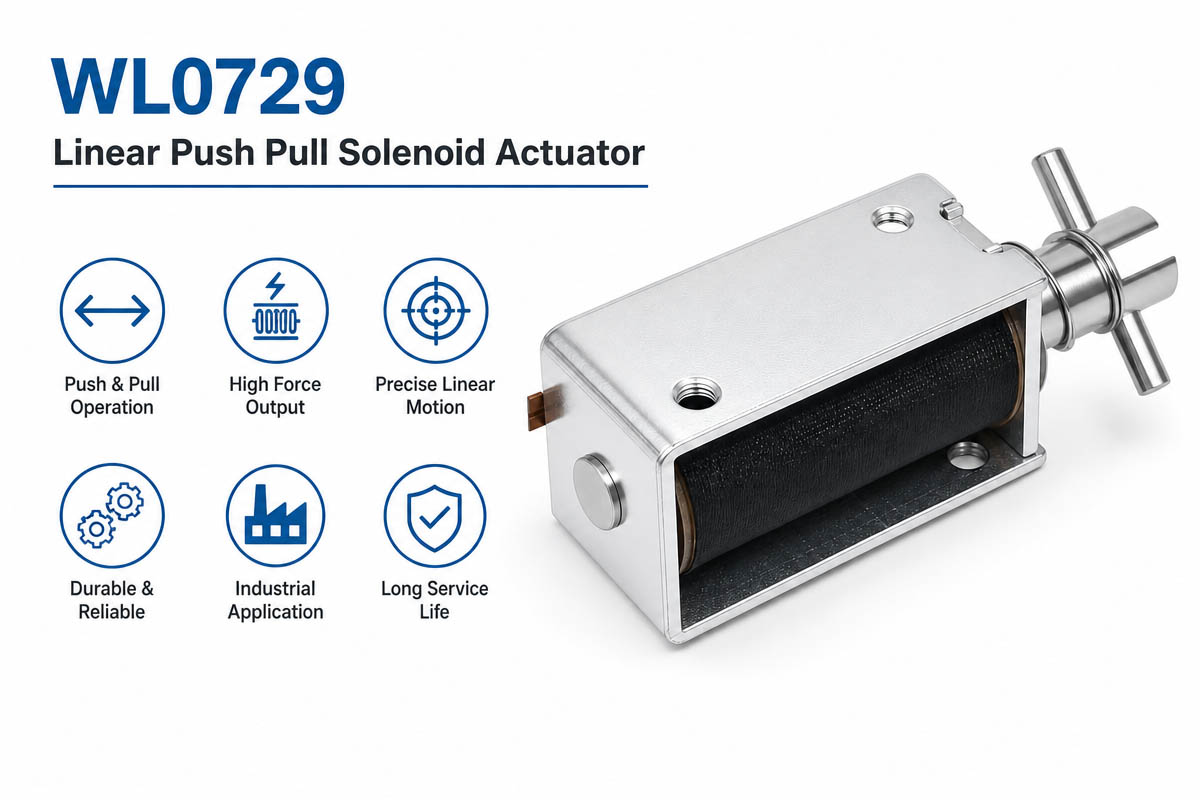
WL0729 Linear Push Pull Solenoid Actuator Industrial Guide

A linear push pull solenoid actuator is a compact electromagnetic motion device that is designed to provide accurate push and pull movement in industrial applications. When electrical power is supplied to the internal coil, a magnetic field is generated that causes the plunger to move in a straight line. This linear movement can then be controlled to actuate valves, locks, switches, clamps, and automated mechanisms .

Fast response, simple design, low maintenance and high reliability are the features of the industrial linear push pull solenoid actuators. They come in a variety of voltage ratings, stroke lengths, force outputs and mounting configurations to suit various application needs. These actuators offer efficient and reliable mechanical control solutions for factory automation equipment, medical devices, security systems and more.

Linear Push Pull Solenoid Actuator Product Overview

The linear push pull solenoid actuator is an efficient electromagnetic actuator for reliable linear motion control. It features a rugged coil structure, robust metal housing and a precision engineered plunger mechanism to deliver consistent push and pull force.

It can be customized to fit various industrial demands with a selection of sizes, voltages and stroke options. The actuator provides fast response, convenient installation and stable performance under the continuous operation. It is suitable for automation machinery, locking systems, control equipment and industrial devices which require precise mechanical movement.

How does a linear push pull solenoid actuator work?

A linear push pull solenoid actuator operates according to electromagnetic principles. The actuator consists of a coil of insulated wire wound around a movable iron plunger. When a current flows through the coil, a magnetic field is created, which pulls or moves the plunger to the center of the coil.

The plunger produces linear force as it moves. Depending on the design of the actuator, the plunger can push or pull a connected mechanical part. Without power, a spring mechanism generally pushes the plunger back to its original position.
The operating process consists of:
Current flows into the solenoid coil.
The coil generates an electromagnetic field.
Magnetic force shifts the internal plunger.
The plunger pushes or pulls to create mechanical motion .
The actuator resumes operation following a power failure.
Fast switching, precise movement and reliable operation are achieved with this simple mechanism .

Main Features of Linear Push Pull Solenoid Actuator

Linear push pull solenoid actuators provide a number of important features for industrial applications. They provide fast response, high reliability and direct linear motion without complicated transmission systems. They are compact in design and suitable for installation in limited spaces, but produce strong electromagnetic force.

These actuators are available in a range of voltage options, stroke distances and force ratings for custom applications. The use of durable materials increases the operating life and the resistance to vibration and to environmental conditions. Low maintenance requirements keep operating costs down. Other features may include spring return, high duty cycle, noise reduction features and customized mounting options for industrial automation equipment.

Linear Push Pull Solenoid Actuator Video

Linear Push Pull Solenoid Actuator Detailed Display

Linear Push Pull Solenoid Actuator Technical Datasheet

Brand Weilong Technology Model Number WL0729
Rated Voltage (V) DC 3–48V Rated Power (W) 10–20 W
Work Model PUSH-PULL Type Holding Force (N) 1-6 N
Stroke (mm) 1–7 MM Reset Time(s) 1 S
Service Life 300 Thousand Times Certification CE, RoHS, ISO9001,
Material Carbon Steel Housing with Zinc Plated Coating Lead Wire Length (mm) 200
Install Style Adjustable Screw Tolerance of Dimension  +/-  0.1 MM
Water-proof  None Insulation Class  F   155 Cel. Degree
Hi-Pot Test AC 600V 50/60Hz 2s Non-excitation Holding Force 0
Working Temperature -10°C-100°C Duty Cycle 1-100%
Thread Depth (mm)  / Payment Term TT, or LC At Sight
Sample Order Yes Warranty 1 Year
MOQ 500 pcs Supply Ability 5000 pcs per Week
Delivery Time 30 Days Port of Loading shenzhen

Why is the Linear Push Pull Solenoid Actuator gaining popularity?

Linear push pull solenoid actuators are becoming increasingly popular due to the growing demand for compact, efficient and reliable automation components in industries. The simple electromagnetic design ensures fast operation, precise movement and integration into modern equipment.

The demand for compact motion components is determined by the development of industrial automation, robotics, intelligent manufacturing and intelligent control systems. Solenoid actuators become a low-cost alternative to complex mechanical systems.

The use of actuators increases in automotive systems, medical devices, security equipment and industrial machinery. Durability and adaptability of these actuators is improved by innovations in materials, energy efficiency and customized design.

With the trend towards automation and precision control in industries, linear push pull solenoid actuators will become a significant element of future mechanical motion systems.

Linear Push Pull Solenoid Industrial Application

Linear Push Pull Solenoid Actuator Industrial Application

Linear push pull solenoid actuators are extensively used in many industrial and commercial applications, where precise linear motion is needed.

In industrial automation these actuators control mechanical parts such as clamps, feeders, locks and positioning devices. Solenoid actuators are widely used in manufacturing machines for fast switching operations and automated control processes.

Linear solenoid actuators are used in the automotive field for driving door locks, transmission systems, fuel control devices, and safety mechanisms. They are compact in design and can be fitted in tight spaces.

Solenoids are also employed in medical equipment like pumps, diagnostic machines and automatic adjustment systems where reliable movement is a necessity.

Push pull solenoid actuators are used in security systems, eg electronic locks, access control equipment and automatic doors. This quick response improves the system’s efficiency and safety.

Other applications include vending machines, agricultural equipment, robotics, HVAC, office equipment and laboratory instruments.

However, despite their basic structure, rapid operation and reliable functioning, linear push pull solenoid actuators are still an important component in contemporary automation and intelligent control systems.

Linear Push Pull Solenoid Actuator Advantage and Disadvantage

Linear Push Pull Solenoid Advantage and Disadvantage

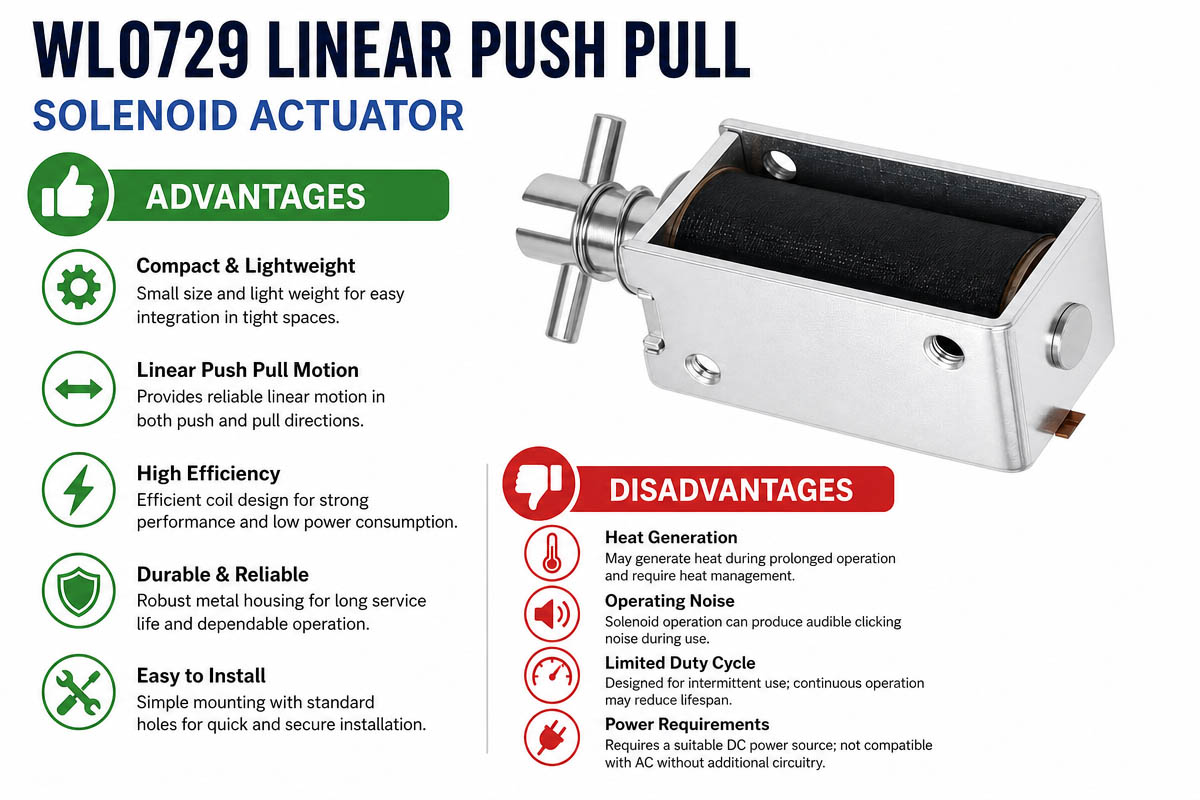
Linear push pull solenoid actuators have a number of advantages for industrial motion control. The electromagnetic design provides fast response and reliable operation of the actuators. They have less mechanical parts compared with motors and are easier to maintain. They are compact and can be installed in restricted areas. Solenoids provide direct linear movement without additional conversion mechanisms and increase efficiency. Moreover, these actuators are inexpensive and can be integrated into automation equipment.

However, linear push pull solenoid actuators have disadvantages. For example, they do not provide a large stroke length compared to electric cylinders. Continuous operation leads to heat accumulation, so it is necessary to ensure proper cooling or duty cycle. The strength of the actuators decreases with increasing stroke length. Noise during operation in sensitive environments is another disadvantage.

Linear Push Pull Solenoid Actuator Troubleshooting Guide

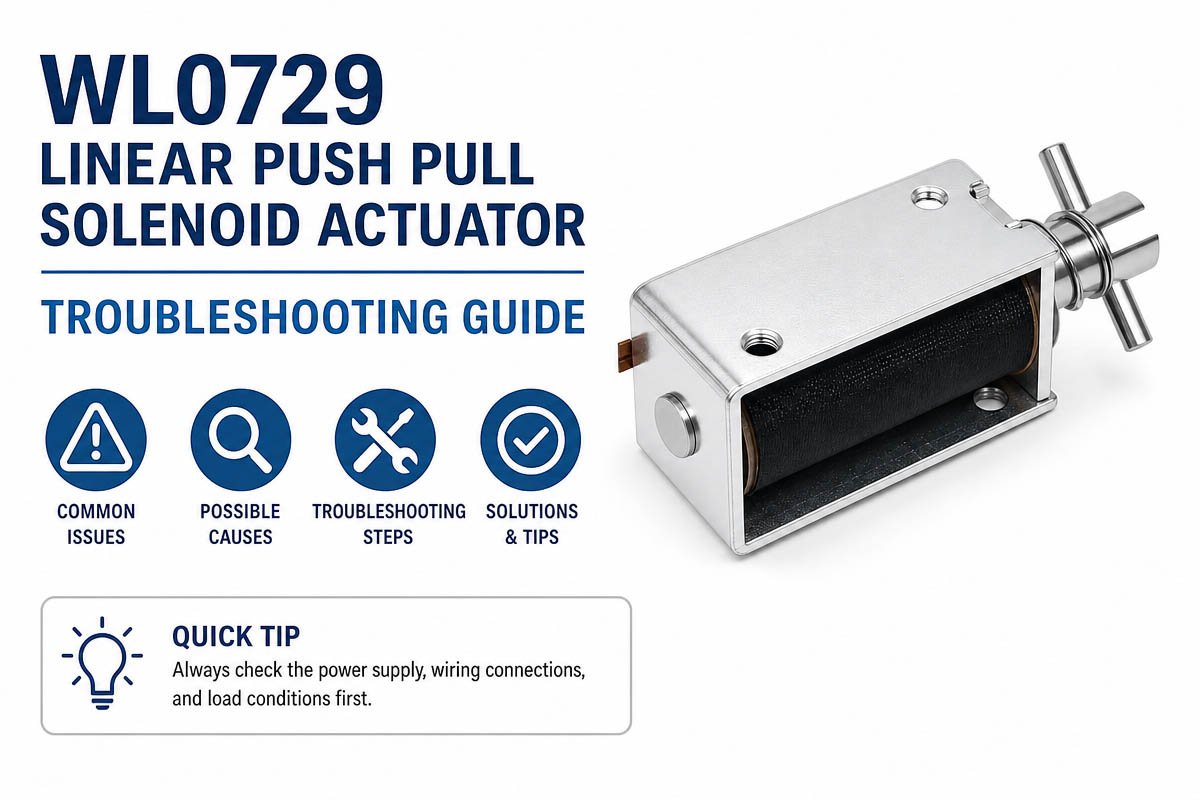
Linear Push Pull Solenoid Actuator Troubleshooting Guide

In most cases the problem can be solved with systematic inspection of the actuator. However, if it does not solve the problem, it is possible to use the troubleshooting table.

The actuator will not move.

Check power supply voltage, wire connections, coil resistance. Damaged coil may inhibit electromagnetic operation.

Weak Force Output

Low voltage, wrong actuator selection or mechanical resistance can reduce force performance. Check conditions of power and load requirements.

Overheating

Excessive duty cycles, incorrect voltage or continuous operation beyond specifications may result in overheating .

Movement Slow

Look for friction, broken springs or low electrical current.

Just Too Much Noise

Noises can be caused by loose mounting, mechanical impact, or incorrect alignment.

Limited service life

Poor environmental protection, overload operation, improper installation can reduce the life expectancy.

Regular maintenance, correct installation and the choice of the right actuator specification can help to avoid most operational problems.

8 Most Frequently Asked Questions of Linear Push Pull Solenoid Actuator

1. What is a linear push pull solenoid actuator?

A linear push pull solenoid actuator is an electromagnetic device that converts electrical energy into linear mechanical motion. It has a coil, magnetic field and moving plunger to create pushing or pulling force. The presence of current in the coil produces a magnetic field which moves the plunger and the actuator can control mechanical components. These actuators are popular in industrial automation, locking systems, medical equipment, automotive devices, and machine control applications due to their quick response, compact structure, and reliable operation.

2. How does a linear push pull solenoid actuator work?

A linear push pull solenoid actuator works on the principle of electromagnetic force. The internal coil, when energized with DC power, creates a magnetic field that either moves or attracts the metal plunger inside the actuator. It produces a push or pull in a straight line. When the power is removed, a return spring or some external mechanism pushes the plunger back to its original position. Its simple electromagnetic design allows fast operation, precise movement and easy integration into automated equipment.

3. What are the most common applications of linear push pull solenoid actuators?

Linear push pull solenoid actuators are used extensively in industrial and commercial equipment. Common applications are automation machinery, robotic systems, electronic locks, vending machines, automotive parts, medical devices, HVAC systems, agricultural equipment and security systems. These are frequently used in factories to control clamps, valves, feeders, switches and positioning mechanisms. They can be used for applications where fast and repeated linear motion is needed thanks to the compact design and reliable motion

4. How to select the right linear push pull solenoid actuator?

The choice of a suitable linear push pull solenoid actuator depends on a number of factors such as force, stroke length, voltage, duty cycle, operating environment and installation space. 1. Determine the load force for the application.

Then choose an actuator with appropriate stroke distance and voltage compatibility. Consider if the actuator will be used continuously or intermittently, as duty cycle affects heating and lifespan. Environmental factors such as dust, moisture and vibration should also be considered when choosing an industrial solenoid actuator.

5. What voltage options of linear push pull solenoid actuators?

Linear push pull solenoid actuators are available in different voltage ratings for different control systems. Typical options are 6V DC, 12V DC, 24V DC, and 48V DC. Industrial versions are typically 12V and 24V DC as these voltages are compatible with automation controllers, batteries and industrial power supplies. Selecting the proper voltage is important because the wrong voltage may reduce the actuator performance, increase heat generation or damage the coil.

6. What are the advantages of linear push pull solenoid actuator?

Linear push pull solenoid actuators provide a number of advantages including fast response time, simple construction, small size, low maintenance and reliable performance. They provide direct linear motion without the need for complicated mechanical transmission systems. The cost-effective design makes them suitable for large-scale industrial applications. They are also easy to install and operate with simple electrical signals. These advantages make them popular choices for automation equipment, safety devices and precision control systems.

7. Why does a linear push pull solenoid actuator get hot?

Heat generation is a common problem of solenoid actuators because electrical energy is converted into electromagnetic force and heat. The unit may overheat due to continuous operation, incorrect voltage, high duty cycle, overload conditions or insufficient cooling. Users should choose an actuator with appropriate duty rating, operate within recommended voltage levels and provide sufficient ventilation to prevent overheating. When applications require frequent operation, a high-duty-cycle solenoid actuator should be selected.

8. How to maintain a linear push pull solenoid actuator for longer service life?

Regular maintenance can significantly increase the lifespan of a linear push pull solenoid actuator. Check electrical connections, mounting screws and mechanical alignment periodically.

• Keep the actuator clean and free from excess dust, moisture and vibration. Don’t run the actuator past the rated force and duty cycle. Regular inspection of the plunger movement and return mechanism can help to detect the problems in time. Reliability and longevity are also ensured by using high-quality actuators appropriate for the application environment.

Linear Push Pull Solenoid Actuator Choosing Guide

Before choosing the right linear push pull solenoid actuator for your application needs, you should know the main application parameters. Here are the main factors that should be taken into account when choosing this type of actuators.

1. Find the force required

You first have to find out what kind of pulling or pushing force you need. Select an actuator that has enough force capability to move the load without overheating or reducing its lifespan.

2. Stroke Length Check

The length of the stroke is the distance that the plunger travels. Choose a stroke that meets the mechanical motion requirements of your machine.

3. Consider Your Voltage Needs

Solenoid actuators are available in a variety of voltage options including 12V DC, 24V DC and other specifications. Verify that it’s compatible with your power supply.

4. Duty Cycle Calculation

The duty cycle defines the actuation frequency and duty cycle. Models for higher duty cycles are needed for continuous operation.

5. Check the Installation Area

Check mounting space before selection The compact design is perfect for applications requiring a small installation space.

6. Consider the environmental conditions

For industrial environments choose actuators with the proper protection against dust, moisture, vibration and temperature fluctuations.

7. Quality Manufacturing Dependability Choose

Material quality and manufacturing precision improve actuator durability, efficiency and operational stability.

A good selection process will ensure better performance, longer life and lower maintenance costs.

Guide to avoid Desiang Mistake for Linear Push Pull Solenoid Actuator

Don’t choose an actuator based on size alone.

You have to think about force output and stroke requirements.

Do not match voltages incorrectly.

Wrong voltage can cause overheating or too little movement.

Think of the heat you generate.

you need proper thermal design if you want run it indefinitely.

Do not allow inadequate mechanical support.

Improper mounting will shorten actuator lifespan.

And don’t forget duty cycle requirements.

Frequent operation requires suitable actuator specifications.

Consider the design of a return mechanism.

The spring force should fit the demands of the application.

Testing under real working conditions.

Prototype testing helps avoid surprises.

Get A Free Quote Now

Contact Form

Related Products

Related News

Scroll to Top

Get A Free Quote Now !

Contact Form
If you have any questions, please do not hesitate to contact us.
Weilong Solenoid Company Culture