
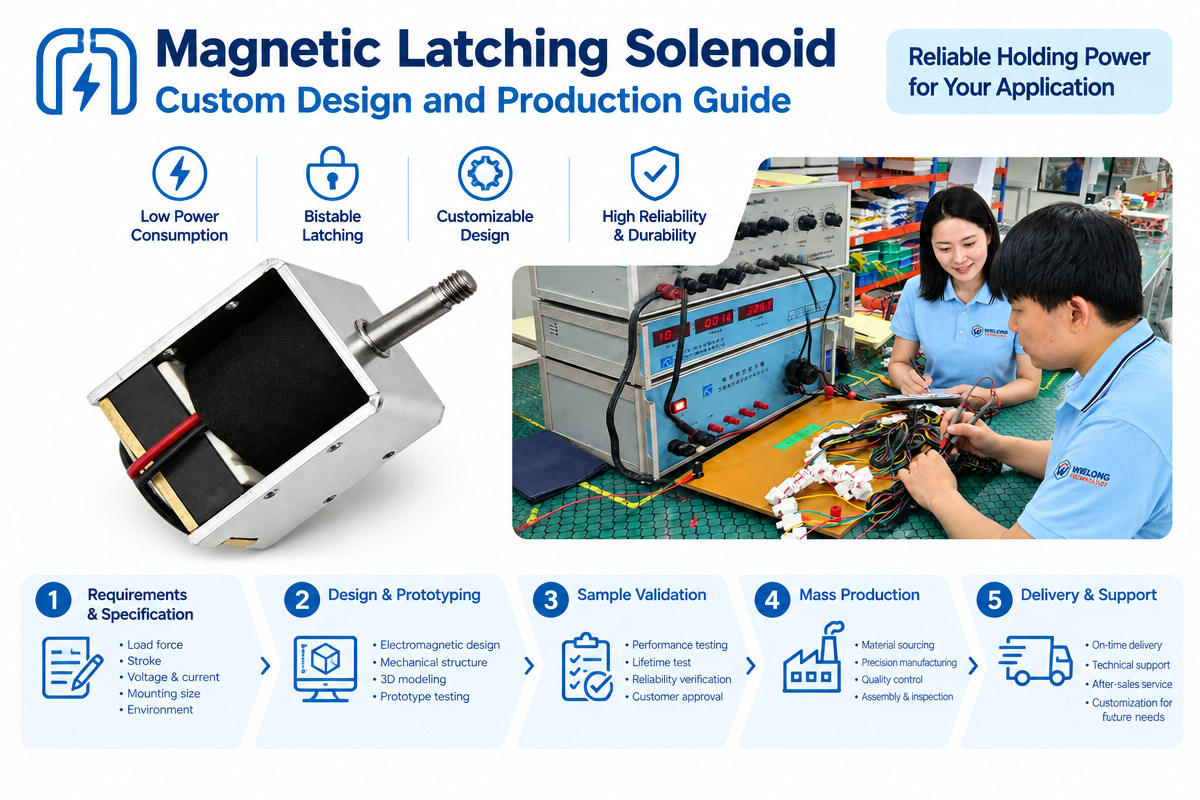
Introduction to Custom Magnetic Latching Solenoid
A custom magnetic latching solenoid is an electromechanical actuator moving a plunger or armature and holding it in a certain position without electrical supply. The technology of electromagnetic actuation with permanent magnet holding is quite effective for such products where the reliable linear motion with low average power consumption is needed.
Magnetic latching technology finds its application in smart locks, access control systems, medical equipment, industrial automation, electronic cabinets, metering devices, vending machines, safety devices, and battery-operated devices.
However, standard catalog solenoids may not meet the requirements of OEM products.
A custom magnetic latching solenoid will provide a better integration when a new OEM product requires special stroke, force, voltage, holding force, plunger form, mounting arrangement, connector, and installation envelope.
Development of a custom magnetic latching solenoid requires close cooperation of the OEM engineering department and the solenoid manufacturer. The combination of mechanical, electrical, magnetic, and manufacturing aspects has to be considered right from the beginning of the design.
The guide includes all steps of the custom magnetic latching solenoid development—from specification and prototype design through to validation and mass production.
1. When is a custom magnetic latching solenoid?
Firstly, one has to consider the standard solenoid since the use of ready designs will help reduce tooling costs, development time, and risks of the project.
Customization may be beneficial in cases where standard products cannot provide an essential feature.
Typical reasons are
Less installation space requirement
Special stroke requirements
Higher initial force
Specific holding force
Low operating voltage
Limited peak current
Special plunger form
Different mounting places
Low noise requirements
Special lead wires or connectors
High cycle life requirement
Environmental Pressures
For example, an OEM smart-lock manufacturer has 30×20×18 mm of space for the actuator and 5 mm stroke and requires specific holding force.
Development of a custom magnetic latching solenoid might be more compact and commercially reasonable compared to redesigning the whole lock to integrate the larger standard component.
The customizing has to be performed as a solution to an engineering problem and not as the creation of a unique component.
2. Start with a full application specification
The quality of the final actuator highly depends on the quality of the initial specification.
Request like:
We need a 12V latching solenoid.
is not enough for engineering development.
The useful specification has to include:
Application: What is the purpose of the latching solenoid?
Voltage: What is the nominal and actual voltage range?
What is the max current that the electronics can put out?
Stroke: How far does the plunger go?
Force. What force in different positions?
Holding Force: What is the needed holding force?
Pulse duration: How long can we fire the coil?
Frequency: How often does the actuator run?
Life cycle. What number of cycles should there be?
Dimensions: What is the maximum envelope that can be installed?
Environment: What temperature, humidity, or vibrations are expected?
The provision of drawings, CAD models, mechanism videos, and load information will significantly enhance the design process.
Based on this information, the manufacturer will decide if it is possible to modify the existing platform or if it is necessary to develop a new architecture of the magnetic latching solenoid.
3. What is the Custom Magnetic Latching Solenoid’s Stroke and Mechanical Movement?
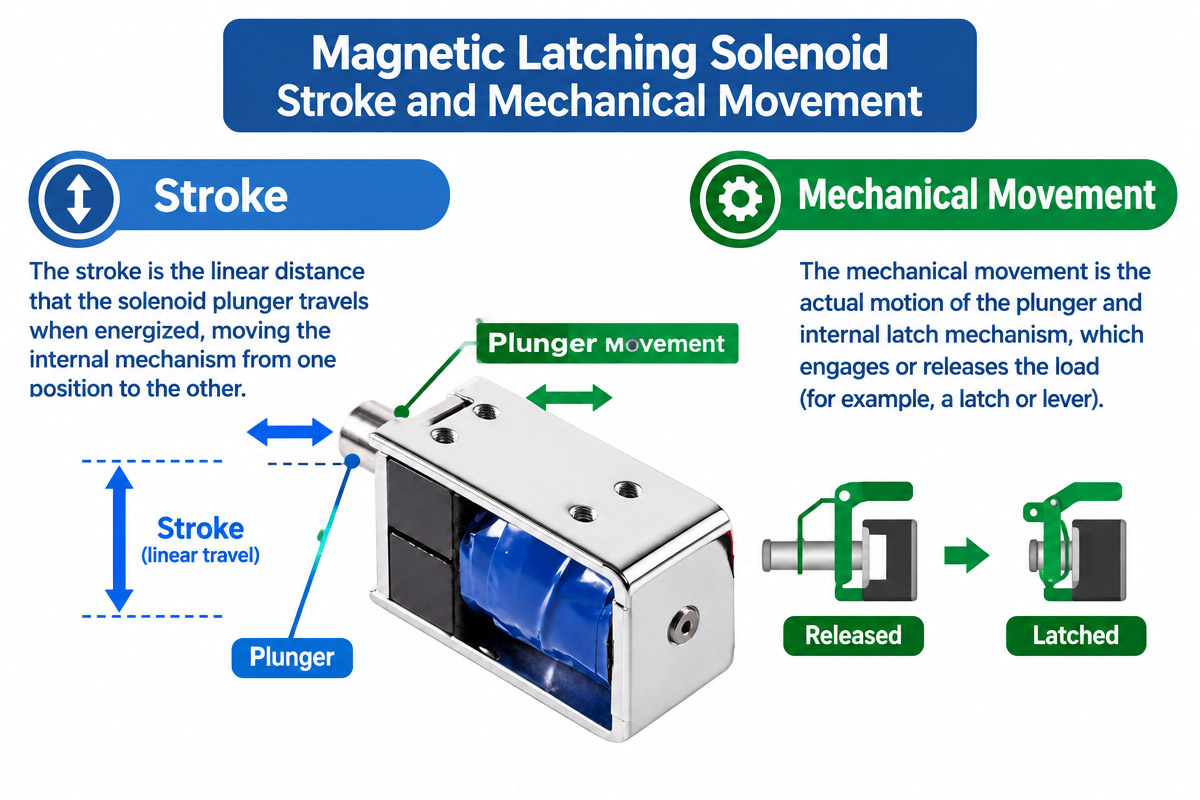
One of the first parameters that engineers have to determine is the stroke.
The actuator has to provide enough travel to operate the mechanism in a reliable way, taking into account manufacturing tolerances. But additional travel may result in a bigger solenoid that is more difficult to optimize.
Consequences of the longer stroke:
Initial force
Magnetic Efficiency
Coil dimensions
Length of plunger
Time of response
Demand for electrical energy
Therefore, OEM engineers have to determine the minimum travel that the mechanism requires.
If the product needs 4 mm of movement, then 10 mm just for providing some margin may reduce the efficiency.
Instead, engineers have to analyze mechanical tolerances systematically.
In the development of a custom magnetic latching solenoid, the analysis of both the stroke and the mechanism is required.
4. Define Force at Correct Stroke Position
One of the most important aspects of custom solenoid design is that force cannot be determined as a single number without position.
The magnetic air gap changes as the plunger moves. That means that the force of the solenoid changes too.
For example, the application specification might be
Starting position: 8 N @ 2 mm
Mid stroke: 12 N, 3 mm
Final position 20 N at near-full engagement
It is more useful information than asking for “20 N force.”
Besides, engineers have to take into account forces generated by:
Springs.
Resistance
Gravitation
Mechanical levers.
Closed
Speeding up
Misalignment
Manufacturing tolerances
These requirements can be used by the manufacturer to optimize the coil, the magnetic circuit, the plunger, and the geometry.
Then the prototype force versus stroke testing will check custom magnetic latching solenoid performance in the working range.
5. Calculate the required holding force
The holding force is one of the important characteristics of a latching actuator.
The permanent magnet force will help to hold the plunger in the required position after the electrical pulse is turned off.
The required holding force depends on the mechanism.
Small internal switches may need less holding force. A locking mechanism, industrial latch, or safety device will need much more holding force.
OEM engineers have to consider the following:
Mechanical load from outside
Recoil springs
Vibrations
Mechanical shock.
Product orientation
Air gap tolerances
Temperature
Product life cycle
Excessive holding force is not always beneficial.
If the holding force is too big, then more electrical energy may be needed to unlock or reverse the mechanism.
That is why in a well-designed magnetic latching solenoid there is always a balance between stability of holding and reliable switching performance.
6. Choose Magnetic Latching Solenoid Voltage, Current, and Coil Parameters
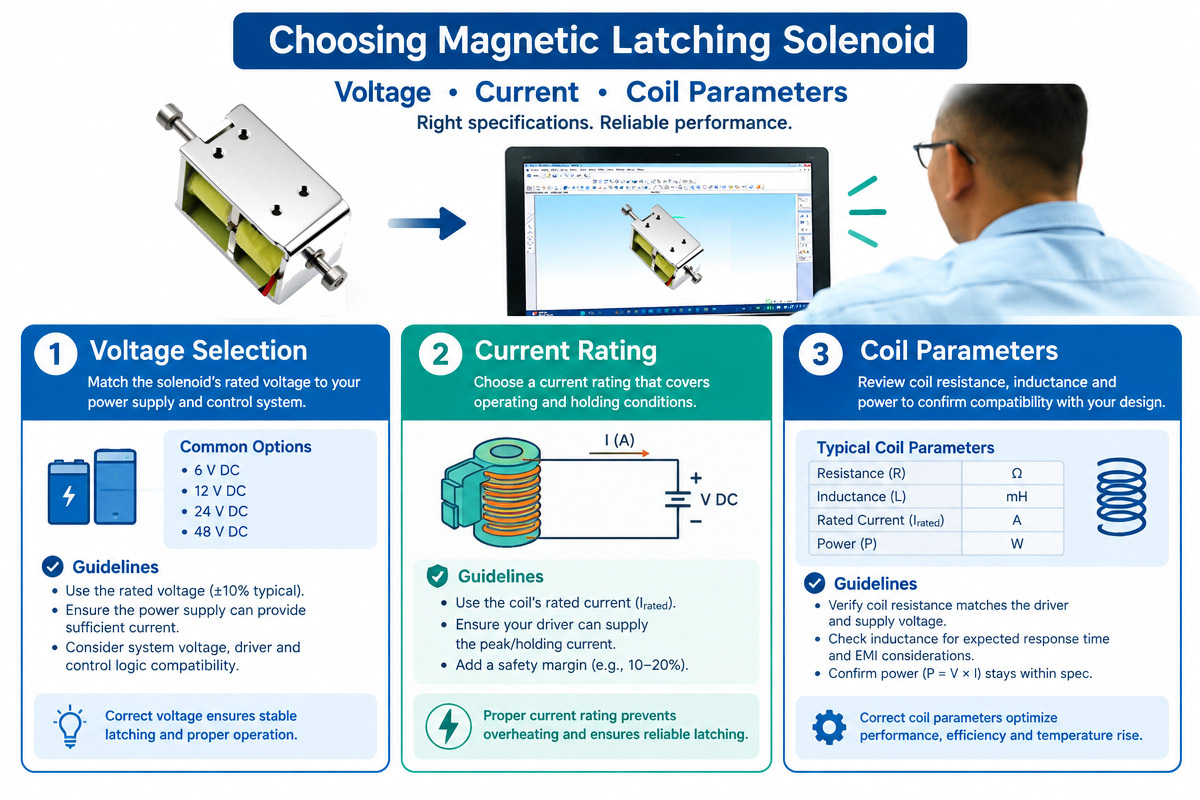
Custom coil design provides an opportunity for OEM engineers to optimize the actuator according to the actual electrical system.
Typical operating voltages are 5 VDC, 6 VDC, 12 VDC, and 24 VDC, although other values are possible.
The manufacturer has to consider the following:
Supply voltage range
Resistance of coil.
Maximum current
Wire diameter
Number of windings in turns
Winding space available
Pulse duration
Rising temperature
The minimum battery voltage is especially important for battery-powered products.
The perfect actuator may become unreliable when connected to a new battery as the battery voltage drops.
That is why the magnetic latching solenoid must be tested at the actual range of operating voltages for the product, not just at the nominal voltage.
7. Optimize the Permanent Magnetic Circuit
The permanent magnet is the key to the latching action.
But it is not enough to just change the magnet to a stronger one.
We have to optimize the whole magnetic circuit.
Important factors are
Magnetic material
Magnet size
Magnet location
Material of the piston
Basic material
Magnetic circuit
Air-spaces
Mechanical clearances
The electromagnetic actuation force must be balanced with the permanent magnetic holding force by engineers.
The manufacturing variation is also important, as the changes in air gap, magnetic material, or part dimensions may influence the performance.
That is why the custom magnetic latching solenoid is designed for ideal prototype dimensions and real mass-production tolerances.
8. Mechanical Design of Plunger and Interface
The plunger converts electromagnetic motion to the customer mechanism.
Possible customization options are
Length of the shaft
Diameter of shaft
Channels
Threading
Flat surfaces
End forms
Pin
Mechanical stops
Connection features
The interface has to transfer force in an efficient way without excessive side loads.
The side loads cause an increase of friction and wear.
In the ideal world the actuator should move only in the linear direction that it was designed for, and any other mechanical movement should be provided by an external guide or linkage.
The mechanical interface of a magnetic latching solenoid should also be designed to allow easy installation in OEM products.
Effective technical design but complicated for installation will increase manufacturing time and cost.
9. Account for Noise and Impact
Noise is the important parameter for smart locks, medical equipment, office equipment, residential products, and high-end consumer equipment.
Often we hear the sound of the solenoid operating when the plunger hits the mechanical stop.
The following ways of noise control are possible:
Optimization of the plunger velocity
Modification of stop geometry
Reduction of clearance over limit
Incorporation of proper damping
Improvement of mechanical alignment
Optimization of electrical pulses.
However, reducing the impact too much can prevent the actuator from reliably completing the movement.
That is why you must compromise noise reduction with actuation force and latching reliability.
If noise is important for you, specify a measurable requirement in the custom magnetic latching solenoid development specification and test it in the final assembly.
10. Create a Custom Magnetic Latching Solenoid Prototype for Validation
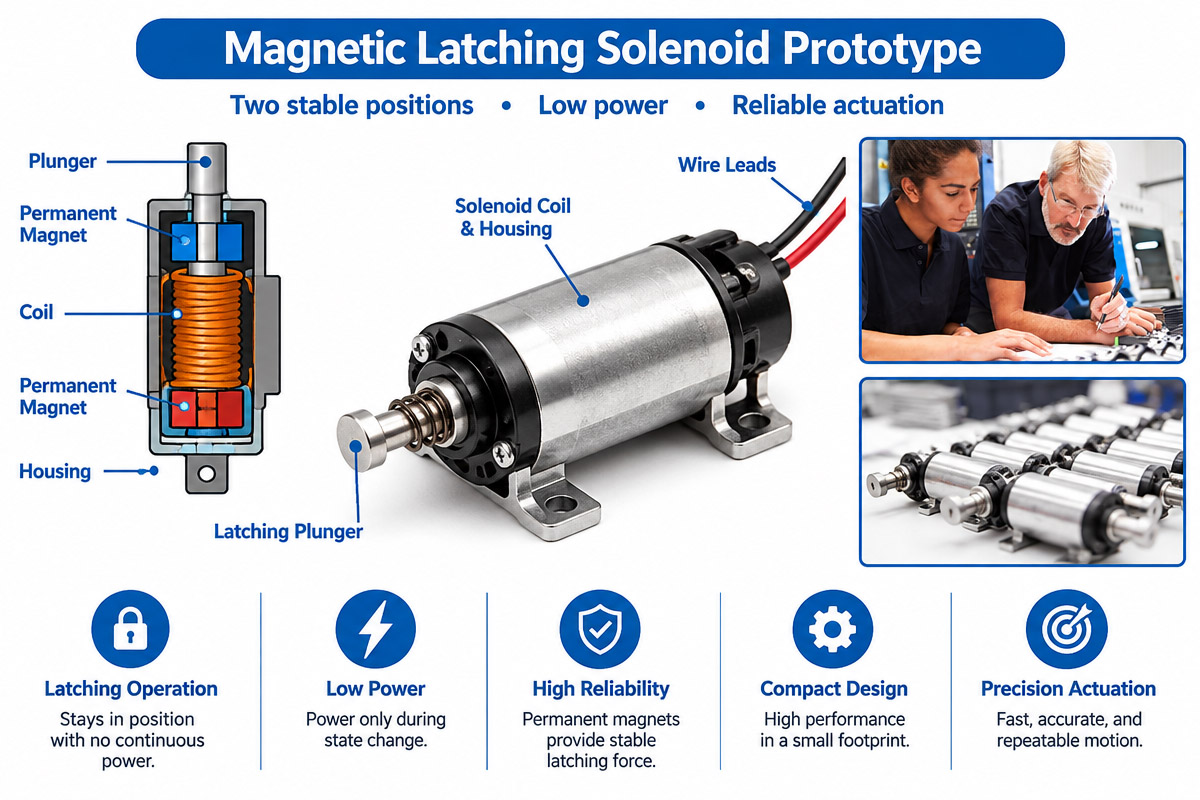
Upon completion of the technical requirements review process, the development of the prototype could be started.
Whenever it is feasible, the first samples should be developed on the basis of the already existing platform rather than developing the entire production tooling right away.
The prototype development process might consist of several steps:
application specification → review by the engineers → initial design → sample → testing → modification → validation
The OEM should validate the prototype in the actual product.
Problems with: bench testing alone could fail to reveal
Mechanical alignment • spring loads of
- Resonant Housing
Limitations of the power supply.
- Temperature •
- Assembly clearance spaces
The team should also figure out the reasons for the failure prior to making numerous changes.
A systematic approach to development would result in a reliable magnetic latching solenoid design and avoid any reengineering.
11. Engineering Verification & Testing
Prior to mass production, the actuator should be validated under realistic and worst-case conditions.
Testing might involve:
Force test: testing of the actuating force over the required travel
Holding-force test: testing the stability of the latching performance.
Voltage test: minimum, nominal, and maximum voltage.
Pulse-testing. Reliable pulse duration limits.
Temperature Test: verification of the operation within the rated temperature range.
Life testing: running the actuator for the required lifetime.
Acoustic performance: conducting or assessing acoustic performance according to the specification.
Vibration testing: a must for automotive, mobile, and industrial applications.
Application test: testing of the actuator in the final assembly.
Validation of a magnetic latching solenoid should account for the production tolerances whenever it is possible. When the design is capable of working with selected-by-hand prototype components, it is not yet ready for volume production.
12. Manufacturing Design
The custom actuator must be engineered to work properly and manufactured reliably.
This implies that the engineering teams have to consider:
- Availability of the material
- Tolerance of the components •
- Winding of the coil
- Assembly technologies
- Installation of the Magnet·
- Calibration of the Plunger
- Inspection technologies
- Required tools
- Production time
- Excessive tolerance requirements could lead to an unnecessary increase in manufacturing costs.
On the other hand, overly loose tolerances can result in unacceptable variations in force or holding performance.
Design for manufacturing is a practical compromise.
For high-volume programs, even small improvements in the assembly process would substantially decrease the cost of production of the magnetic latching solenoid.
13. Tools & Manufacturing Pilot
If the design is reasonable, the production tooling might be required.
Tooling might include, depending on the design of the actuator:
Stamping Tools
- Injection molding of the plastic housing
- Coiling holders
- Assembly fixtures
Welding jigs
- Inspection gages
- Functional test equipment
- A strong recommendation for a pilot build prior to full scale production.
The pilot production would show that the manufacturing process could consistently produce the engineering design.
The buyer should compare the pilot units with the approved engineering samples and examine critical parameters, such as dimensions, resistance, force, stroke, and holding performance.
This step would be helpful to reveal manufacturing issues prior to mass production of the magnetic latching solenoid.
14. Establish Production Quality Controls
“Concentrate on traits that impact function for mass-production quality.”
Depending on the design, they could include:
Coil Resistance •
- Critical dimensions
Myocardial Infarction
- Stroke of the Plunger
- Actuating performance
Holding Performance
- Insulation
- Quality of the wire and connector
Graphics •
- Quality of Construction
- Not all of the characteristics need to be inspected at the same frequency or with the same precision.
The most rigid controls should be applied to the characteristics that impact the function of the actuator.
The OEMs also have to discuss traceability, lot control, and nonconforming product procedures with the manufacturer.
When the magnetic latching solenoid is the critical component of a larger product, the quality has to be consistent.
15. Engineering Change Management
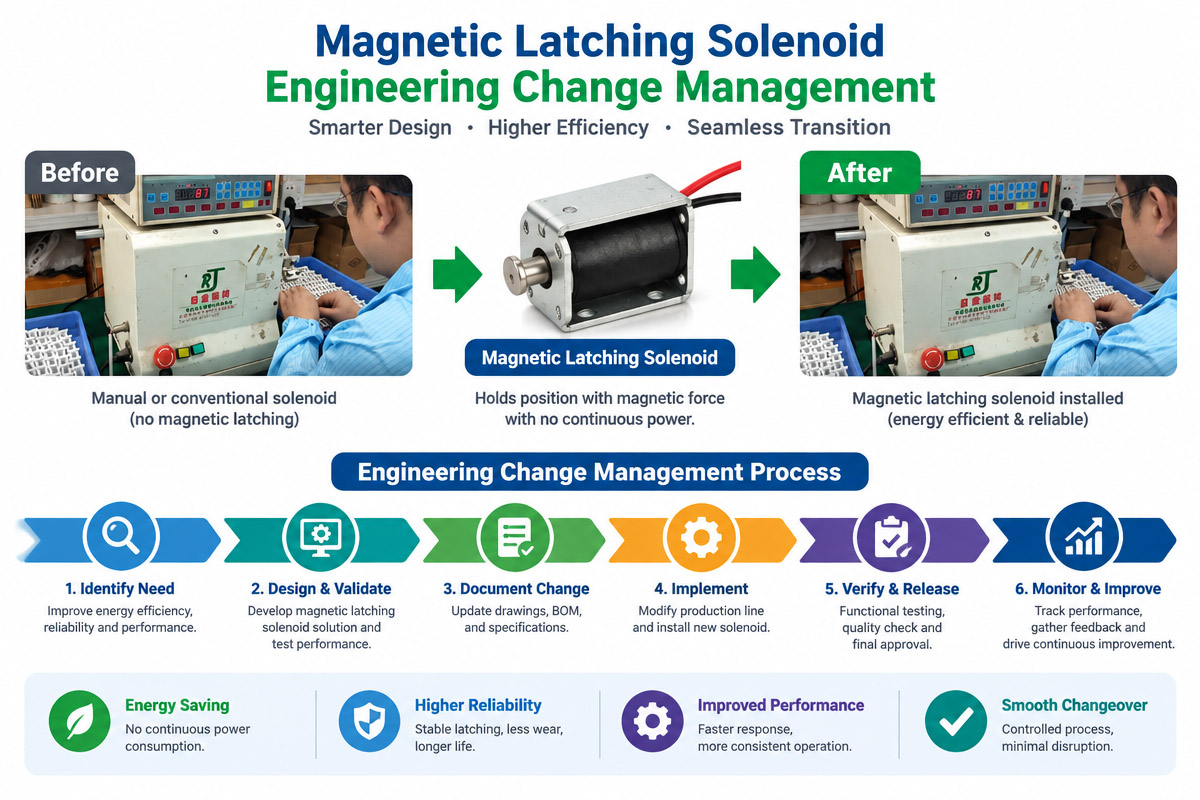
Material or process change could impact the performance without changing the part number.
Major changes could include:
- Magnet Manufacturer ·
- Magnetic substance
- Coil wire
- Piston Materials
- Surface Treatment
*Spring Time
- Adhesive.
- Resine Plastica
- Production process
The OEM buyers have to establish a process for notifying changes in engineering.
Any change that could affect the actuating force, holding force, resistance, dimensions, or service life should be verified prior to implementation.
Good engineering change management is as critical to the long-term OEM project as sample approval.
16. Evaluate the manufacturer’s capability before mass production
Selecting a custom actuator manufacturer is more than just comparing quotes.
What buyers should know:
- Engineering capability •
- Similar products experience
- Prototyping capabilities
- Customizability
- Test equipment
Quality system
- Manufacturing capability
- Supply chain reliability
- Change Management
- Communication
– Time to market
Cost structure
* Ask the supplier about their project transition from engineering samples to volume production.
A manufacturer that knows how to design and manufacture could minimize the performance differences between the prototype and the production.
17. Evaluate the total cost of the project
The lowest component quote is not necessarily the lowest cost solution.
The total project cost could include:
- Design Engineering
- Hardware.
- Prototyping Samples.
Verification. ·
- Unit Cost
- Check
- Meet
- Stock Inventory
- Quality failures
Claims under warranty
- Field Replaceable
The use of the higher-cost actuator that is easier to assemble and performs reliably could reduce the total cost of the product.
The magnetic latching solenoid has to be treated as the part of the complete OEM product and not as a distinct purchased component.
18. What Should a Buyer Put in an RFQ?
RFQ details for a more accurate quote and better technical communication.
For example:
Product: Custom Magnetic Actuator Latching
Application: Smart cabinet lock
Voltage: 12 VDC (G)
Max current available: 1.5 A peak
Stroke: 5 mm
Force at start: 5 mm, 10 N
Required Holding Force: 25N
pulse length: max. 200 msec
Operating temperature: -20°C to +60°C
Expected life: 500 000 cycles
Maximum dimensions: 32 × 24 × 20 mm
Noise: Prefer Low noise
Annual demand: 150,000 pcs.
Target production: Q3
Include drawings, CAD files, loaded data, and photographs of the application if possible.
This would allow the manufacturer to better evaluate the feasibility, cost, tooling, lead time, and production pricing.
Abstract: The custom design of a magnetic latching solenoid has to be a full electromechanical engineering project, not a coil and plunger modification.
Well-designed actuators are balanced between stroke, actuating force, force of holding, voltage, current, pulse duration, properties of the permanent magnet, mechanical integration, noise, temperature, and operating life.
19. Manufacturing considerations are equally important.
The actuator has to be designed in such a way that the winding of the coil and the magnetic components, as well as the dimensions of the plunger and the assembly process, would be reliably controllable in volume production.
The most efficient development process for OEM buyers is the one that starts with the detailed specification and collaboration between the product designer and the solenoid manufacturer.
Then the prototype samples have to be tested in the real mechanism under realistic loads, voltage limits, and environments.
Design validation must be completed during the engineering phase, and design verification must occur during pilot production before full-scale production begins.
Good application specifications, engineering validation, and design for manufacture, as well as discipline quality control, could help OEMs design a custom actuator that would provide reliable performance from the first prototype till the long-term mass production.
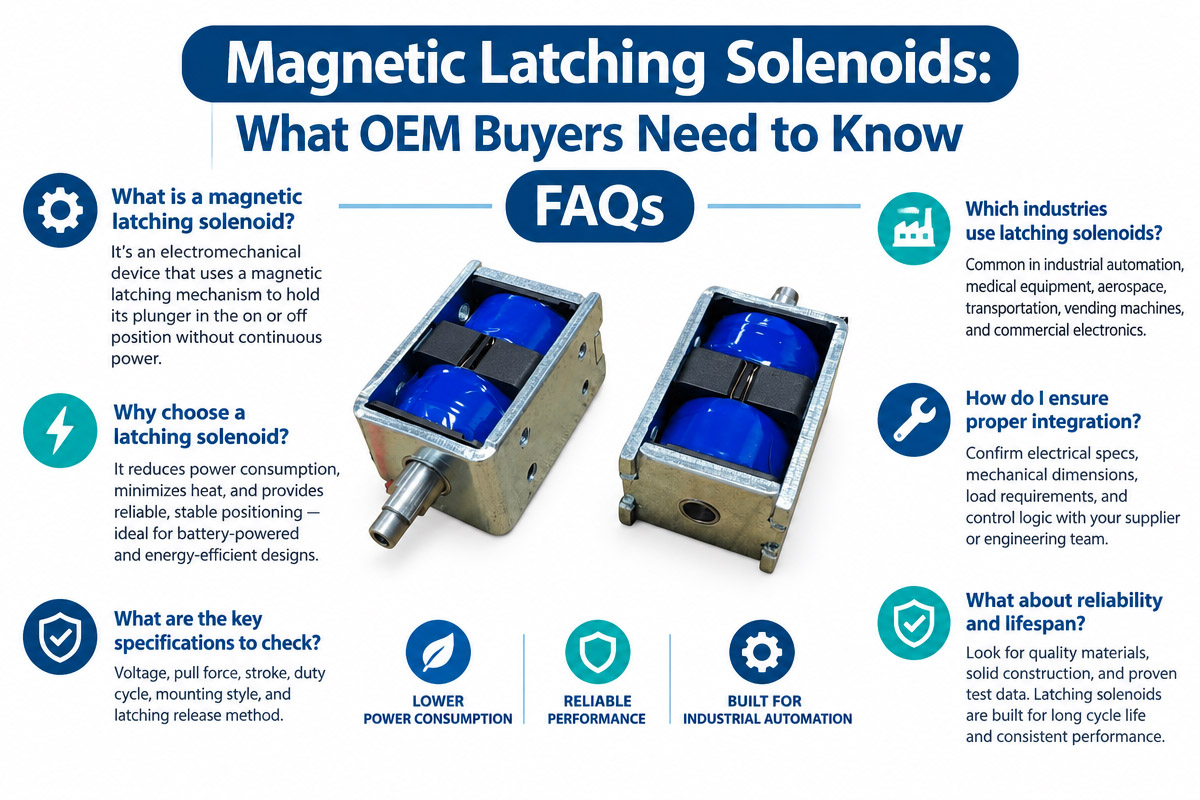
20. Magnetic Latching Solenoids: What OEM Buyers Need to Know – FAQs
1. What information do I need to order a custom magnetic latching solenoid?
The buyers have to specify: • Application • Voltage • currently available. • Stroke required • Force at appropriate points of strike • Requirement of holding force Pulse duration • Operation frequency * Life expectancy • Available dimensions • Temperature range • Annual volume. You can use drawings, CAD files, and mechanism videos to evaluate the suppliers.
2. Minimum Order Quantity for Custom Magnetic Latching Solenoid?
The MOQ depends on the level of customization, manufacturing process, tooling requirements, and the supplier. You can reduce the volume requirements by modifying the existing platform instead of developing a new design. It is recommended to ask for the MOQ for the prototype, pilot production, and mass production separately.
3. What is the cost of the custom tooling?
The tooling cost depends on the design. A project based on the modified standard components might require no special tooling at all. Custom stamping, plastic components, housing, or special assembly processes would require new molds, dies, and fixtures. “Ask the suppliers to break out the tooling costs from unit pricing so you can compare the total project cost.
4. How long does custom development take?
The lead time depends on the complexity of the design, sample tooling, component availability, and testing requirements. Modifying the existing design is usually faster than designing a completely new magnetic structure from scratch. Ask the vendor to provide the development schedule that includes engineering review, samples, revisions, validation, pilot production, and mass production.
5. How to compare quotes from different vendors?
Please remember the unit price. Verify that each quote is based on the same voltage, force, stroke, holding force, lifetime, materials, testing, annual volume, and quality requirements. Compare also engineering fees, tooling costs, costs of samples, lead times, and change control policies.
6. What quality data do I need before approving mass production?
The buyers have to look for the data relevant to the important product characteristics. This might include dimensions, coil resistance, functional test results, force, holding performance, insulation testing, and life test results depending on the design. The pilot production samples for the critical OEM projects should be evaluated prior to volume approval.
7. How to reduce the cost of the custom magnetic latching solenoid?
If you could start from the existing manufacturer platform, it would help. Excessive stroke, high force requirements, tight tolerances, and exotic materials should be avoided when they do not bring clear benefit to the product. The standard wires, connections, and mounting features could also save money. If you discuss design for manufacture at the proper time, you can find additional savings before tooling.
8. How to select a good manufacturer of magnetic latching solenoids?
Evaluate engineering capability besides production cost. The good manufacturer should know how to design the magnetic circuit, coil, mechanical tolerances, force and holding-force testing, life testing, and volume production. The buyers also have to consider prototype responsiveness, quality control, production capacity, change management, communication, and long-term


