

Chapter 1: Introduction – Electric Proportional Valve Explained
The electric proportional valve is one of the advanced types of solenoid valves that operate on the principles of an electromagnetic drive and closed-loop control to continuously regulate fluid flow or pressure. Contrary to traditional solenoids, the electric proportional valve responds to analog control signals (0-10V, 4-20 mA) and allows precise linear control of liquid or gas media in terms of both constant flow and pressure.
An analogy: Standard solenoid valve – a regular light switch. Electric proportional valve – a dimmer knob – regulates how much to open the valve for a required flow rate. It is commonly used as a key actuator in various pieces of equipment and production lines that require dynamic regulation of fluid properties.
Chapter 2: Basic Principles of Operation
The control algorithm of an electric proportional valve can be described as following:
“Electrical signal input → electromagnet assembly → mechanical adjustment → feedback correction”
The entire process takes place with the help of four main components in a fully automated, intelligent, and precision manner.
Components: Electromagnetic coil, valve body and spool, feedback sensor, electronic controller
Step #1 Signal Input: The electronic control system generates an analog electrical signal based on set parameters and sends it to the control assembly. The signal value is proportional to the required valve opening degree.
Step #2 Electromagnetic Drive: The electrical signal reaches the electromagnetic coil and produces a magnetic field whose intensity depends on the value of the signal. As a result, the spool begins to change its position within the valve body.
Step #3 Closed-Loop Feedback: Advanced sensors integrated with the valve constantly monitor flow and pressure and transfer this information to the electronic controller.
Step #4 Dynamic correction: The electronic controller compares the desired opening value (“setpoint”) with the actual one (“measured value”) and adjusts the electrical signal to compensate external influences on the fluid characteristics (fluctuating load, temperature, pressure, etc. ).
Chapter 3: Components of Electric Proportional Valve
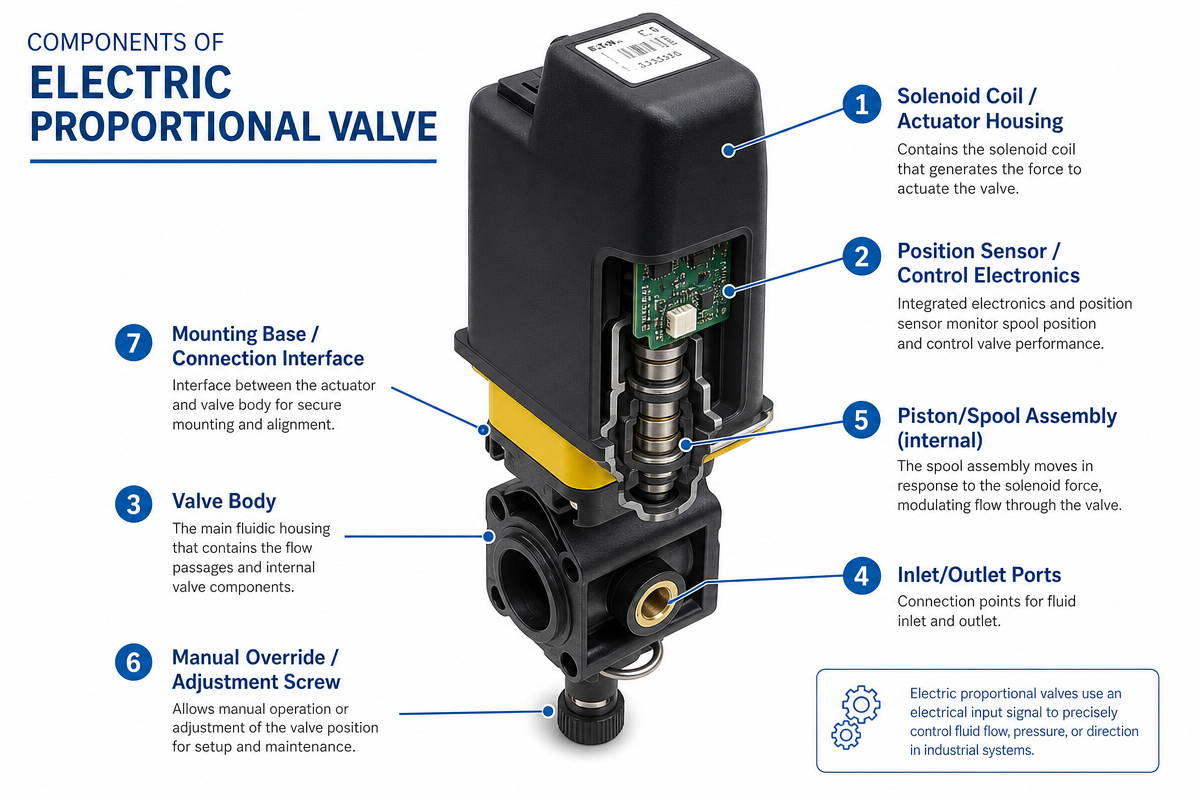
Electric proportional valve is a highly sophisticated mechatronic device consisting of four main components designed for a perfect signal to fluid parameter transformation.
Power core: Electromagnetic Drive Assembly
Electromagnetic coil: Produces a magnetic field that is proportional to the input electrical signal. Linear magnetic strength means smooth control.
Iron core & Armature: Magnetic structures concentrate the magnetic field and amplify its effects.
Return spring: Returns the armature and spool to its initial position when signal is absent or weak. Provides precise zero point calibration and prevents drifting.
Valve body and fluid assembly (control core)
Valve body: A support structure, usually made of brass, stainless steel, or aluminum alloy. Depending on its type, it is used for different pressures and types of media.
Spool: The adjusting element in the form of a plunger or needle. Axial displacement creates openings with different diameters.
Valve seat & seals: Used to create a hermetic seal between the spool and valve body. Seals are typically made of aging-resistant FKM or NBR.
Detection and feedback assembly (precision assurance core)
Position, pressure or flow sensor incorporated. Monitors the spool position and pipe parameters. The collected information is transferred to the electronic controller.
Control core (electronic control assembly)
Integrated control board, signal receiver module, power drive module and terminal block.
Designed to work with standard analog control signals (4-20mA, 0-10V) and equipped with signal calibration, PID tuning and overload protection mechanisms.
General operation principle
Continuous closed loop control:
The signal gets to the control assembly. The electromagnet applies mechanical forces to spool. The spool moves, changing the opening, the fluid parameters. The feedback assembly measures the changes and feeds back. The system constantly adjusts the parameters. This cycle never ends.
Chapter 4: Table of Electric Proportional Valve technical specifications
| Parameter Category | Parameter | Typical Range / Description |
| Basic Specifications | Nominal Diameter (DN) | Typically DN1 ~ DN200, depending on flow requirements |
| Nominal Pressure (PN) | 0 ~ 40 MPa (depends on medium and valve body material) | |
| Media Type | Gas, liquid, steam, hydraulic oil, corrosive media, etc. | |
| Media Temperature | -20°C ~ +200°C (high-temp versions up to +350°C) | |
| Control Performance | Control Signal | Analog: 0-10V, 4-20mA; optional PWM, bus (RS485/CANopen) |
| Valve Opening Range | 0% ~ 100% continuously adjustable | |
| Control Accuracy | ±0.5% ~ ±2% (depends on sensor precision and system) | |
| Repeatability | ≤ ±0.1% ~ ±0.5% | |
| Response Time | 10ms ~ 200ms (depends on spool stroke and drive type) | |
| Rangeability | 50:1, 100:1; high-end models up to 200:1 or more | |
| Flow Characteristics | Flow Characteristic Type | Linear, equal percentage, quick-opening |
| Electrical Parameters | Supply Voltage | DC 12V/24V, AC 110V/220V (with rectifier) |
| Power Consumption | Typically 2W ~ 30W (continuous duty) | |
| Input Impedance | Voltage type: ≥10kΩ; Current type: ≤250Ω | |
| Protection & Reliability | Ingress Protection (IP) | IP54, IP65, IP67 (explosion-proof optional) |
| Leakage Class | Class VI (ANSI/FCI 70-2), GB/T 4213 Class VI | |
| Electrical Connection | Terminal block, M12 aviation plug, D-Sub connector | |
| Materials & Construction | Valve Body Material | Brass, stainless steel (304/316L), aluminum alloy, engineering plastic |
| Seal Material | FKM/FPM, NBR, EPDM, PTFE | |
| Spool Type | Plunger, needle, ball, sliding spool | |
| Connection Type | Thread (G/NPT), flange, ferrule, welding | |
| Environment & Other | Ambient Temperature | -20°C ~ +60°C (wide-temp versions down to -40°C) |
| Relative Humidity | ≤ 90% RH (non-condensing) | |
| Explosion-proof Rating (Optional) | Ex ia/ib intrinsic safety, Ex d flameproof | |
| Service Life | ≥ 1 million cycles (depends on operating conditions and maintenance) |
Chapter 5: Main Electric Proportional Valve technical characteristics
Ultra-high accuracy control
This valve features an infinitely-adjustable mechanism based on an analog electrical signal which ensures a high control accuracy and meets all the requirements for medical products, precision instrumentation, and highly demanding manufacturing facilities.
Fast response time
Due to a highly sensitive electromagnetic drive, the valve operates without mechanical lag and processes the entire process (signal reception, spool adjustment, parameter correction) within milliseconds. Thus, it is perfectly suitable for automated dynamic processes requiring fast adjustments.
Infinite adjustment – continuously
The valve allows infinitely adjustable opening degree ranging from 0% to 100%, so its operations cover a broad range of operating modes from fine tuning with a minimum flow to full flow. Thus, the valve provides much more control flexibility compared to regular solenoid valves.
Electronic integrated control system
The valve is equipped with an advanced electronic controller that can be directly integrated with automation systems (PLC, microcontroller, industrial PCs, etc.). It supports standard analog control signals and can be easily integrated into a smart production line without additional devices.
Broad application
It can work in a wide range of conditions from low-pressure gases and room-temperature clean water to high-pressure hydraulic oil and high-temperature industrial media. The electric proportional valve is suitable for use in many industries: industrial automation, medical equipment, laboratory instruments, vehicle manufacturing, environmental protection equipment, etc.
Chapter 6: Electric Proportional Valve Industrial Application
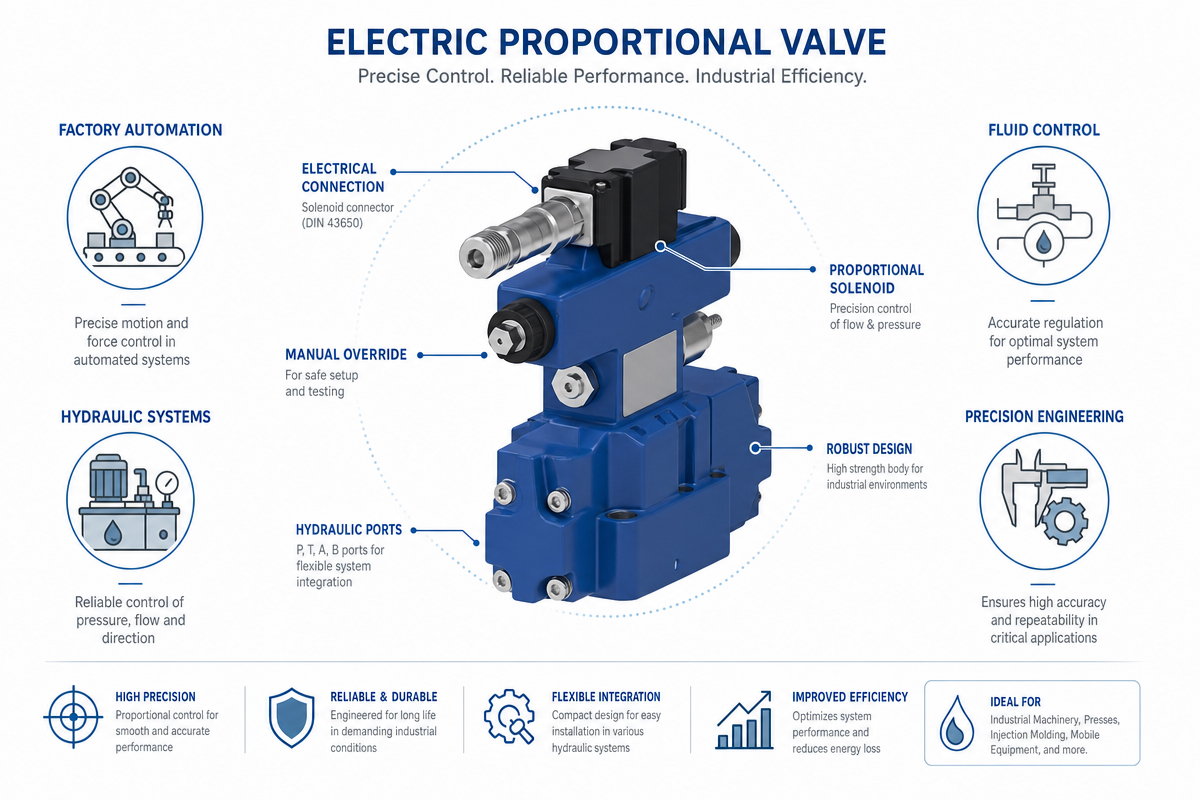
Automotive Industry
Systems of controlling intake air volume of the engine. Precise regulation of intake air volume required for optimal combustion under different engine speeds.
Equipment for testing brake systems, shock absorbers (precise control of the required pressure values).
Diesel or gasoline injection control systems. High precision control of fuel metering.
Industrial Automation Industry
Pneumatic and hydraulic control systems of automatic machine tools. Regulation of flow and pressure of oil, ensuring optimal speed of feed movement and force.
Production lines in the chemical industry. Precise control of the proportion of the flow of raw materials for maintaining stable chemical reactions.
Water cooling systems for equipment temperature control.
Medical equipment
Used in highly precise equipment: respirators, anesthesia machines, dialyzers. In a respirator, for example, the valve controls the parameters of the flow of the mixture of oxygen and air, taking into account the dynamics of breathing.
Laboratory instruments
Ensures precise and constant flow of media through gas chromatographs, fluid analyzers, environmental protection equipment. Eliminates the impact of pressure fluctuations and flow deviation on experimental results.
Chapter 7: how to select the Electric Proportional Valve
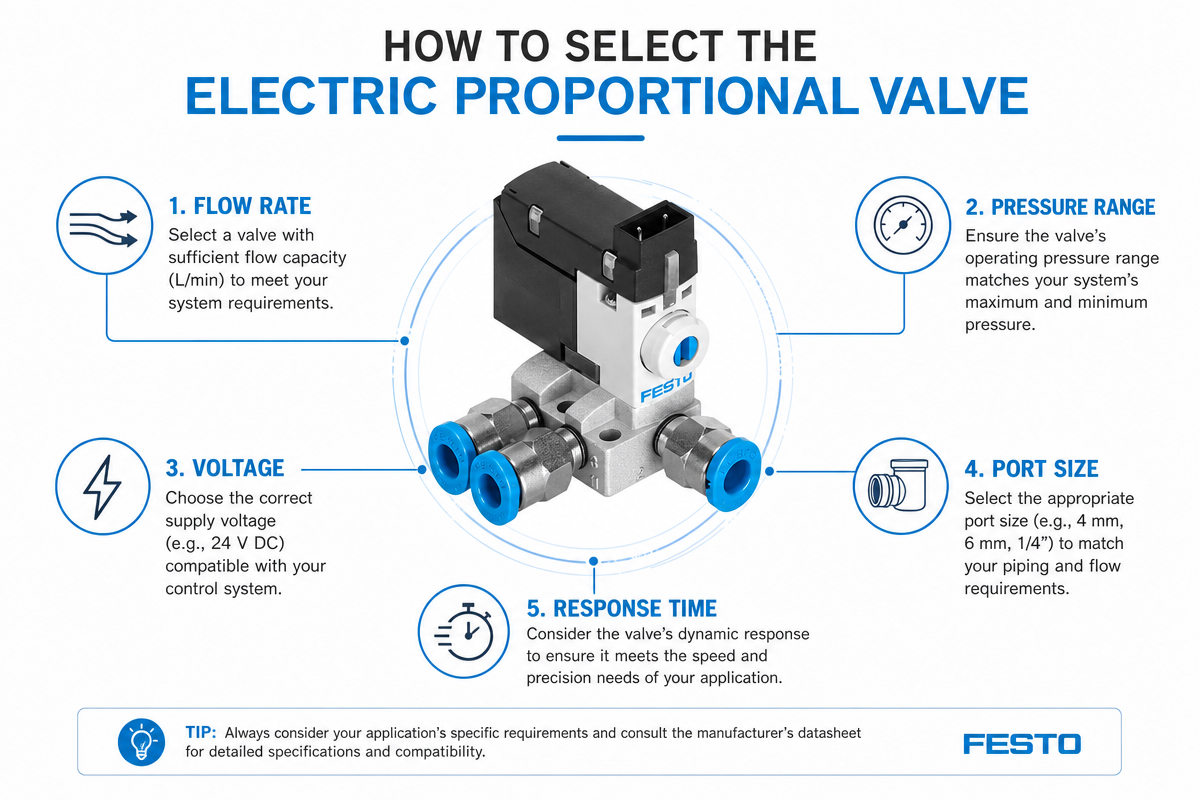
Inappropriate choice may result in imprecise control, slow response, significant leakage, and short service life. Focus on five main points:
Matching the type of the medium and execution environment
Depending on the medium (gas, liquid, hydraulic oil, aggressive medium, etc.), choose appropriate valve body and sealing materials. Valve body and seals made of stainless steel should be used when dealing with corrosive media. Check the required temperature and nominal pressure of the medium and make sure that these parameters exceed the values of the valve’s capacity.
Rangeability and flow characteristics
Linear characteristic: Suitable for applications with stable flow control.
Equal percentage characteristic: Suitable for applications with load fluctuation, requiring fine-tuning of parameters.
Rangeability: Select valves with high rangeability (100:1 or higher). More detailed information can be found here.
Response time and accuracy
Choose models with high response speed for use in applications such as precise instrumentation, medical devices, etc. Control accuracy should not be worse than ±0.5%, while repeatability should not be worse than ±0.1%.
Match the control signal and compatibility with system
Common types of signals are 0-10V voltage, 4-20mA current, and other types. Make sure that the selected valve corresponds to the type of signal generated by your control system.
Also, pay attention to the valve communication protocols and connection interfaces for convenient integration with the pipeline.
Protection class and ingress protection class
If you need maximum sealing, choose a valve with high protection class. Dust or moisture ingress will decrease the lifetime of the product. Therefore, in cases where your environment is dusty or humid, choose models with high IP ratings.
Chapter 8: Typical Issues and Reasons
| electric proportional valve Issue | electric proportional valveCommon Causes |
| Control precision drift, unstable parameters | Sensor contamination (dust/oil); spool wear or sticking; media temperature/pressure fluctuations exceeding adaptive range; signal interference or poor wiring contact |
| Slow response, regulation lag | Spool sticking due to contaminants; aging coil with reduced force; mismatched drive signal power; undersized valve with low response speed |
| Zero-point drift, incomplete closure/leakage | Worn or aged seals; debris on spool; long-term vibration causing zero drift; frequent starts/stops or high-pressure shocks |
| Coil overheating, abnormal operation | Unstable supply voltage; signal overload; aging coil insulation; continuous full-load operation or poor heat dissipation |
| Signal mismatch, inability to regulate | Signal type mismatch (e.g., mixing 4-20mA and 0-10V); poor shielding causing interference; uncalibrated controller parameters |
| Shortened service life, frequent failures | Corrosive media without compatible materials; low IP rating in dusty/humid environments |
Chapter 9: Frequently asked questions of electric proportional valve
9.1 How does electric proportional valve differ from ordinary solenoid valve?
The standard solenoid valve is the simplest on/off control valve that operates in two states: fully opened and fully closed. An electric proportional valve allows infinite continuous adjustment depending on the electrical signal. It uses closed-loop feedback to ensure precise and consistent control.
9. 2 Can electric proportional valve control flow and pressure at once?
Yes. A standard valve regulates flow parameters by adjusting the opening of the spool. With additional pressure feedback sensors, this valve can be used to simultaneously control the flow and pressure in order to meet industrial needs.
9.3 How to troubleshoot issues related to flow fluctuations or unstable parameters?
Take the following steps:
1) Check wiring and signal to prevent interference;
2) Thoroughly clean the spool and interior surfaces of the valve housing from any contamination;
3) Zero and calibration of the device and sensors. If the issue still persists, check the seals and coil for wear or contamination.
9. 4 Does electric proportional valve need maintenance? When should I do it?
Yes. Under regular operating conditions, when working with clean medium, the maintenance interval is from 3 to 6 months (cleaning, recalibration of the zero point). In severe conditions (dusty, oily, or aggressive medium) the valve should be maintained once a month.
9.5 Can I use 4-20mA and 0-10V signals interchangeably in control of the valve?
No. You should strictly comply with the specified parameters in order to avoid improper control or even failure of the driving element. Mixing these signals leads to unexpected behavior of the valve.
What should I do if my valve fails to regulate flow in low-flow fine tuning applications?
Priority is given to miniature electric proportional valves with high rangeability and high precision. In addition, pay attention to improvement in the design of the pipeline for stabilization of upstream pressure. Fine-tuning the control system parameters (PID) to increase resistance to low signal changes.
Chapter 10 :Conclusion of electric proportional valve
The electric proportional valve provides high-precision continuous adjustment, closed-loop precision control, fast response and high versatility – this solves all the shortcomings of standard valves (imprecision and poor versatility). It uses electromagnetic drive and closed-loop control in order to provide dynamic and accurate adjustment of fluid parameters and is used in industrial automation, medical equipment, laboratory instruments, automotive manufacturing, and other industries.
To ensure maximum efficiency and stability, proper selection of this component is crucial. By taking into account medium parameters, control accuracy, system parameters, and overall conditions, you can significantly increase the performance of your electric proportional valve, optimize automated control, and stabilize equipment operation.
For more details about the selection of certain models and technical parameters comparison, please contact us today.


