

Chapter 1 : Introduction of the solenoid surface treatment
The solenoid surface treatment is indeed crucial for long-term stable performance and extended service life in the ubiquitous application of solenoid in industrial automation, automotive systems, medical devices, electronics and smart machinery. Besides a good magnetic design and coil quality, long-term operation also requires an effective surface protection from different environmental influences. A number of premature failures and malfunctions are often caused not by a lack of magnetic efficiency but rather by oxidation, corrosion, coatings peeling, poor conductivity or external contaminants. Without adequate surface protection in a humid workshop, salty environment, seawater or hot factory, the life of a magnetic actuator is significantly reduced due to these factors.
In this blog guide, we will discuss everything you need to know about solenoid surface treatment.
Importance of proper coating
Comparative review of zinc, nickel, chrome, tin and gold coatings
Neutral Salt Spray Test
Solenoid surface treatment depending on project application
Common coating problems of solenoid surface treatment and their solutions
Additional solenoid surface treatment technologies:
Tips for rust protection
Engineering, buying and manufacturing companies can benefit from these useful facts and information.
Chapter 2: Most Used Metallic Materials For Manufacturing Solenoids
Generally speaking, a standard solenoid consists of a construction as shown below:
Housing , Magnetic core , solenoid Coil , assembly Plunger Terminals and brackets
From all these elements of a solenoid, the most critical for surface treatment are magnetic core and housing.
The pure iron is widely used for manufacturing a core due to its good magnetism, but it lacks any natural corrosion resistance. After oxidation, the magnetic efficiency of the core drops significantly while response time becomes unpredictable.
Comment Metals used to manufacture the solenoid
| Material | Main Application | Advantages | Disadvantages | Surface Treatment Necessity |
| Pure Iron / Electrical Pure Iron | Magnetic core | Excellent magnetic permeability | Extremely easy to rust | Mandatory |
| Carbon Steel | Housing, brackets | Strong, low cost | Poor corrosion resistance | Required |
| Stainless Steel | Premium housing | Excellent corrosion resistance | Higher cost, lower magnetic efficiency | Depends on application |
| Copper / Copper Alloy | Leads, terminals | Excellent conductivity | Oxidizes easily | Recommended |
| Aluminum Alloy | Lightweight structures | Low weight, good machinability | Softer material | Requires anodizing |
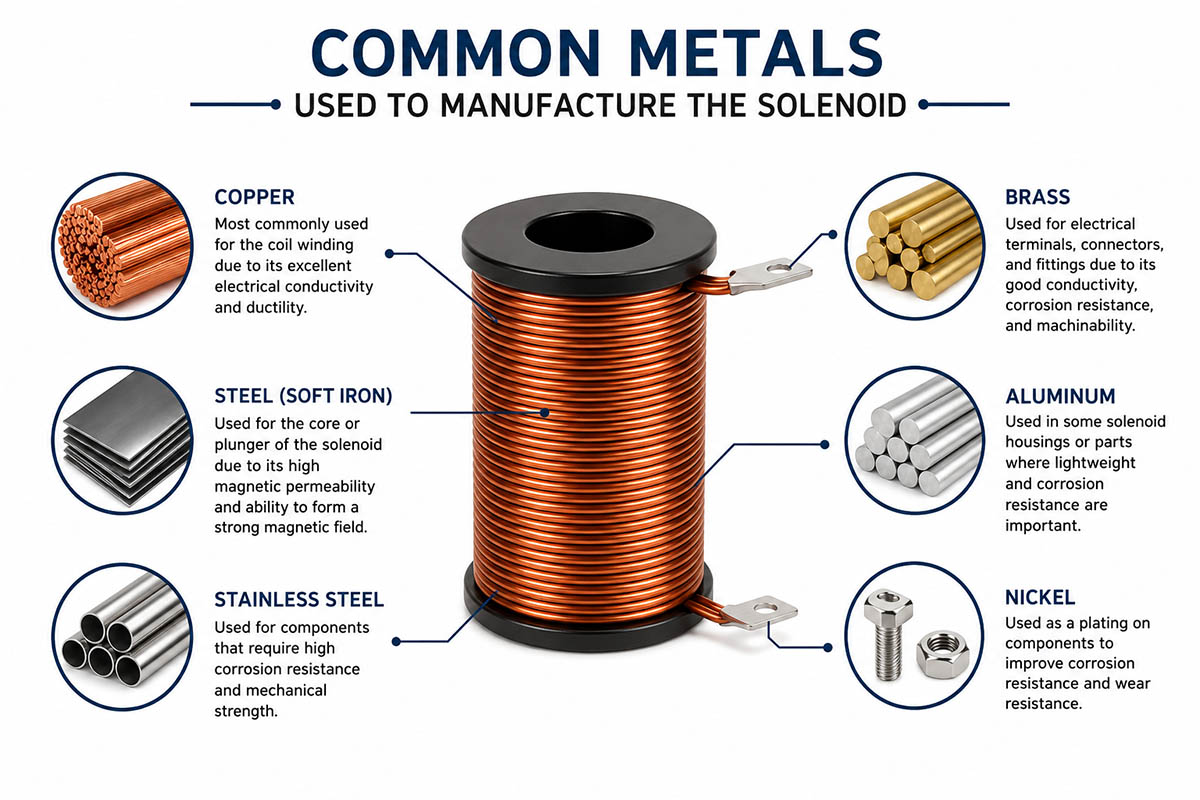
Thus, an adequate surface finishing process is an integral part of solenoid manufacturing.
Chapter 3: Significance of Solenoid Surface treatment
3.1 Corrosion Protection
Protecting from oxidation is a primary feature of surface coating.
In the industrial conditions, the solenoid component is usually exposed to the following environmental influences:
Moisture Dew
Gas acid
Salty air
* Industrial chemicals
Oil mist
Water rain in case of open air installation
Unprotected metallic parts suffer a lot from oxidation which leads to:
Decreased magnetic effectiveness
Increased wear and friction
Sliding plungers
Surface oxidation
Structure weakening
Electrical malfunction
With a proper coating, the lifetime of the part could be greatly increased.
3.2 Increased Conductivity after Solenoid Surface treatment
The coating is needed in order to protect electrical terminals from oxidation and corrosion.
The tin coating and gold plating are popular because:
Low contact resistance
High conductivity
Arcing prevention
Improvement of solderability
Prevention of oxidation
That is why the coating is very important in:
Microelectronics
Automotive connectors
Relay-Systems
Communication equipment
3.3 Better Appearance and Quality of the Product
A good coating increases:
Product quality & appearance
Surface evenness
Assembly precision
Company image
Buyer satisfaction
Good coating protects against scratches, color change and corrosion during shipping and storage.
3.4 Enhanced Wear Resistance after Solenoid Surface treatment
Friction in solenoids is mainly produced by the movement of plungers and other moving parts.
| Coating Type | Standard | Typical Thickness | Salt Spray Requirement |
| Hot-Dip Zinc | GB/T 13912-2020 | 50–80 μm | 24–72h |
| Electroplated Zinc | GB/T 9799-2011 | 10–30 μm | 24h |
| Nickel Plating | GB/T 9798-2015 | 5–20 μm | 24–48h |
| Chrome Plating | GB/T 11379-2008 | 0.5–5 μm | ≥48h |
| Tin Plating | GB/T 12599-2019 | 3–10 μm | 12–24h |
The surface resistance to wear and tear is greatly increased using:
Chromium or nickel coatings
That makes these types of coatings ideal for high-frequency actuators.
Chapter 4: The Types of solenoid Surface Treatment
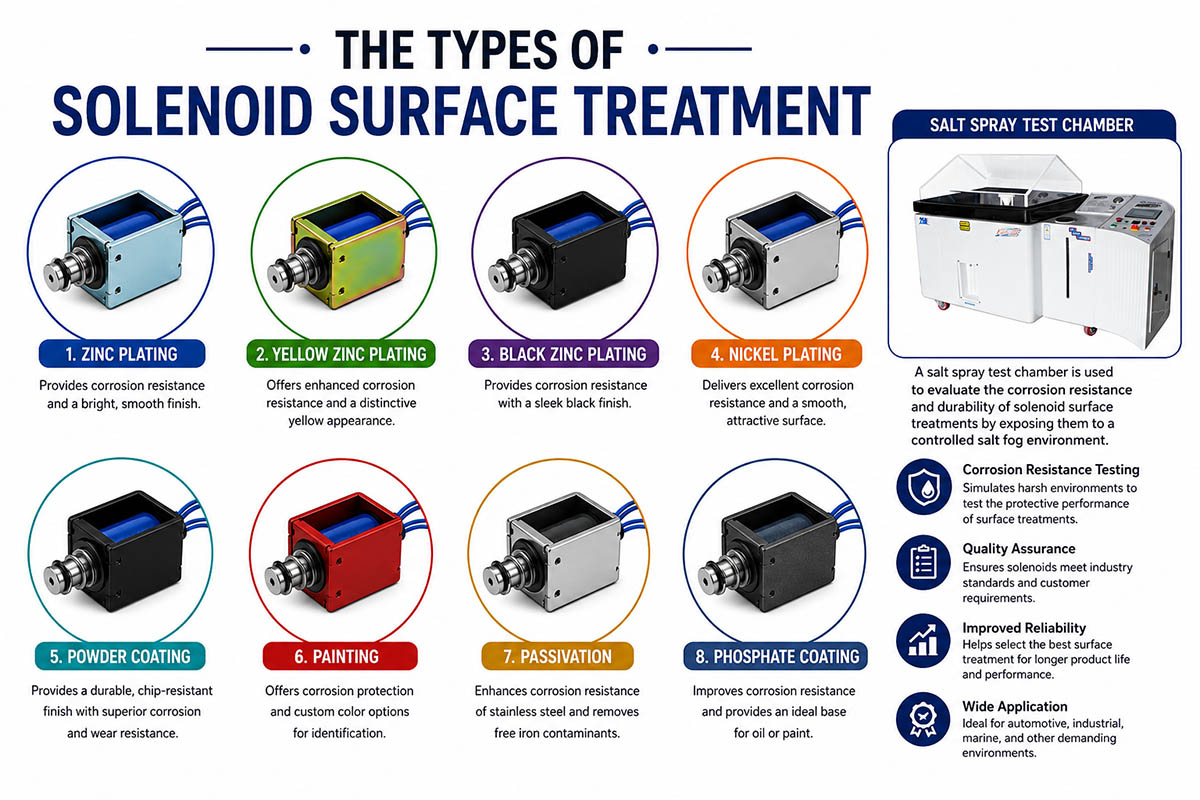
4.1 Zinc Coating of Solenoid Surface Treatment
The cheapest way to prevent corrosion in solenoids is zinc plating.
Types of Zinc Coating
Electro Zinc
“Look slick”
Uniform coating which is thin
Used mostly for internal applications
Hot-Dip Galvanized Method
Thicker coating
Better corrosion resistance
Ideal for external usage Advantages
Cheaper option
Good corrosion resistance
Cons Drawbacks
Mass production possible
Standard durability
white rust appears after some time
Typical usage
Automation industrial
Machine Tools
Control cabinets
Indoor solenoid valves
4.2 Nickel Coating of Solenoid Surface Treatment
Nickel coating prevents oxidation and has decorative features.
Advantages
Very good protection from corrosion
Extremely durable
Smooth coating
High wear resistance
Disadvantages Cons
More expensive compared to zinc
Processing is harder
Applications Usage
Medical equipment
Catering equipment
Marine systems.
Precision tools
Nickel coating is a standard surface finish for high-quality electromagnets that will face moisture and corrosive chemicals.
4.3 Chromium Coating of Solenoid Surface Treatment
Chrome coating is usually applied to mechanical moving parts.
Advantages of Chromium Coating in Solenoid Surface treatment
High hardness
Good abrasive resistance
Minimum friction coefficient
Increased durability
Disadvantages of Chromium Coating in Solenoid Surface treatment
Higher production expenses
More complicated processing process
Usage Applications
Plungers for solenoids
Valve cores
Mechanical shafts
Moving parts working with higher cycles
Chromium plating makes the sliding motion smoother.
4.4. Tin Plate Coating of Solenoid Surface Treatment
Conductive parts are usually coated using tin plating.
Advantages
Good soldering characteristics.
Improved conductivity
Prevents copper from oxidation
Cheap Disadvantages Cons
Softer coating
Low wear-resistance
Application
Electrical terminals
Connectors
Contact points on PCB boards
Coil leads
Almost all electric solenoids use tin plated terminals.
4.5 Gold Plating of Solenoid Surface Treatment
The gold coating is considered as the most reliable.
Advantages
High conductivity
Great resistance to oxidation
Protection from corrosion
Cons Drawbacks
Expensive material
Usage Application
Aerospace systems
Military systems
Quality sensors
High-level communication systems
Gold plating should be used if there is need for utmost reliability.
Chapter 5: Requirements of Solenoid Surface Treatment
There are also some international requirements that your coating must meet:
ASTM specifications
ISO standards of coatings
RoHS requirements
REACH requirements
Always check coating specifications during procurement.
Chapter 6: Electromagnetic Solenoid Salt Spray Test
Salt spray test is probably the most important method to assess the resistance to corrosion.
Definition of Salt Fog Testing
The Neutral Salt Spray (NSS) test is a corrosion test involving the formation of salt fog environment.
Salt spray testing assesses:
Coating life-time
Anti-rusting ability
Surface quality
Environmental stability
Salt Spray Test Specifications
| Parameter | Standard Requirement |
| Solution | 5% NaCl |
| pH Value | 6.5–7.2 |
| Temperature | 35°C |
| Placement Angle | 15–30° |
| Spray Rate | 1–2 mL/(80 cm²·h) |
Pass/Fail Criteria
A good coating should:
Not contain red rust after certain period
Should not have blisters
Flaking is prohibited
Color difference should be minimal
Significance of Salt Spray Testing
The report about the result of a salt spray test gives buyers assurance about the real quality of a coating as it shows real testing results instead of manufacturer declarations.
During the purchase of industrial solenoids, make sure that the buyer offers:
Independent testing laboratory results
Reports about thickness of coating
Certificate of material
That is particularly important when buying export or open-air devices.
Chapter 7: Recommended solenoid Surface Treatments Depending on the Environment
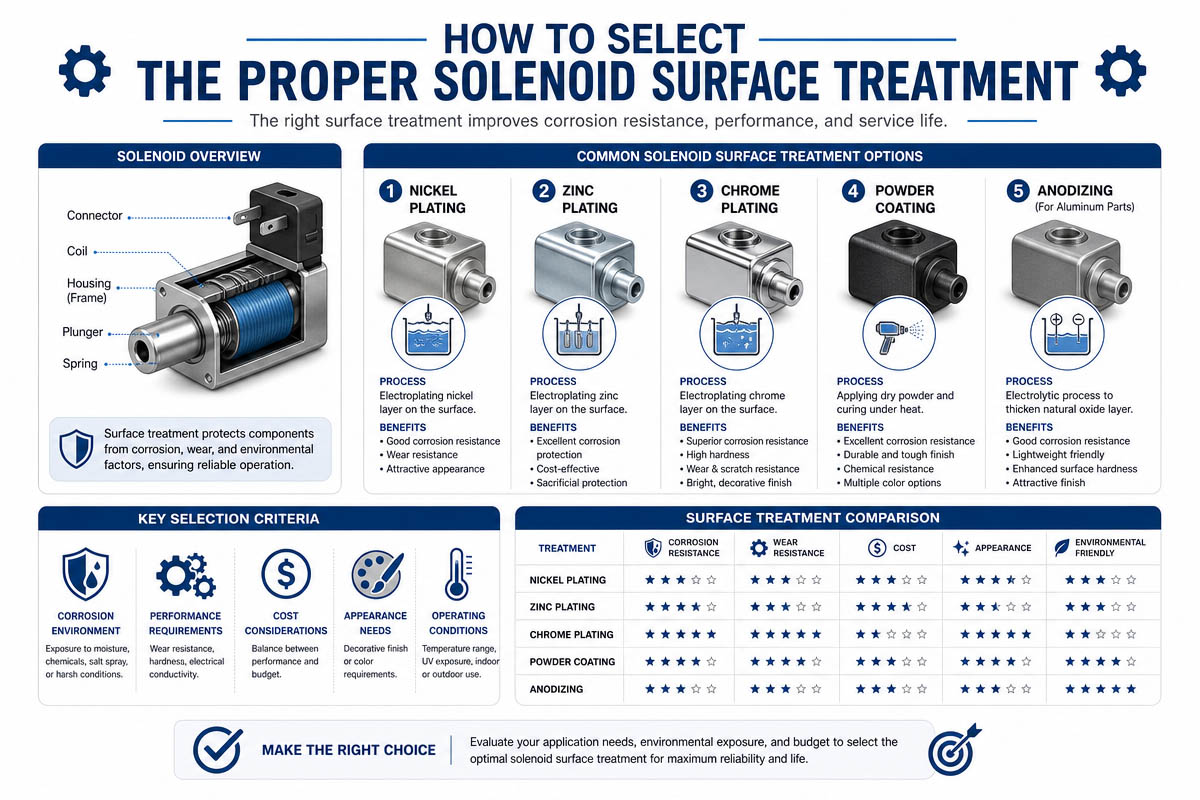
Industrial Environment
Workshop
oil mist
Mechanical vibration Recommended Finishing
Zinc plating
Electroless nickel plating
Outdoor Devices Usage Environment
Weather variations
Sunlight UV light
Temperature changes Coating Suggestion
Coating type: Hot dipped galvanization
Heavy nickel plating
Consumer Electronics Devices Environment
Dry indoor environment
Compacted assembly space Recommended coatings
Zinc plating
Tinning
Medical Equipment Devices Environment
Regular cleaning operations
High sanitary standards Suggested coating
Nickel coating
Stainless steel surface coating
Aerospace and Military Environment
Exposure to extremely hot or cold temperature Coating Suggestion
Gold plating
Nickel coatings
Chapter 8: Problems With Solenoid Surface Treatment and Their Possible Solution
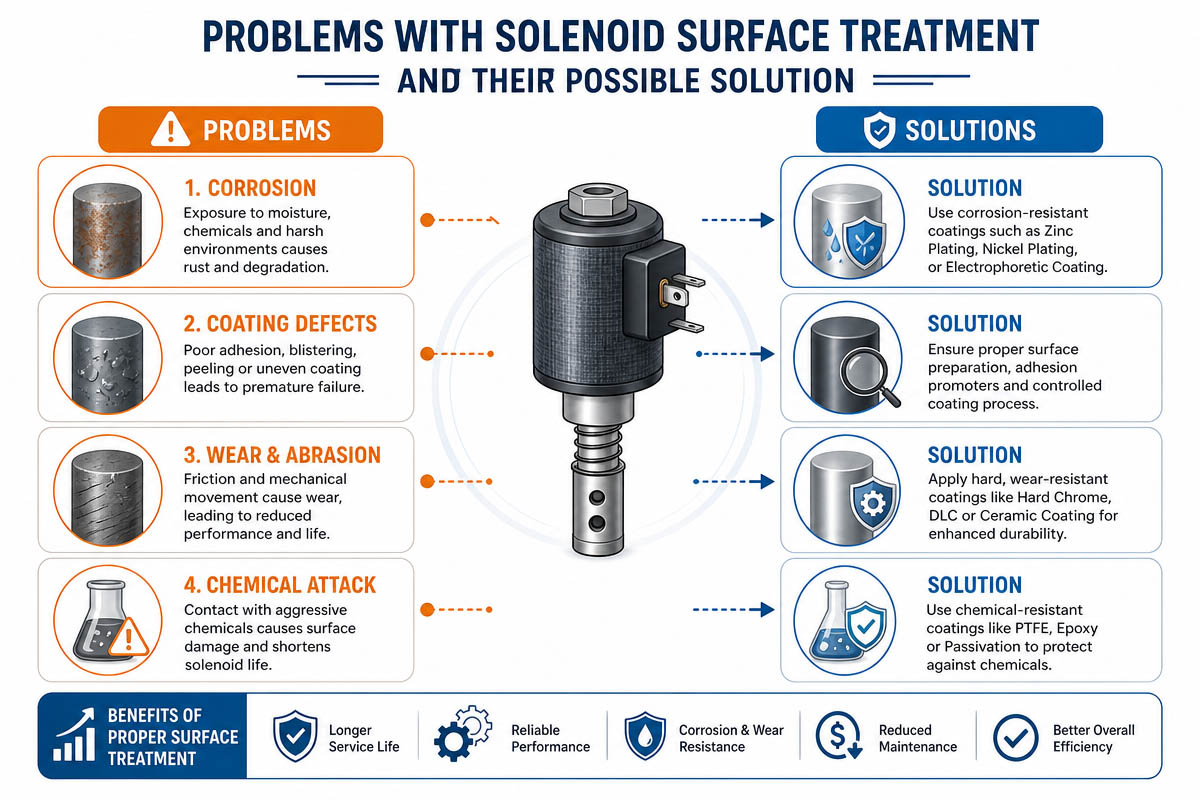
8.1 Reason of coating peeling
Lack of proper surface cleaning
Incorrect surface preparation
Uncontrolled coating process Solution
Enhancement of degreasing process
Optimization of coating parameters
Authorized vendors only
8.2 Rusting and Corrosion
Too thin coating
Too harsh environmental conditions
Bad storage and packing conditions Solution
Make coating thicker
Change coating material
Optimize packaging
8.3 Pinholes and bubbles in coatings
Presence of gas during plating process
Impurities in coating bath Solutions
Improve quality of coating liquid
Improve quality inspection
8.4 Poor Electrical Conductivity
Damaged terminals because of corrosion Solution of Damage
Retinishing of the terminals
Replacement of defective terminals
Regular inspections
Chapter 9: Alternative Solenoid Surface Treatments Technologies
Finishing process can include various surface finishing techniques among which only plating is.
9.1 Powder Coating
Protective thick coating for brackets and housing. Advantages
Excellent corrosion resistance
Good appearance
Eco-friendly
Electrophoresis Coating (E-coating)
Common technique in electromagnetic components automotive Advantages
Uniformity
Edge coverage improvement
High efficiency
9.2 Sand Blasting
Surface is roughened for the sake of coating better. Applications
Before coating
Decorative finishing
9.3 Polishing
Increases surface smoothness. Applications
For ornament parts
Precision equipment
9.4 Anodic Bonding
Usually applied for aluminum-based parts Advantages
High hardness
Excellent corrosion resistance
Various colors available for decoration
9.5 Phosphate Treatment
Process of obtaining a phosphoric coating. Advantages
Improve painting adhesion
Increased corrosion resistance
9.6 Heating Treatment
Even though heating treatment is not a coating process, it can increase:
Material hardness
Improved wear resistance
Strength of the material
It can be used together with surface finishing techniques.
Chapter 10: How To Select The Proper Solenoid Surface Treatment
Engineering considerations are the following:
Conditions of usage
Inside the building or outdoors?
Moist environment?
Salt environment?
Chemical substances?
Functional requirements
Need for high conductivity?
Need for wear resistance? Required?
Aesthetical needs?
Lifespan of the equipment
Short or long-term application?
Will maintenance-free usage be required?
Budgeted
Large quantities and low prices?
Precision equipment? High-end?
None of these coatings can serve all the purposes. An optimum compromise between quality and price is preferable.
Chapter 11: Future Developments of solenoid Surface Treatment
Due to innovations in industrial technologies, new plating methods continue to emerge.
The future of plating includes:
Eco-friendly plating
Non-crome plating
Nanoceramic plating
RoHS plating
Advanced corrosion resistant material
Self healing coatings
Solenoid manufacturers will increasingly take into account not only the environmental impact but also the long-term reliability.
Chapter 12 : Conclusion
Solenoid Surface treatment plating is not a decorative process for electromagnetic components. It is a critical engineering step influencing performance, durability, conductivity, wear resistance and lifespan of a magnetic actuator.
By choosing the proper coating system, meeting international norms and proving coating quality via salt spray test, manufacturers can reduce failures and increase equipment efficiency.
When designing industrial automation systems, outdoor devices, medical equipment and electronic devices, proper surface finishing of solenoid components is extremely important in order to ensure reliable operation under harsh conditions. Good coating can:
Help prevent oxidation & corrosion
Increase conductivity
Increase wear resistance
Extend lifespan
Reduce maintenance expenses
Increase the quality of the product
Investing in a right surface coating will definitely pay off.
Chapter 13 : FAQs on Solenoid Surface Treatment
1. What is the best finish for industrial solenoids?
The most popular surface finishing techniques for industrial solenoids are zinc and nickel plating because of their reliability and price.
2. Why does electromagnet rust so quickly?
Most solenoids’ magnetic cores are made from iron that has great magnetic features but poor resistance to corrosion. Thus, in humid conditions it rusts easily.
3. What is a purpose of doing salt spray test?
Salt spray test is conducted to determine the corrosion resistance of the coating. Coated parts are exposed to a certain salt water atmosphere.
4. Which coating is the best for conductivity?
Gold plating has the greatest conductivity and tin plating is the cheapest one in case of electrical connections.
5. How long should solenoid resist in the salt fog test?
It depends on the purpose. Standard industrial equipment must pass at least 24-48 hours, while marine or outdoor devices might last up to 72 hours.
6. Zinc Plating or Nickel Plating – What Is Best For Solenoids?
Nickel coatings are stronger against corrosion and wear while zinc coatings are cheaper for common industrial solenoids.
7. What Are Reasons For Flaking Off Coatings?
Blistering and coating peeling could be caused by poor pretreatment, oil contamination, wrong plating parameters or insufficient coating adhesion.
8. Can We Avoid Coating When Making Stainless Steel Solenoids?
Yes, in some cases but stainless steel is more expensive than usual metals and doesn’t provide as great magnetic characteristics.
9. What Is the Best Finish For Outdoor Electromagnetic Devices?
For outdoor devices which are exposed to wetness and climate changes, the hot dip galvanization or nickel plating are suggested.
10. How Can Buyers Check the Quality of Coatings?
Buyers should ask for the following documentation:
Report about salt spray test
Report about coating thickness
Material test report
Third party inspection papers.

