

Chapter 1 : introduction of Electromagnetic solenoid
All the modern homes are equipped with dozens of household appliances that need electricity. It may be a washing machine which fills the drum with water, a rice cooker which maintains steam pressure, a coffee machine which dispenses water or a smart door lock which unlocks with a fingerprint scan. All of these activities are performed thanks to one tiny but powerful component – electromagnetic solenoid.
Electromagnetic solenoid is an electromechanical device that transforms electrical energy into linear motion. Such a simple but highly effective device makes household appliances able to perform certain mechanical operations automatically. Today there is a tendency towards creation of smarter, safer, more energy efficient and silent appliances. That is why electromagnetic solenoids become irreplaceable in modern household appliances manufacturing.
Compared to mechanical mechanisms, electromagnetic solenoids are faster, more precise, durable, easy to operate electrically, smaller, cost-effective and highly customizable, which is perfect for modern miniaturized household appliances.
From automatic coffee machine to washing machine, from smart locks and electric pressure cookers to massage devices and water dispensers electromagnetic solenoids make people’s lives easier and more comfortable. Further development of IoT, AI and other smart home technologies will make electromagnetic solenoids even more relevant as a way of linking intelligent electronics to mechanics.
This article will cover the working principles, applications, benefits, technological and environmental aspects of using electromagnetic solenoids in small household appliances to give engineers, designers and manufacturers an insight about why solenoids are so important in modern automation.
Chapter 2: Electromagnetic Solenoid
2.1 Definition of an Electromagnetic Solenoid
Electromagnetic solenoid is an electromechanical actuator which generates magnetic force when electrified with alternating (AC) or direct (DC) current. It basically consists of four elements:
Iron core or plunger
Steel housing
Return spring (in case of most linear solenoids)
When current flows through the copper coil, magnetic field is created in the coil area. Magnetic field magnetizes the iron core and generates the attractive force, that causes linear movement of the plunger. When electrical power is stopped, the magnetic field disappears, and the plunger returns to its initial state thanks to the spring or gravity force.
Such a simple principle of working makes electromagnetic solenoids extremely effective tools to generate quick and repeatable linear motion in any automation processes.
Contrary to the permanent magnets, electromagnetic solenoids can generate magnetic force only when it is supplied with electrical power. Thus, engineers can manage its movement through electronic circuitry.
Due to its compact size, effectiveness and easy integration, electromagnetic solenoids became one of the most used actuators in modern household appliances.
2.2 Why Electromagnetic Solenoids Matter in Small Household Appliances
Today small household appliances have moved far away from being simple electrical devices. They became the systems which can perform various actions automatically and remotely.
The key element of many of these functions is the electromagnetic solenoid.
The basic function of the electromagnetic solenoid is transformation of electrical signal into mechanical motion. That allows household appliances to perform such actions as:
Opening/closing the valve
Locking/unlocking the door
Dispensing the water
Control of steam pressure
Activation of the safety mechanisms
Driving of the vibration devices
Automatic operation of the latch
Without electromagnetic solenoids many of modern appliances would need manual operation or complicated mechanical mechanisms.
For manufacturers, electromagnetic solenoids are one of the simplest solutions to automation of the appliances.
2.3 Improved Performance and Durability of the Products
Comparing with conventional mechanical switches and linkages, electromagnetic solenoids provide some benefits:
Quick reaction
The movement distance (stroke) of the solenoid can be calculated precisely according to the requirements, thus providing consistent operation of the appliance
Durability
Quality electromagnetic solenoids are able to perform hundreds of thousands or even millions of cycles
Maintenance
As it has fewer moving parts, it needs less maintenance comparing to complicated mechanical mechanisms
Reliability
Due to its simple structure, solenoid can work consistently and has low failure rate
For applications like smart locks or automatic dispensing systems, it is extremely important
2.4 Support in Development of Smart Home Appliances
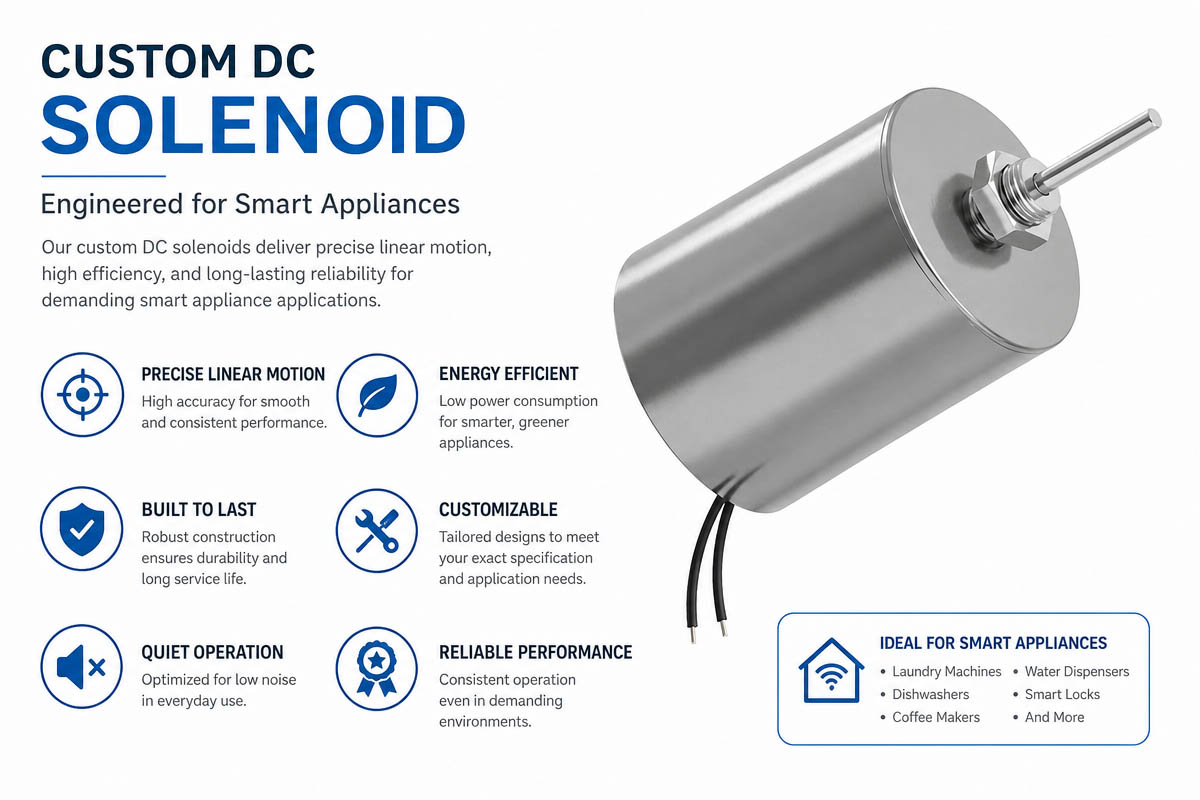
Smart home technologies are revolutionizing the household appliances industry.
Today customers want:
Remote smartphone control
Voice assistant compatibility
Automatic operation
Intelligent sensing
Energy saving modes
Predictive maintenance
Electromagnetic solenoid is the physical actuator which translates control signal into mechanical motion.
Combining with:
Microcontroller
Temperature sensors
Pressure sensors
Motion detectors
Wi-Fi module
Bluetooth communication
it makes possible fully automatic operation of the appliance.
For example:
A smart coffee machine is able to control water flow, brewing pressure and steam generation with help of several solenoid valves controlled with software
2.5 Reduced Size and Cost of the Product
One of the main trends in modern world is miniaturization of the appliances.
Customers prefer:
Smaller appliances
Lighter appliances
More energy efficient appliances
Quieter appliances
Easy installation
Electromagnetic solenoids support this trend because of their:
Compactness
Cost-effectiveness
Customizability
Efficiency in manufacturing
Flexibility of installation
Thus manufacturers can customize:
Voltage
Force
Stroke
Duty cycle
Mounting size
Connector type
without full redesign of the appliance.
Such flexibility saves the development time and manufacturing cost of the product.
Chapter 3 : Understanding Electromagnetic Solenoid
Understanding of the work principles of electromagnetic solenoids helps engineers to design more effective, efficient and smart household appliances.
Despite the fact that this principle was discovered nearly 2 centuries ago, it remains one of the most practical ways of transforming electrical energy into mechanical movement.
3.1 The Electromagnetic Principles
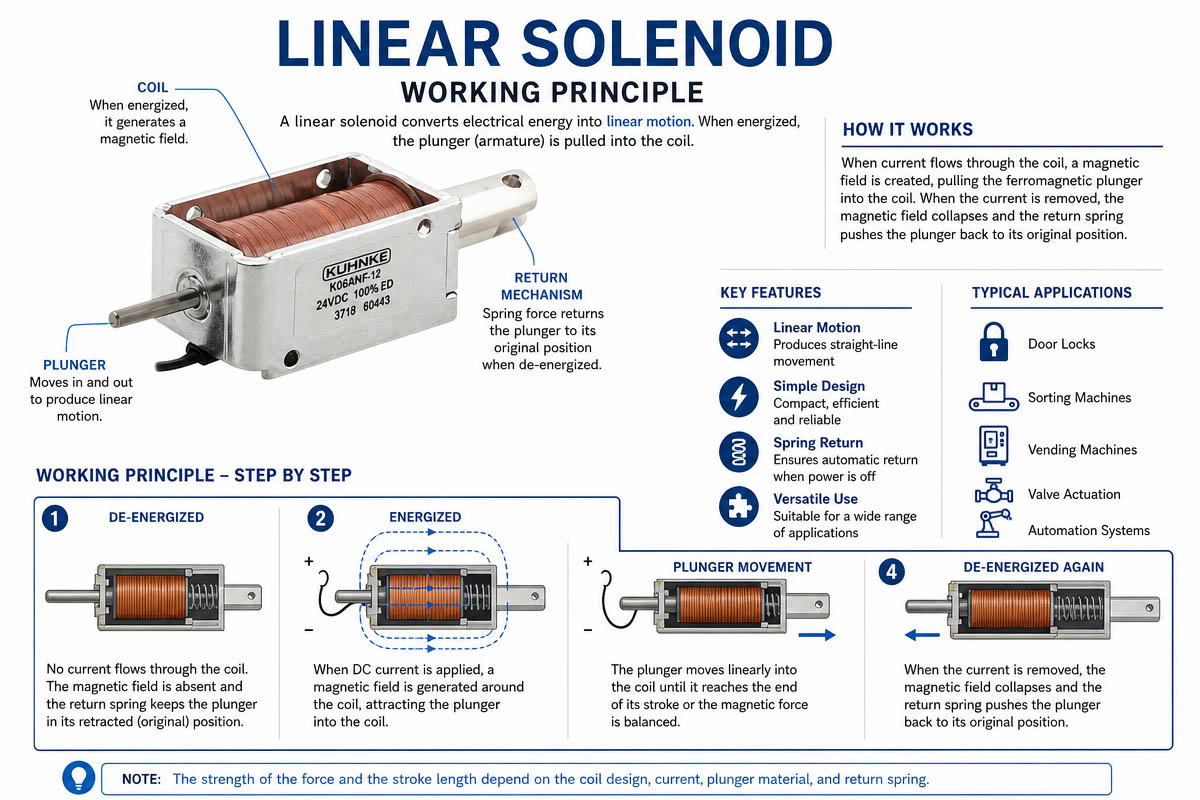
Work of the electromagnetic solenoid is based on the electromagnetic induction and magnetic effect of the electric current.
When electrical current flows through the copper coil, magnetic field appears in its surrounding.
According to the Ampère’s right-hand rule, if you wrap your right hand fingers in the direction of the current flowing through the coil, your thumb points at the North pole of the magnetic field.
As magnetic field develops, it magnetizes the iron core or plunger in the solenoid. The magnetic attraction pulls the plunger to the middle of the coil, generating linear motion.
When electrical power is switched off, magnetic field disappears instantly, and the return spring or gravity moves the plunger to its original position.
This energize-deenergize cycle allows electromagnetic solenoids to perform thousands of operations every day accurately.
3.2 Key Elements of Electromagnetic Solenoid
Typical electromagnetic solenoid consists of:
Copper Coil – which generates the magnetic field when it is energized
Iron Plunger – which translates magnetic force into linear movement
Steel Housing (also called Magnetic Housing) – which concentrates and guides the magnetic flux
Return Spring – which pulls the plunger back after the power is stopped
Lead Wires or Connectors – which supply the solenoid with electrical power
Guide Tube – which guides the linear movement of the plunger
Performance of the solenoid depends on such parameters as number of coil turns, wire diameter, input voltage, air gap between plunger and coil, plunger material, magnetic circuit design and duty cycle.
Choosing right combination of these parameters allows to achieve necessary force, speed and durability of the solenoid.
Chapter 4: Applications of Electromagnetic Solenoid in Smart Home Appliances
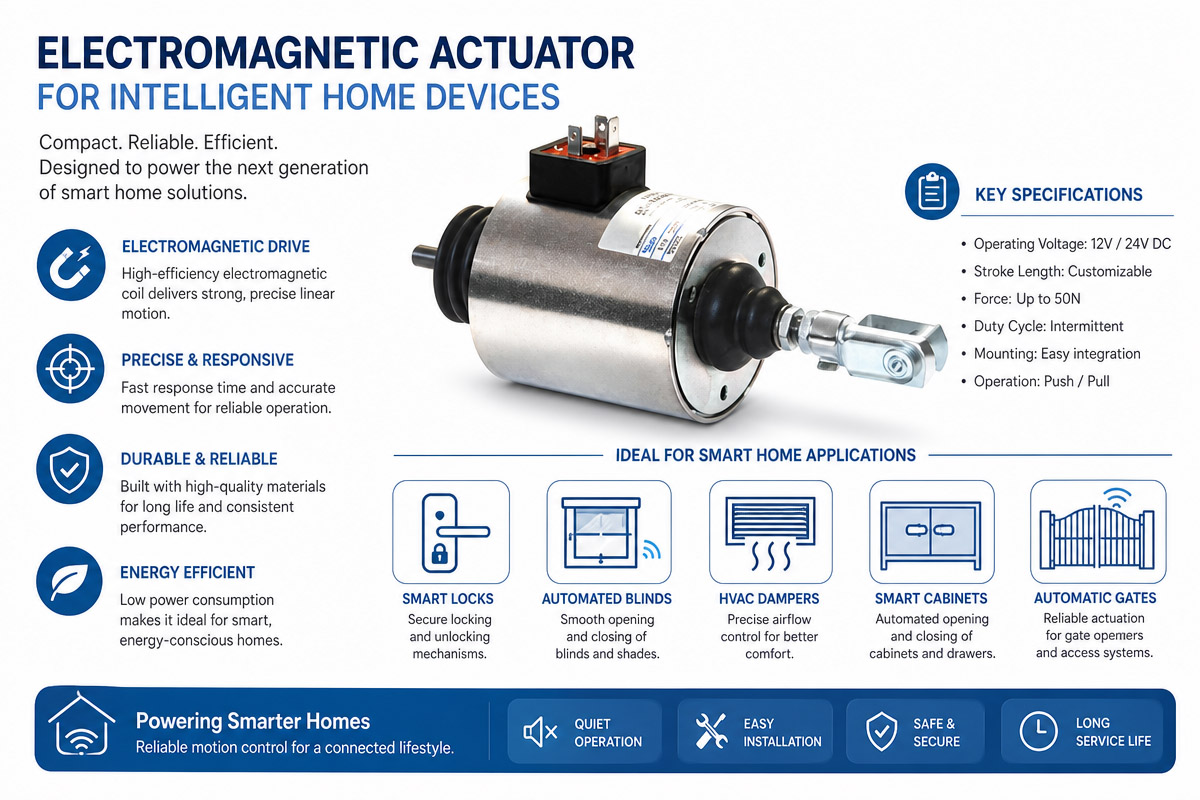
Thanks to the development of IoT, AI and other technologies of the smart home, the electromagnetic solenoid became one of the most popular actuators in household appliances. With the help of electromagnetic solenoids it is possible to automate control of the appliances, improve their safety and user experience.
From the regulation of water flow to opening of locks and vibration generation, electromagnetic solenoids can be found in all kinds of household appliances.
4.1 Solenoid Valves for Automatic Control
The most common application of the electromagnetic solenoids is solenoid valve which controls the water, steam, gas or air flow.
Electric Pressure Cookers
In modern electric pressure cookers solenoid valves regulate safely steam pressure. During the process of cooking controller checks pressure and temperature.
When necessary pressure appears, electromagnetic solenoid closes the valve and keeps this pressure. At the end of cooking process controller stops the power to solenoid, valve opens and releases the steam.
This automation provides:
Improved cooking consistency
Improved quality of the food
Improved safety of the appliance
Less manual operation
Rice Cookers
In premium rice cookers also solenoid valves regulate steam release at different cooking stages. Thanks to this regulation, appliance gives better result for different kinds of rice.
4.2 Automatic Water Inlet and Drainage Systems
Automatic washing machines cannot operate efficiently without electromagnetic solenoids.
Water Inlet Valve
When the washing cycle starts, controller supplies with the power the water inlet solenoid valve. Solenoid opens the valve and the water starts flowing to the drum of washing machine.
When water reaches necessary level, controller stops solenoid, and the valve closes.
Drain Valve
At the end of each washing cycle another solenoid opens drain valve and discharges wastewater.
This automation provides:
Precise water level regulation
Efficient use of water
Reliable washing operation
Lower cost of maintenance
Such systems are used in:
Water dispensers
Water purifiers
Ice makers
Beverage machines
Steam cleaners
4.3 Sensor Controlled Appliances
Today many smart household appliances start integrating sensors and electromagnetic solenoids to provide touchless and intelligent operation.
Smart Trash Can
With the help of the infrared sensors presence of a person who approaches the trash can is detected.
Then electronic controller activates a small linear solenoid and opens the lid automatically. After a while solenoid is released and lid closes silently.
Benefits of this approach:
Touchless operation
Increased hygiene
Decreased leakage of odors
Improved energy efficiency
Smart Dehumidifiers
Solenoids control dampers and drainage valve depending on humidity sensor readings.
4.4 Safety Protection Systems
Safety is one of the most important features of using electromagnetic solenoids.
Many household appliances have built-in protection mechanisms operated by electromagnetic actuators.
Some examples of such mechanism:
Electric Iron
Temperature sensor constantly checks heating plate.
In case of overheating or improper positioning, controller activates safety solenoid which interrupts power supply to the appliance, reducing the risk of fire.
Microwave Oven
Door interlock solenoids make sure that microwave does not leak its radiation in case when the door is opened.
Coffee Machine
Safety solenoids control steam release and pressure release, which protects customers from burning due to excessive pressure inside the machine.
4.5 Driving Small Electric Motors
Although motors rotate, electromagnetic elements are still needed to start their rotation.
Small household appliances:
Electric fans
Food mixers
Blenders
Juicers
Air purifiers
depend on electromagnetic principles to generate rotating magnetic field which drives the motor.
In many cases electromagnetic solenoids are used to activate locks, engage gears or change operating modes.
4.6 Massage Equipment and Health Devices
Wellness industry has implemented electromagnetic solenoid technology quickly.
Neck Massager
Linear solenoids produce rhythmical tapping action, simulating the manual massage.
Percussion Massager
High-speed solenoids produce impact movements that relax muscles and increase blood circulation.
Foot Massage Equipment
Flapper electromagnets provide vibration and tapping action with adjustable intensity and frequency.
Comparing with motor driven mechanism electromagnetic solenoids provide:
Faster reaction
Low noise
Higher precision
Longer durability
4.7 Smart Door Locks
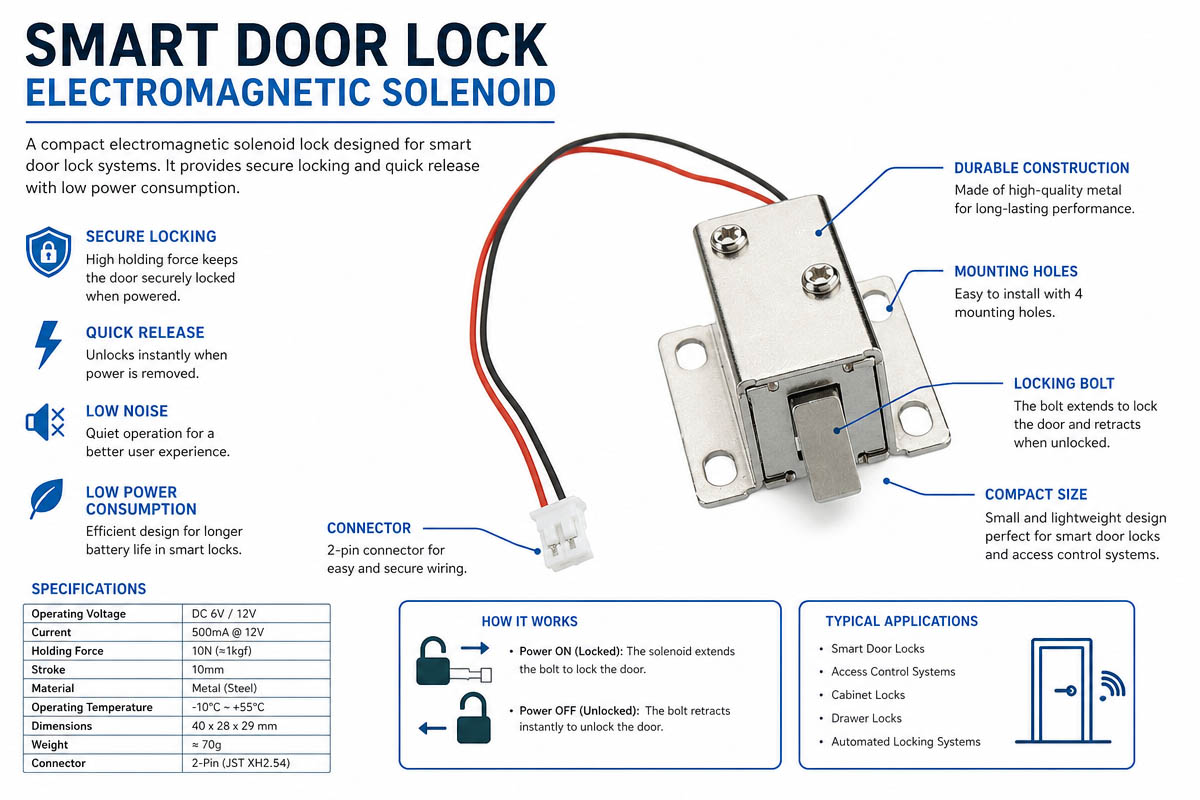
Electronic door locks are one of the fastest growing applications of electromagnetic solenoids.
When a fingerprint, password, RFID card or smartphone authorization is confirmed by the controller, it energizes compact solenoid.
Solenoid moves the locking bolt instantly and door opens.
Advantages of this system:
Fast unlocking
Durability
Low power consumption
High security
Remote control possibility
Many manufacturers of smart locks prefer tubular solenoids because of its compactness and durability.
Chapter 5: Advantages of Using Electromagnetic Solenoids in Small House Appliance Designs
Advantages of electromagnetic solenoids contribute to the enhancement of automation, precision, reliability and safety of household appliance manufacturing.
The benefits are helpful for both producers and customers.
5.1 Increased User Convenience
Today consumers are expecting that appliances should work automatically with minimum efforts.
Using electromagnetic solenoids makes this goal possible due to the possibility to implement:
One-button activation;
Automatic dispensing;
Smart locking;
Programmable control;
Remote control;
Sensor control;
For example, consumers push a button in automatic coffee machine, and numerous solenoid valves coordinate water flow, steam generation and pressure in the process of coffee preparation.
5.2 High Precision and Rapid Response
Contrary to traditional mechanical mechanisms, electromagnetic solenoids operate within milliseconds.
The advantages include:
Rapid valve switching;
Precision;
Consistency of operation;
Process control.
The fast response ensures higher performance and minimizes mechanical wear of appliance elements.
5.3 Improved Reliability
The first reason why producers choose electromagnetic solenoids is long-life period.
Due to the small number of mechanical parts, the wear of these parts occurs rarely.
Industrial solenoids can operate for hundreds of thousand or even millions times.
The reliability of solenoids contributes to the following factors:
Durability of products;
Increased customer satisfaction;
Higher warranty performance;
Longer maintenance periods.
5.4 Enhanced Safety
Safety is one of the most valuable advantages of electromagnetic automation of household appliances.
Solenoids guarantee safety of the appliance through controlling:
Door locking;
Release of the pressure;
Water flow;
Gas valves;
Electrical interlock;
Emergency shut-off system;
All these functions prevent overheat and leaking.
5.5 Lower Manufacturing Costs
Comparing to the complex mechanisms, electromagnetic solenoids provide simple structure and easier integration.
Advantages for the producer include:
Lower cost of assembling process;
Lower cost of tooling;
Easier customization;
Increased efficiency;
Improved uniformity of products;
Due to the possibility to customize many solenoids according to the voltage, stroke length, force, mounting style and connectors, solenoids are appropriate for various designs of products.
5.6 Energy Efficiency
Modern electromagnetic solenoids are created with the purpose to consume less energy but to provide high level of output force.
Design features include:
Optimized magnetic circuit;
High permeability steel;
Low loss copper windings;
Effective plunger shape;
Pulse-width modulation (PWM) control.
All these technologies decrease electricity consumption.
Also, low power consumption supports global programs of energy saving and helps producers to comply with stricter regulations.
Chapter 6: Future Trends in Electromagnetic Solenoids
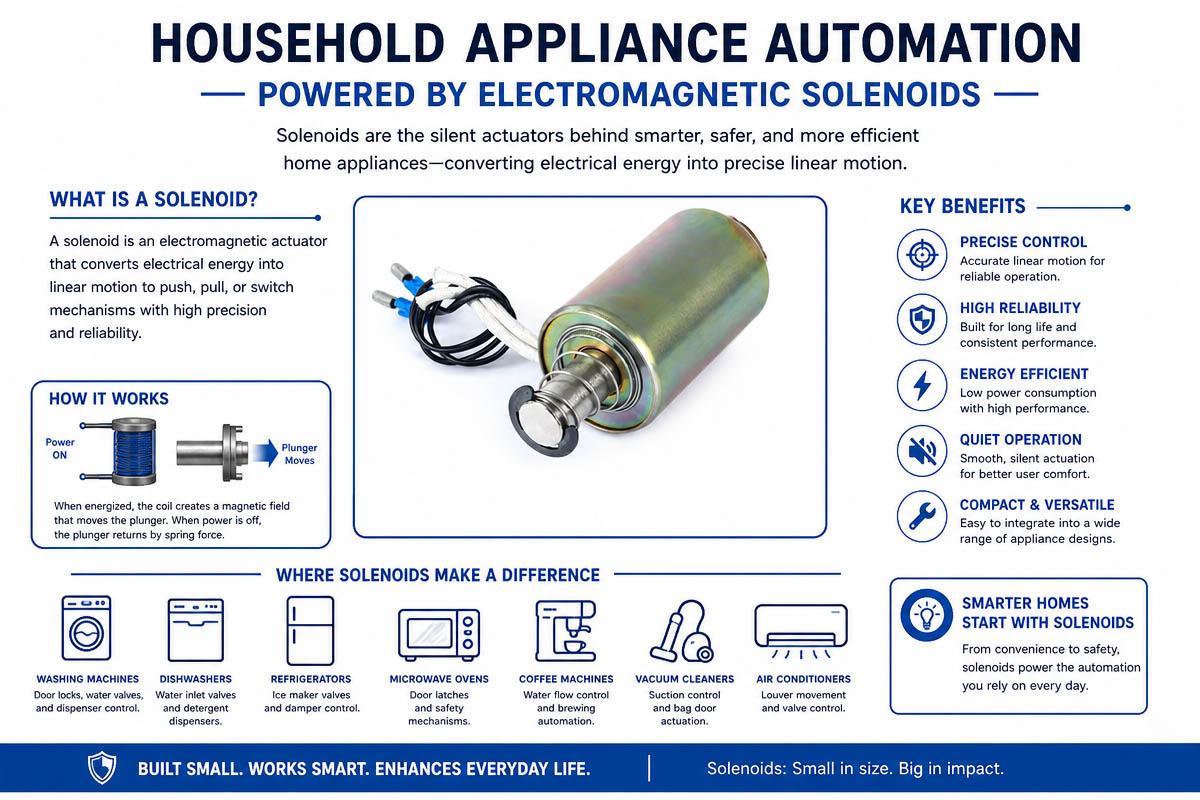
The fast development of smart houses, artificial intelligence (AI), the Internet of things (IoT) and energy-efficient appliances opens a lot of opportunities for the technology of electromagnetic solenoids. In the future household appliances will require actuators which are smaller, smarter, quieter, more efficient and able to operate millions times.
To meet these demands, producers continue developing new materials, innovative designs and intelligent technologies.
6.1 Advanced Magnetic Materials
Material innovation is one of the main driving forces for the improvement of solenoids.
In the future, electromagnetic solenoids will be improved due to:
* High permeability magnetic steel
* Low hysteresis core materials
* High temperature insulation systems
* Advanced copper windings
* Rare earth magnetic materials for hybrid actuator designs
Materials mentioned above give the following advantages:
* Higher magnetic force
* Lower energy consumption
* Reduced heat generation
* Longer lifetime
* Increased reliability under continuous operation
For household appliances with frequent operation, for example, for coffee machine, washing machine, water dispenser the mentioned material innovations will provide better product performance and lower maintenance costs.
6.2 Structural Optimization
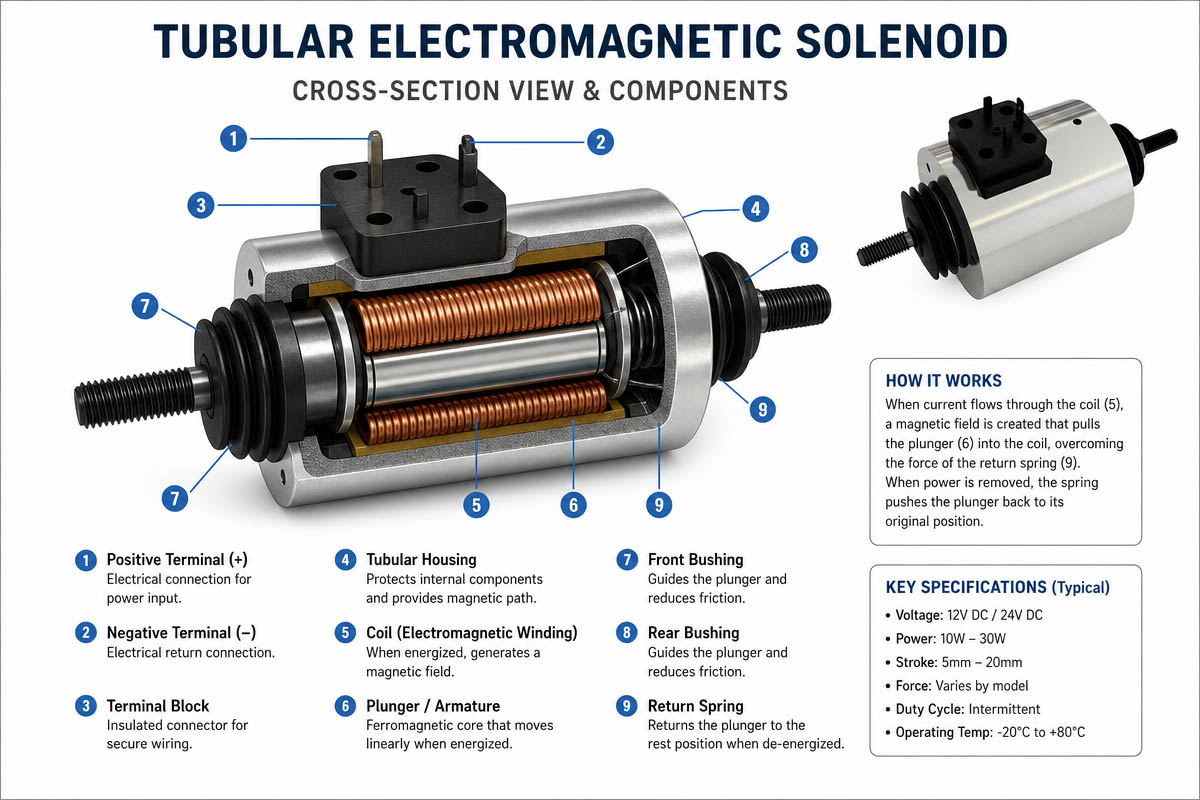
Today modern producers need compact components without reduction of performance.
To provide such requirements, engineers continue optimizing:
* Magnetic circuit design
* Coil winding
* Geometry of air-gap
* Plunger material
* Housing design
* Spring design
The computer-aided electromagnetic simulation allows engineers to increase magnetic force and decrease energy losses simultaneously.
Such innovations resulted in a new generation of miniature solenoids which can produce more force in smaller volumes and become ideal actuator for smart appliances.
6.3 Intelligent Solenoid Control
Classical solenoids just switched ON and OFF.
Modern intelligent appliances require much more.
With the help of modern controllers the following processes can be regulated:
* Coil current
* Holding current
* Speed of operation
* Response time
* Feedback about position
* Temperature compensation
More often now, Pulse Width Modulation (PWM) technologies are used. At first the solenoid gets full voltage to get the maximum pull force. Then after reaching the operating position, controller lowers automatically the holding current and thus energy consumption and heat generation are decreased.
Integrating with the sensors, microprocessors and wireless communication modules, electromagnetic solenoids become a key element of smart house system.
6.4 New Application Areas
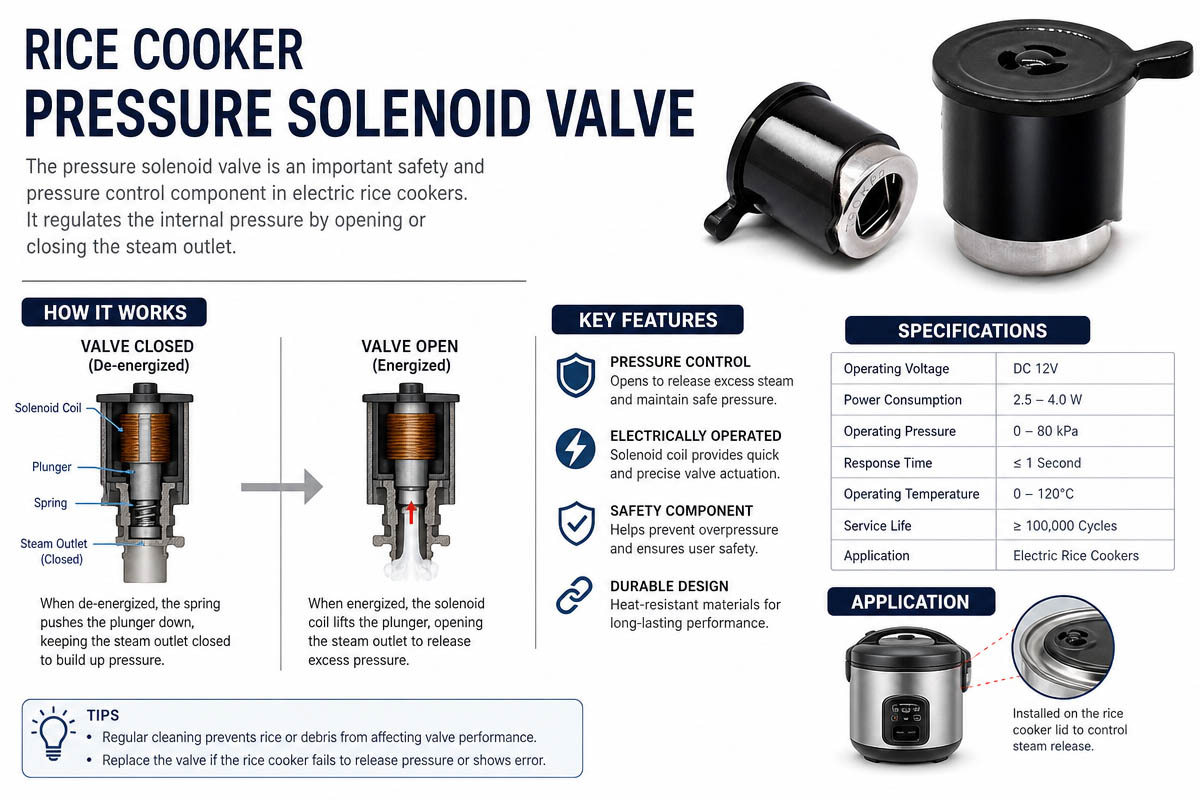
The range of applications of electromagnetic solenoids will constantly widen.
Smart Kitchen Appliances
Future coffee machines, induction cooker, oven, and other multifunctional appliances will have more developed automatic control system driven by electromagnetic solenoids.
Smart Water Management
Water-saving devices like intelligent faucets, automatic irrigation systems and water purification systems will use precise solenoid valves for efficient water control.
Medical Appliances
Portable medical devices, home rehabilitation devices, massage and personal health appliances will more and more use compact electromagnetic actuators for precise movement and safe operation.
Domestic Robotics
Domestic service robots will use electromagnetic solenoids to control gripper, locking mechanism, dispensing system, and safety systems.
6.5 Industrial Upgrading
The future of the electromagnetic solenoid industry will depend on more cooperation in supply chain.
The key trends are:
Standardization
International standards ensure the compatibility of solenoids, quality, testing and reliability of products.
Automated Production
Robotic coil winding, laser welding, automated assembling and intelligent testing significantly increase efficiency of production and reduce manufacturing defects.
Digital Design
Simulation software allows to optimize magnetic circuit of the solenoid during the designing process and shorten the development cycles as well as reduce prototype costs.
These innovations allow producing custom solenoids of high quality at competitive prices.
Chapter 7 : Environmental Impact of Electromagnetic Solenoids
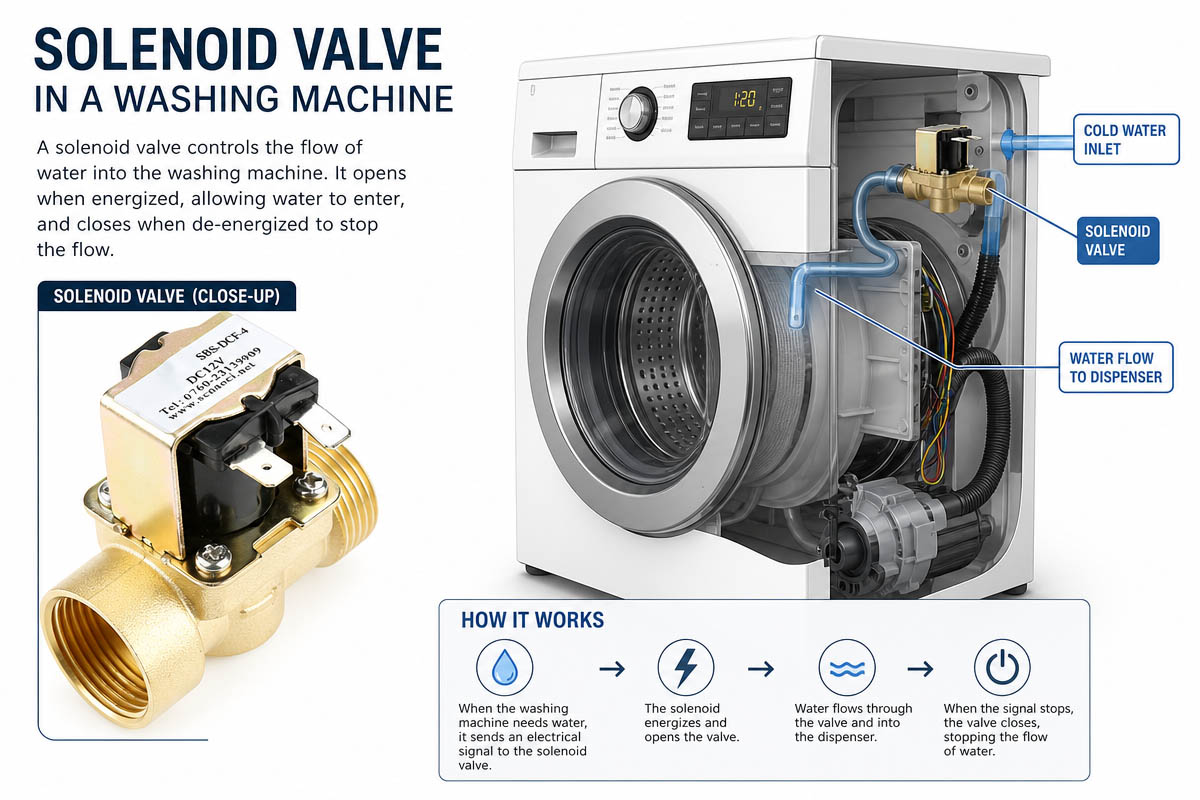
Environmental sustainability became one of the major considerations in the appliance design.
Despite of the fact that the solenoids consume relatively small amount of electricity, billions of appliances work worldwide every day. So the improvement of energy efficiency can significantly reduce the environmental impact.
7.1 Reduction of Energy Consumption
The greatest environmental impact is made by electricity consumption.
The ways of reducing power consumption include:
* High-efficiency coil design;
* Low-resistance copper wire;
* Advanced magnetic materials;
* PWM control;
* Optimized magnetic circuit.
These technologies reduce energy consumption and maintain high performance.
7.2 Improvement of Energy Conversion Efficiency
The electromagnetic device cannot convert electrical energy into mechanical energy perfectly.
The losses occur due to:
* Coil resistance
* Eddy currents
* Hysteresis
* Heat generation
Selecting proper magnetic materials and optimizing magnetic circuit, producers continue to improve energy efficiency and decrease operating temperature.
7.3 Electromagnetic Compatibility (EMC)
All household appliances should work together with other electronic devices such as TV set, computer, Wi-Fi router, smartphone, etc.
The EMC design includes:
* Electromagnetic shield
* Noise suppression circuitry
* Proper grounding
* Good insulation
* Certification and testing of compliance with EMC regulations.
These technologies minimize the interference and ensure safe operation.
7.4 Human Safety
Under normal operating conditions, electromagnetic solenoids of household appliances produce magnetic fields within the limits of internationally accepted safety regulations.
However, producers must ensure:
* Proper insulation;
* Proper operating temperature;
* Electrical safety;
* Compliance with EMC regulation.
Reliable product design provides the safety of the users and surrounding electronic equipment.
7.5 Recycling and Sustainability
The electromagnetic solenoid consists of recyclable materials including:
* Copper;
* Steel;
* Iron;
* Aluminum;
* Engineering plastics.
Recycling reduces the environmental load and minimizes landfill waste.
Today the producers more often use the environmentally responsible manufacturing technologies including:
* RoHS compliant materials;
* Lead free manufacturing;
* Recyclable packages;
* Reduction of hazardous substances;
These practices support the initiatives of global sustainability and meet the customer’s expectations
Chapter 8 : Frequently Asked Questions (FAQs)
8. 1. What is an electromagnetic solenoid?
An electromagnetic solenoid is an electromechanical actuator which converts electrical energy into linear motion by using the electromagnetic force.
8.2. Where electromagnetic solenoids are used in household appliances?
They are used in washing machines, coffee machines, rice cookers, dish washers, refrigerators, smart locks, massage products, water dispensers and automatic valve systems.
8.3. What is the difference between the electromagnet and solenoid?
Electromagnet refers to the magnetic device activated electrically, whereas the solenoid is an electromechanical actuator which creates controlled linear motion. Often the terms are used interchangeably in industrial application.
8.4. Why are solenoids better than mechanical switches?
Solenoids are faster, more precise, have long lifetime, require less maintenance and easy integrate with electronic control system.
8.5. Can electromagnetic solenoids be customized?
Yes. The manufacturer can customize voltage, force, stroke length, duty cycle, mounting dimensions, connectors, cables length and environmental protection according to particular application.
8.6. Are electromagnetic solenoids energy efficient?
Modern solenoids are highly energy efficient. Technologies such as PWM control and optimized magnetic circuit significantly reduce energy consumption and keep operating force high.
8.7. How long does the electromagnetic solenoid last?
Well-designed industrial solenoid can operate for hundreds of thousands or even millions times depending on the application, duty cycle and operating conditions.
8. 8. What should be considered when selecting the electromagnetic solenoid?
Operating voltage, required force, stroke length, duty cycle, response time, ambient temperature, available installation space, expected lifetime, environmental conditions are important factors to consider.
Chapter 9: Conclusion
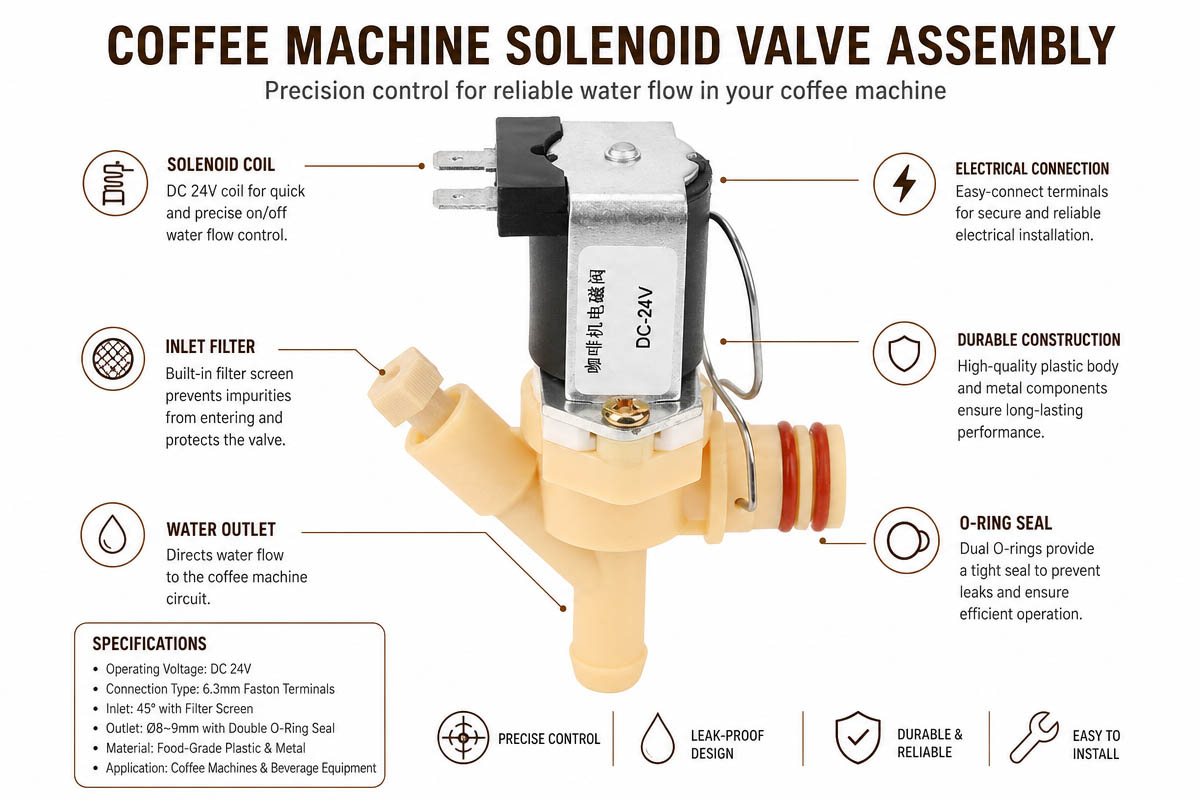
Electromagnetic solenoids became a driving force of modern smart household appliances. Possibility to convert the electrical energy into precise mechanical motion provides automation, reliability, safety and allows miniaturizing the designs.
From washing machines and rice cookers to coffee machines, smart locks, water dispensers, massage products and other automatic safety systems, electromagnetic solenoids provide reliable actuating of these appliances.
Advances in materials, intelligent control systems, energy-saving technologies and smart manufacturing will bring even more important role of electromagnetic solenoids in the next generation of smart home appliances. New designs will provide higher efficiency, quiet operation, long lifetime and integration with AI and IoT smart home ecosystem.
For the appliance producers, choice of high-quality electromagnetic solenoid is not only selection of the component but investment in the product performance and reliability.
Chapter 10: Call to Action
Whether you are designing smart coffee machine, water purifier, automatic dispenser, smart door lock, massage product or any other household appliance, right choice of the electromagnetic solenoid is necessary for the reliable and efficient operation.
Weilong Intelligent Technology (Dongguan) Co., Ltd. specializes in designing and manufacturing customized electromagnetic solenoids, tubular solenoids, push-pull solenoids, latching solenoids, open frame solenoids and solenoid valves for household appliances, industrial automation, medical devices and smart devices.
Our experienced engineering team provides comprehensive customization services including voltage customization, force optimization, stroke customization, duty cycle analysis, connectors options, environmental protection and lifecycle testing to ensure the perfect fit for your application.
Contact us now and see how customized electromagnetic solenoid solutions can improve your smart appliance.


