


How to Choose a Medical Solenoid Valve For your project needs
Valve selection for medical equipment is not only matching the physical dimensions of the valve. The valve should be appropriate to the total environment of usage of the equipment.
1. Medium Identification
First, it is necessary to identify whether the valve is going to control air, oxygen, water, vacuum, gas, liquid reagents, or any other fluid. Medium determines much of the material and sealing compatibility.
2. Definition of Flow Requirements
It is necessary to calculate the effective flow rate of the valve. Consider the desired flow, pressure difference, orifice size, and whether the flow should be constant or variable.
3. Pressure Checking
It is necessary to set minimum, normal, and maximum pressure values. The valve should operate correctly within the whole range of pressures, not only nominal working pressure.
4. Valve Configuration
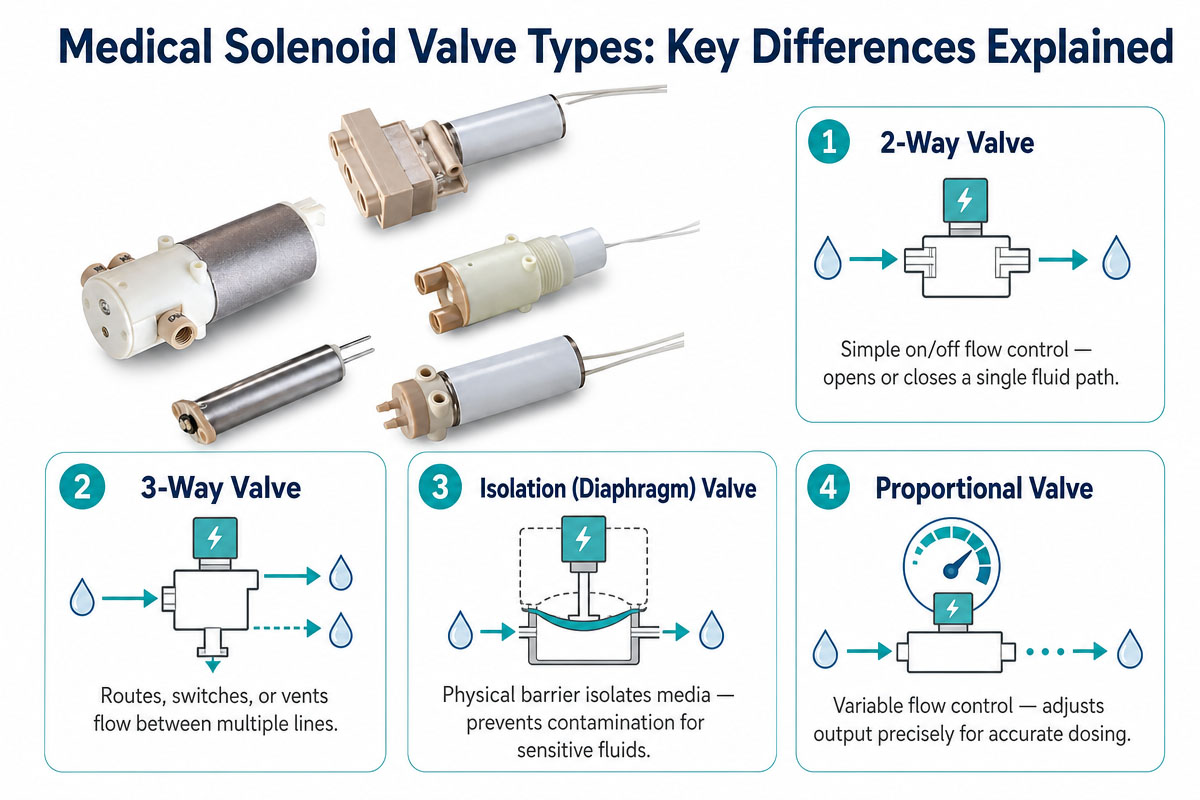
It is necessary to determine if a 2-way or 3-way valve and a normally open or normally closed valve are required. Proper configuration depends on the safety and control logic of the equipment.
5. Electrical requirements verification
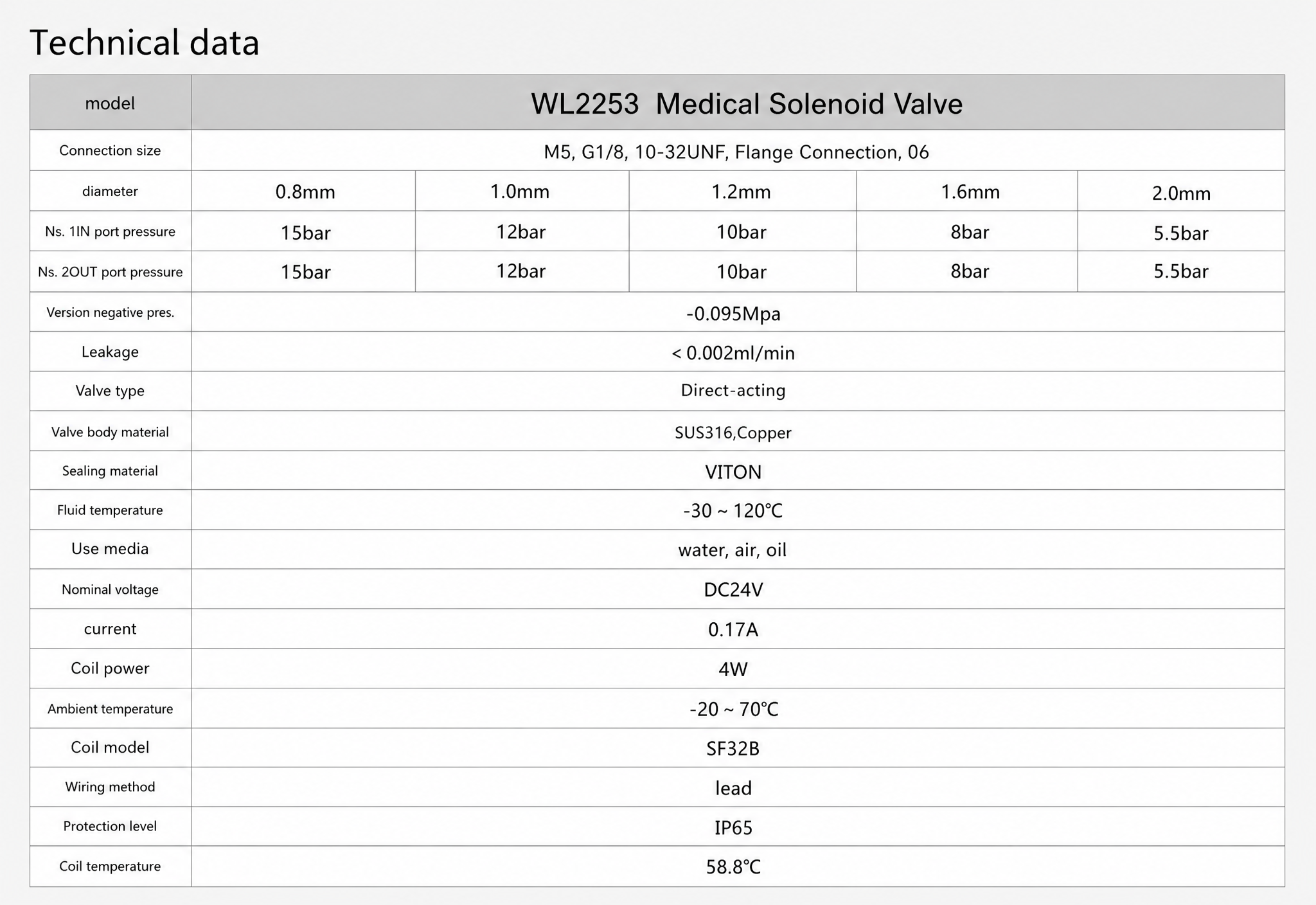
Specify the available voltage, e.g., 12V DC, 24V DC, etc.; current; coil resistance; power consumption; and duty cycle.
6. Analysis of Response Time
In fast switching systems, response time may be crucial for the performance of equipment. Compare opening and closing times of the valve.
7. Verification of the leakage rate
Leakage rate affects the pressure stability, measurement accuracy, gas consumption, and equipment performance. Specify leakage rate before selecting the valve.
8. Taking into account Installation Space
Medical devices are usually small and have limited dimensions. Consider valve dimensions, mounting dimensions, port locations, connector location, and maintenance access.
9. Thermal Performance Analysis
Coil temperatures may increase during continuous or high-frequency operation. Verify the thermal performance of the valve under a real duty cycle.
10. Evaluation of Service Life
Define the number of operating cycles to be required and test the valve under realistic conditions. The valve that passed the short functional test may not meet long-term reliability requirements.
11. Customization capability assessment
In the case of OEM projects, the supplier should be able to change dimensions, coils, materials, connectors, ports, mounting dimensions, and performance parameters if necessary.
12. Final design review
Test the samples of valves on the equipment before large-scale production. Test flow, pressure, leakage rate, response time, temperature, electrical performance, noise, and service life under realistic operating conditions.
Therefore, the best medical solenoid valve is not necessarily the smallest and the cheapest. The valve provides the required performance and is designed to meet the mechanical, electrical, fluidic, reliability, and quality requirements of the equipment.
Common Mistakes in Design of the Medical Solenoid Valve and How to Avoid Them
1. Do not choose a valve based on size alone
The valve may be appropriate for the equipment in terms of size but does not provide sufficient flow or pressure performance.
2. Do not overlook real medium
Different fluids, such as gas, water, chemicals, etc., have different material compatibility requirements. Always check the valve body and sealing material.
3. Specify pressure conditions clearly
Do not give just pressure value. Provide minimum, normal, and maximum pressure values.
4. Consider the whole duty cycle
A coil that works properly for several seconds can overheat and fail when operated continuously. Test the valve under a realistic duty cycle.
5. Leave enough room for installation
Consider not only the valve body but also connectors, wires, mounting hardware, tubing, maintenance access, and manufacturing tolerances.
6. Specify the leakage rate
Leakage rate is a design parameter and should be considered during the design stage, not when the prototypes are built.
7. Verify the coil compatibility with the control system
Check voltage, current, power consumption, resistance, switching frequency, and controller compatibility.
8. Do not change materials without validation
Plunger, valve body, spring, and sealing materials may change magnetic force, corrosion resistance, leakage rate, lifetime, and material compatibility.
9. Test the whole system
Bench testing may not reveal problems with pumps, tubing, pressure fluctuations, controllers, and installation orientation.
10. Define quality requirements before large-scale production
Before production it is necessary to agree on critical dimensions, electrical testing, leakage limits, performance tests, inspection methods, and sampling.


