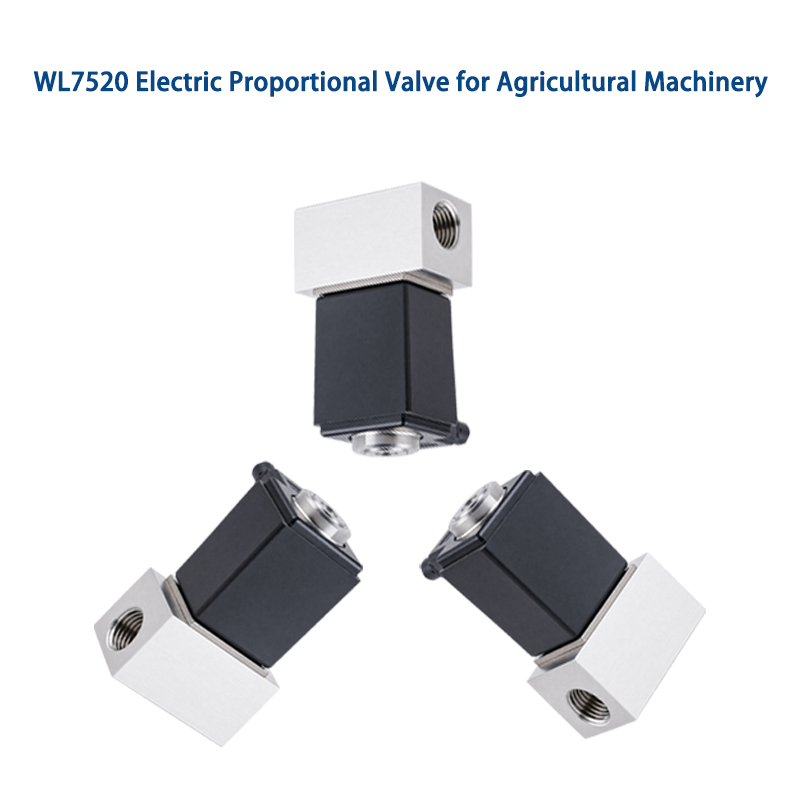
Chapter 1: Introduction to the session
A proportional solenoid valve manufacturer is necessary if your applications need precise control of flow rate, pressure, or motion. A proportional solenoid valve differs from a regular solenoid valve, as its output is variable depending on the input electrical signal. For that reason, they are widely used for precise and repeatable control.
But it will be difficult to obtain a reliable proportional solenoid valve using a standard valve and a standard coil. There are many aspects to be considered, like the magnetic circuit, the coil design, the shape of the plunger, the spring properties, the valve orifice, the materials, the seal system, the electronics, the operating temperature, and the duty cycle.
Collaboration with experienced proportional solenoid valve manufacturers will significantly improve the result of your product and avoid problems such as non-reliable valve actuating force, overheating, leaking, hysteresis, and so on.
This guide discusses how to select the right supplier and what to expect during the Proportional Solenoid Valve manufacturing process, from specification engineering through production and quality assurance testing.
Chapter 2: What is a Proportional Solenoid Valve?
A proportional solenoid valve is an electrically controlled valve that regulates the flow rate or pressure of a fluid in proportion to the magnitude of the input signal.
Generally, there are two basic positions of the standard solenoid valve:
Open position, closed position
But the intermediate position is defined by the proportional solenoid valve. This is why you are able to control the output of the valve by changing the input voltage or current.
For instance, you can change the valve position and control the flow or pressure by increasing the current in the coil, which increases the electromagnetic force and plunger displacement against the spring force.
Common input control signals are
0-5V 0-10V
PWM 4-20 mA
And now it is possible to use a custom signal.
The relation between the valve position and the input current depends on the magnetic circuit, the spring, the mechanical design, the fluid conditions, and the control electronics.
Chapter 3: How to Choose the Right Proportional Solenoid Valve Manufacturer
Proportional valves are precise devices, and even small changes in the manufacturing process can have a great effect on their performance.
The experienced manufacturer should know the interrelationship of:
Input (electrical) -> force (electromagnetic) -> motion (plunger) -> valve opening -> Output (fluid)
If the company manufactures only standard solenoids, it may not have sufficient experience for proportional control.
Selecting a proportional solenoid valve manufacturer partner, you need to consider the company that is able to offer engineering services during all stages of development.
Such a potential partner should have the following key capabilities:
magnetic circuit design
coil design and winding
machining of plunger and core
spring tuning
valve body production
sealing and assembly
electrical tests
flow and pressure test
life cycle testing
OEM customization
Step 1: Identify your proportional solenoid valve specifications.
Create a technical specification before contacting the manufacturers.
The more detailed information you provide to the manufacturer, the easier it will be for him to create the correct design.
Key specifications are
Electrical Characteristics (continued)
Rated voltage range: Voltage rating (VR)
coil resistance at max current power consumption control signal current rating
frequency of PWM (if applicable)
Mechanical Specifications
Dimensions (LxWxH), installation configuration, stroke diameter of plunger spring force required, electromagnetic force connection type, and installation configuration
Specifications of fluid
Operating pressure—medium Maximum pressure flow rate Range of flow rate control Size of port Valve opening
Environmental Criteria: operating temperature, storage temperature, humidity, vibration, shock, corrosion resistance, IP-class
You should also indicate the expected duty cycle and service life.
Step 2: Evaluate the Manufacturer’s Engineering Capabilities
First of all, you should consider whether the supplier is really able to manufacture the product or only to assemble the purchased components.
A good proportional solenoid valve manufacturer partner will be able to evaluate the magnetic circuit and optimize the force curve.
The electromagnetic force depends on the following parameters:
topological charge wire diameter presence of magnet material airgap plunger shape basic form magnetic saturation temperature
The manufacturer of proportional applications should pay special attention to the consistency of the force during the entire working stroke.
A good manufacturer should be able to explain to you how he will give you the desired force-current relationship, not just quote a standard model.
Step 3: Check ability to design custom coils.
A solenoid coil is one of the main elements of a proportional valve.
The coil transforms electrical energy into the magnetic field. Its design influences the electromagnetic force, response time, power consumption, and temperature rise.
The solenoid coil can be produced in accordance with the following custom requirements for the proportional solenoid valve:
presence of resistor; voltage wire diameter size of coil number of turns way of winding-up insulation requirements temperature requirements duty cycle
Internal coil winding capability for the Proportional Solenoid Valve manufacturer is an opportunity for quick response to OEM needs and the possibility to perform the engineering changes without dependence on the external suppliers.
Prototype coils are provided by the manufacturer, and the coil is designed during the development process.
Step 4: Become familiar with magnetic circuit design capabilities
The efficiency of transforming electrical energy into mechanical force depends on the magnetic circuit.
A proportional solenoid requires not only the maximal maThereforetic force but also the controlled force curve.
So, the manufacturer should take into account the following:
Magnetic flux density, substrate material, air gap geometry, plunger material design of pole piece magnetic saturations, existence of permanent magnetism, stroke of power
Poor design of the magnetic circuit leads to:
excessive hysteresis, abuse of power, non-linear force response temperature rise, poor repeatability, low initial force
In the case of demanding applications, you may ask the supplier if he uses magnetic simulation or other engineering methods to optimize the design before tooling and mass production.
Step 5: Check material and surface finish.
The choice of material is very important for the performance and service life of a proportional valve.
Common materials are
steel to magnets stainless steel copper technical plastic elastomers, brass, aluminum, spring steel
The plunger and magnetic core should have proper magnetic properties, dimensional stability, and surface finish.
The valve body should correspond to the medium and pressure.
Surface treatment is required for:
corrosion resistance Abrasion resistance reduced friction, increased surface hardness, and extended service life.
When you check out the manufacturer, you should ask him about the types of surface treatment and material specifications he offers.
Chapter 4: Validate Precision Machining and Tooling Accuracy
Proportional valves offer generally better dimensional control in comparison with standard on/off solenoids.
Key dimensions are
plunger size, bore diameter, and air gap (distance between the plunger and the core). Valve seat. Opening of the valve diameter of the shaft dimensions for mounting
Small differences in dimensions influence friction, magnetic force, and leaking or flow characteristics.
The manufacturer, with its own capabilities of tooling development, CNC machining, stamping, injection molding, and assembling, will control a greater part of the manufacturing process.
This will prevent miscommunication between several suppliers and will make the engineering changes possible.
Chapter 5: Questions to ask a proportional solenoid valve manufacturer for prototyping
Do not choose a manufacturer depending on his mass production pricing.
A proper manufacturer should have a clear prototyping procedure.
A typical prototype procedure would be as follows:
Customer specification
Engineering Review: Magnetic Circuit Design
Prototype Testing, Design Optimization, Tooling, Pilot Production, and Mass Production
The designer is asking the following questions:
What is the time to develop the prototype? Does the supplier provide a custom prototype coil? Can the supplier modify the spring force? Can the plunger geometry be modified? What kind of testing is done with prototypes? What are engineering change procedures?
A manufacturer providing engineering feedback during the prototyping process will shorten the development process.
Chapter 6: Testing and Quality
During production, proportional valves have to be tested.
A professional manufacturer will possess all the equipment for the electrical and mechanical testing.
Electrical Testing
Standard tests are
resistance of the coil rated current power loss insulation resistance
dielectric strength current-force relationship temperature rise
Mechanical Testing
Tests may include:
attack initial force grip force reproducibility of response time spring force friction
inspection of valves
Depending on the application, testing may include:
flow rate pressure stress leakage opening/closing pressure stability linearity of input/output
If you are going to use proportional solenoids for OEM applications, ask whether the manufacturer can provide custom inspection standards that meet your needs.
Chapter 7: Consider Temperature Performance
Temperature has a great influence on the design of a proportional solenoid.
The resistance of the copper wire depends on the temperature of the coil and affects the relationship of the applied voltage, current, and electromagnetic force.
High temperature may also affect:
Insulation of coils: plastic compound seals lubricant.
magnetic material spring fatigue
Thus, the proportional solenoid valve, which is intended for continuous operation, must be tested at the operating temperature.
Forget about room temperature rating. Ask the manufacturer to perform temperature rise tests.
Chapter 8: Consider Service Life
During their service life, proportional solenoid valves in industrial equipment may be cycled dozens or even millions of times.
So the manufacturer has to be able to perform life testing for you.
Life tests may comprise:
wear and tear coil reliability plunger travel spring fatigue seal power energy absorption energy transfer flow pattern
What is the expected life cycle, and under what test conditions was it set?
100,000 cycles are only meaningful if the test conditions are known.
Chapter 9: Evaluation of Proportional Solenoid Valve Manufacturing Quality Management System
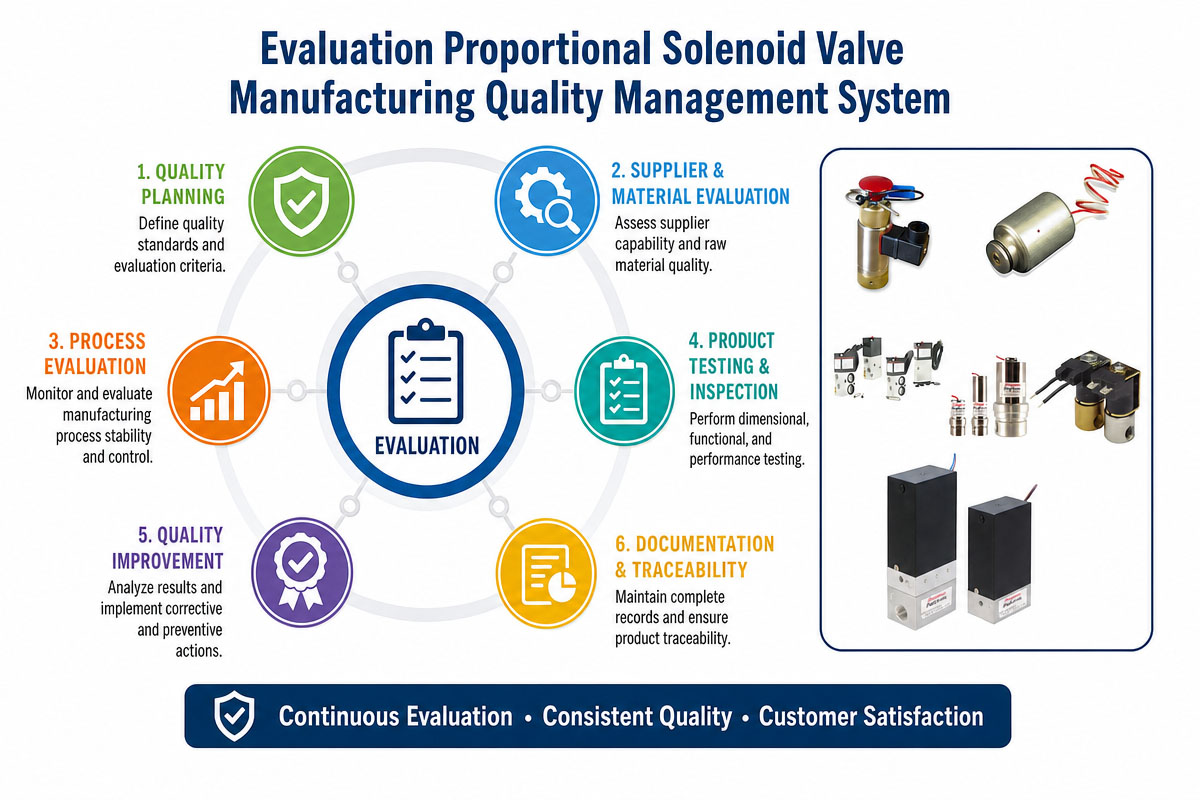
A quality management system is crucial, especially for OEM projects.
While comparing the manufacturers, check whether the supplier has a formal quality management system and production process documentation.
The most important areas are
inspection of incoming materials in-line inspection coil resistance measurement dimensional inspection assembly inspection performance test traceability of final inspection procedures for corrective action
ISO 9001 certification is another piece of evidence of the quality management system.
Some applications may require certain certificates for particular industries.
Chapter 10: Flexibility Measurement for Customization
Off-the-shelf products cannot cover all the needs of proportional valves.
You may have to customize:
coil resistance coil voltage
spring curves hub spring force valve opening port settings mounting holes plug installation materials seals, control properties
Make sure that your manufacturer can not only modify your needs but also provide you with custom designs.
The true OEM manufacturer will be able to translate your technical specifications into the drawing, prototyping, tooling, testing, and production.
Chapter 11: Do Not Evaluate Unit Price, Compare Total Cost
The lowest price is not always the best choice.
You have to consider total development cost:
Prototype Tooling Engineering Testing Production Quality Logistics Warranty Risk
If the supplier with the slightly higher unit price has:
Fast engineering support better quality control. lower failure rate shorter lead times in-house production, better customization, better testing
For long-term OEM projects the reliability of the supplier is more important than a small difference in unit price.
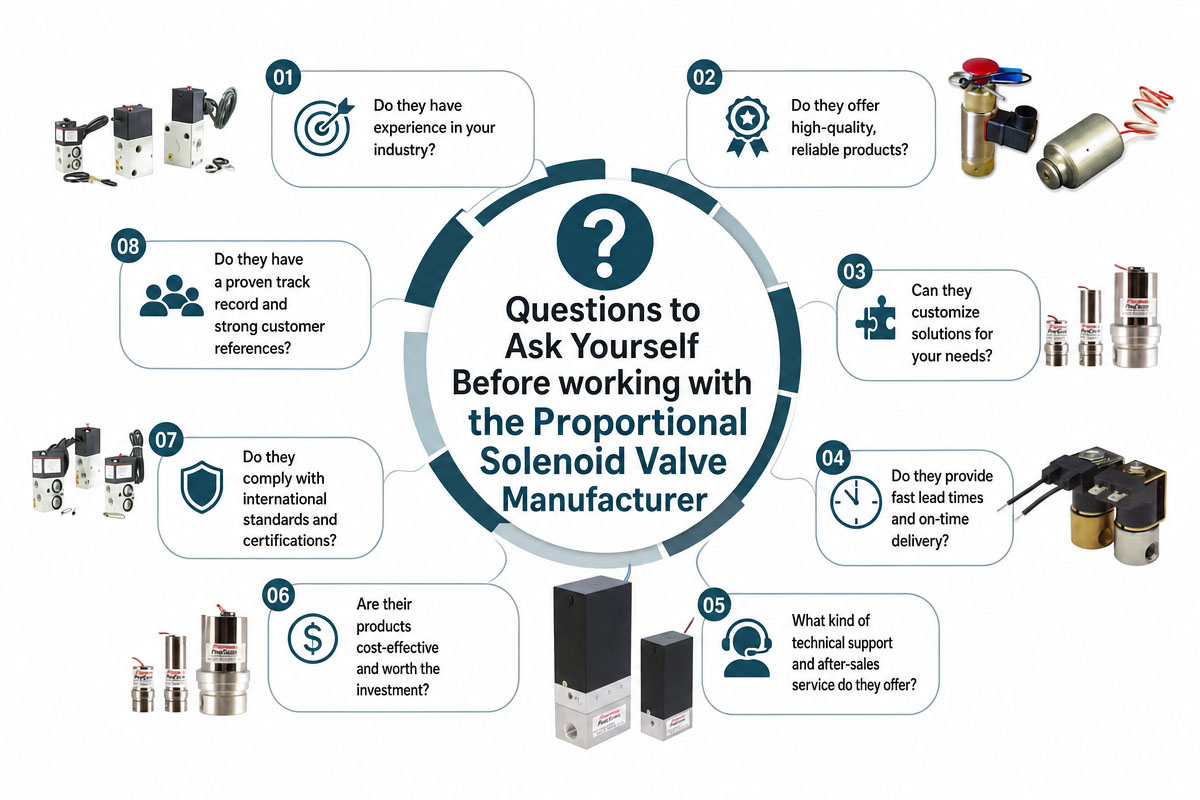
Chapter 12: Questions to Ask Yourself Before working with the Proportional Solenoid Valve Manufacturer
Before selecting a partner for Proportional Solenoid Valve Manufacture, ask him the following questions:
“Yes, we can design a customized proportional solenoid valve for you.”
“Yes, we can customize the coil of the electromagnet.”
“Can the magnetic circuit be optimized?”
“What stroke, what force can you get?”
“Could you share force—current test data?”
“What tests are there for flow and pressure?”
“What do you recommend?” “Expected Service Life”
“What is the time frame for a prototype?”
“What does the tooling cost?”
“What is the minimum output quantity?”
“Do you have quality certificates?”
“You have engineering drawings?”
“Yes, the design can be changed during the development process.”
“What is your lead time for mass production?”
The answers to these questions will help you to distinguish between a competent engineering manufacturer and a simple trading company that just buys standard products.
Chapter 13: A professional manufacturer’s production process includes the following stages:
-
Requirements gathering
The manufacturer gathers the requirements for electrical, mechanical, fluid, environmental, and performance.
-
Design Engineering
The engineers design the magnetic circuit, coil, plunger, spring, valve body, and seal system.
-
Simulation & Optimization
The magnetic circuit and the mechanical structure are analyzed and optimized.
-
Prototype Fabrication
The prototype components and coils are fabricated for testing purposes.
-
Performance Testing
Testing is performed for force, stroke, current, temperature, leaking, flow, and response.
-
Optimized Design
Test results are used for design modifications.
-
Development of Tools
- The design is approved before production tooling is developed.
-
Production Piloting
Limited production run confirms the consistency of production.
-
The Mass Production
Manufacturing, assembly, testing, and inspection of approved parts.
-
Final Quality Control
All valves are tested for defined electrical, mechanical, and functional testing prior to shipment.
Chapter 14: Why Should You Partner With an Experienced Proportional Solenoid Valve Manufacturer?
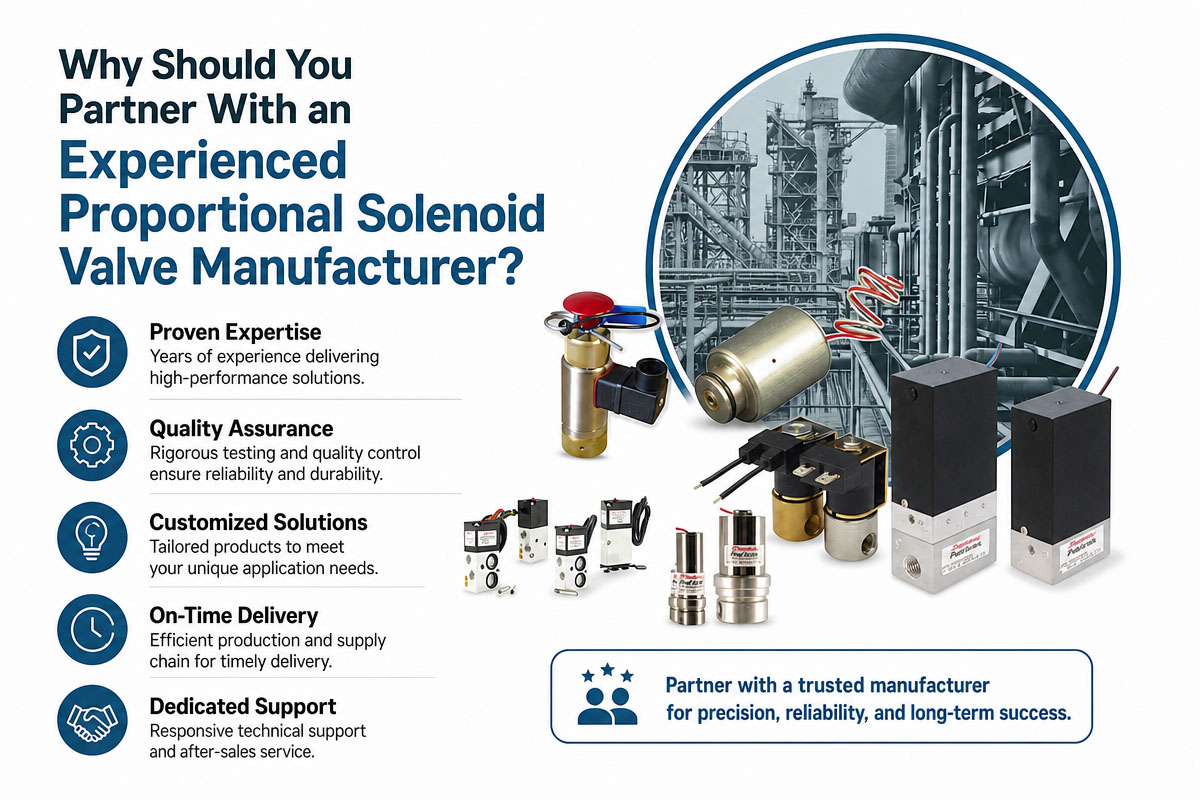
There are many reasons to work with an experienced manufacturer.
Integration of engineering: the coil, magnetic circuit, valve structure, and mechanical parts can be optimized as a whole.
Customization: instead of forcing the application to use the standard product, we can take OEM requirements into account.
Quality control: we can do more manufacturing processes in-house.
Fast Development: communication between the customer and the production team and the engineering department.
Cost control: producing in-house reduces dependency on external suppliers.
Long-term support. The supplier can help with improvements in production and revisions of future products.
These factors can significantly reduce the technical and commercial risk for industrial OEMs.
Final Checklist for Selecting a Proportional Solenoid Valve Manufacturer
Chapter 15: Rate your supplier against the following criteria before placing an order:
Before placing an order, evaluate the supplier against these criteria:
|
Evaluation Area |
What to Look For |
|
Engineering |
Custom magnetic and mechanical design |
|
Coil |
In-house coil design and winding |
|
Materials |
Appropriate magnetic and corrosion-resistant materials |
|
Machining |
Precision CNC and tooling capability |
|
Prototyping |
Fast sample development |
|
Testing |
Force, flow, pressure, electrical, and life testing |
|
Quality |
Documented inspection procedures |
|
Customization |
OEM dimensions and performance |
|
Production |
Stable mass-production capability |
|
Support |
Responsive technical and engineering service |
Chapter 16: Summary
Selection of a proportional solenoid valve manufacturer partner is not a rush decision. It is an engineering decision that can greatly affect the performance, reliability, cost, and service life of your end equipment.
The competent manufacturer should be more than a catalog of valves. He has to be able to design the magnetic circuit, customize the coil, optimize the mechanical structure, manufacture precision parts, test the performance, and provide stable mass production.
For OEM applications you want to select the supplier that will be able to support you through the whole process from initial specs and prototype development through tooling, pilot production, quality inspection, and long-term supply.
Based on the engineering capability, customization, manufacturing technology, testing resources, quality management, lead time, and total cost, you will be able to select a suitable solenoid valve manufacturer to be your long-term technical partner, not only a component supplier.
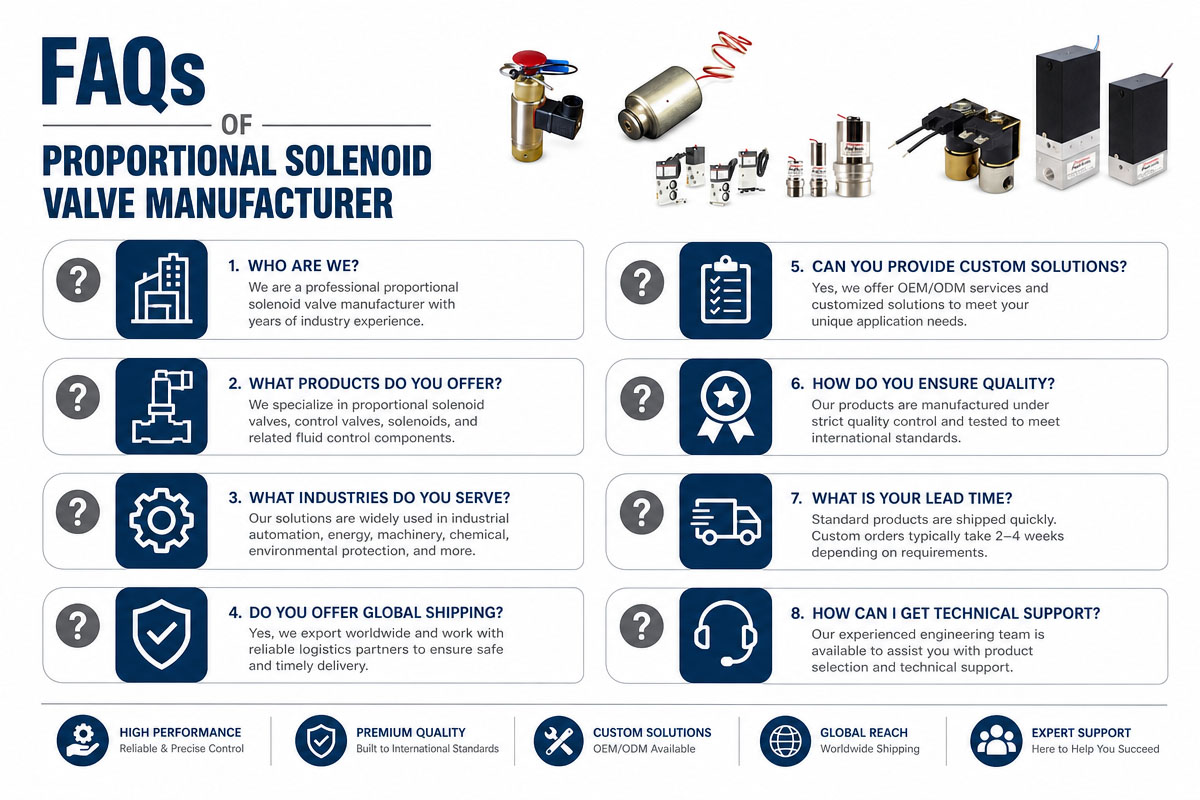
Chapter 17 FAQs of proportional solenoid valve manufacturer
-
What is the production of a proportional solenoid valve?
Proportional solenoid valve manufacture is the process of designing and manufacturing the electrically operated valve that provides variable flow, pressure, or mechanical output according to input current or voltage.
-
How does a proportional valve differ from a regular solenoid valve?
The usual operation of a standard solenoid valve is on/off. A proportional solenoid valve, on the other hand, can provide different positioning and output based on the electrical input.
-
Can proportional solenoid valves be customized?
Yes. OEM manufacturers can customize the coil, voltage, current, stroke, force curve, spring, valve orifice, housing, mounting dimensions, materials, seals, and electrical connections.
-
“What can I give to a maker?”
Where appropriate, list the operating voltage, current, stroke, force, flow rate, pressure, fluid medium, operating temperature, duty cycle, dimensions, expected service life, and mounting requirements.
5. What is the role of the proportional solenoid valve coil?”
Very important is the coil. This coil generates the magnetic field that moves the plunger. Coil resistance, wire gauge, turns, current, power consumption, and temperature directly affect the valve performance.
6. “How does temperature affect a proportional solenoid valve?”
The electric resistance depends on the temperature of the coil. It in turn affects the current and the electromagnetic force. Thus, the thermal performance has to be evaluated under actual operating conditions.
7. How to Test a Proportional Solenoid Valve
It may include testing of coil resistance, current, force, stroke, response time, temperature rise, leakage, flow rate, pressure, repeatability, and life cycle, among others.
8. “How long does it take to develop a custom proportional valve?”
It depends on the complexity, tooling, materials, testing, and the quantity. In this case a modification could be done relatively quickly, while a new valve could require several iterations of prototype and optimization.
9. Trading company or manufacturer?
In such cases, it is often better to work directly with a manufacturer of highly customized proportional valves. This will enable you to communicate directly with the engineering and production people.
10. What are the priorities when choosing a proportional solenoid valve manufacturer?
When selecting proportional solenoid valve vendors, one has to select them on the basis of engineering capabilities, customization, testing, manufacturing quality, reliability, communications, manufacturing capacity, and total costs, not just low prices.