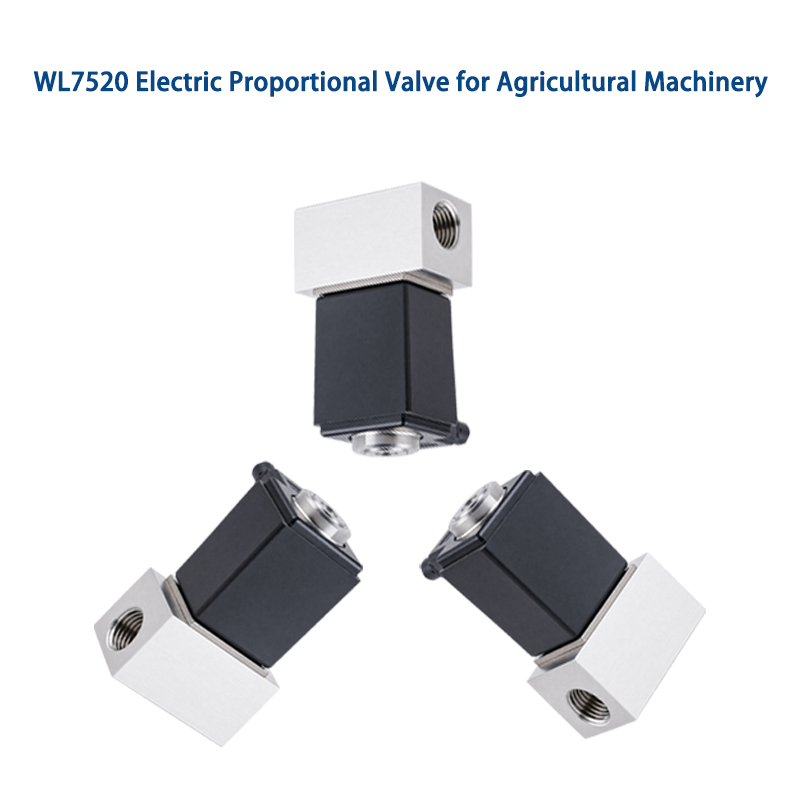
Chapter 1: Proportional Solenoid Valve Manufacturer Introduction
If your applications require precise control over the flow rate, pressure, or motion, then a proportional solenoid valve manufacturer becomes critical. A proportional solenoid valve differs from a standard solenoid valve in a variable output depending on the electrical signal input. Thus, they are widely used when precise and repeatable control is necessary.
However, a reliable proportional solenoid valve cannot be created just by buying a standard valve with a standard coil. There are a number of aspects to consider, including the magnetic circuit, the coil design, the plunger shape, the spring properties, the valve orifice, the materials used, the seal system, the electronics, the operating temperature, and the duty cycle.
Working with experienced proportional solenoid valve manufacturers can significantly improve the result of your product and avoid such problems as non-reliable force of valve action, overheating, leakage, hysteresis, and so on.
This guide describes how to select the right supplier and what to expect during the proportional solenoid valve manufacture, starting with specification engineering and ending with production and quality assurance testing.
Chapter 2: What Is a Proportional Solenoid Valve?
A proportional solenoid valve is an electrically operated valve that regulates the flow rate or the pressure of a fluid according to the magnitude of the input signal.
In a general case, a standard solenoid valve has two basic states:
Open state
Closed state
The proportional solenoid valve, however, gives the intermediate position. That is why you can regulate the valve output by varying the voltage or current input.
For instance, you can increase the coil current and, thus, the electromagnetic force and deflection of the plunger against the return spring to adjust the valve opening and, therefore, control the flow or pressure.
Typical input control signals include:
0 to 5V
0-10V
4-20 mA
PWM
Custom signal for the current control
The precise relationship between the input current and the valve position depends on the magnetic circuit, spring, mechanical design, fluid conditions, and control electronics.
Chapter 3: Choosing the right proportional solenoid valve manufacturer is crucial.
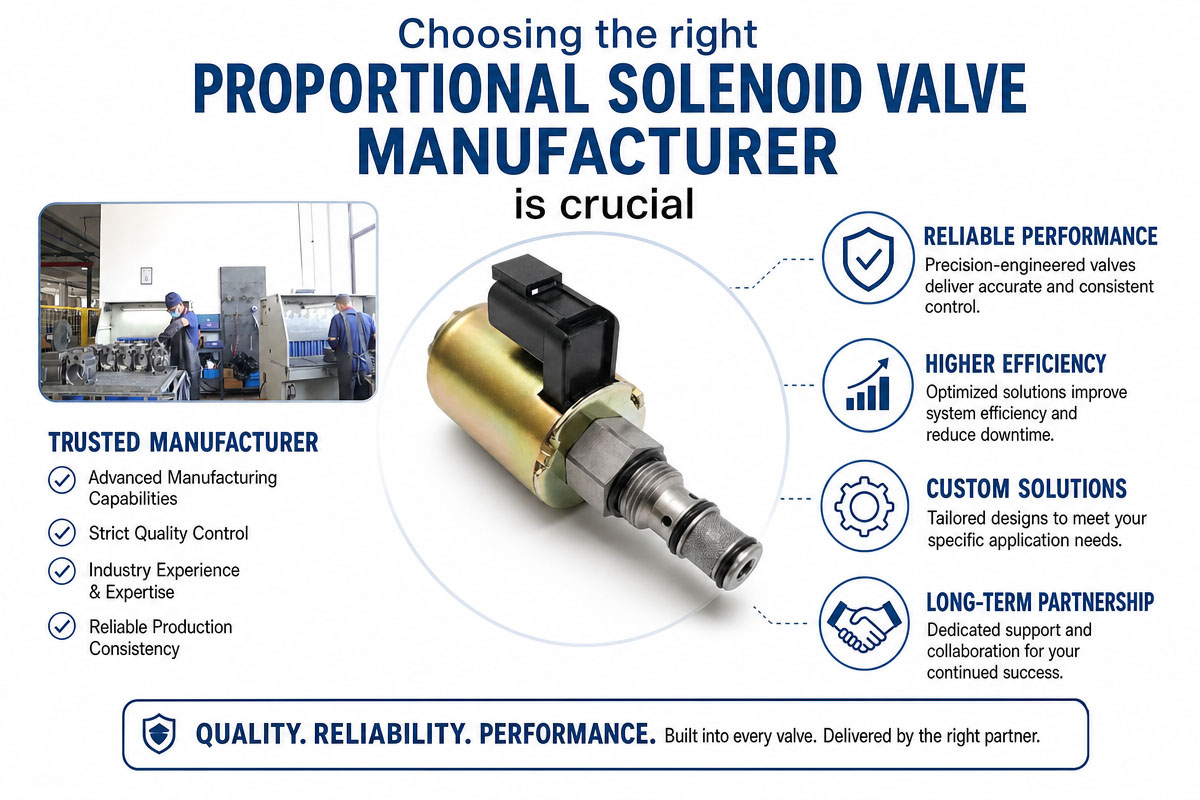
Since proportional valves are precise mechanisms, small deviations in the manufacturing process may have a significant effect on their performance.
Experienced manufacturers should have knowledge about the interrelationship of:
Input (electrical) → force (electromagnetic) → motion (plunger) → valve opening → output (fluid)
If the company manufactures only standard solenoids, then it may lack the necessary experience with proportional control.
When you are looking for a proportional solenoid valve manufacturer partner, you should find a company that can provide you engineering services throughout the development process.
Key capabilities of a potential partner include:
design of magnetic circuit
coil design and winding
machining of plunger and core
spring tuning
valve body production
sealing and assembling
electrical tests
flow and pressure test
life cycle testing
OEM customization
Step 1: Define your proportional solenoid valve requirements.
Draft a technical specification before you contact manufacturers.
The more information you provide, the easier it will be for the manufacturer to provide you with a correct design.
Major specifications include:
Electrical Characteristics
Voltage rating
operating voltage range
current rating
maximum current
resistance of the coil
power consumption
control signal
PWM frequency (if applicable)
Mechanical Specifications
Dimensions (LxWxH)
installation configuration
stroke
diameter of plunger
spring force
required electromagnetic force
connection type
installation configuration
Fluid specifications
Medium
operating pressure
maximum pressure
rate of flow
range of flow rate control
size of port
valve opening
Environmental Criteria
operating temperature
storage temperature
humidity
vibration
shock
corrosion resistance
IP class.
You also should state the expected operating duty cycle and the service life.
Step 2: Evaluate Engineering Capabilities of the Manufacturer
One of the first questions is whether the supplier can actually manufacture the product or just assemble the bought components.
Competent proportional solenoid valve manufacturer partners should be able to analyze the magnetic circuit and optimize the force curve.
Electromagnetic force depends on the following parameters:
number of turns of coil
wire diameter
presence
material of magnet
air gap
plunger design
basic geometry
magnetic saturation
temperature
The manufacturer of proportional applications should pay special attention to the consistency of the force throughout the working stroke.
The good manufacturer should be able to explain to you how he is going to provide you the desired force-current relationship rather than just quoting a standard model.
Step 3: Check the capabilities of custom coil design.
A solenoid coil is one of the most important components of a proportional valve.
The coil converts electrical energy into the magnetic field. Its design affects electromagnetic force, response time, power consumption, and temperature increase.
A solenoid coil can be manufactured to custom requirements for a proportional solenoid valve in the following way:
Voltage;
presence
resistance
wire thickness
number of turns
size of coil
winding method
insulation specifications
duty cycle
temperature requirements
Internal coil winding capability for a proportional solenoid valve manufacturer usually means a fast response to OEM requirements and the possibility to implement the engineering changes without being completely dependent on the external suppliers.
Check whether the manufacturer can provide you prototype coils and design a coil during the development process.
Step 4: Study the capabilities of magnetic circuit design
Efficiency of electrical energy to mechanical force conversion depends on the magnetic circuit.
The proportional solenoid requires not only maximum magnetic force but also a well-controlled force curve.
Thus, the manufacturer should take into account the following:
Magnetic flux density
air gap geometry
substrate material
material of plunger
design of pole pieces
magnetic saturation
presence of permanent magnetism
working stroke
Poorly designed magnetic circuits can cause:
nonlinear force response
excess hysteresis
low initial force
bad repeatability
abuse of power
temperature increase
In case of a demanding application, ask the supplier whether he uses the magnetic simulation or other engineering methods to optimize the design before tooling and mass production.
Step 5: Check material and surface finishing.
Choice of material has a significant effect on the performance and service life of a proportional valve.
Typical materials may include:
steel for magnets
stainless steel
copper
technical plastic
elastomers
brass
aluminum
spring steel
The plunger and magnetic core should have proper magnetic properties, dimensional stability, and surface finish.
The valve body should be adapted to the working medium and pressure.
Surface treatment may be needed for:
corrosion resistance
abrasion resistance
reduced friction
increased surface hardness
prolonged service life
When you review a manufacturer, ask him about material specifications and types of surface treatments he provides.
Chapter 4: Confirm Precision Machining and Tooling Capabilities
Proportional valves usually provide more precise dimensional control than standard on/off solenoids.
Critical dimensions may include:
plunger size
bore diameter
air gap (distance from plunger to the core).
Valve seat.
valve opening
shaft diameter
dimensions for installation
Small differences in dimension can affect friction, magnetic force, leaking, or flow characteristics.
A manufacturer with internal capabilities of tooling development, CNC machining, stamping, injection molding, and assembling will control a larger part of the production process.
That can help to avoid miscommunication between several suppliers and make the engineering changes possible.
Chapter 5: Ask the Proportional Solenoid Valve Manufacturer about prototyping
Don’t choose a manufacturer according to his mass production price.
The competent supplier should have a clear prototyping process.
Typical processes can include:
Customer specification
Engineering review
Magnetic design
Prototype
testing
design optimization
tooling
pilot production
mass production
Ask the designer:
how long it takes to develop a prototype
whether the supplier can provide you a custom prototype coil
Can the supplier change the spring force?
whether the geometry of the plunger can be improved
What kind of tests are done with prototypes?
What are engineering change procedures?
The manufacturer that offers the engineering feedback during the prototyping process will reduce the time of the development process.
Chapter 6: Testing and Quality Control
Testing is required for the manufacture of proportional valves.
The professional manufacturer will have all the equipment to perform tests of electrical and mechanical performance.
Electrical Tests
Typical tests include:
coil resistance
rated current
power consumption
resistance of insulation
electrical strength
temperature rise
current-force relationship
Mechanical Test
Tests may include:
stroke
initial force
grip force
response time
reproducibility
friction
spring force
valve performance tests
Depending on the application, testing may include:
flow rate
pressure stress
leaking
opening
closing
pressure stability;
linearity of the input/output.
For OEM applications, ask if the manufacturer can set the custom inspection standards according to your requirements.
Chapter 7: Consider Temperature Performance
Temperature has a big role in the design of a proportional solenoid.
Resistance of the copper wire increases with the temperature of the coil and affects the ratio between applied voltage, current, and electromagnetic force.
The high temperature may also affect:
coil insulation
plastic materials
seals
lubricant
spring fatigue
magnetic material
Thus, a proportional solenoid valve for continuous operation should be tested at the operating temperature.
Don’t trust room temperature ratings. Ask for temperature rise test data from the manufacturer.
Chapter 8: Consider Service Life of a proportional solenoid valve
Proportional solenoid valves in industrial equipment may cycle tens or even millions of times during their operation.
Thus, the manufacturer should be able to provide you life testing.
Life tests may include:
wear and tear
coil reliability
plunger stroke
spring fatigue
seal durability
leaking
energy degradation
flow characteristics
What is the expected cycle life, and under what test conditions was it established?
The statement “100,000 cycles” has sense only if test conditions were specified.
Chapter 9: Check Proportional Solenoid Valve Manufacturer’s Manufacturing Quality Management System Evaluation
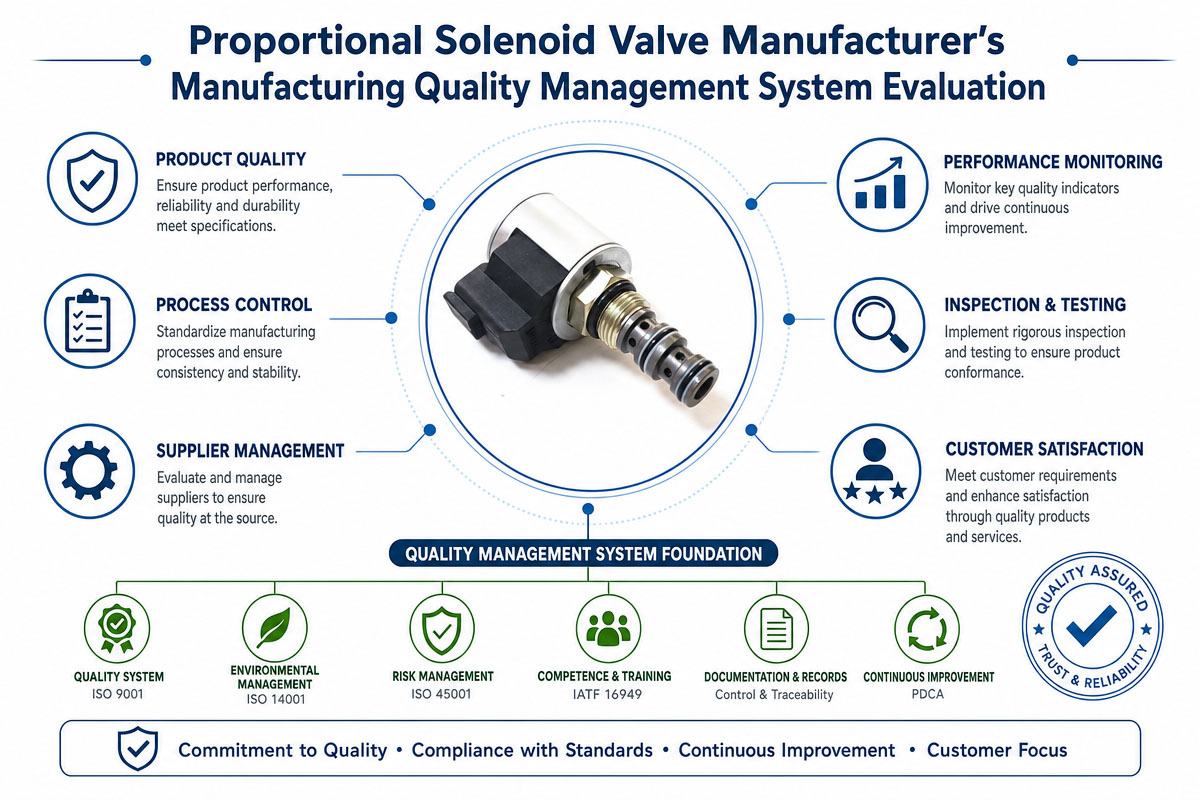
The importance of a quality management system is particularly high in OEM projects.
When comparing the manufacturers, check that the supplier has the formal quality management system and production process documentation.
Main areas include:
inspection of incoming material
inline inspection
resistance testing of the coil
dimensional inspection
assembly inspection
performance testing
final inspection
traceability
corrective action procedures
ISO 9001 certification can serve as additional evidence of a quality management system.
For some industries, specific certifications are required for some automotive or highly regulated applications.
Chapter 10: Evaluate Customization Flexibility
Not all proportional valve applications are suitable for off-the-shelf products.
You may need to customize:
coil voltage
coil resistance
Kraftkurve
stroke
spring force
valve opening
port settings
mounting holes
plug
accommodations
materials
seals,
control features
Be sure that any manufacturer you choose can provide both minor modifications and full custom designs.
The true OEM manufacturer will be able to move from your technical requirements to the drawings, prototyping, tooling, testing, and production.
Chapter 11: Don’t Judge Just by Unit Price, Evaluate Total Cost
The lowest price is not necessarily the cheapest offer.
Total development cost should be considered:
Prototype + tooling + engineering + testing + production + quality + logistics + warranty risk
The supplier with a slightly higher unit price may offer better value if he has:
fast engineering support
better quality control
reduced failure rate
shorter lead times
in-house production
better customization
more precise testing
The reliability of the supplier can be more important than a small difference in unit price for long-term OEM projects.
Chapter 12: The List of Questions to Ask Yourself Before working with the Proportional Solenoid Valve Manufacturer
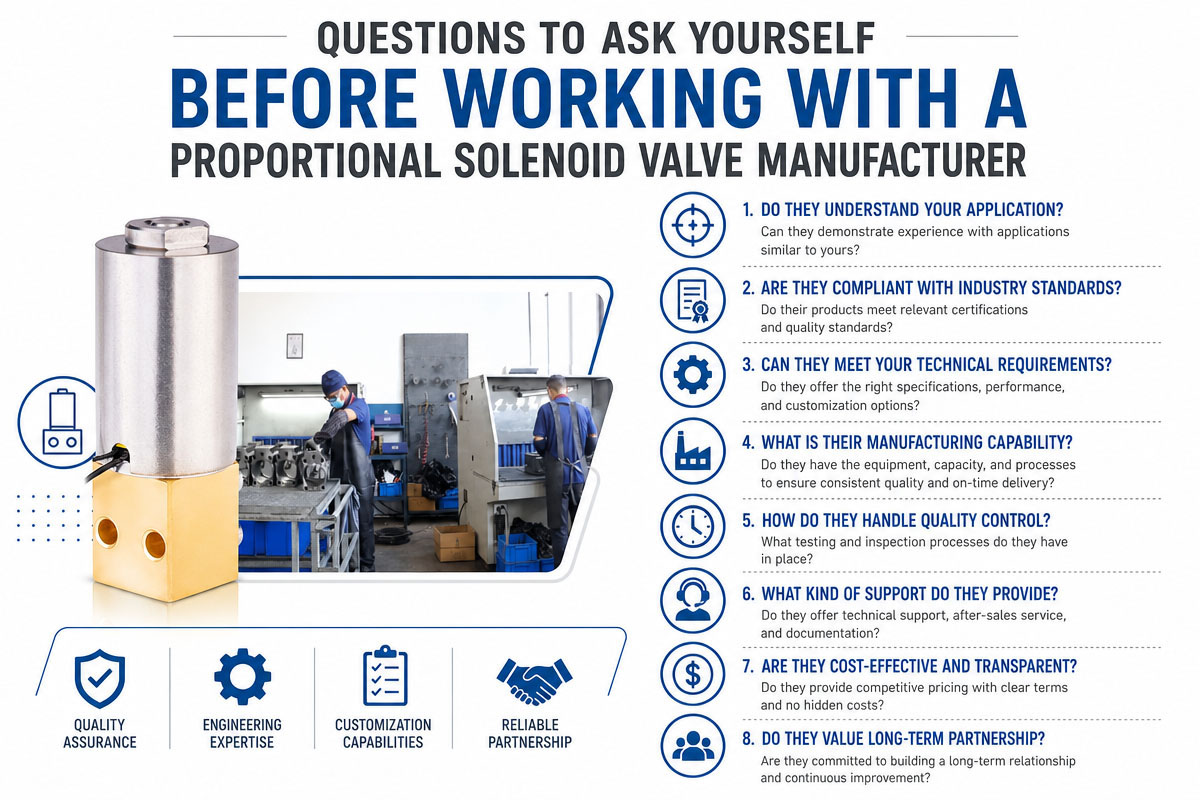
Before you choose a Proportional Solenoid Valve Manufacture partner, ask him the following questions:
Yes, we can design a fully customized proportional solenoid valve for you.
Yes, we can customize the electromagnet coil.
Can you optimize the magnetic circuit?
What stroke and what force can you achieve?
Can you provide force current test data?
What tests are available for flow and pressure?
What material can you recommend?
What is expected service life?
What is the lead time for a prototype?
What is the tooling cost?
What is the minimum production quantity?
Do you have quality certifications?
Do you have engineering drawings?
Can you modify the design during the development process?
What is your mass production lead time?
The answers to these questions will help you to distinguish between a competent engineering manufacturer and a mere trading company that buys standard products.
Chapter 13: The manufacturing process of a professional manufacturer has the following stages:
1. Requirement Gathering
The manufacturer should gather requirements for electrical, mechanical, fluid, environmental, and performance.
2. Design for Engineering
The magnetic circuit, coil, plunger, spring, valve body, and seal system are designed by the engineers.
3. Simulation & Optimization
The magnetic circuit and mechanical structure are analyzed and optimized.
4. Prototyping Fabrication
The prototype components and coils are manufactured for testing purposes.
5. Performance Test
Tests of force, stroke, current, temperature, leaking, flow, and response characteristics are performed.
6. Design Optimization
Design is modified according to test results.
7. Tooling Development
- Design is approved prior to development of production tooling.
Chapter 14: Why Should You Partner With a Proportional Solenoid Valve Manufacturer with Experience?
Benefits of collaboration with an experienced manufacturer are numerous.
Engineering integration: The coil, magnetic circuit, valve structure, and mechanical parts can be optimized as a single system.
Customization: OEM requirements can be designed in instead of forcing the application to use the standard product.
Quality control: More manufacturing processes can be controlled in-house.
- Fast Development: The customer and production team can communicate with the engineering department.
Cost control: In-house manufacturing reduces the dependence on external suppliers.
Long-term support. The supplier can assist in production improvements and future product revisions.
These benefits can significantly reduce the technical and commercial risks for industrial OEMs.
Final Checklist for Choosing a Proportional Solenoid Valve Manufacturer
Chapter 15: Before placing an order, evaluate the supplier against these criteria:
| Evaluation Area | What to Look For |
| Engineering | Custom magnetic and mechanical design |
| Coil | In-house coil design and winding |
| Materials | Appropriate magnetic and corrosion-resistant materials |
| Machining | Precision CNC and tooling capability |
| Prototyping | Fast sample development |
| Testing | Force, flow, pressure, electrical, and life testing |
| Quality | Documented inspection procedures |
| Customization | OEM dimensions and performance |
| Production | Stable mass-production capability |
| Support | Responsive technical and engineering service |
Chapter 16: Summary
Choosing a proportional solenoid valve manufacturer partner is not a quick decision. It is an engineering decision that can have a significant impact on the performance, reliability, cost, and service life of your final equipment.
The competent manufacturer should not just be the catalogue of valves. He should be able to design the magnetic circuit, customize the coil, optimize the mechanical structure, manufacture precision parts, test the performance, and provide stable mass production.
For OEM applications, you should choose the supplier that will be able to assist you in the whole process, from initial specs and prototype development through tooling, pilot production, quality inspection, and long-term supply.
Taking into consideration the engineering capability, customization, manufacturing technology, testing resources, quality management, lead time, and total cost, you will be able to select a suitable solenoid valve manufacturer to be your long-term technical partner, not just a component supplier.
Chapter 17: FAQs on Proportional Solenoid Valve Manufacturer
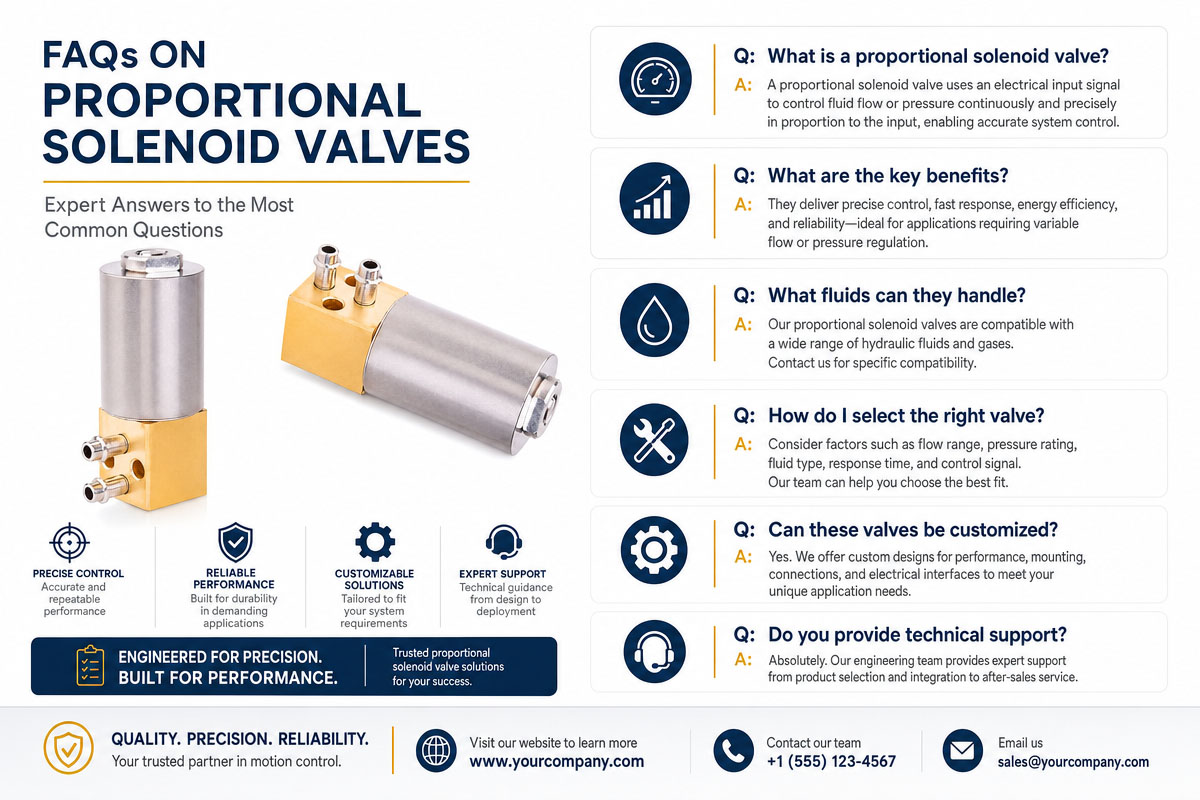
1. What is the manufacture of a proportional solenoid valve?
Proportional solenoid valve manufacture is the process of designing and manufacturing the electrically operated valve that offers variable flow, pressure, or mechanical output depending on input current or voltage.
2. What is the difference between a proportional valve and a standard solenoid valve?
A standard solenoid valve will usually run in an on/off fashion. On the other hand, a proportional solenoid valve can offer varied positioning and output based on the electrical input.
3. “Is it possible to customize proportional solenoid valves?”
Yes. OEM producers may customize the coil, voltage, current, stroke, force curve, spring, valve orifice, housing, mounting dimensions, materials, seals, and electrical connections.
4. “What is it that I can offer a manufacturer?”
State the operating voltage, current, stroke, force, flow rate, pressure, fluid medium, operating temperature, duty cycle, dimensions, expected service life, and mounting requirements where applicable.
5. “How significant is the proportional solenoid valve coil?”
The coil is very significant since it creates the magnetic field that moves the plunger. Coil resistance, wire gauge, turns, current, power consumption, and temperature directly affect valve performance.
6. “What is the effect of temperature on a proportional solenoid valve?”
Electrical resistance is increased by the coil temperature. In turn, it affects the current and the electromagnetic force. The thermal performance should therefore be assessed under actual operating conditions.
7. “How to Test a Proportional Solenoid Valve”
This process may consist of coil resistance, current, force, stroke, response time, temperature rise, leakage, flow rate, pressure, repeatability, and life-cycle testing, among others.
8. What is the development time for a custom proportional valve?
It depends on the complexity, tooling, materials, testing, and quantity. In this case, a modification could be completed relatively quickly, while a new valve might require several prototype and optimization iterations.
9. “Trading company or producer?”
In case of highly customized proportional valve applications, it is often better to deal directly with a manufacturer. It will allow communicating directly with the engineering and production staff.
10. “What are the priorities when selecting a proportional solenoid valve manufacturer?”
When choosing proportional solenoid valve vendors, one should select them on the basis of engineering capabilities, customization, testing, manufacturing quality, reliability, communications, manufacturing capacity, and total costs, and not just low prices.