

This guide will help the reader understand the functioning, types, selection criteria, specifications and maintenance practices of electromagnetic clutches and brakes. It will prove handy for engineers, OEM designers, procurement specialists or maintenance technicians interested in purchasing electromagnets for their equipment.
Chapter 1 : What are Electromagnetic Clutches & Brakes
Electromagnetic clutch is used for torque transmission by means of electromagnetic forces between rotating shafts; electromagnetic brake, on its hand, is used for halting or holding motion due to electrically activated friction and magnetic resistance.
Both systems make use of electromagnetic coils wherein passing of electricity causes the formation of a magnetic field which initiates engagement of the clutch or activates the brake. Springs or other mechanisms release power off of the system.
Electromagnetic clutches and brakes are popular due to their quick response and accurate control in such applications as:
Conveyors Packing Robots Textile machinery Industrial machinery Medical devices Automatic production lines CNC machinery Electric cars
Chapter 2 :How Do Electromagnetic Clutches & Brakes Work?
Electromagnetic clutches operate on the principle of magnetic attraction.
When the electricity starts flowing in the coil, the magnetic field forms to pull the armature towards the rotor or friction disc. It provides for the mechanical coupling and transmits torque from the driver shaft.
After disconnecting the power source, the armature gets separated as the result of the action of springs.
Key benefits of these clutches include:
Quick coupling/disengagement Smooth torque transmission Remote control capability Reduced mechanical wear Synchronicity High cycle operation
Electromagnetic brakes function similarly but instead of providing for torque transmission, they are designed to arrest or hold the rotating motion.
Chapter 3 : Main Types of Electromagnetic Clutches & Brakes
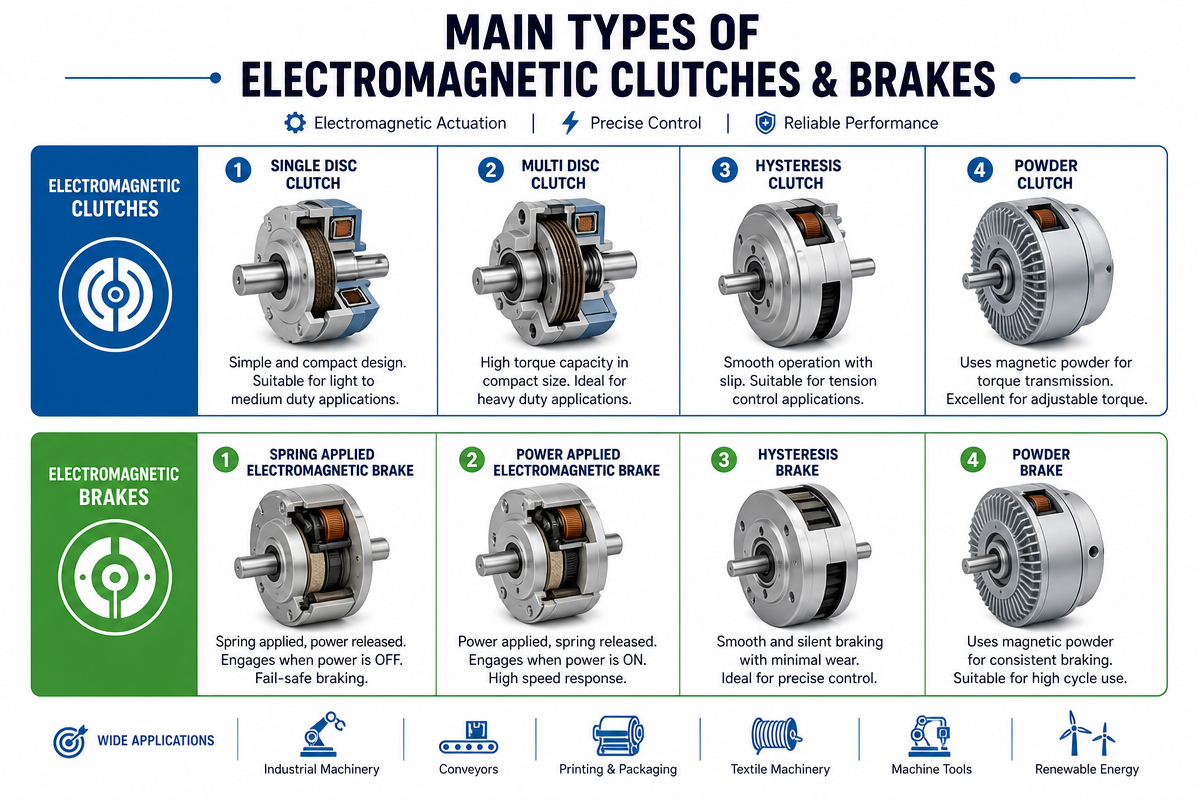
| Type | Typical Application | Main Feature |
| Single-Plate Clutch | General industrial machinery | Compact design, moderate torque |
| Multiple-Plate Clutch | Heavy-duty industrial systems | High torque density |
| Tooth Clutch | Precision positioning | Zero slip engagement |
| Hysteresis Clutch | Tension control systems | Constant torque without wear |
| Spring Applied Brake | Safety braking systems | Fail-safe braking |
| Particle Clutch/Brake | Winding and tension control | Adjustable torque output |
Spring brake Brakes of safety Fail-safe brakingP article clutch/ brake Tension control
3.1. Electromagnetic clutch, single plate
These designs are quite compact and affordable. They can be applied for medium duty machines where the torque needs to be transmitted at a moderate level.
Advantages:
Compactness Cost effectiveness Easy maintenance Disadvantages:
Less torque capacity compared to multi-disk systems
3.2. Electromagnetic multi-disc clutch
Many friction plates are included to provide for a larger surface contact and, hence, a greater torque transmission capacity.
Advantages:
High torque capacity Heavy-duty applications Strong construction Disadvantages:
Increased cost More heat generation
3.3. Electromagnetic Clutches & Brakes with exposed type
Exposed type of electromagnetic clutches and brakes are electromechanical system meant to transmit power. The open-frame means that friction surfaces, armatures and coils are not contained in any housing but rather are exposed.
Fast Response Speed
Engagement times of typical open electromagnetic clutches and brakes fall in the range of 10-100 ms.
Compact Design
Due to the absence of a housing, such systems are compact.
Ease of Maintenance
Open structure allows for such operations as:
Fast inspection Quick cleaning Easy replacement of worn-out components
Perfect Motion Control
Perfect for such operations as indexing, positioning, stopping and synchronization.
High Reliability
Such devices can operate in a stable mode with minimal mechanical complexity.
3.3.1 Drawbacks of Exposed Electromagnetic Clutches & Brakes
Despite having many positive features, exposed designs have certain drawbacks.
1.Environmental Impact
Open frames are vulnerable to such factors as:
Dust Contamination with oil Moisture and debris Additional protection required in harsh environments.
2. Generation of Heat
Continuous operation generates plenty of heat causing for the necessity of:
Cooling systems Good ventilation Temperature monitoring
3.Friction Wear
The surfaces of friction elements wear down slowly but surely and require periodic servicing.
3.4. Hysteresis brake/ clutch
Hysteresis systems generate a constant torque by means of magnetic drag.
Advantages:
No wearing Torque control – soft Ideal for tension control Limitations
Low maximum torque capacity
Chapter 4 :Important Parameters to Check before Purchasing
4.1. Nameplate Torque
Nameplate torque plays an essential role in the selection of electromagnets.
The clutch or brake needs to be chosen by maximum load torque taking a safety factor of 1.5 to 2.0 into account.
Typical values are as follows:
Miniature systems 0.1-1 N·m
Typical industrial systems 5-200 N·m
Heavy-duty systems 500-5000+ N·m
Too low torque can cause slipping, overheating and early failure.
4.2. Power and Voltage
Electromagnetic clutches are mostly operated by using DC voltage, including such voltages as:
12V DC 24V DC 90V DC
Compatibility check with your control system and power supply is recommended.
Main things to keep in mind:
Greater voltages require less current to run. Overheating or poor engagement Incorrect voltage Standard voltage tolerance +10/-0%
4.3. Response Speed
Response speed has a huge impact on productivity and accuracy of indexing and positioning.
Typical response speeds:
FunctionTypical time
Engagement 20-100 ms
Disengagement 10-50 msec
Very high-speed automation may require response times below 20 ms.
4.4. Thermal Capacities
Frequent cycling causes overheating of the clutch or brake assembly.
For systems intended for continuous usage select:
Models with better heat dissipation Forced cooling systems Thermocouples
Ignoring thermal capacities leads to a huge reduction in the lifespan of these components.
4.5. Resistance to Environment
Electromagnetic clutches exposed to various environments are likely to suffer from such conditions as:
Dust Contamination with oil Moisture Water jet High temperatures
Consider such protection measures as:
IP54, IP65 Sealed housings Wash-down environments Operating temperatures usually range between -10 °C to 80 °F.
4.6 Additional Selection Standards of Electromagnetic Clutches & Brakes
Mounting Configuration
Available mounting options:
Shaft-mounted Flange mounted Mounted bearings Proper mounting ensures stable functioning and minimized vibrations.
Quality of Friction Materials
Quality of materials affects:
Resistant to wear Heat resistant Live service Quality depends on application but typically, steel and composites are used.
Noise and Vibrations
Electromagnetic clutch brake for precision machinery needs to be silent.
Look for such designs as:
Low ripple torque Dynamic equilibrium Anti-vibration construction
Type of Electrical Connection
Typically used connection types:
Leads on the wing Junction box Quick disconnect connectors Choose according to your requirements.
Qualifications
Products for international markets might require:
CE UL Listed RoHS Compliant Certified products guarantee safety and ability for exports.
Chapter 5 :Best Explained: Electromagnetic Clutches & Brakes Selection Criteria in 2026
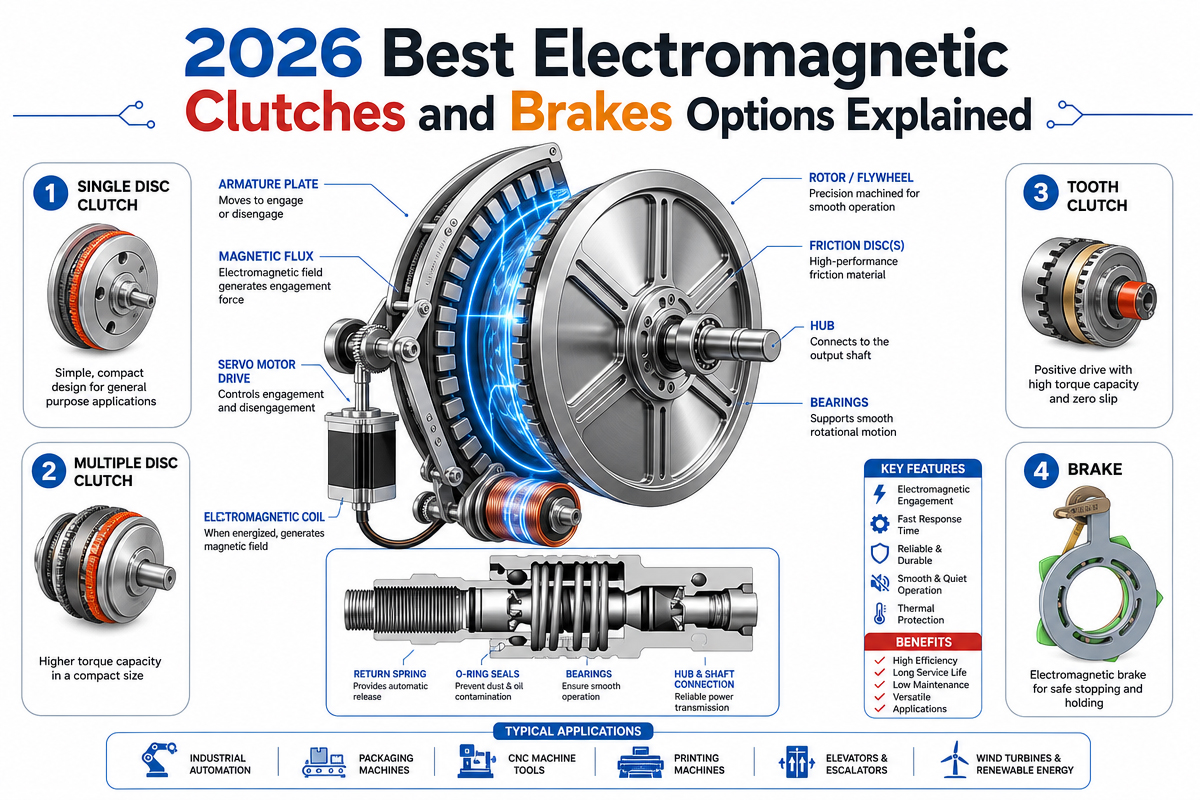
Electromagnetic Clutches & Brakes systems are expected to advance in 2026 with respect to energy efficiency, durability and smart controls.
Main trends for 2026
5.1 Faster Engagement Mechanisms
With advances in design of armatures, high speed systems may feature engagement times under 10 ms.
5.2 Compact design but high torque
There is always a trend for developing electromagnets with compact sizes but greater torque capacity.
5.3 Intelli-monitoring systems
Contemporary electromagnetic clutch brake systems include:
Temperature sensors Wear detection with help of Internet-of-things technology Predictive maintenance
5.4 Efficient coils
Advanced electromagnetic coils consume less power and generate less heat.
Chapter 6:Typical Applications of Electromagnetic Clutches & Brakes
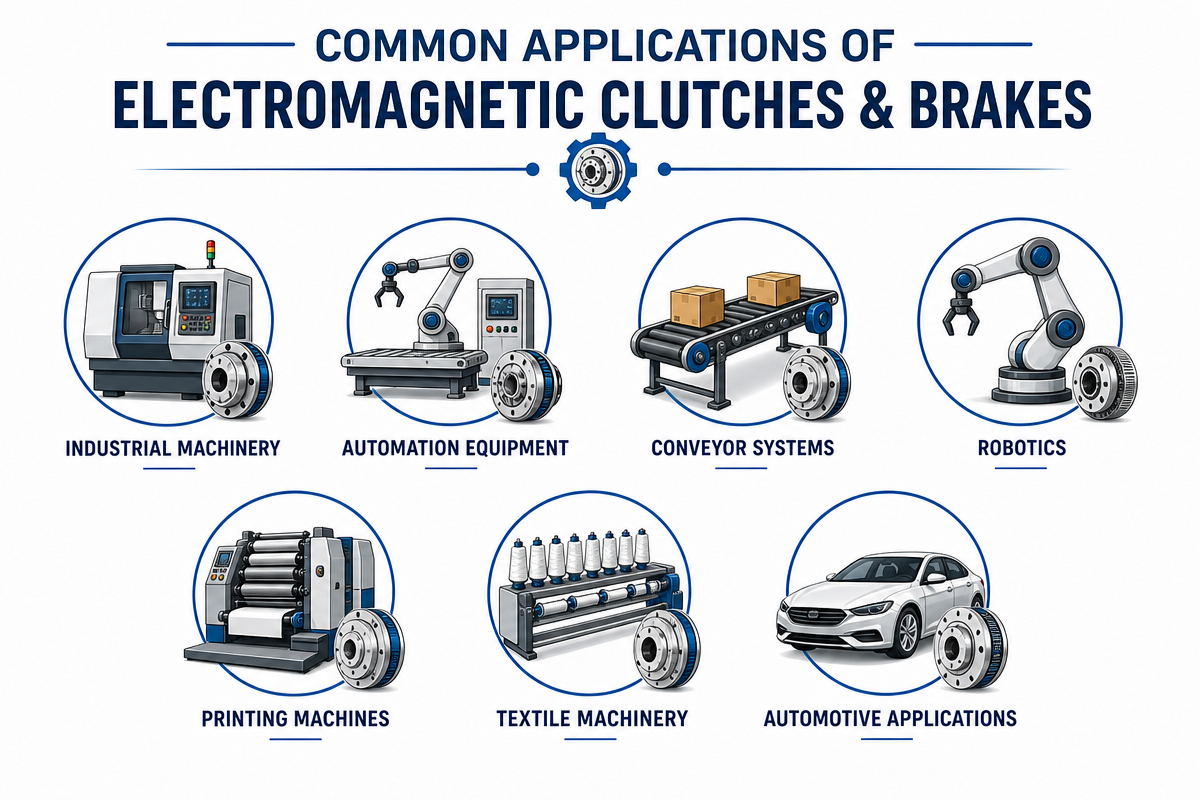
Industrial Automation
For precise movement control of robot arms, conveyors and other automated equipment.
Packing Machinery
For exact indexing and positioning for labeling, sealing and cutting processes.
Printing Machinery
To control the synchronization and tension control of high-speed printing machinery.
Medical Devices
Silent and precise positioning of medical equipment becomes possible with the help of small electromagnetic brakes.
Machine CNC
For rapid engagement and braking spindle and axis control.
Chapter 7 :Installation & Maintenance Tips
Correct installation and maintenance will considerably prolong the life of the system.
Recommendations for installation:
Ensure proper shaft alignment (0.05 mm) Verify that air gap is correctly established (0.2-0.8 mm) Use soft start controller to reduce inrush current Proper grounding and wiring
Maintenance checklist
Periodical check-up of friction surfaces Pay attention to overheating Vibration and noise Monitoring of coil resistance Follow “Replace worn parts with original ones” policy
Unexpected failures and repair costs lots of money. Preventive maintenance prevents such events.
Chapter 8 :Troubleshooting Common Problems of Electromagnetic Clutches & Brakes
| Problem | Possible Cause | Solution |
| Overheating | Excessive cycling | Improve cooling |
| Slipping | Insufficient torque | Upgrade clutch size |
| Delayed response | Coil voltage issue | Verify power supply |
| Excessive noise | Misalignment | Realign shaft |
| Premature wear | Incorrect air gap | Adjust clearance |
8.1 Symptoms of Electromagnetic Clutches & Brakes Slipping
Reduced torque transfer
instability of machine speed
Smell of burning
Overheating
In part involvement
Typical Causes
Not enough torque capacity
Friction surfaces worn
Too big an air gap
Low voltage of coil
Contamination by grease or oil
Trouble Shooting Solutions
Verify Torque Settings
Make sure the clutch is properly sized to application load.
Incorporate a safety factor:
Rated T for Teenagers
≥1.5×T loading
Check the friction surfaces.
Look out for:
Oil contamination Wear Cracking Glazing
Replace the damaged friction discs immediately.
Measure the air gap
Too large an air gap weakens the magnetic force.
Usual Range:
0.2 mm0.8 mm≤g
Set to manufacturer specifications
Check Coil Voltage:
Low voltage reduces the magnetic attraction.
Common ratings for voltage:
12VDC 24VDC 90VDC
Measure supply voltage with the circuit powered.
8.2. Problems with overheating of Electromagnetic Clutches & Brakes
Symptoms
Higher surface temperature
Smell of burnt coil
Less torque.
Failure of coil insulation
Auto power off
Typical Causes
High frequency of cycling
Continuously overloaded
Inadequate ventilation
Wrong voltage Friction slip Ups Troubleshooting solutions
Decrease Cycling Frequency
Frequent engagement creates heat in plenty.
Calculate duty cycle:
Duty Cycle= ON Time Total Cycle Time
×100%
For continuous duty, use a clutch brake model of higher duty.
Increased Cooling
Installation:
Cooling fan(s)
Ventilation system”
Heat sinks
Maintain airflow thru clutch brake assembly.
Removed by Slipping
Friction heat is produced rapidly in slipping.
Review:
Air gap Condition of friction surface Torque sizing
8.3. Symptoms of Coil Burnout or Failure of Electromagnetic Clutches & Brakes
Clutch not engaging
Brake won’t release
burning smell
Reading on an open circuit
Fuse blown
Common Causes
Overvoltages
Overheating continued.
Inadequate insulation
Bypass
Wrong connections
Solutions for Troubleshooting
Coil resistance check
Check the resistance with a multimeter.
Open or shorted coils must be replaced.
Check Power Supply
Keep voltage at:
V real
=V rated
±10%
Too much voltage reduces coil life.
Check wiring connection
Check for:
Loose connectors.
Broken cables
Wrong polarity
Ground faults
8.4. Slow Engagement or Release Symptoms of Electromagnetic Clutches & Brakes
Machine response delay
Poor slow stop performance
Errors in positioning
Synchronization issues
Typical Causes
Weak magnetic field
Too much inertia.
Wrong air gap
Friction Surfaces Pollution
Low voltage supply Troubleshooting solutions
Reduced Rotating Inertia
Heavy rotating masses mean that the system takes longer to respond.
Use lighter components where available.
Spring Condition Test
The weak release springs make it slow to come out.
Replace any broken or fatigued springs.
Setting Air Gap
“Magnetic efficiency is less because of wrong air gap.
Ensure proper clearance settings.
8.5. Symptoms Of Excessive Noise And Vibration of Electromagnetic Clutches & Brakes
Scraping noises
Vibrations on engagement.
Unstable operation
Mechanical vibration.
Frequent reasons
Misalignment of shaft
bearings worn
Frictions Uneven Wear
Mounting hardware loose.
Rotor imbalance
Troubleshooting Tips
Check alignment of the shaft
Suggested alignment tolerance:
Alignment Error Max . 0.05mm
Wear increases significantly with misalignment.
Check bearings
If the bearings are worn replace them immediately to prevent secondary damage .
Tighten Mounting Hardware Tighten the mounting hardware.
Loose bolts on the mountings cause vibration and noise during operation.
8. 6. Brake Does Not Hold the Load Symptoms of Electromagnetic Clutches & Brakes
Drifts when stopped load
Brake Unable to Hold Position
Lower holding force
Frequent Causes
Worn friction material
Incorrect brake sizes
coil weak
Oil Pollution
Overload Troubleshooting Solutions
Check Holding Torque
The brake holding torque must exceed the load requirements.
Suggested:
T grip
load > T
Clean Friction Surfaces
Delete:
Oil Grease Dirt Moisture Contamination Replace Worn Parts
Regularly inspect armature and friction discs.
8.7. Over Friction Wear Symptoms of Electromagnetic Clutches & Brakes
Decreased performance
requires frequent adjustment
Dust build-up
Surface marks
Typical Causes
Cycling frequently Misalignment
“Wrong air gap”
Overload conditions
Material quality = low friction
Solutions to Troubleshooting
Align Better
Misalignment causes irregular wear patterns.
Use the correct operating conditions
Stay away from:
Overload
Slipping, constantly
Emergency stops often
Preventive Maintenance Plan
Regular inspection greatly increases service life.
Chapter 9 :How to avoid comment mistakes when picking up the Electromagnetic Clutches & Brakes
Choosing the right Electromagnetic Clutches & Brakes is essential to ensure proper performance and safe operation of the machine. However, there are certain selection mistakes often made by designers and buyers, which can result in overheating, slipping, premature wear, breakdowns, and additional maintenance expenses.
Whatever purpose of electromagnetic clutch brake selection, whether for an automated machine, a robot or packaging lines, being aware of the main selection errors will allow to prevent possible failures and optimize performance.
Below you’ll find tips regarding the most frequent selection mistakes when choosing electromagnetic clutch and brakes — and how to avoid them.
9.1. Selection of Torque Capacity of Electromagnetic Clutches & Brakes
The Error
Not taking into account additional torque in case of machine starts, overload conditions and emergency braking.
Low torque will cause the clutch to:
Be prone to slippage.
Produce more than needed heat.
Work less efficient.
Have a shorter service life.
How to Prevent This Error
Always calculate:
Initial Torque
Running Torque
Peak Torque Under Load
Emergency Stopping Torque
Apply Safety Factor 1.5-2.0
Example 1:
Machine requires:
T = 20 N.m
Select clutch that can provide
T rated =30 to 40N.m
9.2. Ignoring Heating Issues and Cycling of Electromagnetic Clutches & Brakes
The Error
Mistakes related to frequency of engagement of clutch or brake.
Frequent cycling results in:
Higher heating.
Overheating of the coil.
Damage to friction lining.
Decreased torque output.
How to Avoid It
Think about:
Engagement Frequency.
Time usage is constant.
Ambient Temperature.
Cooling possibilities.
When dealing with highly cyclic applications:
Go for ventilated designs.
Add Forced Air Cooling.
Use friction material that can operate at higher temperatures.
Add thermal protection sensors.
9.3. Using Incorrect Voltage of Electromagnetic Clutches & Brakes
The Error
Incorrect supply voltage causes underactuation or overheating of the coils.
Common issues are:
Partial Engagement.
Burned Out Coils.
Unstable Operation.
How to Avoid This Error
Pay Attention To:
Rated Coil Voltage.
Reliable Power Supply.
Voltage Tolerance.
Recommended Voltages:
12V DC;
24V DC;
90V DC
Set Clutch/brake Voltage according to the machine control system.
9.4. Not Meeting Response Time Criteria of Electromagnetic Clutches & Brakes
The Error
Fast engagement and disengagement require special design features, but users choose regular types regardless the response time required.
It negatively impacts:
Accuracy of Machine Positioning.
Output Speed and Performance.
How to Prevent This Error
Calculate:
Time On Time Off.
Release Moment.
Moment of Inertia
Normal Response Time:
Engagement: 20-100ms;
Disengagement: 10-50ms
Response Times less then 20ms may be required in some cases.
9.5. Not Taking into Account the Environment
The Error
Regular clutch brakes often have a short service life in adverse operating conditions.
Potential Risks for Clutch Brake Include:
Dust;
Humidity;
Oil Pollution;
Corrosive Material.
How to Avoid These Errors
Select Clutches and Brakes Having:
Casing and sealing.
IP-Rating more then IP55.
Materials resistant to corrosion.
Protected surface coating.
Consider IP65 or higher Protection in wash-down applications.
9.6. Not Considering Mounting and Shaft Alignment
The Error
Incorrect mounting and shaft alignment of the unit leads to:
Increased Vibration.
Unpleasant Noise.
Premature Wear.
Reduced Bearing Life.
How to Prevent These Errors
Ensure:
Mounting inaccuracy is 0.05mm;
Mounting Stiffness on the Right Side of the Unit;
Appropriate Gap Between Units’ Parts;
Balance of Rotating Components.
Use precise tools for assembly and alignment of the unit.
9.7. The Error of Selecting Electromagnetic Clutches & Brakes Only on Price
The Low-cost units might consist of:
Poor friction material.
Poor magnetic coils.
Imprecise machining.
Poor quality bearings.
And other cheap components.
Additional Costs for Cheap Products Will Include:
Additional Service Costs.
Frequent Replacements.
Machine Standby Time.
How to Avoid this Error?
Focus On:
Quality of Product.
Manufacturer Reputation.
Technical Support.
Warranty Service.
Long-term Operational Cost.
Industrial Clutch Brakes that are of Higher Quality Offer Better Lifecycle Costing.
9.8. Failing to Consider Maintenance Requirement
The Error
Users commonly believe that electromagnetic clutches and brakes are self-operating devices and no maintenance is required.
Maintenance-free Operation of Electromagnetic Devices May Be Accompanied With:
Gaps Between Parts Reduced.
Worn Out Friction Surfaces.
Coil’s Performance Decreased.
Clutch Brake Torque Reduced.
How to Avoid It
Make a Preventative Maintenance Program.
Maintenance Operations Should Include Regular Checkups, Such As:
Measuring of Gaps Between Units.
Friction Surface Worn Out Checking.
Test Resistance of Coil.
Noise and Vibration Monitoring.
Check Up Temperature.
Periodic maintenance contributes much to extended service life and higher reliability.
9.9. Excluding the Need of Emergency Stops
The Error
There are machines that require braking in emergency conditions. Standard clutch-brakes might fail under such conditions.
Result Is Overheating.
Brake’s Failure.
How to Prevent It from Occurring
In Case of Machine Required to Operate under Emergency Conditions:
Use Highly Efficient Braking Systems.
Go For Spring Applied, Fail Safe Brake.
Check its Stopping Torque Capacity.
Verify Brake Thermal Energy Capability.
Special Brakes Solutions for Machines That Require High Degree of Safety
9.10. Not Consulting the Manufacturer
The Error
Often buyers prefer to buy products basing on only technical specifications from catalogs.
Such approach may be wrong, as theoretical calculation doesn’t take into account practical circumstances.
How to Avoid This Error
Contact Manufacturing Company to Discuss the Following Issues:
Conditions of Application Loading.
Application Frequency.
Environment Characteristics.
Required Speeds.
Space Limitations.
Professional engineering support can eliminate all kinds of costly errors.
Chapter 10 : Electromagnetic Clutches & Brakes Conclusion
In conclusion, torque requirements, voltage compatibility, response speed, thermal capacities, mountability and environmental impact are the main factors which should be taken into account when selecting Electromagnetic Clutches & Brakes.
Selection of electromagnetic clutches & brakes improves:
Efficiency Safety Epsilon (accuracy) Maintenance Intervals Uptime in production
As the technologies of industrial automation continue to evolve, electromagnets are also getting more efficient, intelligent and energy-effective in 2026. The selection of Electromagnetic Clutches & Brakes in industrial applications requires a lot of thoughtfulness from engineers and buyers.
If the application involves challenging conditions, there are benefits of c


