Introduction: Troubleshooting in Manufacturing of Custom Air-Core Coils
Stability of inductance, core losses, performance in high frequency, and customized dimensions are among the most common applications of custom air-core coils. In contrast to coil windings that have a magnetic core, the performance of custom air-core coils relies mainly on the geometry of the winding, the conductor features, the number of turns, and the turn spacing.
The custom air-core coils look simple to produce; however, it can be difficult to manufacture such products with repeatable results. The variations in wire diameter, winding tension, dimensions of the coil, spacing, and turn termination affect inductance, resistance, and mechanical stability of the product.
It is recommended to consider the difficulties in the manufacturing of the custom air-core coils while purchasing, defining specifications, reviewing samples, and preparing for production.
In this paper, we consider the most common issues related to the production of custom air-core coils, their causes, solutions, and the things that buyers should discuss with the coil supplier before ordering.
1. Coil sizes that are different
Dimensional consistency is one of the most important aspects in the production of custom air-core coils. Such parameters as inner diameter, outer diameter, length, height, pitch, and lead location influence the ability of a coil to mount in the final assembly.
One of the most common issues is the fact that a custom air-core coil may increase or decrease its dimensions or deform after removal from the winding tool. This situation is especially frequent in the case of spring-like wire and large-diameter coils.
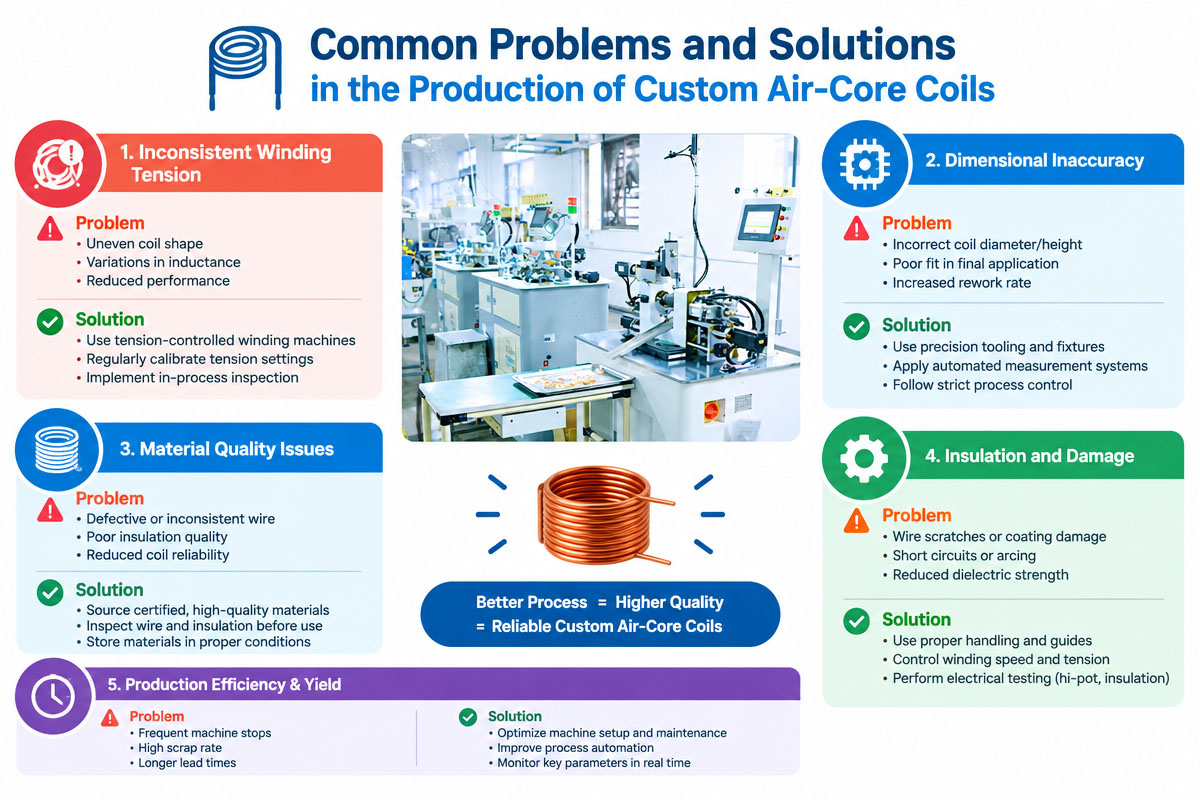
Dimensional inconsistency in custom air-core coils can result from uneven winding tension, tooling inconsistency, wire springback, inappropriate machine setup, and post-winding handling.
Answer:
The dimensional inconsistency can be reduced through precision winding mandrels, controlled winding parameters, stable fixtures, and a proper forming process.
The production team should define the tolerance limits before mass production. Buyers should provide the nominal diameter and define the range of acceptable dimensions.
For high-volume projects, automated winding equipment and appropriate tooling can help minimize differences between production lots.
2. Change in Inductance
Inductance is often one of the most important electrical parameters of custom air-core coils. However, the inductance depends on a number of physical factors, such as
Number of rounds
Diameter of coil
Coil length
Spacing of turns
Wire diameter
Geometria de hélice
Even small dimensional changes can cause inductance alterations.
If the coil is stretched during handling, the turns can become more distant. Thus, the winding geometry changes and affects the inductance of the coil.
Answer
The first thing to do is to define the realistic inductance requirements and tolerances.
The manufacturer should control the winding geometry and verify the electrical performance of the coil using calibrated inductance measuring equipment. Inductance readings may differ under various test conditions, and, in case of necessity, samples should be tested at the requested by the customer frequency.
Buyers should not only specify the target inductance but also the tolerance for demanding projects.
3. Custom Air-Core Coils’ Irregular Winding Pitch
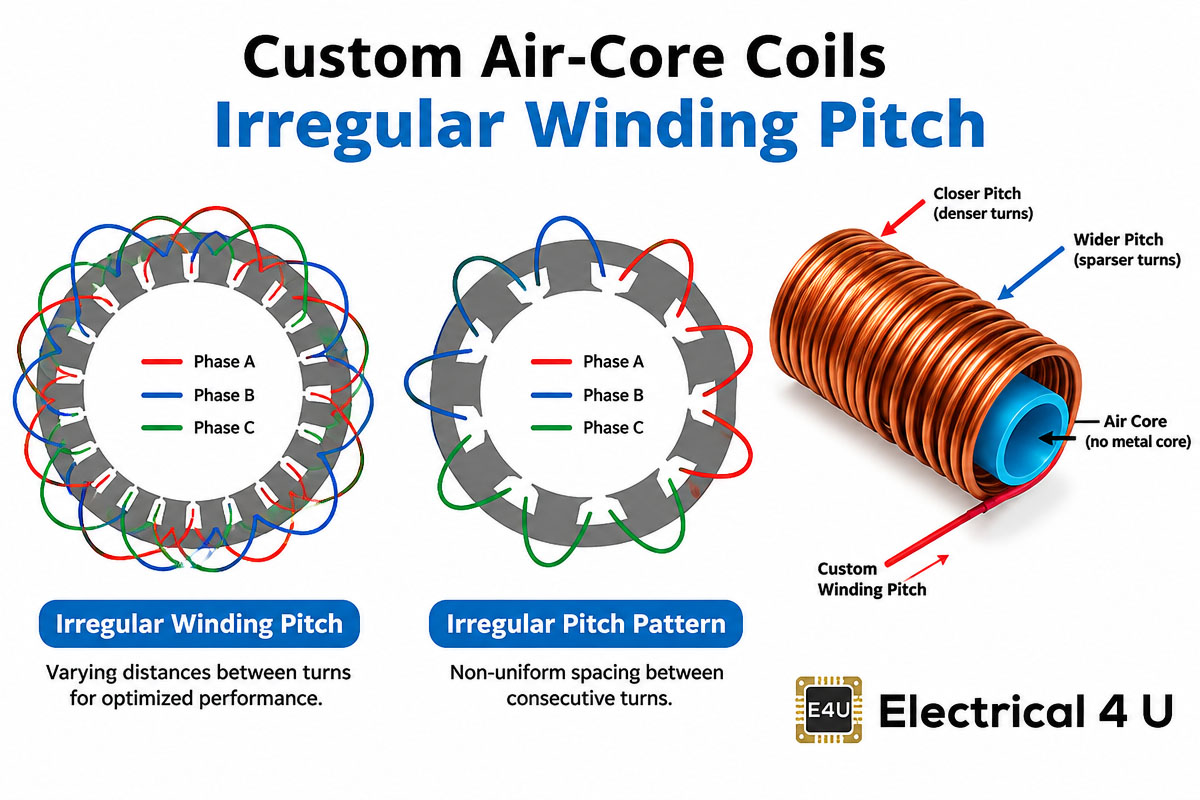
Custom air-core coils can have either tightly packed or defined spacing between adjacent turns. It can be quite difficult to maintain the same pitch throughout the coil, especially in the case of fine wire, an unusual shape, and a large number of turns.
Uneven pitch may cause electrical and mechanical problems. It can affect the length of the entire coil, the inductance, the parasitic characteristics, and the visual appearance of the product.
Answer:
Computer-controlled winding machines can minimize the differences in the pitch of the air core coil through wire feeding and mandrel rotation control.
The tooling is also important. The guide mechanism should be properly designed and allow the conductor to be accurately positioned in the winding process.
If the pitch is critical, the supplier and the buyer should come to an agreement about the pitch measuring and tolerance. Microscopes or optical systems can be used to measure especially small-dimension coils.
4. Damage to Wire Insulation
Many coils are made of insulated conductors such as enameled copper wire. The insulation layer prevents any unintended electrical contact between the neighboring turns.
During production, excessive tension, sharp tooling surfaces, abrasion, improper wire guides, and wrong handling can damage the insulation.
This is a serious problem since the damaged insulation causes a turn-to-turn short circuit. Although the coil looks acceptable from the outside, it fails in electrical terms during the operation.
The manufacturing of custom air-core coils should take the insulation protection into account.
Answer
Solution
The manufacturers should use smooth wire guides and properly maintained winding equipment. The winding tension should be within the required range depending on the conductor used.
Tooling surfaces that are in contact with the wire should be checked for burrs, sharp edges, or excessive wear.
In some cases electrical testing can also be done to verify the coil for short circuits, insulation problems, or abnormal resistance before the products leave the factory.
5. Incorrect Number of Turns
The performance of the air core coil is directly related to the number of turns. In some coil designs missing a single turn may affect the performance greatly.
An incorrect number of turns may be caused by machine programming mistakes, wire slipping, misalignment, operator mistakes, or interrupted winding.
Just visual inspection may not be enough in the case of precision custom air-core coils.
Answer
Turn counting should be accurate on automated winding machines. Machine programs and parameters should be checked before starting the production.
The first piece inspection is extremely helpful. The first finished products can be inspected for dimensions, turns, inductance, resistance, and visual appearance before producing the whole batch.
After accepting the sample according to the specification, the production can start using validated machine parameters.
6. Custom Air Core Coil Handling and Deformation
In some cases an air-core coil can be mechanically flexible due to the absence of the solid magnetic core.
Thin wire coils, large-diameter coils, and coils with large turns and spacing are especially sensitive to deformation.
So a properly produced coil may be distorted during removal from the mandrel, during further processing, packaging, transportation, or final assembly.
It is a critical aspect for the buyers of custom air-core coils since the electrical parameters of the product may change due to mechanical deformation.
Answer
Excessive handling in the production process should be minimized. Fixtures can be used in the forming, inspection, soldering, and other secondary operations.
Depending on the design and application, bonding materials, coatings, adhesives, or other methods of stabilization of the coil geometry can be used.
Packaging should also be designed depending on the mechanical properties of the product. Individual trays, compartments, or special protective packaging can prevent the coils from compression and tangling during the transportation.
7. Leadwire Length and Lead Position Issues
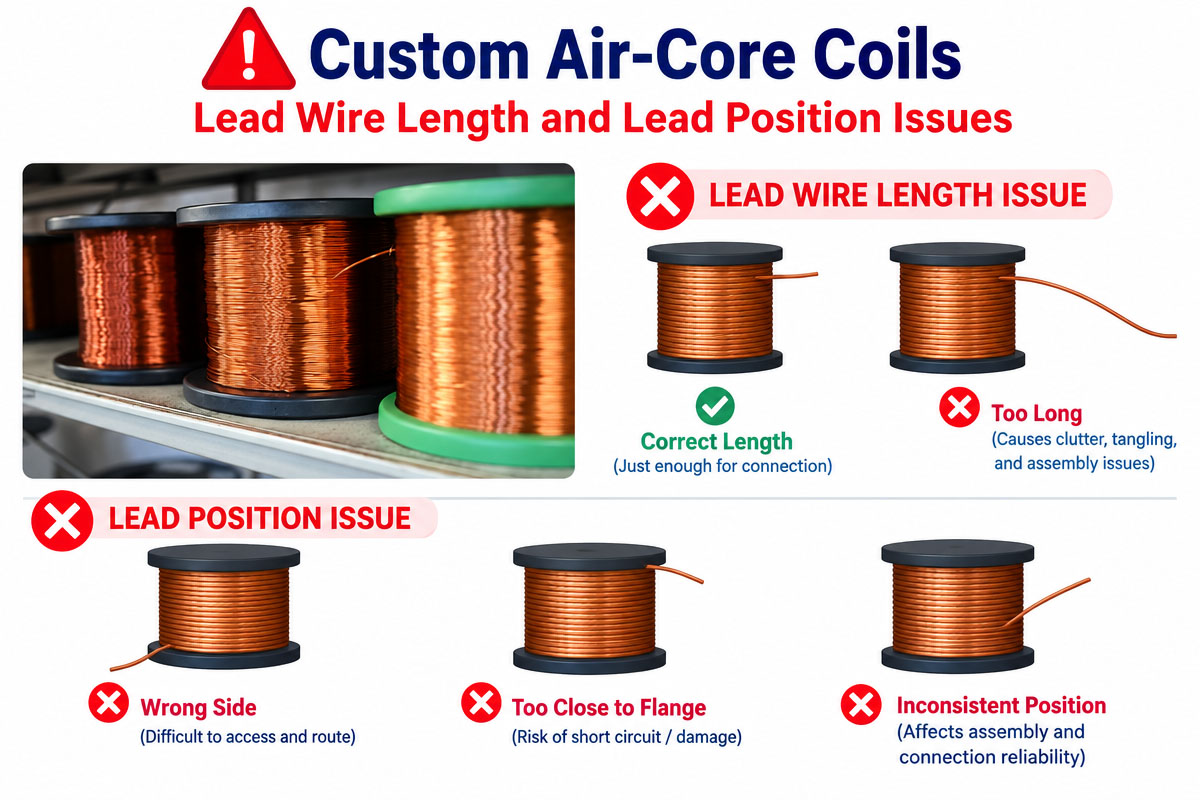
Coil leads are often considered an afterthought at the early stages of design; however, they significantly influence the efficiency of assembly.
The coil may not be properly placed in the PCB, housing, connector, or other assemblies due to incorrect lead length, orientation, stripping length, or terminal position.
These problems are especially important in the case of automating the installation of custom air-core coils.
Solution
Drawings that show the following parameters should be provided by buyers:
Length and tolerance of leads
Train the trainer.
Stripping requirements
Tinning specifications
Terminal size
Bending angles, if applicable
Reference samples or 3D information on assembly can also help the manufacturer to understand how the coil will be mounted.
The better the interface requirements are specified, the less risk of problems in final assembly.
8. Resistance Not Within Acceptable Range
The DC resistance (often called DCR) is one of the most important parameters in the design of custom air-core coils.
The resistance depends on conductor diameter, wire length, material features, number of turns, temperature, and termination quality.
If the resistance is too high, the coil can heat up and dissipate too much power.
Thus, the design of custom air-core coils is often a compromise between inductance, physical dimensions, number of turns, and conductor diameter.
Response
The manufacturer should select the conductor based on the customer’s electrical and dimensional requirements.
If the tolerances are strict, the resistance should be measured in defined test conditions. During the quotation and engineering phase, the buyers should specify the maximum DCR and the allowed operating current.
This will help the supplier to evaluate the feasibility of the required combination of dimensions and electrical performance.
9. Poor Solderability or Termination Quality
Proper termination of the coil is essential for its integration into the product.
Potential issues are inappropriate soldering temperature, uneven tinning, conductor surface contamination, and removal of enamel.
Poor termination results in either higher contact resistance or an unreliable electrical connection.
Thus, the quality of the termination is to be taken into account within the quality control process for custom air-core coils with pre-tinned or prepared leads.
Solution
Depending on the type of wire insulation and conductor size, the stripping process can be chosen and implemented. It can be mechanical, thermal, chemical, or otherwise.
After stripping the lead, it should be inspected to ensure that enough insulation has been removed without damage to the conductor.
If the lead is tinned, parameters such as stripped length and tinned length should be defined in the drawing.
10. Difference between Sample and Mass Production
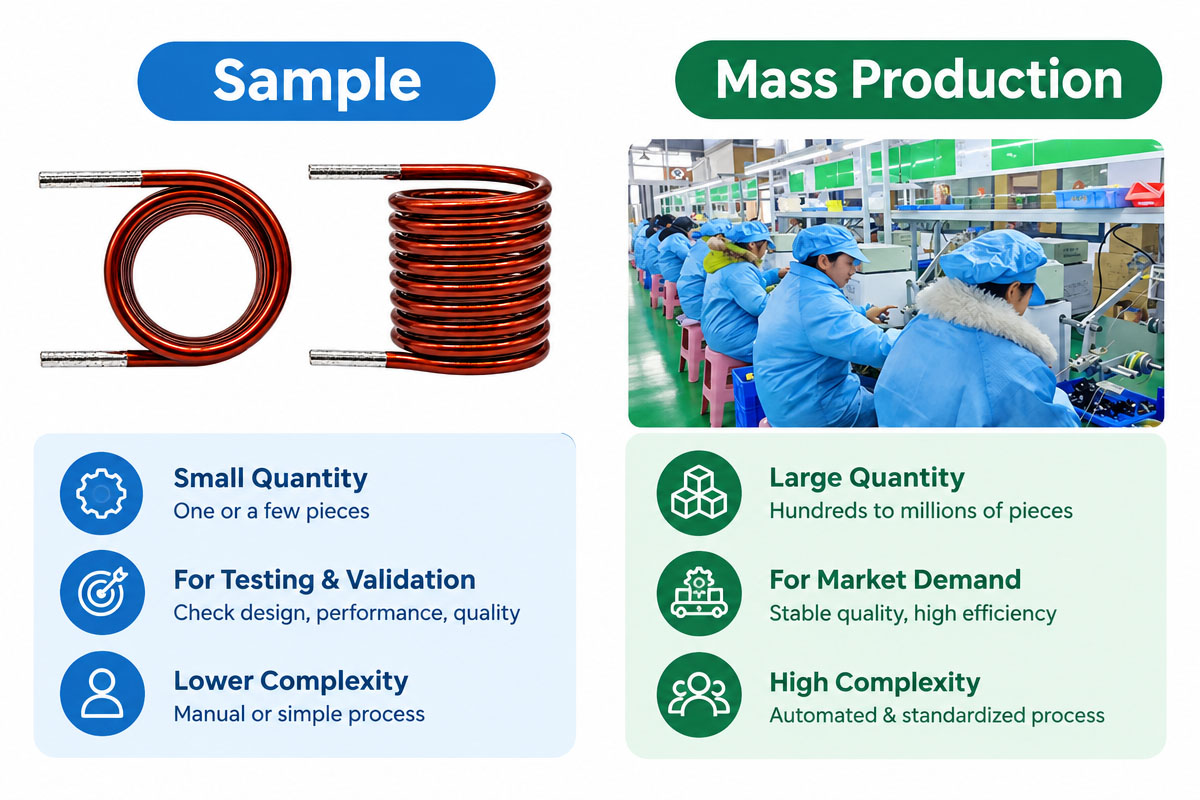
The prototype may function properly; however, issues may arise in production on hundreds or thousands of pieces.
This situation can arise if prototypes are manufactured manually and mass production coils are manufactured using different machines, tools, winding speeds, or operators.
Material substitution can bring unexpected variation between sampling and the mass production process.
Answer
The buyer should inquire whether the process of sample manufacturing reflects the process of mass production manufacturing.
After custom air-core coils have been approved, critical materials, tooling, dimensions, and process parameters should be controlled.
Golden samples or approved reference samples can serve as a point of reference in terms of appearance and mechanical configuration.
For mass production, the manufacturer can perform first-article inspection in accordance with the requirements.
11. Issues Related to Material Choice
Not every conductor is suitable for all kinds of applications.
Material choice can be influenced by many parameters, such as conductor diameter, insulation class, temperature requirement, solderability, frequency, mechanical properties, and environment.
Choosing the material by the price, the buyer risks getting trouble in production or operation.
Response:
The buyer should provide as much application information as possible before manufacturing.
The main parameters are operating current, frequency, temperature range, expected environment, installation method, dimensional constraints, and compliance requirements.
If the suggested conductor and insulation system are suitable for the project, a vendor with experience in manufacturing custom air-core coils will determine this.
12. Lack of Quality Control
Even a reliable winding process requires adequate inspection.
Without established quality standards, defective coils can enter into production undetected. Such issues as wrong dimensions, damaged insulation, deformity, improper lead preparation, or incorrect resistance or inductance out of tolerance can arise.
Solution
“Quality inspection should be based on the properties relevant to the final application, not appearance.”
The inspection plan for custom air-core coils may include dimensional measurement, inductance testing, resistance measurement, visual inspection, turn count verification, lead inspection, and functional testing, depending on the project.
In case the project involves critical electrical or mechanical tolerances, the buyer should discuss inspection standards at the quotation stage.
13. How to Reduce Production Problems Before Placing an Order
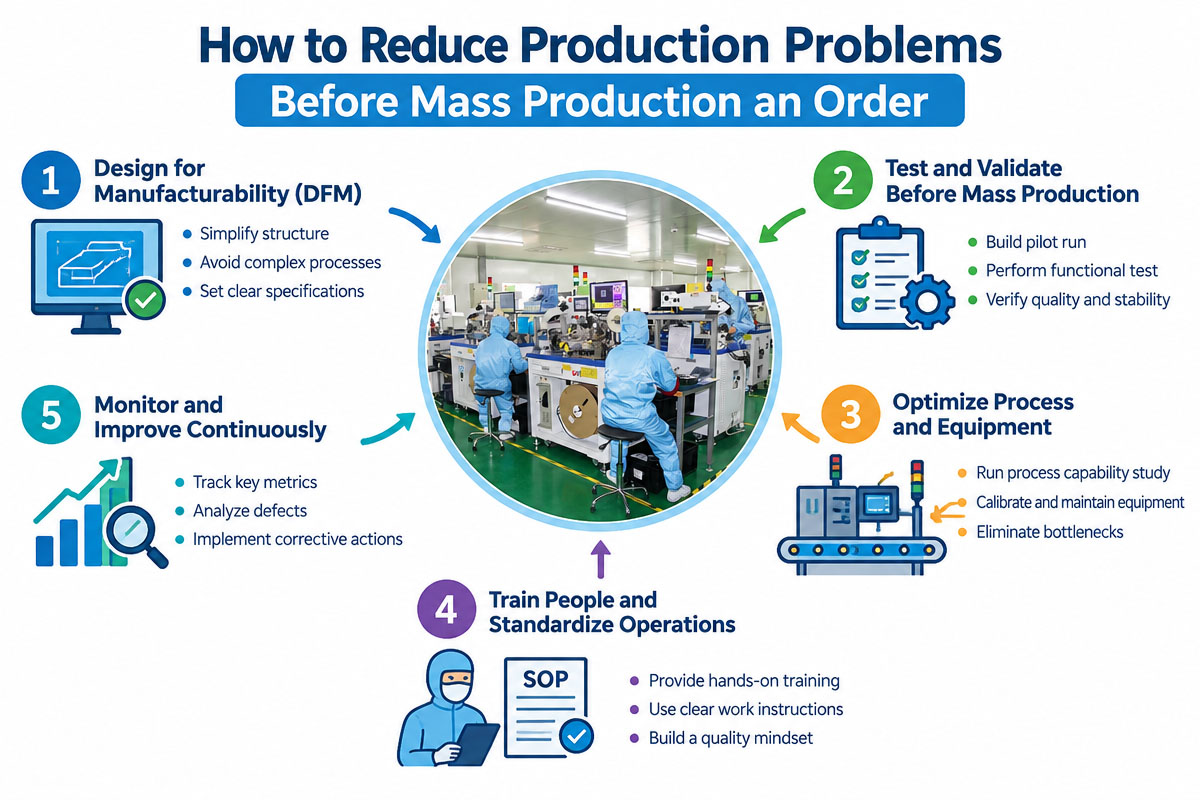
Many manufacturing problems can be prevented before the first coil is wound.
One of the best assets a buyer can give you is a good technical drawing. It should indicate dimensions, tolerances, wire specifications, winding direction if any, lead configuration, and electrical requirements.
When ordering custom air-core coils, the following information should be supplied to the supplier:
- Target inductance and tolerance
- Testing frequency
- Maximum DCR
- Operating current
- Wire material and diameter, if specified
- Inner and outer diameter requirements
- Length or height of coil 13.
- Number of turns or pitch required
- Length and orientation of the lead
Environmental or temperature specifications
10. Estimated order size
11. Special packaging or inspection requirements
12. In case parameters are not yet defined, application requirements should be provided for the manufacturer to propose possible options.
14. Importance of Prototyping
Manufacture of prototypes enables the buyer and manufacturer to identify potential problems before manufacturing the coils in mass production.
The prototype shows that the coil will fit into the assembly, that the inductance and resistance are correct, and that the lead configuration will be acceptable for the process of manufacturing.
Buyers should not evaluate a single parameter of the new custom air-core coils. Even if the inductance of a coil is correct, it may not be suitable for the application because of its dimensions, resistance, mechanical strength, or termination configuration.
After successful testing of the prototype, an approved sample and drawing will serve as a reference for further manufacture.
15. Conclusions
The manufacture of air-core coils is not only the winding of the wire around a mandrel. Geometry of the coil, wire properties, winding tension, tooling, termination, handling, inspection, and packaging contribute to the final product.
Typical manufacturing problems are dimensional variation, unstable inductance, inconsistent winding pitch, damage to the insulation, wrong turn counts, deformation, lead position errors, high resistance, and non-uniform termination.
Most of these issues can be solved by adequate specification, appropriate winding equipment, controlled tooling, proper materials, prototyping, and effective inspection.
The process of successfully purchasing custom air-core coils starts with the buyer communicating electrical and mechanical requirements. A good manufacturer is able to read specifications, identify potential manufacturing risks, produce samples, and establish repetitive control in mass production.
When drawings, tolerances, test methods, materials, and acceptance standards are defined before production, it becomes much easier to achieve consistent quality and prevent delays, rework, and unnecessary expenses.
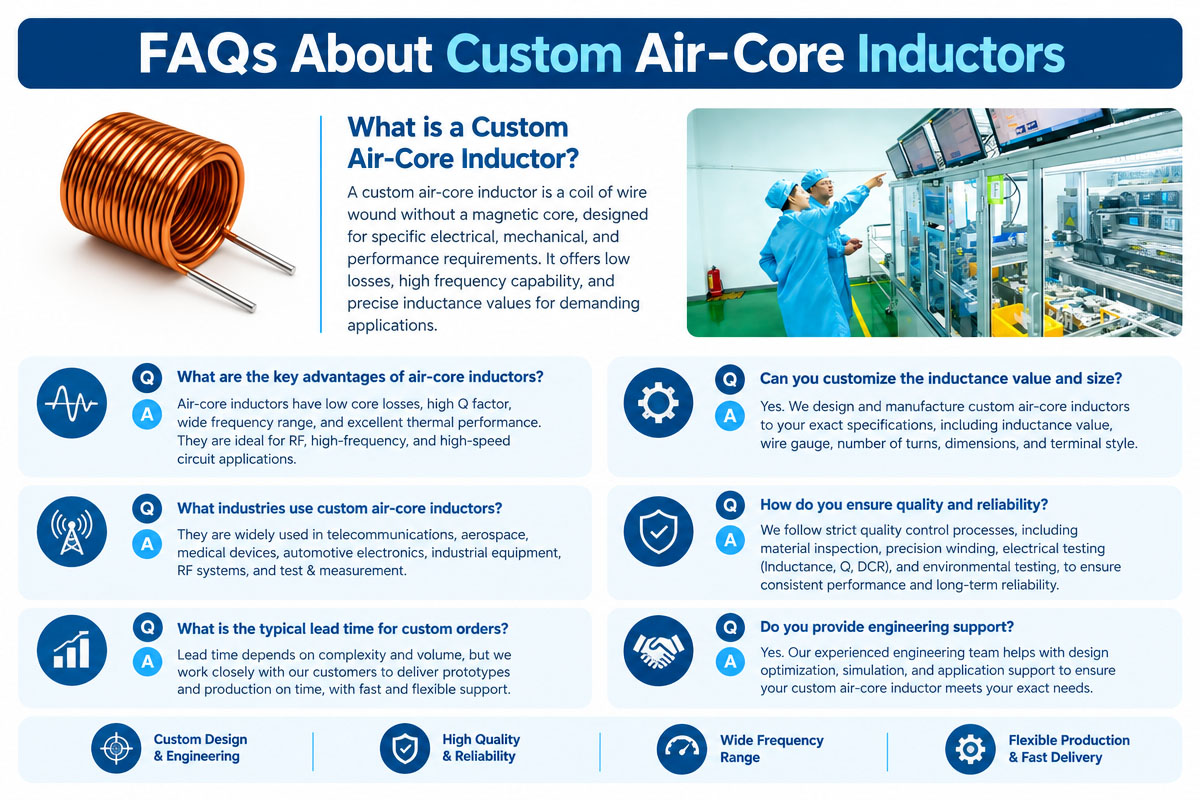
16. FAQs About Custom Air-Core Inductors
1. What information should I provide when making a quote request?
Provide target inductance, tolerance of inductance, test frequency, diameter of wire, dimensions of coil, number of turns if known, DCR requirement, operating current, lead configuration, and estimated order quantity. A technical drawing or reference sample will help in providing a more accurate quote.
2. Can you develop a coil if I provide only electrical requirements?
Yes, usually. If you do not have a complete drawing, please provide the required inductance, installation space available, operating frequency, current, resistance limit, and environment requirements. The manufacturer will assess possible winding sizes and conductor material choices.
3. Why do the measured inductance values vary between the samples?
Variations could be caused by differences in coil size, turn spacing, conductor properties, test frequency, measurement equipment, and ambient conditions. A clear definition of tolerance and a common test method help to avoid misunderstandings between the buyer and supplier.
4. Should I order prototypes before mass production?
Yes, especially on new designs. Prototype samples will enable you to check electrical performance, physical fit, lead configuration, solderability, and assembly compatibility before manufacturing in larger quantities.
5. What is the price of a custom air-core coil?
The main factors that influence prices are wire material and diameter, coil size, number of turns, manufacturing complexity, dimensional tolerances, electrical tolerances, additional operations, testing requirements, packaging, and order quantity. Tight tolerances mean high manufacturing and inspection expenses.
6. How can I ensure consistency between batches of production?
Use an approved drawing with clearly defined tolerances and test conditions. Approved samples can be retained as reference. Ask the supplier how he maintains repeat production controls of critical materials, tooling, machine parameters, inspections, and engineering changes.
7. What quality inspections should I ask my supplier to perform?
The inspection plan depends on the application. Typical tests are coil dimensions, appearance, inductance, DCR, number of turns, lead dimensions, winding pitch, insulation condition, and termination quality. Additional electrical or functional testing may be necessary in some critical applications.
8. How to choose the best suppliers for custom air-core coils?
Do not look only at the price per unit. Evaluate the manufacturer’s engineering support, winding capability, tooling, measuring equipment, material control, prototyping process, quality system, and ability to maintain repeatability in volume production. A good manufacturer will offer to review your specifications and highlight potential manufacturing risks before mass production.