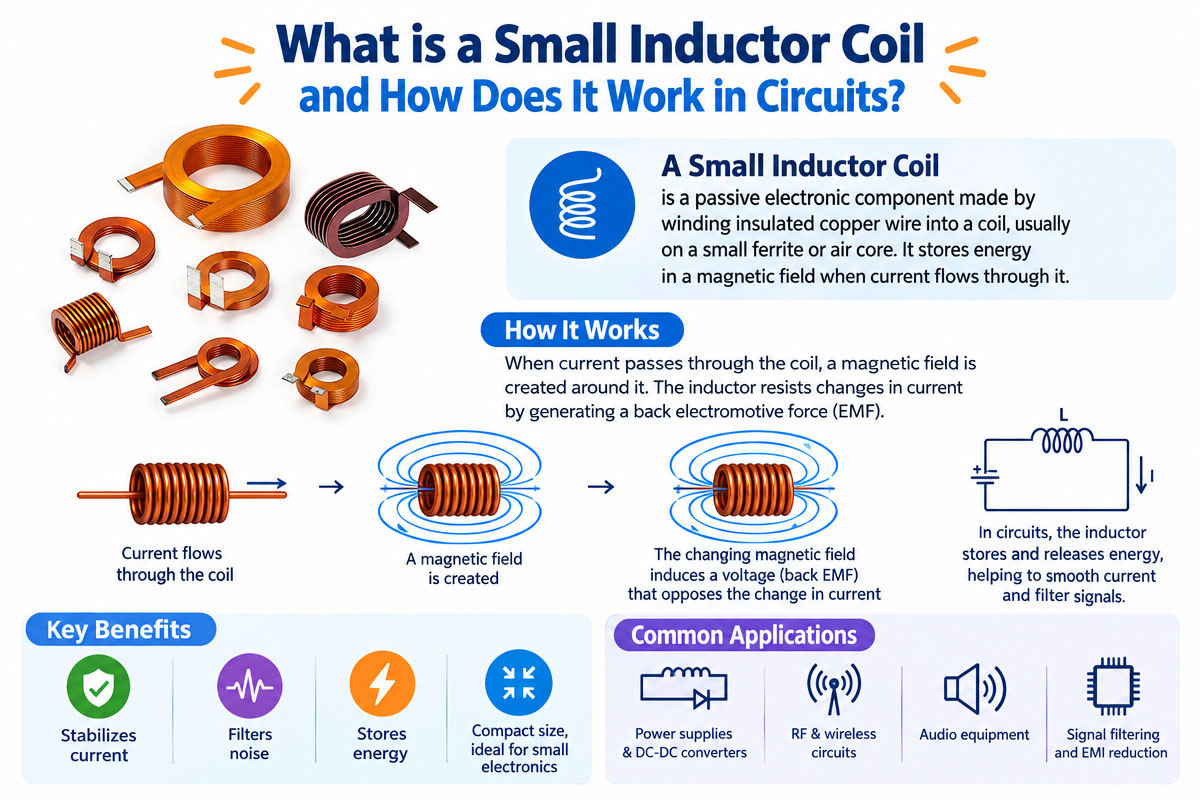
Chapter 1: Introduction to Small Inductor Coil
Small inductor coils are valuable electronic components that find use in numerous electrical and electronic circuits. Despite their small physical size, inductor coils play a significant role in current control, energy storage, filtering of signals, reduction of electromagnetic interference, and effective power conversion.
Small inductor coils are used in products such as cell phones, computers, communications equipment, automotive electronics, medical devices, power supplies, sensors, industrial automation systems, and consumer electronics.
The working principle of inductors is quite simple. When you conduct an electrical current through the coil of wires, a magnetic field is created around the coil. The magnetic field stores energy and creates an electrical effect that causes resistance to abrupt current changes.
It is the property that makes small inductor coils highly valuable in those circuits where engineers should control the current flow or filter electrical signals.
However, the choice of an appropriate small inductor coil is not just the choice of the component depending on its size. Such parameters as inductance, current capacity, resistance, frequency of operation, core material, saturation properties, and mounting space are of crucial importance.
Here is the guide to the process of working with the small inductor coils, the functions of them in electronic circuits, common uses, their various types, and the choice of inductor for your project.
Chapter 2: What Is a Small Inductor Coil?
An inductor coil is a small electrical device consisting of a wire coil.
The coil may be wound on:
an air-core;
ferrite core;
a core of iron powder;
some other magnetic material.
The coil is made to create inductance.
Inductance is the property of the element to store energy in the magnetic field when electric current flows through it.
Henry (H) is the unit of inductance.
Since many electronic inductors have rather small values of inductance, they are usually measured in:
mH (millihenries);
Micro-Henry (µH);
nH—nanohenry.
Thus, for example:
1 H = 1.000 mH, 1 mH = 1.000 µH
Small inductor coils are produced according to the requirements of the circuit. The final values of inductance and performance depend on the number of turns, wire diameter, coil size, core material, and winding structure.
Chapter 3: How does a small inductor coil work?
The small coils of inductors work according to the principle of electromagnetism.
When electric current flows through the wire coil, the magnetic field appears around the conductor.
When the current increases, the magnetic field becomes stronger and stores the energy in the magnetic field surrounding the coil.
When the current decreases, the collapsing magnetic field induces a voltage that resists the change in current.
It is described by the following relationship:
V = L x di/dt
When: Where:
V = induced voltage
L = inductance di/dt = rate of change of current
It means that the inductor inherently resists changes of electrical current.
Due to this feature, small coils of inductance are highly valuable in many circuits.
For example, an inductor can:
smooth the electric current,
filter high-frequency noises.
Switching Power Supplies: Energy Storage
block AC signals
Provide support for signal filtering.
reduce electromagnetic interference.
The small inductor coil is mounted in the circuit to provide its specific function.
Chapter 4: The key function that small inductor coils play in electronic circuits
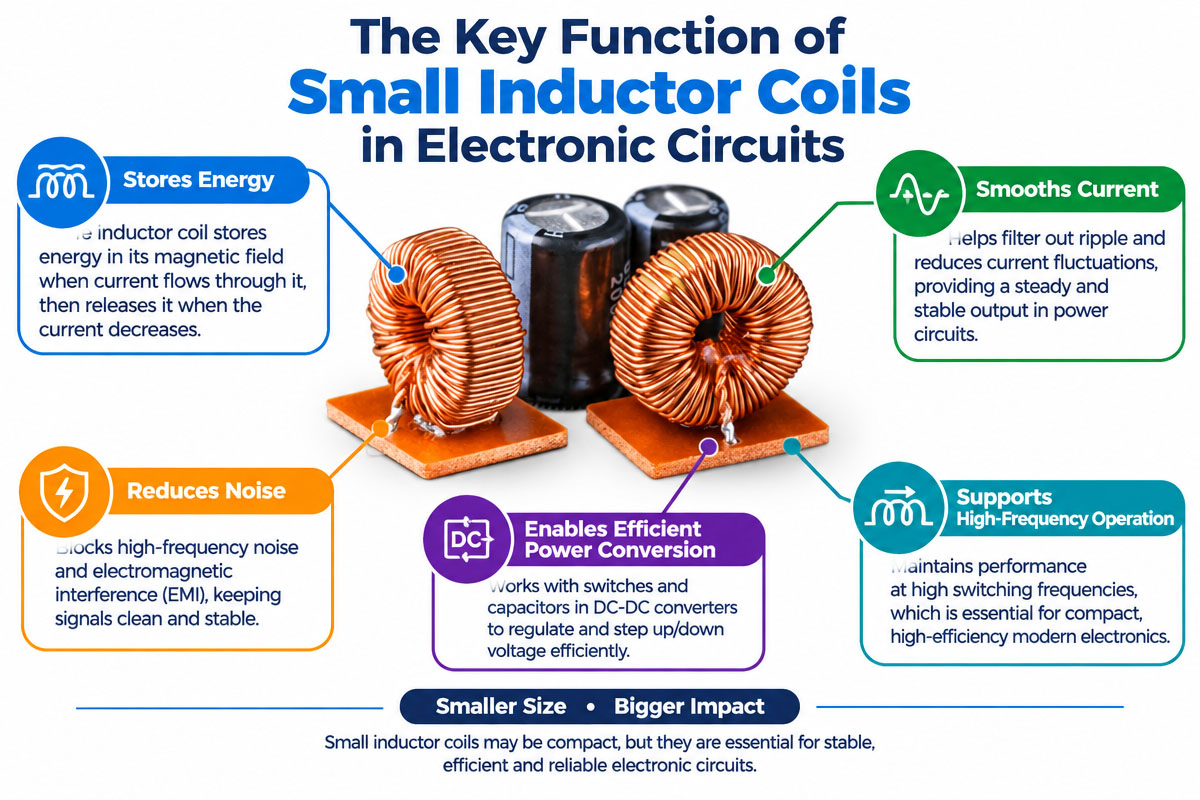
There are several important purposes of small inductor coils in electronic circuits.
4.1 Energy Storage
One of the main purposes of the inductor is to store energy.
The coil stores energy in its magnetic field when current flows through it.
This purpose is of considerable importance in switching power supplies.
Both buck converters and boost converters use inductors to store energy and release it effectively.
So, a small inductor coil can play an important role in controlling voltage and current in compact electronic power systems.
4.2 Noise Removing
Electronic circuits can generate unwanted electrical noise.
This noise may appear from switching devices, power supplies, motors, communication equipment, or from the external electromagnetic sources.
Small inductor coils can remove unwanted high-frequency signals.
The inductors can be combined with capacitors to create filters that pass some frequencies but block the others.
The typical types of filters are
low-pass filter
high-pass filters
bandpass filters
band-stop filter
Thus, small inductor coils are very important in communication equipment, audio electronics, power supplies, and sensitive electronic systems.
4.3 Current Smoothing
Inductors resist rapid changes of current.
It makes them valuable for smoothing current in electrical circuits.
It is highly valuable in DC power conversion systems and in switching power supplies.
If the inductance is rather low, the current can change rapidly, producing unwanted ripples or electrical noise.
The properly chosen small inductor coil can help to improve the stability and efficiency of the circuit.
4.4 Reduction of Electromagnetic Interference
Modern electronic equipment can produce electromagnetic interference, or EMI.
EMI can degrade the performance of the neighboring electronic components and communication systems.
Small inductor coils can be a part of the system of EMI filtering.
Its advantages include the reduction of unwanted high-frequency electrical signals and the improvement of electromagnetic compatibility.
The EMI control is important in:
automotive electronics
medical equipment
automation industry
communications systems
consumer electronics
4.5 Signal Processing
Small inductors are used in the signal processing and frequency-related circuits.
Together with the capacitors, the inductor can create resonant circuits.
The resonant frequency is directly proportional to the following relation:
f = 1 / (2π √LC)
Where: •
f = resonance frequency
L = inductance
C = capacitance
The principle is used in radio frequency and communication circuits.
The engineers can choose the values of inductance and capacitance in order to create the circuit operating at a particular frequency.
Chapter 5: Applications for Small Inductor Coil
Small inductor coils serve many industries by providing important electrical functions in a relatively small mounting space.
Consumer Electronics
Small inductor coils are used in many:
smartphones
tablets
capsules
portable computers
chargers
cameras,
sound equipment
gaming machines
High-density electronic products require small components having stable electrical performance.
The engineers should use miniature inductor coils to control power and filter electrical signals due to limited space.
Power Supply
Small inductor coils are critical in the switching power supplies.
The inductors are used to:
DC to DC converters
Buck converter
Boost converter
Power management circuitry
Voltage regulation equipment
These applications use the inductor to store and release energy during switching cycles.
The proper choice of inductance and current rating is important for reliable operation of the power supply.
Automotive Electronic
Nowadays, there is a growing number of electronic systems in cars.
The miniature inductor coils can be used in:
engine control units (ECUs),
LED lighting systems,
battery management systems.
DC-DC conversion
sensors
communication modules
EMI filters
The automotive applications are strict concerning temperature, vibration, electrical reliability, and long-term durability.
Industrial Machinery
In industrial electronic systems, small inductor coils are often used for:
power conversion
signal filtering
motor control
sensors
systems plc
automation machinery
EMI suppression
If the standard products do not meet the required electrical or mechanical specifications, custom inductor coils may be needed.
Medical Equipment
The tiny inductor coils may be used in compact electronic medical devices.
The potential applications include:
monitoring devices
portable electronic devices
diagnosis systems
medicine sensors
power management system
Depending on the application, such parameters as reliability, size, electrical stability, and material requirements may be important.
Chapter 6: The Type of Small Inductive Coil
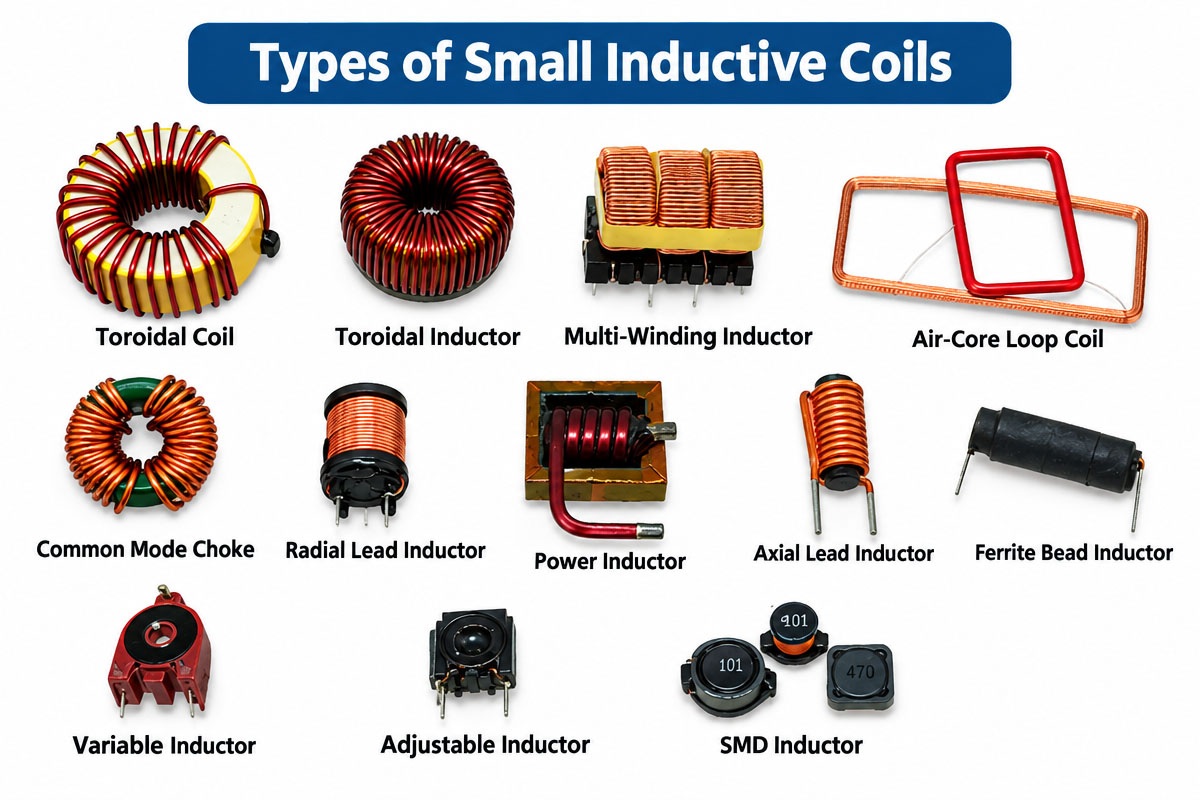
Depending on the requirements of the circuit, the small inductor coils can be available in different designs.
6.1 Air Core Inductors
The air core inductors do not contain the magnetic core material.
Instead, the coil is wound on the air or nonmagnetic structure.
The advantages may include:
no magnetic saturation
good for repeated use
low core losses
The air-core coils are widely used in radio-frequency and communication circuits.
6.2 Ferrite Core Inductor
The ferrite core inductors are made of ferrite material, providing good magnetic properties.
Ferrite materials can generate high inductance values with relatively small dimensions.
These inductors can be found in:
switching power supply
EMI Filters.
power electronics
However, the designer should take into account the frequency characteristics and magnetic saturation.
6.3 Iron Powder Core Inductor
For some power and energy storage applications, the cores are made of iron powder.
Such inductors may be suitable for particular switching power supply designs and provide favorable magnetic properties.
The final selection depends on the present frequency, inductance, and operating conditions.
6.4 Surface Mount Inductors
SMT Inductors Surface Mount Technology (SMT) inductors are intended for direct mounting onto printed circuit boards. These inductors are widely used in modern electronic devices of compact size. Advantages:
Small size
Automated PCB assembly
Efficient manufacturing
Compact construction of circuits
6.5 Specialty Coil Inductors
Some applications require the use of special small inductor coils. If the project has the following special requirements for:
L Inductivity
Coil sizes
Wire size
Capacity at present
Resistance
Main substance
Operating frequency
Installation type
Temperature range
Manufacturing of a custom coil will make it possible to adapt the design for the certain application.
Chapter 7: Choosing the right small inductor coil
Choosing the right small inductor coil requires special attention to the application.
There are several important parameters.
7.1. Value of Inductance
One of the first specs that must be determined is the necessary inductance.
The circuit design may require a certain inductance value in:
nH mH µH
The wrong value of inductance may have a negative impact on the filtering, power conversion, signal processing, and other circuit performance.
7.2 Current Rating
The inductor should be able to carry the expected operating current. High current value may cause the core saturation or overheating of the wire. Always check:
Present rating
Current saturation
Heat rise
7.3 Resistance of DC
The wire of the coil has an electrical resistance. This resistance is called DC resistance, or DCR. Too high resistance can lead to losses of power and generation of heat. Low DC resistance is desirable for power applications.
7.4 Material of Core
Core material has an influence on the inductance, frequency response, saturation, and losses.
Common materials are
Air.
Ferret
Iron powder
Application determines the proper core material.
7.5 Operational Frequency
Various inductors are designed for different frequency ranges. An inductor that works well in the low-frequency power circuit will work badly in the high-frequency RF circuit. Always consider the operational frequency while choosing the components.
7.6 Physical Dimensions
In small electronic devices, usually there is a limited place. The biggest:
Diameter, length, and height of the PCB footprint should be known before choosing the inductor.
7.7 Working temperature
Temperature may influence the electrical resistance and magnetic properties. For industrial and automotive applications it is necessary to evaluate the working temperature range properly.
Chapter 8: Small inductor coils & capacitors
Both inductors and capacitors are energy-storing devices. However, they store energy differently.
The inductor stores energy in:
Magnetic field
The capacitor stores energy in:
Electric field
Inductors and capacitors often are used together because of their different reactions to electrical signals. For example, an LC circuit may be used for:
Filtration
Frequency selection
Resonance
Signal processing
Small loops of inductors, as well as capacitors, allow engineers to make very effective electronic filters and resonant circuits.
Chapter 9: Why You Might Need Custom Small Inductor Coil
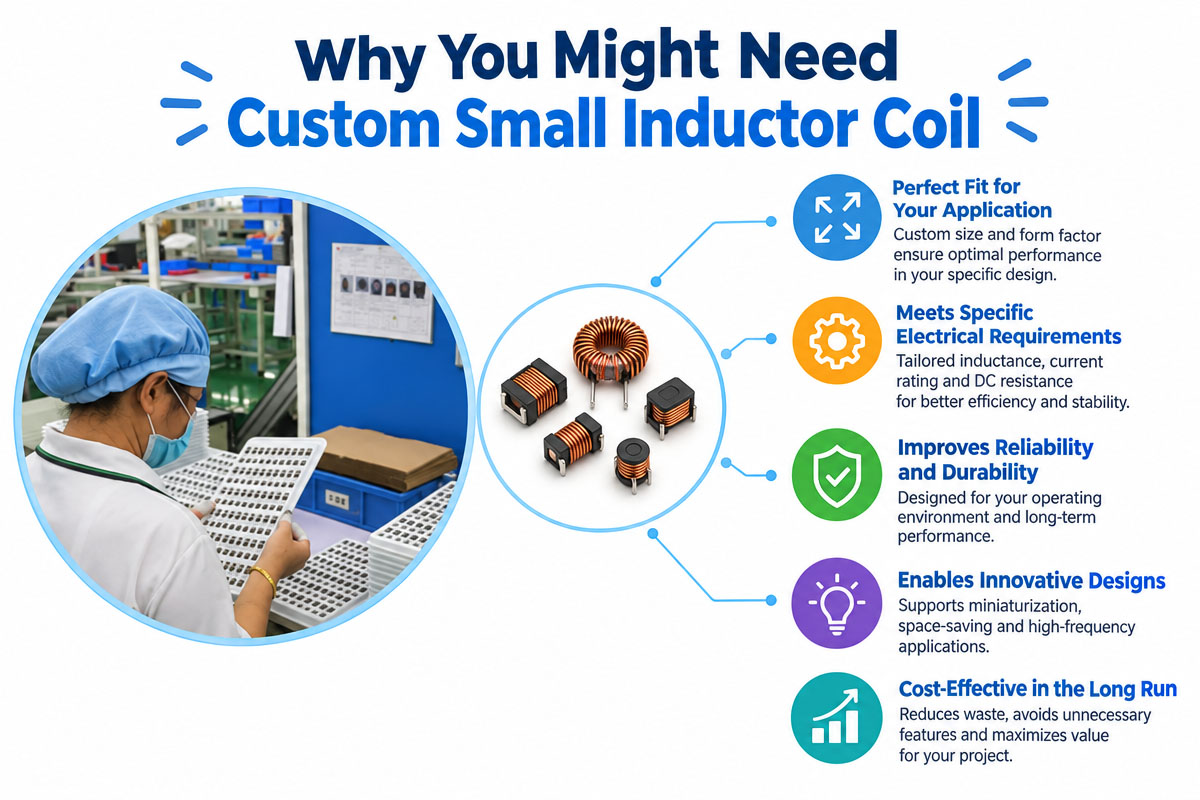
In most cases standard inductors are suitable.
However, there are projects for which the standard product will not suit the electrical and mechanical requirements. There may be special requirements for a custom small inductor coil when:
Non-standard sizes
Specific inductance
High current.
Low resistance
Specific winding design
Specific terminals
High heat resistance
Insulating
specific mounting requirements
Collaboration with the experienced coil manufacturer may help engineers to optimize the design for electrical performance, manufacturing, and installation requirements.
Chapter 10: Summary
Although the physical size of the small inductor coils is small, they play an important role in the modern electronic circuits. Small inductor coils store energy in a magnetic field and oppose the change of electrical current, which helps in power conversion, current smoothing, noise filtration, EMI reduction, and signal processing. They are widely used in consumer electronics, power supplies, automotive electronics, industrial equipment, communication systems, and medical devices.
Engineers must pay attention not only to the inductance value when choosing small inductor coils. Important specifications are current rating, saturation characteristics, DC resistance, operating frequency, core material, physical dimensions, and operating temperature.
In some applications a custom inductor coil may be a better choice than a standard one. It is especially true if the application has specific electrical or mechanical requirements.
Knowing how small inductor coils work will help you choose the proper design for the circuit.
Chapter 11: The Most Common Questions About Small Inductor Coil
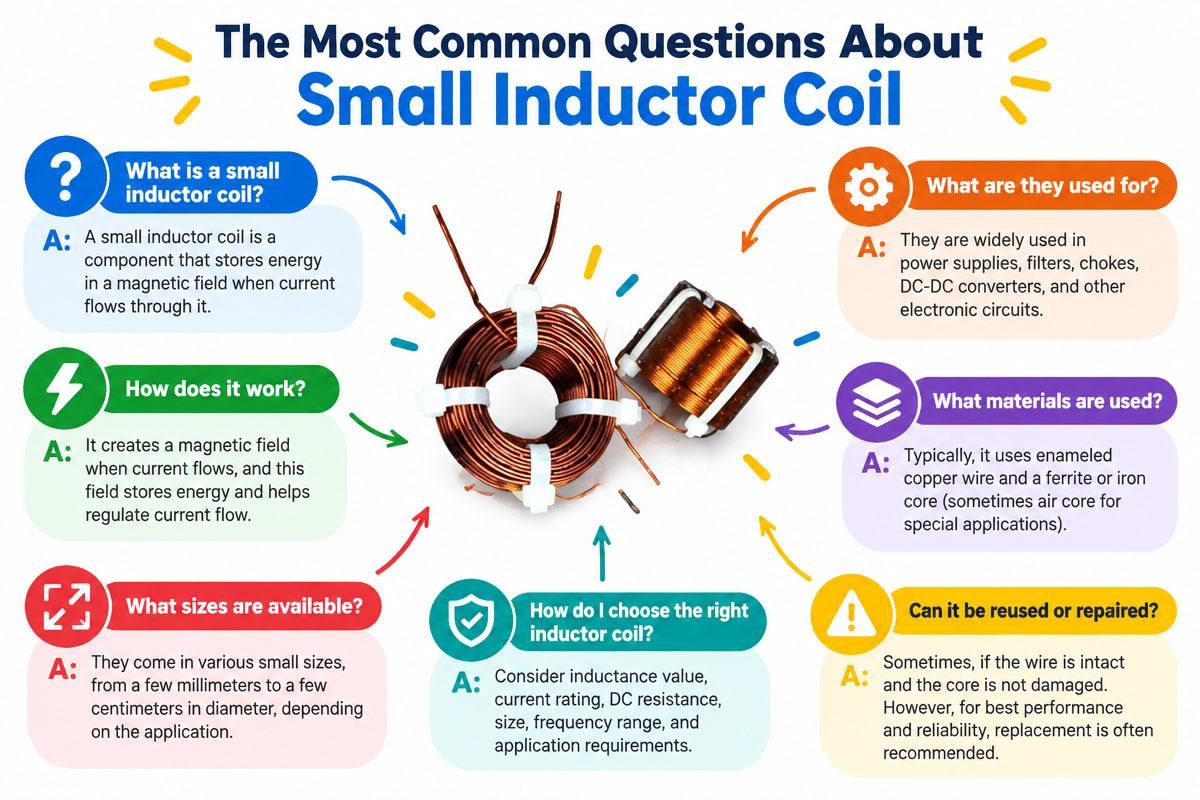
1. Small inductor coils What are they used for?
Power conversion, energy storage, current smoothing, noise filtration, EMI reduction, and signal processing are some applications of small inductor coils.
2. How is an inductor different from a capacitor?
An inductor stores energy in a magnetic field, and a capacitor in an electric field. These devices are often used together in filters and resonant circuits.
3. What factors affect the inductance of a small coil?
The inductance may depend on the number of wire turns, coil dimensions, winding structure, core material, and magnetic properties of the core.
4. What is an air-core inductor?
An air core inductor is the coil that does not use magnetic core material. This type is often useful for high-frequency applications due to the lack of core saturation.
5. How do I pick the right small inductor coil?
Pay attention to such requirements as inductance, current rating, DC resistance, saturation current, operating frequency, core material, physical dimensions, and operating temperature.
6. Can small coils be made to order?
Yes. Custom small inductor coils can be manufactured according to your requirements concerning inductance, dimensions, wire size, current carrying capacity, resistance, core material, terminals, and mounting configuration.
Are you looking for custom small inductor coils for your electronic application? Discuss a suitable coil solution with Weilong Intelligent Technology (Dongguan) Co., Ltd. according to your required inductance, current, voltage, dimensions, operating frequency, and application requirements.