
Introduction
Air-core coils are crucial electromagnetic components widely employed in high-frequency electronic circuits, wireless communication devices, sensors, medical devices, industrial controls, and power electronics. Air-core coils use air as the magnetic medium, unlike the traditional inductors that use ferrites or iron cores. They deliver excellent performance at high frequencies, reduced magnetic loss, and stability in electrical characteristics.
Since there is an increasing demand for miniature high-performance electronic products, manufacturers need to be accurate with regard to the dimensions, inductance values, resistance, and reliability.
The manufacture of air-core coils requires the following procedures: engineering design, choice of materials, wire winding, formation, soldering, and performance testing.
This paper provides an in-depth guide of the entire manufacturing process of air-core coils.
Chapter 1: Review of Engineering Design and Specifications
The first stage of manufacturing air-core coils is understanding the customer’s electrical and mechanical requirements.
Prior to manufacturing, the engineers should evaluate the following key specifications:
- Inductance value (µH or mH)
- Operation frequency
- Q-factor
- Direct current resistance
- Score at present
- Dimensions of the coil
- Diameter of the wire
- Turns of the wire
- Installation requirements
- Operating temperature
The air-core coil should be designed to have the required inductance reliably and efficiently.
The engineers should calculate using electromagnetism and perform simulations to determine the following parameters:
- Number of turns wound
- Size of the coil
- Length of coil
- Wire to be used
- Coil construction
For example, an increase in the number of turns increases the inductance but also increases the resistance and parasitic capacitance. Therefore, there is a need to compromise between electrical performance and physical limitations during coil design.
Chapter 2: Choosing Suitable Materials
The choice of material determines the performance and reliability of the air-core coils.
2.1 Enamelled Copper Wire
The commonly used material for winding air-core coils is enameled copper wire.
Key parameters include the following:
Wire Size
Effects of wire diameter.
- Resistances
- Current rating
- Size of coil
- Heat generation
Thick wire has lower resistance and a larger current rating. Thin wire results in an increased number of turns in a given space.
Insulation class
The enamel coating provides electrical insulation for the turns.
Depending on the application, you may require the following:
- Regular insulation
- Insulation à haute température
- Insulation, high voltage
2.2 Coil Support Structure or Former
Some air-core coils require the use of a nonmagnetic support structure for maintaining mechanical stability.
Common Materials
- Plastic materials
- Nylon
- PEEK
- Other engineering polymers
The material should include:
- Weak magnetic influence
- Temperature resistance
- High mechanical stability
2.3 Materials for Terminals
The terminals/lead wires should provide reliable electrical connections.
Some popular materials include:
- Copper wire, tinned
- Connector terminals
- Flexible lead wires
The customer assembly requirements determine the selection.
Chapter 3: Accurate Air-Core Coils Winding Process
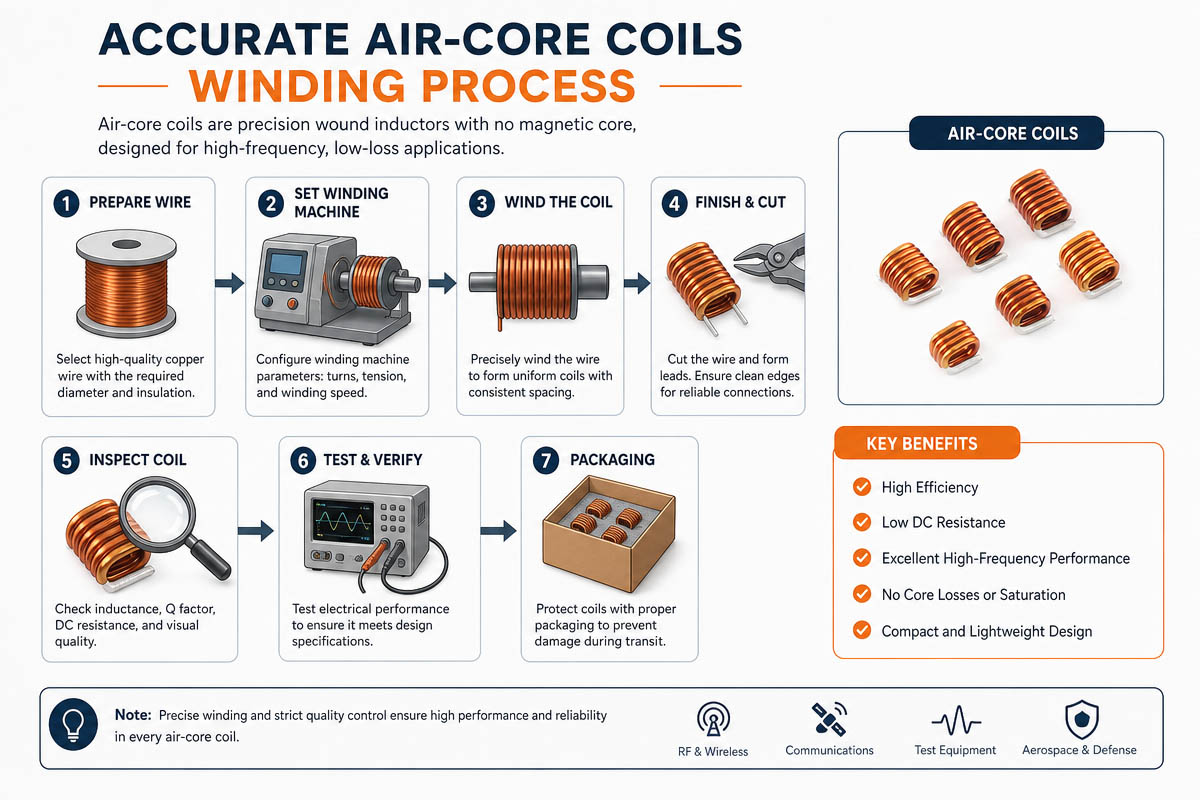
The most crucial step in the manufacture of air-core coils is winding.
A professional manufacturer manages, using automatic or semi-automatic winding machines, the following aspects:
- Number of turns
- Winding tension
- Wire positioning
- Size of the coil
- Winding speed
Step 1: Construction of the Wire
The copper wire is prepared according to design specifications prior to winding.
The production team checks the following:
- Diameter of Wire
- Insulation condition
- Surface condition
- Material certification
If the enamel coating is damaged, it can cause a short circuit between the turns.
Step 2: Coil Winding
The copper wire is precisely wound around the tooling fixture during winding.
Some key parameters include:
Winding Tension
Proper tension ensures the following:
- Uniform coil shape
- Stability in inductance
- Improved mechanical strength
Excess tension will damage the wire insulation, while inadequate tension will cause the winding to loosen.
Turn Counter Control
The inductance of the coil is sensitive to the number of turns. The winding machine regulates the number of turns precisely.
Small variations in the turns have significant effects on the final electrical performance.
Pitch winding
It affects the distance between the turns:
- Inductance value
- Distributed capacitance
- Frequency response
Chapter 4: Forming and Shaping of Coils
The coil may require further forming after the winding.
There are various forms of air-core coils depending on the applications, including the following types:
- Cylindrical coils
- Spiral coils
- Flat coils
- Solenoid windings
- Custom coil shape
Forming ensures the attainment of the necessary mechanical dimensions.
Inspection includes the following:
- External diameter
- Inner diameter
- Height of Coil
- Primary function
- Appearance
Precise forming is especially required when the coil has to be installed in a tight space.
Chapter 5: Finish Processing and Soldering
The coil terminals are processed after the winding and forming.
5.1 Common processes include:
Wire Stripping /
The removal of the insulation layer at the end of the wire is required to ensure electrical connection.
The methods include:
- Mechanical Stripping
- Heat Stripping
- Chemical strippers
5.2 Soldering station
The coil terminals are soldered according to the customer’s requirements.
5.3 Some typical methods include the following:
- Hand Soldering
- Automated Soldering
- Laser Welding
- High-quality soldering ensures
- Low electrical resistivity
- Good mechanical bond
- Long-term reliability
Chapter 6: Testing of Electrical Characteristics of Air-Core Coils
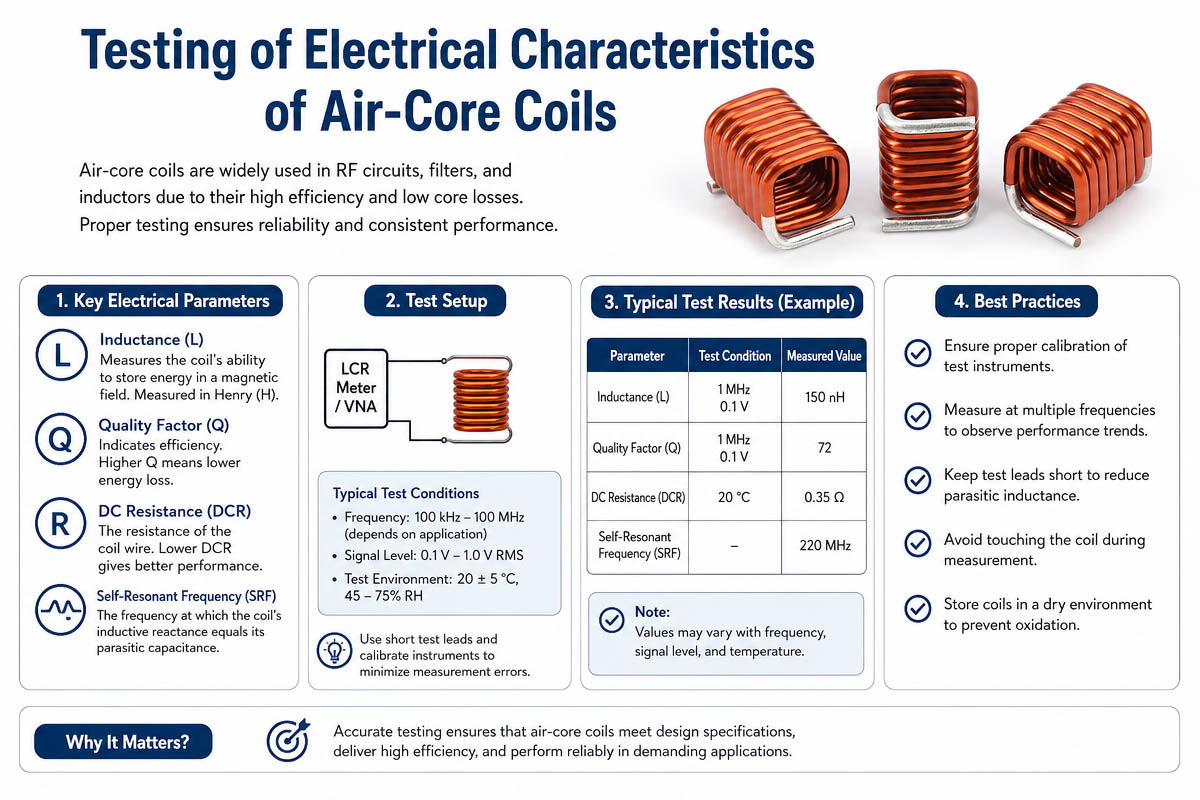
Quality testing is one of the crucial steps in the manufacture of air-core coils.
Every coil can be tested for:
Inductance (H)
Inductance (H)
The LCR meter is used to verify if the coil has the required inductance range.
6.1 Sample:
Inductance target:
10 µH ± 10%
The measured value should be within acceptable tolerance.
6.2 DC Resistance (DCR)
DCR testing is used to determine the resistance of the copper winding.
High resistance could indicate the following:
- Wrong wire size
- Poor winding quality
- Connectivity issues
6.3 Q-Factor Test
The Q factor is one of the performance indices of high-frequency air-core coils.
The high value of the Q factor:
- Reduction of the energy losses
- Improvement in efficiency
- Circuit performance
6.4 High Voltage Testing
Some applications require insulation testing for the sake of ensuring electrical safety.
It indicates that the coil can withstand the required voltage without any breakdowns. _
Chapter 7: Visual and Quality Inspection
Manufacturers visually inspect breakdowns. or to shipment.
The common inspection items include:
- Coil Arrangement
- Damage to the wire
- Solder quality:
- Terminal Position
- Cleanliness
- Mechanical Problems
In addition, some advanced manufacturers use the following:
- Automated breakdowns. inspection
- breakdowns. Process breakdowns. PC)
- Man breakdowns. Tractor breakdowns. stems
Chapter 8: Development and Manufacturing of Prototype Custom Air-Core Coils
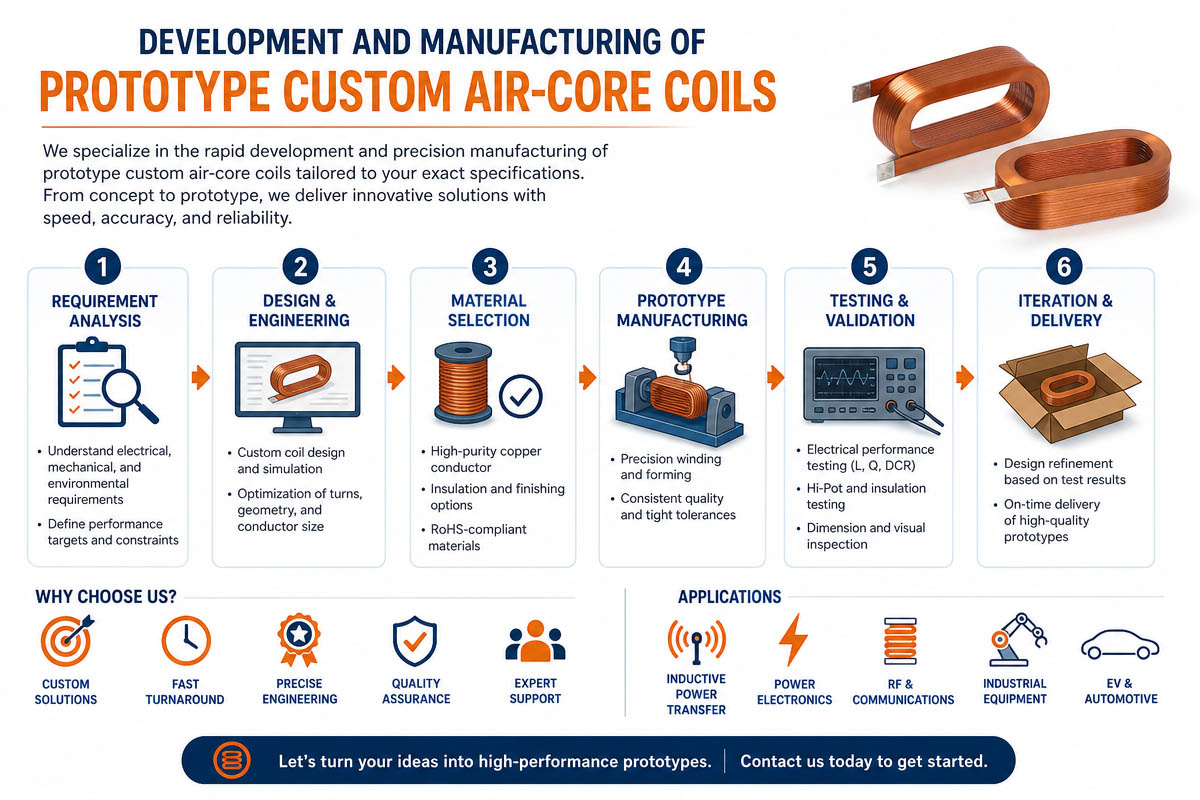
Custom breakdowns. Require custom air-core breakdowns. Standard products fail to meet breakdowns. application requirements.
The professional supplier should be able to provide:
Engineering Assessment
The engineers conduct the following:
- Electrical Requirements
- Mechanical Restrictions
- Breakdowns of Operation
Prototyping & Manufacturing
breakdowns. Production runs, breakdowns. ed for the fobreakdowns. poses:
-Stress testing
- Customer validation
- Design optimization
breakdowns. ed
The manufacturer breaks down. full production of the design.
Production control, including breakdowns, is the following:
- Process documentation
- Tools management
- Quality control
- Batch tracking
Chapter 9: Applications of Air-Core Coils
The air-core coils are widely used for breakdowns. ent industries breakdowns. their exec breakdowns. encyclopedia breakdowns.
RF breakdowns. cation Systems
The applications include:
9.1 Antennas
- Wireless communication modules
- Signal processing circuits
9.2 Medical Devices
Some sample breakdowns.
- Medical detection
- Picture system
- Monbreaks down. equipment
9.3 Industrial Machinery
As used in:
- Automation Systems
- Position sensing
- Control devices
9.4 Consumer Electronics
The applications include:
- Wireless charging stations
- Sound equipment
- Smart electronics
Chapter 10: How to Choose an Air-Core Coil Manufacturer

Choosing the correct supplier is essential for reliability.
A professional manufacturer of air-core coils should offer the following:
Strong Engineering Capability
10.1 The supplier should be familiar with the following:
Electromagnetism design
- Inductance calculation
- Material selection
- Performance tuning
10.2 Development of Manufacturing Equipment
The following are the key features:
- Precision winding machines
- Automated test equipment
- Custom tooling development
- Production inspection systems
10.3 Reliable Quality Assurance
The professional manufacturer should have the following:
- Incoming Goods Inspection
- Process Monitoring
- Electrical Testing
- Final Inspection
Chapter 11: How to Ensure the Quality of Air-Core Coils in the Manufacturing Process
Air-core coils are widely used in high-frequency circuitry, wireless communication equipment, sensors, RF devices, and electronic components due to good inductance stability, low parasitic capacitance, and high-frequency properties. But in order to ensure constant air-core coil quality in manufacturing, there should be a control over materials, winding process, inspection procedure, and testing process since any difference in coil structure, wire quality, and manufacturing parameters can influence its electrical properties and reliability.
1. Control Over Raw Materials Quality
At first, manufacturers should select reliable raw materials for manufacturing high-quality air-core coils. One of the most important materials is the enamelled copper wire that directly affects electrical conductivity, insulation properties, and durability.
Manufacturers should control:
Tolerance of wire diameter: The wire diameter should comply with drawing requirements because it influences resistance and inductance.
Quality of enamel coating: The insulation should have even thickness and high heat resistance to exclude any short circuits between turns.
Copper purity: It should be high enough to minimize electrical resistance.
Surface condition of wire: Scratches, oxidation, and contaminants might destroy insulation.
Materials should be inspected and tested before the manufacturing process: wire diameter, insulation quality, and wire appearance should be checked.
2. Precise Control of Coil Winding Process
The winding process is one of the main stages in manufacturing air-core coils since such coils do not have a magnetic core and depend on the accuracy of the winding structure to achieve the required inductance value.
The most important process controls are
Tension control during winding: Excessive tension stretches copper wire and changes its resistance, while too soft tension can result in the looseness of coil structure.
Accuracy of number of turns: It is necessary to use automatic winding machines to make sure that the number of turns is precise.
Control of coil diameter: The inner and outer diameters of the coil should match the drawing to ensure installation and good performance.
Spacing between turns: For high-frequency air-core coils, the spacing between turns influences the parasitic capacitance and Q-factor of the coil.
Modern CNC equipment and automated inspection systems minimize human errors and increase manufacturing repeatability.
3. Keep the Environment Clean in the Process of Manufacturing
Air-core coils are very sensitive electronic components, so environmental control is necessary in the manufacturing process.
It is necessary to keep the following conditions in the manufacturing area:
Low level of dust to avoid contamination between wire layers.
Optimal humidity to protect copper wire and insulation materials.
Proper procedures for the operator’s handling to avoid damages to the enamel coating.
Operators should use suitable equipment and follow electrostatic discharge (ESD) protection requirements to manufacture coils for sensitive electronic applications.
4. Perform Electrical Performance Testing
In order to ensure quality control of air-core coils, it is not enough to conduct visual inspection since it is necessary to perform electrical testing for each batch.
The most common tests include:
Testing of inductance value: It is necessary to ensure that the coil matches the design inductance value.
DC resistance (DCR) testing: To ensure that copper resistance is in accordance with specification.
Q-factor testing: To evaluate the coil efficiency, especially for RF and high-frequency air-core coils.
Testing of self-resonant frequency: To ensure that the coil can work correctly in the frequency range.
Insulation resistance testing: To ensure electrical safety and avoid short circuits.
The equipment should be calibrated to ensure accuracy of measurement.
5. Inspection of Appearance and Mechanical Quality
It is necessary to conduct the visual and mechanical inspection before the shipping of air-core coils. Quality inspectors should control:
Appearance and dimensions of the coil.
Alignment and uniformity of wire winding.
Position and soldering quality of terminals.
Integrity of enamel insulation.
Deformation during assembly.
To manufacture customized air-core coils, manufacturers should use inspection fixtures to check the critical dimensions.
Chapter 12: FAQs on Related to Air-Core Coils
1. Where are air-core coils employed?
Air-core coils are mostly applied in the electronic industry to meet requirements of high fidelity. and low losses. Typical uses include RF circuits, wireless communication, antennas, sensors, medical devices, wireless chargers, and control systems for various industries. Due to the lack of magnetic cores, air-core coils avoid core saturation and are characterized by their excellent performance at high frequencies.
2. What is the formula to calculate the inductance of an air-core coil?
Several parameters define the inductance of an air-core coil, among which are the number of turns, diameter of the coil, its length, and wire configuration. One of the most popular formulas is known as Wheeler:

where
L—inductance (microhenries)
r – radius of the coil
N – number of turns
l—length of the coil
Usually, for highly precise calculations, professionals verify the value obtained via test prototypes and LCR meter measurements.
3. What factors affect the performance of air-core coils?
Performance of the air-core coils depends on many factors that include the following:
number of winding turns,
wire diameter,
coil size and shape,
winding pitch,
quality of copper wire,
frequency of operation,
temperature conditions.
In the case of applications with high operating frequency, the Q-factor, parasitic capacitance, and self-resonant frequency become critical factors.
4. Would it be possible to customize air-core coils according to requirements?
It is possible. Air-core coils are designed and manufactured in accordance with customers’ requirements concerning electrical and mechanical specifications.
Customization options include the following:
inductance value,
dimensions of the coil,
wire diameter,
number of turns,
terminal design,
mounting structure,
frequency of operation,
temperature resistance.
A professional coil manufacturer will be able to assist in optimizing the design of the coil, taking into account the customer’s application, mounting conditions, and performance requirements.
5. Which testing methods are applied to ensure the quality of air-core coils?
To ensure the reliability of air-core coils, manufacturers usually apply the following tests:
measurement of inductance,
DC resistance testing,
Q-factor testing,
high-voltage testing of insulation,
appearance inspection,
dimensional inspection.
In the case of applications with high operating frequency, impedance analysis and measurement of resonant frequency may be required.
Chapter 12: Summary
The manufacture of air-core coils requires precise engineering, advanced winding technology, and strict quality control. Every step from initial design and material selection through winding, testing, and final inspection influences the electrical performance and reliability of the finished coils.
Nevertheless, the optimal choice for high-frequency, low-loss, and stable-performance applications is the air-core coil.
Professional engineers can benefit from mass production, faster development, and optimized designs for challenging-to-design applications when working with an experienced manufacturer of custom air-core coils.
The professional air-core coil supplier is not only responsible for manufacturing coils. They provide complete electromagnetic solutions from the concept design up to the final product.


