Toroid Choke Coil for Filtering Electrical Noise
Toroid Choke Coil Applications in Modern Electronics
Toroid Choke Coil Supplier for OEM Custom Projects
Toroid Choke Coil Quality Testing and Inspection
Toroid Choke Coil Customization and OEM Capability
Reliable Toroid Choke Coil for Automotive Electronics
Toroid Choke Coil for Filtering Electrical Noise
Toroid Choke Coil Applications in Modern Electronics
Toroid Choke Coil Supplier for OEM Custom Projects
Toroid Choke Coil Quality Testing and Inspection
Toroid Choke Coil Customization and OEM Capability
Reliable Toroid Choke Coil for Automotive Electronics

WL38125 Toroid Choke Coil for High Performance EMI Filtering

Toroid Choke Coil is a magnetic component that is used to improve electrical performance and eliminate unwanted interference in electronic systems. Magnetic core is ring-shaped and has the great inductance stability, low magnetic radiation and high filtering efficiency. Toroid Choke Coils feature a closed magnetic circuit which ensures better energy efficiency and more compact design compared to conventional inductors. They are used in switching power supplies, power converters, solar inverters, electric vehicles, audio equipment, industrial controllers and communication devices. Toroid Choke Coils are available in different core materials, winding technologies and electrical specifications and can be custom-made according to voltage, current, frequency and application requirements. Noise reduction and power management are the main criteria for modern electronic designs and high performance make them a preferred choice.

Toroid Choke Coil Description

Ferrite Toroid Choke Coils are passive electronic components made from insulated wire wound onto a toroidal magnetic core. It is used to remove high frequency noise and let through desirable current signals in circuits. The circular shape of core provides a closed magnetic path, reduces electromagnetic radiation and improves efficiency. Depending on the frequency and power requirements, toroid choke coils are usually manufactured from ferrite, powdered iron and other magnetic materials. They are widely used in EMI suppression and current filtering in power supplies, inverters, renewable energy devices, automotive electronics, communications systems and industrial controllers.

How does a Toroid Choke Coil work?

A Toroid Choke Coil is a device that makes use of the phenomenon of electromagnetic induction to resist sudden changes in current flow. Passing a current through the coil winding will generate a magnetic field inside the toroidal core. It is a magnetic core which stores energy and creates inductive reactance which blocks high frequency noise signals while letting through lower frequency or DC current signals.

Closed magnetic path of the toroidal core provides better magnetic efficiency and reduces electromagnetic interference. The choke is used in EMI filtering applications to suppress unwanted common mode or differential mode noise that occurs in switching circuits. Coil value, magnetic core, winding structure and operating frequency are the main parameters for the filtering performance and current capacity.

Toroid Inductor Coil Video

Toroid Inductor Coil Detail Display

Toroid Choke Coil Data Shee

Sendust Toroidal Coil Model Catalog 1

| Parameter | Typical Value |
| ——————— | ——————– |
| Core Material | Sendust (Fe-Si-Al) |
| Inductance Range | 2.2µH – 10 mH |
| Rated Current | 6A – 30A |
| Saturation Current | Up to 30A |
| Operating Frequency | 10 kHz – 100kHz |
| Operating Temperature | -40°C to +125°C |
| Insulation Type | Enameled Copper Wire |
| Core Shape | Toroidal |

Why Toroid Inductor Coil is Gaining so Much Popularity?

Toroid Inductor Coil are gaining popularity as modern electronic systems require high efficiency, better power quality and strong EMI control. Rapid development of electric vehicles, renewable energy, smart devices and industrial automation has increased the demand for compact and reliable magnetic components.

With low electromagnetic radiation, high efficiency, excellent filtering performance and customizable design, they are suitable for advanced electronic applications. Toroid Choke Coils provide better magnetic utilization and size efficiency than conventional inductors.


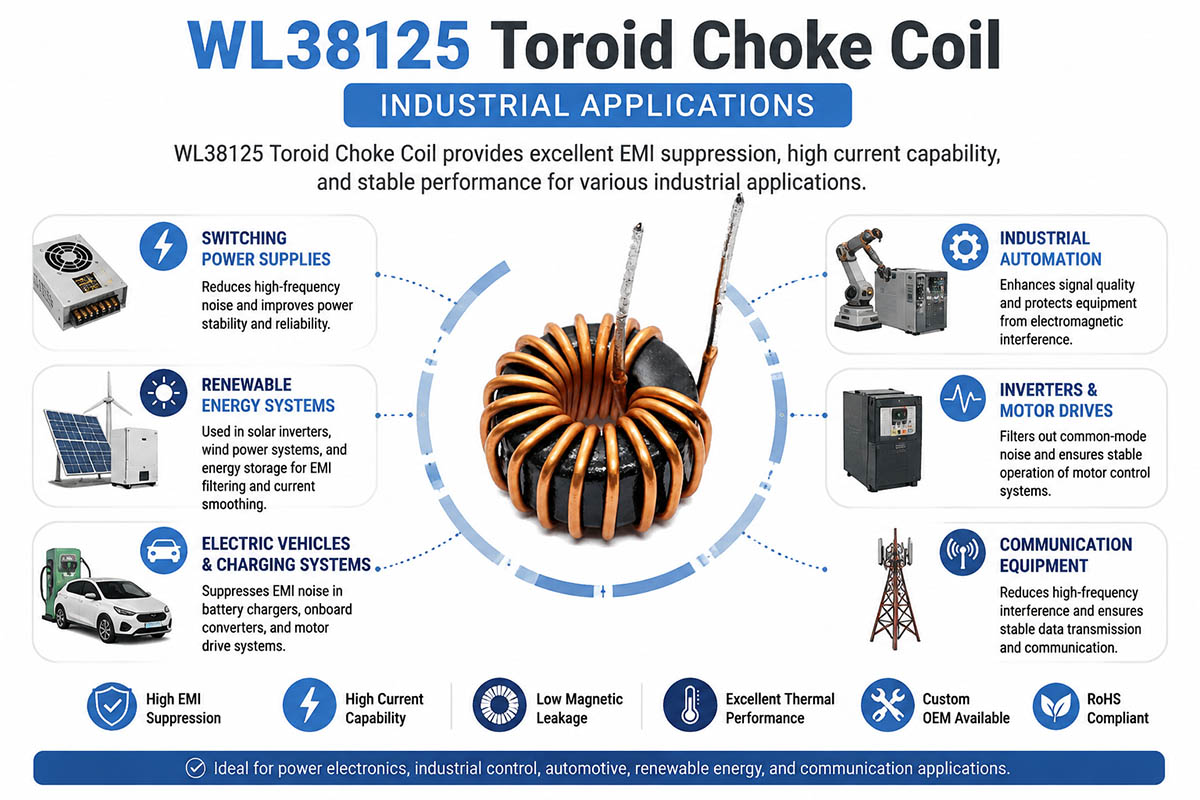
Toroid Choke Coil Applications

Toroid Choke Coil Design Guide for Power Applications

Toroid Choke Coils have found wide application in many different sectors thanks to their great filtering capability and efficient magnetic performance.


Toroid choke coils are used in power electronics for switching power supplies, DC-DC converters and AC power filters to reduce electrical noise and improve stability of the system.

In renewable energy systems they are used in solar inverters, wind power converters and energy storage devices to control the ripple of the current and to reduce electromagnetic interference.

Toroid Choke Coils for electric vehicles reduce electrical disturbances, improve charging systems, battery management systems and motor controllers.

They are used in PLC systems, motor drives and control devices in industrial automation for reliable operation in complex electrical environments.

These coils are used in consumer electronics like audio equipment, computers and communication devices to improve signal quality and reduce interference.

Thanks to their compact design, low radiation and high reliability, Toroid Choke Coils are also used in medical equipment, aerospace electronics and telecommunication systems.

Today, with the growing demand for efficient power conversion and cleaner electronic environments, Toroid Choke Coils are still very important to modern electronic designs.

Toroid Choke Coil Adv. & Disadv

Toroid Choke Coil Working Principle and Advantages

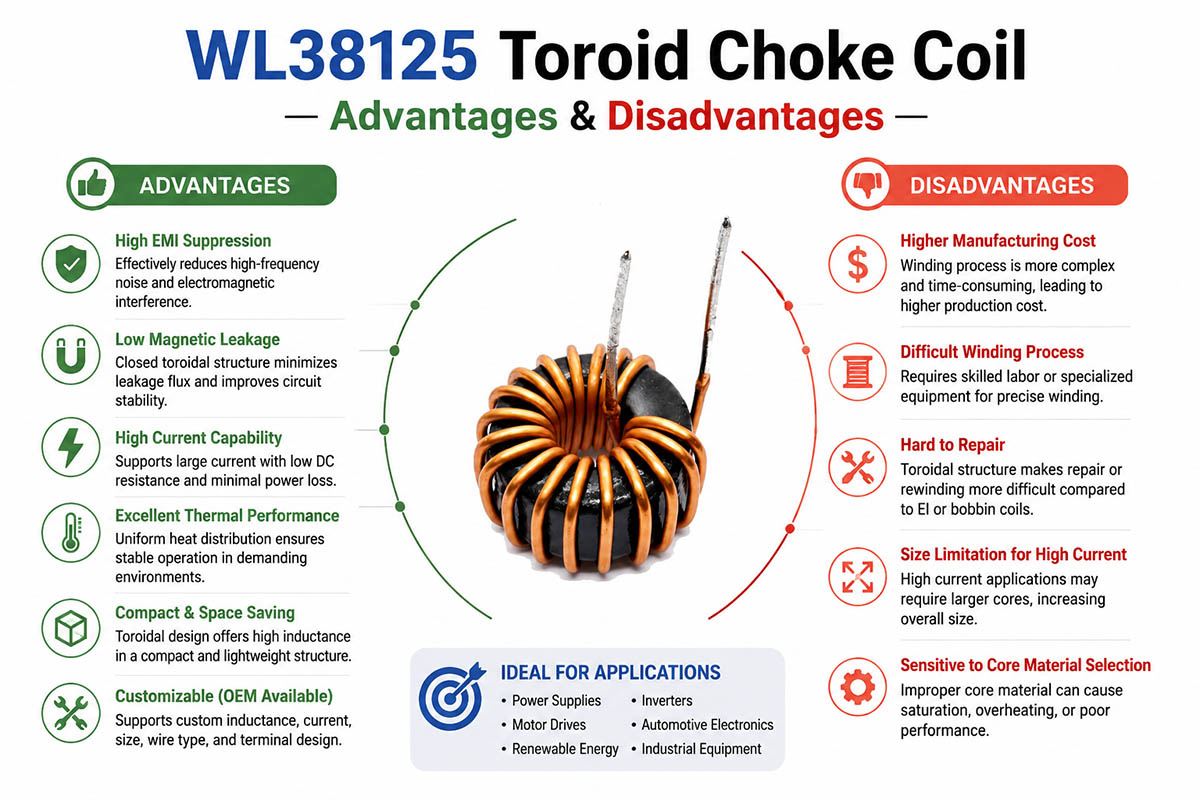
Advantages and Disadvantages of Toroid Choke Coil

Advantages

Toroid choke coils have a number of advantages over conventional magnetic components. Closed magnetic path reduces leakage flux and electromagnetic radiation, making them ideal for EMI sensitive applications. They have high inductance efficiency, small size, low power loss and good thermal performance. Symmetrical design improves the magnetic utilization and stability of electrical properties. Toroid Choke Coils are highly customizable for various current ratings, frequencies and installation requirements.

Weaknesses

Toroid Choke Coils also have some limitations, despite their advantages. Winding process is more complex than that of standard inductors which increases the manufacturing cost. Some designs require manual or special winding equipment. Poor selection of the core materials leads to the reduced efficiency or saturation problems. High current applications require larger cores which increases the size and weight of the product. Also, compact winding design of toroidal cores makes them difficult to repair or modify.

Toroid Choke Coils are suitable for applications which require high efficiency, high reliability and noise reduction.

Toroid Choke Coil Manufacturing Process Explained

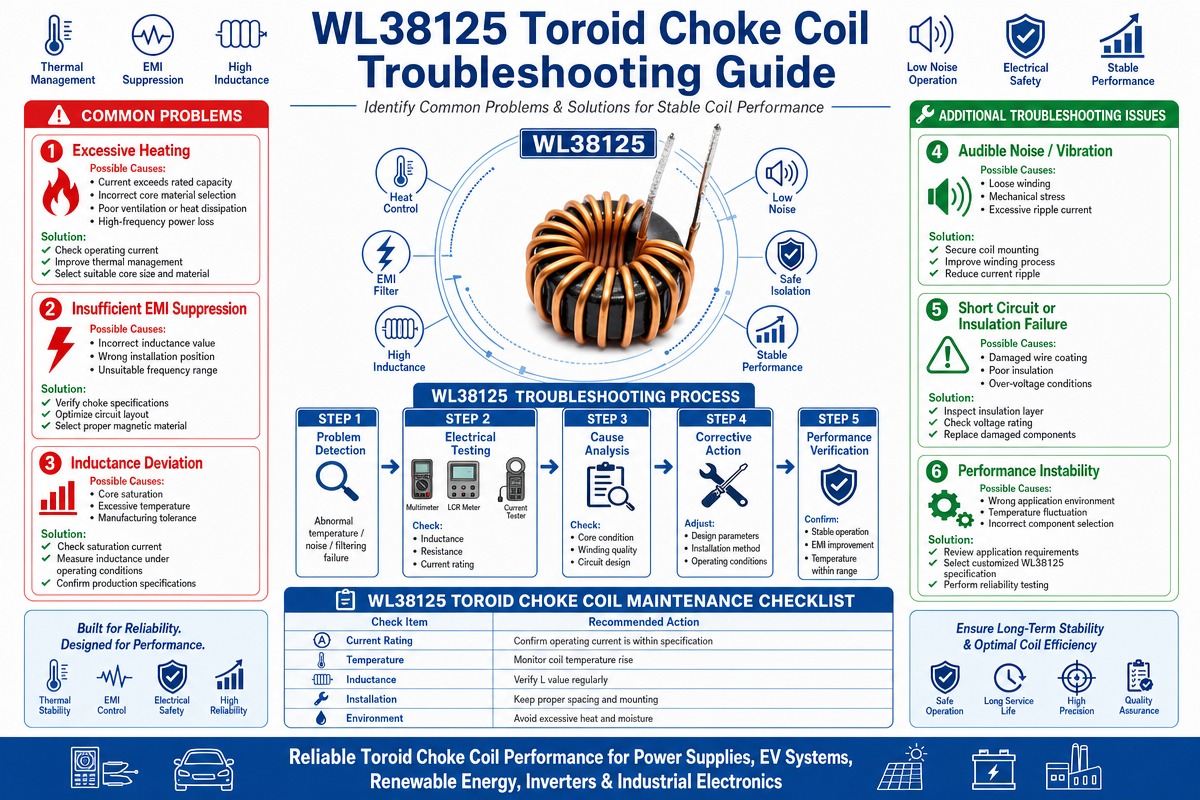
Troubleshooting of Toroid Choke Coil

Common Toroid Choke Coil problems can reduce system efficiency and reliability. Troubleshooting will help you determine whether the problem is design-related or installation.

1.Overheating

If the coil temperature increases abnormally, check whether the current exceeds the rated value. Incorrect core selection or inadequate wire size can also cause overheating.

2.Inadequate EMI filtering performance

If the noise suppression is insufficient, check the inductance value, winding configuration and installation location. Incorrect core material can reduce filtering performance.

3.Inductance change

Inductance can be changed due to magnetic saturation, too high temperature or mechanical damage. Check the working conditions and replace damaged parts.

4.Audible sound

Buzzing or vibration can be caused by loose winding, core stress or excessive ripple current. Noise can be reduced by improved winding technique and good mounting.

5.Insulation failure or short circuit

Check insulation layers, wire coating and environment conditions. Make sure the coil meets the safety standards.

Regular electrical testing, thermal monitoring and quality inspection can be used to ensure stable performance of Toroid Choke Coil.

FAQ

1. What is the purpose of Ferrite Toroid Choke Coil?

Ferrite Toroid Choke Coil is mainly used to reduce electrical noise, reduce electromagnetic interference (EMI) and improve the stability of power. They are widely used in switching power supplies, inverters, EV chargers, industrial controllers, communications equipment and renewable energy systems. Toroid core provides a closed magnetic path with a higher efficiency and less magnetic leakage compared to conventional inductors.

2. How does Toroid Choke Coil reduce EMI noise?

Toroid  coil produces inductive impedance to high frequency noise interference signals and thereby reducing the EMI noise. Noise currents which are induced in the coil create a magnetic field in the toroid core, which opposes the rapid change of the current. As a result, it filters out the high frequency noise while allowing the necessary power signals to pass through. Choice of the appropriate core material and winding design improves the EMI filtering performance.

3. What material is used for the cores of Toroid Coils?

Ferrite, powdered iron, nanocrystalline materials and iron-based magnetic alloys are usually used for cores of Toroid Coils. Ferrite cores are widely used for high frequency EMI suppression and powdered iron cores are suitable for power applications where higher energy storage is needed. Nanocrystalline cores have high permeability and good common-mode noise suppression performance.

4. What is the selection of Toroid Choke Coil?

Selection criteria of Toroid Choke Coils includes the inductance value, rated current, operating frequency, voltage level, core material, temperature range and installation space. The engineers must also determine the need for common mode filtering, differential mode filtering or energy storage. Properly selecting a coil with correct electrical parameters ensures efficiency and prevents overheating or saturation.

5. Why would one use Toroid Choke Coil instead of a standard inductor?

There are several advantages of using Toroid Choke Coil, such as reduced electromagnetic radiation, higher magnetic efficiency, small dimensions and higher inductance stability. Leakage flux is reduced and energy utilization is improved due to closed magnetic circuit. Therefore, Toroid Choke Coils are highly suitable for EMI sensitive applications, like medical devices, automotive electronics and industrial equipment.

6. Are Toroid Choke Coils customizable for OEM applications?

Yes, Toroid Choke Coils can be customized according to customer requirements such as core size, inductance value, current rating, wire diameter, winding method, terminal type and insulation requirements. OEM manufacturers can design Toroid Choke Coils for numerous applications, including solar inverters, EV chargers, power converters and industrial automation equipment.

7. Why does my Toroid Choke Coil become hot during usage?

Excessive current, improper core choice, insufficient wire size, high frequency losses or inadequate ventilation. In order to solve the problem it is necessary to check the operating current, check the saturation rating, improve the thermal management and choose the coil which is suitable for the desired power level.

8. How do I test performance of Toroid Choke Coil?

Generally, testing of Toroid Choke Coil includes the following parameters: Inductance, DC resistance (DCR), Rated current, Saturation current, Temperature rise, Impedance characteristics, EMI suppression capability. Advanced tests can include frequency response and environmental reliability testing. Inspection will ensure stable operation and help to prevent possible failures before the system installation.

How to Choose a Toroid Choke Coil?

Choosing the right Toroid Choke Coil requires several electrical, mechanical and environmental considerations.

1.Decide on the operating current

One of the most important parameters is the rated current. Choose a Toroid Choke Coil that will not overheat or saturate at the operating current (continuous). Larger cores and thicker winding wires are required for high current applications.

2.Choose the right inductance value

The inductance of the choke defines its filtering performance. Higher inductance means better noise suppression, but may also affect response speed. Designers should choose inductance depending on the frequency range and circuit requirements.

3.Consider the frequency range

Various magnetic materials are required for various applications. Ferrite cores are ideal for EMI suppression at high frequencies, while iron powder cores are usually used for power filtering and energy storage.

4.Check Voltage and Insulation ratings

The coil should fall within the system voltage ratings and safety standards. Proper insulation prevents electrical breakdown and ensures reliability.

5.Assess Size and Thermal Performance

Physical dimensions, installation space and heat dissipation should be considered. A compact design helps to save space, but proper thermal performance should be ensured.

6.Pick the right core material

Ferrite, nanocrystalline and powdered iron materials have different magnetic properties. The choice of the right one depends on the frequency, power level and efficiency requirements.

7.Consider the application environment

Reliability of the product is affected by temperature range, humidity, vibration and mechanical conditions. For industrial and automotive applications, there is often a need for higher durability.

8.Assess Customization Ability

OEM projects often involve customization of winding technique, terminals, packaging and electrical specifications. Choosing an experienced manufacturer guarantees better product performance and consistency.


Properly chosen Toroid Choke Coil improves system efficiency, reduces interference and increases reliability of electronic products.


Tips for avoiding common mistakes in toroid choke coil design

Inductance selection should not be based on size, but on current and frequency requirements.

The coil should not be operated at currents exceeding its saturation current limit.

Choose the right magnetic core material depending on the operating frequency.

Insulation should be thick enough for the safety requirements.

Heat generation should be taken into account in continuous operation.

Do not wind it incorrectly, otherwise the filtering performance will be degraded.

Check EMI requirements at the final design stage.

Prototype testing in real working conditions before mass production.

Get A Free Quote Now

Contact Form

Related Products

Related News

Scroll to Top

Get A Free Quote Now !

Contact Form
If you have any questions, please do not hesitate to contact us.
Weilong Solenoid Company Culture
