

Chapter 1: Introduction to Toroidal Coil Manufacturer
When choosing a toroidal coil manufacturer, both engineering and procurement departments should expect more than a standard product from the catalog. The right manufacturer should be capable of understanding the electrical requirements, recommending the appropriate core materials and winding setup, manufacturing high-quality coils, and ensuring quality control throughout the process.
Weilong Intelligent Technology is an electromagnet component manufacturer, providing OEM and custom services to industrial customers. We specialize in coil winding, metal stamping, injection molding, CNC machining, assembly, and product testing, allowing customers to partner with a single manufacturing partner for various electromagnet components.
We develop our toroidal coil products based on requirements for inductance, operating current, frequency, voltage, winding, dimensions, insulation, and environment.
Below, we explain what a toroidal coil is, how it works, what materials are used, how toroidal coils are manufactured, where are toroidal coils used, how to customize toroidal coils, and how to choose a reliable toroidal coil manufacturer.
Chapter 2: What Is A Toroidal Coil
A toroidal coil is just a coil of insulated wire wound around a donut-shaped magnetic core. The magnetic core is round or ring-shaped, and the winding is distributed around the circumference.
The toroidal form allows having quite a closed magnetic field. When the winding receives the current, it creates a magnetic field around the core. The magnetic flux is concentrated inside the core, making the toroidal coil efficient at magnetic performance and minimizing magnetic leakage and electromagnetic interference.
Here are some designs of toroidal coils, such as:
Coil Choke Coil Inductor
Common mode choke.
EMI filter element
Power filter component
Energy storage in coil
Signal filtering section
Transformer windings
Magnetic part of the current
The final design depends on the customer’s electrical and mechanical requirements.
That’s why it’s often preferable to use a customized toroidal inductor rather than a standard component in the application with strict space, current, frequency, or performance requirements.
Chapter 3: How Does a Toroidal Coil Work?
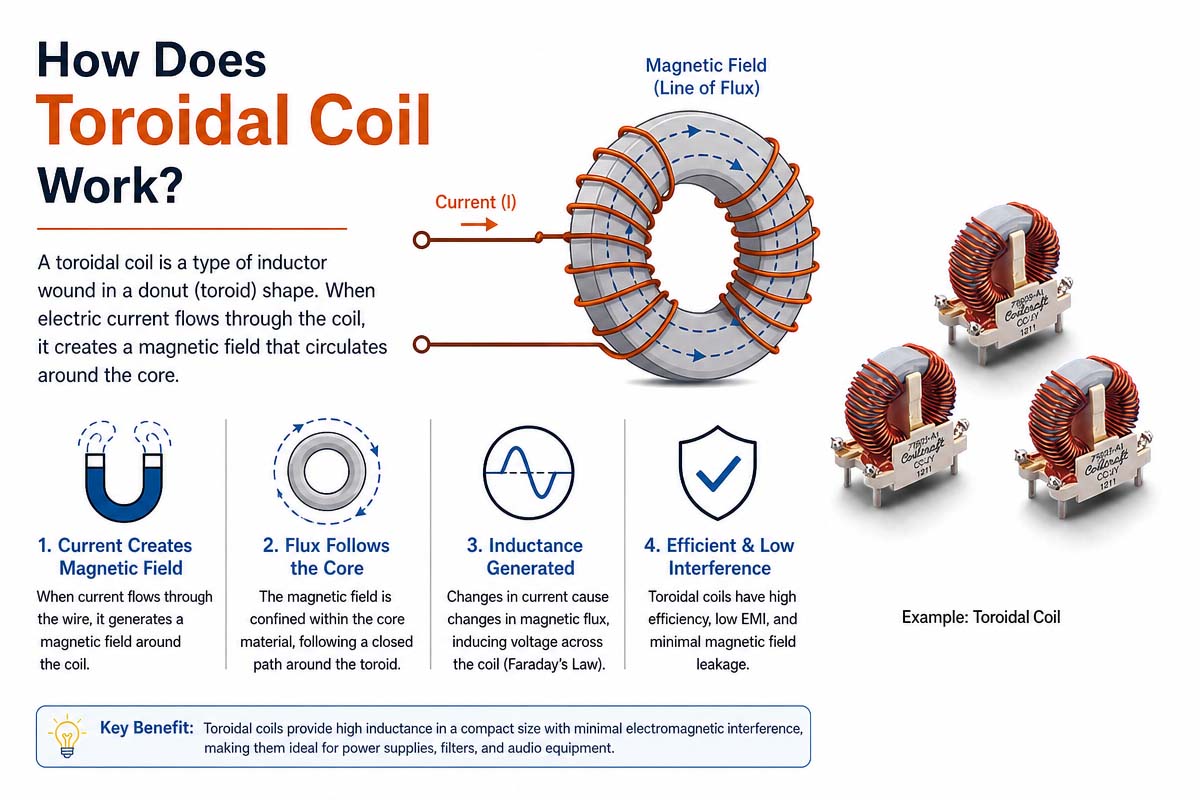
The working principle of a toroidal coil is based on magnetic flux and electromagnetic induction.
When the DC or AC current passes through the winding, it creates a magnetic field. The magnetic core provides a low-reluctance path for the magnetic flux.
For an ideal toroidal magnetic circuit, the magnetic field strength is approximated by:
H ~ N I / l, where:
H = strength of the field
N = amount of revolutions
I = current, l = length of effective magnetic path
The inductance depends on a lot of parameters, such as
Turns number
Main materials
Basic dimensions
Magnetic permeability
Airgap
Frequency of operation
Current level
More turns increase the inductance, but the core material defines some magnetic properties, including permeability, saturation, and frequency performance.
Chapter 4: Why use a toroidal shape?
The toroidal form has some advantages.
4.1 Efficient Magnetic Field
The round-shaped core provides a continuous magnetic field that allows the magnetic flux to be concentrated within the core.
4.2 Minimal magnetic leakage
Due to the closed magnetic field, toroidal designs have lower magnetic leakage compared to some other open magnetic designs.
4.3 Compact design
The toroidal coil can provide useful inductance in a relatively compact package.
4.4 EM Interference
Toroidal designs are useful in applications in filtering and electromagnetic noise suppression.
4.5 Flexibility of the winding setup
The manufacturer can customize the winding according to the application:
Amount of rotations
Wire diameter.
Winding arrangement
Many coils
Insulating
Termination method
Chapter 5: Materials Used in Toroidal Coils
Choosing the material is one of the key stages in developing a toroidal coil.
The core material should be selected by a professional manufacturer of ferrite toroidal coils, considering the electrical requirements and environment.
5.1 Ferrite Cores
Ferrite is a widespread material for high-frequency magnetic components.
Ferrites have high electrical resistivity and magnetic characteristics, which make them suitable for applications in EMI filtering, switching power supplies, and high-frequency circuits.
Different ferrites have different performance properties.
The material choice should depend on:
Frequency of operation
Required inductance
Temperature
Core losses
Saturation characteristics
5.2 Iron Powder Cores
Powdered iron cores are used to implement distributed air gaps and energy storage.
They may be used for:
Inductors’ Power
DC filtering
Energy storage
Switch mode power supplies
The material to be used depends on the required inductance and current conditions.
5.3 Copper wire
Copper magnet wire is widely used in toroidal coil windings due to its excellent electrical conductivity.
When selecting the wire, consider:
Wire diameter
Rating Current
Space that the wire windings occupy
Rise in temperature
Insulation requirements
Operating voltage
For the higher currents, a larger conductor or optimized winding should be used. _
5.4 Materials for insulation
Depending on the application, you may need insulation between:
Wire and core
Various windings
Windings and connections
Coil & housing
The insulation system should be chosen in accordance with requirements for voltage, temperature, and safety.
Chapter 6: Custom Toroidal Inductor Manufacturing
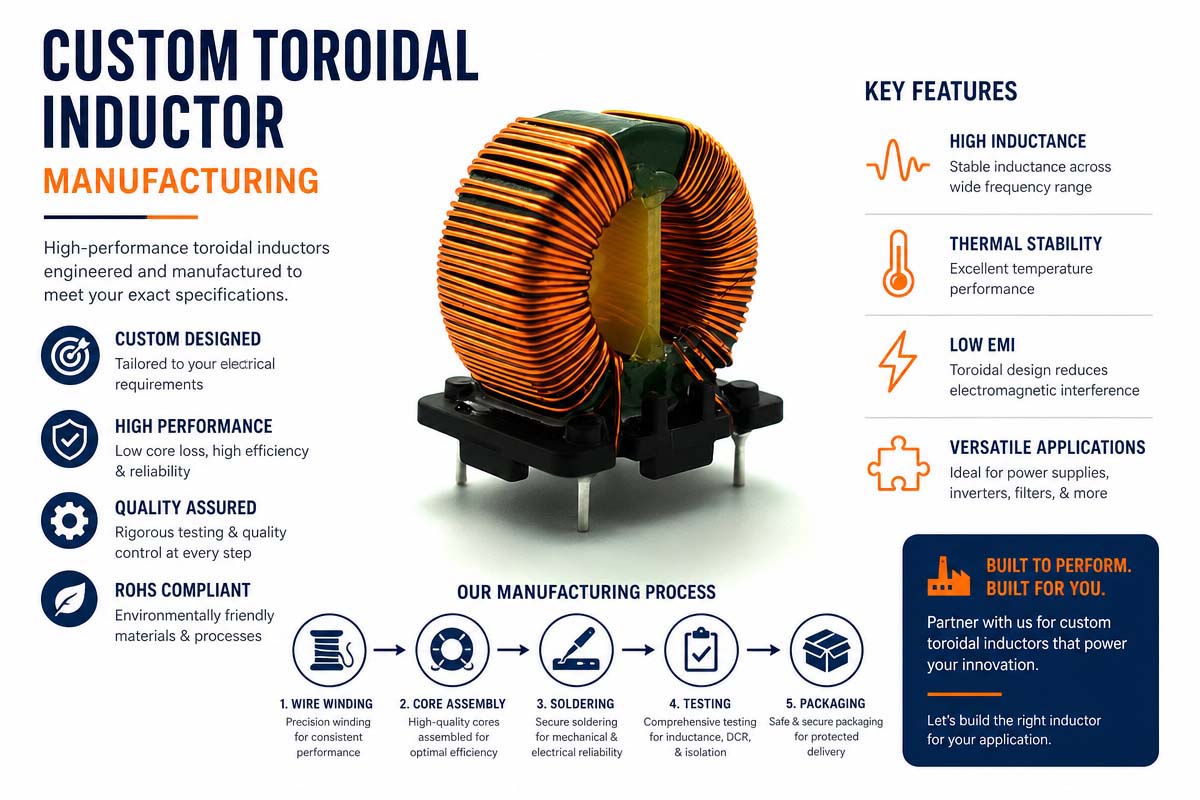
Not every application can use a standard toroidal coil.
A custom toroidal inductor can be designed around the customer’s electrical, mechanical, and environmental requirements.
Typical customization parameters include:
| Parameter | Custom Options |
| Core | Ferrite, powdered iron, and other materials |
| Inductance | Customer specified |
| Current | Rated and saturation current |
| Wire | Different diameters and insulation |
| Turns | Customized |
| Winding | Single or multiple winding |
| Dimensions | Custom |
| Terminals | Wire, pin, connector, etc. |
| Insulation | Customized |
| Operating temperature | Application dependent |
| Testing | Customer specification |
Custom Mechanical Dimensions
In many industrial products, the available PCB or enclosure space is limited.
A custom coil can be designed around:
Maximum outer diameter
Inner diameter
Height
Lead position
Mounting method
Connector location
This approach can make a custom component more suitable than modifying an existing standard product.
Chapter 7: Toroidal Coil Manufacturing Procedure
A reputable toroidal coil manufacturer does not just outsource the winding operation but provides a controlled manufacturing process.
The following stages compose a typical manufacturing process.
Step 1: Engineering Review
Before starting the manufacturing process, the engineering team of the manufacturer reviews the customer’s requirements.
Common requirements include:
Inductivity
Current rating
Maximum current.
Operating frequency
Resistance Voltage
Key dimensions
Total dimensions
Count of turns
Wire Specifications
Insulation needs
Working temperature
Application
If the customer requirements are incomplete, the manufacturer must identify the missing parameters before producing samples.
Step 2: Choosing the Core
When choosing the core material and its dimensions, you should take electrical requirements into account.
For example, a high-frequency EMI filtering application will require a different ferrite material than a high-current power inductor.
Not only physical size matters, but also magnetic properties.
Step 3: Choosing the Wire
The wire diameter and insulation are chosen according to current, voltage, temperature, and the space available for winding.
For high-current applications, conductor resistance and temperature rise are especially important
Step 4: Winding 6 Toroids
The wire is wound on the toroidal core according to the design engineering.
Important parameters are
Count of rounds
Direction of winding
Winding distribution
Wire tension
Stratification
Density of winding
It is important to have consistent winding since the deviations influence the electrical properties and mechanical dimensions.
Step 5: Insulation and Protection
After winding, the coil can require additional insulation or protection.
It can include, depending on the application:
Tape insulation
Sleeves.
Protective coating: epoxy
Heat shrink wrap.
Casing (external)
The appropriate method depends on the electrical insulation requirements, temperature, and environment.
Step 6: Lead and Terminal Processing
The winding ends are processed according to the customer’s requirements for assembly.
Possible ways of termination are
Tin-coated wire
Solder terminals
Connector Pins
Custom Leads
Step 7: Performing Electrical Testing
The toroidal coil is tested according to the agreed specification.
The common tests can include:
Inductivity
DC resistance
Insulation resistance
Hypodermic/Dielectric Strength
Current properties
Temperature rise
Visual inspection
Dimensional testing
The electrical test requirements should be defined in the engineering stage.
Chapter 8: Applications of Toroidal Coils
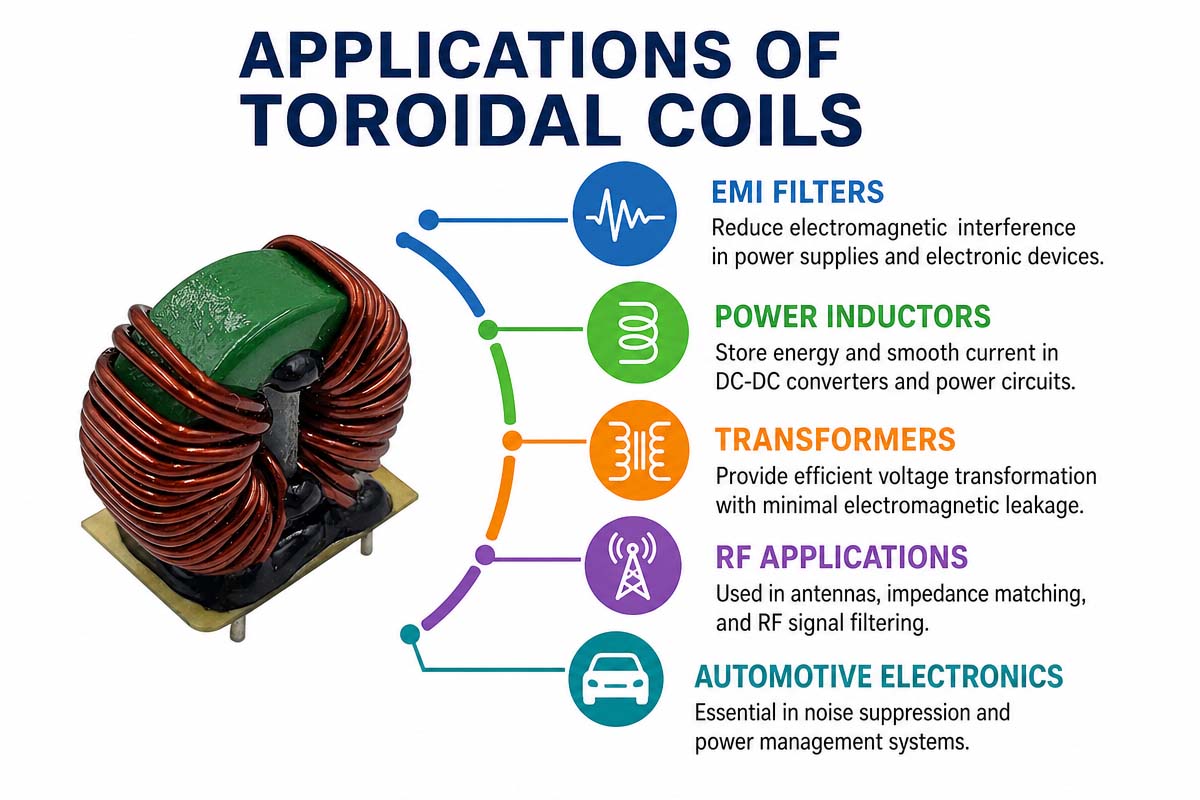
Numerous industrial and electronic devices use toroidal coils.
8.1 Power Supply Units
In power electronics, toroidal inductors and chokes can be used to perform filtering and storing energy.
Examples are
AC/DC power supply
DC-DC converter
Industrial power supply
Battery pack
8.2 EMI and EMC Filtering
Another important application of toroidal magnetic components is their ability to filter out electromagnetic noise.
The manufacturer of common mode chokes needs to be aware of the difference between common mode and differential mode noise.
Common mode chokes have multiple windings around the same core and suppress common-mode interference, allowing for a proper power signal.
Applications are:
Filters of power input
Industrial control
Communications equipment
Power supplies
EV charging equipment motor drives
8.3 Solar Inverters
Toroidal inductors and chokes can be built in the following high-frequency switching circuits of renewable energy equipment:
Solar inverter
Energy Storage
Battery Management Systems (BMS)
Power electronics for grid connection
The considerations during the design of such components have to involve parameters of current, frequency, heat, and environmental requirements.
8.4 Electric Vehicle Charging Stations
Power conversion and filtering elements are necessary for EV charging stations.
Toroidal magnetic elements can be used in:
AC Charging Stations
DC charging systems
Power supplies for charging
EMI filter
Heat performance and saturation characteristics are of particular importance for the high-current applications.
8.5 Industrial Automation
Toroidal chokes and inductors can be used in:
Motor Drivers
Industrial power supplies
PLC systems
Servo systems
Factory Automation Devices
Useful magnetic components could guarantee stable electrical performance and EMI control.
8.6 Audio equipment
Toroidal magnetic components can also be used in audio electronics due to their low electromagnetic interference and compact design.
Applications are:
Power amplifier
Professional audio equipment
Power Filter
Noise suppression circuits
Chapter 9: How to choose a toroidal coil manufacturer
Making your decision just according to price can result in troubles later on.
Evaluation of a reliable supplier has to be based on its engineering, manufacturing, testing capabilities, and long-term production stability.
9.1 Validation of Engineering Capabilities
Asking the manufacturer whether he can provide:
Core Selection
Winding Design
Wire Selection
Heating Problems
Electrical Testing
Prototype Building
If your design is still under development, a supplier who is only willing to follow the existing drawing is not the right choice.
9.2 Evaluation of In-House Manufacturing Capability
Ask how many manufacturing processes are done in-house.
Important capabilities include:
Winding Coils
Plastic Molding
Metal Stamping
CNC Machined
Assembly and Testing
More in-house manufacturing processes mean greater control over customization and coordination.
9.3 Testing Capability Test
This is not just about the supplier’s quality inspection.
But asking specifically:
What kind of tests are performed for each batch of production?
Depending on the product, it could include:
Inductance Resistance
Insulation Hi-pot
Dimensions Look
Temperature Performance Typica
Chapter 10: How to Avoid the Common Mistakes in Selecting a Toroidal Coil Manufacturer
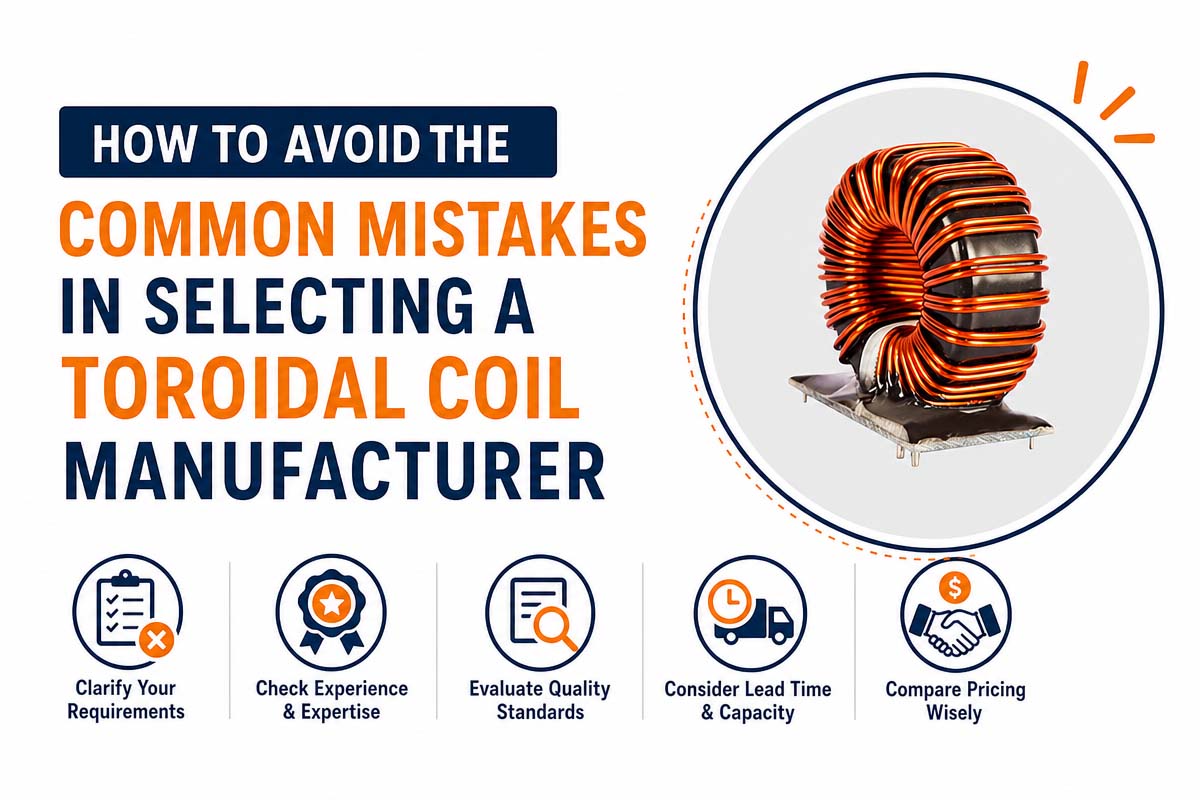
You can prevent many of your purchasing problems before placing an order, reviewing the following points below.
Mistake #1 – Choosing Only Based on Price
The lowest quotation is not always equal to the lowest total cost.
The cheap coil could have:
Inductance mismatch
Bad winding quality
Higher resistance
Bad insulation
Bad batch-to-batch reproducibility
Instead, compare price, quality, engineering support, and delivery reliability.
Error 2: Providing only the value of inductance
Usually the requirement, like “10 mH toroidal coil,” is not enough.
The manufacturer needs information like
Service frequency
Voltage Current Temperature Dimensions
Usage of DC resistance
If the coil is of the proper inductance value but wrong in current or frequency operation, it may fail in its final application.
Mistake #3: Ignoring the saturation current
The saturation effect could decrease inductance value dramatically.
It is always better to specify the operating current and ensure that the selected core provides the required saturation performance.
Error #4: Choosing the core only by size
Two cores of similar sizes can have entirely different magnetic characteristics.
Consider the material, permeability, AL value, saturation characteristics, and frequency characteristics.
Mistake #5: Not testing samples in real-life conditions
A unit that passed the inductance test is not guaranteed to work properly in the final equipment.
Testing the prototype before mass production in representative conditions:
Voltage Out
Current Frequency
Heat
Duty cycle conditions.
Mistake #6: Ignoring Thermal Performance
Heat is generated by copper losses and core losses.
For continuous-duty industrial applications, the supplier should define the temperature rise under actual operating conditions.
Mistake 7: Not Verifying the Supplier’s Production Capacity
A supplier might be able to produce 10 prototypes successfully but could face problems with 10,000 production pieces.
Before approving, ask the supplier:
Production Capacity.
Equipment for winding
Quality Control
Production Cycle Time
Raw Material Supply
Batch Uniformity
Chapter 11: Manufacturing capacity of Weilong Toroidal Coil
Weilong Intelligent Technology offers a custom electromagnetic components manufacturing service for industrial and OEM applications.
Our manufacturing capacity is
Wrapping
Metal stamping
Tooling development process
Plastic injection molding
CNC Machining
Components Assembly
Electrical tests
Product development
Through our integrated manufacturing capacity, we are able to support customers from engineering discussions to prototype and mass production.
Our engineering department is able to assess the electrical and mechanical considerations for your custom project involving toroidal coils and determine whether the proposed design can be manufactured.
Quality Control of Toroidal Coil
The quality control starts prior to winding.
A typical quality control system includes:
Incoming Material Inspection Receiving
Core measurement
Core material
Size of wire
Wire insulation
Materials specification
Production Inspection Test
Rotation numbers
Position of winding
Tension of wire
Length of lead
Insulation:
Final check
Inductance (L)
DC ohms:
Insulation Resistance—
Hi-pot Dimensions
Looks
In OEM projects, the inspection procedure can further include additional criteria according to the customer’s requirements.
Chapter 12: What information should be provided for the toroidal coil RFQ?
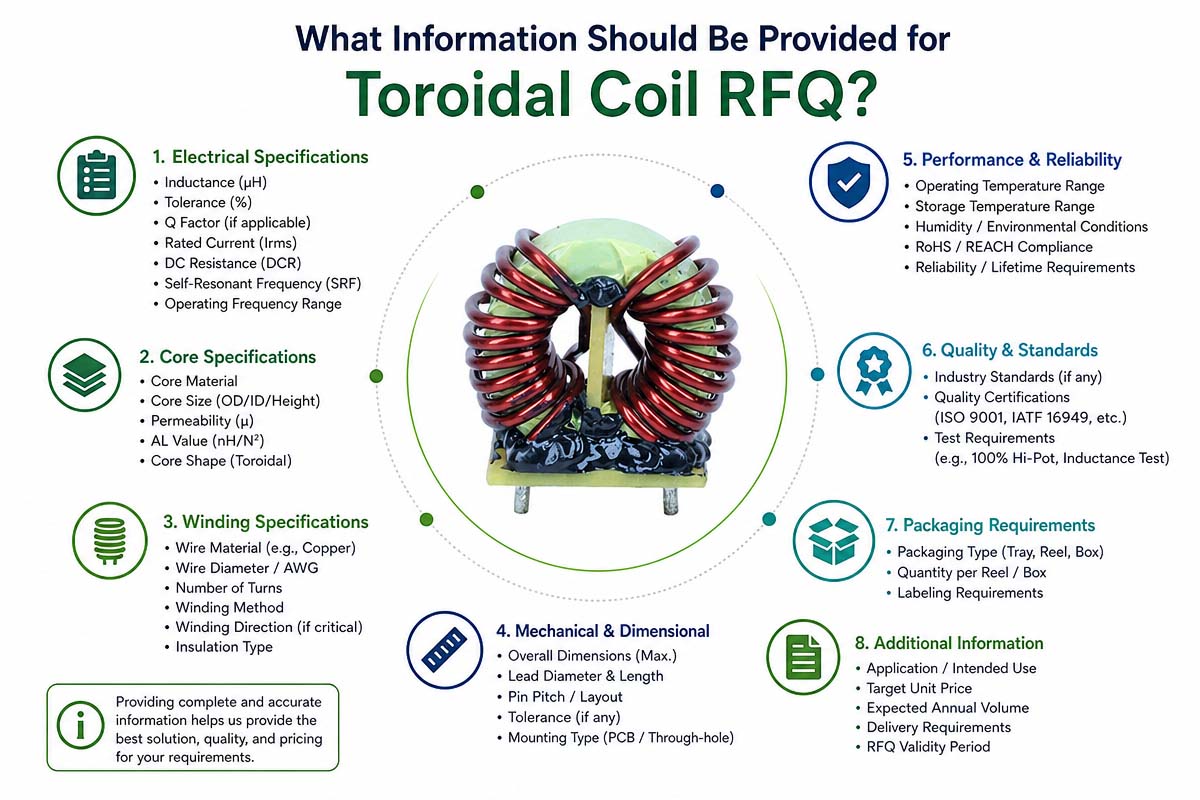
To offer you an accurate quote and engineering assessment, please provide the information as follows:
Inductance requirement
Current rating
Maximum current
Operating frequency
Supply voltage
Requirement of DC resistance
Core material (if any)
Outside diameter
Inside diameter
Maximum altitude
Number of turns
Wire specifications
Insulation requirements
Working temperature
Application
Estimated annual quantity
Drawings, existing samples, or product specifications are particularly useful.
If some information is unknown, please provide the application and electrical consideration. Then, an experienced manufacturer will be able to assist you with the definition of other design parameters.
Chapter 13: FAQs About Toroidal Coils
What is the function of a toroidal coil?
Toroidal coils are often used for inductance, energy storage, EMI filtering, common mode noise suppression, and power filtering in electronics and industrial devices.
What is a toroidal inductor?
It is an inductor wound by conductive wire around a circular-shaped core. The use of toroidal inductors is beneficial in cases when there are requirements for small size, efficient magnetic coupling, and low magnetic leakage.
What is a common mode choke?
It has multiple windings on a common magnetic core, which cancel common mode electromagnetic interference while allowing signal or power current to pass through.
How to choose the ferrite toroidal core?
Core selection depends on the operating frequency, current, inductance, temperature, core loss, and saturation considerations. Physical size should not be the decisive factor.
Is the toroidal coil customizable?
Yes. It can be customized with respect to core material, core dimension, wire diameter, number of turns, wire winding configuration, terminals and insulation, and electrical specifications.
What data should be provided for a customized toroidal inductor?
Minimum: required inductance, operating frequency, current, voltage, available size, and application. Additional information like DC resistance and temperature requirement will improve the accuracy of the design.
Is the toroidal coil applicable for EMI suppression?
Yes. Toroidal magnetic components are widely used for EMI filtering and common mode noise suppression applications.
What is the difference between a toroidal inductor and a common mode choke?
Generally, the toroidal inductor consists of a single magnetic winding for inductive filtering and energy storage. A common mode choke usually has multiple windings on a common magnetic core, which suppresses common mode interference.
Are you able to make prototypes before mass production?
Prototype development is possible for custom projects prior to mass production for electrical and mechanical performance assessment and approval.
Request Toroidal Coil Quote
Looking for a reliable toroidal coil manufacturer, toroidal inductor supplier, or common mode choke manufacturer?
Weilong will evaluate your needs and give you an engineering assessment for custom toroidal coils, inductors, and choke applications.
Please send to:
Product drawing+electrical specification+application+estimated quantity
Our engineering team will then be able to assess the core, winding, wire, dimension, and test requirements and recommend the best manufacturing solution.
Want to develop your custom project for a toroidal coil? Please contact Weilong Intelligent Technology and request your OEM quotation now.


