Custom Wireless Charging Coil for Smart Electronics device
Custom Wireless Charging Coil Manufacturer for charging device
Custom Wireless Power Coil Design for Smart Electronics Devices
Custom Wireless Charging Coil for Smart Electronics guide
Custom Wireless Charging Coil For electronic charging Solutions
Custom Wireless Charging Coil for Medical Equipment Device
Custom Wireless Charging Coil for Smart Electronics device
Custom Wireless Charging Coil Manufacturer for charging device
Custom Wireless Power Coil Design for Smart Electronics Devices
Custom Wireless Charging Coil for Smart Electronics guide
Custom Wireless Charging Coil For electronic charging Solutions
Custom Wireless Charging Coil for Medical Equipment Device

WL11G50 Custom Wireless Charging Coil for Electronics Solutions

A custom wireless charging coil is a highly flexible solution for a product that cannot comply with the dimensions and electrical characteristics of a standard coil. The buyer can design the coiaccording to the product’s needsct.

Diameter, length, thickness, inductance, resistance, type of wire, winding pattern, ferrite shielding, and terminals can be customized.

In addition, the coil can be optimized in accordance with the required charging power, operational frequency, thermal performance, and available installation space.

The main advantage for the customers is improved integration into the system. Well-matched coils can improve the wireless power transfer, charging performance, and thermal performance of the system and reduce unnecessary space inside the finished product.

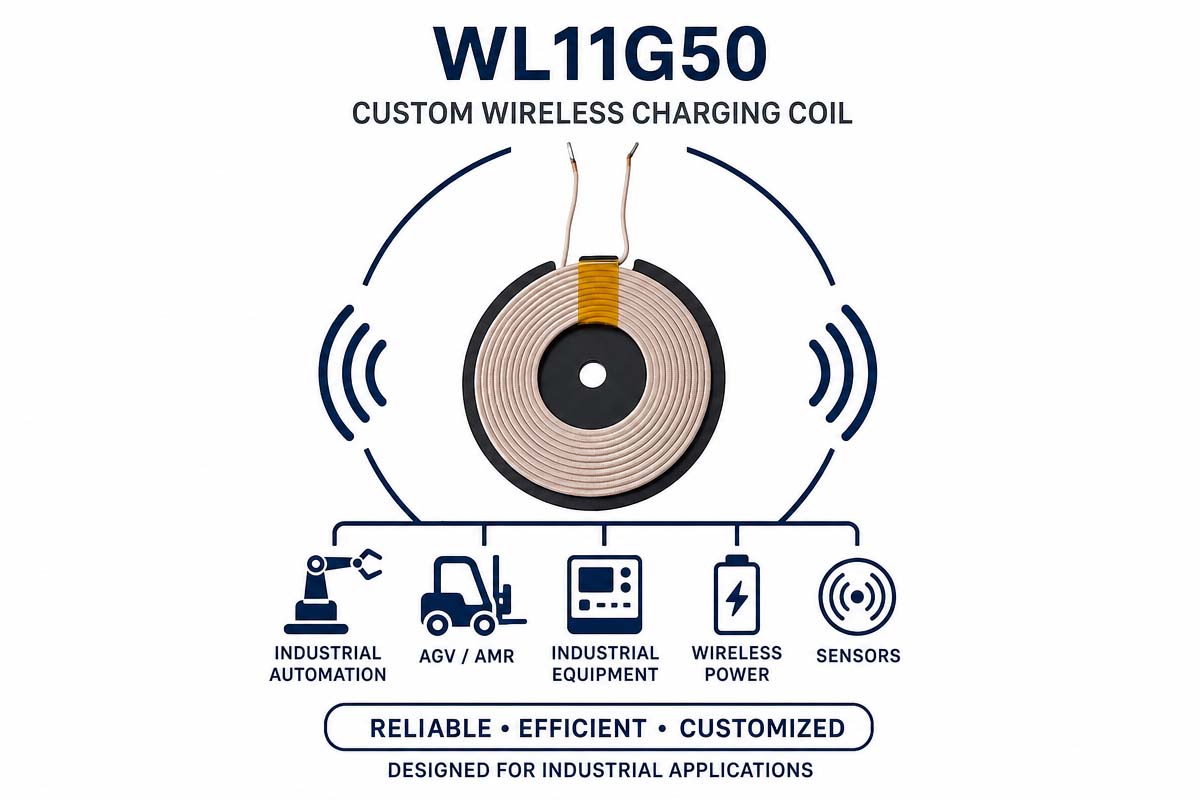
Custom wireless charging coils are perfect for smartphones, smartwatches, IoT products, medical electronics, automotive devices, industrial sensors, charging pads, and any embedded wireless-power applications. OEM manufacturers can offer development, testing, optimization, and mass-production services in accordance with customers’ specifications.

Custom Wireless Charging Coil Product Overview

The custom wireless charging coil is a specially designed component for wireless energy transfer between electronic devices. It can be customized as needed in size, inductance, operational frequency, charging power, resistance, wire structure, and installation conditions. Depending on the application, the design may include copper wire, Litz wire, FPC construction, or magnetic ferrite shielding. The coil can be designed for both transmitter and receiver applications and optimized for charging performance, thermal performance, and alignment tolerance. The OEM development process usually includes requirement analysis, engineering design, prototype production, electrical testing, charging verification, and production optimization. This allows custom wireless charging coils to be ideal for smartphones, wearables, IoT, medical, automotive, and industrial electronics.

How a Custom Wireless Charging Coil Works

Wireless charging is made possible by magnetic coupling and electromagnetic induction.

Step 1 – Electrical energy input

The charging circuit provides an alternating current to the transmitter coil.

Step 2—Generating the Magnetic Field

The transmitter coil transforms electrical energy into a varying magnetic field.

Step 3 – Magnetic Coupling

The magnetic field passes the gap between the transmitter coil and the receiver coil.

Step 4 – Energy Received

Once again the receiver coil transforms the changing magnetic field into electrical energy.

Step 5 – Power Conditioning

The rectifier and charging circuit transform and regulate the received power for the battery or electronic load.

Key factors that affect performance

Position of coil

Operational frequency

Self-Inductance

Resistance of the coil

Distance between coils

“Ferrite shielding

Charging power

Metal parts surrounding

Temperature condition

Design the transmitter, receiver, charging IC, and coil as a single system for an OEM product, not an isolated component.

Main Features of a Custom Wireless Charging Coil

Customized geometrical and electrical parameters and high magnetic performance are the main features of a custom wireless charging coil. The coil can be designed according to specific inductance, resistance, operating frequency, and current requirements. Diameter, length, and thickness can be optimized in case of limited installation space. Depending on the application, copper wire, Litz wire, FPC, and other winding structures can be considered. Ferrite shielding enhances magnetic coupling and reduces the undesired electromagnetic interference. Custom winding patterns can increase charging performance and thermal performance of the system. OEM development allows the buyer to test the coil with the charging circuit, enclosure, and battery system of the customer’s device prior to the mass production, decreasing the integration risk.

Custom Wireless Charging Coil Product Video

Custom Wireless Charging Coil Datasheet

Brand Weilong Technology Model Number WL11G50
Product Size: 50*1.0 * 10 TS *6,5 UH Rated Power (W) 5, 10, or 15 W
Wire: 0.08 mm * 105 Holding Force (N) Nil
DCR 26.5 UH +/- 10% Reset Time(s) Nil
Service Life 300 Thousand Times Certification CE, RoHS, ISO9001,
Material copper wire Power Contact lead wire
Install Style adhered tape Tolerance of Dimension ± 0.1 MM
Water-proof None Insulation Class F
Hi-Pot Test AC 600V 50/60Hz 2s Non-excitation Holding Force 0
Working Temperature -10°C-100°C Duty Cycle 1-100%
Thread Depth (mm) 0.1 mm Payment Term TT, or LC at Sight
Sample Order Yes. Warranty 1 Year
MOQ 1000 pcs Supply Ability 5000 pcs per week
Delivery Time 30 Days Port of Loading Shenzhen

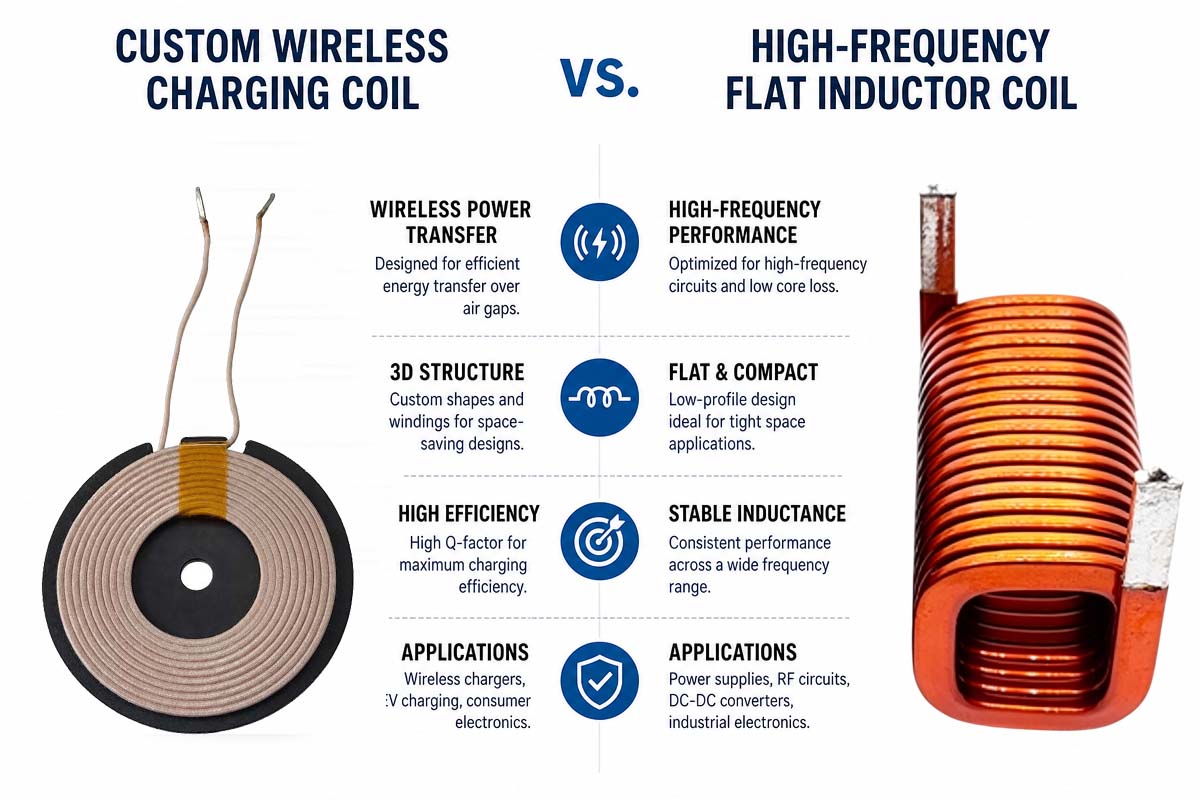
Custom Wireless Charging Coil vs. High-Frequency Flat Inductor

Coil

Custom Wireless Charging Coil vs. High-Frequency Flat Inductor Coil

Feature Custom Wireless Charging Coil High-Frequency Flat Inductor Coil
Primary Function Wireless power transfer Energy storage/filtering in circuits
Main Principle Electromagnetic coupling Inductance and high-frequency impedance
Typical Application Wireless charging Power electronics, RF, and filtering
Power Transfer Transfers power between coils Normally does not transfer power wirelessly
Coil Structure Optimized for transmitter/receiver coupling Optimized for circuit inductance
Magnetic Field Designed to couple with another coil Mainly used within its own circuit
Ferrite Shielding Frequently important Application dependent
Alignment Often critical Usually not applicable
Air Gap Important design parameter Generally not a primary parameter
Charging IC Matching Very important Circuit matching is important.
Thermal Design Important for continuous charging Depends on current/frequency
Typical Products Smartphones, wearables, charging pads, IoT DC-DC converters, filters, RF circuits
Design Priority Power transfer efficiency and coupling Inductance, Q factor, and impedance
Customization Size, inductance, shielding, winding, and power Inductance, size, frequency, and Q factor


The only difference

A custom wireless charging coil is basically the coil that is designed for transferring energy to another coil wirelessly. A high-frequency flat inductor coil is basically the inductive component that is used in an electronic circuit.

Both are electromagnetic devices and may look similar physically but have different electrical purposes, magnetic designs, testing, and system applications.

For the wireless charging, the whole design should consider the transmitter coil, receiver coil, charging IC, magnetic shielding, and mechanical structure as a whole.


Custom Wireless Charging Coil Application Guide

Custom Wireless Charging Coil Industrial Application

Custom wireless charging coils are used in consumer electronics, industrial equipment, and special electronic systems. Smartphone and wearable products use thin coils for energy transfer and installation in restricted spaces. Custom dimensions and optimized charging performance can benefit smartwatches, wireless earbuds, and portable electronics.

Custom wireless charging coils can provide contactless power to the sensors, monitoring devices, smart meters, and automated equipment in IoT and industrial applications. It allows reducing exposed electrical contacts and simplifies the design of the device enclosure.

Customized wireless charging coils can be applied in medical electronics, where compact size, reliable power transmission, and controlled thermal behavior are crucial. It can be designed in accordance with the device enclosure and charging electronics.

Customized wireless charging coils can be implemented in charging pads, vehicle accessories, and embedded electronic systems for automotive applications.

Other applications are

Wireless charging spots

Home automation products

Industrial sensors

Robotics •

Machine Tools

Mobile devices

Consumer electronics

Battery-operated devices

On-board charging systems

The key advantage of customization is the possibility of designing the coil in accordance with the actual mechanical and electrical requirements of the final product.

Why is the custom wireless charging coil becoming popular for smart phone charging solutions?

The growing demand for wireless charging of smartphones is creating a need for coils that fit into the compact and complex structures of the devices.

Inside the phone, the components of smartphones should be as small as possible while still providing reliable power transfer. The custom wireless charging coil allows the engineers to optimize the coil diameter, thickness, inductance, resistance, and magnetic shielding to match the phone’s architecture.

The other important parameter is charging performance. As the charging power increases, coil efficiency and thermal management become increasingly important. A coil specifically designed for the charging system can help to find a compromise between power transfer, temperature, and available space.

Customization also allows incorporating the coil with other components such as batteries, NFC structures, shielding materials, and phone enclosures.

The task for the smartphone manufacturer is not only to find a coil that works. You need to find a coil that fits, works efficiently, dissipates heat, and can be mass-produced.

Thus, custom wireless charging coils are becoming more and more popular in high-performance smartphones, wireless charging accessories, and other small consumer electronics.

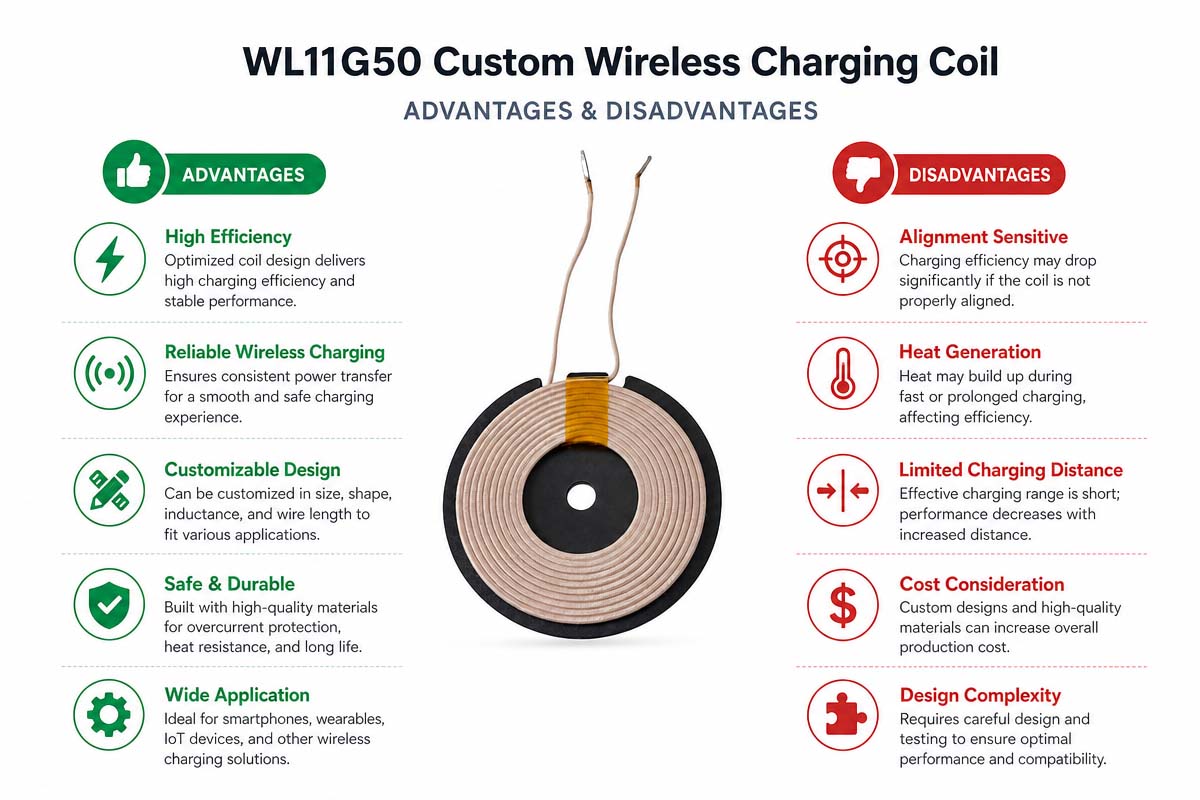
Custom Wireless Charging Coil Advantage and Disadvantage

Custom Wireless Charging Coil Advantages and Disadvantages

Custom wireless charging coils can be very valuable for the finished product in case standard components can’t offer what is needed.

Advantages

Enhanced product integration:

The coil can be designed to fit into the available installation space.

Electric performance improvement:

Inductance, resistance, and winding structure can be tuned for the charging circuit.

Higher charging efficiency:

Proper coil geometry and magnetic shields can enhance the power transmission.

Greater mechanical design flexibility:

Round, square, rectangular, ultra-thin, and application-specific designs of the coil are possible.

Thermal optimization improvement:

The coil can be designed for continuous charging requirements.

Greater OEM flexibility:

Instead of adjusting the product to the standard component, the customer can design the coil.

Disadvantages

Greater initial development cost:

More money is needed for custom engineering and prototype development.

Greater development time:

Design, sampling, and testing take more time than ordering the standard coil.

Minimum order quantity:

Sometimes it is necessary to buy more to make mass production cost-effective.

Engineering complexity:

The coil is tuned for charging the IC, enclosure, and adjacent parts.

Generally, customization is most valuable when performance, space, reliability, or integration needs outweigh the lowest initial component price.

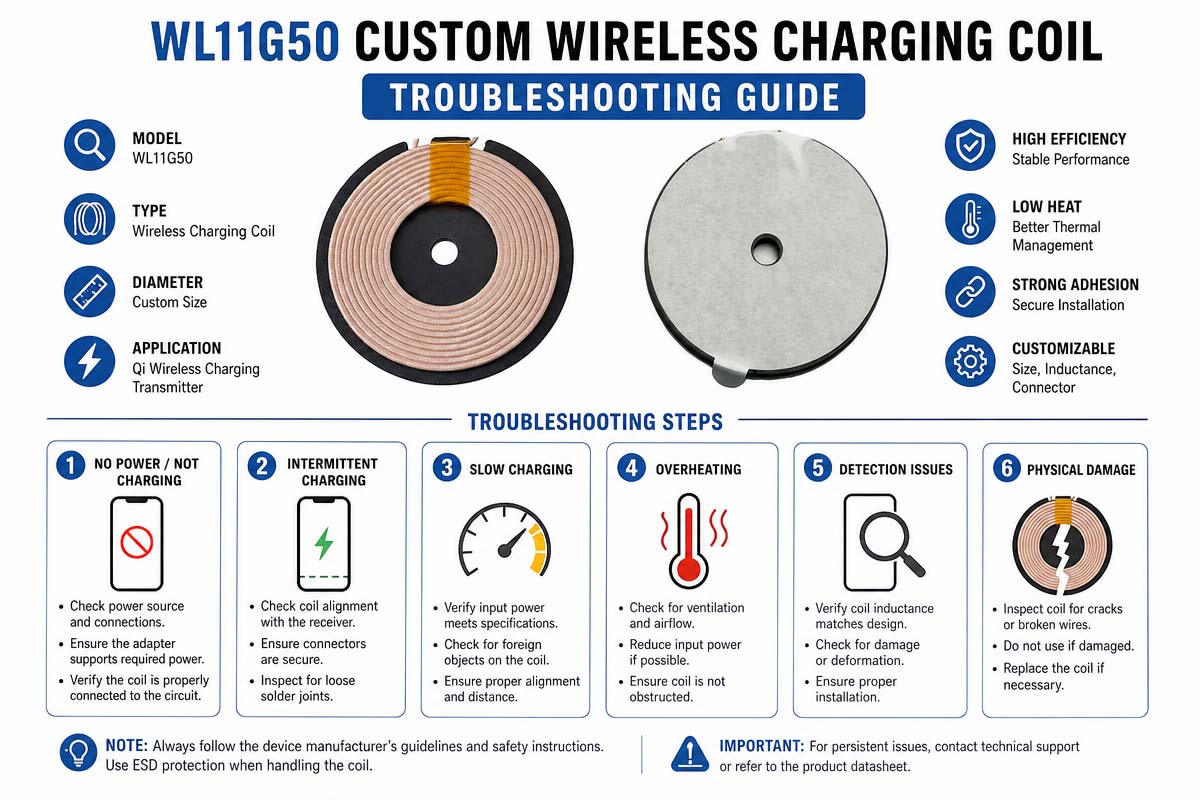
Troubleshooting of Custom Wireless Charging Coil

WL11G50 Custom Wireless Charging Coil Troubleshooting guide

In case when the wireless charging system works improperly, the coil, charging circuit, and mechanical assembly should be tested.

Problem 1: Inefficient Charging

Test coil alignment, operating frequency, inductance, coil resistance, and distance between transmitter and receiver coils. Nearby metallic parts can reduce the magnetic coupling.

Problem 2: Charging is sporadic.

Check the alignment of coils in the transmitter and receiver. Also test the charging IC, power supply, and connector connections.

Problem 3. High Temperature.

Excessive temperature may be caused by high DCR, excessive current, poor ventilation, or improper operating conditions. Test wire diameter and winding structure.

Problem 4: Limited chargPlease checkange

Check the magnetic coupling and the air gap. A larger coil, proper alignment, or an improved ferrite structure might be needed.

Problem 5: Coil Not Matching Circuit

Test inductance, resistance, frequency, and Q factor for matching with charging IC.

Problem 6: Electromagnetic interference

Test ferrite shielding and the proximity of nearby electronic components. Engineering might be needed for the case of metalwork and high-frequency circuits.

Troubleshooting Procedures

Measurement Comparison to Specification Determination of the Cause of Changing of Coil/System Test Again

In the case of OEM development, testing should be performed in the actual product assembly; a good-performing coil can behave differently when being installed inside the final enclosure.

8 Common Questions About Custom Wireless Charging Coils

1. What is a custom wireless charging coil?

A custom wireless charging coil is the coil that is designed for the electrical, mechanical, and charging requirements of the product. It can be customized for diameter, inductance, resistance, operating frequency, power level, winding structure, and magnetic shielding.

2. Why use custom wireless charging coil instead of the standard one?

Custom coil allows building the charging system, which will be adjusted for your installation space and performance requirements. It can be tuned for the charging efficiency, temperature, alignment tolerance, and charging IC compatibility.

3. What specifications do I need to give for a custom wireless charging coil?

Critical specifications include charging power, operating voltage, frequency, target inductance, max DCR, coil diameter and thickness, charging distance, type of transmitter/receiver, and available installation space. Information about the charging IC is also important.

4. Can I customize wireless charging coils for smartphones?

Yes. Wireless charging coils can be designed for smart phones and other small devices. The coil can be optimized for constrained installation space, charging power, thermal performance, magnetic shielding, and integration with the phone’s internal components.

5. Do you make ultra-thin wireless charging coils?

Yes. Ultra-thin coil designs can be developed in the case when there is limited space inside the device. The final thickness of the coil is determined by the required charging power, coil design, wire choice, ferrite material, and mechanical requirements.

6. How do I know that my custom coil will be efficient enough to charge?

The coil should be tested with the actual transmitter/receiver circuit and final product assembly. Performance depends on factors such as coil alignment, inductance, DCR, operating frequency, air gap, magnetic shielding, and charging power.

7. Is it possible to make custom wireless charging coils in volume?

Yes. Once the prototype is tested and the design is validated, the coil can be moved to mass production. Before making a big order, the buyer should check the electrical specifications, dimensional tolerances, quality standards, packaging, MOQ, and production lead time.

8. What is the typical process of a custom wireless charging coil?

Typically the process is requirement analysis → engineering design → prototype → electrical and charging testing → optimization → design approval → mass production. Having a full set of product specifications upfront can help to shorten the development time and avoid redesigns.


How to Select a Customized Wireless Charging Coil

Selecting the right custom wireless charging coil is not just about choosing a coil based on its dimensions. The buyer should take into account electrical, mechanical, thermal, and application needs.

1. Set the charging power

First of all, determine the required output power. The requirements for a low-power wearable device are very different than those of a smartphone, IoT sensor, or automotive system. Target power affects the coil structure, wire choice, and thermal design.

2. Check the Operational Frequency

The coil must be compatible with the chosen charging IC and wireless power system. The frequency affects inductance, impedance, charging performance, and heating.

3. Inductance setup

The charging circuit will require calculating the required inductance. Incorrectly sized coils can cause charging performance and system stability issues.

4. Determine Available Space

Specify the maximum diameter, length, and thickness allowed. In the case of compact products, even a slight difference in dimensions can affect the final assembly.

5. Consider Coil-to-Coil Distance

The magnetic coupling depends on the distance between the transmitter and receiver coils. A large air gap requires adjusting the coil design.

6. Check Magnetic Shielding

Ferrite shielding can also concentrate the magnetic flux into the receiving coil and reduce interference with nearby electronic components.

7. Consider Temperature

The wireless charging causes heating. The buyer should state the permissible temperature rise and operating conditions so that the manufacturer could optimize the resistance, wire size, and winding structure.

8. State Mechanical Requirements

Specify the mounting method, adhesive requirements, connector or terminal location, and enclosure restrictions.

9. Ask for Prototype Testing

Prototype testing in the real product environment before mass production. Verify the charging performance, temperature, alignment tolerance, and mechanical fit.

10. Choose Supplier

Choose the supplier who can perform design, prototyping, testing, and mass production services, not just a coil supplier.

So the best coil is the one that has the right balance between charging performance, dimensions, thermal performance, reliability, and cost.

Common Pitfalls in the Design of Custom Wireless Charging Coils and How to Avoid Them

Pitfall 1: Design of Coil Without Charging IC

Coil design must take the charging circuit into account. Please provide specifications for the charging IC or electrical requirements.

Pitfall 2: Focusing only on the size of the coil

Physical fit does not guarantee electrical fit. Take into account inductance, resistance, frequency, and power together.

Pitfall #3: Ignoring the Air Gap

The coupling is very sensitive to the distance between the transmitter and receiver coil. Measurement of actual installation distance

Pitfall 4: Metal too close to the coil

Metallic parts can interfere with magnetic fields and reduce the charging efficiency. Test the whole assembly and not only the coil.

Pitfall 5: Not considering heat dissipation

High resistance can result in excessive heat because of continuous charging. Prototype testing includes thermal testing.

Pitfall #6: Not Testing the Prototypes

Never move straight from the CAD design to mass production. Test the coil in the actual enclosure and charging system.

7. Changing specification too late

Changes to the diameter, thickness, inductance, or winding design after tooling and production have been established will increase development time and cost.

Buyer Tips

Give power, voltage, frequency, inductance, dimensions, air gap, charging IC, and installation environment to the manufacturer as soon as possible.

Get A Free Quote Now

Contact Form

Related Products

Related News

Scroll to Top

Get A Free Quote Now !

Contact Form
If you have any questions, please do not hesitate to contact us.
Weilong Solenoid Company Culture
