

Chapter 1: Introduction
Wireless charging technology has become an essential source of power supply for smartphones, wearable devices, smart home appliances, medical equipment, automotive electronics, and industrial appliances. The wireless charging coil is a key element of every wireless power transfer system. The technology enables the transmitter and receiver to exchange energy via electromagnetic induction.
It is important to choose the best wireless charging coil manufacturer in order to achieve functionality, reliability, and scalability of product production. A professional manufacturer is able to offer customized Qi coil design, engineering, material selection, prototyping, and production services depending on application requirements.
This guide will give answers to the main questions about custom wireless charging coil manufacturing, from design and working principles, through customization options, performance optimization, and important points when selecting a manufacturing partner.
Chapter 2: What Is a Wireless Charging Coil?
A wireless charging coil is an electromagnetic element that allows transferring electrical energy without physical connection. This component mainly consists of a copper wire winding structure, magnetic shielding materials, insulating layers, and other components.
The coil can act as a transmitter coil or a receiver coil:
Transmitter Coil (TX Coil): Turns electrical energy into an alternating magnetic field.
Receiver Coil (RX Coil): Receives the magnetic energy and transforms it back into electrical energy.
Modern Qi wireless charging systems require proper coil design in order to reach high efficiency, stable energy transfer, and safe operation.
A professional wireless charging coil manufacturer produces coils to meet industry standards, including Qi certification, application space requirements, power output, and thermal management.
Chapter 3: How Do Wireless Charging Coils Work
Wireless charging coils operate according to electromagnetic induction principles.
The transmitter coil is charged with an alternating current, which forms a changing magnetic field. The receiver coil goes through this magnetic field, and an induced voltage is formed to transfer electrical energy to the battery charging circuit.
The performance of the charger is influenced by the following factors:
Coil diameter and shape
Number of turns in the winding
Diameter of copper wire
Frequency of operation
Materials for magnetic shielding
Alignment of TX and RX coils
Space between coils
A professional wireless charging coil manufacturer uses simulations and testing equipment to optimize these factors before mass production.
Chapter 4: Process of Custom Wireless Charging Coil Design
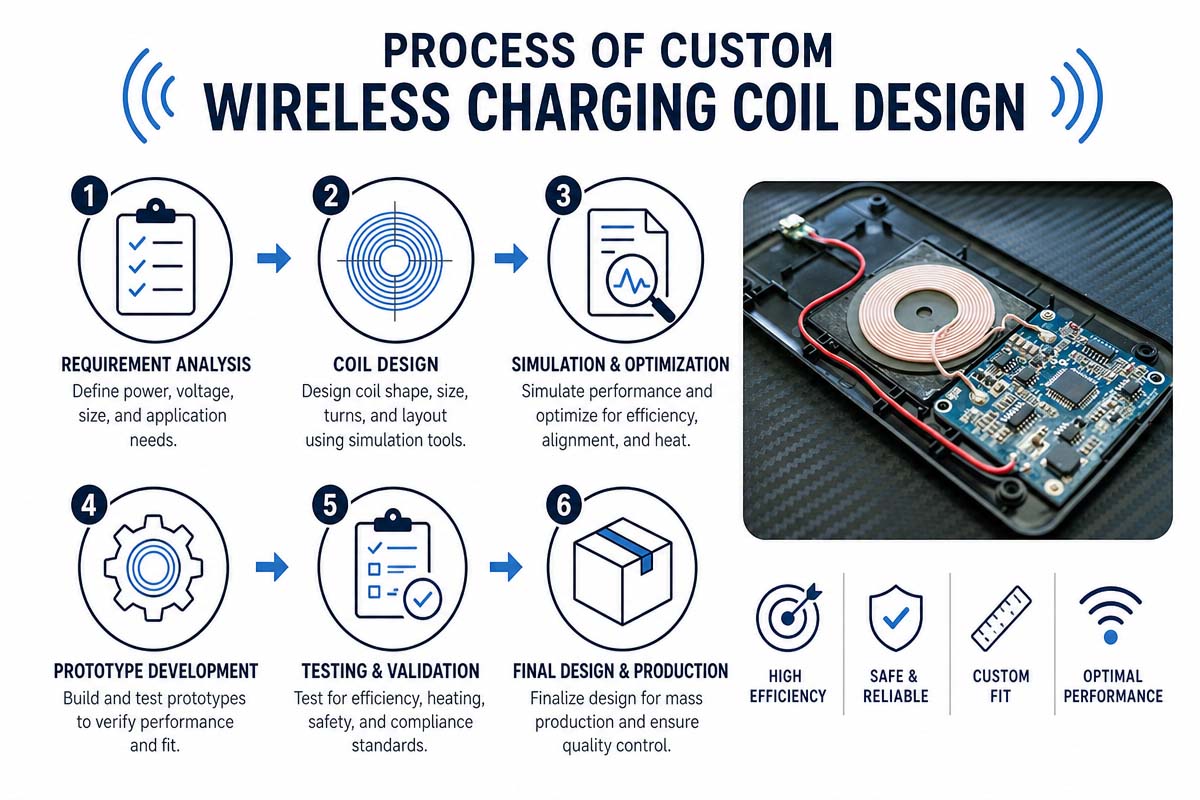
4.1 Analysis of Application Requirements
Tcreating custom Qi coils is to know coils is knowing the customer’s product requirements.
Engineers analyze:
Installation space and device design
Required charging power
Voltage and current ratings.
Restrictions on the coil size
Environment
Temperature requirements
Volume of production
Different applications need different coil designs. For instance, a compact, high-density coil is necessary for a smartwatch, while a large-size, high-power coil is required for an electric vehicle charging system.
4.2 Coil Structure Design
A professional wireless charging coil manufacturer offers customized design according to electrical and mechanical requirements.
Popular coil structures are
Coil spiral
The spiral coils are widespread in mobile phones, tablets, and wearables due to their small size and high efficiency.
4.3 Multi-Layer Coil (MLC)
MLCs provide high inductance and power capacity in a small size.
Flexible Coil with
Flexible coils are made from thin materials and are suitable for curved surfaces, smart devices, and applications with limited space.
Shape of Custom Coil
Certain applications may need a rectangular, oval, or other non-standard shape of the coil to comply with unique product design.
Chapter 5: Key Materials for Wireless Charging Coil Manufacturing
Selection of materials directly influences the charging efficiency and durability.
Copper Wire
Features of quality copper wire:
Low electric resistance
High energy transfer efficiency
Minimal heat generation
Longer service life
Material for Magnetic Shielding
Typically, ferrite sheets are placed behind charging coils for:
Focus of the magnetic field
Minimization of energy losses
Protection of the adjacent electronic components
Increase of charge stability
Insulating Materials
Insulating layers prevent short-circuits and increase mechanical protection.
Typical materials are
Polyimide film (Kapton)
PET insulating film
Layers of adhesive
Chapter 6: Optimizing the Performance of Custom Qi Coils
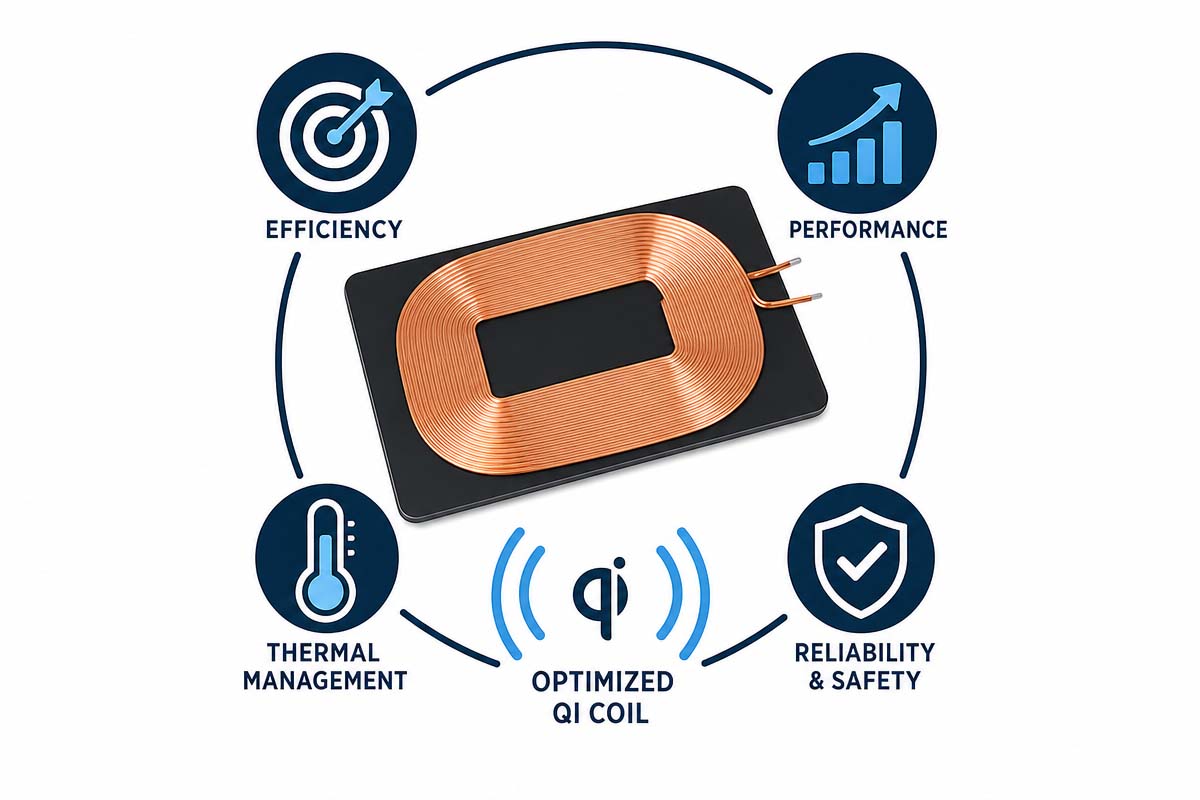
A professional wireless charging coil manufacturer focuses on several key performance indicators.
Charging Efficiency
Higher efficiency means lower energy loss and faster charging speed.
Methods of optimization are
Proper design of coil windings
Best magnetic shielding
Higher tolerance to alignment
Materials with low resistance
Temperature Regulation
Safe wireless charging requires effective heat management.
Engineers optimize:
Size of copper wire
Coil resistance
Thickness of ferrite
Service current
Electromagnetic Compatibility (EMC)
Wireless charging coils should generate minimal electromagnetic interference with other electronic components.
Testing involves:
Configuration of the magnetic field
Radiation testing
Interference analysis_
Chapter 7: Wireless Charging Coil Production Process
STEP 1: Design engineering
The manufacturer considers the customer’s specifications and develops:
Electrical diagrams
3D Model
Coil winding schemes
Simulation of performance
Step 2: Prototype Creation
Prototypes are produced for:
Efficiency testing
Testing of temperature
Mechanical testing
Compatibility testing
Testing of prototypes allows making necessary design changes before the start of mass production.
Step 3: Automatic coil winding
Advanced winding machines guarantee:
Exact windings of the coil
Equal dimensions of the coil
Constant electrical performance
Step 4: Coil Assembly
The coil assembly process includes:
Winding of the copper coil
Attaching the ferrite
Glue bonding
Protective Film Application
Assembly of Cable/Connector
Step 5: Quality Testing
Each batch of production undergoes testing for:
Resistance value
Inductions
Q-factor,
Charging efficiency
Appearance quality
Performance reliability
Chapter 8: Applications of Wireless Charging Coils
Wireless charging coils are electromagnets, which make it possible to transfer energy from the charging transmitter to a charging receiver without establishing an electrical contact. Due to the use of electromagnetic induction or magnetic resonance, wireless charging coils make the power transfer convenient and cable-free for many applications. The increasing development of wireless power technology is leading to the growing importance of wireless charging coils in small, intelligent devices.
1. Smartphones and Consumer Electronics
One of the most widespread applications of wireless charging coils is the charging of smartphones. With the help of a transmitter coil placed in the charging pad, an alternating magnetic field is created, which, in its turn, is converted back into electrical power by the receiver coil, located in the smartphone.
The application of wireless charging coils can be observed in the charging of smartwatches, wireless earbuds, tablets, handheld gaming devices, and other portable electronics due to their compact design.
2. Automotive Wireless Charging
Wireless charging coils are more and more often applied for automotive purposes. The application of such coils can facilitate the charging of smartphones in cars, as well as create the opportunity for charging of electric cars in the future. To ensure the proper operation of automotive wireless power systems, special attention should be paid to magnetic coupling efficiency, thermal management, mechanical robustness, vibration, and temperature tolerance.
In the case of EVs, the large size of the transmitter and receiver coils allows for the transfer of significant amounts of energy without traditional plug connections.
3. Wearable Devices
To make wearable products more convenient, the use of power components of compact size can be very beneficial Wearable products include smartwatches, fitness trackers, medical wearables, and other devices of relatively small size. With the help of wireless charging coils, it is possible to eliminate mechanical wear caused by constant plugging/unplugging the charging connector. The absence of charging contacts increases the sealing properties of the product.
Custom design in terms of dimensions of the coils, winding structure, ferrite core material, and terminal design is possible according to the available installation space.
4. Medical Equipment
Wireless charging coils have significant potential in medical and healthcare equipment. The use of wireless charging coils can allow the provision of contactless charging of medical devices, sensors, monitoring equipment, and other healthcare products. In this way, it is possible to remove the exposure of the charging contacts, which leads to increased hygiene and a reduced probability of connection failure.
For medical purposes, the design of the coil has to consider efficiency, EMC compliance, operating temperature, and reliability.
5. Industrial Equipment and IoT Devices
Industrial sensors, automated equipment, smart meters, RFID-related systems, IoT devices, and others can use wireless power transfer. Thanks to wireless charging coils, sealed or hard-to-reach devices can get power from the transmitter without constantly inserting/removing the wires.
The wireless charging system can be especially useful when it comes to sensors, which are located in the hard-to-reach places. With the proper design of the charging system, it is possible to reduce wiring requirements and prolong the operating period.
6. Smart Home and Consumer Products
The use of wireless charging coils can be observed in various consumer products like smart speakers, remote controls, electronic locks, cleaning devices, smart lighting, and other devices. Coils can be placed directly in the housing of the product or charging station.
7. Custom OEM Applications
For OEM manufacturers, wireless charging coils can be designed according to the power requirement, operating frequency, coil diameter, thickness, inductance, resistance, ferrite core structure, and installation space. Such custom designs will help increase coupling efficiency and reduce EMF and heat generation.
Chapter 9: How to Choose a Professional Wireless Charging Coil Manufacturer?
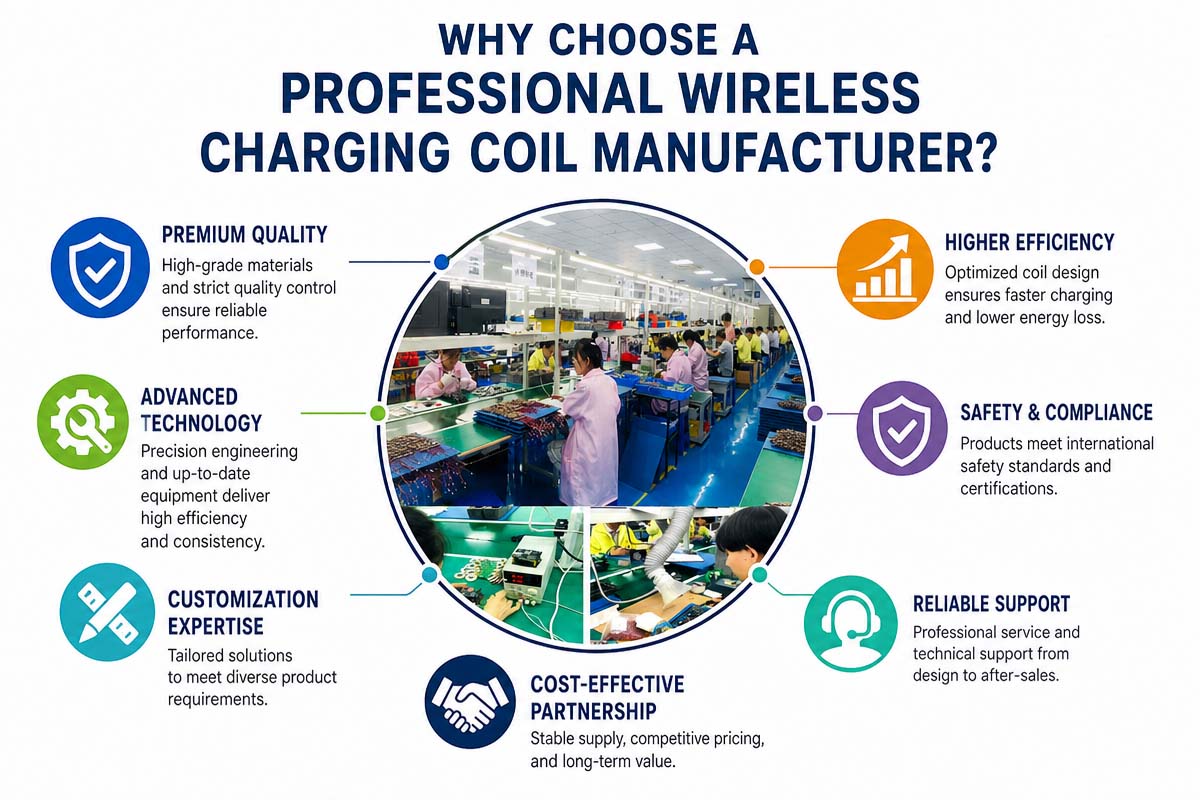
There are many advantages in cooperation with a manufacturer with experience in this field.
Custom Engineering Service
Professional suppliers help customers to optimize:
Coil design
Material selection
9.1 Electrical performance
Mechanical interaction
OEM & ODM Capability
A good manufacturer is able to produce:
Prototypes Samples
Small-scale manufacturing
Large-scale manufacturing
Wireless Charging Coils solutions for you
Stability of Quality Control
9.2 To ensure this, manufacturers use inspection systems:
Constant performance
Reliability of the product
Traceability of manufacture
Cost Optimization
9.3 Cost efficiencies can be reached by experienced manufacturers due to:
Optimization of the manufacturing process
Material control
Manufacturing automation
Chapter 10: How to Select a Good Wireless Charging Coil manufacturer?
While choosing a supplier, buyers should pay attention to:
Technical capabilities
Make sure that the manufacturer has:
Experience in coil design
Engineering teams
Test laboratories
Manufacturing equipment
Capability to Customize
The supplier should offer help:
In production of various sizes of the coil
Various shapes (by the Customer)
Various voltage requirements
Design solutions for certain applications
QC (Quality Control)
Important certifications and controls:
ISO quality systems
Reliability testing
Incoming materials inspection
Production inspection
Production Experience
The manufacturer with industry experience can manage:
Complex design
Large-scale production
Special requests
Chapter 11: Tips to avoid the common mistake when selecting a wireless charging coil manufacturer
In selecting a proper supplier of wireless charging coils, one must take into account such criteria as stability of charging, energy transfer efficiency, and high quality of the product. In case of improper supplier selection, one can face charging inefficiency, heating, electromagnetic interference, instability of coil parameters, and delays in product development. Below is the list of key aspects that OEM customers must consider before purchasing a wireless charging coil.
1. Do Not Select Supplier Only by Low Quotation
The first mistake is the selection of the supplier by means of the lowest quotation. Lower-priced coils use low-grade wire, ferrites, insulating materials, or adhesives, which decrease charging efficiency and reduce the product lifetime. One must consider such indicators as quality of materials used, engineering and testing services provided, tooling cost, MOQ, and production consistency.
2. Make Sure the Supplier Can Provide Custom Design Services
Wireless charging coils require customization because of installation space constraints. The standard coil may not fit the diameter, thickness, inductance, resistance, power, or operating frequency specifications. A professional wireless charging coil manufacturer provides customized coil structure, winding, ferrite shielding, terminals and connectors, and mechanical dimensions.
3. Confirm Electrical Parameters
One must not choose a coil only according to its size. In addition to size, electrical parameters play a key role in selection. These parameters include inductance, DC resistance, Q factor, operating frequency, rated power, current, voltage, and temperature rise. The supplier must provide reliable data for all electrical parameters obtained under clearly defined test conditions. This information allows engineers to find out if the coil fits the transmitter, receiver, and charging IC.
4. Estimate Charging Efficiency and Thermal Properties
Even if the coil is working electrically, it can produce excessive heat during work, which results in an inefficient charging process and heating up other electronic components. It is necessary to ensure that the manufacturer will estimate coil temperature, losses, magnetic coupling, and efficiency in the operational environment. Such tests are especially necessary for compact smartphone and wearable chargers, as well as automotive applications.
5. Check Ferrite and Shielding Quality
Ferrites are used for directing the magnetic field and reducing electromagnetic interference. Poor quality and design of shielding can influence charging efficiency and interfere with other electronic elements. The customer should ask the supplier to describe the ferrite material used, its thickness, permeability, bonding process, and structure.
6. Check Manufacturing and Testing Processes
A professional supplier possesses reliable manufacturing processes like winding, assembly, soldering, adhesive bonding, and inspection. The quality of production can be estimated with the help of inductance, resistance, Q factor, dimensions, electrical continuity, temperature rise, and durability tests.
7. Ensure Consistency between Prototypes and Mass Production
Though prototype works properly, it does not necessarily mean that mass production products will possess the same electrical and mechanical characteristics. Before choosing the supplier, ask how the manufacturer controls such manufacturing processes as winding tension, wire positioning, ferrite assembly, adhesive bonding, and final inspection. This step is crucial for maintaining a stable charging process in large quantities.
8. Consider Engineering and Lead Time Issues
Wireless charging projects typically require many design changes before the final product configuration is established. Therefore, the customer must select the supplier who is able to communicate with his/her engineering team and give technical recommendations. In addition, before making an order, it is necessary to find out the sample lead time, tooling, MOQ, production capacity, and delivery schedule.
Chapter 12: The Future Trend of Wireless Charging Coil
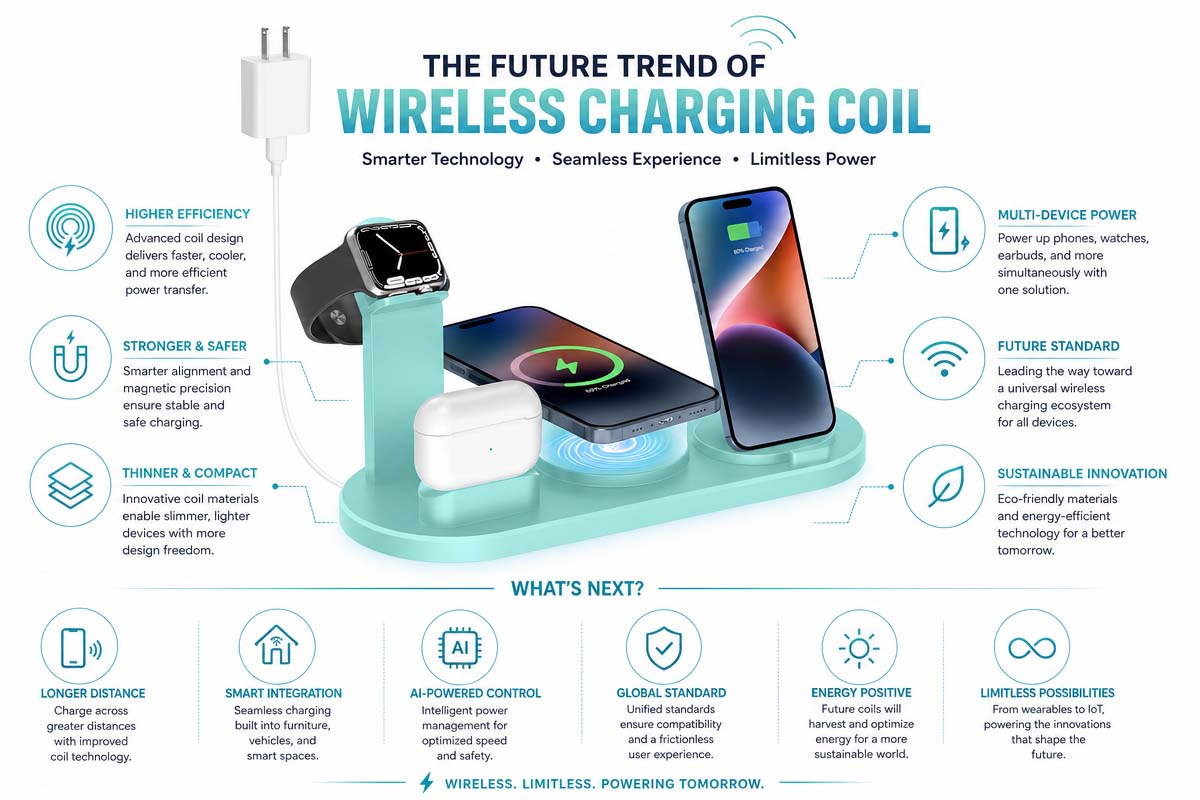
Wireless charging technology develops towards:
Higher power transmission
Compact coils design
Faster charging
Improved thermal management
Increased application areas
Wireless charging coils of the future will become more integrated, efficient and intelligent and will help in the development of IoT devices, smart vehicles and advanced electronic devices.
Chapter 13: Summary
For companies developing wireless power solutions, choosing the right Wireless Charging Coil Manufacturer is an important step. A reliable manufacturing partner will support you all the way through from the first stage of coil design and prototyping up to large-scale production and quality control.
Professional manufacturers with advanced engineering capabilities, customized Qi coil solutions and strict production management help to deliver wireless charging products efficiently and reliably in global markets.
Chapter 14: Wireless Charging Coil Manufacturer FAQs
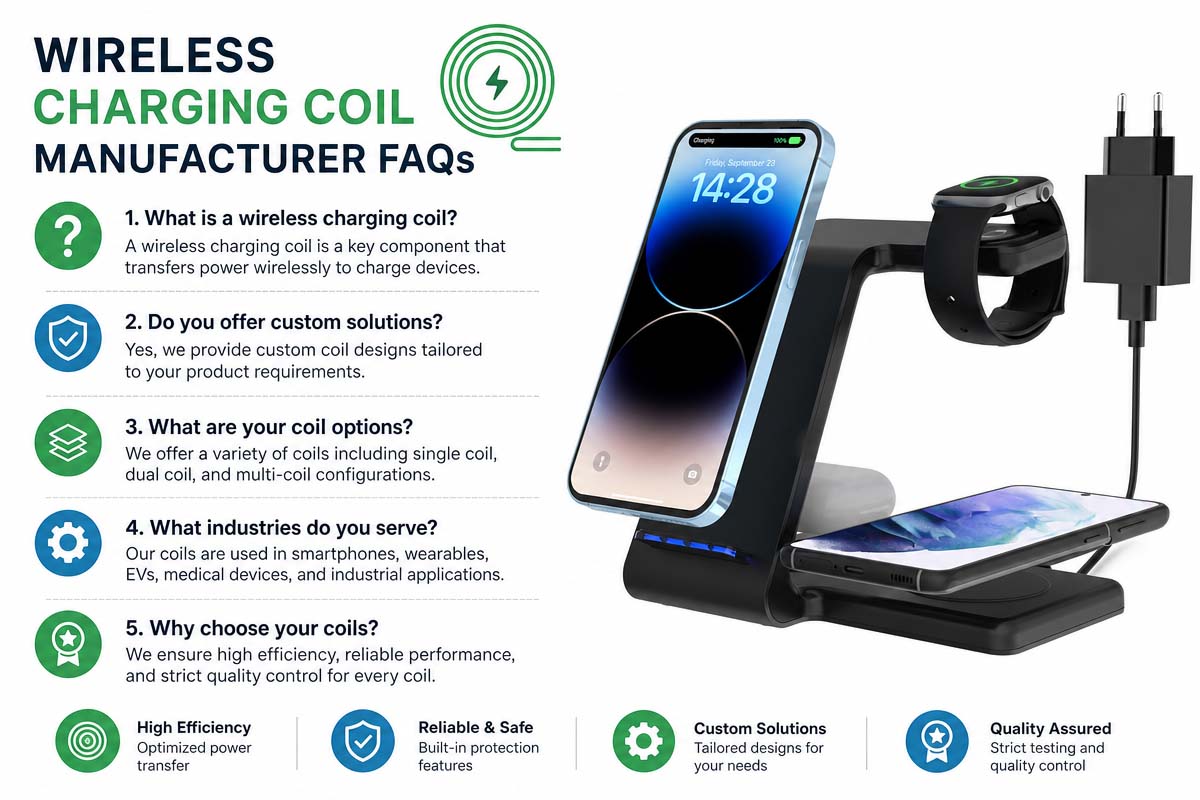
1. What is wireless charging coil manufacturer?
Wireless Charging Coil Manufacturer is a company providing engineering, production and customization services for wireless charging coils for various electronic applications. _
2. Is it possible to customize wireless charging coils according to product requirements?
Yes. Wireless charging coils can be customized according to size restrictions, charging power, operating frequency, voltage requirements, mechanical installation.
3.What affects the efficiency of wireless charging coils?
Important factors are coil design, quality of copper wire, design of windings, magnetic shielding, alignment, operating frequency and thermal management.
4. How long does it take to produce custom wireless charging coils?
It depends on complexity and volume of production. Prototyping usually takes several weeks and the lead time of mass production depends on manufacturing requirements and order volume.
5. How to select the best Wireless Charging Coil Manufacturer?
Choose a supplier with strong engineering capability, OEM experience, certifications, testing facilities and custom solutions capability from prototyping to mass production.


