

Introduction on Electromagnet Coils:
In the rapidly developing world of today’s electronics, electromagnet coils are among the key passive components of modern electrical circuits. Inductor coils play an important role in regulating electric current flow, ensuring high energy efficiency and proper functioning of a range of applications from smartphones to automotive electronics, renewable energy, and industrial automation.
Inductor coils are small-sized devices, but their applications range from energy storage, filtering, noise suppression, and power conversion. As technology development requires improved efficiency, miniaturization, and smarter energy management, the production of advanced inductor coils becomes essential for manufacturers and engineers worldwide.
Chapter 1: What is an Electromagnet Coil?
An electromagnet coil is a passive electrical component that consists of coiled conductive wire, typically copper wire, around a magnetic core or an air core. The electrical current going through the coil creates a magnetic field that stores energy.
The operation of an electromagnet coil is based on the principle of electromagnetic induction. The coil creates a magnetic field that resists changes in current, providing the ability to manage and regulate electrical energy in a circuit.
The electrical loop is used for generating current due to changes in magnetic flux.
The Basic Components of an Inductor Coil Include:
Copper winding: provides the electrical path and the creation of magnetic field; • Magnetic core: improves the inductance and energy-storing abilities of the coil; • Insulating layer: prevents short circuits between wire layers; • Housing or protection mechanism: ensures the mechanical protection and reliability of the inductor coil.
Chapter 2: How Do Electromagnet Coils Work?
The electromagnet coil stores energy in the magnetic field surrounding the coil when current passes through it. Changes in the current cause changes in the magnetic field, resulting in the generation of the counter voltage.
Such a unique feature allows the inductor coils to:
Provide current flow smoothening, unstable • Noise reduction • Efficient energy storing and release • Voltage transformation (increase or decrease) • Improve circuit stability
Thanks to these abilities, inductor coils are widely used in power supply circuits, electric vehicles, communication equipment, and industrial control systems.
Chapter 3: Major Applications of Electromagnet Coils in Modern Technology
3.1 Energy Conversion and Power Electronics
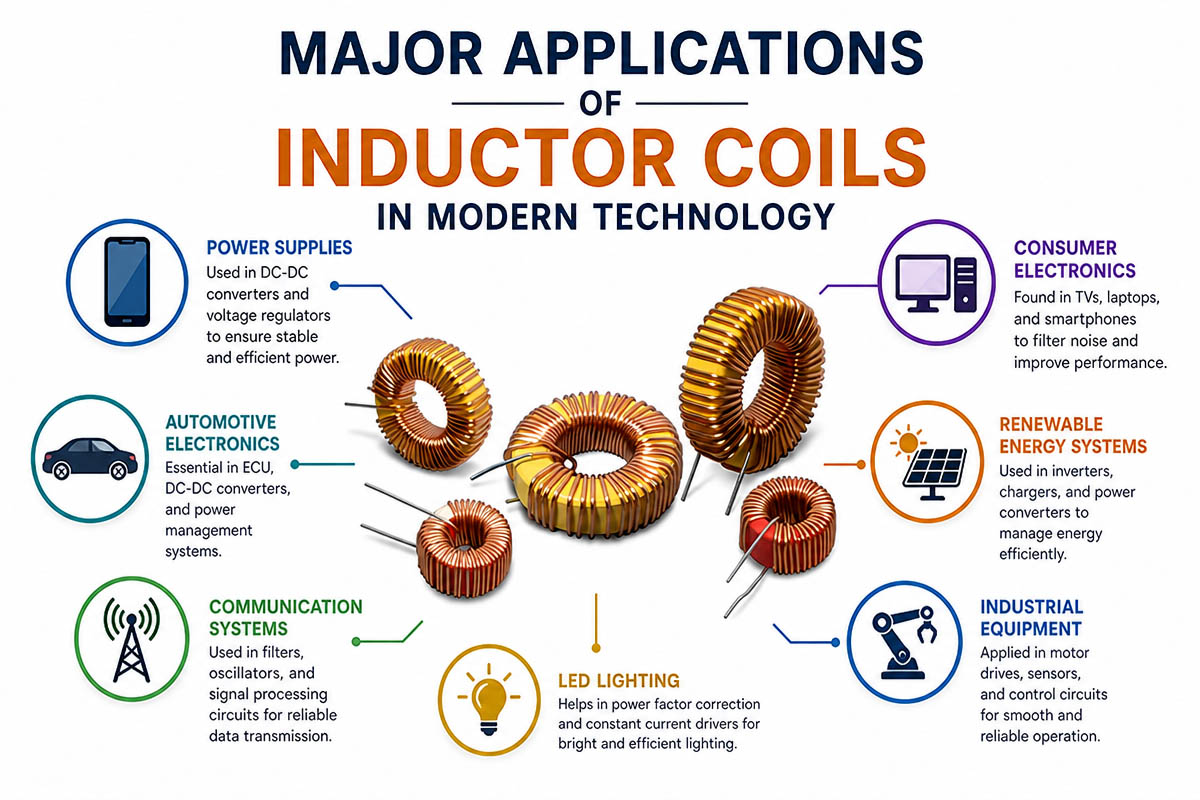
One of the most significant uses of inductor coils is power electronics.
In modern power systems, energy conversion between various voltage levels is required. The inductor coils are the key elements of the following: • DC-DC conversion; • Switching power supplies • Battery chargers • Voltage regulators
They reduce losses and improve energy conversion efficiency, thus providing reliability and energy efficiency of electronic products.
3.2 Automotive Electronics & Electric Vehicles
The development of electric vehicles (EVs) causes the growing demand for highly efficient inductor coils.
In EV systems, inductor coils are used in:
Battery management systems • Motor drivers • Charging stations • Power conversion units
High-quality inductor coils for automobiles should have the following features:
Heat resistance • Energy savings • High reliability • Long life span
3.3 Renewable Energy Systems
Modern power management systems for solar and wind energy use inductor coils to stabilize energy conversion from the renewable sources into the electric grid.
Main applications include the following:
Solar inverter; • Energy storage systems; • Grid interconnection equipment: – Battery energy storage systems;
Inductor coils provide a cleaner and sustainable energy solution with higher power efficiency.
3.4 Consumer Electronics
The miniature inductor coils are used in many modern electronic devices, such as:
Smartphones, • Laptops, • Wireless charging, • Connected household devices, • Wearable devices,
With the growing miniaturization and power of electronic products, the manufacturers need smaller and more efficient inductor coils.
Chapter 4: The Importance of Advanced Electromagnet Coil Manufacturing
The manufacturing process of an electromagnet coil plays an important role in its performance.
The manufacture of professional inductor coils includes precise control of:
Coil Winding Technology The proper winding technology provides uniform values of inductance and stable electrical performance of the coil.
Selection of Core Materials
Different applications require different magnetic materials, such as:
Ferrite cores – for high-frequency applications • Iron powder cores – for power applications • Air cores – for high-frequency signals
Heat Dissipation!!
The operation heat can influence the performance of the electromagnet coils. The advanced designs provide better heat dissipation and extend the life of the product.
Miniaturization Capability
The electronic devices need smaller and smaller components without reducing performance. The manufacturers develop more compact solutions for high-density inductor coils.
Chapter 5: Tips for Avoiding Mistakes in Choosing an Electromagnet Coil Supplier
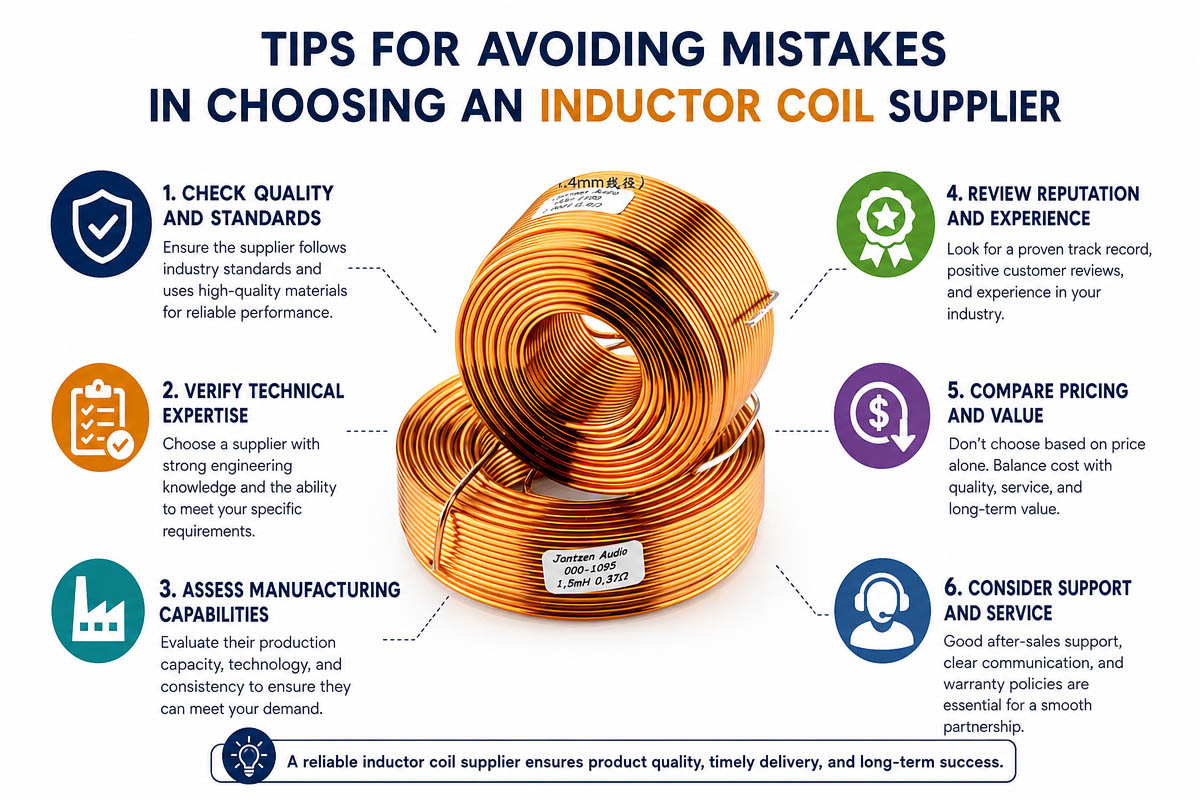
Choosing a reliable electromagnet coil manufacturer is essential for all engineers and purchasing teams who need such components. A badly chosen supplier can negatively affect your product in many ways, including the performance, cost, and delivery. Below you will find several tips that may help you to avoid common mistakes in selecting inductor coil manufacturers.
5.1 Do Not Choose the Cheapest Supplier
The cheapest inductor coil can be made of low-quality materials and wound improperly. Such products may show unstable behavior during work and even overheat. So it is better to look for a company that will be able to provide you with a proper balance between cost and performance.
5.2 Pay Attention to Manufacturing Experience
Not every electronic component supplier can produce custom inductor coils. You should pay attention to such factors as
Experience in designing custom inductors
Ability to wind coils precisely
Knowledge of various types of magnetic cores
Experience in working with high frequencies
Automated manufacturing and testing process
Good experience in electronics engineering can help you to avoid various problems connected with development.
5.3 Agree on Technical Requirements Before Order
There are lots of cases when orders fail due to misunderstanding of customers’ requirements. To avoid such a situation, you should discuss main inductor coil parameters, including
Value of inductance
Rated current
Operating frequency
Voltage requirements
Inductor coil dimensions
Working temperature
Application environment
5.4 Pay Attention to the Quality Control System
Professional Electromagnet coil manufacturer should have quality control system which involves various tests, including electrical, visual, reliability tests, etc.
Also, it is important to know what kind of tests the company does and whether they can provide test results before launching mass production.
5.5 Consider Your Future Cooperation With Company
Your cooperation should not be limited by one order. A reliable company should provide technical support, good production capacity, communication, and improvement opportunities.
Chapter 6: Why Electromagnet Coils Are Becoming Popular in Modern Industrial Applications
Modern electromagnet coils have gained great popularity due to their efficiency in energy management and power management. As the industries become more and more automated, electrified, energy-saving, and intelligent, the need for inductor coils becomes more and more pronounced.
6.1 Efficient Energy Management
As far as the benefits of inductor coils are concerned, the first reason why these devices are so popular among the industrial enterprises is the ability to save energy. The role of inductor coils in power conversion systems is crucial in managing the process of energy saving, energy regulation, and increasing system efficiency.
These coils are required in:
Industrial power supply systems
DC-DC converter
Battery chargers
Energy storage equipment
Renewable energy systems
Thanks to proper power management, inductor coils help reduce the costs of energy consumption in the company.
6.2 Inductors for Power Electronics Development
Modern industrial equipment requires stable and reliable power control. One of the key functions of inductor coils is the protection against electrical noise, reduction of voltage fluctuation, and protection of sensitive electronics.
They are used in:
Industrial automation equipment
Robots
Motor control systems
PLC control systems
Intelligent manufacturing equipment
It would not be possible to stabilize the work of many electronic systems without the reliable inductor coils.
6.3 Contribution to Electric Vehicles and Renewable Energy
The fast development of electric vehicles and renewable energy systems has led to increased demand for high-performance inductor coils.
The inductors are used in electric cars in the following:
Battery management systems
Charging systems
Motor controllers
Power conversion modules
Solar panels and wind generators require inductors for energy management and transmission.
6.4 Miniaturization and High Performance
Modern industrial equipment becomes smaller, smarter, and more powerful every day. Modern inductor coil manufacturers offer their clients compact designs that provide high inductance and better thermal performance in small spaces.
Modern technologies of production, like precise winding, automated assembling, and advanced magnetic materials, enable the production of high-performance industrial inductors.
6.5 Various Custom Applications
Another advantage of these devices is their high flexibility. It means that inductor coils can be customized according to the specific demands of various industries:
Different size requirements
Inductance values
Current capacity
Frequency range
Temperature resistance
This makes inductor coils suitable for use in the following industries:
Medical equipment
Telecommunications
Automotive
Industrial automation, etc.
Chapter 7: Future Trends of Electromagnet Coil Technology
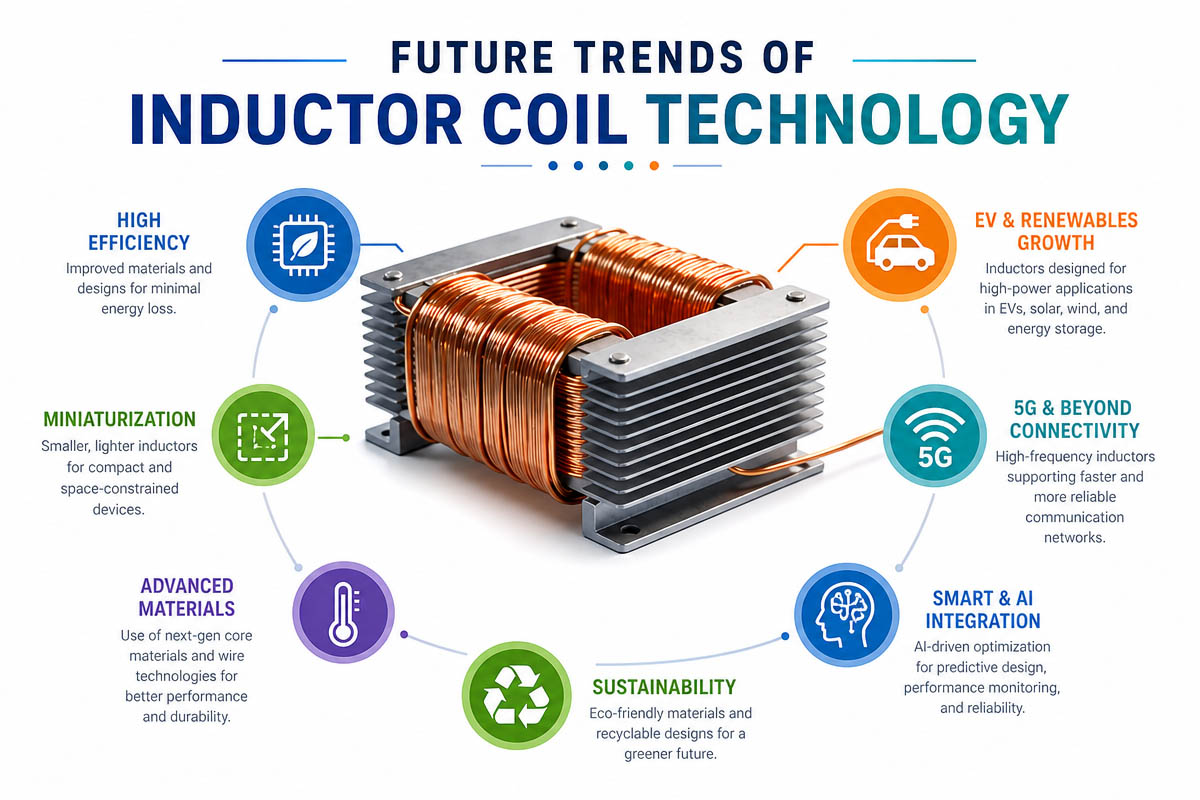
Inductor coils are indispensable parts of electronics used by various industries in our modern world. They help improve the efficiency, power management, miniaturization of electronic equipment, and size of components and have wide applications in the development of innovative technologies in almost every industry. Therefore, it is possible to assume that inductor coil technology will become even more relevant in the future.
The main future trend in inductor coil technology is related to the development of miniaturized inductor coils with high power density. Modern industries require the use of miniature electronic devices that work more effectively and have high efficiency, which implies increasing the inductance of inductor coils and improving their thermal characteristics using the appropriate materials.
The second trend that has a future impact on inductor coil technology is related to increasing the frequency range for the application of inductor coils. In other words, due to the rapid development of various technologies in such fields as artificial intelligence, IoT, wireless charging, and 5G equipment, it becomes necessary to develop inductors capable of working in higher frequency ranges and having high efficiency and low losses. This is possible with the use of advanced materials and winding designs.
The third future trend is related to the development of inductor coils for electric vehicles (EVs) and renewable energy systems. Such products as power converters, battery management systems, EV charging stations, solar energy equipment, and others should have highly efficient inductors that provide the reliable and stable conversion of power.
Finally, the future inductor coil technology will include such a trend as the implementation of smart manufacturing and customized solution creation. Advanced manufacturing technologies such as automated winding machines, precise testing systems, and intelligent quality control will provide the possibility to create customized inductor coils.
Moreover, the development of green technology will affect future trends in inductor coil technology and imply the development of sustainable production processes and environmentally friendly materials.
Consequently, inductor coil technology in the future will be characterized by high efficiency, reduced dimensions, strong performance, and intelligent manufacturing.
Chapter 8: How To Choose the Right Electromagnet Coil Manufacturer?
Selecting the right supplier of inductor coils guarantees the quality, stability, and long life of your product. If you use inductor coils in your applications like automotive electronics, power supplies, renewable energy systems, communication equipment, or industrial control systems, the supplier you choose will influence the performance and efficiency of your production.
First of all, you need to find out whether the supplier possesses appropriate technical knowledge and experience in the production of inductors. It is necessary for the manufacturer to have profound technical knowledge about the design of the inductor coil, materials used, and technologies of winding and testing of the product. Suppliers with years of experience will be able to give you some professional recommendations concerning inductance value, current rating, frequency, and other parameters of the inductor.
The next important factor is the production capability of the supplier and quality control system. Professional manufacturers should possess state-of-the-art equipment for production, winding machines, and quality inspection facilities. Quality certifications based on ISO management systems guarantee the highest product quality and reliability.
Thirdly, you should pay attention to the customization capability of the supplier. Different applications require inductor coils with different specifications. A good supplier should be able to customize an inductor coil in accordance with specific customer requirements concerning its dimensions, core material, wire type, inductance value, and other parameters.
The testing and validation process of the supplier should be taken into account while choosing your partner. A high-quality inductor coil should pass the following tests: inductance measurement, DC resistance test, saturation current test, temperature rise measurement, insulation test, and durability test before being delivered to the customer. Comprehensive test results will help you make sure that the products correspond to your requirements.
The cost of the product is one of the factors to take into account when choosing an inductor coil supplier, but not the main one. The lowest price does not always guarantee good quality. It is much more reasonable to choose your supplier, taking into account the total cost of the product. Finally, ally communication and cooperation ability are important aspects to be considered when establishing long-term cooperation.
Taking into account technical capabilities, production capabilities, quality control, customization ability, testing standards, and services offered by the supplier, you can choose the right inductor coil manufacturer.
Chapter 9: FAQs on Inductor Coils
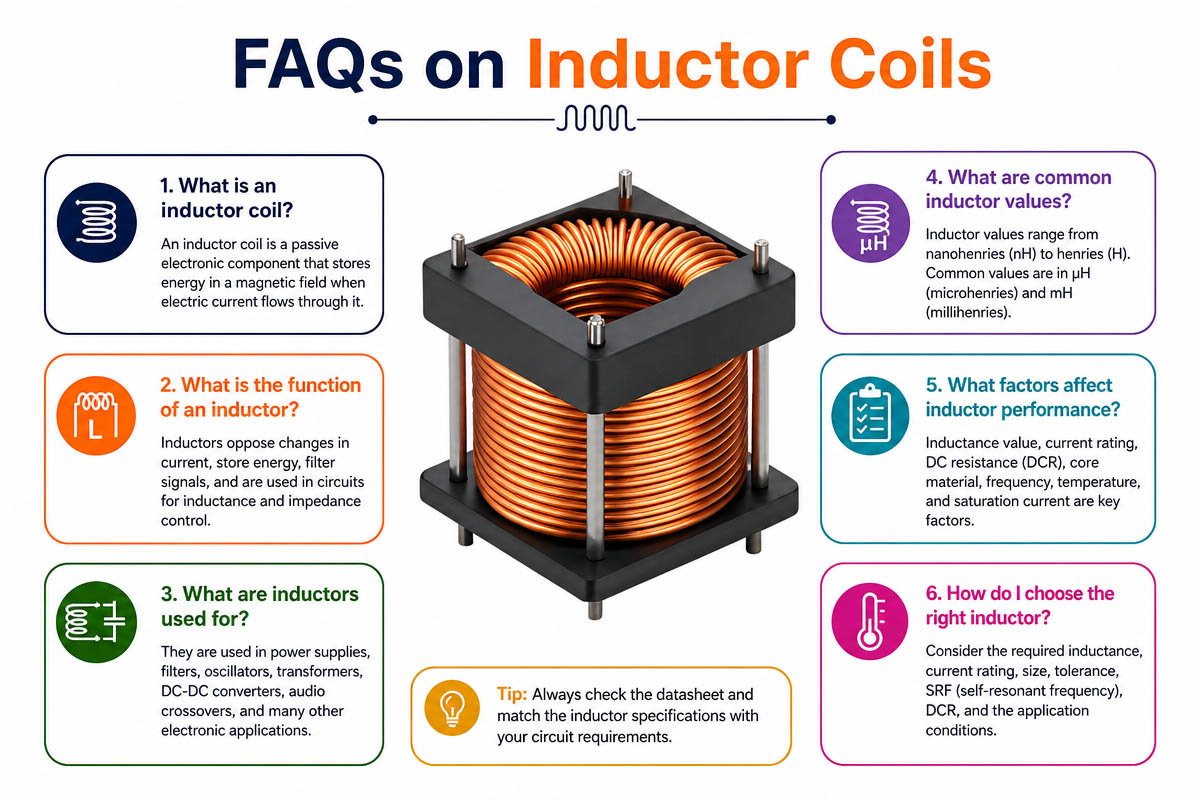
9.1 What is the purpose of an inductor coil?
The main function of an inductor coil is the storage of electrical energy in a magnetic field and regulation of changes in current flow in an electronic circuit.
9.2 Where do you find coils of inductors?
The inductor coils can be found in power supplies, electric vehicles, renewable energy systems, communication equipment, industrial controls and consumer electronics
9.3 What materials are used for manufacturing inductor coils?
Typical materials include copper wire, ferrite cores, iron powder cores, magnetic alloys, and insulating materials.
9.4 What influences the performance of inductor coils?
The main factors influencing the performance of inductor coils include inductance value, wire diameter, core material, winding technique, operating frequency and temperature, and current ratings.
9.5 Can we customize inductor coils?
Yes. Custom inductor coils are produced according to specific needs: size, inductance, voltage, current rating, frequency range, and application environment.
9.6 Why are good inductor coils important?
Advanced inductor coils result in energy efficiency, lower electrical noise, higher reliability, and extended service life of electronic equipment.
Chapter 10 : Conclusion
Inductor coils are critical components that drive innovations in modern electronics and energy applications. These electromagnetic components make possible many technologies that influence our everyday lives, from improved power conversion efficiency to electric vehicles and renewable energy systems.
The manufacture of advanced inductor coils will remain crucial as the industries are demanding smaller, smarter, and more efficient electronic systems. New generation reliable and energy-efficient technologies will be developed thanks to investments in advanced materials, precision production, and customized solutions.


