

Introduction: Solenoid Coil Manufacturing
Solenoid coils are key electromagnetic components commonly applied in industrial automation, automotive, medical instruments, electronic locks, and fluid control products. Electrical energy transformation into linear mechanical motion in a controlled way is made possible by professional solenoid coil manufacturing.
A good solenoid coil requires a professional approach in engineering in terms of wire selection, winding technique, insulation coating, magnetic circuit creation, thermal management, and reliability testing. Knowing the design principles, working process, materials, and applications of solenoid coils can help in choosing the proper solution for your products.
This guide covers the basics of solenoid coil manufacturing, the operation of solenoid coils, types of materials used, the way to select the appropriate coil size, and the applications in modern industry.
Chapter 1: What is a Solenoid Coil?
A solenoid coil is an electromagnetic device that transforms electrical energy into linear mechanical motion. A solenoid coil consists of insulated copper wire wound around a bobbin or magnetic core. An electromagnetic field is created when the electric current flows through the winding.
A ferromagnetic plunger, placed in the coil, is pulled or pushed by this electromagnetic field and creates linear motion. Solenoid coil motion is used for controlling:
Solenoid valve
Magnetic lock
Actuators for industrial applications
Relays and switches
Brakes and clutches
Automation machinery
The basic principle of the solenoid coil operation is
Electrical energy -> magnetic field -> mechanical motion
In the process of professional solenoid coil manufacturing, the magnetic force, power consumption, operating temperature, and lifetime optimization are the key issues for the particular application.
Chapter 2: What Are Solenoid Coils Made Of?
A solenoid coil consists of several key materials. Selection of material for each stage of solenoid coil manufacturing impacts the performance and efficiency of the product.
2.1 Copper wire
Copper wire is the most common conductive material due to high electrical conductivity and thermal properties.
Advantages:
Low electrical resistivity
High electrical conductivity
High heat resistance.
Long lifetime
Aluminum wire could be used in some cases for reducing weight or price.
2.2 Insulation coating
Copper wire should be covered with insulation coating to avoid electrical short circuits in the winding.
Insulation materials could be:
Enamel paint
Polyurethane paint
Heat-resistant insulations
The class of insulation must be compatible with the operating temperature of the application.
2.3 Bobbin-Spule
The coil geometry is retained by the winding of the wire on the bobbin.
Popular bobbin materials:
Nylon and PBT plastics
Phenol resin
Thermoplastic with high heat resistance
Bobbin should have:
Mechanical properties
Electrical insulation
Thermal stability
2.4 Plunger and magnetic core
A solenoid’s magnetic core consists of the following:
Soft iron
Low carbon steel
Magnetic stainless steel
Materials are highly permeable to the magnetic force and therefore create a strong electromagnetic force.
2.5 Protective packaging materials
Solenoid coils can be applied for industrial applications:
Epoxy resin
Plastic overmolding
Metallic packaging
These materials protect the coil from:
Moisture
Dust
Vibration
Mechanical shock
Chapter 3: How does a DC solenoid coil work?
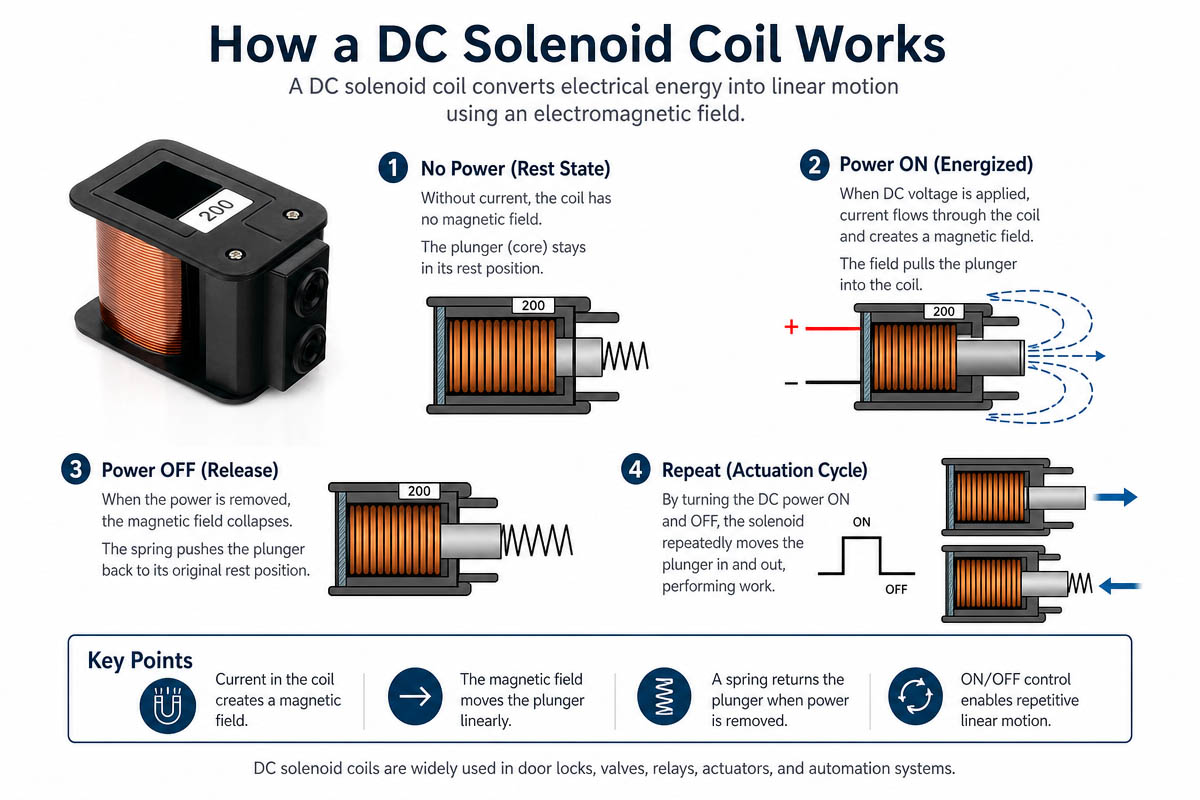
A DC solenoid coil operates according to the principle of electromagnetic induction.
If DC voltage is applied:
Electrical current flows through the winding of the coil.
This creates an electromagnetic field around the coil.
The metal plunger is attracted by the electromagnetic field.
The plunger moves linearly and makes mechanical work.
If the power source is switched off:
The electromagnetic field disappears.
The plunger moves back with the help of a return spring.
The system returns to the previous state.
Magnetic force depends on a few factors.
Number of turns of the coil (N)
Level of the present (I)
Material of magnetic circuit
Air gap distance
Coil size
CHAPTER 4: MATERIAL SELECTION FOR SOLENOID COIL MANUFACTURE
Selection of proper material is one of the most important steps in the process of solenoid coil manufacturing.
Choosing Copper Wire
Engineers should consider:
Wire resistance
Wire diameter
Current capacity
Temperature rating
Thick wire:
Low resistance
High current handling
Improved heat performance
Thin wire.
A high number of turns is possible
Possibility of higher magnetic force
High resistance
Core Material Choices
A good magnetic core enhances the following:
Magnetic efficiency
Pulling force
Reaction time
Soft magnetic materials are selected for quick magnetization and the absence of magnetization after switching off the power.
Construction materials
Environmental conditions: Manufacturers can use:
Engineering plastics.
Stainless steel
Carbon steel
Aluminium alloy
The housing protects internal components and improves mechanical reliability.
Chapter 5: Solenoid Coil Design Considerations Wire Size and Turns
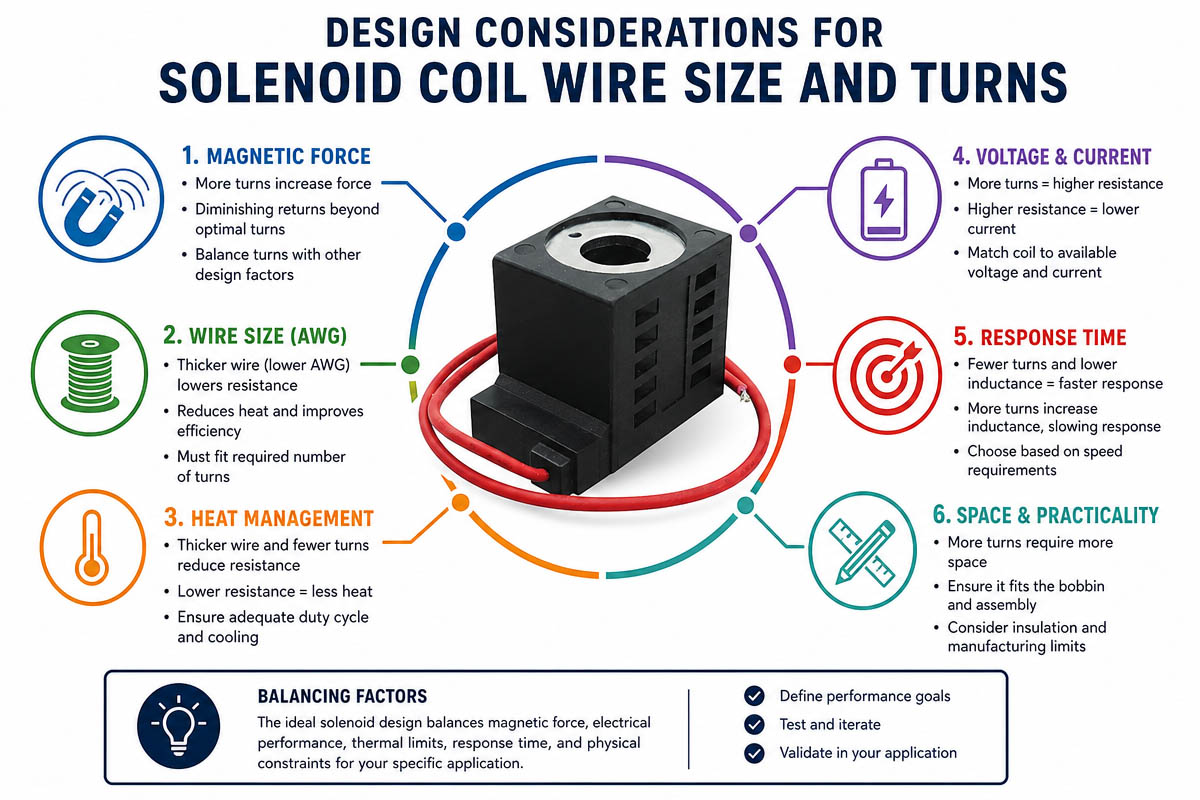
Designing a coil is a matter of balancing the force output, power consumption, and cooling needs. The coil resistance, current, and ampere turns depend on the turns and the wire size. The example of the design analysis is as follows:
Thin wire (for example, AWG 30) and many turns = high resistance and low current. The coil does not heat, but the produced magnetic force may not be enough for any practical purposes. • Moderate wire (for example, AWG 23) is optimal as far as the balance between force and cooling is concerned. This option ensures the appropriate ampere turns and no excessive heating. • Thick wire (e.g., AWG 20) with few turns will produce the greatest amount of magnetic energy and force. However, the I²R losses may be very high (over 1.2 kW), and thus such construction will be usable only in applications with active cooling.
Magnetic energy stored in the coil depends more on the force than the inductance itself. A coil with large inductance and low current can produce less force than the coil with low inductance and high current.
Selection of the correct solenoid coil size is the compromise between the electromagnetic performance, mechanical requirements, and thermal limitations.
Key design parameters are the following:
5.1 Voltage and the Current
The coil should match the power source:
DC 5V, DC 12V, DC 24V, DC 48V, AC 110V, AC 220V
The selection of voltage impacts:
Current consumption
Heating of the coil
Magnetic field
5.2 Stroke length
The stance that the plunger moves is called “the stroke.”
Considerations:
Short stroke: more power
Long stroke: bigger coil is required
5.3 Required Force
Force needed is:
Coil size
Magnetic circuit design
Wire diameter
5.4 Duty Cycle
The duty cycle is the period of time when the coil is energized.
For example:
Intermittent operation
Duty cycle 25%
Continuous operation 100%
5.5 Operating environment
Engineers should take into account:
Humidity
Temperature
Dustproofing
Anti-vibration characteristics
Waterproof standards
Chapter 6: Production Processes Bobbin Buildup and Precise Winding
The production process begins with winding the magnet wire onto a bobbin or mandrel. Winding precision results in equal spacing and even tension of the windings, both required for the predictable electromagnetic behavior of the product. The wire is wound by automated winding machines to form compacted layers. More turns of wire fit in the provided winding window.
The winding of the standard bobbin is fixed on a plastic spool that was previously manufactured. The wire terminations are attached to the lead pins or terminals via sockets molded in the bobbin flanges. Recently there appeared pin housing designs integrated with the bobbin casing to ease the manufacturing process and decrease its vulnerability because of inserting the lead pins.
Chapter 7: DC versus AC Solenoid Coils
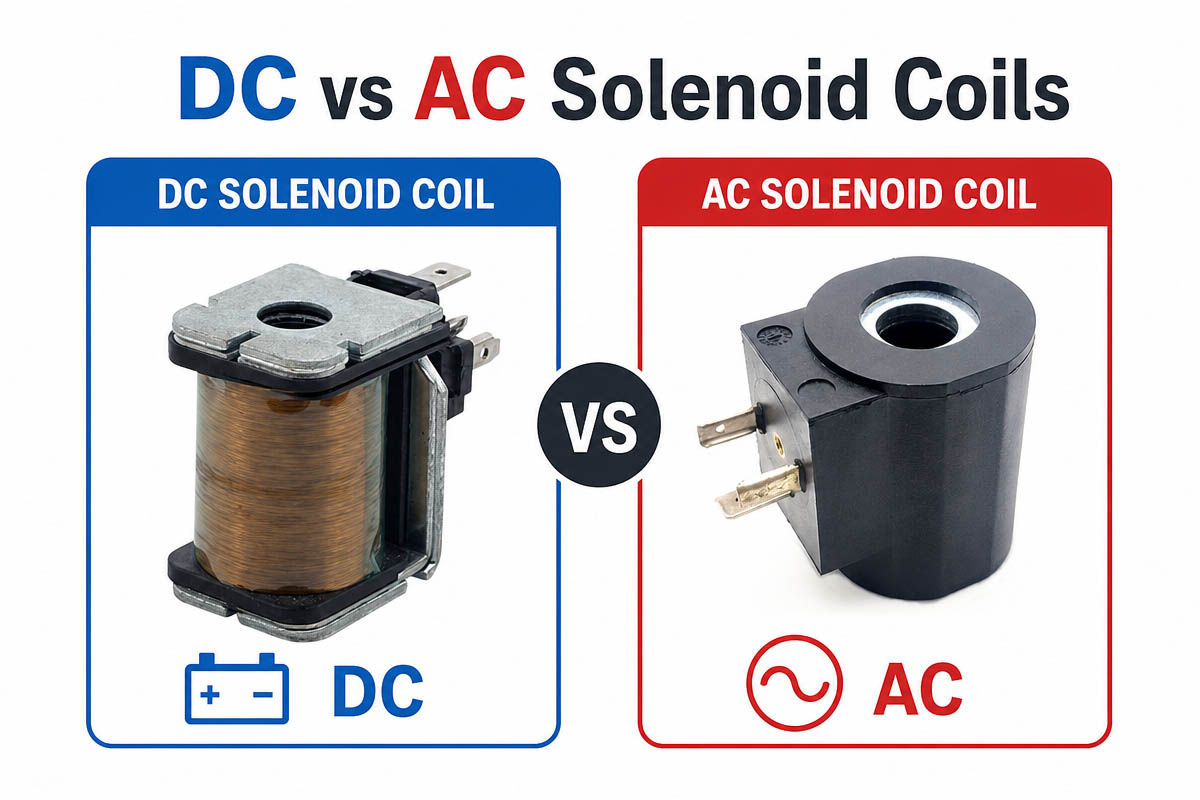
During the manufacturing of solenoid coils, it is crucial to know the differences of DC and AC solenoid coils.
DC Solenoid Coils
Advantages:
Silent operation
Constant magnetic force
Simple construction
Exact control
Applications:
Battery-powered devices
Industrial automation
Medical devices
Electronic locks
Solenoid Coil A.C.
Advantages:
Fast response
Great for high-speed switching
Strong pulling force
AC solenoids normally require a laminated magnetic core and shading rings to reduce vibration and noise.
Comparison of DC and AC Solenoid Coils
Feature DC Coil AC Coil Noise Lower Higher Response Stable Faster Control Application Vibration Moderate Excellent Low HigherPrecision systems Industrial switchgear
Chapter 8: Resistance of Solenoid Coils and its Relation to Temperature
Temperature control is an essential part of the solenoid coil manufacturing process.
When increasing the temperature of the coil, copper resistance increases.
A relation could be represented by the formula
R(T)=R_{0}[1+\alpha(T-T_{0})]
Where:
RT: Resistance at operating temperature R₀: Resistance at reference temperature α: Copper temperature coefficient T: Operating temperature
The heat generation is:
P = I^2 R
Increasing the resistance means the following:
Lower current
Lower magnetic pulling force
Loss of energy
Therefore, the professional solenoid coil manufacturers optimize the following:
Copper wire diameter
Winding density
Heat dissipation design
Working cycle
Chapter 9: Solenoid Coil Applications
Solenoid coils are widely applied in many industries due to their compact structure and reliable operation.
9.1 Applications of Electronic Locks
For example:
Smart locks
Safety boxes
Vending machines
Access control systems
9.2 Automotive applications
Where are solenoid coils used?
Transmission system.
Fuel injection system
Engine systems
Valves’ actuation systems
9.3 Medical devices
Applications include:
Valve, medical
Pump systems
Laboratory automation
Gas control facility
9.4 Railways
Applications:
Door control
Brakes
Signaling equipment
9.5 Industrial automation
Typical applications include the following:
Pneumatic valves
Hydraulic system
Robotics
Automation of assembly lines
Chapter 10: Solenoid coil advantage and disadvantages
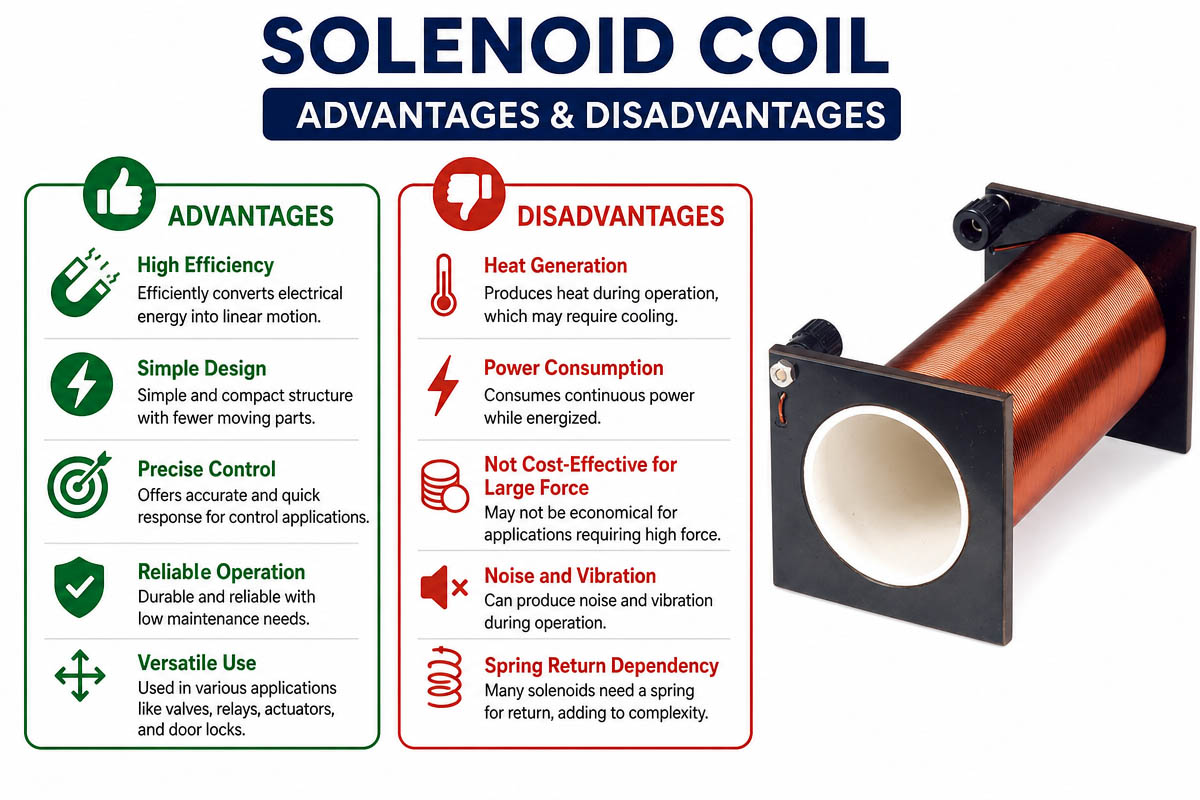
The solenoid coil is an electromagnet that converts electrical energy into linear or rotary motion. This is the reason why they are used extensively in automobile starters, industrial valves, locks, and other applications. The solenoid coil has some unique strengths and limitations.
Benefits:
The first and foremost benefit is remote and instant actuation. Specifically, it is possible to activate a solenoid remotely and immediately by sending low-power signals—which is critical from the point of view of safety and automation. It has few moving parts, which makes them very reliable and long-lived if operated according to their ratings. In the case of latching (locking) solenoids, the holding force is extremely powerful. If there is a permanent magnet, then no power is needed to maintain the position of the lock, which conserves power.
It is also cost-effective because it requires much less money to manufacture solenoids than complicated motor-gearbox sets. The other benefit of a solenoid is its simple control. The DC solenoid requires only application/removal of a certain voltage. Lastly but not least, it operates silently without any fluids, which is critical in cleanroom applications or in hospitals.
Limitations
However, the major limitation is the high power consumption and generation of heat. The coil has a very low DC resistance; thus, the inrush current is very high. It results in rapid heating (I2R losses), which might lead to burnout of the coil if the duty cycle is not properly regulated. Most solenoids are designed for intermittent use only.
Additionally, the stroke is extremely short—several mm, which restricts the applications that require a long stroke. Moreover, the force is decreased exponentially with the increase of the gap between the pole and the core. The initial magnetic force is relatively low and only reaches the maximum when the plunger is in its final position. Thus, it takes time for it to reach the necessary value (“soft” start).
It is also prone to residual magnetization, which makes it harder for the plunger to release. Solenoids are sensitive to voltage changes, and if the voltage level becomes low, then the magnetic field will become too weak to initiate the actuation. Eventually, constant high-speed operation leads to mechanical wear of the plunger and its contacts.
Chapter 11, FAQs – Solenoid Coils
Q1: Why does a solenoid coil heat up?
The solenoid coil gets hot. It is caused by the resistance loss (I² R) and energy transformation from electrical into heat energy. Proper design and cooling is required.
Q2: Can I use a solenoid without a core?
Yes, but the magnetic force is much lower. Most of the industrial solenoids require a ferromagnetic core.
Q3: How can I increase the force of a solenoid?
The force could be increased by:
Increasing number of coils
Increasing current
Improvement of magnetic materials
Decreasing air gaps
Q4: What is the lifetime of a solenoid coil?
The industrial solenoid coil, properly designed, could operate during hundreds or millions of cycles depending on the application conditions.
Q5. Is it possible to repair solenoid coils?
Most of the industrial solenoids, which are hermetically sealed, are replaced but not repaired.
Chapter 10: Conclusion – How to Select the Best Solenoid Coil Manufacturer
An electromagnetic device that couples electrical control signals to the mechanical motion is a solenoid coil.
The solenoid coil manufacturing process requires professional knowledge in the following fields:
Winding technology
Selection of materials
Magnetic circuits design
Temperature control
Testing of reliability
Original Equipment Manufacturing
Solenoid coils ensure reliable, precise, and efficient motion control in various applications, from automotive systems to industrial automation and medical devices.
You will receive better performance, a longer lifetime, and the most optimized solution for your application needs if you choose the experienced solenoid coil manufacturer.
A professional OEM partner can offer the whole solution from prototype development, engineering validation, tooling design, mass production, and quality testing.


