


How to Select a Qi Wireless Charging Coil
Selecting the right Qi wireless charging coil is not only matching physical dimensions. The coil has to work correctly with the whole wireless charging circuit and the intended mechanical environment.
1. Qi Wireless Charging Coil Definition
First of all, determine how much charging power you need. Higher power requirements will influence coil size, wire selection, resistance, thermal performance, and magnetic design.
2. Check Qi Wireless Charging Coil Dimensions
Calculate the area of installation. Calculate the area of installation. Consider OD, ID, thickness, coil height, and what is around it. Smart phones and other compact consumer electronics will require a thin coil.
3. Determine the Qi Wireless Charging Coil Inductance
Required inductance has to be compatible with the charge controller and the whole circuit design. Incorrect inductance can lead to decreased system efficiency or even circuit malfunction.
4. Consider the Qi Wireless Charging Coil Resistance
Low resistance, in general, reduces copper losses and heat generation. Therefore, wire diameter, winding length, and coil construction have to be considered together.
5. Alignment Assessment
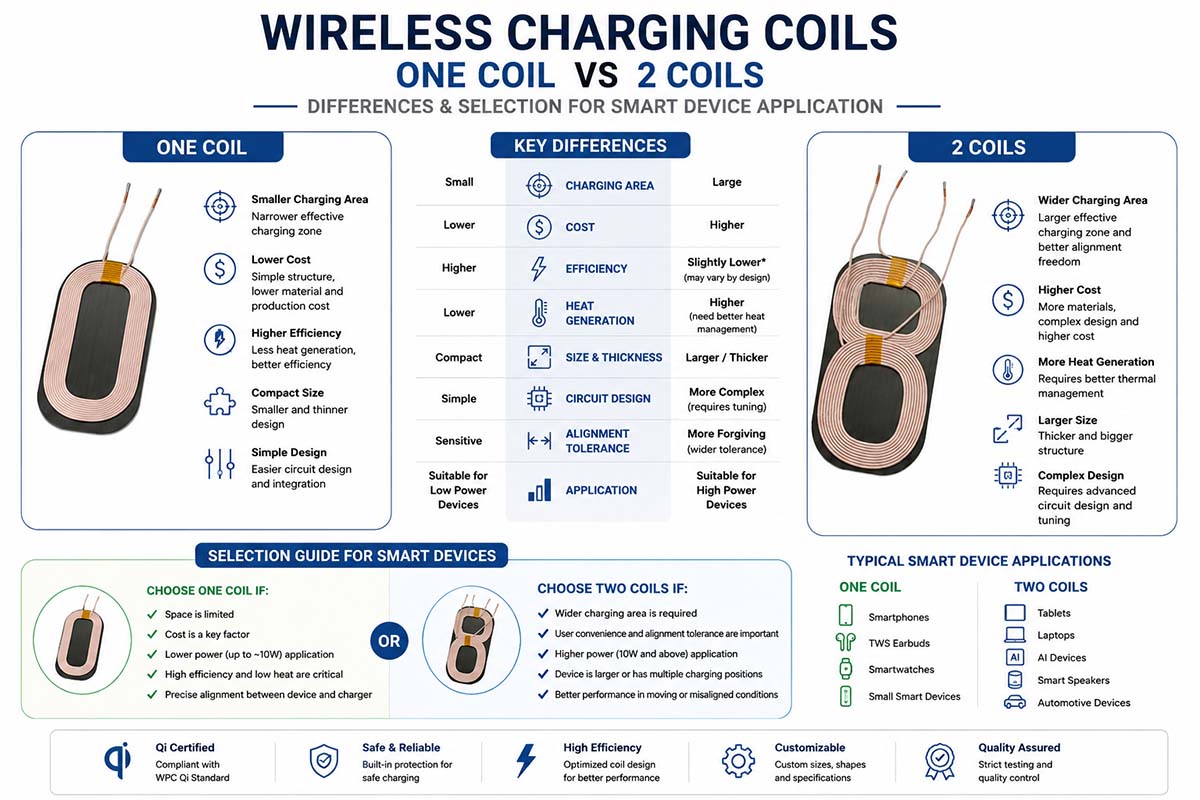
Determine the achievable positioning accuracy for the transmitter and receiver. If users can put devices anywhere in the relatively large area, the multi-coil configuration might provide better coverage.
6. Dual Qi Wireless Charging Coil vs. Single Qi Wireless Charging Coil
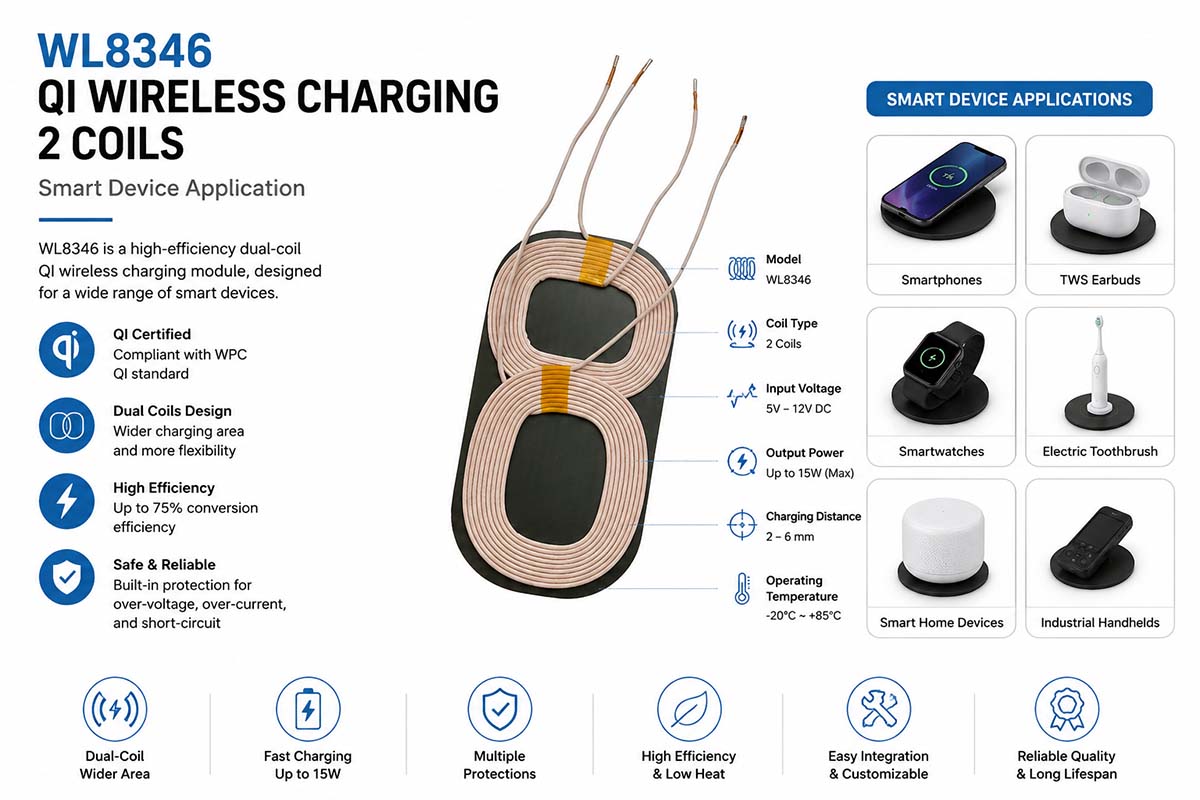
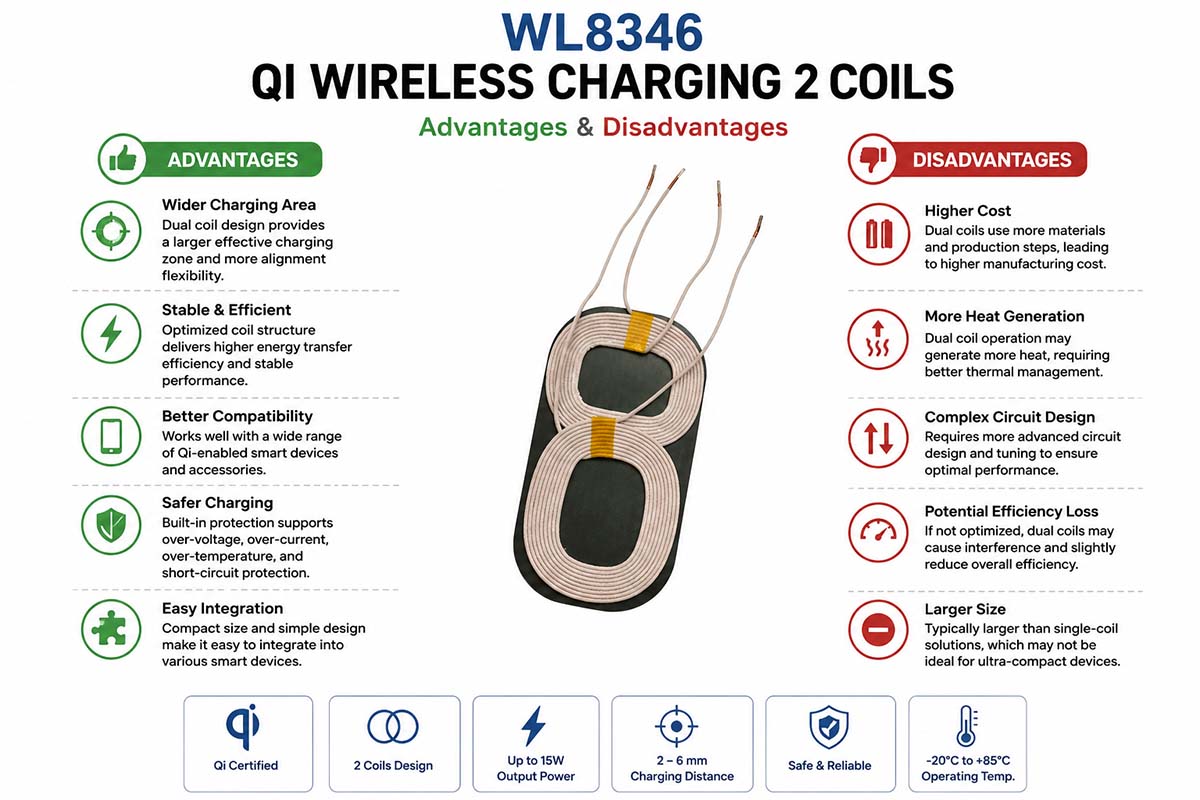
The single coil gives a simpler and more compact solution. Two coils provide more flexibility for positioning but require additional control, space, and design.
7. Magnetic Shielding Test
Magnetic shielding structures like ferrite may be needed to control the magnetic field and to minimize the interference with nearby components.
8. Thermal performance evaluation
Check the temperature rise at the expected charging power. Temperature depends on coil resistance, current, PCB design, shielding, and enclosure material.
9. Check Mechanical Integration
Consider adhesive, flexible PCB, connector, wire outlet, coil thickness, and mounting technique.
10. Test the whole Qi Wireless Charging Coil system.
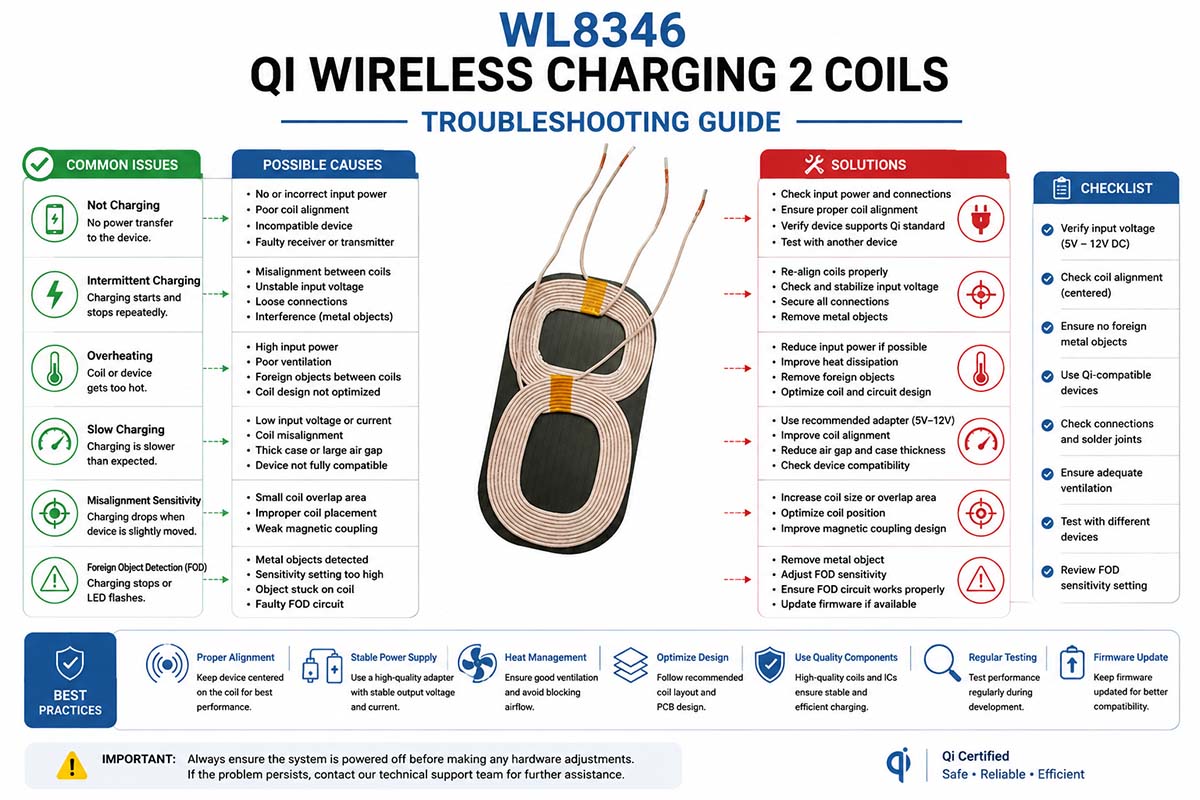
Never approve a coil based on its datasheet. Test the coil with the real transmitter, receiver, enclosure, battery system, and operating conditions.
How to Avoid Typical Design Errors in a Qi Wireless Charging Coil.
The following mistakes can cause poor charging performance, overheating, or unstable system operation.
1. Don’t design the Qi Wireless Charging Coil yourself
The coil has to be designed with a transmitter, receiver, and charging controller.
2. Pay Attention to Coil Alignment
Two coils maprovideve better coverage, but their positioning and spacing should be carefully considered.
3. Don’t choose wire size based on its appearance
Wire diameter is proportional to resistance, current-carrying capability, heat, and efficiency.
4. Coil Thickness Cannot Be Ignored
The coil may be electrically appropriate, but it may not fit into the thin product.
5. Don’t Forget About Magnetic Shielding
Local metal parts may affect magnetic coupling and charging performance.
6. Don’t Assume That Two Coils Always Mean Better Efficiency
The dual-coil design can improve the coverage, but additional switching and control circuitry may introduce losses.
7. Don’t Test Only at Room Temperature
The charge should be tested at realistic temperature and enclosure conditions.
8. Re-check the Circuit Before You Change the Coil
Changes in inductance, resistance, or coil geometry can affect the whole charging system.
9. Don’t Overlook the Qi Wireless Charging Coil Tolerance
Define tolerances for coil dimensions, inductance, resistance, and positioning.
10. Always Build Engineering Qi Wireless Charging Coil Samples
To prove charging power and efficiency, temperature and alignment tolerance, and reliability of mass production, always build engineering samples.


