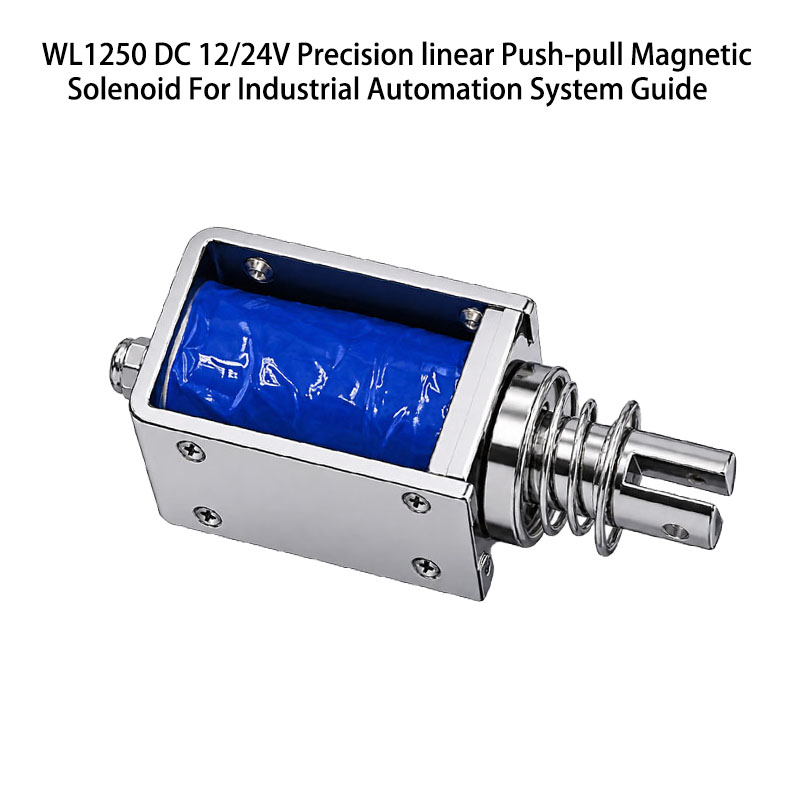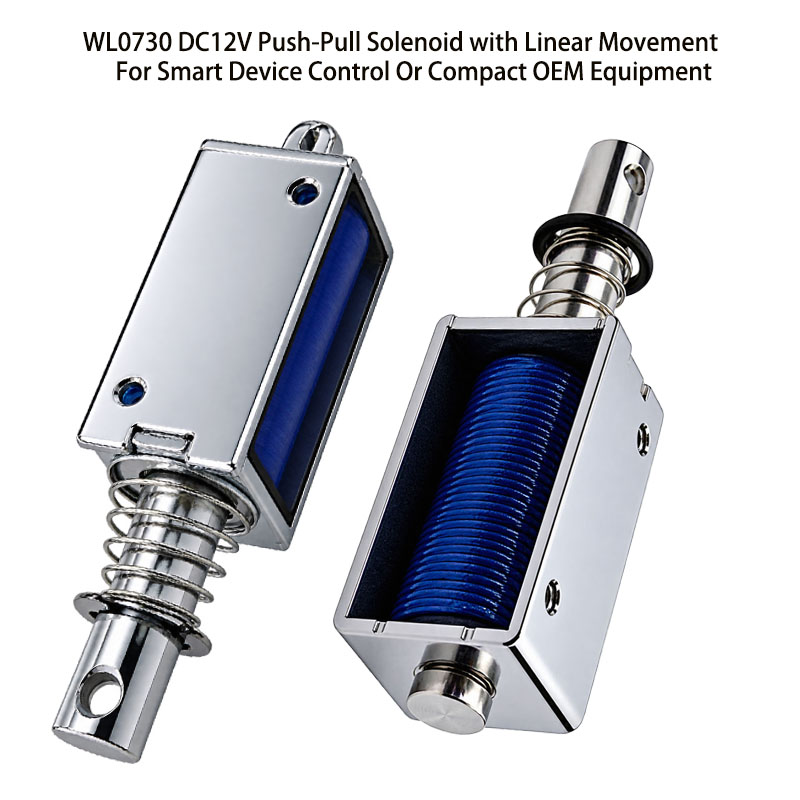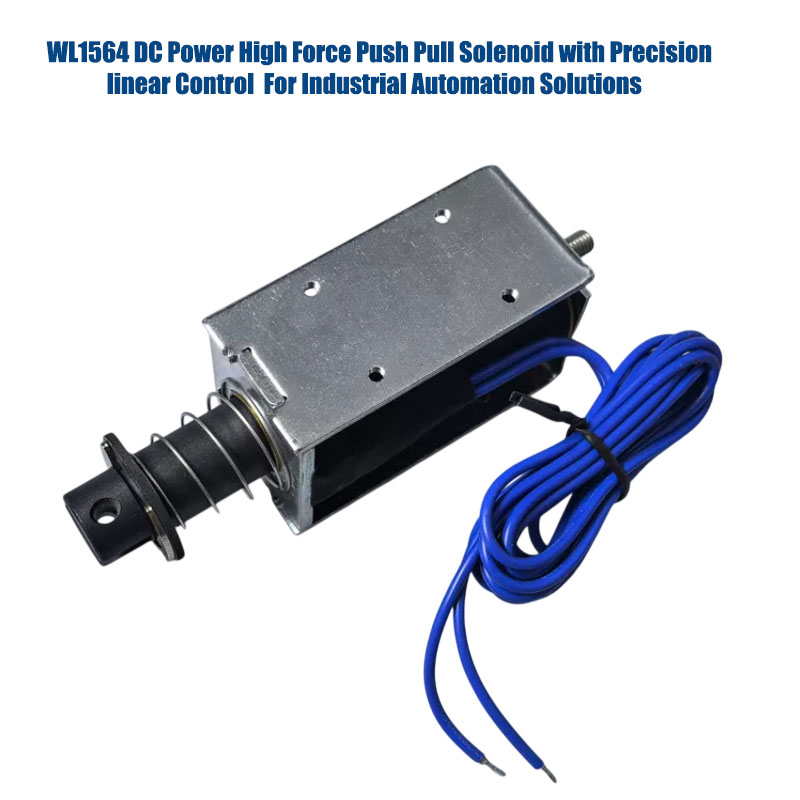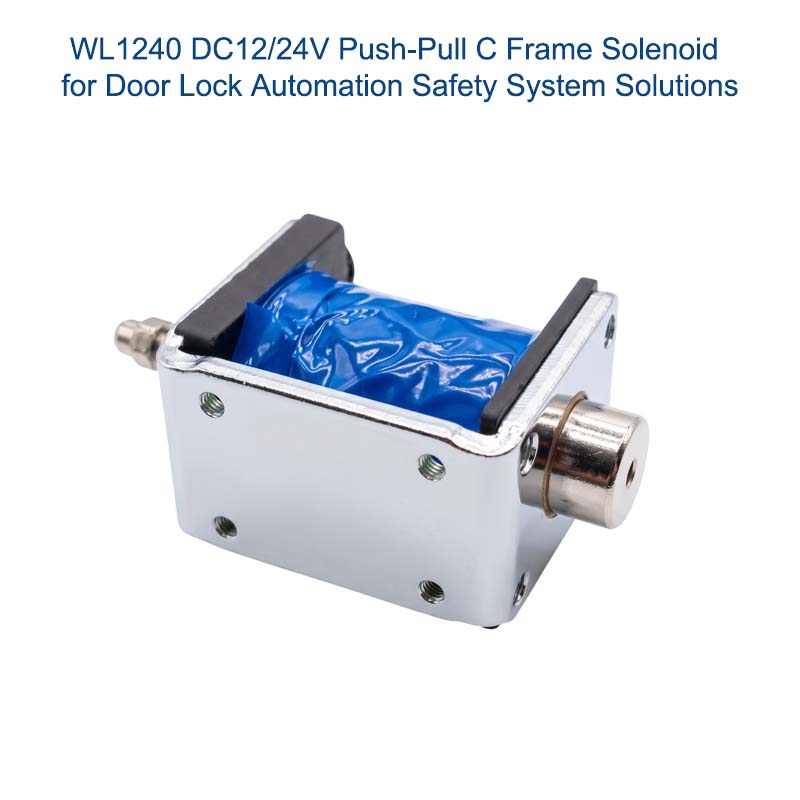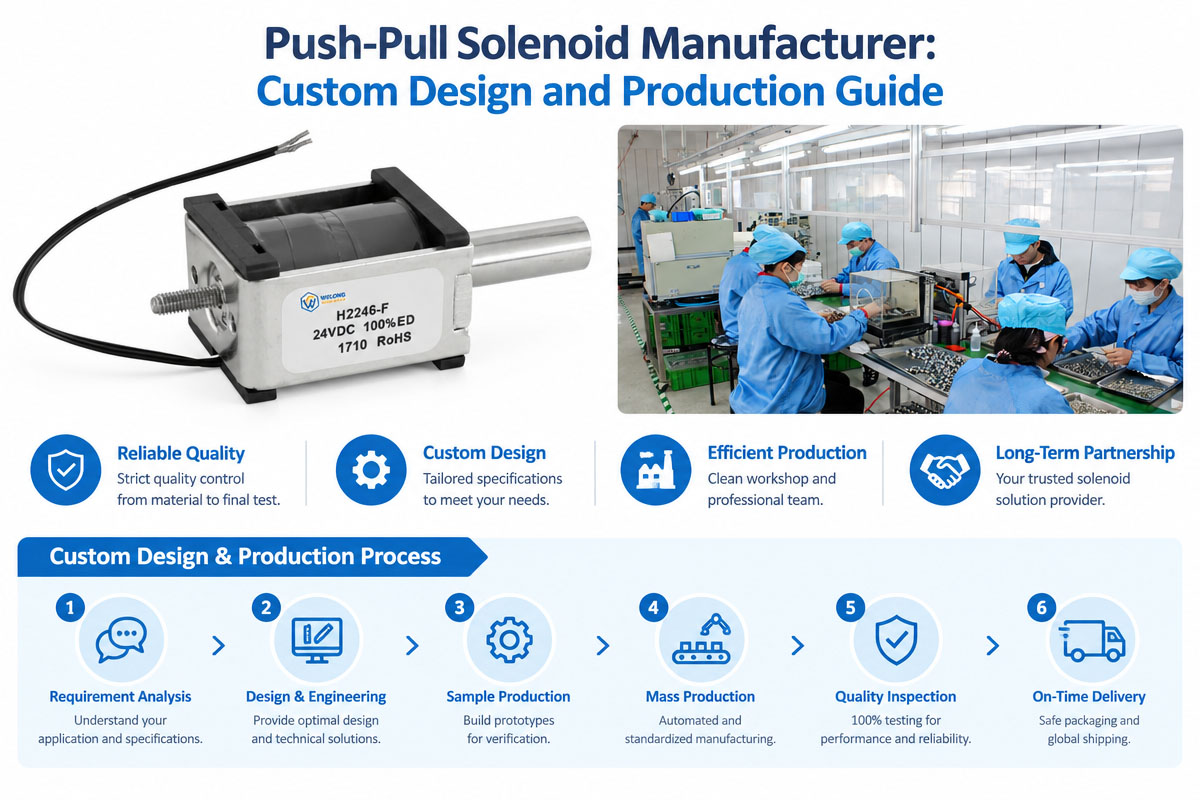
Introduction to Push-Pull Solenoid Manufacturer
Push-pull solenoids are small electromagnetic actuators used to create controlled linear movement in equipment such as industrial applications, locking systems, vending machines, automation equipment, medical devices, dispensers, sorting machines, and numerous other OEM products.
Regular solenoids can satisfy a variety of demands, but in certain cases the developer may have to deal with demands that cannot be met with a regular component.
These demands may consist of:
- Specific stroke,
- Higher start force,
- Certain operating voltage,
- Low current consumption,
- Unique plunger geometry,
- Specific mounting,
- Low noise level or
- Very compact dimensions.
In case some of these demands appear, a customized design in collaboration with a professional manufacturer can provide a better technical and economic solution.
But customization should go beyond just changing plunger size or voltage. Electromagnetic design, characteristics of force/stroke, coil winding, heat performance, mechanical connection, springs, materials, life cycle, and manufacturing tolerances—all of this affects each other.
When dealing with an OEM customer, a supplier has to be able to deliver its products from prototype development, pilot run production, and long-term mass production.
This article will guide you through the process of customization of push-pull solenoids as well as highlight the key factors that a buyer should keep in mind when choosing the manufacturer.
1. What kind of OEM would require a custom push-pull solenoid?
For most projects the best starting point is always an existing solenoid platform.
You will be able to save:
- Engineering time ·
- Tooling expenses
- Prototype timing ·
- Development efforts
- Prototype risk
Customization becomes relevant in case a regular product cannot meet one or several key requirements.
The main reasons are
- Higher force at certain stroke,
- Specific operating voltage,
- Limited peak current,
- Unique geometry of the plunger,
- Specific push rod,
- Limited installation space,
- Custom mounting,
- Specific return-spring force,
- Long-term cycle life,
- Low operation noise or
- Conditions of work at high or low temperatures.
- Alteration of the connections
A professional push-pull solenoid manufacturer will first check whether it’s possible to alter an existing platform before proposing a completely new design.
As a result, the development and costs will be lowered considerably.
2. Start with a detailed specification of the application.
An application, rather than actuator dimensions, is the starting point of a custom solenoid project.
The manufacturer has to understand what the function of this solenoid is in your design.
Detailed specification should include:
Application: What does the solenoid do? Action: Is it a pushing or pulling function?
Voltage: Range of operating voltage Current: Capacity of current supplied by the electric system
Stroke: Length of the stroke Force: Required force at different positions of the stroke Duty Cycle: Duration of coil energization
Frequency: Frequency of solenoid action Lifetime: Required number of cycles Environment: Temperature, vibration, dust, or humidity conditions. Dimensions: Installation space: The more comprehensive the specification, the more accurately the push-pull solenoid manufacturer will be able to evaluate the feasibility.
The development can be improved even further with such information as mechanical loads, pictures and videos, CAD models, etc.
3. Force at specified stroke
Force is one of the most important parameters in solenoid development.
At the same time, it’s also one of the most widely mistaken.
Solenoid force depends on the position of the plunger. Therefore, the force value should be indicated alongside a stroke where it should take place.
An example of a requirement is such:
Start Position 12 N at 10 mm Middle stroke: 18N @ 5mm.
Final Position: 30 N @ 0 mm
This provides much more understanding of the required force profile.
Mechanical load should include:
Resistance to spring,
Static friction,
Dynamic friction,
Gravitation,
Linking forces,
Acceleration,
Closed mechanical tolerance
The push-pull solenoid manufacturer will be able to measure or provide information about solenoid force versus stroke characteristic.
4. Optimize the Push-Pull Solenoid Stroke
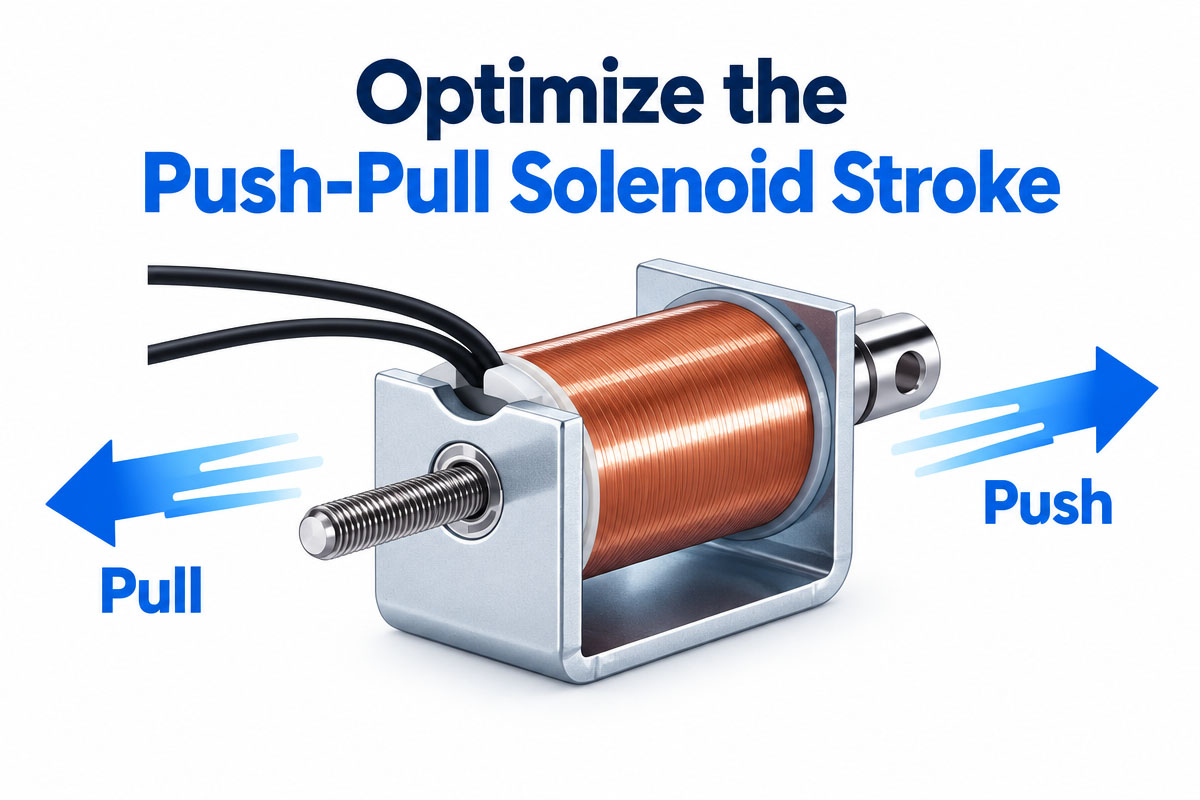
Stroke has a direct influence on the size and electromechanics of a solenoid.
Usually a longer stroke means that the magnetic system has to produce force on a bigger air gap.
In case the product requires only a 5 mm stroke, the addition of 15 mm as a safety buffer makes the actuator larger or inefficient.
The engineer has to define:
- Minimum stroke for normal functioning,
- Assembly tolerance,
- Clothing allowance
- Mechanical clearances
- Required overtime
The main goal is to have sufficient stroke for reliable functioning but no more of it.
In the custom development process, a push-pull solenoid manufacturer may suggest to the client alterations of the mechanism geometry if it is possible to make the stroke shorter.
5. Wind coil around the electrical system
One of the most obvious advantages of customizing is the opportunity of designing the coil of the solenoid.
Push-pull solenoids can be designed to operate on different DC voltages; for instance, such options as
DC 5V
6VDC
12 VDC.
24 V DC
But not every voltage means the same performance.
The manufacturer has to take into account:
Coil resistance diameter of wire
Number of windings in turns of current
Force Available Winding Space Working Cycle
Temperature restrictions
The product powered by a battery prefers less energy consumption, but the industrial device prefers powerful and fast operation.
A custom push-pull solenoid manufacturer has to optimize the coil according to the electrical system of your product.
6. Consider the duty cycle from the beginning
The duty cycle has a strong influence on the coil design.
Let’s take two applications using the same mechanical actuators:
- Application A pulses the solenoid for 200 ms every 30 sec.
- Application B keeps the solenoid energized for several minutes at a time.
Their thermal behavior is very different.
Short duty operation may allow using coils with relatively big power to produce strong force for a short period of time.
Continuous operation requires a much more accurate heat management system.
When filling out the specification, the following information will be much more helpful than just saying, “Intermittent Duty”:
ON Time: 1 sec OFF Time: 4 sec Cycle: 5 sec Duty Cycle: 20%
Then push-pull solenoid manufacturers can adjust the parameters of the coil, such as power consumption, force, and heat.
7. Evaluate the push-pull solenoid thermal performance.
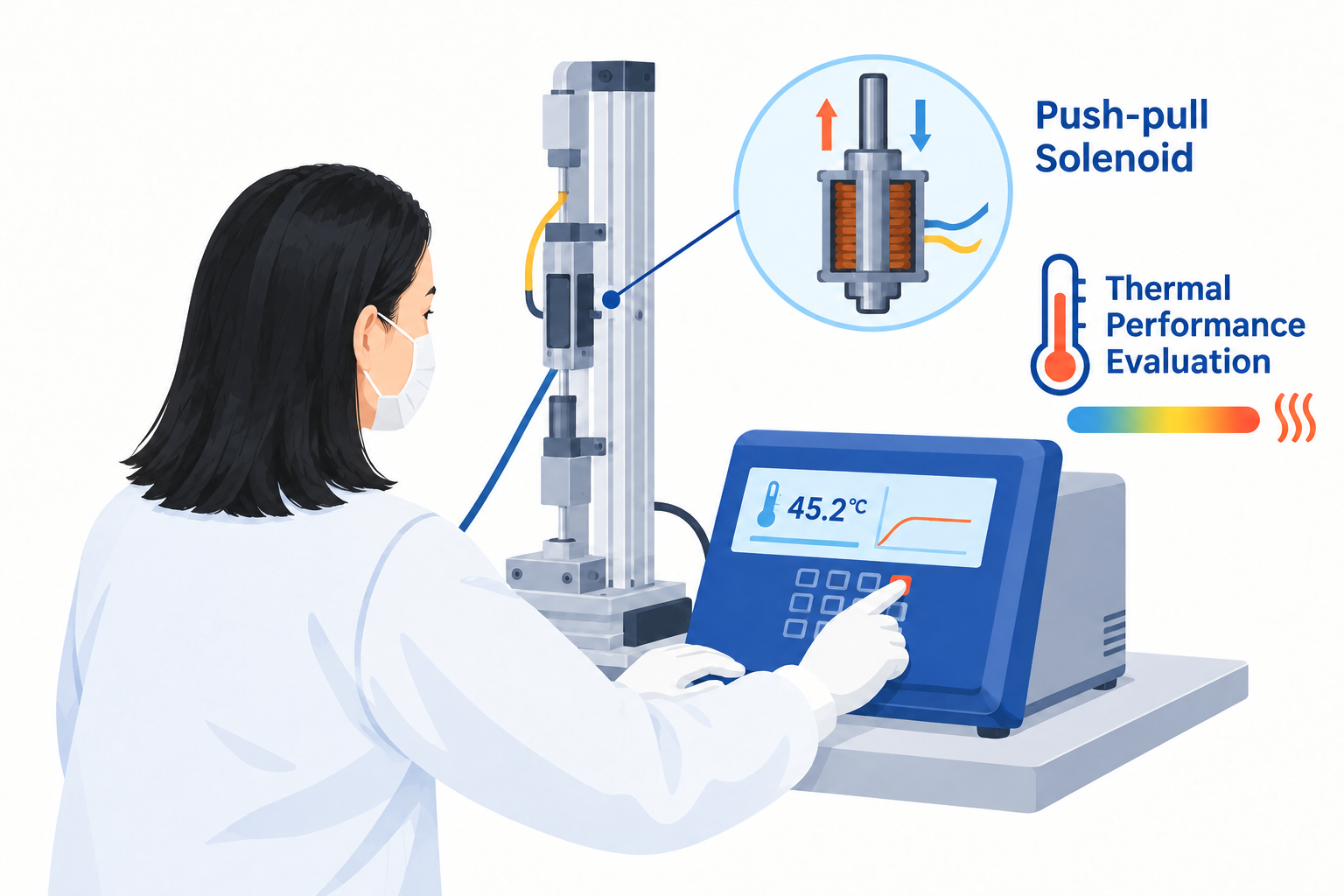
Thermal behavior is one of the aspects of the custom design process.
The current passing through the coil creates heat, and the resistance of this coil varies due to temperature increasing.
Factors influencing the thermal performance of the solenoid:
Power of Coil Cycle Time Environmental temperature material of construction Size of solenoid air flow rate
Installation box
Nearby sources of heating
A product tested in a laboratory in a room air conditioner may behave very differently when installed in a compact machine.
In case you develop a custom project, give all necessary information about expected environmental temperature and installation.
If your application requires force margins, ask the manufacturer about temperature rise tests and hot coil force performance.
8. Design a plunger for your application.
A plunger or armature transforms electromagnetic force into mechanical motion.
Among custom plunger designs may include:
Different shaft length,
Threaded ends, Channel,
Cross-holes,
Pin,
Flats, Surface,
Special shape of the tip, push rods,
Mechanical stops,
The mechanical connection has to be made for the efficient force transmission.
Linear solenoids are designed to perform axial movement only. High values of lateral force may increase the friction and the wear of the plunger.
A push-pull solenoid manufacturer has to evaluate how the customer’s mechanism will work with the actuator, not just produce a plunger from the drawings.
9. Select and set the return spring
Many of the pull-push solenoids require a return spring in order to return the plunger after electrical power disconnect.
Spring selection has its influence on the spring force and required energization force.
Using spring with higher force will provide:
Faster returning, more definite returning, and improved vibration immunity.
On the other hand, during the powered stroke, the solenoid has to overcome the spring force. In case this force is too high, there will be a required more powerful coil or magnetic core.
Therefore, a correct spring selection is a part of the actuator design.
10. Reduce push-pull solenoid noise and mechanical shock
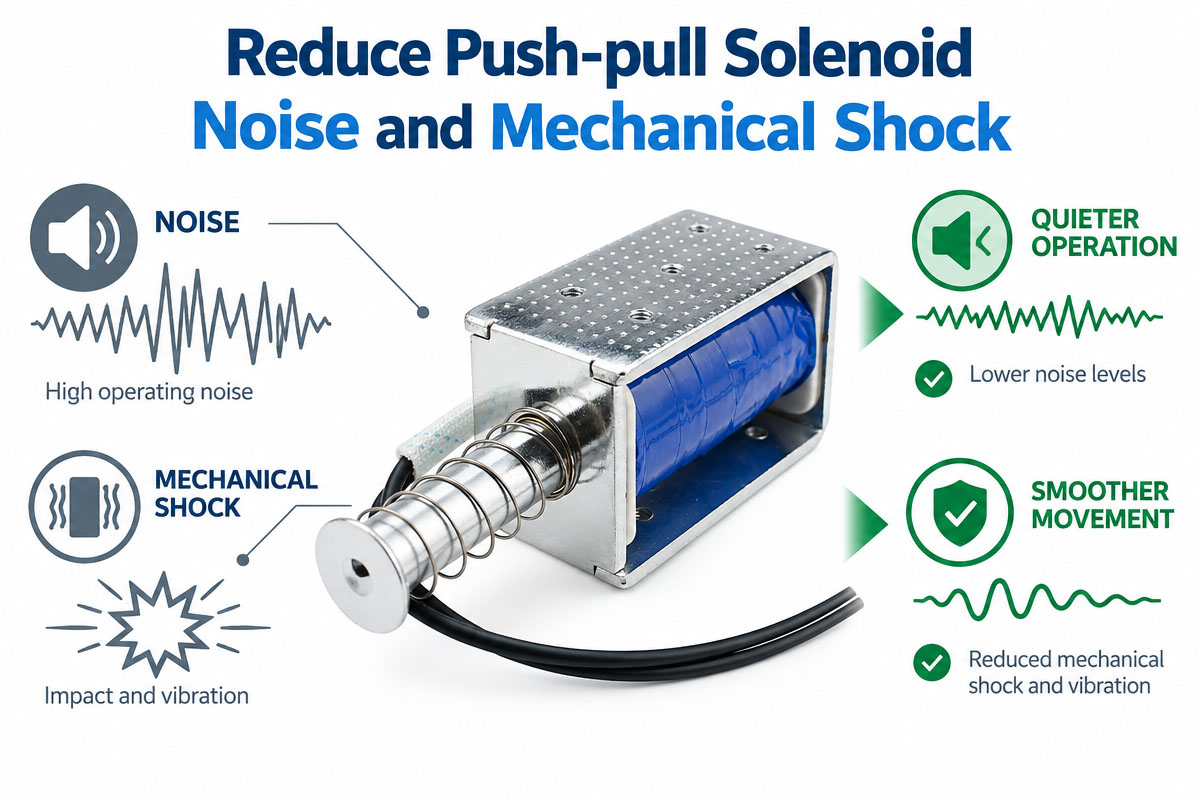
The solenoid may have a “clicking” noise when the plunger collides with the mechanical stops.
This may not be an issue in industrial machines but is important for applications such as:
Medical devices, laboratory equipment, office equipment,
Smart home devices
Vending equipment.
Premium products. Possible sources of noise are
Noise of plunger collision, excessive clearances, spring moving, mounting resonance, or the customer’s linkage.
Improvements may consist of:
Tuning plunger speed Changing the location of mechanical stops,
Better alignment, proper clearance control, damping.
Electric drive optimization
If acoustic performance is important for your product, let the push-pull solenoid manufacturer know that from the beginning.
11. Design for the intended service life.
Defining the cycle-life requirements is one of the key moments.
A solenoid that operates for 20 times per day needs very different durability requirements than an automation device operating 100+ times per second.
In case of mechanical wear, we may expect:
Plunger guides, shaft, and ceasing springs
Touch area connections,
And other factors like coil heat, side loading, contamination, velocity of collisions, and lubrication can also have influence.
Buyers should ask about validation of life. For instance, saying “one million cycles” is meaningless if the test condition is not specified.
Ideally, life tests should reproduce real stroke, load, voltage, duty cycle, and temperature.
12. Select material and surface finishes
Material choice may influence magnetic properties, corrosion resistance, friction, wear, and cost.
Among the materials used for custom solenoids may be:
Steel,
Magnetic components from stainless steel, copper winding wire
Springs,
Plastic bobbins,
Surface treatment of metal parts.
In some cases mechanical or corrosion protection may require surface treatment.
However, altering magnetic material or coatings may sometimes affect the magnetic circuit or dimensional tolerance.
Changes of materials should not be perceived as buying decisions.
Control of the materials affecting the performance of an actuator is a must for push-pull solenoid manufacturers.
13. Make Push-Pull Solenoid Prototyping
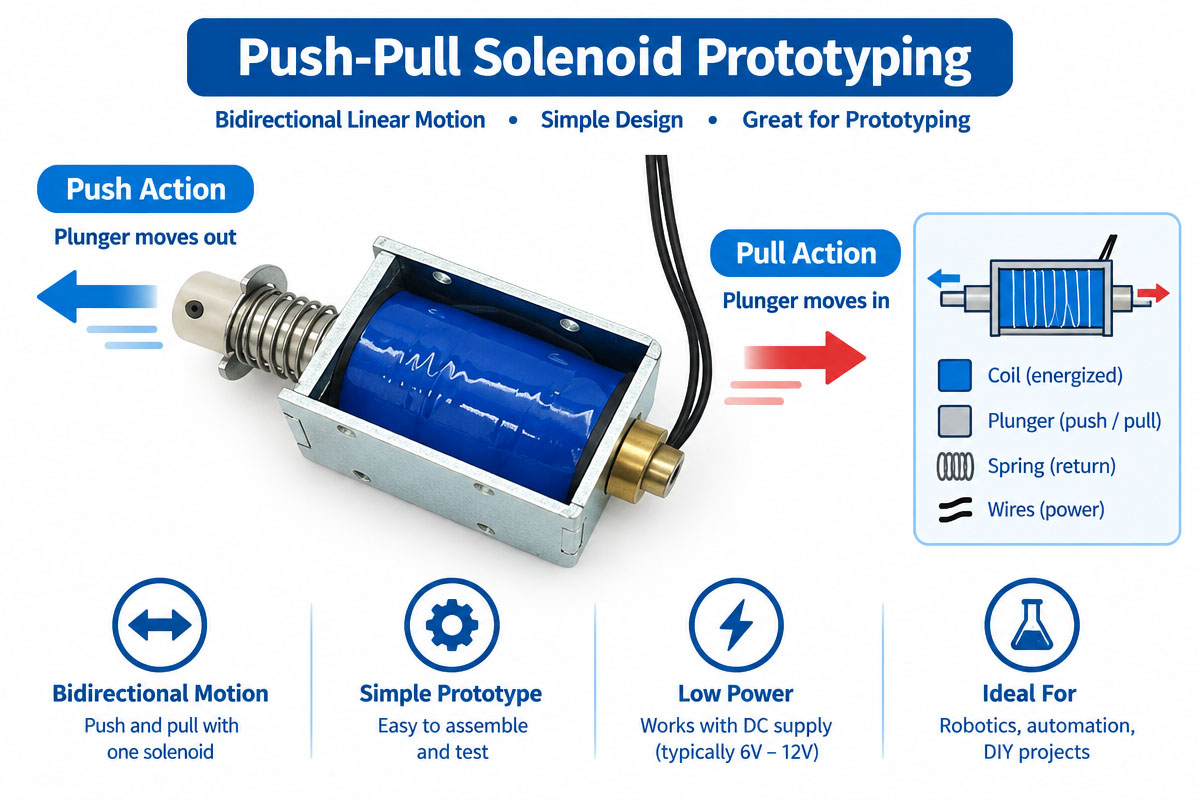
After the development of a technical specification is done, work on the prototype begins.
The manufacturer, where possible, may begin with an existing electromagnetic platform and modify components like:
Spring Plunger
Spring Brace Push Rod
Lead Wire
Connector
o This may reduce the product’s development time.
The usual process is:
Application requirements, engineering review, concept, prototype, test, optimization, validation
OEM engineers should use the prototypes in the actual mechanism.
Mechanical alignment, loading, power supply limitations, enclosure temperature, or linkage geometry may all cause a solenoid to function properly on a test fixture while failing to work the same way after integration.
14. Verify the Custom Design
Engineering validation should show that the actuator functions under realistic and worst-case conditions.
Tests can include:
Force testing: Measure the force at critical points of stroke.
Stroke testing: Verify actual usable stroke.
Voltage testing: Minimum, nominal, and maximum voltage tests.
Testing now: Electrical requirements.
Temperature Test: Test the temperature of the coil and hot condition performance.
Response testing: Verify actuation and release times
Life test: Check durability under cyclic operations.
Environmental testing: Application-specific test temperature, vibration, or other conditions.
The push-pull solenoid manufacturer should measure performance characteristics prior to the design release for mass production.
15. Design for Production
That prototype that passed the tests is just the beginning.
A custom actuator must be manufacturable at the required volume and cost.
Design for manufacturability issues include:
o Uniformity of coil winding
o Plunger tolerances
o Magnetic air gaps
. Spring variation.
o Order of assembly
o Welding or bolting
o Lead wire installation
o Fixture design
o Inspection methods
o Tighter than necessary tight tolerances increase costs.
Loose tolerances can result in performance variation.
The engineering team should identify critical-to-function characteristics and control them accordingly.
A good push-pull solenoid manufacturer designs for repeatability and does not rely on manual adjustments during final assembly.
16. Push-pull Solenoid Tooling and Pilot Production.
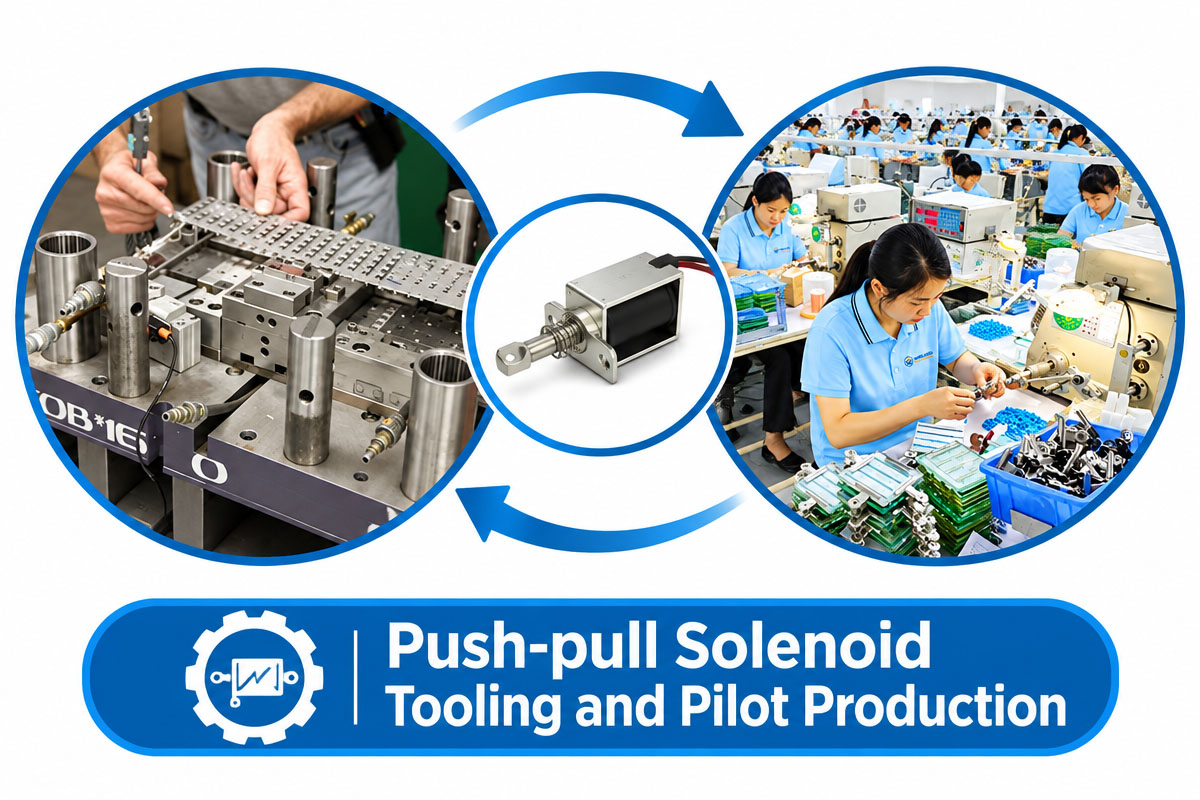
Custom designs may require dedicated tooling.
Such tooling may include, depending on construction and volume:
o Press-tools
o Injection Molds
o Coil fixtures
o Fixtures for assembly
o Welding fixtures.
o Gages for inspection
o Test fixture for functional testing
Buyers need to verify tooling costs, ownership, maintenance, and expected tooling life prior to project approval.
Pilot production is a very important process that follows tooling completion.
The pilot units should be made using the production materials, tooling, operators, and processes.
This will ensure that the manufacturing process is able to produce the performance demonstrated in engineering prototypes.
17. Set up quality control for mass production
3) Quality control should target features that directly affect performance.
These can be, depending on the design:
Coil resistance
Current
o Myocardial Infarction
o Critical dimensions
o Plunger travel
o Force of spring
o Electrical insulation
o Actuating function
o Wire and connector integrity
Force testing may be required for critical applications.
Buyers should discuss with the push-pull solenoid manufacturer the inspection methods and sampling plans before mass production.
For long-term OEM programs, you may also need to implement lot traceability and nonconforming-product control.
18. Engineering change control
It is not enough to check the finished units to ensure production consistency.
Materials and manufacturing processes also have to be controlled.
Changes that might affect performance are:
Wire for coil
Magnetic steel
o Material of the piston
o Spring manufacturer
o Surface treatment
o Bobbin material
o Glue.
o Production process
OEM buyers need to set expectations for engineering-change notifications.
Any performance-sensitive change should not be implemented without evaluation.
Change control helps a push-pull solenoid manufacturer to continue to deliver units meeting the design initially validated by the customer.
19. Assessment of production capacity and supply reliability
Just because a supplier makes 20 good prototypes doesn’t mean they can make 100,000 consistent units a year.
OEM buyers, take note:
o Existing manufacturing capacity
o Coil winding machinery
Ability to assemble
o Equipment for testing
o Time required for production
o Material sourcing
o Capacity Enhancement
o Quality staffing
o Continuity of supply
o Ask the manufacturer about their capacity planning for your forecast.
During the development stage, discuss future volume if demand is expected to increase substantially after product launch.
This will give the supplier the opportunity to consider automation, tooling, and production layout before capacity becomes an issue.
20. Compare total cost, not just unit price
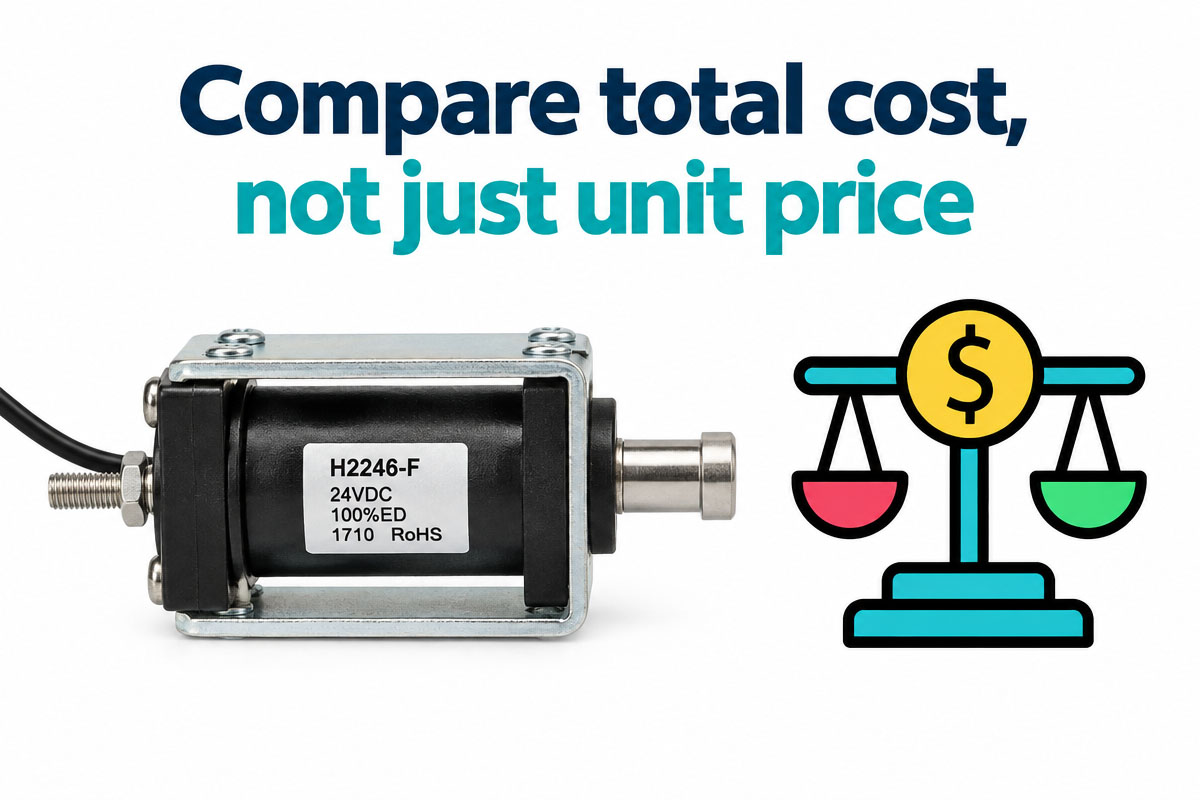
The buying departments will compare unit prices, of course, but the lowest quote is not always the cheapest in total.
Think:
Engineering fees
Equipment
Cost of samples
Cost per unit.
Verification
Assembly labor
Failure rates
Product downtime
Claims under warranty
Field replaceable
Communicating with Suppliers
A relatively more expensive solenoid that works reliably and consistently arrives can be much less expensive over the life of an OEM program.
Suppliers should be compared on price as well as technical capability and manufacturing risk.
21. Develop a complete RFQ
A clear RFQ allows the suppliers to offer more accurate technical proposals and quotations.
For instance:
Application: Locking system for industry
Solenoid type: Pull-pull
Action: Draw.
Nominal voltage: 24 VDC
Voltage range: 21-27 Vdc
Stroke required: 8 mm
Starting force: 15 N at 8 mm
Final Force: 30 N ON Time: 1 Sec OFF Time: 4 sec
Operating Temperature: -20°C to +60°C
Life expectancy: 1,000,000 cycles
Max size: 45 x 30 x 25 mm
Connection: 200 mm lead wire with connector
Demand per year: 100.000 pcs.
If possible, attach drawings, CAD files, pictures, or videos of the mechanism.
This will allow the push-pull solenoid manufacturer to determine what would be the best solution: an existing platform, a modified standard product, or a totally custom design.
Conclusion
A custom push-pull solenoid design requires coordination of electromagnetic design, mechanical engineering, electrical requirements, thermal performance, and manufacturing.
Force should be defined at the actual working stroke. The coil design should match the available voltage, current, and duty cycle. The plunger and return spring should be appropriate for the customer’s mechanism, and also the temperature, noise, response time, and life should be tested.
The manufacturing capabilities are equally important for OEM buyers.
A good push-pull solenoid manufacturer will be able to perform application review, custom engineering, prototypes, testing, tooling, pilot production, quality control, and long-term volume manufacturing.
The most successful projects are usually based on detailed specification and early supplier involvement.
Don’t ask for voltage, force, and price, but provide the whole operating conditions and let the manufacturer evaluate the actuator in the whole electromechanical system.
With good engineering, design for manufacturing, and disciplined production control, OEM companies can develop a custom push-pull solenoid that provides reliable performance from initial prototypes through long-term mass production.
22. Common Questions from Push-Pull Solenoid Manufacturer’s Buyers
1. What information do I need to provide to a push-pull solenoid manufacturer for a custom quote?
Application, push or pull direction, nominal voltage and voltage range, current available, stroke required, force at certain stroke positions, ON/OFF time, operating frequency, temperature range, dimensions, mounting requirements, expected cycle life, wires or connectors, annual quantity, and target production date. Drawings and CAD files will be a significant help to the supplier’s evaluation.
2. What is the MOQ I should expect on a custom push-pull solenoid?
The MOQ will depend on how much customization you need and the manufacturer’s process. A modified standard platform can be more beneficial than a new actuator with dedicated tooling for lower MOQ. Buyers should ask separately for quantities for engineering samples, pilot production MOQ, and normal mass production MOQ.
3. What is the cost of custom push-pull solenoid tooling?
The tooling cost will depend on the parts being customized. Minor changes to the plunger, spring, bracket, wire, or connector may involve minor tooling, but new housing or magnetic structure may require stamping dies, molds, fixtures, and special test equipment. We kindly ask that suppliers separate tooling from unit pricing.
4. What is the lead time for custom solenoid development?
Lead time will depend on design complexity, tooling requirements, availability of materials, sample iterations, and validation testing. Creating a new electromagnetic structure will take longer than modifying an existing one. Buyers should request a schedule including design review, prototypes, revisions, tooling, pilot production, and mass production approval.
5. How are buyers to compare quotations from various push-pull solenoid manufacturers?
Ensure all suppliers quote against the same force, stroke, voltage range, current limits, duty cycle, lifetime, temperature, materials, dimensions, connectors, annual volume, and quality requirements. Also compare tooling costs, sample lead times, engineering support, test capability, production capacity, and change control procedures.
6. What samples should I test before I approve mass production?
Use engineering prototypes and test them on the actual mechanism. Request pilot production samples made with the materials and processes that will be used after design approval and production tooling. If applicable, check force, stroke, voltage range, current, hot-coil performance, temperature, response time, noise, mechanical fit, and operating life.
7. How do I lower the cost of a custom push-pull solenoid?
Wherever possible, use an existing manufacturer platform. Avoid unnecessary overstroke, excessive force requirements, overly tight tolerances, and nonstandard materials unless they provide a measurable benefit. Standardization of brackets, wires, connectors, and mounting features can also reduce tooling and unit cost. Early discussions with manufacturing about design can uncover additional savings.
8. How to choose a reliable push-pull solenoid manufacturer?
Don’t just look at cost—look at engineering and manufacturing capability. A good push-pull solenoid maker understands force versus stroke performance, coil and magnetic circuit design, thermal behavior, duty cycle, materials, life testing, and mechanical integration. Buyers should also consider prototype support, quality control, capacity, traceability, engineering change management, delivery performance, and long-term supply capability.