Custom Solenoid Flapper Valve for Printing Equipment
How Solenoid Flapper Valves Improve Industrial Control
Solenoid Flapper Valve Applications in Modern Printing
Solenoid Flapper Valve for Precision Control System
Solenoid Flapper Valve for Ink and Fluid Control
Industrial Solenoid Flapper Valve Selection Guide
Custom Solenoid Flapper Valve for Printing Equipment
How Solenoid Flapper Valves Improve Industrial Control
Solenoid Flapper Valve Applications in Modern Printing
Solenoid Flapper Valve for Precision Control System
Solenoid Flapper Valve for Ink and Fluid Control
Industrial Solenoid Flapper Valve Selection Guide

WL0725 Solenoid Flapper Valve for Industrial Automation Solutions

A solenoid flapper valve is a combination of the electromagnetic technology and the flapper mechanism that provides the flow control. For those applications that require high-frequency switching, reliable operations, and small space. The solenoid coil generates the magnetic field that energizes to move the flapper to control the flow of fluid or air.

The solenoid flapper valve is widely used in industrial printing systems, ink control equipment, medical equipment, and automation machinery because of its fast response and reliable operations. Customized design allows the engineers to tune the voltage, force, stroke, sealing capability, and lifetime in order to fulfill the specific application requirement. Well-designed solenoid flapper valves can help improve the efficiency of the equipment, reduce the maintenance cost, and increase the system reliability.

Compact Solenoid Flapper Valve Product Overview

A solenoid flapper valve is a magnetic control valve that employs an actuator in the form of a solenoid to either open or close the flexible flapper mechanism in order to control air flow, ink flow, gas flow, or liquid flow. The electromagnet, powered by electricity, generates the magnetic field to control the flapper mechanism in order to direct the flow path. In comparison to the traditional valve, a solenoid flapper valve provides fast response, small size, low power consumption, and reliable operations. They find wide application in printing equipment, medical equipment, automation equipment, and fluid control systems.

How does the solenoid flapper valve work?

A solenoid flapper valve works by using the concept of electromagnetic force generated by the solenoid coil.

The working process includes:

1. Electrical Activation

The voltage supplied to the coil generates the current to create the magnetic field.

2. Movement magnetic

The magnetic force attracts the inner plunger or armature, generating the mechanical movement.

3. Flapper (Open or Close)

The movement drives the flapper to control the flow path in opening or closing.

4. Flow of control

If the valve opens, the fluid, ink, or air flows through. If the power source stops, the returning spring or elastic force drives the flapper to restore its initial position.

The outcome of this simple design is

Quick response

Quiet operations

Proper switching.

Long life span.

Solenoid Flapper Valve Features Review

The main features of the solenoid flapper valve are

compact design

fast response time

reliable switching performance

precise flow control

The design is made specially for frequent operation in industrial equipment. It has low power consumption, good repeatability, and reliable performance in various working environments. Key design features include improved magnetic materials, sealing materials, optimized coil winding, and mounting design options. Solenoid flapper valve designs can support the various requirements of voltages, flow rates, pressure levels, and lifetimes depending on the customer needs, which makes them perfect for OEM automation and industrial applications.

Compact Solenoid Flapper Valve Video Presentation

Compact Solenoid Flapper Valve Detail Display

Solenoid Flapper Valve Technical Data Sheet

Brand Weilong Technology Model Number WL0725
Rated Voltage (V) DC 3–48V Rated Power (W) 3-6 W
Work Model Flapper Type Design Holding Force (N) 50 Gf
Stroke (mm) 19.7 MM Reset Time(s) 50 Ms
Service Life 300 Thousand Times Certification CE, RoHS, ISO9001
Material Carbon Steel Housing with Zinc-Plated Coating Lead Wire Length (mm) 200
Install Style Adjustable Screw Tolerance of Dimension ± 0.1 MM
Water-proof None Insulation Class F 155 Cel. Degree
Hi-Pot Test AC 600V 50/60Hz 2s Non-excitation Holding Force 0
Working Temperature -10°C-100°C Duty Cycle 1-100%
Thread Depth (mm) / Payment Term TT, or LC at Sight
Sample Order Yes. Warranty 1 Year
MOQ 500 pcs Supply Ability 5000 pcs per week
Delivery Time 30 Days Port of Loading Shenzhen

Solenoid Flapper Valve vs. Latching Solenoid Valve—Difference in Working Principles and Applications
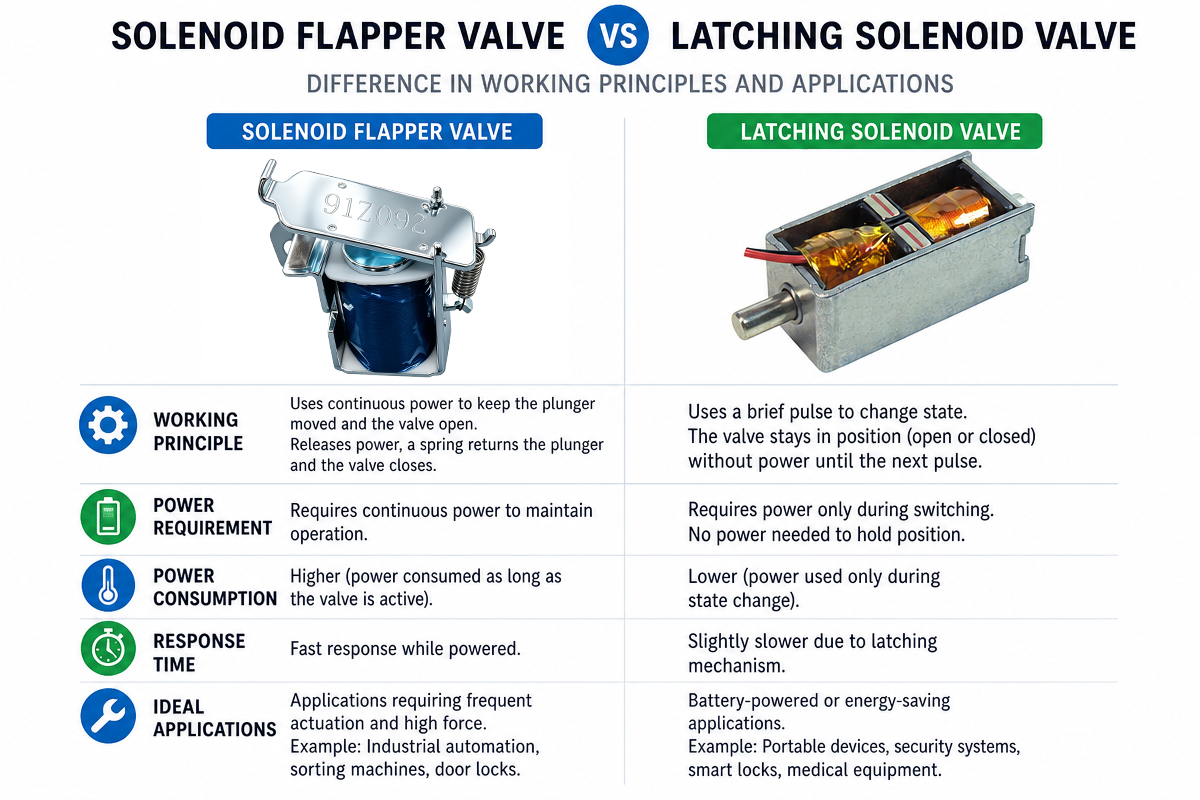
Solenoid Flapper Valve VS. Solenoid Latching Valve Guide

Solenoid valves are widely used in industrial automation, printing machinery, medical equipment, fluid control systems, and smart machines. There are several types of electromagnetic valves to be chosen depending on project requirements. The solenoid flapper valve and latching solenoid valve are examples of such solutions, which offer high control performance but work in a different way.

The choice of solenoid flapper valve or latching solenoid valve depends on specific application needs such as power consumption, response time, operational mode, holding performance, and working conditions.

1. Difference in Working Principles

Flapper Solenoid Valve

The solenoid flapper valve is designed to use an electromagnetic force to move a flapper to open or close a flow channel.

Upon applying voltage:

  • Electromagnetic force is generated by a coil
  • Inside armature moves

The flapper opens or closes the fluid passage.

  • Control fluid flow, air, gas, or ink.

If voltage is not applied, a spring or an elastic force returns a flapper to its initial position.

The valve should have a continuous power supply if it is necessary to keep the valve in an active position.

Latching Solenoid Valve

Latching Solenoid Valve The design of the permanent magnet keeps a valve in place without a continuous power supply.

The working principle:

  • A coil operates with a short electrical impulse.
  • A plunger is moved by the electromagnetic force.
  • A permanent magnet keeps the position.
  • No continuous power supply is necessary.

A reverse impulse shifts the valve to another position.

The design is particularly useful for battery-powered or energy-efficient applications.

2. Relative Power Consumption

One of the main differences of these technologies is power consumption.

Solenoid Valve (Flapper)

Pros:

  • A simple control method
  • Quick activation speed
  • Suitable for frequent switching

Cons:

  • Requires continuous power when used
  • Heat generation upon long-time usage

Typical applications are

  • Print press
  • Industrial control systems
  • Pneumatic control systems

Solenoid Valve with Latch

Pros:

  • Ultra low power consumption
  • Does not generate heat during holding
  • Suitable for battery applications

Cons:

  • Needs special pulse control electronics
  • Complex control system

The typical applications are

  • Smart meters
  • Battery-operated gadgets
  • Energy-efficient fluid control system
  1. Comparison of Response Time

Flapper Valve Solenoid

The solenoid flapper valve generally has a very quick response time due to the light weight of the construction and optimization for quick movement.

Advantages:

  • Quickly opens or closes
  • High switching frequency
  • Precise flow control

It is particularly useful for printing applications, where the timing is important.

Latch Solenoid Valve

The latching valves also have a fast response; however, they are primarily designed for position holding instead of quick switching in continuous mode.

They are more appropriate for applications where the valve changes position occasionally and then stays at one position for a long time.

4. Design of Mechanical Structures

Design of Solenoid Flapper Valve

Main components:

  • Solenoid coil
  • Core magnetic
  • Armature

Flapper

  • Spring
  • Sealing elements

Features:

  • Small size
  • Simple design

* Easy integration

Design of Latching Solenoid Valve

Main components:

  • Solenoid coil
  • Magneto fix
  • Plunger
  • Housing magnetic
  • Return mechanism

Features: •

  • Magnetic holding feature
  • Energy efficient
  • Position stability
  1. Comparison of Applications

Solenoid Flapper Valve Applications

Popular industries:

Printing Machines

For use:

  • Fluid control
  • Cleaning machines
  • Air pressure control

Medical devices

For use:

  • Fluid control
  • Gas control systems

Automation Devices

For use with

  • Equipment for dispensing
  • Pneumatic control

Latching Solenoid Valve Uses

Popular industries:

“Smart water meters”

Pros:

  • Battery operated
  • Long life

Portable Devices

Pros:

  • Low power consumption

Remote Control Systems:

Pros:

  • Low power consumption
  1. Advantages and Disadvantages Summary
Item Solenoid Flapper Valve Latching Solenoid Valve
Power Consumption Higher Very Low
Holding Power Requires power No power required
Response Speed Very Fast Fast
Control Method Simple ON/OFF Pulse control required
Heat Generation Higher Very Low
Structure Simple More complex
Best For Frequent switching Long-holding operation

7. How to choose the solenoid flapper valve or the latching solenoid valve?

If you need a solenoid flapper valve, choose:

  • Quick switchover
  • Continuous use
  • Simple control
  • Compact fluid control

Latching Solenoid Valve Features If you need to choose:

  • Low power requirements
  • Battery operated
  • Long holding period
  • Low heat output

8. Conclusion

Both the solenoid flapper valve and latching solenoid valve are reliable electromagnetic control solutions but are designed for different applications.

The solenoid flapper valve is optimal for high-speed switching applications such as printing machines, automation devices, precise fluid control systems, etc.

If the application is energy saving and the valve should stay in position without power, it is better to choose a latching solenoid valve.

Understanding of working principles, power consumption, reaction speed, and application requirements helps engineers to choose the best solenoid solution for their projects.


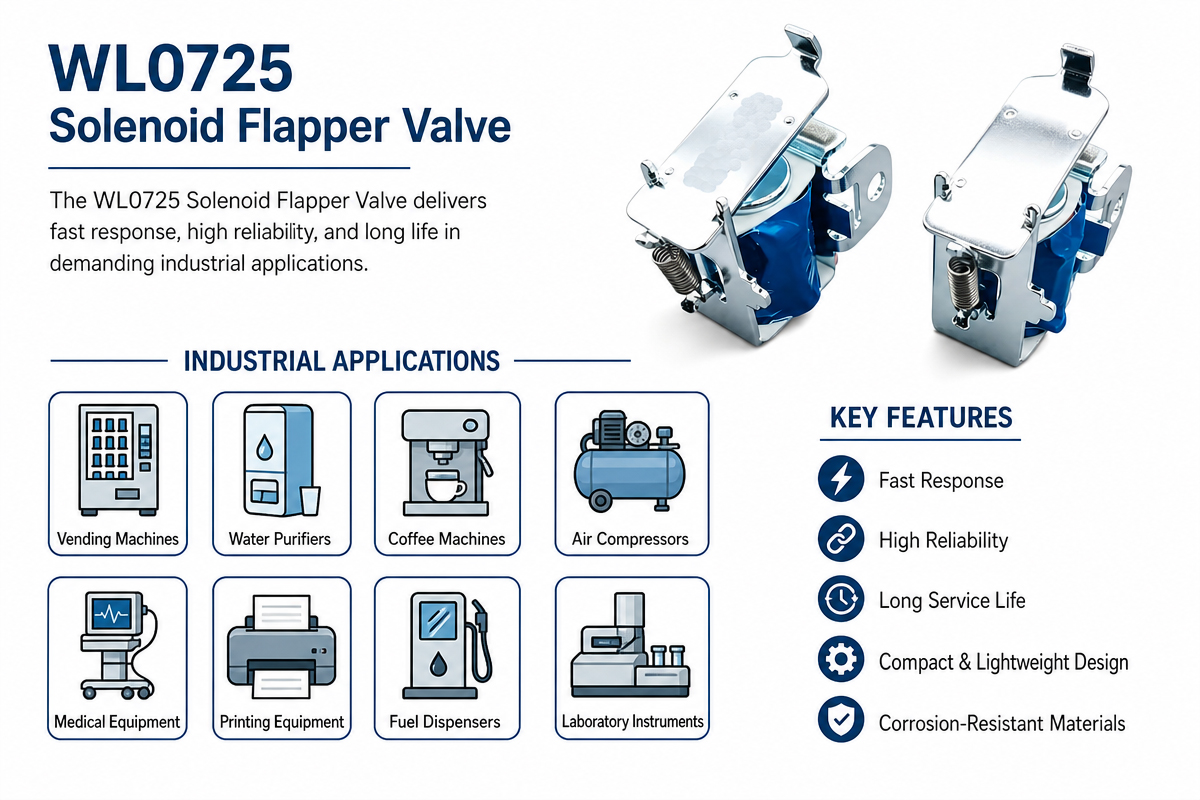
Compact Solenoid Flapper Valve Industrial Application

Compact Solenoid Flapper Valve Industrial Application

The solenoid flapper valve is widely used in industries where precise and fast flow control is necessary.

1. Print Industry

Printing machines need precise control of the ink, air pressure, and fluid flow. The solenoid flapper valves are suitable for fast switching and reliable operation in ink delivery systems, print heads, and cleaning mechanisms.

2. Medical Gear

Medical devices need miniaturized and reliable valves for air and fluid control. The solenoid flapper valves are used in diagnostic equipment, analytical equipment, and laboratory equipment.

3. Industrial Automation

Solenoid flapper valves are used in automation machinery for pneumatic control, material handling, and precise dispensing machinery.

4. Packaging Machine

In packaging machines for filling, sealing, and dispensing applications, the fast response of the valve is required.

5. Robot Systems

Compact electromagnetic valves can provide such advantages as precise movements and process control for robotic equipment.

Solenoid flapper valves are a perfect choice for modern industrial equipment because of their advantages in small size, quick response, and customization.

Why is the solenoid flapper valve becoming increasingly popular in the printing industry?

The printing industry requires a highly accurate control of ink and air flows. Today’s printing press operates at such a high speed that it needs precision control that conventional valves cannot provide.

The solenoid flapper valve is increasingly popular because it provides:

rapid response time

precise switching

good installation

easy maintenance

long life

Today’s printers require much higher speeds and ink management. Solenoid flapper valves are great for controlling ink flow, cleaning systems, and pneumatic operations.

Custom design allows customizing the performance of valves for different printing platforms, making them an essential part of modern printing equipment.

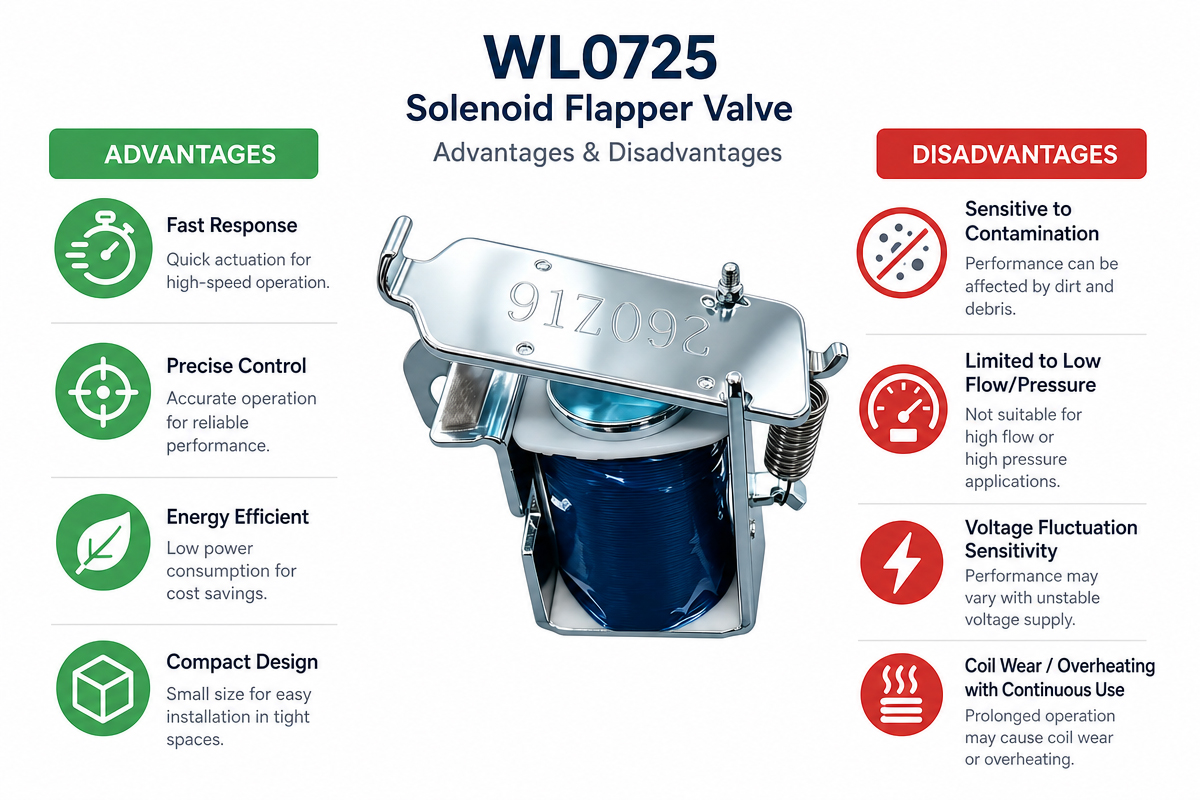
Solenoid Flapper Valve Advantage and Disadvantage

Compact Solenoid Flapper Valve Advantage and Disadvantage

Solenoid Flapper Valve Advantages

There are several advantages of using a solenoid flapper valve:

fast switching

small size

low power consumption

basic electronic control

high reliability

easy maintenance

especially advantageous in applications requiring frequent operation and accuracy of control.

Solenoid Flapper Valve Disadvantages

But there are some disadvantages of the valve:

less pressure capability than some industrial valves.

performance dependent on sealing design

requires sufficient voltage control

may require custom application development

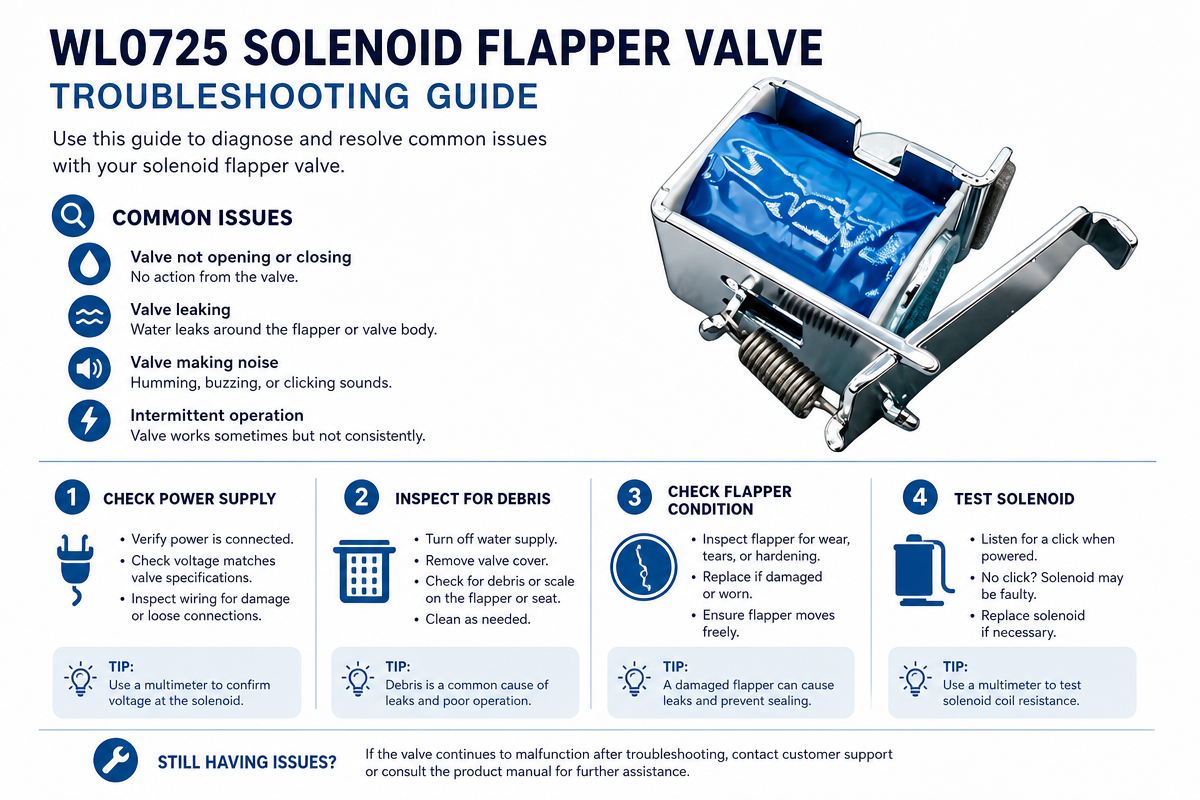
Solenoid Flapper Valve Problems and How to Solve Them

Compact Solenoid Flapper Troubleshooting Guide

Problem 1: Valve is not working.

Reasons:

wrong voltage

failure of the coil

problems with wiring.

Solution:

checking power supply

testing the resistance of the test coil

checking connection.

Problem 2: Poor flow control capabilities

Reasons:

obstruction

not sufficiently strong

insufficient sealing

Solutions:

cleaning valve

pressure check

design optimization

Problem 3: Overheating

Reasons:

too high voltage

wrong duty cycle

bad heat dissipation

Solutions:

specifications check

thermal design improvements

Problem 4: Leakage

Reasons:

damage of flap

bad sealing material

poor assembly

Solutions: 1.

changing seal components

improvement of the manufacturing process.


Frequently Asked Questions About Solenoid Flapper Valve

1. What is Solenoid Flapper Valve?

A solenoid flapper valve is a valve that operates through a magnetic force generated by a solenoid. The solenoid valve is actuated by electricity to move a flapper in order to enable or shut off the flow of air, ink, gas, or liquid.

The solenoid flapper valve is more compact in design, faster in response, and economical and reliable than traditional valves. It is mainly used in printing devices, medical devices, automated systems, and precision fluid control.

2. How does Solenoid Flapper Valve work?

A solenoid flapper valve is based on the principle of electromagnetic force.

The process of functioning is as follows:

Electrically, the valve is powered by an electric current.

There is an electromagnetic field inside the valve.

The armature or plunger is moved due to the effect of the electromagnetic field.

The valve is opened or closed.

Medium is allowed to pass through or is restricted from passing.

When the power is turned off, the flapper comes back to its original position by means of the spring or elastic force.

The flow of the medium is accurately controlled by means of this operation.

3. What are the uses of Solenoid Flapper Valves?

Solenoid flapper valves are mainly used in the following devices:

Printing machines

Ink Jet Printing Systems

Medical Devices

Laboratory equipment

Industrial automation machinery.

Pneumatic control systems

Dispensing systems

Robotic systems

Solenoid flapper valves are popular in the printing industry because of their ability to give precise control of ink and air flow with fast response speed.

4. How to choose the Solenoid Flapper Valve correctly?

Factors that influence the choice of solenoid flapper valve for engineers:

Voltage (DC 5V, 12V, 24V, and others).

Flow rate

Operating pressure

Medium (air, ink, liquid, gas)

Turnaround time

Duty cycle:

Increasing space

Estimated lifespan

For OEM projects the customer should provide the detailed technical data about the application to improve valve design, coils, and sealing performance by the manufacturer.

5. Can I customize the Solenoid Flapper Valve?

Yes. Custom Solenoid Flapper Valves can be customized according to the requirements of the application.

Options for customization are

Various voltages

Various sizes

Customized connectors.

Different sealing materials

Specific flow performance

Different mounting construction

Increased service life requirements

Custom designs are often used in industrial printing machinery, industrial automation, and special OEM machinery where standard valves are not able to meet the performance requirements.

6. What determines the service life of a Solenoid Flapper Valve?

The life of the solenoid flapper valve depends on the following factors:

Frequency of operation

Duty cycle.

Operating temperature

Material quality

Coil design

Mechanical wear.

Compatibility with fluids

To increase the service life, the engineers should make the right choice of valve specification and should not exceed the rated operating parameters.

High-quality materials, precise manufacturing, and reliability testing can ensure hundreds of thousands of operating cycles.

7. Why the Solenoid Flapper Valve is so popular in the printing machinery?

Solenoid flapper valves are frequently used in printing systems because of:

Fast switching speed

Precise ink control

Compact size.

Consistency

Easy maintenance

Printing devices operate with high speeds and require precise control of the ink delivery, cleaning, and air flow systems.

Due to their compact design and fast response time, solenoid flapper valves are a perfect solution for modern printing applications.


8. What are the common problems with Solenoid Flapper Valves and how to solve them?

Problems usually are:

The valve is not working.

Reasons are:

Incorrect voltages

Damaged coil

Wiring problem

Answer:

Check the electrical connection and coil resistance.

Slow flow

Reasons may be:

Blockage

Incorrect valve selection

Low operating pressure

Answer:

Check the flow requirement, and clean the valve.

Leakage Problem

Reasons are:

Leaky gaskets

Improper assembly

Answer:

Replace sealing elements, improve assembly accuracy.

Overheating.

Reasons may be:

Excessive duty cycle

Incorrect volts

Solution:

Check specifications, and improve thermal management.

The reliability of solenoid flapper valves can be significantly improved with regular maintenance and proper product selection.

How to Choose a Solenoid Flapper Valve?

Selection of the suitable solenoid flapper valve is done based on the assessment of a number of technical parameters.

1. Controlled Environment Confirmation

2. Identify the controlled environment:

Gas-Liquid-Air-INK

The type of the fluid determines the material and sealing structure.

3. Verify Voltage Requirement

Voltage options:

DC 5V

DC 12V

DC 24V

The voltage affects the coil design, power consumption, and heat generated.

4. Set flow requirement

Engineers should confirm:

Flow rate

Pressure Range of

Opening Size of

The valve should have enough flow performance for the application.

5. Confirm Response Time

A fast switching response is required for the high-speed equipment. The printing and automation systems usually operate at the millisecond level.

6. Determine Lifetime Need

Confirm the expected cycles:

100k cycles

500,000 cycles

1 million cycles

7. Confirm the Space for Installation

Consider:

Valve size

Location of connector

Type of installation

8. Choose a Reputable Supplier

A reputable supplier will provide you with:

Prototype test.

Performance figures.

Quality control.

Engineering expertise support.

How to avoid mistakes while designing a solenoid flapper valve?

“Choosing a valve according to size alone is a mistake.

Flow requirement confirmation should precede design.

Ignore the temperature conditions at your own peril.

The sealing material compatibility should be tested.

The frequency and duty cycle must be considered.

Response times need to be checked before the operation.

Lifetime should be confirmed at the beginning.

Do not set safety margins too tight.”

Advantages and Disadvantages of Solenoid Flapper Valve (200 Words)

Advantages

There are several advantages of using a solenoid flapper valve:

fast switching

small size

low power consumption

basic electronic control

high reliability

easy maintenance

especially advantageous in applications requiring frequent operation and accuracy of control.

Disadvantages

But there are some disadvantages of the valve:

less pressure capability than some industrial valves.

performance dependent on sealing design

requires sufficient voltage control

may require custom application development


Get A Free Quote Now

Contact Form

Related Products

Related News

Scroll to Top

Get A Free Quote Now !

Contact Form
If you have any questions, please do not hesitate to contact us.
Weilong Solenoid Company Culture