

Chapter 1: What is an electromagnetic Force?
Electromagnetic force is a force arising due to the interaction of an electric current and a magnetic field.
The direction of the flux of the magnetic field generated by a permanent magnet is directed from the North pole (N) to the South pole (S).
When a current conductor is located in the magnetic field, the magnetic field and current interact with each other to generate force. This is called an electromagnetic force.
Fleming’s Left Hand Rule is used to determine the direction of this force:
Thumb → Force direction (motion direction) Index finger → Direction of the magnetic field (magnetic flux) Middle finger → Direction of the current When the index finger represents magnetic flux and the middle finger represents current, the thumb indicates the direction of the resulting force.
Chapter 2: How Does the Electromagnetic Force From ?
Electromagnetic force is formed due to the interaction of electric current and magnetic field. It is one of the ways to connect electricity and magnetism.
2.1. Magnetic Field Created by Electric Current
When an electric current passes through a conductor (wire or coil), a magnetic field forms around it.
This magnetic field is formed by loops around the conductor according to the right-hand rule.
2.2. Interaction of Two Magnetic Fields
When the current magnetic field is put into the external magnetic field (permanent magnet), the two magnetic fields interact:
– same direction magnetic fields – reinforce each other
– opposite direction magnetic fields – cancel each other out
Imbalance of the magnetic pressure occurs in the magnetic field around the conductor.
2.3. Generation of Force (Motion Effect)
Due to this imbalance, the conductor gets the force and wants to move.
– side with a higher magnetic pressure wants to push harder
– conductor moves towards the weaker side
This is an electromagnetic force.
2.4. Force Creation Explanation Based on Energy
Field lines behave as stretched elastic bands. They want to shrink to reduce their length.
So when the electric current passes in the magnetic field:
– field lines distort
– system wants to reach a lower energy state
– mechanical force (motion) is created
2.5. Direction of Force (Fleming’s Rule)
The direction of the electromagnetic force is determined according to Fleming’s Left Hand Rule:
Thumb → Force direction Index finger → Direction of the magnetic field Middle finger → Direction of the current
Chapter 3: Relationship Between Current and Magnetism
3.1 Relation Between Current and Magnetism
The relationship between the electric current and the magnetism is one of the key principles in electromagnetism. When electric current passes through the conductor, it generates magnetic field around it and the strength of this magnetic field depends on the current.
3.2. Current Creates Magnetic Field
When current passes through the wire or coil:
– magnetic field forms around the conductor
– field forms loops around the wire
– direction is determined according to the right-hand rule
3.3. More Current → More Magnetism
There is a direct relation between current and the strength of magnetic field:
– larger current → stronger magnetic field
– lower current → weaker magnetic field
So, the magnetism is proportional to the current (for a fixed coil configuration).
3.4. Coil Loops Increase the Magnitude of the Magnetism
In the case of an electromagnet:
– loops of wire add up to the magnetic field
– more loops = more total magnetism
– total strength of the magnetic field depends on current and number of loops
So, magnetism is proportional to:
Magnetic Strength ∝ Current × Number of Loops
3.5 Interaction of Magnetic Fields Generates the Force
When the current-generated magnetic field interacts with an external magnetic field:
– fields combine or cancel each other
– this results in an imbalance of the magnetic pressure
– as a result a mechanical force (electromagnetic force) is created
3.6 Frequency Effect (AC Current)
In the case of the alternating current (AC):
– changing current creates changing magnetic fields
– higher frequency can affect dynamic magnetic field
– however, the strength mainly depends on the amplitude of the current
Chapter 4. Does Electromagnet Have the Residual Magnetism?
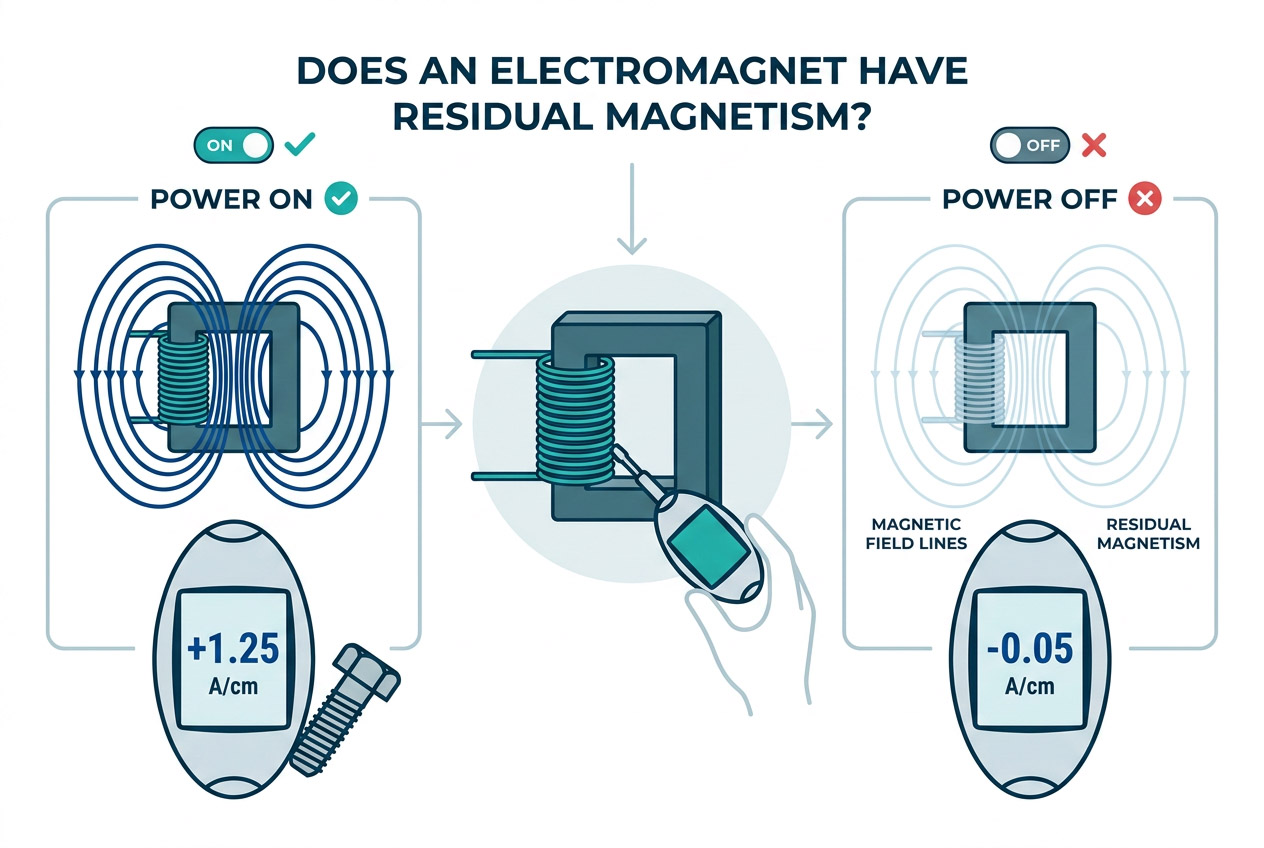
Yes. The electromagnet can hold some amount of the magnetism even after the electric current is turned off. This phenomenon is called the residual magnetism (remanent magnetism).
4.1 Reason for Residual Magnetism
When the current passes through the coil:
– magnetic domains inside the core material are oriented in one direction
– magnetic field is generated
After the current is turned off:
– most domains lose orientation
– however, a part of them remains partially oriented
This orientation is responsible for the residual magnetism.
4.2 Factors that Influence the Residual Magnetism?
Residual magnetism depends on many factors:
– type of the core material (soft iron or steel)
– magnitude of the current used
– number of the coil turns
– operating temperature
– magnetization time
Soft magnetic materials reduce the residual magnetism easier than hard ones.
4.3 Where the Residual Magnetism is Commonly Found
Residual magnetism can be observed in:
– lifting electromagnets (cranes)
– solenoids and actuators
– relays and switching devices
– industrial magnetic fixtures
In these systems workpieces can stay stuck even after the power supply is turned off.
4.4 Effects of Residual Magnetism
Residual magnetism can be both useful and problematic:
Advantages:
– helps to maintain the slight holding force in relays
– increases magnetic responsiveness of some devices
Disadvantages:
– workpieces may not release easily in the lifting systems
– reduces the efficiency of the demagnetization cycles
– may affect precision of some devices
4.5 How to Eliminate the Residual Magnetism
Methods to remove the residual magnetism include:
– reversing the current direction (degaussing)
– applying alternating current with decreasing amplitude
– mechanical separation (wood, copper tools)
– using demagnetization circuits
These methods randomize magnetic domains and decrease residual magnetism.
Chapter 5 :How to Calculate Electromagnetic Force
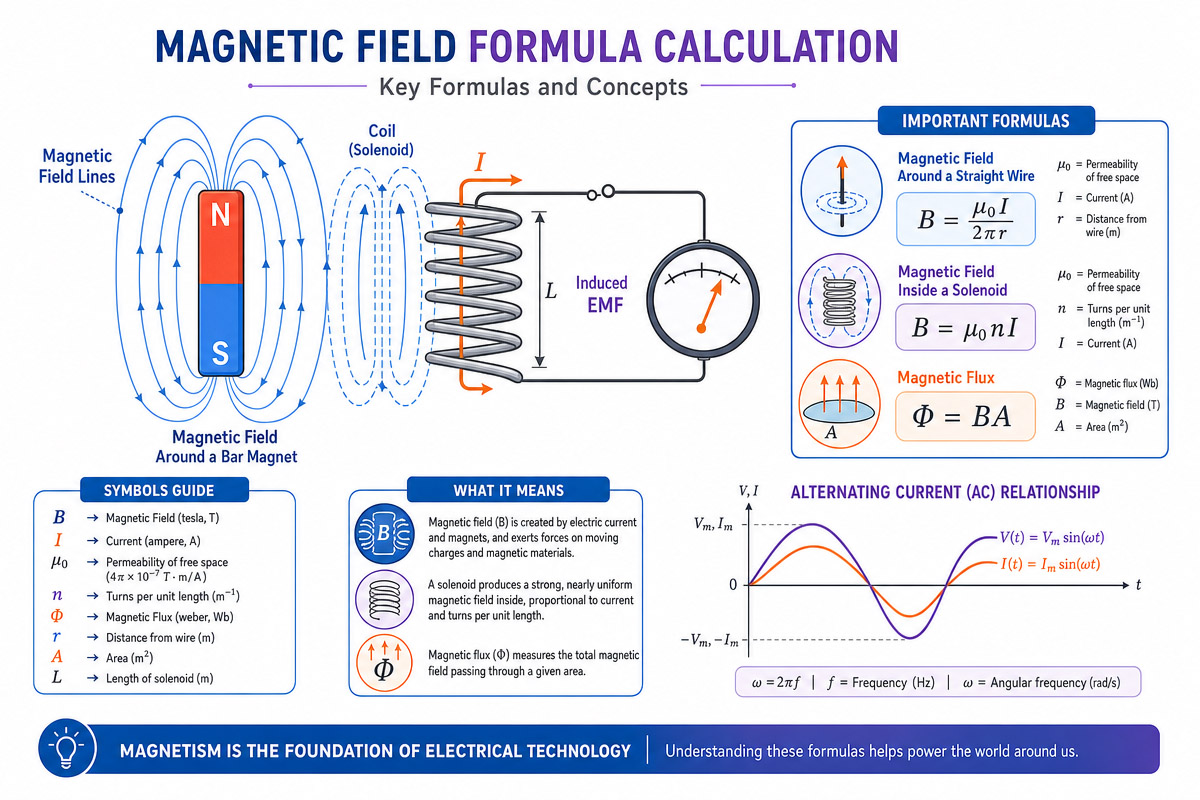
Electromagnetic force can be calculated as a result of the interaction of a current conductor and the magnetic field. The most commonly used formula in engineering and physics is derived from Lorentz force.
5.1 Basic Formula to Calculate Electromagnetic Force
For the straight conductor in the magnetic field:
F = B I L sinθ
Where:
– F – Electromagnetic force (Newton, N)
– B – Magnetic flux density (Tesla, T)
– I – Current (Ampere, A)
– L – Length of the conductor in the magnetic field (m)
– θ – Angle between the direction of the current and magnetic field
5.2. Maximum Force Condition
The force depends on the angle θ:
– when θ = 90° → sinθ = 1 → maximum force
– when θ = 0° → sinθ = 0 → no force
So, the conductor receives the maximum force when it is perpendicular to the magnetic field.
5.3. Relation Between Variables
From the formula we can see that:
– increasing current (I) → increasing force
– increasing magnetic field (B) → increasing force
– increasing length (L) → increasing force
Changing angle influences the direction and magnitude of the force.
So:
👉 Electromagnetic force is directly proportional to B, I and L
5.4. Application of Formula in Engineering
This formula is widely used in:
– electric motors
– solenoids and actuators
– relays
– magnetic lifting systems
In motors this force produces torque (mechanical output).
5.5. Special Case: Long Parallel Conductors Force
For the long parallel conductors:
– force depends on interaction of their magnetic fields
– this interaction is calculated using Ampère’s law
Chapter 6: Electromagnetic Force in Physics
Electromagnetic force is one of the four fundamental forces of nature. It describes the interaction between charged particles and electric and magnetic fields.
6.1. Electromagnetic Force Definition in Physics
Electromagnetic force is the force which acts between charged particles due to:
– electric fields (due to stationary charges)
– magnetic fields (due to moving charges)
It combines:
– electric force
– magnetic force
This interaction is described by the Lorentz force law.
6.2. Lorentz Force Formula
The total electromagnetic force on a moving charge is:
F = q(E + v × B)
Where:
– F – electromagnetic force (N)
– q – electric charge (C)
– E – electric field (V/m)
– v – velocity of the charge (m/s)
– B – magnetic field (T)
6.3 Electromagnetic Force Nature
Main properties of the electromagnetic force:
– acts at a distance
– can attract or repel
– much stronger than gravity
– is responsible for atomic structure
It is the force which holds:
– atoms together
– molecules stable
– everyday matter
6.4. Electromagnetic Force Role in Physics and Technologies
Electromagnetic force explains:
– electric circuits
– operation of motors and generators
– magnetic levitation
– chemical bonding
– light and electromagnetic waves
It is essential both for classical and quantum physics.
6.5. Unification of Electromagnetic Force in Modern Physics
In modern physics:
– electromagnetic force is unified with the weak nuclear force
– it forms electroweak force at high energy levels
– it is a part of the Standard Model of particle physics.
Chapter 7 : Electromagnetic force Applications
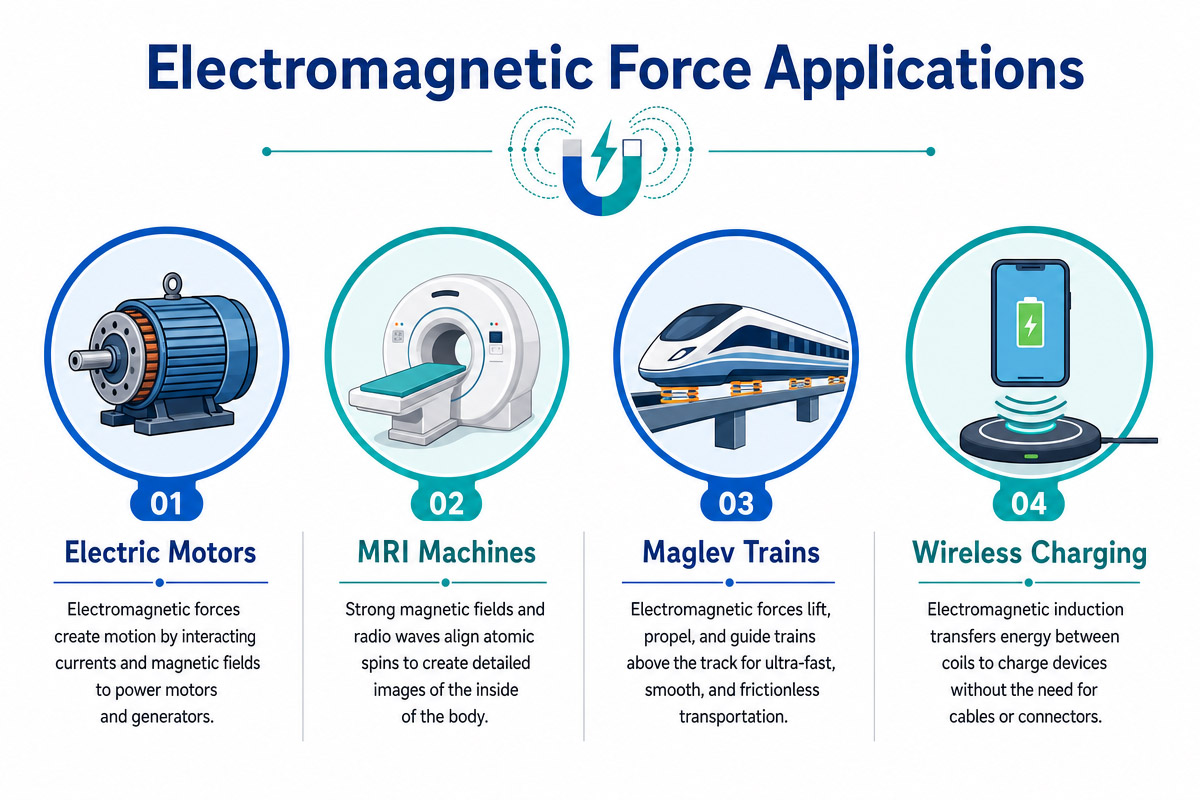
Electromagnetic force is one of the four fundamental forces of nature, and its applications are used in modern life everywhere. It is the force that arises between the electrically charged particles, and its practical applications are mostly connected with the manifestation of two main types of electromagnetic forces – the magnetic force of the permanent magnets and the electromagnetic force (which is created by the electric currents).
Here are some of the most significant applications of electromagnetic force in different fields.
7.1 Power and Motion: Motors, Actuators, and Levitation
This is perhaps the most classic application of electromagnetic force. It is used to convert electrical energy into mechanical motion and vice versa.
Electric Motors and Generators: Most electric motors work by using electromagnets to create magnetic field which interacts with the field of another permanent magnet or other coils. This interaction creates the force (torque) which makes the motor’s shaft to rotate. This principle powers everything from tiny toys to huge industrial machines, including washing machines, cars, and fans Generators work in reverse way, by using mechanical energy (from wind turbine or steam turbine) to move coils in the magnetic field, which generates electricity
7.2 Magnetic Levitation (Maglev) Trains:
Superconducting magnets are used to create the powerful magnetic field which can lift the train off its tracks, eliminating the friction and making the incredible speeds possible. The interaction between magnets in the train and track provides lift and propulsion
Micro-Electromechanical Systems (MEMS) Actuators: At microscopic scale, electromagnetic actuators play crucial role in many devices. They are used in micro-optical systems, microrobotics, and precision micromanipulation, providing high precision and fast reaction For instance, they are used in safety and arming devices for ammunition, using electromagnetic force to move mechanical parts and control arming states
7.3 Advanced Manufacturing and Materials Processing
The applications of electromagnetic forces, particularly the Lorentz force, are used in some very sreaction industrial processes.
Electromagnetic Forming (EMF): This is the high-velocity forming process for the sheet metals. The powerful, short impulse of the electric current is passed through the coil next to the metal workpiece. As a result of electromagnetic Lorentz force the metal workpiece can be formed without touching it. It provides such benefits as improved formability, reduced wrinkling, and contactreaction ng
Electromagnetic Processing of Materialsreaction ndustrial settings electromagnetic forces are used to control the flow and shape of the highly conductive materials like the liquid metals. It allows to stir, levitate and shape the molten metal for casting and refining Healthcare: Medical Technology
The ability to control electromagnetic fields precisely made revolutionary advances in healthcare.
MRI Machines (Magnetic Resonance Imaging): These machines use the powerful and controlled magnetic fields to create images of the inner structures of human body. The magnetic field aligns the protons in the water molecules in the body and the radio waves are used to create the signal which computers translate into images
7.4 Magnetic Robot Control:
Researchers developed systems for remote control of the tiny magnetic robots (like capsule endoscopes) inside the body. By using electromagnetic actuation systems they can manipulate these robots to move inside the body, taking pictures or even delivering drugs to target locations。
7.5 Daily Life and Infrastructure
You interact with the applications of electromagnetic force in your daily life more often than you realize.
Magnetic Cranes and Separators: Powerful electromagnets are used in scrapyards and recycling centers to lift and move the heavy ferrous (containing iron) metals. They are also used in other settings to separate magnetic materials from non-magnetic ones
7.6 The Technology in Your Home
Almost every appliance that you use contains the electric motor, which works on the basis of electromagnetic force. This includes computers, stereo systems, and many other devices
Telecommunications: Electromagnets and electromagnetic fields are the foundations of telecommunications technology, including networks that power our phones and the internet.
7.7 Aerospace and Advanced Research
The principles of electromagnetism are also used in advanced aerospace and research technologies.
Flow Control in Aerospace: For fluids which are electrically conductive, like the seawater or ionized air, electromagnetic forces can be used to control the fluid flow. For example, by applying Lorentz force to the surface of the aircraft wing or hydrofoil, it is possible to prevent flow separation, which would increase lift and reduce drag. This is very useful in takeoff and landing phases
Satellite Deployment: In a novel application, the satellites in low Earth orbit can use the interaction between the electric current flowing on their deployable panels and the geomagnetic field of the Earth to generate the force. This force can be used to deploy or retract the panels, like solar arrays, without need for the complicated mechanical hinges or motors
7.8 Nondestructive Testing:
Electromagnetic fields are used to test materials without damaging them. For example, eddy current testing uses the magnetic fields to induce the electrical currents in the conductive material. Defects or flaws in the material would disturb these currents, which allow to detect problems in metal structures or composite materials
In summary, the electromagnetic force is not just a theoretical concept in physics. It is highly versatile and practical tool that powers our world, from the largest industrial processes to the most delicate medical procedures.
Chapter 8 : How Strong is the Electromagnetic Force?
To understand its strength, physicists compare it to other fundamental forces. On this scale, the electromagnetic force is incredibly strong—it is about 100 times weaker than the strong nuclear force (which holds the atomic nuclei together) but about 10¹⁰ times stronger than gravity (the force that holds planets in orbit).
However, this “strength” completely depends on the distance. The electromagnetic force follows an inverse square law, meaning its strength quickly drops off with the distance. If you double the distance between two charged objects, the force becomes four times weaker. This is why the electromagnetic force dominates at the atomic and human scales (holds the electrons in orbit, powers motors), but it becomes negligibly small at vast astronomical distances.
Practically speaking, its strength is impressive. Even a simple fridge magnet is able to lift a piece of metal, easily overcoming the gravitational force of the entire planet Earth. This fact alone proves the overwhelmingly powerful nature of electromagnetism compared to gravity at the short distance.
In short: Electromagnetism is the second strongest fundamental force, absolutely enormous force at short distances, but becomes completely insignificant over cosmic scales.
Chapter 9: What Do We Still Not Know About the Electromagnetic Force?
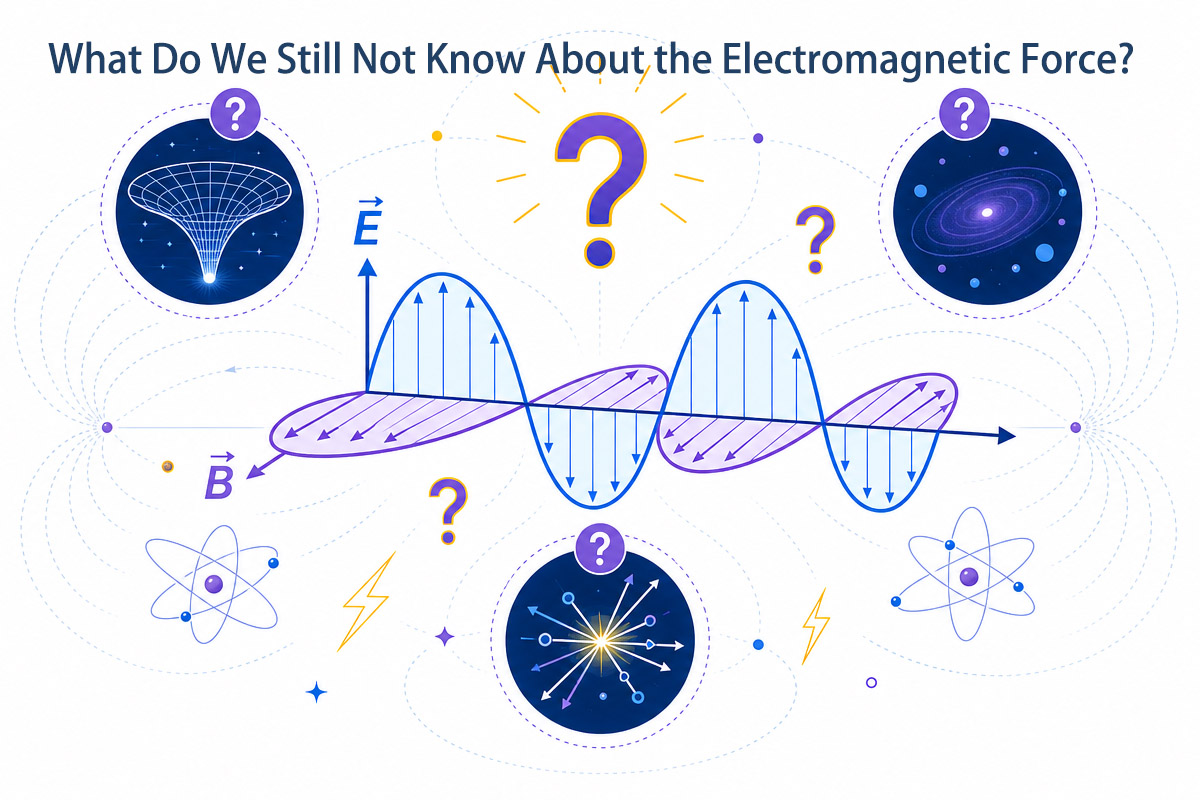
Electromagnetic force is one of the most understood forces in physics and is described with great accuracy by quantum electrodynamics (QED). Nevertheless, despite the success, there are still open questions and limitations of our knowledge.
One of the biggest challenges is unification with gravity. Electromagnetism is fully described within the framework of quantum mechanics, while gravity is described by general relativity. Complete theory of unification of all forces, especially including gravity, was never confirmed experimentally.
Another open question is the behavior of electromagnetism at extremely high energies. At extremely high energy levels (as during the first moments after the Big Bang or inside particle accelerators), electromagnetic force merges with the weak nuclear force into electroweak interaction. However, the underlying structure of this unification is still investigated.
Physicists also do not fully understand charge quantization, meaning why electric charge always appears in discrete units (like the charge of electron) and never takes arbitrary values.
Also, the behavior of the electromagnetic fields in extreme environments (near black holes or neutron stars) can reveal new physics beyond the existing models.
Finally, scientists are exploring whether the electromagnetism is really fundamental force or it is just a part of some deeper theory.
In summary, despite the excellent modeling, electromagnetic force still holds some unanswered questions at the frontier of modern physics.
Chapter 10: FAQs on Electromagnetic force
Q1: What is electromagnetism?
Electromagnetism is the branch of physics that studies interactions between electric currents and magnetic fields as well as the electromagnetic force that arises from these interactions.
Q2: What is the electromagnetic force?
It is one of the four fundamental forces of nature that acts between all electrically charged particles via the exchange of photons. It controls both electric and magnetic interactions.
Q3: What is Faraday’s Law?
Faraday’s Law says that changing magnetic field generates the electromotive force (voltage) in a conductor. This law is the basis of electric generators and transformers.
Q4: What is electromagnetic induction?
Electromagnetic induction is the process of generating voltage in a conductor due to changing magnetic field, described by Faraday’s law.
Q5: How do electromagnetic waves propagate?
Electromagnetic waves propagate as oscillations of mutually perpendicular electric and magnetic fields which sustain each other as the wave propagates through space at the speed of
Chapter 11 : Conclusion on electromagnetic force
Electromagnetic force is a fundamental physical interaction that explains the connections between electricity and magnetism. From simple motors to advanced medical imaging systems, it is the base of modern technology.
Understanding of calculation and controlling of electromagnetic force is crucial for designing efficient electromagnets and electrical
systems.
