Latching Solenoid Lock for Industrial Systems
High Performance Latching Solenoid Lock Guide
Latching Solenoid Lock for Access Control
Latching Solenoid Lock for Smart Lockers
WL0726 Industrial Solenoid Lock Solutions
Latching Solenoid Lock for Security Use
Latching Solenoid Lock for Industrial Systems
High Performance Latching Solenoid Lock Guide
Latching Solenoid Lock for Access Control
Latching Solenoid Lock for Smart Lockers
WL0726 Industrial Solenoid Lock Solutions
Latching Solenoid Lock for Security Use

WL0726 Energy saving latching solenoid lock guide

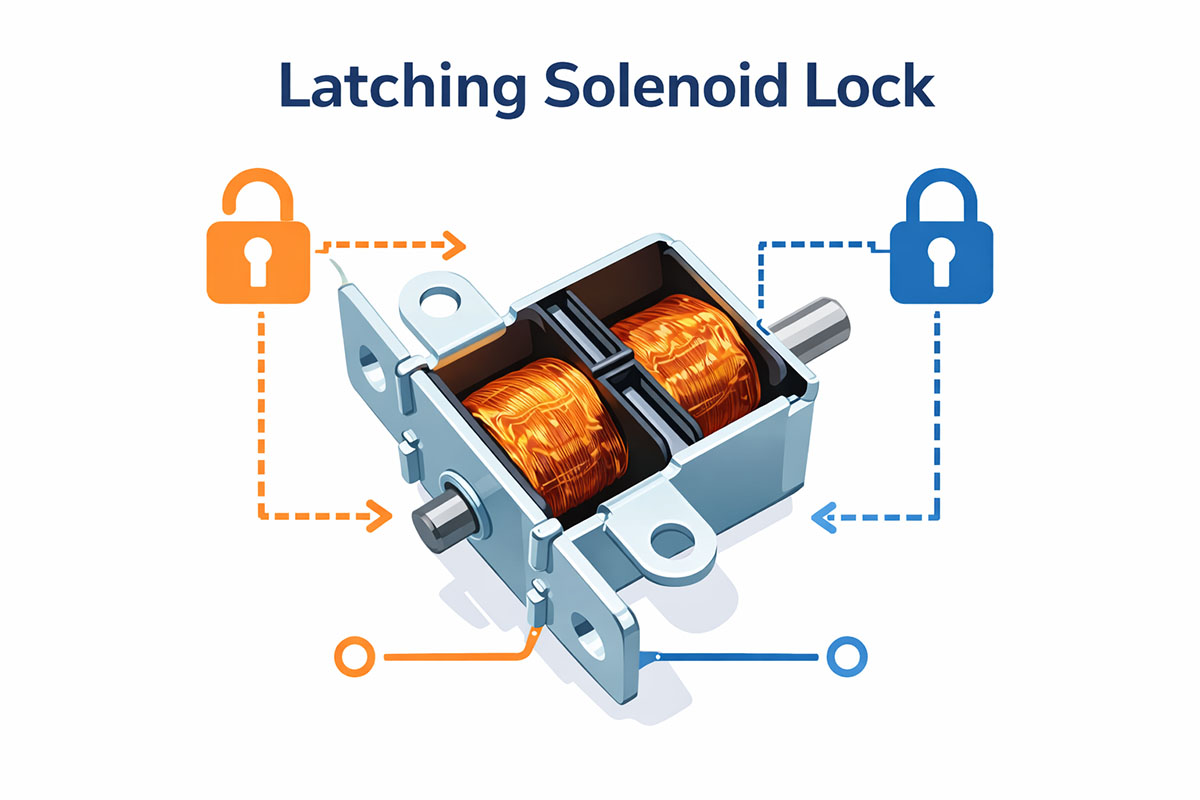
A type of lock called the latching solenoid lock is commonly used in many types of automated systems and security systems. It is a compact and energy-efficient type of electromagnetic lock. The lock can remain in place without the use of electrical current. A pulse of electrical current is what activates it. The lock is ideal for use in smart lockers and other types of applications where electrical current is important.

To ensure that the locking action is steady and stable, the lock is composed of a coil and a latch. Depending on the needs of the application, it can be designed as fail-secure or fail-safe. The Latching Solenoid Lock is quickly becoming popular in many types of industrial and Internet of Things-based applications because of its many advantages. The advantages of this type of lock include its rapid response time, long life cycle, and low heat generation. The lock is suitable for many applications because of its compact size and ability to adjust its force and stroke.

Leaching Solenoid Lock Product Overview

The latching solenoid lock is used for energy-efficient applications and is small and powerful. It is designed as an electromagnetic lock and contains a bistable mechanism that does not require constant power to maintain in the locked or unlocked position. It allows for flexible integration into smart and industrial applications and is available in various voltage options: 12V and 24V. To ensure long service life and reliable operation, the lock is made of strong and durable materials. Because it is adjustable in terms of force and stroke, it is applicable in various situations. It is a reliable and efficient solution for locking applications and is used in access control, smart lockers, and vending machines.

WL0726 latching solenoid lock video

How to Choose a Latching Solenoid Lock

WL0726 Latching Solenoid Lock Technical Data sheet

Brand Weilong Technology Model Number WL 0726
Rated Voltage (V) DC 6V, 12V, or 24V Rated Power (W) 14–25 W
Work Mode Push and Pull Linear Holding Force (N) 1–10 N
Stroke (mm) 5-10 MM Customized Reset Time(s) 1 S ON  9  S OFF
Service Life 200 Thousand Times Certification CE, ROHS, ISO9001,
Material Superior Magnet Iron Lead Wire Length (mm) 200 MM
Install Style Screw Tolerance of Dimension  +/-  0.1 MM
Water-proof  None Insulation Class B
Hi-Pot Test AC 600V 50/60Hz 2s Non-excitation Holding Force 0
Working Temperature -10°C-100°C Duty Cycle 1-100%
Thread Depth (mm) / Payment Term TT, or LC At Sight
Sample Order Yes Warranty 1 Year
MOQ 1000 pcs Supply Ability 5000 pcs per Week
Delivery Time 30 Days Port of Loading shenzhen

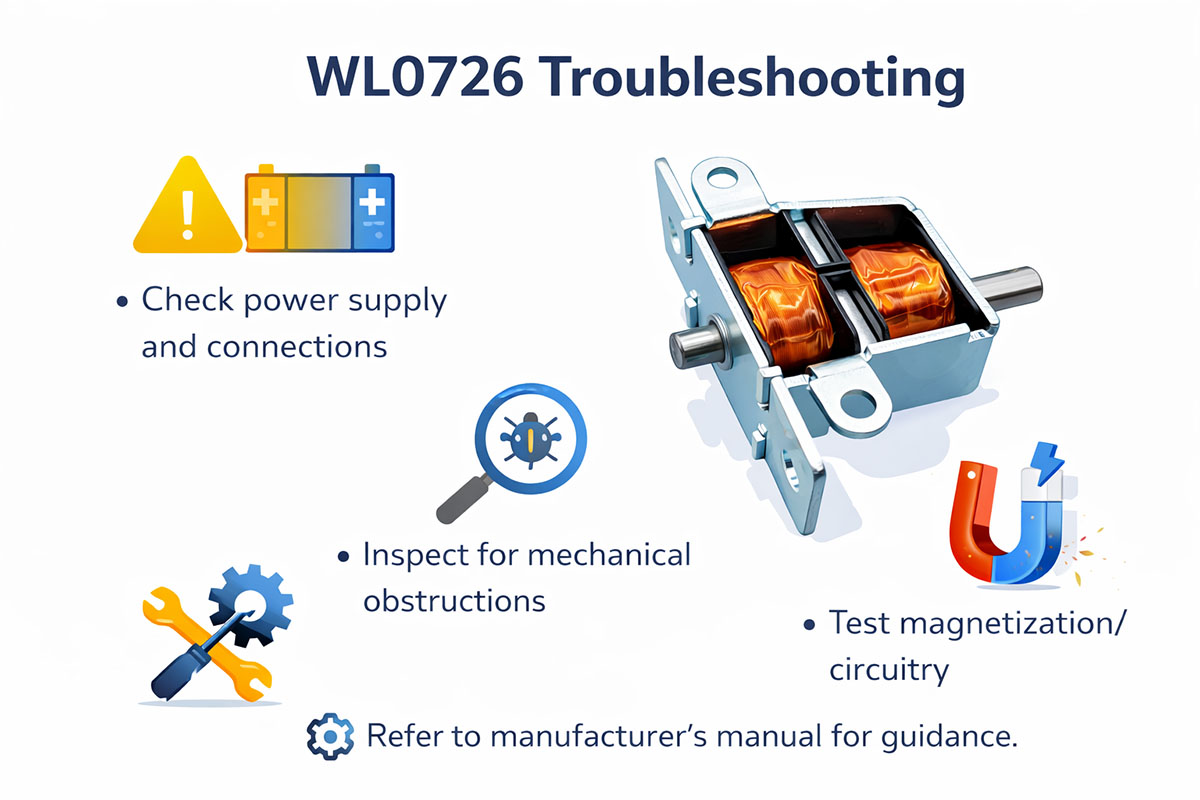
Latching Solenoid Locks Troubleshooting

Although latching solenoid locks are quite dependable, certain issues may arise because of incorrect voltage, incorrect installation, and control issues. However, using a methodical troubleshooting guide, it is possible to detect and resolve issues in a timely manner.

1. The lock is not moving or activating.

Potential Reasons:

Not enough power and incorrect voltage

No pulse signal was generated

Wiring issues

Damage to coils

Remedy:

Check and ensure that the voltage is correct (12V or 24V).

Check and ensure that the pulse signal is correct, which should be between 20 and 100 ms.

Check and ensure that terminals and wiring are correct.

Use a multimeter to check and ensure that the coils are correct.

2. The lock engages but does not latch

Potential Reasons:

Not enough energy in the pulse

Inadequate internal latch or magnet

Solutions for mechanical misalignment:

Increase the voltage or pulse length (within specification)

Check the condition of the internal latch or magnet.

Check if the locking structure and plunger are aligned.

3. Inadequate Locking Power

Potential Reasons:

Voltage of the supply too low

Inaccurate solenoid model (insufficient force)

Wear or mechanical obstruction

Solutions:

Check if the voltage supply is stable.

If necessary, consider a solenoid model with higher force.

Check if all moving parts are clean and well lubricated.

4. Coil overheating

Potential Reasons:

Continuous power applied (wrong usage)

Overvoltage applied

High duty cycle

Solutions:

Use pulse control. Continuous power should not be used.

Check the voltage rating to avoid overvoltage.

Reduce the switching frequencies.

5. Unstable or Sporadic Operation

Potential Reasons:

Inadequate electrical connections

Unstable control signal

Presence of environmental factors

Solutions:

Check if all electrical connections are tight.

Use a stable control circuit.

If necessary, consider IP-rated housing.

6. Vibration or noise during operation

Potential Reasons:

Loosely mounted

Worn-out parts

Solutions for Misalignment:

Tight mounting of the mounting screws

Replace the parts.

Check if the alignment of the solenoid installation is correct.

7. Lock stuck in one position

Potential Reasons:

Failure to apply reverse pulse

Jamming

Failure of the internal parts

Solutions:

Check if the reverse pulse has been applied.

Clear the obstruction and clean the mechanism.

If necessary, replace the defective unit.

8. Slow Reaction or Postponement

Possible Reasons:

Weak signal or voltage too low

Old coils

Presence of friction between moving parts

Solutions:

Ensure proper voltage and pulse strength.

Replace the old solenoid.

Apply lubrication and

🧰 Pro Maintenance Tips

✅ Use proper voltage and pulse duration

✅ Steer clear of continuous energizing

✅ Routine cleaning and inspection

✅ Ensure proper installation alignment

✅ Use high-quality power supply and driver circuit. Professional Perspective


The majority of latching solenoid lock failures are not caused by the solenoid itself, but by:

Inaccurate control signals received by the solenoid.

Instability of the power supply.

Mechanical misalignment. 👉 A well-designed system will last longer than 500,000 cycles.


WL0726 Latching Solenoid Lock Applicaitoin

Latching Solenoid Lock application

Latching solenoid locks are ideal for modern applications due to several significant advantages. These solenoid locks are extremely energy efficient since they use power only during operation. Reliable locking without current is ensured due to a bistable characteristic.

These solenoid locks are ideal for applications that have limited space since they are lightweight and compact. They provide reliable operation for long periods of operation.

They are ideal for applications that demand rapid response times. In addition, they can be customized in terms of voltage, force, and stroke. They are ideal for applications that demand fail-safe or fail-secure operation. These solenoid locks are ideal for applications that use batteries or industrial automation due to a long lifespan and low heat dissipation.

Because of their reliability and efficiency in power consumption, latching solenoid locks are commonly used in various industries. The most popular applications for smart locker systems, such as self-service storage lockers and parcel delivery lockers, are just some examples of latching solenoid applications. The devices are ideal for this purpose because they require reliable locking with low power consumption.

They are used in vending machines to secure the sections of the products while ensuring their timely and controlled access. Similarly, they are often used in the ticketing systems, ATMs, and kiosks where the locking is critical and needs to be automated and secure.

The latching solenoid locks are often used in storage cabinets and diagnostic equipment in the medical sector. The electronic locking systems and compartment control are some of the automotive applications of the solenoid locks.

They are also critical in the smart home systems and IoT devices where energy efficiency is critical. The locks are critical in the access control and safety of the machines in the industrial automation systems. The locks are popular in the modern electromechanical locking systems due to their versatility, low power consumption, and small size.

Advantages and Disadvantages of Latching Solenoid Lock

Latching Solneoid Lock Advantage and Disadvantage

Solenoid Lock Benefits and Drawbacks

Benefits

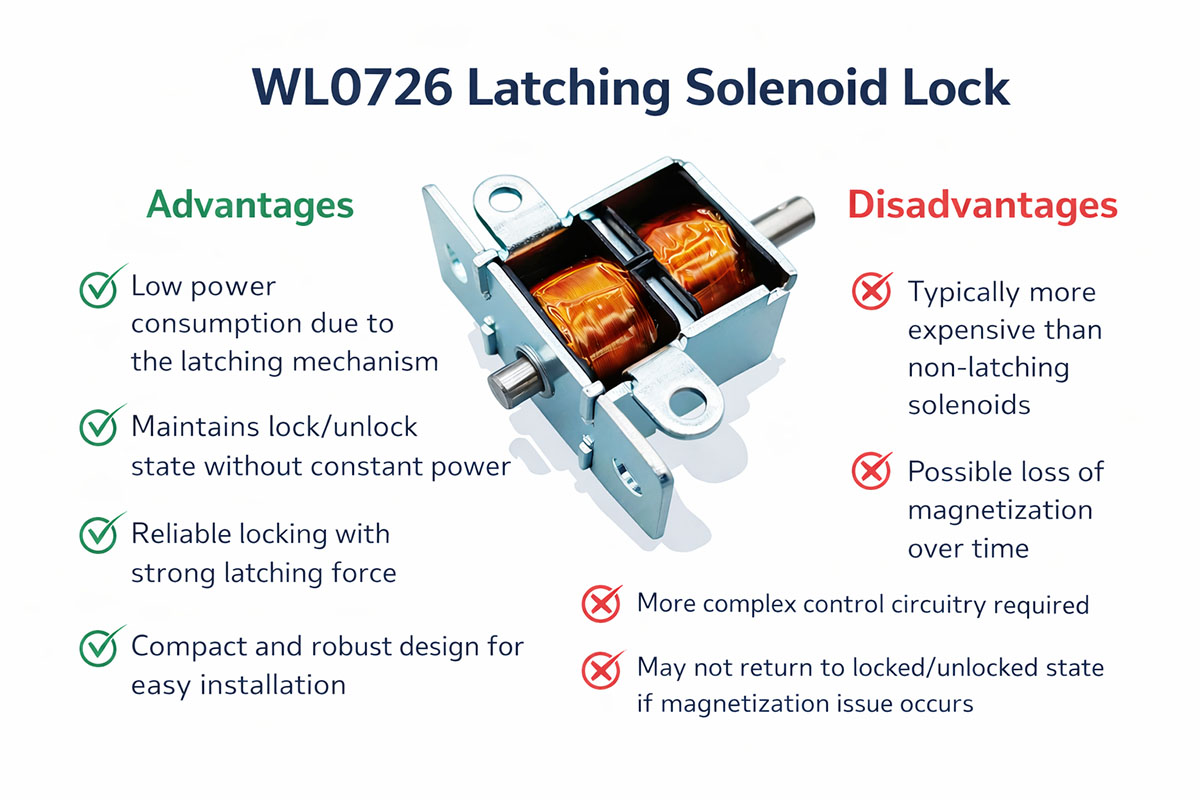
The latching solenoid locks are extremely energy-efficient since they require power only when changing state. The locks are therefore suitable in devices that are battery-powered. The locks are safe and have a longer lifespan since they produce less heat compared to the continuous duty solenoids. The locks are also stable even in the absence of power since they are bistable in nature. The locks are durable and often have a lifespan of over hundreds of thousands of cycles. The locks are fast and have a small size and versatility, making them easy to integrate in a wide range of applications.

Drawbacks

However, latching solenoid locks also have certain disadvantages. First and foremost, in order to generate pulse signals, precise control circuits are required. This could make the system more complicated. In addition, the initial cost may be higher compared to traditional solenoids. Furthermore, depending on the design, the reset time may be somewhat longer. The holding force may also be somewhat lower in certain situations. In addition, malfunction and reduced lifespan may occur if incorrect voltage and pulse timing are used.


FAQs Of WL0726 Solenoid Lock

1. What is the best way to select a latching solenoid lock?

Customers should consider size restrictions, holding force, stroke length, and voltage requirements, i.e., 12V/24V. Also, consider if the application must be fail secure or fail safe. A low-power bistable design is best for battery-powered devices.

2. How do latching and non-latching solenoid locks differ from each other?

The difference between a latching and a non-latching solenoid lock is:

The latching solenoid lock holds its position without current flow and only requires current flow during switching. The non-latching solenoid requires constant current flow and thus consumes much more energy and generates much more heat.

3. What power and voltage specs are available?

The most common capacities for latching solenoid locks are 6V, 12V, and 24V. Resistance and pulse length of the coil determine the power. It is recommended that the purchaser check the compatibility of the power source.

4. How long does a latching solenoid lock last?

For good-quality solenoid locks, this range is between 300,000 and 1,000,000 cycles depending on conditions and correct control.

5. In solenoid locks, what is meant by fail-secure and fail-safe?

Fail-Safe: unlocks safety/emergency exits in case of a power outage

Fail-Secure: used for security applications and remains locked in case of a power outage

6. Is it possible to customize the solenoid lock?

Yes, it is possible for the manufacturer to change:

Length of stroke

Output of force

Mounting framework

Type of connector

IP rating

7. Which application scenarios are most common for solenoid locks?

Vending machines, parcel services, medicine cabinets, vehicle compartments, smart lockers, and automation equipment

8. What is the most common reason for solenoid lock failure?

The most common issues are:

Incorrect pulse signal/voltage

Incorrect alignment of the machine

Continuous operation (overheating)

Incorrect installation

Guide to Designing a Custom Latching Solenoid Lock

When designing a custom latching solenoid lock, it is important to strike a balance between electrical design, mechanical design, and environmental factors to satisfy the needs of the application. The following is a guide that shows you the most important steps to design a custom latching solenoid lock.

  1. List the needs of the application

You need to know exactly what you want to achieve.

For example: smart locker, vending machine, medical device, and car.

Operating environment: indoors, outdoors, high humidity, and/or dust.

Power source: battery or constant on.

Safety requirement: fail-safe or fail-secure.

This step determines 80% of how the design is going to go.

⚡2. Parameters for Electrical Design

Important Things:

Voltage Rating: 6V, 12V, 24V DC.

Pulse Duration: usually 20 to 100 ms.

Power Use: very important.

Current Draw: depends on how much resistance the coil has.

Tips for Designing:

Do not use constant voltage; use pulse control circuits.

Ensure it is compatible with the MCU and driver board.

Ensure it can handle reverse polarity for bistable operation.

3. Things to think about when designing mechanically

Main Parts:

Length of stroke: (e.g., 2 to 10 mm).

Holding Force: depends on how much force is needed.

Push/Pull/Rotary Plunger.

Structure for mounting: bracket, flange, and/or custom housing.

Tips for Designing:

Do not overdesign (more force means more cost).

Ensure that the lock and latch mechanism are in line.

Think about how well it can resist wear for applications with a lot of cycles.

🧲 4. The magnetic and latching mechanism

Latching solenoids rely on:

Permanent magnet or a mechanical latch structure

Design options:

Magnetic latching: easier and cheaper to do

Mechanical latch: more stable in case of vibration. The choice should be based on the cost-reliability balance.

🌡️ 5. Design for thermal and duty cycle

Important Things to Think About:

Make sure it does not overheat, especially if you’re designing something small.

Make sure the coil is of high quality.

Make sure the duty cycle is correct. This is intermittent operation.

Advice for Designing:

Make sure you’re using copper wire of high quality.

Add a thermal margin.

Test under the worst conditions.

6. Protect the environment

For outdoor or harsh environments:

IP Rating: IP54, IP65, or IP67

Seal the dust and water out.

No rusting materials, e.g., stainless steel.

This is important for outdoor kiosks and parcel lockers.

 🔌 7. Control and Integration

Factors to consider:

Control signal type: Pulse or polarity reversal.

Driver type: MOSFET or Relay.

Optional: Feedback signal.

Integration of Smart Systems:

Works with IoT and smart locker technology.

Design for low-power standby.

Customization of PCB or connector.

 🧪8. Testing for Life Cycle and Reliability

Standard Testing:

Cycle life test: 300K to 1M cycles.

Rising temperatures test.

Vibration and shock test.

Salt spray test if you’re designing something for outside. The test data proof is very important to buyers.

9. Options for customization

Most manufacturers will allow customization:

Voltage (6V, 12V

Length and strength of the stroke

Size and the way it is mounted

Type of cable or connector

Level of waterproofness

Special coatings or materials ⚠️

10. Mistakes in design that happen a lot

Avoid these common mistakes: ❌ Using continuous power (causes overheating) ❌ Using the wrong amount of force (too weak or too strong) ❌ Not aligning well with the lock mechanism ❌ Not thinking about the weather ❌ Not leaving a safety margin on voltage or temperature 11. Suggested design process

Define the application and its needs

Define the voltage and the way it will be controlled

Find the force and the stroke

Find a good way of latching

Design the mechanical structure

Design the thermal performance

Build a prototype and test it

Make it as inexpensive and easy to make as possible.

Expert Advice (Important for Buyers)

The best custom design isn’t the strongest or the most complicated, but the one that

Needs the exact amount of force

Needs the least amount of power

Will last a long time

Will fit perfectly into the system

Get A Free Quote Now

Contact Form

Related Products

Related News

Scroll to Top

Get A Free Quote Now !

Contact Form
If you have any questions, please do not hesitate to contact us.
Weilong Solenoid Company Culture
