DC Latching Solenoid Valve Low Energy Operation
Energy-Saving DC Latching Solenoid Valve System
High Efficiency DC Latching Solenoid Valve Design
Compact DC Latching Solenoid Valve for Automation
Reliable DC Latching Solenoid Valve for Industry
DC Latching Solenoid Valve High Performance Use
DC Latching Solenoid Valve Low Energy Operation
Energy-Saving DC Latching Solenoid Valve System
High Efficiency DC Latching Solenoid Valve Design
Compact DC Latching Solenoid Valve for Automation
Reliable DC Latching Solenoid Valve for Industry
DC Latching Solenoid Valve High Performance Use

WL0730 Smart DC Latching Solenoid Valve guide

A DC latching solenoid valve refers to a special kind of valve whose state (whether it is open or closed) can be changed using pulses of current. Upon receiving an impulse of electricity, it opens or closes. Unlike common solenoid valves, it will retain its state once switched without the need for any further power supply. DC latching solenoid valves use latching mechanisms and magnetic force (magnetic solenoids or permanent magnets) to keep the valve in the desired position.

This solution consumes considerably less energy compared to traditional solenoid valves. A single pulse of electricity is enough to activate it, and another impulse is needed to switch the valve. Latching solenoid valves stay in the selected state indefinitely until a switch command.

Key Features Of DC Latching Solenoid Valve

The DC latching solenoid valve has low power consumption since only one impulse is required to switch its state. Energy consumption is minimized, making it highly efficient. The small size enables easy integration into compact constructions. It performs quickly and accurately while generating less heat than ordinary solenoid valves. Low thermal stress results in longer component life. Maintenance is infrequent due to durability. Valves are suitable for battery-powered and remotely operated applications. Reliable switching in fluid control

DC Latching Solenoid valve Product Overviews

A DC latching solenoid valve represents compact, economical devices that control fluid flow in automation systems. It uses magnetic latching to retain the valve position. A DC latching solenoid valve can have normally open and normally closed configurations, and it operates with different media, including gas and water. Valves are produced from sturdy materials such as stainless steel, brass, and engineering plastics. Such valves are often utilized in smart devices and medical equipment due to their low power consumption and quick switching.

DC Latching Solenoid Valve Video

DC Latching Solenoid Valve Detailed Display

DC Latching Solenoid Valve Technical DataSheet

Brand Weilong Technology Model Number WL0730
Rated Voltage (V) DC 12V or 24V Rated Power (W) 7-10W
Work Model Pull Push Type Holding Force (N) 600 GF, push force: 200 gf
Stroke (mm) Customized Reset Time(s) 1S
Service Life 200 Thousand Times Certification CE, RoHS, ISO9001,
Material Carbon Steel Housing Lead Wire Length (mm) 200
Install Style mounted screw hole for easy setup Tolerance of Dimension  +/-  0.1 MM
Water-proof  None Insulation Class B
Hi-Pot Test AC 600V 50/60Hz 2s Non-excitation Holding Force 0
Working Temperature -10°C-100°C Duty Cycle 1-100%
Thread Depth (mm) / Payment Term TT, or LC At Sight
Sample Order Yes Warranty 1 Year
MOQ 500 pcs Supply Ability 5000 pcs per Week
Delivery Time 30 Days Port of Loading shenzhen

What maintenance is required for a DC latching solenoid valve?

Maintenance of DC latching solenoid valves is usually minimal. However, neglecting it can result in sticking, leakage, or malfunctioning. Here are practical guidelines on how to maintain them:

1. Valve Cleaning (most crucial)

The #1 reason why valves fail is contamination.

Clean the valve to clear all dirt, scales or sediments

Even when using dirty fluids the inside is always clean

Install/frequent cleaning of upstream filters or strainers

Particularly relevant for systems using water coffee machines, and irrigation

2. Inspect Diaphragm and Seal

These wear out eventually, affecting valve performance.

Test for leaks or deformations

Replace o-rings or diaphragms when hardened or cracked

Select appropriate material for your fluid (EPDM, NBR, FKM, …)

3. Test Electrical Connections

Connections should be sound despite low-power operation

Inspection for corrosion and loose connections in wiring and terminals

Check the pulse polarity and voltage level

Inspect wet or outdoor environment connections

Poor connections cause switching failures.

4. Inspect the Pulse Signal

This procedure applies to latching valves only.

Verify pulse voltage, time and polarity

The valve will not switch with insufficient pulse strength

Long pulse duration will overstress the coil

Pulse control issues are primarily caused by faulty valves.

5. Inspect Magnet and Mechanism

Check the movement of the plunger

Remove any leftover debris or corrosion

Ensure that the magnet holds its position reliably

6. Environmental and Temperature Controls

Keep a cool environment.

Store in dry locations with no moisture, dust, or chemicals

Correctly rated IP housing for outdoor installation

7. Fluid Compatibility Testing

Using the wrong media can cause degradation of components.

Compatibility between seals and body with the media verified

8. Periodic Testing

Look out for chemical swelling or corrosion

Do not wait until failure occurs

Switch the valve On/Off periodically

Verification of open/close response

Look out for delays or inadequate actuation

9. Frequency of Maintenance (general advice)

Cleaning/inspection: 3-6 months (more frequent in extreme conditions)

Replacement of seals: By cycle life or indication of leakage

Electrical testing: Once annually or during system maintenance

What not to do to valves

No filter installed equals internal obstruction.

Incorrect pulse control causes switching failure

Ignoring small leaks will lead to large failures.

Use inappropriate fluids damage the seal

10. Bottom Line

A DC latching solenoid valve has few maintenance requirements but requires clean fluid, proper pulse control, and reliable seals. When these requirements are met, the system will ensure that valves operate efficiently for millions of cycles.

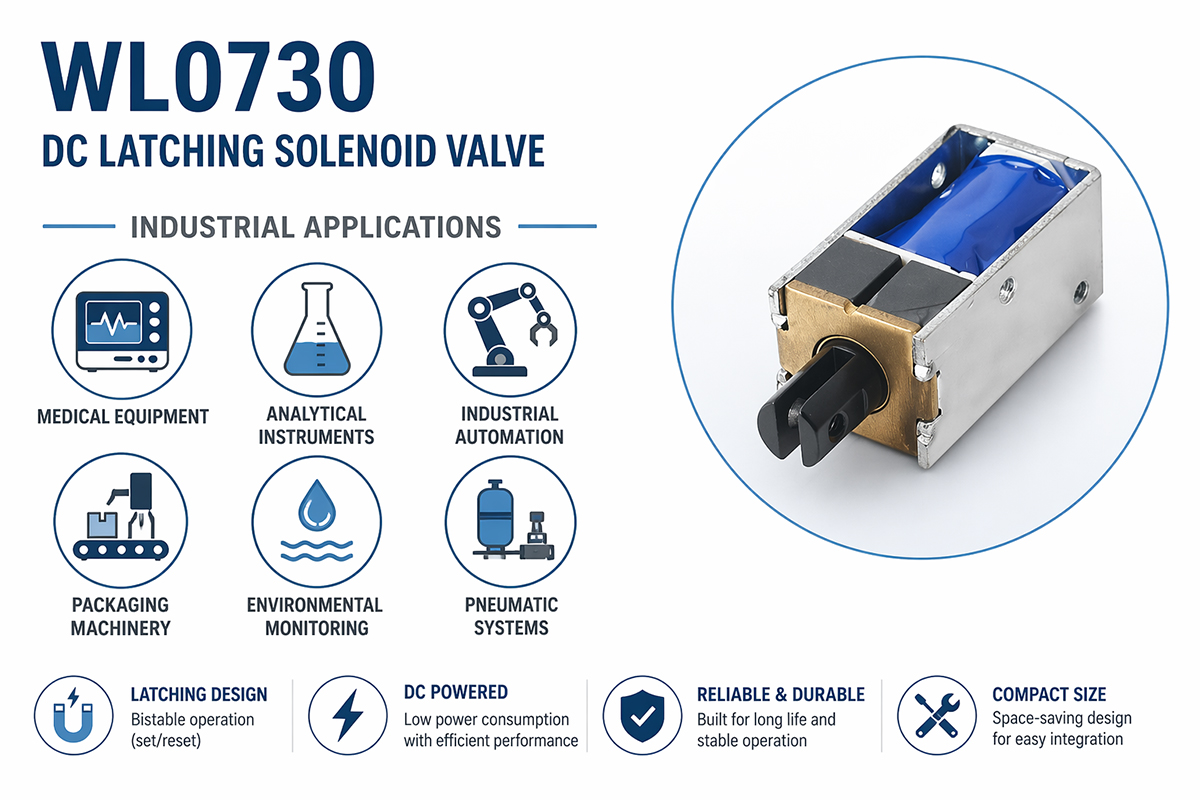
DC Latching Solenoid Valve Industrial Application

DC Latching Solenoid Valve Industrial Application

A brief description Of DC Latching Solenoid valve

The DC latching solenoid valve works with electricity pulses, unlike conventional ones that work with constant power. It remains closed or open after receiving an impulse, thus retaining its state without requiring any further energy expenditure. Due to this principle of operation, it is highly economical. Such valves find application in all spheres where it is critical to minimize power consumption: battery-operated systems, smart water meters, medical devices, industrial automation, etc. Small dimensions and precise switching allow effective fluid flow control. Latching valves last longer because they produce less heat than usual valves and face less electrical stress. There are various models that satisfy different pressure, flow rate, and liquid-properties requirements.

DC Latching Solenoid Valve Application

Many sectors favor the use of latching valves due to their efficiency and reliability. Latching valves are applied in such fields as smart water meters, irrigation systems, and leak detectors. In such systems, it is important to minimize power consumption to reduce costs. They are perfect for remote installations due to their ability to work with battery power for a long time without charging. Latching valves provide steady operation of pneumatic and hydraulic equipment. Latching valves are used in medical equipment, e.g., for portable oxygen supply and diagnostics. Home appliances use the latching solenoid valve. In the automobile industry, valves are used as fuel delivery units and emissions controllers. IoT-enabled systems use latching solenoid valves due to their continuous operation without the need for frequent connection to energy sources.

How can Weilong Technology guarantee the DC latching solenoid valve quality?

Weilong production qualiyt and process is based on design, materials, manufacturing, and testing. Let us take a closer look on what Weilong Solenoid manufacturer will do to produce high-quality DC latching solenoid valves:

🏭 1. Stringent Incoming Material Quality Control (IQC)

“Quality Begins Before Production”:

Copper wire → conductivity, insulation quality, temperature rating
Permanent magnets → flux density, stability, magnetoresistance
Corrosion resistance → materials of valve body (brass/stainless/plastic)
Seals (O-rings/diaphragms) → material qualification (EPDM, NBR, FKM)

👉 Only qualified traceable materials allowed to production.

⚙️ 2. Precision Manufacturing & Control of the Process

Precision CNC Machining of Valve Body
Automated coil winding with uniform resistance value
Assembly tolerances control (air gap, alignment)
“Clean” assembly room to eliminate contamination

👉 Even minor dimension defects affect both magnetic and sealing.

🧪 3. 100% Electrical Performance Testing

Electrical test for all manufactured items:

Coil resistance and insulation
Pulse response (forward and reverse switching) test
Checking power consumption 👉 Reliability of actuation in real conditions.

4. Leak & Pressure Test 💧

Testing air or water leakage
Pressure test for endurance
Flow rate verification

👉 Necessary test for valves of fluid control systems.

🔄 5. Durability (Life Cycle) Testing

Switching cycle tests (typical 100,000 to 1,000,000 and more)
Wear testing, sealing, actuation time measurement

Ensures long term reliability, not only initial performance.

🌡️ 6. Environmental and Reliability Test

High/Low Temperature Testing
Humidity Test, Corrosion Testing if needed (Salt spray)
Vibration and Shock testing 👉 Ensures performance in severe environments.

⚡ 7. Checking the Control Circuit Compatibility

Tests with pulse drivers/H-bridge circuits
Checking correct functioning at different voltages/pulse durations

» Helps prevent control circuit mismatching.

📉 8. Quality Management System (QMS)

ISO 9001 accredited, or similar certification
Standard Operating Procedures manufacturing and inspection
Traceability (production batch, materials, test results)

👉 Ensures quality consistency throughout large production batches.

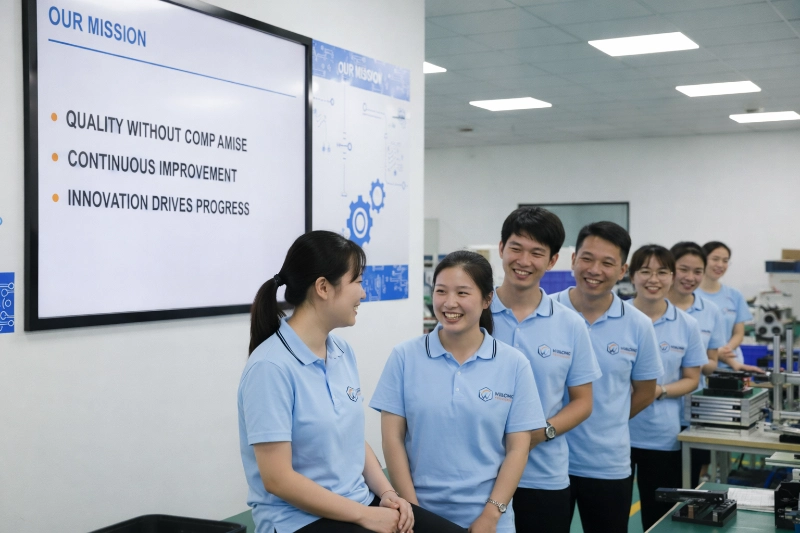
👷 9. Skilled Workforce and Training 👷

Technicians trained in winding and assembly operations
Ongoing quality assurance training
Process auditing

👉 Even in precision electromechanical product, the human factor plays a significant role.

🔍 10. Final Inspection and Sampling (QA)

Visual inspection (surface, labeling)
Sampling for destructive or prolonged test procedure
Packaging inspection (shock and moisture resistance) 🚨 Factors of Customer Confidence Building

What can serve as the best evidence for a potential client:

Test reports (electrical, leakage, life cycle)
Material Certificates
Product validation before mass production
✅ Stability between production batches

Weilong solenoid manufacturer ensures DC latching solenoid valve quality by means of:

Controlled materials
Precision Manufacturing
100% Performance Testing
Long-Term reliability validation
Effective Quality Management System

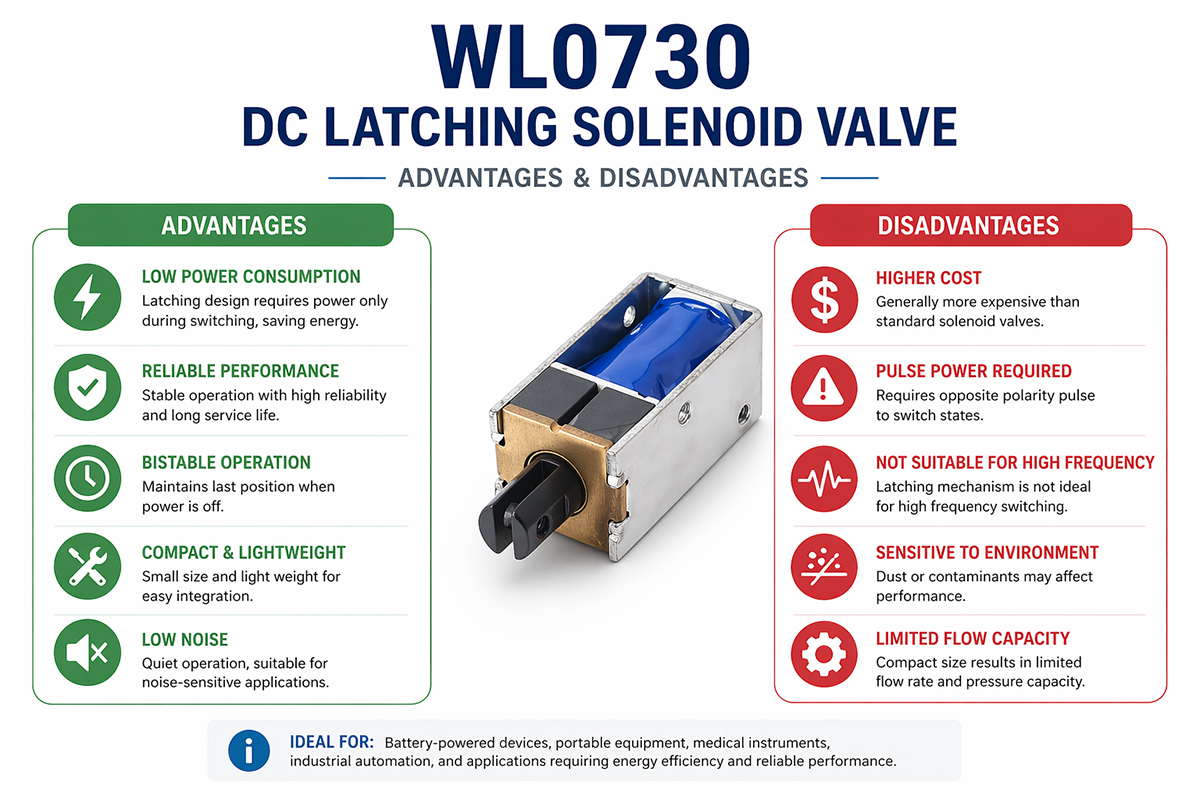
Advantages and Disadvantages of DC Latching Solenoid Valve

DC Latching Solenoid Valve: Advantages and Disadvantages

Pros and Cons of DC Latching Solenoid

Pros of DC Latching Solenoid

– Significant power savings since the solenoid valves consume energy only during switching.

– Minimal heat generation.

– High reliability because they are bistable and retain their position even if there is no power.

– Reduced wear and tear results in fewer maintenance costs.

Cons of DC Latching Solenoid

– Requires a circuit for providing a pulse, adding to the complexity of design.

– Higher prices compared to traditional solenoid valves.

– Lower switching speed in some valves.

– Switching malfunctions due to incorrect pulse control; performance depends on magnetic design quality.

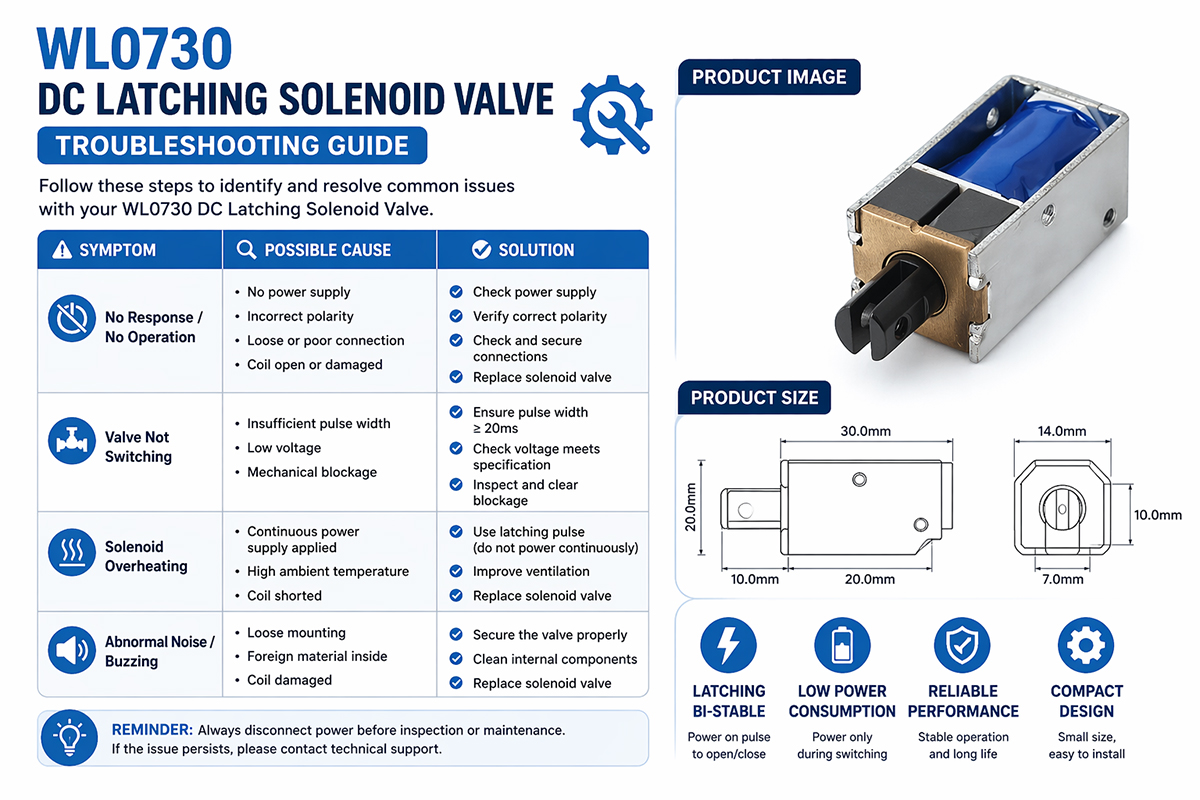
Fixing DC Latching Solenoid Valve problems

DC Latching Solenoid Valve Troubleshooting Guide

Typical faults related to the performance of a DC latching solenoid valve include failure to switch, leakage, and malfunction. If your valve does not switch to open or closed positions, it is necessary to ensure that the pulse voltage and pulse time correspond to those stated in the manufacturer’s instructions. Lack of sufficient pulse energy prevents valves from working properly. It is also recommended to check the wiring and polarity; the valve might have been improperly wired and needs reversing. To prevent leaks, inspect valve seals and internal components. If you experience any problems with leaking, replace dirty seals and filters, as they may have clogged the mechanism. It is possible that the magnets become weak over time, reducing valve performance. Extremely low or high temperatures affect valve operation as well.

FAQs of DC Latching Solenoid valve

1. What is a DC latching solenoid valve?

A DC latching solenoid valve is the valve that opens/closes due to a short pulse of electricity and keeps its position when the power stops flowing. It usually includes a permanent magnet or a mechanical latch that holds its position.


2. What is the role of a DC latching solenoid valve?

It works by supplying the valve with electricity for a few milliseconds. Then, a strong magnetic field moves the plunger. Once it reaches the desired position, the built-in permanent magnet or latch holds the plunger in place. The reverse impulse switches the valve.


3. Why should one choose a DC latching solenoid valve?

The most important benefits of a DC latching solenoid valve are low power consumption, no heating, and great compatibility with battery-operated systems. No current is needed to hold the valve in a specific position.

4. Why shouldn't one choose a DC latching solenoid valve?

Some possible cons of a DC latching solenoid valve may include a somewhat complicated control circuit (it is necessary to send pulse signals and change polarity), increased cost of procurement, and sensitivity to incorrect pulses.


5. What is the typical application of DC latching solenoid valves?

They are used mostly in devices powered by batteries, as well as water control systems (smart meters, irrigation systems) and gas shut-off devices. Such valves find numerous applications in medical equipment.


6. What is the difference between latching and non-latching solenoid valves?

The main difference between the two types is that the former holds its state without power supply while the latter always requires some energy supply. Latching solenoid valves consume less energy.

7. Is it possible to use DC latching solenoid valves with alternating current?

No. They can only operate with a DC power supply. AC power can result in various problems, including excessive heating and inability to switch positions.


8. How should one select DC latching solenoid valves?

The most important parameters to consider include operating voltage, pressure rating, flow rate, media compatibility (water, gas, and others), switching speed, and environmental conditions.

Tips for Selecting The DC Latching Solenoid Valve

Choosing the appropriate DC latching solenoid valve is a task that entails consideration of various important factors. To begin with, one should establish what type of fluid the valve is supposed to regulate (e.g., water, air, gas, or oil) as well as the level of their compatibility to avoid rusting, corrosion, and any other damage.

Secondly, it is imperative to determine the flow rate and operating pressure of the system, which the valve has to manage effortlessly. Efficiency greatly depends on selection of the proper orifice size.

Then, one has to look at the power source. The valve must work effectively under the conditions of a specific system voltage range, and the control circuit must be capable of generating a proper pulse.

One has to consider the operating conditions, particularly temperature, humidity, and the potential presence of dust and chemicals in the surrounding environment. Protection ratings have to be adequate.

When automating certain processes, the speed of switching and the switching frequency have to be considered. One has to estimate the service lifetime of the valve and the level of maintenance that it would require.

Finally, one should give preference to a trusted brand that guarantees high quality, customization options, and reliable customer support. In this respect, studying the datasheet, as well as testing some samples, would be a wise idea.

To secure smooth and efficient operations and minimal energy consumption in your application, you should consider all the aforementioned factors.

What is the difference between a single and a bistable DC latching solenoid valve?

Difference Between Monostable and Bistable Latching Solenoid

There are several differences between monostable and bistable latching solenoids that can be attributed to two criteria: how they behave after the supply is shut off and how many stable positions each one has.

1. Monostable Latching Solenoid

Description
It has only one stable position—default.

Operation principle
– Supply turns it on and pulls it to the actuated position.
– Removal of power brings it back to the initial position (with the help of a spring).

Main features
– Need for permanent power application or pulses for retaining actuated position.
– Spring-return mechanism.
– Relatively simple design.
– Fast resetting operation.

Main uses
– Door locks (fail-safe).
– Valves with the necessity to switch to the initial position in case there is a power outage.
– Safety systems.

2. Bistable Latching Solenoid (Latching Solenoid)

Description
Has two stable positions, both of them are possible with no power application.

Operation principle
– First pulse moves the plunger to position A.
– Second (opposite polarity) pulse moves it to position B.
– If the power is switched off, the solenoid remains in its current position.

Main features
– No permanent power supply required.
– Maintaining the position with the help of permanent magnets or a magnetic latch.
– Very energy-efficient solution (good option for a battery-driven application).
– Need for a more complex control circuitry capable of polarity reversal/pulse switching.

Main uses
– Smart meters.
– Battery-driven valves.
– Automation applications.
– Automotive systems requiring low energy consumption.

3. Core Differences (Quick Comparison)

Feature Single-Stable Bistable Latching
Stable Positions 1 2
Power Requirement Continuous (to hold) Pulse only
Return Mechanism Spring Magnetic latch
Power Loss Behavior Returns to default Stays in last state
Energy Efficiency Lower Higher
Complexity Simple More complex

4. How to choose the single latching solenoid or the bistable latching solenoid?

You should use a monostable latching solenoid if:
– You need fail-safe switching (returns to initial position in case of power loss).
– There is no need to take care of the power consumption.
– Simple control circuit is preferable.

Use a bistable latching solenoid if:
– Power saving is an issue.
– The system operates from the battery.
– There is a need to have a stable position without power application

Get A Free Quote Now

Contact Form

Related Products

Related News

Chapter 1 : Introduction on Solenoid Vs. Electromagnetic Coil Electromagnetic technology plays a significant role in modern automation industry, electronics, […]

Scroll to Top

Get A Free Quote Now !

Contact Form
If you have any questions, please do not hesitate to contact us.
Weilong Solenoid Company Culture