DC Latching Solenoid Applications & Design
DC Latching Solenoid Features and Benefits
DC Latching Solenoid Industrial Guide
DC Latching Solenoid Product Guide
DC Latching Solenoid vs Standard Solenoid
Latching Solenoid DC 24V Guide
DC Latching Solenoid Applications & Design
DC Latching Solenoid Features and Benefits
DC Latching Solenoid Industrial Guide
DC Latching Solenoid Product Guide
DC Latching Solenoid vs Standard Solenoid
Latching Solenoid DC 24V Guide

WL0724 DC Latching Solenoid selection Guide

The DC latching solenoid is a solenoid that does not require constant power to stay in a particular position. A latching solenoid maintains its position using a mechanical lock or a magnet. This concept is different from a regular solenoid, which requires constant power to stay activated.

The DC latching solenoid works by moving the plunger to a new position when a voltage pulse is applied. This new position is maintained even when the power is turned off. This process is reversed by a voltage pulse of the opposite direction to return the solenoid to its initial position.

DC latching solenoids are designed to meet the criteria for reliable and efficient switching operations. The fact that they can retain their position without the application of electrical power at all times is perhaps the most important feature. It reduces heat generation and power consumption to a large extent. It also has a long life, a compact size, and a fast response.

Industrial DC Latching Solenoid Description

Overview of DC Latching Solenoid Product

The DC Latching Solenoid is an electromagnetic bistable actuator designed for effective and efficient switching. The device uses a short electrical pulse to move the plunger and then holds it in position without the need for continuous power. The DC Latching Solenoid is commonly used in control systems, automation, and smart devices where switching and power efficiency are required.

WL0724 DC Latching Solenoid Video

DC Latching Solenoid: Complete Engineering Guide

Wl0724 DC Latching Solenoid Datasheet


Brand Weilong Model Number WL0724
Rated Voltage (V) DC 12V 18V and 24V Rated Power(W) 24 W
Work Model Pull Push Type Holding Force (N)  280 GF
Stroke(mm) 3-8 MM Customized Reset Time(s) 0.2S ON, 2S OFF
Service Life 100 Thousand Times Certification CE,ROHS,ISO9001,
Material Superior Magnet Iron Lead Wire Length(mm) 200 MM
Install Style Screw Tolerance of Dimension  +/-  0.1 MM
Water-proof  None Insulation Class B
Hi-Pot Test AC 600V 50/60Hz 2s Non-excitation Holding Force 0
Working Temperature -10°C-100°C Duty Cycle 1-100%
Thread Depth(mm) / Payment Term TT, or LC At Sight
Sample Order Yes Warranty 1 Year
MOQ 1000 pcs Supply Ability 5000 pcs per Week
Delivery Time 30 Days Port of Loading shenzhen

WL0724 DC Latching Solenoid

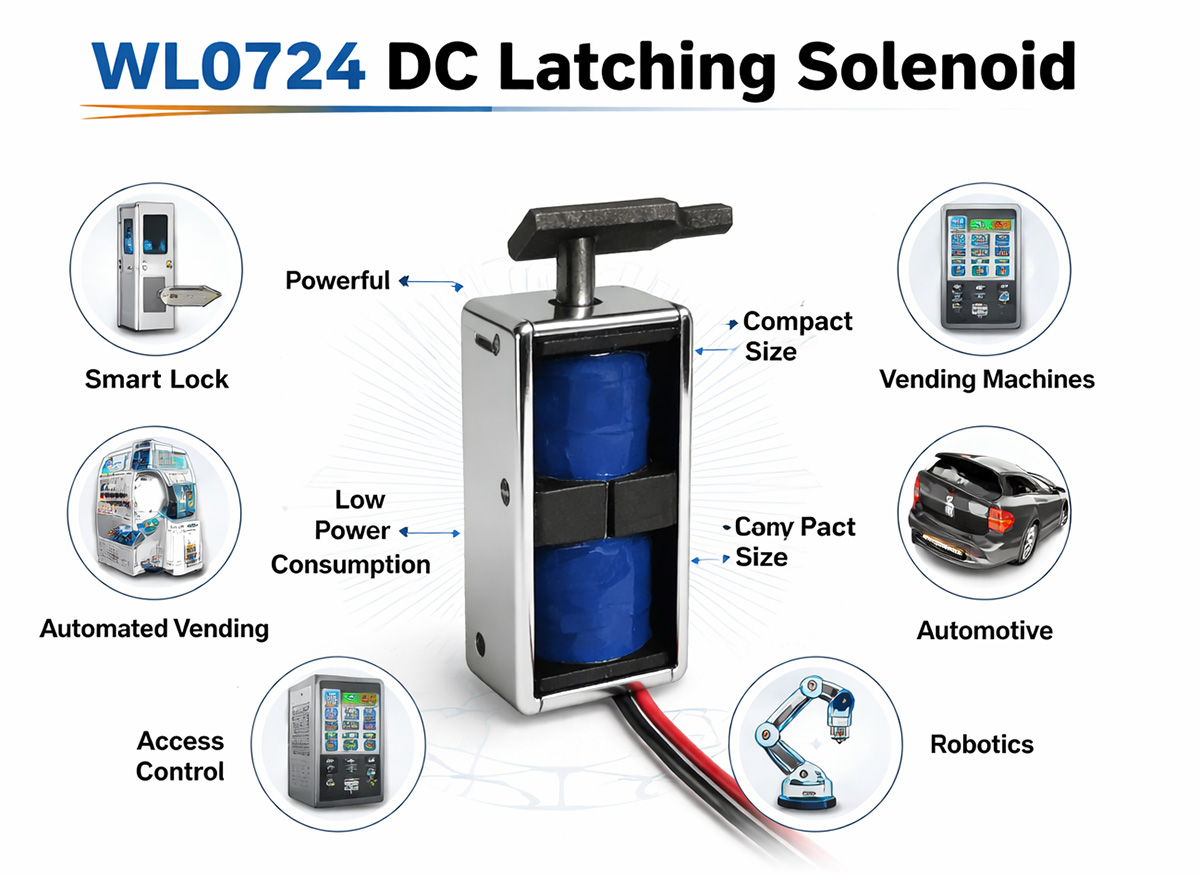
WL0724 DC Latching Solenoid Application

Because of their reliability in bistable operation and low power consumption, DC latching solenoids are used in modern industry and electronic systems.

Vending Machines: The most popular application of latching solenoids is in vending machines. The solenoids control the mechanisms used to dispense products from vending machines. The use of a latching solenoid in a vending machine helps to reduce its energy consumption because it only requires a pulse of current to operate.

Latching solenoids are used in smart locks to provide safe locking and unlocking mechanisms. The latching solenoids improve safety in smart locks because they remain in a locked or unlocked state even in a power outage.

The devices are used in portable medical devices, automated medical diagnosis systems, precise fluid control systems, and other applications. The devices are perfect for battery-powered applications because they are compact in size and consume low energy.

DC latching solenoids are used in industry to improve automation systems. The devices are used to control actuators in industry. The devices are used in automated systems to switch mechanical systems and to position mechanical systems.

The latching solenoids are also used in home appliances, smart meters, communication systems, and automotive systems.

The latching solenoids are still an important part of modern electromechanical system designs because they are reliable and consume low energy.

Advantages and Disadvantages of Latching Solenoids

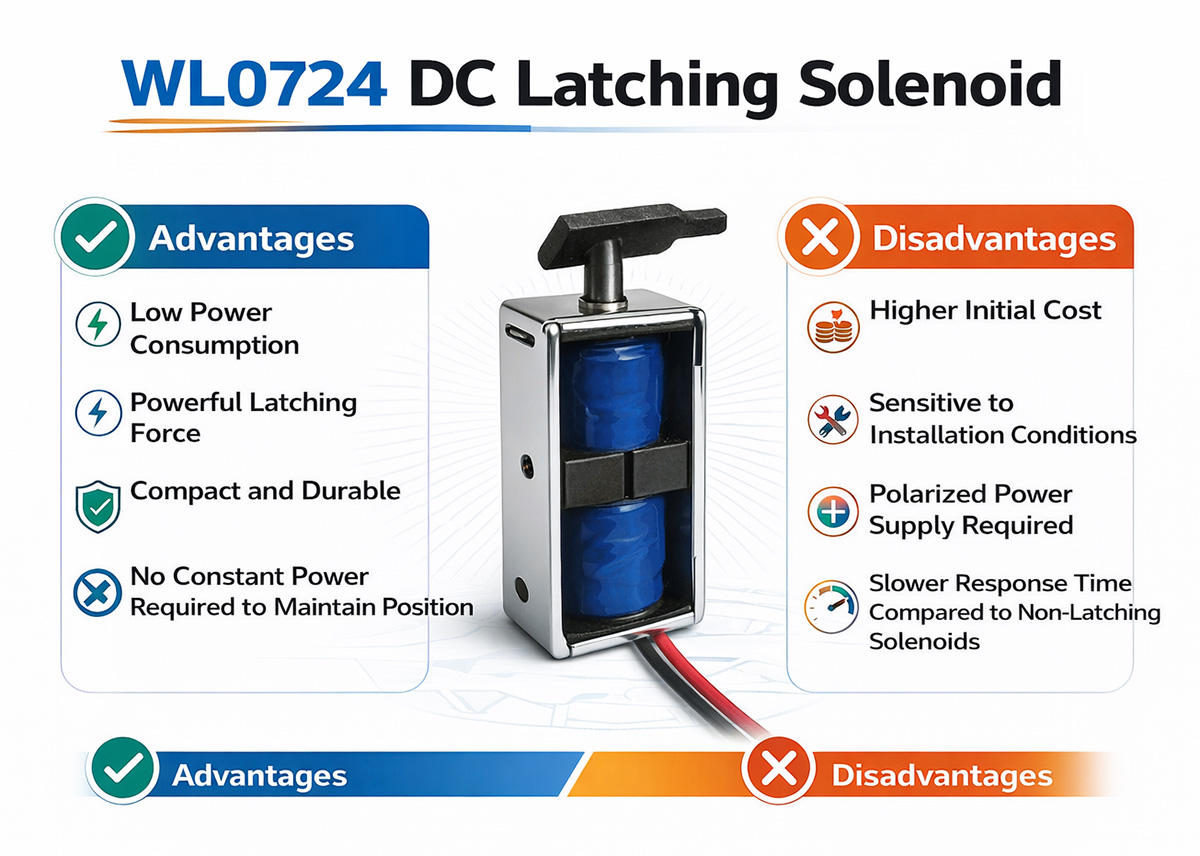
WL0724 DC Latching Solneoid Advantage and Disadvantage

Benefits

Efficiency of Energy Use

“The capacity of the solenoid to stay in place without the use of power is one of the key benefits.”

Decreased Production of Heat

“The accumulation of heat is minimal since the coil is only energized momentarily.”

Extended Service Life

“The intermittent use and reduced electrical load make the device more durable.”

Small and Dependable

“The majority of latching solenoids have good switching performance and a basic mechanical design.”

Friendly to Batteries

“Suitable for use with battery-powered or portable products.”

Drawbacks

Increasingly Complicated Control Circuit

“Polarity reversal or a reverse pulse may be needed.”

Increased Starting Cost

“The cost of the device may be more expensive due to the permanent magnets used.”

Restricted Range of Holding Force

“Some DC latching solenoids may have a reduced holding force compared to continuous duty types.”

Sensitive to Design

“The stable latching performance of the device is dependent on the optimization of the magnetic design.”

Despite the above-mentioned disadvantages, DC latching solenoids remain the recommended choice for energy-efficient electromechanical systems.

H2 DC Latching Solenoid Purchasing Checklist

Engineers should be mindful of the following key factors while purchasing a DC latching solenoid. In order to ensure that the DC latching solenoid is compatible with the power supply used in the system, the engineer should check the operating voltage and current that the device needs. He should then check the holding force and stroke length that the device should possess. In addition, the engineer should also check the size of the device and the installation method.

Therefore, in order to ensure long-term reliability, it is also important to verify the expected operating frequency and duty cycle. The solenoid’s reliability can also be influenced by certain environmental factors, such as temperature, humidity, and vibration. Lastly, in order to make an informed decision on whether or not to purchase, one should also consider the manufacturer’s support, testing, and quality.


FAQ of WL0724 Latching Solenoid

1. What are the key differences between a latching solenoid and a standard solenoid?

A latching solenoid only needs a short current pulse to change its position, whereas a standard solenoid needs a constant current to be active. Latching solenoids become extremely energy-efficient this way.

2 What are the standard voltages for DC latching solenoids?

The standard voltages for DC latching solenoids are 12V, 24V, or 48V DC. However, customized voltages are also possible based on the requirements.

3 Do DC self-locking solenoid valve use electricity continuously?

No. The ability to use electricity only when the solenoid changes its position, rather than when it’s holding its position, is one of the greatest advantages of a latching solenoid.


4 Which sectors use DC self-locking solenoid valve extensively?

Vending machines, smart locks, medical equipment, industrial automation, communication devices, household appliances, etc.

5 What is the lifespan of a DC latching solenoid?

The lifespan of a DC latching solenoid varies, but the majority of them have a lifespan of 500,000 to several million cycles of operation, depending on the conditions of use and the design of the solenoid.


6 Is it possible to customize DC self-locking solenoid valve?

Yes. Custom voltage, stroke length, holding force, mounting structure, waterproof housing, and special plunger designs, to name a few, are the various customizations that DC latching solenoids offer.

7 What leads to the failure of a DC latching solenoid?

Overvoltage, excessive duty cycles, overheating, mechanical failure, and contamination of the guide tube, to name a few, lead to the failure of a DC latching solenoid.


8 Are DC latching solenoids appropriate for devices that run on batteries?

Yes. DC latching solenoids are perfect for use in battery-powered and energy-saving devices since they only draw a brief electrical pulse to operate.


How to Choose the Correct DC Latching Solenoid
WL0724 DC Latching Solenoid Application

In order to ensure long and effective operation, efficiency, and the longevity of the equipment, it is essential to select the correct DC latching solenoid. Prior to selecting the best DC latching solenoid, engineers consider several key factors.

1 Voltage at Work

It is essential to verify the voltage available in the system. The majority of DC latching solenoids are designed for 12V, 24V, or 48V DC. The solenoid’s coil should be designed for the system voltage in order to avoid insufficient force and overheating.

2 Stroke Length Requirement

The stroke length is the length that the plunger travels in actuating the solenoid. The stroke length varies between 2 mm and 20 mm, depending on the application. The system will work mechanically provided that an appropriate stroke length is chosen.

3 Maintaining Power

The ability of the solenoid to hold the position of the plunger after latching is referred to as the holding force. Higher holding forces are required in certain applications, such as locks and safety devices.

4 Force of Actuation

The initial force required to actuate the solenoid should be sufficient to move the mechanical load attached to the solenoid, aside from the holding force.

5 Reaction Time

The response time of the solenoid refers to how fast the solenoid responds to the pulse signal. Fast response times are required in high-speed automation systems.

6 Duty Cycle

While latching solenoids require short pulse times, certain solenoids might be required to handle high switching rates. It should be confirmed that the desired rate is achievable.

7 Space for Installation

Mechanical requirements are also important. The engineer should consider the following:

Solenoid size

Mounting style

Plunger action – Pull or Push

Space available for mounting

Modern designs often prioritize space-saving designs.

8 Conditions of the Environment

The environment in which the solenoid will be used can have an important effect on the performance of the solenoid. The operating temperature should be taken into account:

Operating temperature

Humidity

Dust and contaminants

Vibrations

It may be necessary to employ specialized designs, such as high-temperature coils.

9 Anticipated Life of Service

Millions or hundreds of thousands of cycles may be required for this purpose. Before purchasing a solenoid, one should review the life cycle test results provided by the manufacturer.

10, Personalization Choices

The standard model might not always be entirely satisfactory for the purpose. Reliable manufacturers usually provide the following personalization options:

Personalized voltage

Personalized stroke length

More holding force

Waterproof design

Personalized plunger design

In Conclusion

While choosing a DC latching solenoid, one should keep various parameters such as durability, mechanical parameters, electrical parameters, and environmental parameters in mind. By analyzing these parameters, an engineer can select a solenoid that will provide reliable service.
DC Latching Solenoid Troubleshooting

DC Latching Solenoid Troubleshooting

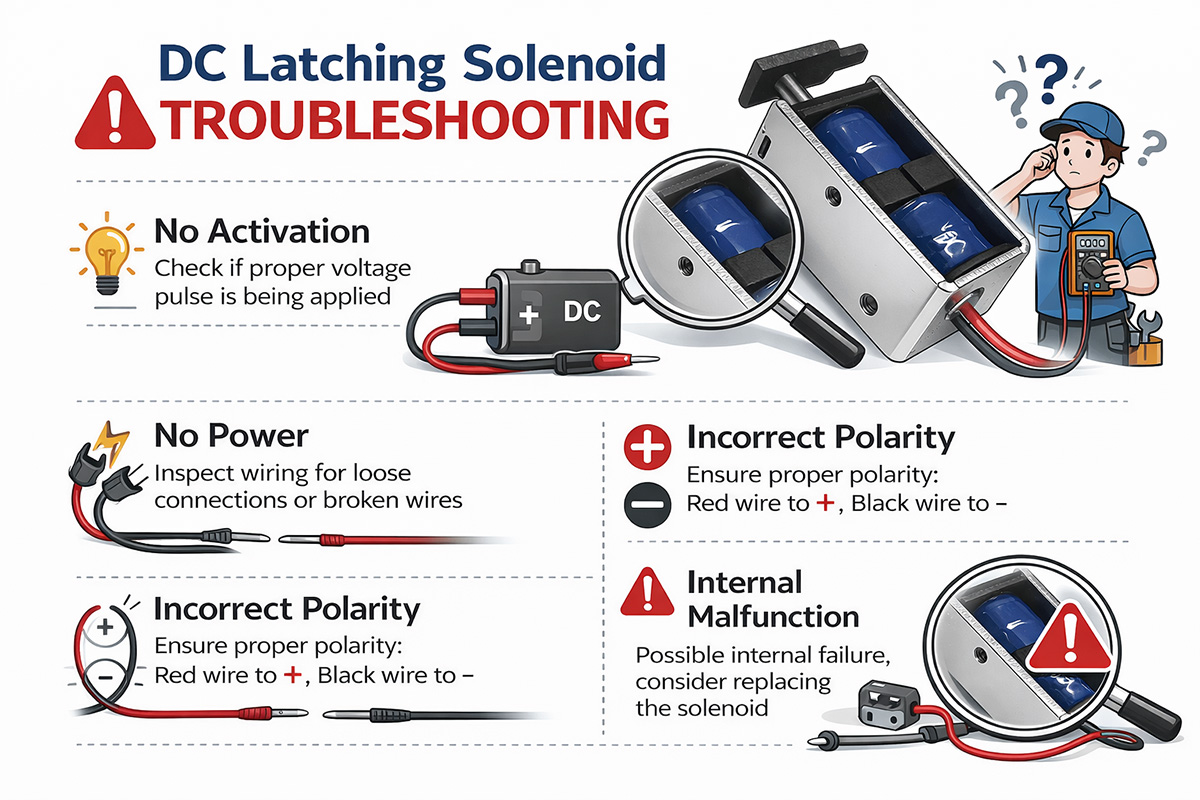
As discussed, DC latching solenoids operate reliably and efficiently. However, electrical, mechanical, and environmental factors may lead to a malfunction. Troubleshooting these factors helps to effectively identify the causes of the malfunction and resume the solenoid to its normal operations.

1. The solenoid fails to activate.

Potential Reasons

Lack of power or incorrect voltage

Damaged or loose wiring

Burnt coils

Failure of the control signal

Remedy

Use a multimeter to check the voltage being supplied to the solenoid.

Check the wiring for proper connections and the signal being sent to the solenoid.

Use a multimeter to check the resistance of the coils to determine whether they are damaged.

Remedies

Ensure there is enough current being drawn from the power source.

To reduce the effect of voltage drop, use thick wires.

Lessen the load or mechanical resistance

If the resistance seems unusual, change the coil

Third. Slow Movement or Plunger Sticking

Potential Reasons

Presence of contaminants such as dust or debris within the guide tube

Inadequate lubrication

Presence of mechanical deformation on the plunger

Remedies

Clean the guide tube and plunger.

If necessary, lubricate the plunger with the correct lubricant.

Replace any mechanical part that has been damaged.

Four. Overheating of the Solenoid

Potential Reasons

Presence of overvoltage on the coil

Presence of a duty cycle that exceeds design parameters

Inadequate dissipation of heat

Remedies

Check the power source and the rated voltage.

Cut down on the frequency of use

Enhance the cooling system.

Fifth. Inconsistent Latching or Inability to Maintain Position

Potential Reasons

Weakening of the permanent magnets

Inaccurate pulse control signal

Misalignment of the magnetic circuits

Remedies

Check the magnets for accuracy.

Ensure that the internal parts are correctly assembled.

Sixth. Overpowering Noise While Operating

Possible Causes

Loose mounting screws

Worn-out guide tube and/or plunger

Effects of high-speed actuation

Solutions

Tighten mounting screws

Replace guide tube and/or plunger

Change driving voltage or add damper

Seven. Postponed Reaction

Possible Causes

Low voltage supplied

High friction levels in moving parts

Old coils or damaged insulation

Solutions

Confirm steady voltage supplied

Keep internal parts clean and in good condition

Change old coils, if necessary

Some Tips for Preventive Maintenance

In order to ensure that DC latching solenoids work reliably over long operating times, it is recommended that:

Connectors and wiring should be checked periodically.

The guide tube and plunger should be kept clean.

Never exceed the duty cycle and voltage rating.

Functional tests should be performed periodically.

DC latching solenoids can last for long and work reliably in an industrial environment.

Get A Free Quote Now

Contact Form

Related Products

Related News

Introduction to Solenoid Burnout Solenoids can be used in different industries from industrial automation to smart locks, medical devices, automotive, […]

  Chapter 1: Introduction of Solenoid Lifespan? The solenoid lifespan represents one of the most widely considered points nowadays in […]

Chapter 1 : What is a Metal Stamping Die? Metal stamping die (also called stamping tool, press tool or metal die) […]

Scroll to Top

Get A Free Quote Now !

Contact Form
If you have any questions, please do not hesitate to contact us.
Weilong Solenoid Company Culture
