

Chapter 1: What is a Tubular Solenoid?
Tubular solenoids are miniature electromagnetic actuators which convert electrical energy into accurate linear motion. Tubular solenoid consists of a cylindrical body, copper coil, iron core and a moving plunger. Upon excitation they generate magnetic field, which results in the plunger moving and producing push or pull force. Due to their compact design, high force output, quick response and reliability tubular solenoids can operate in limited space.
Chapter 2: How does a tubular solenoid work?
Tubular solenoid operates on the basis of electromagnetic actuation principle which means the conversion of electrical energy into controlled linear motion. Tubular solenoids have a cylindrical iron core around which a copper coil is wound. Passing electricity through the coil generates magnetic field. The magnetic field is amplified by high permeability of the iron core. Due to efficient design tubular solenoids are capable of producing strong force with a compact structure.
A magnetic field acts on a plunger which is able to move within the tube. The excited plunger is moved inwards or outwards depending on the design of tubular solenoids. Such linear motion is utilized for mechanical operations like locking, switching or valve operating.
The force produced by tubular solenoids is directly proportional to the supplied current and the number of turns of the coil. This allows the precise control of motion making tubular solenoids ideal for automation, automotive and industrial control applications requiring rapid and reliable operation.
Chapter 3: The Type of Tubular Solenoid
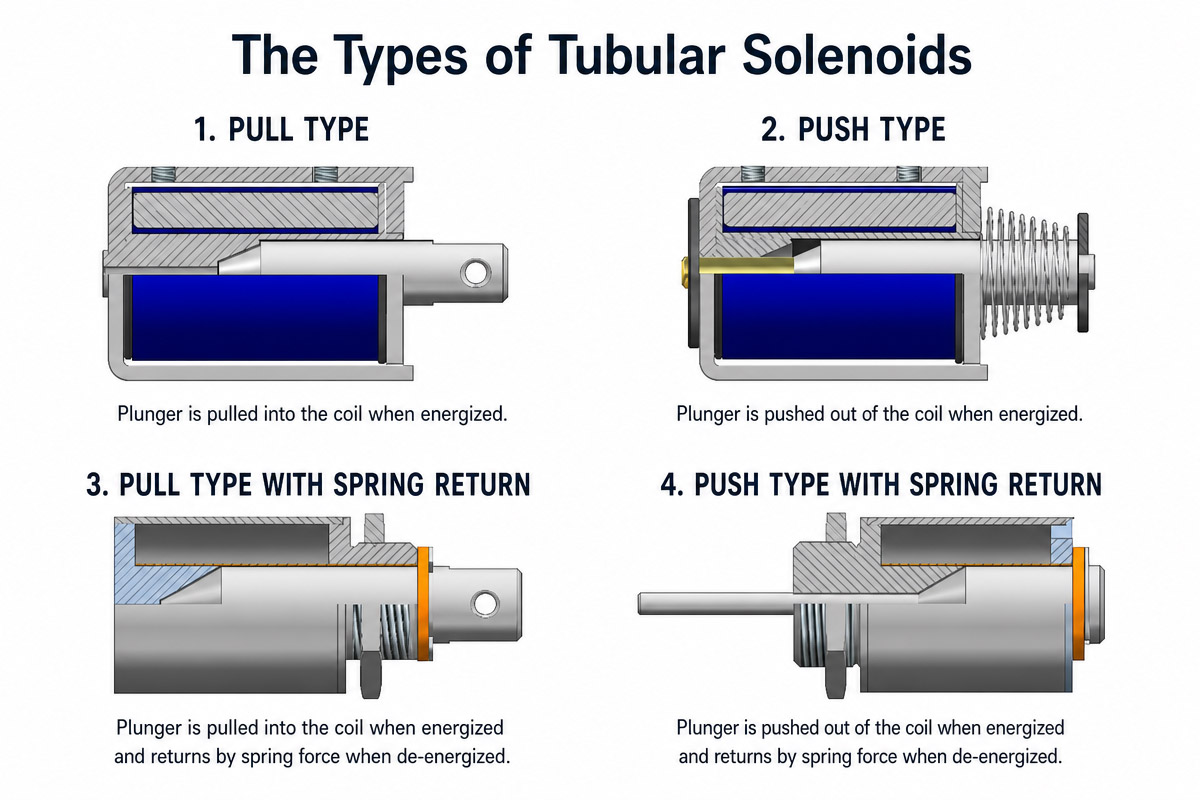
There are various types of tubular solenoid which are designed to perform particular kinds of motion.
3.1 Solenoids of Push-Type
Push type tubular solenoids feature pushing of the plunger when they are excited.
Used for ejecting or releasing mechanism
Popular in vending machines and automation systems
Suitable for applications requiring the force outwards
3.2 Pull-Type Tubular Solenoid
When being energized, pull-type tubular solenoids pull the plunger in.
Most common tubular solenoids design
Used in locks and valve systems
High strength of pull—
3.3 Tubular Latching Solenoid
Tubualr Latching solenoid remain stationary without the need for constant power supply.
Energy saving design
Used in battery-powered systems, especially in
Maintain their position when no power supplied
3.4 Tubular Continuous-Duty Solenoids
These tubular Continuous-Duty solenoids are designed for extended operation period.
Ideal for industrial automation
Constructed from heat-resistant materials
Capable of working non-stop without failures
Chapter 4: Structure and Components of a Tubular Solenoid
Structure of tubular pu solenoid:
4.1 Copper Coil
In tubular solenoids the magnetic field is generated by the copper coil.
Copper wire, high conductivity
The number of turns impacts force output.
Need to insulate properly
4.2 Kern de fer
Iron core is used in tubular solenoids to improve magnetic properties.
Ferromagnetic materials
Concentrates magnetic field.
Increases efficiency of force output
4.3 Plunger
Tubular solenoid has plunger which serves as the moving component.
Transfers electromagnetic energy into motion
Designed for linear movement
Output function of the actuator
4.4 Connection Wires
Provide electrical power to tubular solenoids to assure stable operation.
4.5 Housing
Protects tubular solenoids from dust, moisture and mechanical damage.
Chapter 5:. Why the tubular solenoid becoming so popular?

Tubular solenoid is increasingly being used for industrial, automotive and consumer applications due to their good combination of performance, size and efficiency. One of the reasons for the growing popularity of tubular solenoids is their small cylindrical structure which allows easy integration of such solenoids into devices having limited size without compromising their force output.
Another important feature of tubular solenoid is their good force-to-size ratio. These solenoids are small in size yet are high in linear force which makes them ideal for precision applications like door locks, valves and automated systems. The fast response time is another feature making them suitable for modern automation processes.
Reliability is another feature of tubular solenoid due to their simple structure consisting of few moving parts which reduces maintenance requirements making them economical to use for long periods of time.
Another factor contributing to the popularity of tubular solenoid is their energy efficiency, especially in case of latching solenoids which only consume energy when they are switched on. Also technological advances allowed increasing durability and thermal performance of tubular solenoids allowing them to operate in harsh environments.
In conclusion, the combination of small size, high linear force, reliability and versatility has made tubular solenoids highly demanded in modern engineering applications.
Chapter 6: Advantages and Disadvantages of Tubular Solenoid
Tubular solenoid is widely used in automation and control systems thanks to their effective design and reliable performance. But like all electromagnetic actuators tubular solenoids have advantages and disadvantages which should be considered before selection.
Advantages of Tubular Solenoid
One of the advantages of tubular solenoids is their ability to produce high force output in compact design. Tubular solenoids are perfect for applications requiring high linear force in small volume. They also have quick response times which is useful for rapid and precise movements in automation systems. Also the simple design of tubular solenoids with few moving parts increases reliability and decreases maintenance requirements. Tubular solenoids are flexible and suitable for industrial equipment, automotive and home appliances.
Disadvantage of Tubular Solenoid
Tubular solenoid has advantages but there are also drawbacks. One of the restrictions of their use is the limited stroke length which cannot be used when a long linear motion is required. Another drawback is heat generation, as continuous use of tubular solenoids may lead to overheating without appropriate design. Tubular solenoid is susceptible to external magnetic interference which may influence their performance in some environments.
In general, if tubular solenoid is matched to application requirements they will provide excellent performance and efficiency.
Chapter 7: Important Factors in Design of Tubular Solenoid
When designing or selecting tubular solenoids several important factors need to be considered for achieving optimal performance and extended lifetime. Among such factors the force and stroke length are important. Tubular solenoids have to be matched to the mechanical load and stroke of the application to work reliably.
But there are also important electrical characteristics. To avoid overheating of tubular solenoids and ensure their stable operation it is necessary to match voltage, current and duty cycle to the system requirements. Thermal management is especially important for continuous-duty applications.
Environmental conditions have to be taken into account as well. Tubular solenoids used in harsh environments may require sealed housing to protect from moisture, dust or corrosion. Another important condition is the operating temperature range since harsh heat or cold environment can decrease efficiency of the solenoid.
Finally, the size and mounting arrangement have to fit the available installation space. When designed properly tubular solenoids are able to operate effectively, safely and reliably in their intended application.
Chapter 8: Power Consumption of Tubular Solenoid
The power consumption of tubular solenoids is an important parameter to consider when designing them and evaluating their performance. You can calculate it with the following electrical formula:
P = V x I P = power in watts V = voltage I = current
For example if tubular solenoids are operated at 12V and draw .5A then the power consumption is 6 watts. It allows determining energy efficiency and thermal load.
In reality the actual power consumption of tubular solenoid can differ from the theoretical value due to coil resistance, temperature and duty cycle. In order to ensure safe and efficient operation without overheating or decreased performance it is important to properly calculate power consumption of tubular solenoid.
Chapter 9: The applications of Tubular Solenoids

Tubular solenoids are famous for their small size, quick response and reliable linear motion in industrial, automotive and consumer applications. Tubular solenoid is good for automation and control systems since they can convert electrical energy into precise mechanical motion.
Tubular solenoid is widely used in industrial automation for conveyor systems, sorting machinery and robotic equipment. Tubular solenoids are used to control gates, locks and diverters to ensure smooth and precise material handling. Tubular solenoids are used in the assembly line to increase efficiency of rapid and repetitive mechanical actions.
Tubular solenoid is used in the automotive industry for fuel injection, transmission control and engine management systems. Their ability to turn rapidly allows precise control of fluids and mechanical components improving vehicle performance and fuel economy.
Tubular solenoid is also applied in household appliances like washing machines, dishwashers, coffee makers, water dispensers, etc. Tubular solenoid is appled to control valves to ensure automated and reliable operation of the water flow.
In addition, tubular solenoid is used in security systems such as electronic door locks and access control devices due to their compactness and reliable actuation.
Generally tubular solenoid is a vital component in modern engineering systems in a wide variety of industries.
Chapter 10: Common Mistakes in Selecting Tubular Solenoid
Selection of tubular solenoid for an application is an important task which should be done with caution since there are several common mistakes which can result in poor performance or even system failure.
One of the common mistakes is incorrect choice of voltage which can result in poor performance or overheating of tubular solenoids reducing their lifetime. Neglect of duty cycle requirements is another mistake as many tubular solenoids are made for intermittent duty and can be thermally damaged when used continuously.
Another mistake is ignoring force and stroke requirements as tubular solenoids unsuitable for mechanical load will not be able to actuate the system or will work inconsistently. Likewise, wrong stroke length will not allow the movement in the application to take place.
The fourth mistake is neglecting environmental factors which can lead to corrosion or decreased efficiency of tubular solenoids used without appropriate sealing in humid, dusty or high temperature environments.
Mechanical stress and shortened lifetime of the tubular solenoids will result from improper mounting and alignment.
Such mistakes should be avoided to guarantee reliable, efficient and safe operation of tubular solenoids. Proper selection considering electrical, mechanical and environmental factors is essential to achieve long lifetime and maximum performance.
Chapter 11: Tubular SolenoidTrouble Shooting Guide
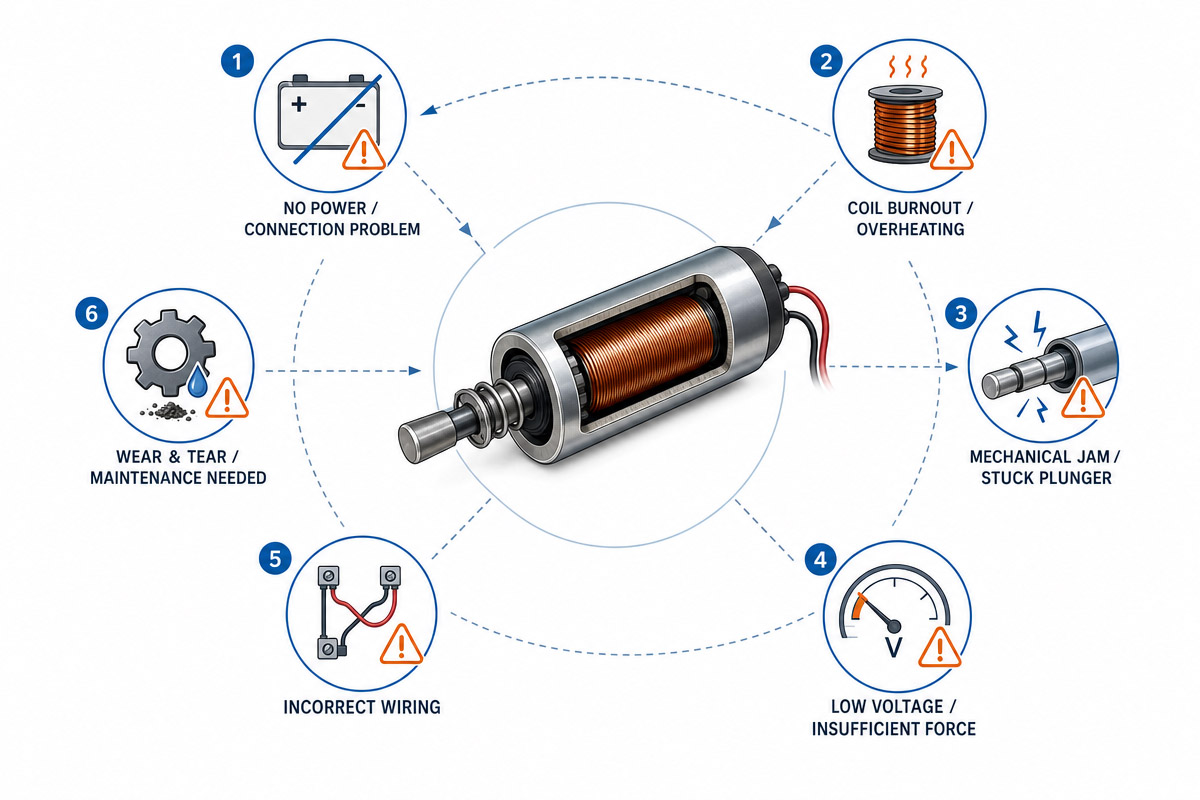
If tubular solenoid does not work properly then a systematic troubleshooting approach can help to solve the problem. One of the common problems is no motion or weak actuation of tubular solenoid. This usually happens if tubular solenoid is operated with too low voltage or current. Check if the voltage and current supply match the rated values. Check for broken or loose wiring connections.
Another problem is the overheating of the solenoid. Overheating can happen if tubular solenoids are operated beyond their duty cycle or continuously without proper cooling. The operating time should be reduced or ventilation enhanced to avoid damage.
Intermittent operation of the solenoid can be caused by unstable electrical contact or issues with the controller. Check the connectors, switches and control circuitry to assure constant power flow to tubular solenoids.
Noisy or vibrating tubular solenoids may indicate improper alignment or worn-out parts. Make sure the plunger is not binding and properly aligned during installation.
Complete failure usually indicates burnt coils, insulation damage or internal short circuit. Often such problems require replacement of tubular solenoids.
Proper installation and matching of electrical parameters, as well as proper maintenance, are necessary to ensure efficient operation and longevity of tubular solenoids.
Chapter 12:. 8 Common FAQs About Tubular Solenoid
Q1: What is the function of tubular solenoid?
Tubular solenoid converts electrical energy into linear motion for various applications like locking systems, valves, automation equipment and automotive systems.
Q2: How do tube-type solenoids work?
Tubular solenoid works in the following way: the electric current passing through a coil creates a magnetic field which moves the plunger generating push or pull force.
Q3. What is the difference between push type and pull type tubular solenoid?
Push type tubular solenoid push the plunger out and pull type tubular solenoid pull the plunger in when being power on. Both movement
directin is not the same.
Q4: Is tubular solenoid energy-saving?
Yes, especially latching tubular solenoid. In certain configurations of tubular solenoids power consumption is needed only during switching.
Q5. What is the force of tubular solenoid?
The force of tubular solenoids is determined by the number of turns of the coil, current value and magnetic properties of the core material.
Q6: Can tubular solenoid operate continuously?
Continuous-duty tubular solenoids are specifically designed for extended operation period. The continuous use of standard solenoids can lead to overheating.
Q7. What causes the failure of tubular solenoid?
Overheating, incorrect voltage, mechanical blocking and improper installation of tubular solenoids are the most common causes of failure.
Q8: What is the lifetime of tubular solenoid?
When properly operated tubular solenoids are able to provide millions of cycles of operation depending on the duty cycle and operation conditions.
Chapter 13: Summary
Tubular solenoid is electromechanical instruments that transform electricity into linear movement through a tubular shape. The tubular shape offers efficiency, power output, and smooth operation whether moving forward or backward. They are commonly applied in automation, medical instruments, locks, and other machines where accuracy is highly desired. As opposed to open frame solenoids, tubular solenoids are more efficient because of their better control of magnetic circuits and minimized losses. They come in varying sizes, voltage ratings, and forces for their application. It is vital to manage heat and ensure correct sizing for good performance and longevity.


