

Chapter 1 : Introduction of Solenoid Valves for Iot and Automation
The Invisible Force of Smart Systems With the emergence of smart homes, precision farming, and the Industrial Internet of Things (IIoT), intelligence and automation became the defining features of contemporary systems.
A smart weather-responsive sprinkler system, an intelligent factory that automatically modifies production or a medical device that dispenses medicine in precise quantities – all of those systems share one invisible and indispensable component.
That component is the solenoid valve.
An electrically activated device controlling flow of liquids and gases in a very precise way, solenoid valves translate electric impulses into mechanical movement. Growth in importance of solenoid valve technology continues to rise alongside connectivity and datification of industries.
Chapter 2 : What is a Solenoid Valve?
Solenoid valve is a valve which operates with the use of an electric current and which can be operated through PLCs, sensors, timers or cloud-based IoT systems.
In other words, it is a valve driven by an electric current, not manually. In principle, a solenoid valve is an apparatus that converts electrical energy into mechanical motion to open or close an orifice inside a valve housing. When electrical impulse stops coming, a solenoid valve typically returns to default position, usually with the help of a spring mechanism.
This simple principle of electric to mechanical conversion allows for precise, automatic and remote fluid control in multiple industries.
Chapter 3: Construction and Working Principle of a Solenoid Valve
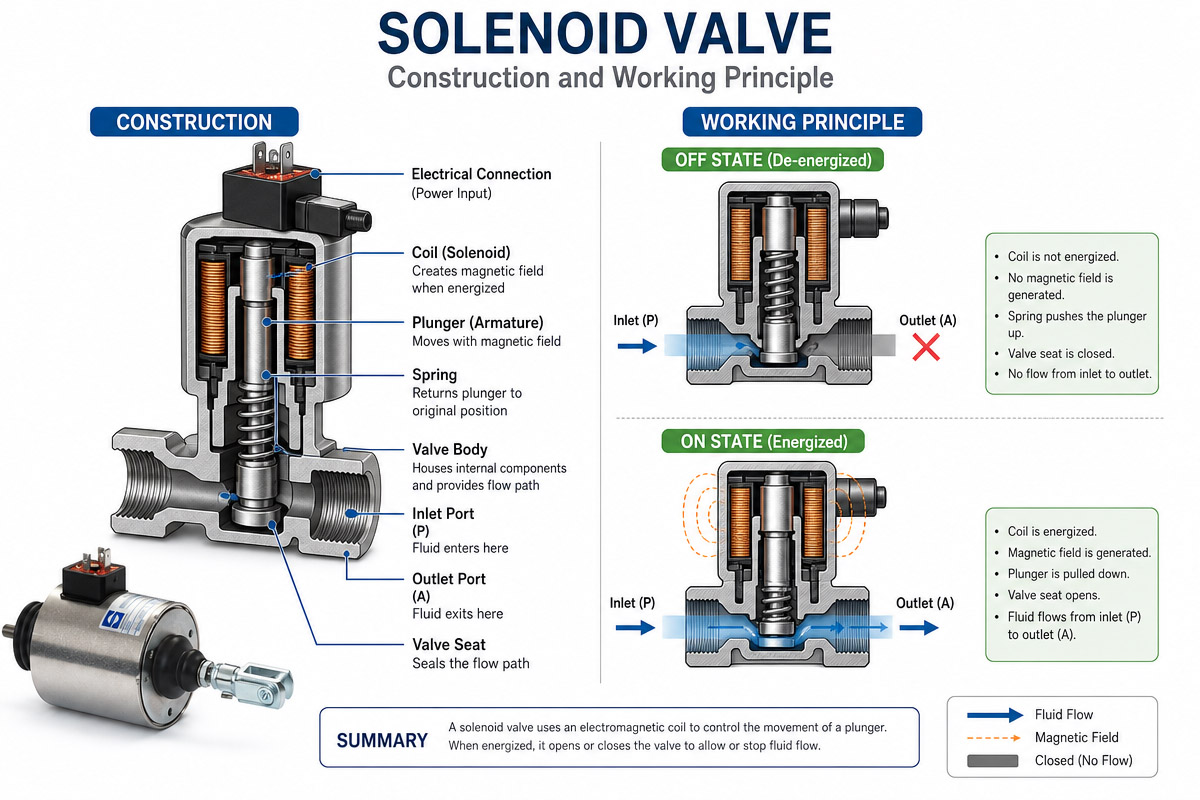
A solenoid valve consists of two main elements which function together:
3.1. Electromagnetic coil (solenoid)
“This is the driving element of the valve. It is made of copper wire wrapped around a core. After activation it produces a magnetic field which makes the ferromagnetic plunger (armature).
3.2. The Valve Body (Flow Control Section)
It is integrated in the piping system and contains the inlet, outlet, orifice and sealing mechanisms that regulate flow of fluid.
3.3 Working Principle
After receiving electrical impulse a solenoid produces a magnetic field that attracts the plunger up or down, depending on a design. This action opens or closes the orifice, regulating the flow of fluid. Upon disconnection of the power the magnetic field dissipates and a spring resets the plunger.
3.3 Modern solenoid valves may include additional options such as:
- Shaded pole rings in AC solenoid valves to minimize vibration and humming • Latching mechanism that holds position without continuous power
- Low power IoT solenoids
These innovations greatly enhance efficiency and reliability of the system, especially for battery-operated or remote ones.
Chapter 4 : Types of Solenoid Valves
Solenoid valves are not a single product that will fit everyone’s needs, it is rather a family of varied products that can satisfy different needs.
By number of ports
4.1 Two-Way Valves
It is the most common type that is used for simple on/off control. It has one inlet and one outlet port and it is used in water systems, irrigation and pneumatic systems.
It could be:
4.2 Normally Closed (NC):
no flow when powered off •
4.3 Normally Open (NO) –
flow when de-energized. NC type is usually preferred for safety reasons.
4.4 3-Way Valves (or)
It is a three-port valve which is used for diversion or mixing of flow. It is widely used in pneumatic systems to control single-acting cylinders, supplying and exhausting air.
4.5 By Actuation method
Direct Acting Solenoid Valves
In direct acting valves the electromagnetic force directly opens or closes the orifice. Such valves do not depend on line pressure and can operate in zero-pressure conditions.
They are
- Quick acting
- Very reliable
- Suitable for low flow applications
But in general, they can only be used in smaller orifices.
Pilot-Operated (Servo-Operated) Valves
Pilot-operated valves use the small solenoid to actuate a small orifice which creates pressure differential so that the main valve could be actuated with system pressure.
They are perfect for:
- High-pressure areas • Large flow applications
- Industrial automation systems
This enables using a small solenoid to effectively actuate a much larger fluid volume.
Chapter 5: The Role of Solenoid Valves in IoT and Automation
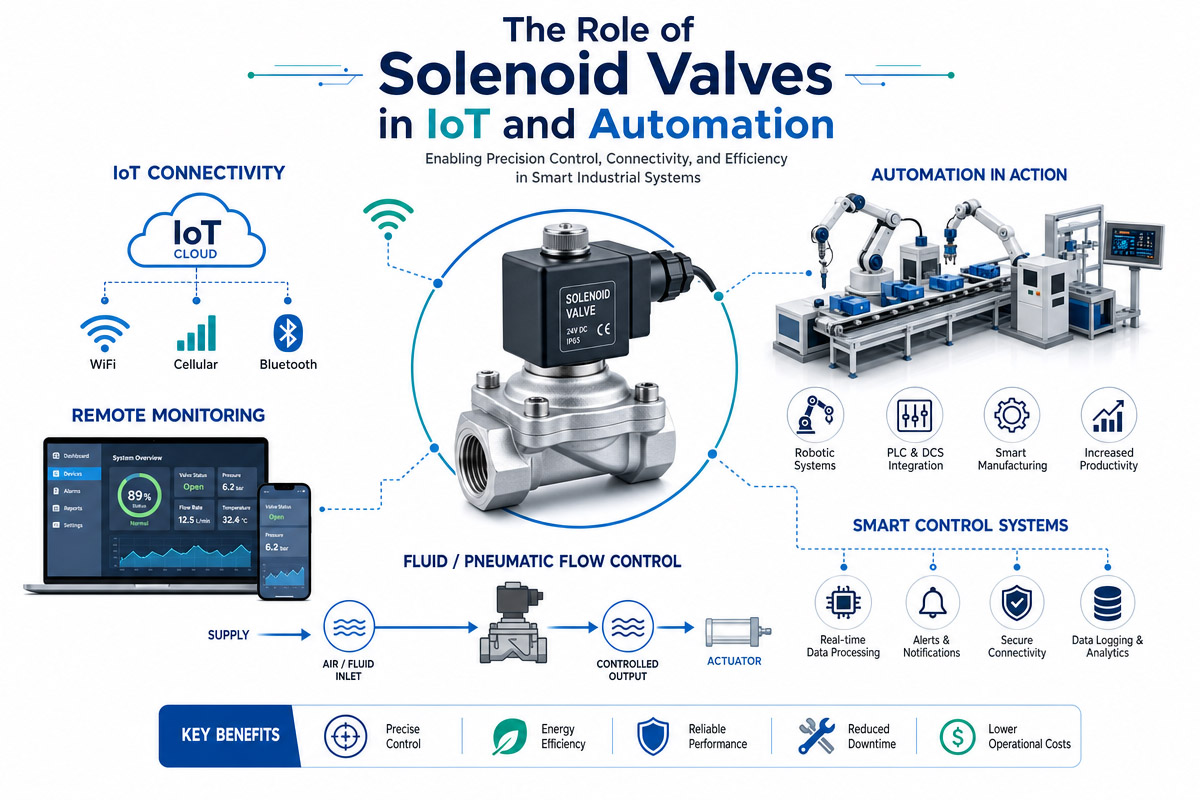
Thanks to integration with digital systems and intelligent control architecture, solenoid valves became an indispensable component of modern automation.
Main advantages include:
- IoT platforms for remote monitoring and control
- Integration with diagnostics that eliminates additional sensors
- Real-time data feedback for predictive maintenance
- Easy to integrate with industrial communication protocols
- Energy efficient operation, usually with standard 24V DC systems
- Rapid response time (in milliseconds)
These are the key features of a smart infrastructure, industrial automation and a connected environment.
Chapter 6: Application in Various Industries
The most common application of solenoid valves can be found in many industries:
- Automotive industry: fuel injection, transmission systems, turbo control
- HVAC industry: air conditioning, humidifier, zoning systems
- Medical industry: oxygen concentrators, dialysis machines
- Food and Beverage industry: coffee machines, ice machines, dispensers • Industrial Automation: process control and fluid control systems
In IoT-enabled environments, they can be used for:
- Smart water and gas control in home • Industrial surveillance
- Energy management systems
- Automated agricultural systems
Chapter 7 : Solenoid Valve Advance Technological
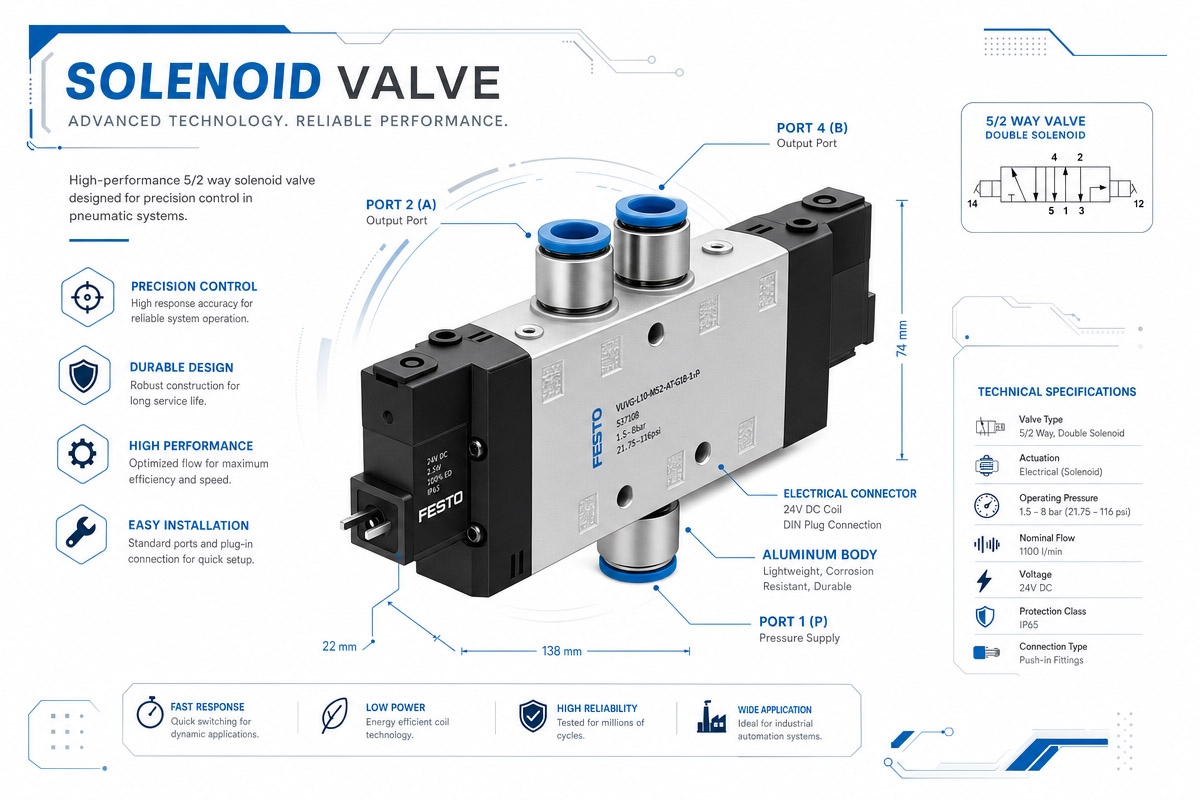
New technologies change performance and efficiency of solenoid valves in following ways:
7.1. Bi-Coil Technology
Two windings – for actuation and holding – decrease energy consumption greatly.
7.2. Energy-Saving Coil Designs
Decrease the holding current after actuation, making operation more thermal-efficient and increasing lifetime.
7.3. Ultra-Low Power Valves
Next generation valves operate on sub-1W power level, ideal for battery-operated IoT systems.
Chapter 8: Research on Reliability and Failure Prediction
Modern research improves reliability of solenoid valves by:
- Remaining Useful Life (RUL) prediction models • Early detection of changes in coil resistance
- Finite element analysis (thermal & structural modeling)
Such improvements enable to reduce downtime and implement predictive maintenance strategy in industrial systems.
Chapter 9: Cross-reference Automotive and Industrial Systems
Automotive and industrial systems represent different environments, but basic principles of solenoid valves are the same:
- Electrical signals initiate mechanical action • Pressure differential actuation
- Impact of response time on performance
- Durability – depends on seal material
Examples:
Automotive Component Industrial Counterpart
Fuel injector Direct acting solenoid valve
Pilot valve Transmission controller
Brake, Valve ControlHydraulic solControl nit
EVAP purge valve Gas solenoid valve
This helps to choose the right vaControl r industrial applications.
Automotive versus Industrial SoleControl lve Systems
Automotive System Industrial CounControl
Fuel injector Solenoid valve, dirControl ing
Brake Control Valve Brake ControlControl ydraulic solenoid valves
Pilot valve Drive system
SolenoiControl , EVAP gas system
Control a way for engineers to chControl e proper industrial solenoid valve.
Chapter 10: How to choose a solenend Control valve for Industrial and IOT application?
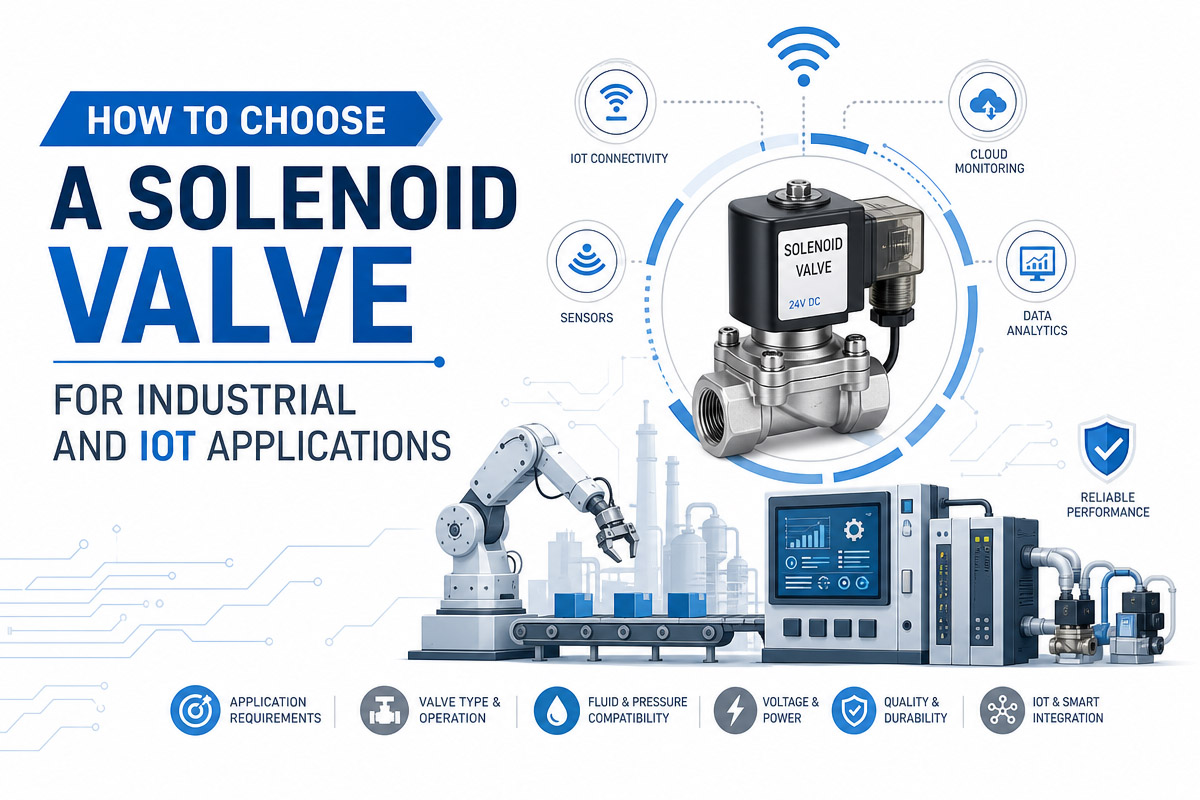
Choosing the right solenoid valve for industrial and IoT application is the key to reliability, efficiency and durability of a system. First of all, you have to know what medium is controlled: air, water, oil, gas or any other, because different media require different sealant materials, for example, NBR, EPDM or PTFE.
Then comes pressure and flow requirements. You have to choose a valve pressure range and orifice size according to your system conditions to avoid performance loss or coil overload. Pilot-operated valves are better suited for high pressure or high-flow systems, while direct-acting valves are best for low flow or zero-pressure applications.
Voltage and power consumption is important especially for IoT systems. Low power DC solenoids (12V or 24V solenoids, for example) are preferable for energy efficiency and remote or battery-powered installations. For smart systems you need to look for valves with low power consumption or latching type.
Environmental conditions are also relevant. Choose a right IP protection class, corrosion-resistant housing and temperature resistance for outdoor and industrial applications.
Lastly, you should think about system compatibility and control integration. IoT-compatible solenoid valves should be compatible with PLCs, sensors or wireless controllers for real-time monitoring and automation.
By properly evaluating these criteria you ensure reliable operation, reduced maintenance costs and maximum performance for your industrial automation and IoT systems.
Chapter 11: Solenoid Valves Future Trend in Automation
Solenoid valves play key roles in IoT and smart manufacturing/industrial automation systems. They allow to manage the flow of liquids and gases remotely and automatically and, therefore, they are an indispensable part of modern engineering.
With innovations in energy efficiency, miniaturization and IoT integration, solenoid valves become smarter, more efficient and sustainable.
With ongoing trend toward connected ecosystems in industries, solenoid valve technology will remain an integral part of intelligent automation systems.
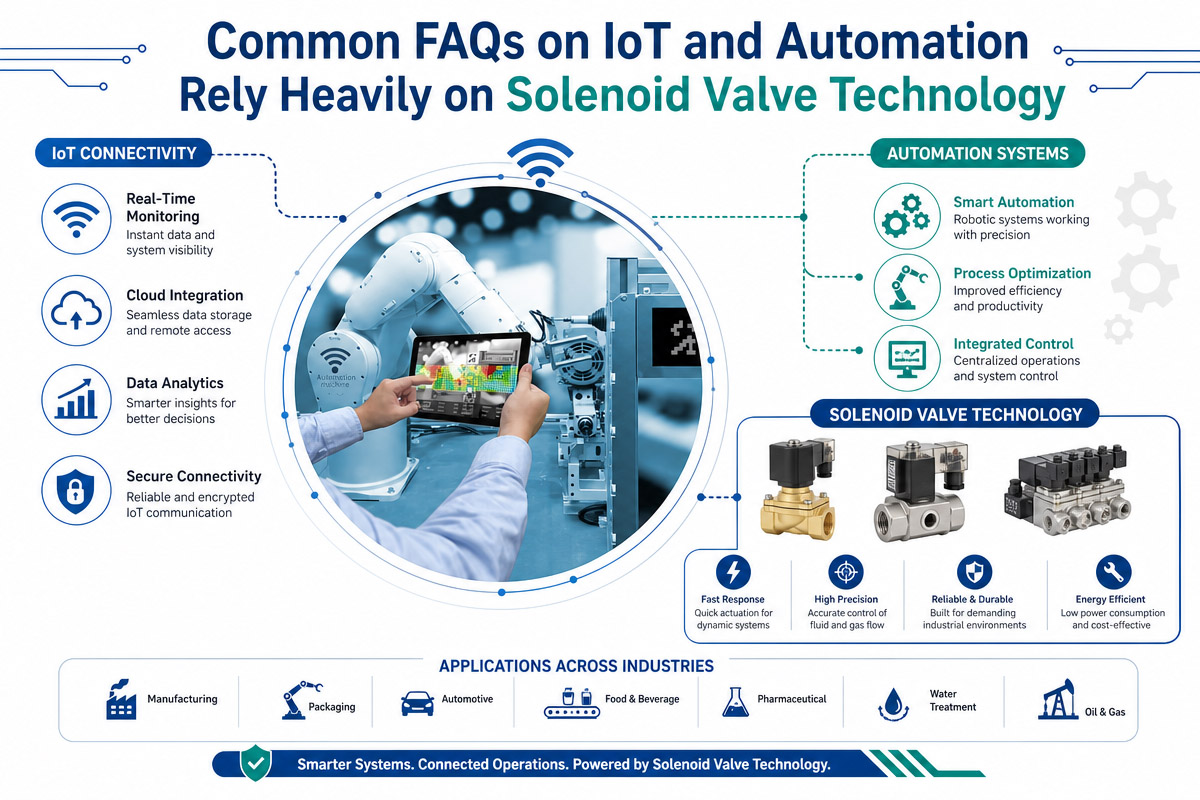
Chapter 12: Common FAQs on IoT and Automation Rely Heavily on Solenoid Valve Technology
12.1: What is the Definition of the Solenoid Valve and Why is it Significant for Automation?
Solenoid valve is an electrically controlled fluid switching mechanism that consists of an electromagnet or solenoid, a plunger, spring, and valve housing with inlet and outlet orifices. When energized by electricity the solenoid creates a magnetic field that moves the plunger and opens or closes the valve seat in order to switch the flow on/off.
The reason why it is vital for automation and Internet of Things is the following – it allows controlling the fluid without any manual involvement. In other words, with the help of a simple digital signal, one can physically turn a solenoid valve on or off and get certain actions in result.
Solenoid valves are used in the following applications:
For watering plants according to the information from sensors.
As pneumatic controls and robotic systems in industry.
For controlling water flow in the smart water filtration system.
For controlling the refrigerant in the HVAC systems.
In other words, it is the most commonly used actuator in IoT systems.
12.2: What are the Types of Solenoid Valves?
It is crucial to choose the right type of the valve because the wrong selection can significantly affect the reliability of your system. The first thing you should do is to understand the types of solenoid valves by two classification schemes:
By Number of Ports:
| Type | Description | Common Use Cases |
| 2-Way Valve | One inlet and one outlet; simple on/off flow control | Irrigation, water dispensers, pneumatic cylinders -8 |
| 3-Way Valve | Three ports; can mix flows or divert single flow between two outlets | Single-acting cylinders, diverter systems -8 |
By Actuation Method:
| Type | Description | Best Application |
| Direct-Acting | Solenoid moves plunger directly; operates from 0 psi | Low-pressure, low-flow systems; compact applications -8 |
| Pilot-Operated | Solenoid controls small pilot port; system pressure assists main valve opening | High-pressure, large flow rate industrial systems |
12.3: What Are the Features of DC Latching Solenoid Valves and How to Compare Them with the Alternatives?
This is especially important for battery-powered IoT systems. Usually, the regular AC solenoid valves are always powered but DC latching valves have certain advantages for IoT systems.
How It Works
It works with the help of a simple electronic pulse that activates a small piston and latches it with a magnetic force. In order to unlatch it, you need to send the pulse in reverse polarity. Once it is latched, it will remain in the same position even without the power supply. That is why it is especially good for battery-powered irrigation controllers.
AC vs. DC: The Reliability Debate
| Feature | AC Solenoids | DC Latching Solenoids | DC Motorized Pilot Valves |
| Power Use | Continuous draw | Ultra-low (pulse only) | Ultra-low (pulse only) |
| Ideal For | Wired, high-power systems | Wireless, battery-powered systems -5 | Wireless, battery-powered, high-reliability -5 |
| Failure Mode | Coil burnout possible | Plunger can stick from debris or scale | Superior mechanical advantage; removes sticking issue |
Practical Consideration
In case if you have a system where you are using a wireless battery-powered controller like Verdi or Milesight UC51x series, then the DC latching solenoid valves or motorized pilot valves will be the right choice. It is necessary to mention that there are manufacturers that sell the latter ones as solenoids although they use a tiny motor with gears instead of a coil. It gives much more power to the valve.
12.4: What are the Main Failure Modes of the Solenoid Valve and How to Troubleshoot It?
Despite the reliability, sometimes solenoid valves can experience some failure modes. In case if you work with automated systems, it is crucial to troubleshoot them quickly. As a rule, the problems appear in one of the following ways:
1, Stuck open (constant flow)
Valve allows the flow constantly regardless the control signal.
Possible reasons:
Power failure left the valve open.
There is debris that stuck on the valve seat.
Valve seat/stem is damaged.
The coil burnt out and the plunger cannot return.
2.Stuck closed (no flow)
Valve does not allow the flow although it receives a command and everything is fine with upstream pressure.
Possible reasons:
There is no power or the wiring is wrong.
Burnt out/ open circuit coil.
The plunger is jammed due to the rust, mineral deposits or particles.
Differential pressure that exceeds the limit of operation.
3. Partially stuck/sluggish
Uncommon noise during the activation, strange noises (buzzing, chattering), sluggish movement, slow start.
Possible reasons:
There is some debris on the diaphragm/seat.
Armature tube is bent.
Corrosion and excess of friction.
Incorrect pressure profile.
Step-by-step troubleshooting guide
First of all, you should check the electrical supply. Use multimeter to find out whether the valve receives the right voltage. The working valve usually emits faint click when it is energized.
Listen and observe the valve to see whether there is a sound of buzz or chatter that shows that the valve does not work properly.
If it is possible, isolate the valve to see whether the problem is really in the valve and not in the system itself.
Look for the debris in the water system.
Think about automation rules – maybe they are too sensible and that is why the valve constantly activates.
12.5: How IoT Integration Improves Solenoid Valves ?
Integration of solenoid valves with the Internet of Things transforms them from the simple devices that perform the on/off switching into intelligent devices within a connected ecosystem. Such integration is one of the driving forces of the innovation in the field of industrial automation.
Current IoT Integration Capabilities
Monitoring in real-time. Smart solenoid valves equipped with the sensors are able to monitor pressure, flow rate and temperature of the medium and give live updates to the system.
Predictive maintenance. The data received from the valves can be analyzed and used for prediction of future malfunctions. The machine learning algorithms will help to detect irregularities and make recommendations for maintenance.
Remote and centralized control. Solenoid valves can be added to the network of the devices and managed from the central system or from the cloud. With its help you can program each element to adjust pressure fluctuations, prevent leaks and avoid any shutdowns.
Wireless connectivity. Protocols like LoRaWAN, BLE and NB-IoT can be used to integrate the valves into wireless sensor networks.
Chapter 13: Conclusion: The Essential Link
Solenoid valve is not only a component, but a key link between the world of microcontrollers and the world of liquids and gases flow. Whether it is a water dispenser in a smart refrigerator or complex pneumatic system in a robotic assembly line, principles of solenoid valve are working there. As we’ve seen, its simple yet effective construction with the solenoid and plunger and diversity of types, two-way, three-way, direct-acting and pilot-operated, make it a universal solution for any automation task.
This technology is the future of automation. Industry 4.0 demands valves that are not only “smart” enough to react to remote commands, but also monitor their own state. The Internet of Things requires components that can run on tiny amounts of power and innovations like latching solenoid valves create wireless, battery-powered devices that can operate for years. Miniaturization trends in medical and analytical instrumentation industries push for limits of precision and scale.
Evolution of solenoid valve from simple electromagnet and spring to smart, connected and energy-efficient node of vast network proves its fundamental importance. It is the silent hero of automation, guaranteeing the smooth work of our modern connected world.


