Wireless Power Transfer Coil for Power Transfer Systems
Wireless Power Transfer Coil for Charging Applications
ndustrial Wireless Power Transfer Coil Manufacturer
Wireless Power Transfer Coil Custom Design Solutions
Wireless Power Transfer Coil for Consumer Electronics
Wireless Power Transfer Coil for Electronic Devices
Wireless Power Transfer Coil for Power Transfer Systems
Wireless Power Transfer Coil for Charging Applications
ndustrial Wireless Power Transfer Coil Manufacturer
Wireless Power Transfer Coil Custom Design Solutions
Wireless Power Transfer Coil for Consumer Electronics
Wireless Power Transfer Coil for Electronic Devices

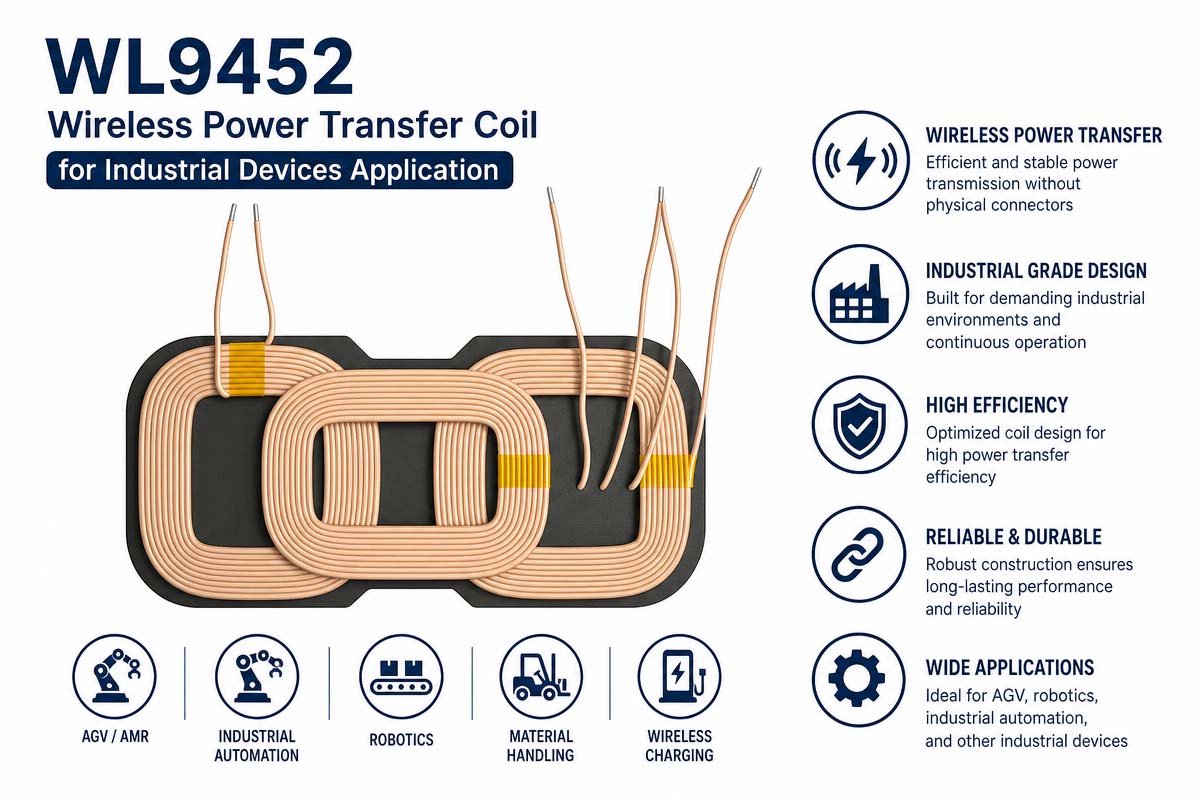
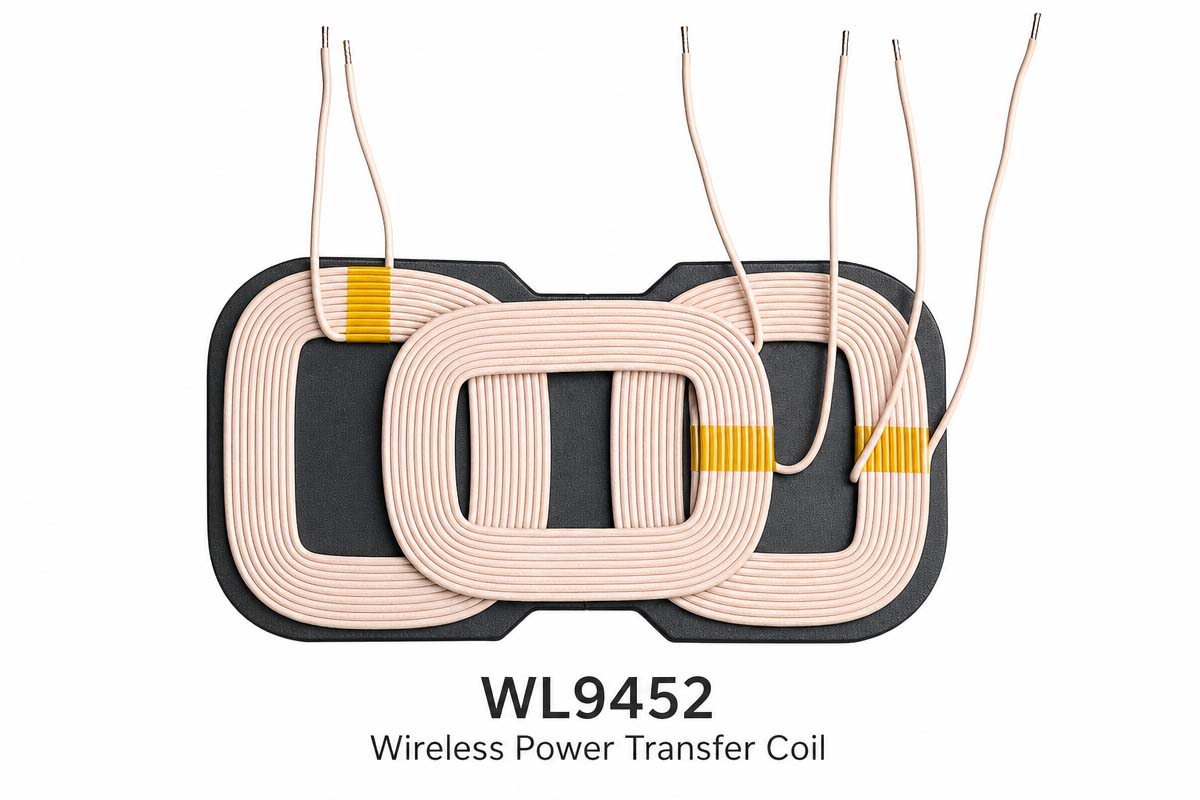
WL9452 Wireless Power Transfer Coil for Industrial Devices Solutions

Wireless Power Transfer Coil—enables contactless transfer of electrical energy between compatible devices. The coil is capable of transferring power through an air gap by electromagnetic coupling without conventional wiring, connectors, or exposed electrical contacts. This makes wireless power transfer highly useful in cases that require sealing, convenient charging, or minimal mechanical connections.

Wireless power transfer coils can be designed for various power levels, frequencies, dimensions, and installation environments. Customized designs can include single coil, multiple coil, and three-coil configurations depending on required transfer distance, alignment tolerance, and system design.

Applications can be industrial equipment, automated equipment, sensors, robotics, battery-operated devices, medical electronics, smart devices, and embedded charging systems. The key parameters for OEM projects are inductance, resistance, Q factor, coil diameter, number of turns in winding, wire specification, operating frequency, air gap, temperature rise, and power transfer efficiency.

Good coil design will provide stable operation, good energy transfer, and reliable performance in the long run.

Wireless Power Transfer Coil Product Overview

Wireless Power Transfer Coil is an important electromagnetic component of contactless power transmission system. It can be designed as transmitter coil, receiver coil, coupling coil or multi coil assembly depending on system requirements. Customization of this product is usually done in terms of coil diameter, thickness, inductance, resistance, number of turns in winding, wire specification, operating frequency and connection method. Magnetic shielding or supporting structures can be integrated into coil as needed. The single coil design is simple in terms of architecture, but the three coil design could provide more design flexibility for specialized power transfer systems. Wireless power transfer coils can be included into industrial equipment, smart devices, automation systems, IoT products and battery charging solutions with customized electrical and mechanical parameters.

Wireless Power Transfer Coil: What It Is and How It Works

A wireless power transfer coil normally operates by electromagnetic induction or resonant magnetic coupling.

Step 1 – Power In

DC power is converted into high-frequency AC power by an electronic driver.

Step 2—Creation of Magnetic Field

The transmitter coil is driven by AC current, thus creating an oscillating magnetic field.

Step 3 – Magnetic Coupling

The magnetic field passes through the air gap and interacts with the receiving coil.

Step 4 — Creation of Electrical Energy

A receiving coil converts the changing magnetic field into AC voltage.

Step 5 — Rectification

Then the rectifier converts the AC energy received into DC power.

Step 6 – Voltage Regulation

Voltage and current supplied to the electronic load or battery are regulated by the control circuit.

Energy flow:

DC input → Driver → Transmitter Coil → Magnetic field → Receiver Coil → Rectifier → DC output → Load

In the case of a three-coil system, an additional coupling/coil can be used between the transmitter and receiver to modify magnetic coupling.

Main Features of Wireless Power Transfer Coil

Main features of wireless power transfer Coils are customized for electrical performance, compact construction, flexible installation, and contactless energy transfer. The key parameters for coils are optimized according to operating frequency, inductance, resistance, Q factor, power requirements, and transfer distance. Coil diameter, thickness, number of turns in winding, and wire specification can be customized for various applications. Magnetic shielding is applied to manage the electromagnetic fields and improve integration with sensitive electronic components. Multi-coil configurations could be used in cases requiring greater alignment tolerance or a special energy transfer path. Consistency of electrical performance, temperature performance, and long-term reliability is guaranteed by high-quality materials and a proper winding process.

Compact Wireless Power Transfer Coil Product Video

Compact Wireless Power Transfer Coil Product Details Display

Compact Wireless Power Transfer Coil Technical Datasheet

Brand Weilong Technology Model Number WL9452
Product Size: 94*52*3.0 * 9 TS * 8.6 UH Rated Power (W) 15 W or 20 W
Wire: 0.08 mm * 9 TS Holding Force (N) Nil
DCR 28.5 UH +/- 10% Reset Time(s) Nil
Service Life Nil Certification CE, RoHS, ISO9001,
Material copper wire Power Contact lead wire
Install Style adhered tape Tolerance of Dimension ± 0.1 MM
Water-proof None Insulation Class F
Hi-Pot Test AC 600V 50/60Hz 2s Non-excitation Holding Force 0
Working Temperature -10°C-100°C Duty Cycle 1-100%
Thread Depth (mm) 0.1 mm Payment Term TT, or LC at Sight
Sample Order Yes. Warranty 1 Year
MOQ 1000 pcs Supply Ability 5000 pcs per week
Delivery Time 30 Days Port of Loading Shenzhen

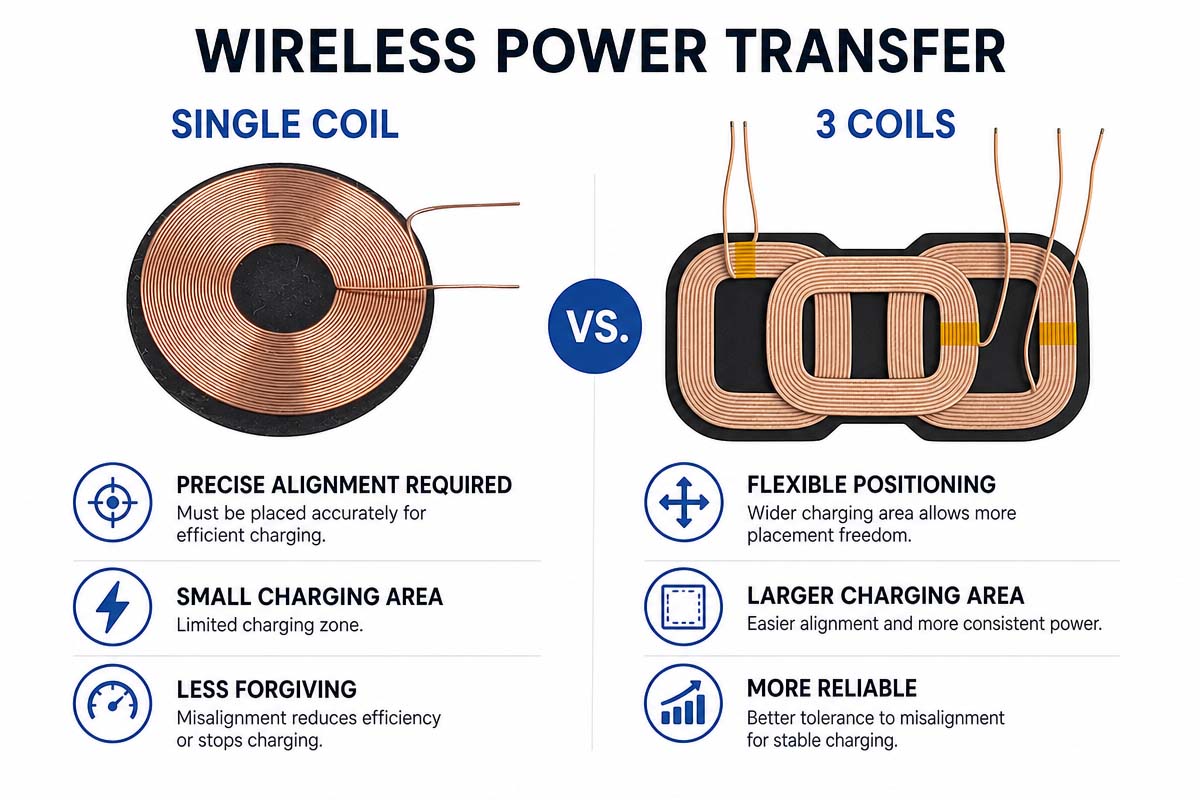
Wireless Power Transfer: Single Coil vs. 3 Coils

Wireless Power Transfer Single Coil vs. 3 Coils

Feature Single-Coil System 3-Coil System
Basic Structure Transmitter + Receiver Transmitter + Coupling + Receiver
Design Complexity Lower Higher
Number of Coils 1 TX + 1 RX 1 TX + 1 Coupling + 1 RX
Circuit Design Relatively simple More complex
Cost Generally lower Generally higher
Space Requirement Lower Higher
Magnetic Coupling Direct coupling Coupling through an additional coil
Alignment Flexibility Application dependent Can offer additional design flexibility
Power Transfer Optimization Relatively straightforward More parameters can be optimized.
Suitable Applications Standard wireless charging Specialized or optimized systems
OEM Customization Moderate High
System Tuning Simpler More involved

Wireless Power Transfer Using Single-Coil

The conventional wireless power transfer scheme includes the transmitter coil and receiver coil. It is appropriate for the applications where the distance is small and the coils’ alignment can be controlled.

The benefits are simpler design with fewer components, lower cost, and easier integration.

Three-Coil Wireless Power Transfer

The three-coil scheme involves the coupling coil, or resonant coil, between the transmitter and receiver. It allows adding one more parameter for optimization of magnetic coupling and behavior of the system.

Benefits are additional design freedom, potentially better coupling characteristics in some cases, and more coil placement options.

Which Scheme Buyers Should Choose?

If the simple design, compactness, and cost are the top priorities, use the single-coil scheme.

Use the 3-coil scheme if you need extra design freedom, specific magnetic coupling, greater separation, or more advanced system optimization.

The power, frequency, distance, alignment, temperature, and installation-space requirements should determine the best choice for the OEM project, not the number of coils.


Compact Wireless Power Transfer Coil Smart Device Application

WL9452 Wireless Power Transfer Coil for industrial Device

Wireless Power Transfer Coils are used in many industrial and electronic applications when contactless energy transmission would be beneficial for product convenience, reliability, or mechanical design.

Smart Appliances

Smartphones, smartwatches, earbuds, portable electronics, and other portable devices have wireless charging coils embedded in them.

Industrial Equipment

Wireless power transfer could provide energy to sensors, monitoring devices, control modules, and equipment in places where conventional connectors are inappropriate.

Robotics & Automation

Wireless charging systems could be used by robots, AGVs, and automated equipment to reduce dependence on exposed charging contacts and to automate energy replenishment.

IoT Gadgets

A wireless power transfer coil could be used to provide energy to low-power IoT sensors and smart devices, especially in cases when it’s hard to replace or connect batteries.

Medical Electronics

Some medical and healthcare electronics could use contactless power transfer in cases when sealed housing and fewer electrical contacts are required.

Battery Charging

Wireless coils could provide power for rechargeable batteries in portable and embedded devices.

Smart Home Devices

Wireless energy transfer could be used for compact integration of smart locks, sensors, control panels, and other connected devices.

Industrial Monitoring

Wireless power systems could provide power to sensors in enclosed equipment, rotating machinery, or hard-to-access places.

OEM manufacturers should consider coil geometry, power requirements, operating frequency, and installation. Is the popularity of wireless power transfer coils for charging smart devices growing?   

Is the popularity of Wireless Power Transfer Coils for charging smart devices growing?

Wireless power transfer coils have gained popularity rapidly because they provide an easy way to add contactless charging to electronic products.

Smartphones, wearables, earbuds, and portable Internet of Things (IoT) products more often require convenient charging without cable connections. A wireless charging coil transfers electrical energy between two compatible devices through electromagnetic coupling.

Moreover, from the product design perspective, wireless charging can eliminate the usage of exposed connectors. It could be especially helpful for the products that require the compact design, better sealing, or multiple charging cycles.

Wireless power transfer can also be interesting for industrial applications. The automatic equipment could recharge the devices without manual connection of the cable. Sensors and IoT products can be supplied without opening the battery compartment.

Also, an important advantage is the customization of the OEM. The wireless power transfer coils could be customized to fit the available product space and not to adapt the product design to the standard coil.

As smart devices become more compact and integrated, manufacturers look for charging components that can optimize the balance between efficiency, size, thermal performance, alignment tolerance, and reliability. It makes the wireless power transfer coil the key component of the next-generation contactless charging solutions.

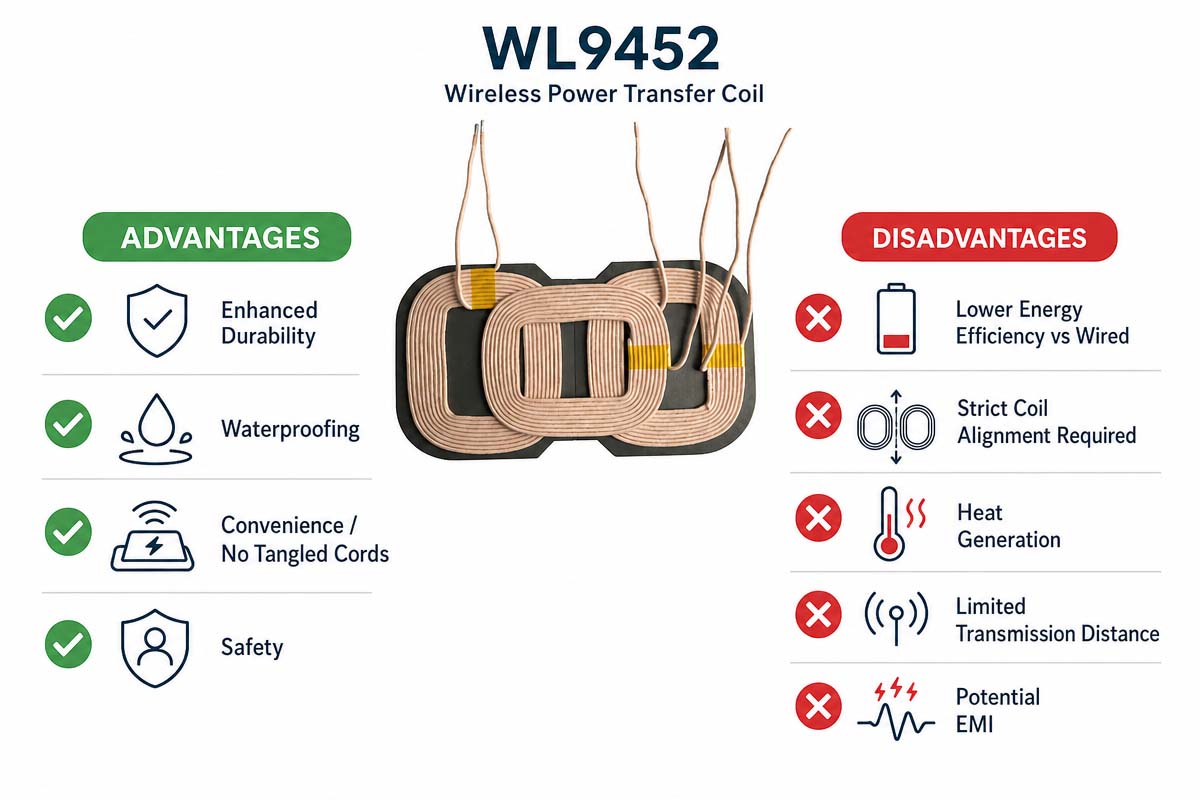
Compact Wireless Power Transfer Coil Advantage and Disadvantage

WL9452 Wireless Power Transfer Coil Advantages and Disadvantages

Wireless Power Transfer (WPT) coils are quite popular in various modern electronic and industrial products. However, the designer should still take some disadvantages into account.

Compact Wireless Power Transfer Coil Pros

Wireless Energy Transfer:

The electrical power can be transferred without any exposed contacts, connectors, or cables.

Better Product Sealing:

Removal of charging contacts can simplify designs of sealed or enclosed products.

Reduced Mechanical Wear:

The number of physical contacts that wear out during repetitive charging decreases.

Easy Charging:

Compatible devices can be charged without manually connecting the cables.

Flexibility of OEM Integration:

Coils can be custom manufactured for different geometries and electrical requirements.

Automation Friendly:

The wireless charging technology can be used in automated machinery, robots, and sensors.

Compact Wireless Power Transfer Coil Pros and Cons

Low Efficiency in Certain Conditions:

The efficiency of energy transfer can decrease depending on the air gap or misalignment.

Thermal Issues:

There could be heat generation due to power losses, especially in high-power applications.

Electromagnetic Interference:

The magnetic field can interfere with electronic or metal parts in close proximity.

Position Dependency:

The poor alignment between transmitter and receiver coils would lead to decreased power transferred.

Additional Electrical Components:

A full WPT system requires a driver, resonant, and rectifier and control circuits.

Wireless power transfer would be more effective in the case of the integration of the coil, electronics, and mechanical structure

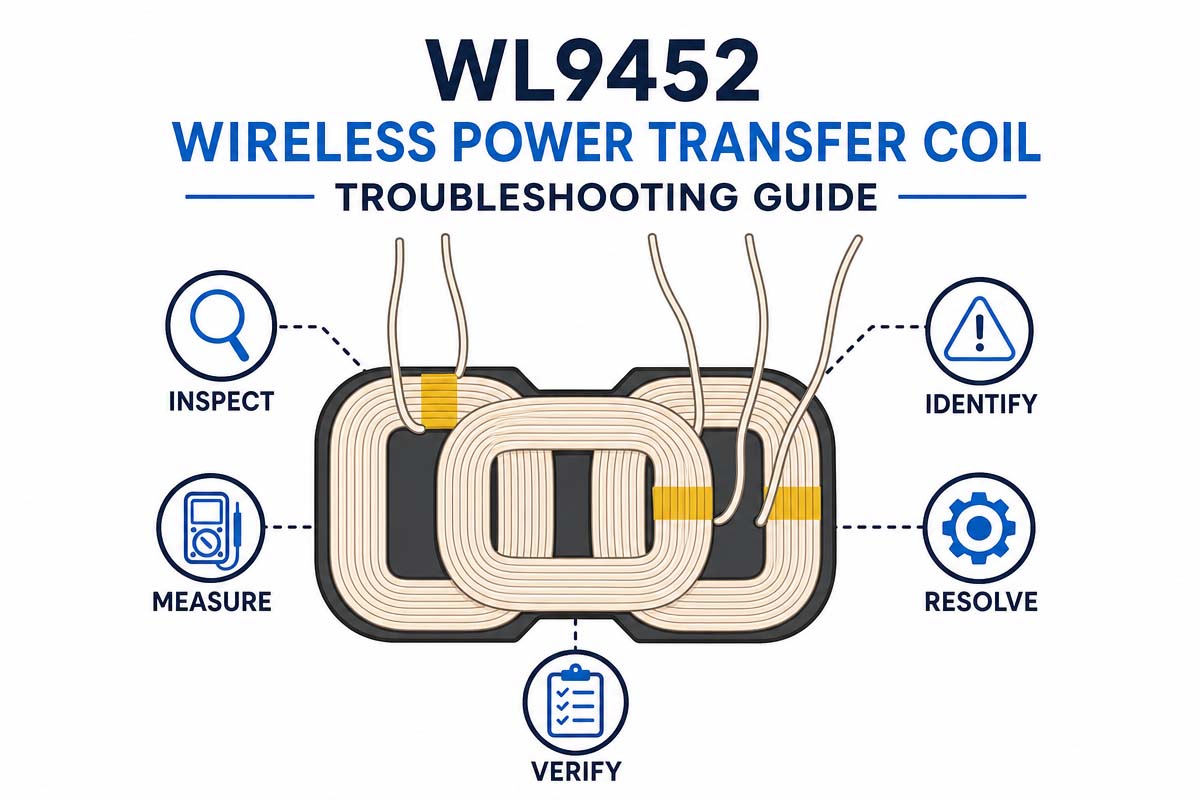
Wireless Power Transfer Coil Troubleshooting Guide

WL9452 Wireless Power Transfer Coil troubleshooting guide

How to Troubleshoot the Entire System Systematically If the Wireless Power Transfer Coil does not work as expected

Problem 1: Low Output Power

Check transmitter/receiver alignment, air gap, coil inductance, operating frequency, and input power. Poor magnetic coupling could be the reason.

Problem 2: Overheating

Check the coil resistance, operating current, frequency, winding quality, and surrounding materials. The presence of metal parts close to the coil could cause additional losses.

Problem 3: Unstable Charging

Check that the resonance circuit and parameters match between the transmitter and receiver. Also, check for movement or misalignment that may cause intermittent coupling.

Problem 4: Lack of power transmission

Check the first coil’s resistance and continuity. Then verify the driver output, coil inductance, and receiver circuit.

Problem 5: Too Low Efficiency

Check the air gap and alignment. Evaluate Q factor, coil geometry, shielding, and operating frequency.

Problem 6: Performance Dependence on Assembly

The product housing could affect the magnetic field. Check coil performance inside and outside the final enclosure.

Troubleshooting Sequence

Input Power → Driver → Transmitter Coil → Magnetic Coupling → Receiver Coil → Rectifier → Load

Each of the stages can be checked individually to identify the possible origin of the issue.

8 common Wireless Power Transfer Coil FAQs

What is a Wireless Power Transfer Coil ?

A wireless power transfer coil is the electromagnetic device for transferring electrical power without physical contact. It works on creating and receiving oscillating magnetic fields. Wireless power transfer coils are widely used in smartphones, smart devices, IoT equipment, industrial sensors, automation systems, battery chargers, and other contactless power applications.

2.How Does Wireless Power Transfer Coil Work?

An alternating magnetic field is generated by a transmitter coil with the help of AC. The energy is captured by the receiver coil, which is located in the magnetic field and is transformed into electrical power. Power received is rectified and regulated to power up the electronic device or to charge the battery.

W

3. What Are the Factors Impacting the Performance of Wireless Power Transfer Coils?

Some of the important factors are coil inductance, operating frequency, Q, coil diameter, winding turns, wire size, air gap, alignment, input power, temperature, and surrounding materials. Metal parts near the coil can affect the magnetic coupling and efficiency.

4,Some of the important factors are coil inductance, operating frequency, Q, coil diameter, winding turns, wire size, air gap, alignment, input power, temperature and surrounding materials. Metal parts near the coil can affect the magnetic coupling and efficiency.

Yes. The coil size and shape, winding, wire specifications, inductance, resistance, terminal configuration, and magnetic shielding are the other aspects where OEM applications could differ. Manufacturers can customize them based on the requirements of the product.

5.What is the Difference Between Single-Coil and 3-Coil Wireless Power Transfer Systems?

A single-coil wireless power transfer system includes the transmitter and receiver coils, which are directly magnetically coupled. The 3-coil system has one more intermediate coupling or resonant coil. The additional coil gives additional design parameters for magnetic coupling, transfer distance, and system optimization.

6.How Can I Make Wireless Power Transfer More Efficient?

It is quite common to optimize alignment, air gap, inductance, operating frequency, resonance, Q factor, and coil geometry to increase efficiency. Another way is to minimize resistance and properly deal with the metal components.

7. Are There Any Industrial Applications for Wireless Power Transfer coils?

Yes. They can be incorporated into industrial sensors, robotics, AGVs, automation equipment, IoT equipment, battery-powered equipment, monitoring systems, and sealed electronic products. Wireless power transfer eliminates the need for exposed connectors and makes the automatic charging easier.

8.What Information I Need to Provide for Order of Custom Wireless Power Transfer Coil?

In order to obtain an OEM quote and evaluation, please specify input/output power, operating frequency, required inductance, coil dimensions, available installation space, air gap, alignment tolerance, operating temperature, wire requirements, and application description. A 2D drawing or 3D model could be useful for mechanical integration.

How to Select a Wireless Power Transfer Coil
How to Select a Wireless Power Transfer Coil

Selecting the right wireless power transfer coil is not just choosing coil diameter. The electrical, mechanical, thermal, and application requirements should be considered jointly.

1. Determine required power

At first determine the required power output. Low-power IoT sensors and high-power industrial devices will require totally different coil designs.

2. Specify operating frequency

Operating frequency affects impedance, losses, resonance, and performance of the system. The coil should be designed for the selected driver and receiver circuits.

3. Choose proper inductance

One of the most important parameters is inductance. Required inductance depends on circuit design, operating frequency, and resonant capacitor.

4. Evaluate coil size

Determine the installation space of the coil, such as diameter, thickness, and height. A coil that performs well electrically might not fit into the final product.

5. Evaluate transfer distance

Calculate the required air gap between transmitter and receiver coils. Normally, the larger is the distance, the less efficient is the energy transfer.

6. Evaluate alignment tolerance

If you can’t guarantee precise alignment between transmitter and receiver, then consider the design with greater tolerance to lateral or angular misalignment.

7. Temperature Evaluation

Determine operating temperature and temperature rise at max load. Overheating reduces the efficiency and lifetime of the components.

8. Evaluate surrounding materials

Nearby conductive materials, including metal parts, batteries, and PCBs, could affect the magnetic coupling and performance of the system.

9. Shielding Evaluation

Magnetic shielding might be needed for management of magnetic field distribution and protection of nearby electronic components.

10. Validate the whole system

Finally, validate the coil together with the transmitter, receiver, driver, rectifier, and final product housing. Coil performance can not always be evaluated separately from the whole wireless power system.

It is the best practice to provide the manufacturer with your power, frequency, dimensions, air gap, operating temperature, and application data before requesting a custom design.

Design Mistakes to Avoid for Wireless Power Transfer Coils

Low efficiency, overheating, or unstable wireless power transfer might happen because of some common design mistakes.

Don’t Select the Coil by Its Size

Even though the size of the coil can be correct, inductance, resistance, or Q factor could be wrong.

Don’t Forget About Operating Frequency

The driver and the coil should be tuned to a proper operation frequency.

Consider the Total Magnetic Environment.

The magnetic coupling could be impacted by the metal housing, batteries, PCB tracks, etc.

Don’t Test Only in Ideal Conditions

The actual product could shift or get misaligned. Therefore, testing the coil in practical mounting conditions is crucial.

Early Thermal Considerations

The coil might demonstrate good power transfer but excessive heating during operation.

Do not change coil characteristics without validation. Changing the diameter, turns, or geometry of the coil could significantly change its electrical properties.

Validate the Final Product

Testing of the wireless power system has to be performed within the actual housing, not only during laboratory measurement of the coil. _____________________________

Get A Free Quote Now

Contact Form

Related Products

Related News

Scroll to Top

Get A Free Quote Now !

Contact Form
If you have any questions, please do not hesitate to contact us.
Weilong Solenoid Company Culture
