Flat Copper Coil for High Efficiency Power Systems
Flat Copper Coil Solutions for Modern Electronics
Flat Copper Coil Design for Compact Applications
Flat Copper Coil Technology for Industrial Use
Flat Copper Coil Benefits in Power Electronics
Flat Copper Coil Applications in Smart Devices
Flat Copper Coil Advantages in Compact Equipment
Flat Copper Coil for Energy Efficient Systems
Flat Copper Coil for High Frequency Applications
Flat Copper Coil Manufacturing and Design Guide
Flat Copper Coil Solutions for Automotive Industry
Flat Copper Coil Technology for Advanced Devices
Flat Copper Coil for High Efficiency Power Systems
Flat Copper Coil Solutions for Modern Electronics
Flat Copper Coil Design for Compact Applications
Flat Copper Coil Technology for Industrial Use
Flat Copper Coil Benefits in Power Electronics
Flat Copper Coil Applications in Smart Devices
Flat Copper Coil Advantages in Compact Equipment
Flat Copper Coil for Energy Efficient Systems
Flat Copper Coil for High Frequency Applications
Flat Copper Coil Manufacturing and Design Guide
Flat Copper Coil Solutions for Automotive Industry
Flat Copper Coil Technology for Advanced Devices

WL3049 Flat Copper Coil for Industrial Using Guide

A flat copper coil is a type of electrical component made by winding the flat copper conductors in a coil form, spiral pattern, or multiple layers. Flat copper coils are constructed using rectangular-shaped or ribbon-like copper conductors. Such coils have a bigger surface area and lower resistance compared to conventional round wire coils. It helps to significantly increase the efficiency, heat dissipation, and electrical capacity.

Flat copper coils find various applications in wireless charging systems, power electronics, sensors, medical electronics, automotive systems, and industrial automation. Due to a smaller profile, these components allow creating more compact solutions without sacrificing high performance. Flat copper coils are used for applications where space efficiency and performance matter because of superior electromagnetic properties and energy transfer capabilities.

Compact Flat Copper Coil Poduct Overview

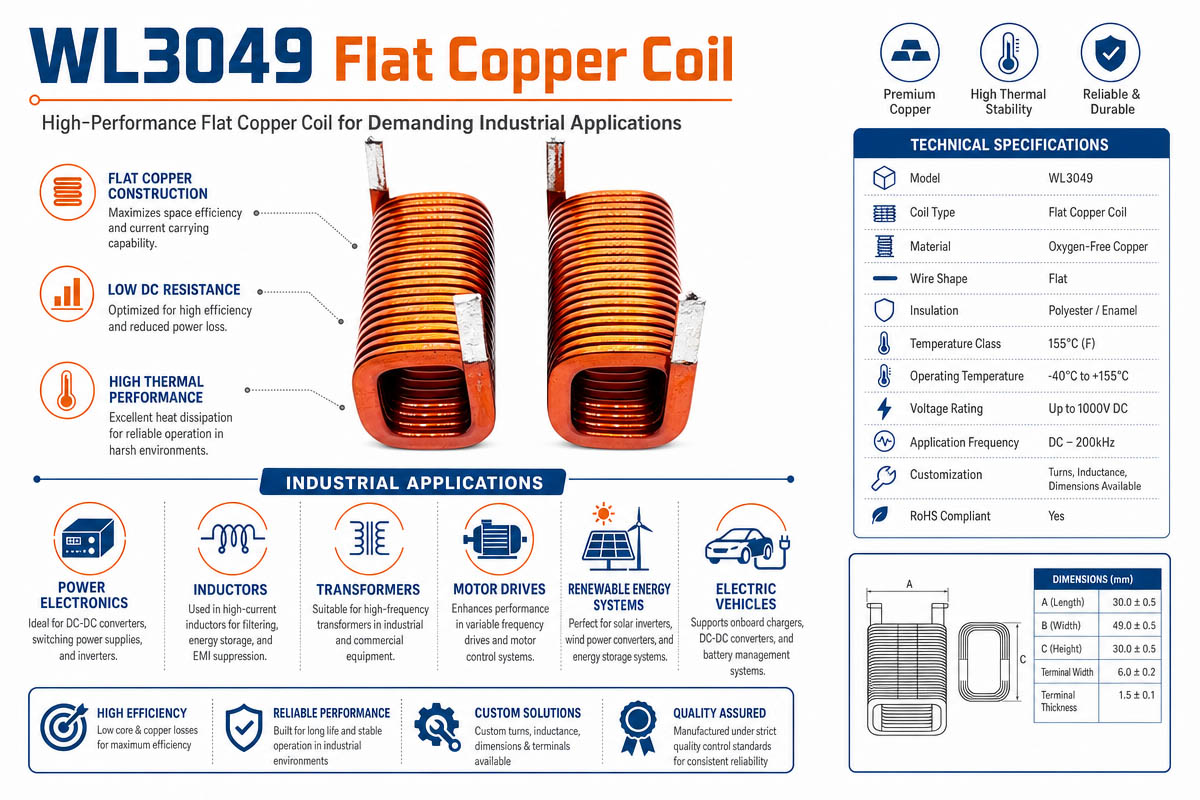
Flat copper coils are innovative electromechanical components intended for efficient power transfers, signal processing, and energy storage. They include flat copper conductors that have a lower resistance and heat dissipation capacity compared to traditional coils made of round wires.

Such coils find wide application in wireless charging systems, power converters, automotive electronics, industrial automation, and medical devices. Small profiles and compact designs allow incorporating flat copper coils in limited spaces and maintaining excellent performance. Flat copper coils come in customized sizes, shapes, and inductance values.

Flat Copper Coil Product Video Presenation

High Performance Flat Copper Coil Detailed Display

Compact Flat Copper Coil Data Sheet

team Description
Compact Flat Copper Coil Enameled copper wire
Wire Diameter 0.20 (AWG options available)
Winding Type Single-layer round or sectional  winding
Core Material Air (non-magnetic) Copper wire
Footprint length 15 mm
Encapsulation Optional varnish, epoxy, or coating
Mounting Through-hole / Custom

Electrical Specifications (Typical)

Parameter Description
Inductance Range 0.1 µH – 100 µH (customizable)
Inductance Tolerance ±2%, ±5%, ±10%
DC Resistance (DCR) 14 Ohm with 5.5 turns
Q Factor High Q, optimized for frequency range
Self-Resonant Frequency High, application-dependent
Operating Frequency kHz to MHz range
Rated Current Custom per design
Insulation Resistance ≥100 MΩ

How Does a Flat Copper Coil Work?

The operation of a flat copper coil is based on the laws of electromagnetism and electromagnetic induction. An electric current passed through the coil generates a magnetic field around it. A magnetic field allows for storing energy, transferring energy, and creating current in adjacent conductors.

The flat copper conductor design provides higher efficiency due to a larger surface area. A flat conductor reduces AC resistance caused by skin effect losses. Therefore, flat copper coils are suitable for high-frequency applications, such as inductors, transformers, and inductive power transfer components.

Characteristics of Flat Copper Coil

There are numerous distinctive features that characterize flat copper coils. The flat conductor construction makes such components more efficient compared to the conventional round-wire coils. The increased surface area reduces resistance and helps to dissipate heat. As a result, the heat rise during operation becomes lower.

Such coils are characterized by compact design, excellent electromagnetic and efficiency characteristics, and stable inductance values. Besides, these coils have a small profile and low heat dissipation. Flat copper conductors can be custom designed in various sizes, inductance values, and geometries. They provide outstanding durability and reliability.

What makes flat copper coils so popular?

Flat copper coils are becoming increasingly popular because of higher efficiency, compactness, better thermal behavior, and higher power density of modern electronic and industrial products. Flat copper coils have several important technical advantages compared to traditional round wire coils. These advantages align perfectly with modern tendencies in technology.

1. Increased Electrical Efficiency

Flat copper wire conductors have a larger cross section and lower DC resistance compared to traditional round wires. It means that these coils will have higher efficiency.

Even minor improvements in efficiency could result in substantial savings of energy in areas like power electronics, EV chargers, and switching power supplies.

2. Improved heat dissipation

Flat copper coils possess an increased surface area.

Benefits of increased surface area include:

  • Enhanced heat transfer
  • Lower operating temperature
  • Longer component life
  • Capacity to operate at higher current loads

Thermal management becomes an increasingly important aspect with the increasing power and compactness of electronic devices.

3. Suitable for High Frequencies

Modern electronics often operate with a high switching frequency.

Cut-down flat copper conductors:

  • Losses due to skin effect
  • Losses from proximity
  • AC resistance

It makes flat copper coils perfect choices for the following:

  • Wireless charging systems
  • Transformers with high frequencies
  • Wireless charging
  • RF hardware
  • DCDC converters


4. Compact & Space-Efficient Design

Modern devices are becoming more and more compact but still need to perform many different tasks.

Benefits of flat copper coils:

  • Fit in thinner devices
  • Decrease overall product size
  • Increase power density
  • Make packaging more flexible

Especially needed in smartphones, tablets, wearables, medical devices, and automotive electronics.

5. Expansion of Wireless Charging

The rapid growth of wireless charging resulted in increased demand for flat copper coils.

Uses of flat copper coils include:

  • Smartphone wireless chargers
  • Electric toothbrushes
  • Smart watches
  • Medical devices
  • Electric vehicle wireless charging systems

Flat geometry makes efficient magnetic coupling possible in such components.

6. Rapid Development of Electric Vehicles (EV)

One of the most significant drivers of flat copper coil expansion is the rapidly growing electric vehicle industry.

Examples of flat copper coil use in EVs include:

  • On-board chargers
  • DC-DC converters
  • Battery management systems
  • Wireless charging systems
  • Power inverters

Electric vehicle producers need high-efficiency and compact components—both characteristics are present in flat copper coils.

7. Higher Power Density

The goal of engineers is always to deliver as much power as possible from ever more compact devices.

Flat copper coils can help to

  • Increase current carrying capacity
  • Cut power losses
  • Reduce the size of magnetic components
  • Use space more effectively

It results in higher power density.

8. Manufactured Using Automated Processes

Modern flat copper coils can be produced by:

  • Precision winding
  • CNC forming
  • Automated assembly

It positively affects the following:

  • Consistency of the products
  • Manufacturing efficiency
  • Quality control
  • Scalability

With increasing production volumes, the price per unit continues to drop.

9. Growing Renewable Energy Systems Market

Renewable energy systems depend greatly on power conversion equipment.

Examples of flat copper coils’ use in renewable energy systems:

  • Solar inverters
  • Energy storage systems
  • Wind power converters
  • Smart grid equipment

Thanks to higher efficiency, these components help to maximize energy conversion.

10. Support of Industry 4.0 and Smart Devices

Industry 4.0 technologies need compact and efficient electromagnetic components.

Examples of uses of flat copper coils in Industry 4.0 devices:

  • Sensors
  • Robotics
  • Industrial automation
  • IoT devices
  • Smart appliances

Their excellent characteristics make them perfect for next-generation devices.

Conclusion

Several global tendencies cause the popularization of flat copper coils:

  • Need for higher energy efficiency
  • Better thermal management
  • Growth of wireless charging
  • EV expansion
  • Electronics miniaturization
  • Requirement for higher power density
  • Development of renewable energy systems
  • Expansion of Industry 4.0

With time, we expect these technologies to make flat copper coils even more widespread across various fields.

Compact Flat Copper Coil Product Application

Flat Copper Coil Industrial Application

Flat copper coils are extensively used in modern electronics because of unique advantages, including compact designs, energy efficiency, and outstanding electromagnetic properties.

The key component responsible for efficient power transmission in wireless charging systems, flat copper coils are widely used in smart phones, wearables, and electric vehicle charging stations.

In power electronics, flat copper coils are used as inductors and transformer windings in DC-DC converters, inverters, and switching power supplies. The low resistance of such conductors significantly enhances the energy efficiency.

In automotive industry, flat copper coils are utilized in electric cars, battery management systems, on-board chargers, and advanced driving assistance systems. Compact design allows easily mounting components in small spaces.

The medical industry uses flat copper coils in imaging systems, monitoring devices, and surgical tools. Precise electromagnetic properties allow performing efficient operations and transmitting signals.

Flat copper coils find applications in various sensors and control equipment used in industrial automation systems. Their reliability and durability are crucial in this case.

In addition, flat copper coils are commonly used in RFID systems, wireless communication devices, inductive heating equipment, renewable energy systems, aerospace electronics, and consumer electronics. Excellent high-frequency operation allows improving the performance of future technologies.

Flat Copper Coil Advantage and Disadvantage

Flat Copper Coil Advantage and Disadvantage

Flat Copper Coil  Advantages

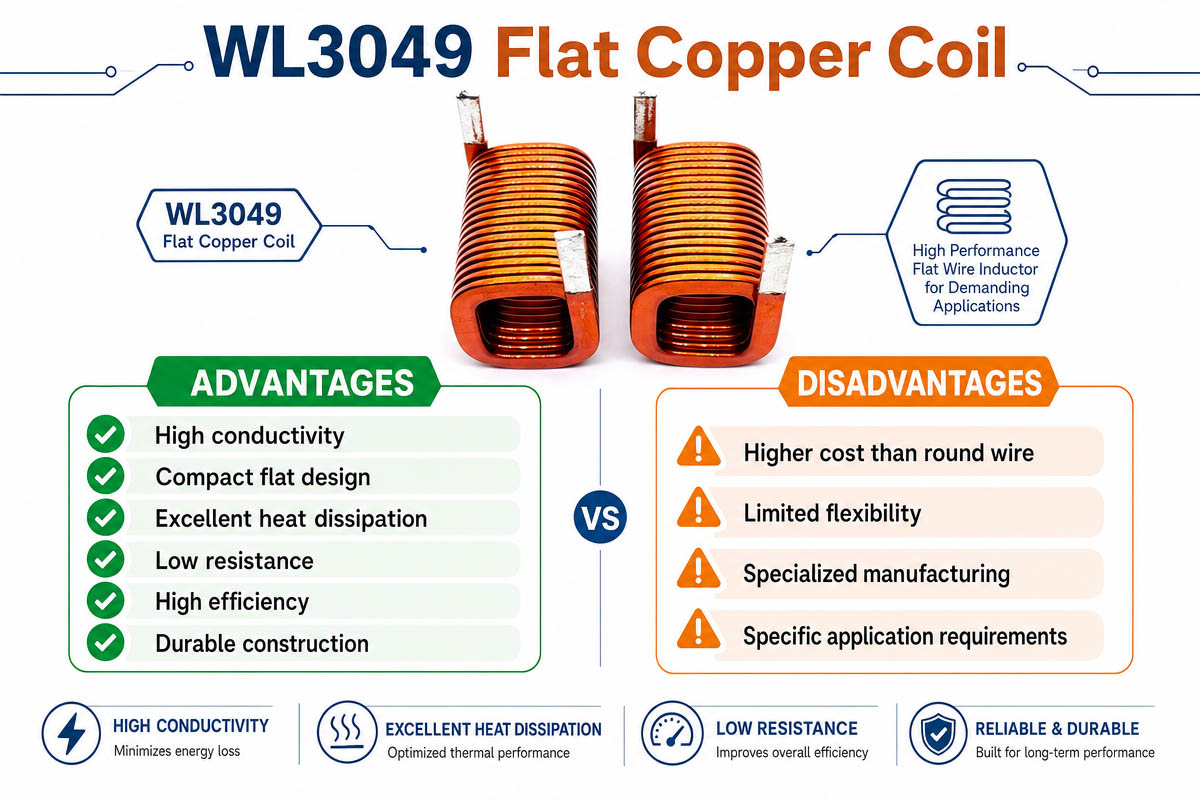
There are many pros of flat copper coils. The flat conductor construction reduces electrical resistance and increases current-carrying capacity. The increased surface area of flat conductors helps to enhance heat dissipation and improve thermal performance. As a result, the life of the device becomes longer.

These coils are extremely efficient at high frequencies. Reduced losses caused by the skin effect make them perfect for high-speed applications. The small profile makes it possible to create more compact solutions. Besides, flat copper coils have good electromagnetic properties, energy transfer, and flexible geometries. Mechanical stability and longevity contribute to the industrial use of such coils.

Flat Copper Coil: Advantages and Disadvantages

Despite the mentioned pros, flat copper coils have certain limitations. Manufacturing processes for such components are rather complex and costly compared to conventional round-wire coils. Flat copper coils usually require a specially designed winding machine. Design optimization and customization may be problematic, especially at high frequencies. Moreover, improper electromagnetic parameters may affect the performance.

Flat copper conductors are not as flexible as round ones, making winding difficult and limiting winding possibilities. Custom-designed products require additional manufacturing time. The poor design may cause unevenly distributed magnetic fields and parasitic effects in the circuit.

Troubleshooting Flat Copper Coil

Flat Copper Coil Troubleshooting guide

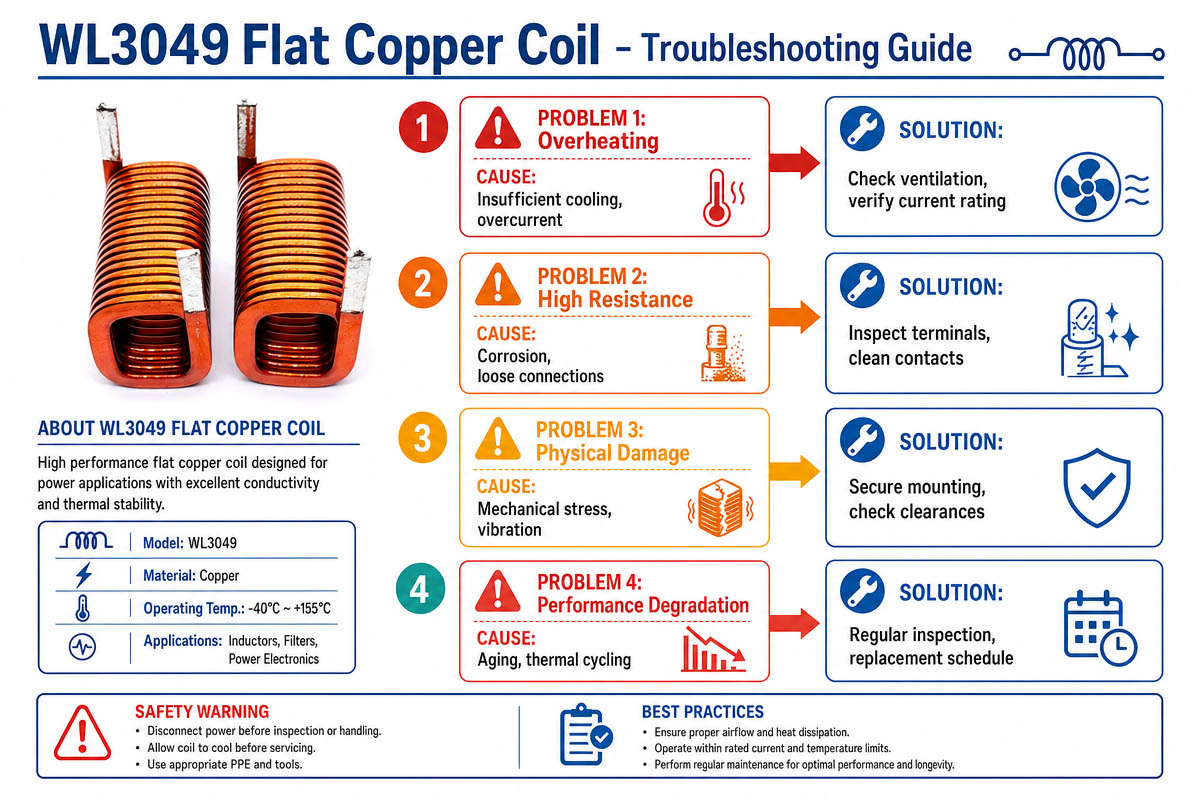
Various problems may affect the performance of a flat copper coil.

Minimal Inductance

Possible causes are the damaged coil, incorrect design, and electromagnetic interference. Verify the coil parameters. Look for damages to the physical part of the coil.

Overheating

This issue can appear due to excessive current or poor thermal design. Confirm operating current and cooling conditions. Verify mounting of the component.

Lower efficiency

Poor connection, oxidized conductors, and high-frequency losses are the reasons for lower efficiency. Make sure that all connections are tight.

Open circuit

Broken conductors and damaged solder joints prevent current flow. Use a multimeter to measure resistance.

Shortcircuit

It indicates that insulation is broken between the windings and creates internal shorts. Replace the insulation material and, if necessary, install a new coil.

Electromagnetic compatibility

Interference from other electronic devices can affect coil performance. Install a shield and increase the distance between components.

Proper installation and compliance with the operating conditions greatly increase the operational life of flat copper coils.


Frequently Asked Questions about Flat Coils

Q1: What is a flar coil?

A flat coil is an electromagnetic component made from copper wire of rectangular or square cross section (flat wire) rather than a traditional round wire. The only essential difference is the shape of the wire. This fundamental difference results in several performance benefits. In particular, flat coils perform better in high-power applications.

Q2: What advantages do flat coils possess?

Flat coils have many advantages, which mostly come from the unique geometry of the wire:

Superior Heat Dissipation: A large surface area of flat wire allows better heat conduction away from the component, reducing operational temperature.

Increased Space Efficiency: The ability of flat wires to pack better than round wires results in a higher “slot fill rate.” The latter can reach 20% more than that of round wire. This means that a higher number of flat wires can be placed into the same place, providing more copper and a stronger magnetic field.

Lower DC Resistance (DCR): Due to increased cross-sectional area, flat coils have lower DCR and, thus, power losses.

Improved Mechanical Stability: A flat wire won’t be able to slip from another turn, making the coil more mechanically stable.


Q3: What applications can use flat copper coils?

Due to better thermal management and high power density, flat copper coils can be used in the following:

  • High-current inductors and transformers.
  • EV motors (usually hairpin windings).
  • Solar inverters and electric vehicle charging systems.
  • High-end audio subwoofers for power handling.
Q4: What are the downsides of flat coils?

Even though the performance of these components is superb, they are more complicated and expensive to produce. The first problem is that flat wire is less flexible and difficult to bend compared to traditional round wire. Thus, producing flat coils (particularly for electric vehicle motors) becomes a complex task. Moreover, due to their rectangular shape, the insulation may be applied unevenly. Sharp edges (R角) of the wire can cause problems.

Q5: How does flat wire help dissipate heat?

There are two reasons why flat wire dissipates heat better:

  • First, due to its geometry, flat wire has a bigger surface area, allowing faster conduction of the heat away from the conductor.
  • Second, when it comes to coils, the flat sides of adjacent turns create better contact compared to the points of contact of round wires. This way, the heat can be conducted better from the inside layers of the coil to the outer parts or even directly to a heatsink.
Q6: What sizes of flat coils are available?

Dimensions of flat wire can vary greatly depending on application. One producer notes that the width of flat copper wire can range from 5 mm to 200 mm, and thickness can vary from 0.1 mm to 5 mm. The exact dimension depends on the application and is carefully selected during design.


Q7: What failures can happen to flat copper coils and how to avoid them?

Failure modes of flat copper coils include:

  • Insulation breakdown
  • Open circuit (broken wires)
  • Overheating
  • Corrosion
  • Preventing methods include proper design (i.e., avoiding excessive temperature, etc.) and regular maintenance (visual inspection, electrical tests, and cleaning). Failure mitigation requires repairing the insulation, soldering of the connections, or even rewinding the coil.
Q8: What certification should flat coils have?

When selecting such components for industrial applications, it’s recommended to look for products that conform to major international standards in order to assure the safety and high quality of the component:

  • ISO 9001
  • UL
  • RoHS
  • CE

How to Avoid Typical Mistakes When Choosing a Flat Copper Coil

An improper choice of flat copper coil leads to low efficiency, overheating, or even system failure. One of the typical mistakes associated with flat copper coils is ignoring electrical and current capacity requirements and focusing only on inductance.

The next mistake is ignoring frequency parameters. The flat conductor design provides good frequency response and reduced skin effect losses. Otherwise, the selection of the flat copper coil at low frequencies significantly affects the performance.

Sometimes, users tend to ignore the installation area and mounting options. Make sure that selected flat copper coils are compatible with the available space.

Another typical mistake is overlooking environmental conditions. Harsh environmental conditions require protective coatings to prevent corrosion and other defects.

Some engineers forget about the thermal management and resistance. Too much resistance makes flat copper coils inefficient because of heat loss and performance degradation.

Moreover, choosing the cheapest available coil does not necessarily mean selecting an optimal solution. Work with experienced manufacturers and clearly define all the requirements to achieve the desired result.

How to Pick a Flat Copper Coil

The selection of flat copper coils should be preceded by careful analysis of all requirements.

Electrical Requirement Analysis

First of all, determine the inductance, resistance, maximum current, voltage, and operating frequency. They influence coil design and performance.

Check Frequency Range

It is important to identify the range of frequencies. Special flat copper coils are developed for high-frequency operation. Knowledge of operating frequency helps to calculate the cross-section of conductors.

Review Current Capacity

Determine the current capacity that should be carried by conductors and select a suitable size.

Think About Thermal Performance

It is crucial to analyze heat generation and thermal management. Continuous operation requires a good thermal management and conductor cross-sections.

Review Physical Size

Identify the available installation space. Flat copper coils are characterized by compact size and good compatibility.

Assess Environment Requirements

Determine temperature, humidity, vibrations, and other environmental conditions. Flat copper coils that will operate under extreme conditions should feature protective coatings.

Magnetic Performance Test

Analyze magnetic field requirements and evaluate electromagnetic compatibility. Correctly designed coils will provide the highest energy efficiency and the lowest interference.

Check Manufacturing Quality

It is important to choose a manufacturer that provides quality materials and precision winding and conducts strict quality control tests.

Look for Customization

Many applications require customized coils with specified sizes, inductance, and shapes. Work with suppliers and optimize the design of the component.

Cost-Performance Balance

It is essential to find an optimal balance between price and performance. While selecting the cheapest product, consider all efficiency requirements and lifetime.

Get A Free Quote Now

Contact Form

Related Products

Related News

Scroll to Top

Get A Free Quote Now !

Contact Form
If you have any questions, please do not hesitate to contact us.
Weilong Solenoid Company Culture