SMD Air Inductor Coil-Features and Applications
Custom SMD Air Inductor Coil Manufacturer
High-Q SMD Air Inductor Coil for RF Circuits
SMD Air Core Inductor for High Frequency Use
SMD Air Inductor Coil Technology Explained
SMD Air Inductor Coil vs Ferrite Inductors
SMD Air Inductor Coil-Features and Applications
Custom SMD Air Inductor Coil Manufacturer
High-Q SMD Air Inductor Coil for RF Circuits
SMD Air Core Inductor for High Frequency Use
SMD Air Inductor Coil Technology Explained
SMD Air Inductor Coil vs Ferrite Inductors

Complete Guide to WL610 SMD Air Inductor Coil

An SMD Air Inductor Coil is a surface-mount wire-wound inductor with an air magnetic medium used as a substitute to the traditional ferrite or iron core. Due to the absence of a magnetic core in the inductor, it doesn’t experience magnetic saturation and core losses. Therefore, SMD Air Inductor Coils are considered highly suitable for RF circuit design, wireless communication, antenna matching and signal filtering purposes, providing the best high-frequency performance and highest Q-factor. These inductors are relatively small in size and have SMT packaging making them easily adaptable for consumer electronics, automotive, industrial applications and medical devices requiring highly reliable and stable inductance values.

Compact SMD Air Inductor Coil Product Overview

SMD Air Inductor Coils are RF applications with low losses. Their air-core design provides high self-resonance frequency, absence of saturation and core losses and improved linearity. These inductors are available in many inductance values and package sizes. They can be easily integrated into automation process using SMT technology and OEM customized design. Typical applications include antenna matching, wireless communication, RF amplifiers, oscillators and filters. SMD Air Inductor Coils are preferred in modern electronic designs due to their compactness, low DC resistance and stable performance under changing operating conditions.

Compact SMD Air Inductor Coil Video

Compact SMD Air Inductor Coil Detailed Display

Compact SMD Air Inductor Coil Datasheet

tem Description
SMD Air Inductor Coil Enameled copper wire
Wire Diameter 0.1 (AWG options available)
Winding Type Single-layer round or sectional  winding
Core Material Air (non-magnetic) Copper wire
Footprint length 10-15 mm
Encapsulation Optional varnish, epoxy, or coating
Mounting Through-hole / Custom

Electrical Specifications (Typical)

Parameter Description
Inductance Range 0.1 µH – 100 µH (customizable)
Inductance Tolerance ±2%, ±5%, ±10%
DC Resistance (DCR) Custom
Q Factor High Q, optimized for frequency range
Self-Resonant Frequency High, application-dependent
Operating Frequency kHz to MHz range
Rated Current Custom per design
Insulation Resistance ≥100 MΩ

How Does an SMD Air Inductor Coil Work?

When electric current passes through copper wires, a magnetic field is formed in the coil. Thanks to electromagnetic induction, a changing magnetic field will store energy and oppose change in electric current. The magnetic path is made of air instead of a core. There are neither hysteresis losses nor magnetic saturation.

When the frequency increases, inductive reactance is increased. This ability of SMD Air Inductor Coils allows them to be used as filters, noise eliminators and impedance matchers. SMD Air Inductor Coils are highly suitable for usage in high-frequency RF circuits and wireless communication systems.

Why is the SMD Air Inductor Coil so much popular?

Rapidly growing popularity of SMD Air Inductor Coils is driven by the rapid development of 5G communications, Wi-Fi 6, Bluetooth devices, IoT products, automotive electronics and medical devices. These modern electronics require high-Q, low-loss, linear and high frequency inductors.

SMD air core inductors have no magnetic saturation and core losses like the ones typical for ferrite-core inductors making them suitable for RF circuits and precision circuits. Their small SMT package is optimal for automated manufacturing of miniaturized electronic devices.

Everyone knows that the RF technology is constantly developing towards high frequencies and fast signal transmission. Consequently, SMD Air Inductor Coils become essential components of the modern electronic systems.


Compact SMD Air Inductor Coil Inductrial Application

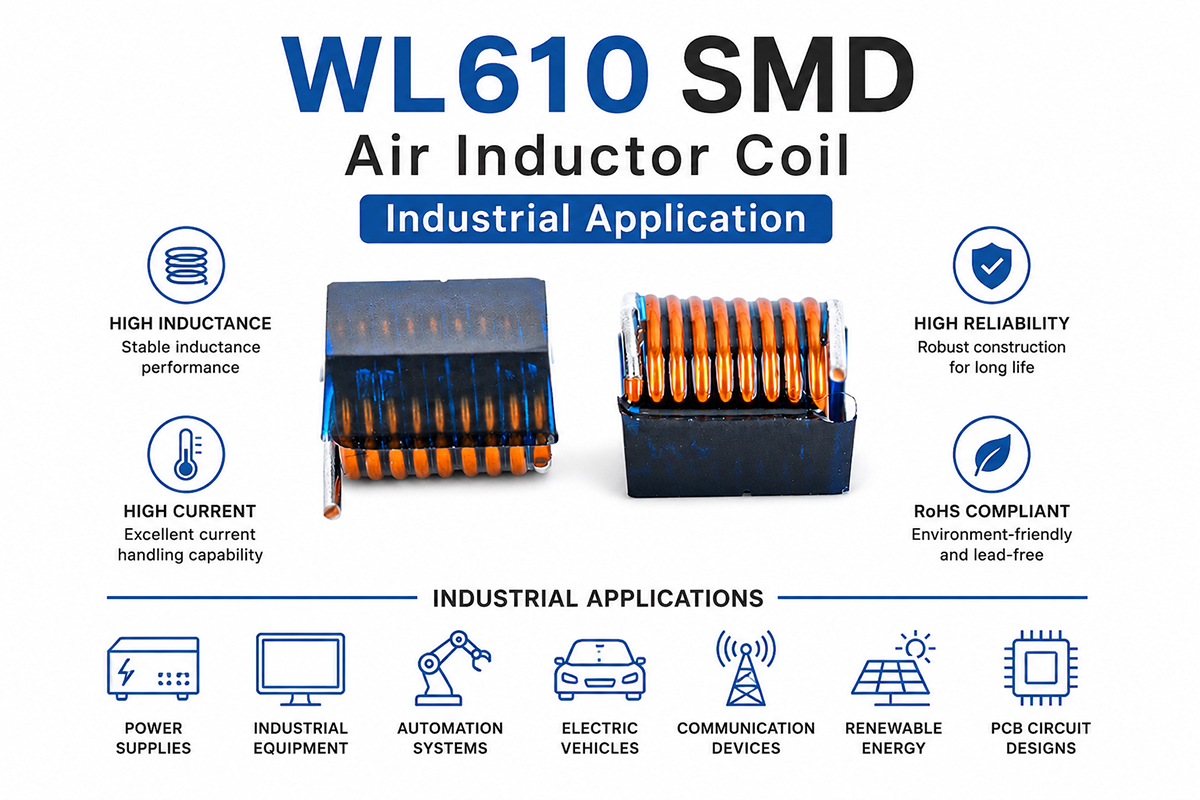
WL610 SMDS Air Inductor Coil Industrial Application

Due to excellent RF performance and high reliability, these inductors find wide application in RF electronics systems such as Bluetooth modules, Wi-Fi routers, GPS, RF transceivers, antenna matching networks and signal filters in wireless communication devices. Due to stable inductance and low signal distortion, they can be successfully used in medical electronics.

SMD Air Inductor Coils are widely implemented in automotive electronics in telematics systems and navigation units. High self-resonance frequencies are required in industrial control systems, measuring instruments and test equipment.

Air-coil inductors can be applied in consumer electronics devices including mobile devices, portable devices and IoT products due to compact surface mounting and high signal quality.

All these features allow SMD Air Inductor Coils to be highly demanded in electronic systems.


Advantages and Disadvantages of Compact Air Inductor Coil

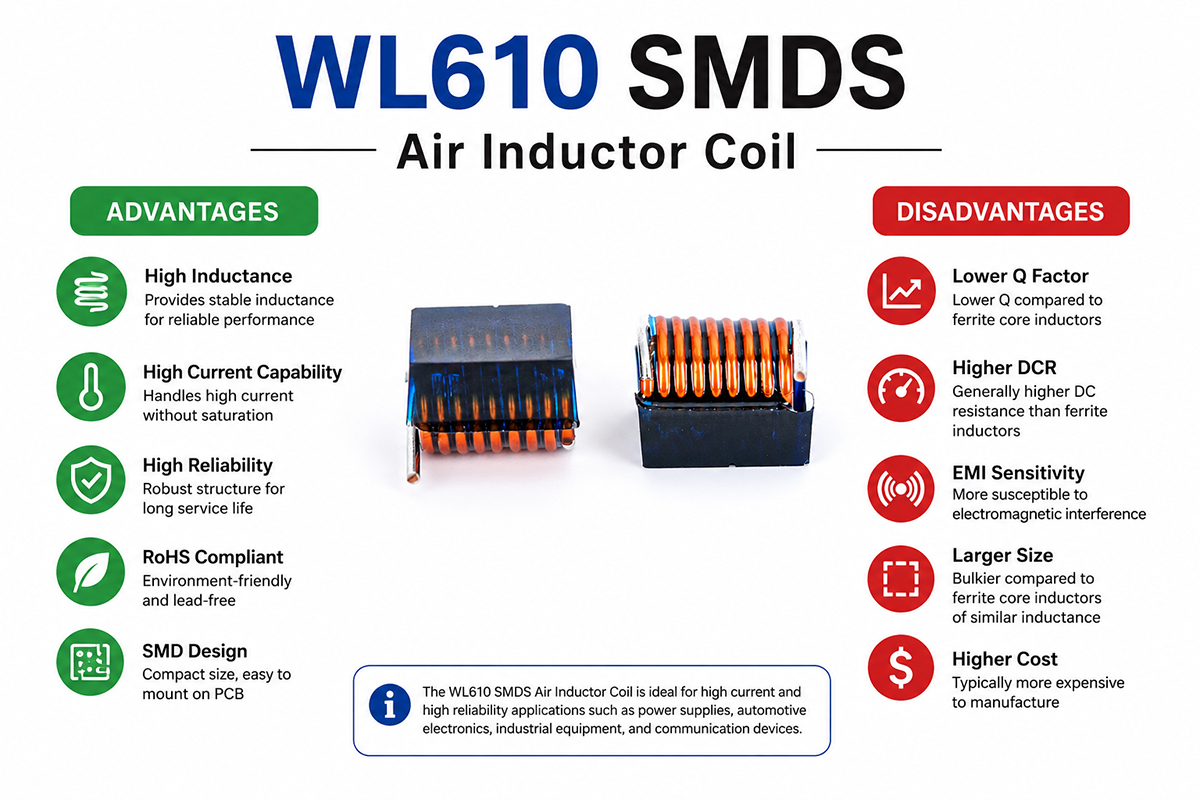
WL610 SMDS Air Inductor Coil Advantage and Disadvantage

Compact Air Inductor Coil Advantages

Absence of magnetic saturation.

Absence of core-losses

High Q-factor.

High frequency performance.

Linearity improvement.

High self-resonant frequency.

Low signal distortion.

Surface Mounting.

Good temperature stability.

Suitability for RF and wireless applications.

Compact Air Inductor Coil Advantages Disadvantages

Lower inductance values compared with ferrite-core inductors.

Large sizes for equal inductance.

Low energy storage capability.

Susceptible to external EMI.

Expensive in precision applications

Poor applicability for high-energy storage circuits.

SMD air inductors are highly preferred in RF circuits and RF systems due to their high quality, performance and reliability despite mentioned disadvantages.

How To Troubleshoot Your SMD Air Inductor Coil

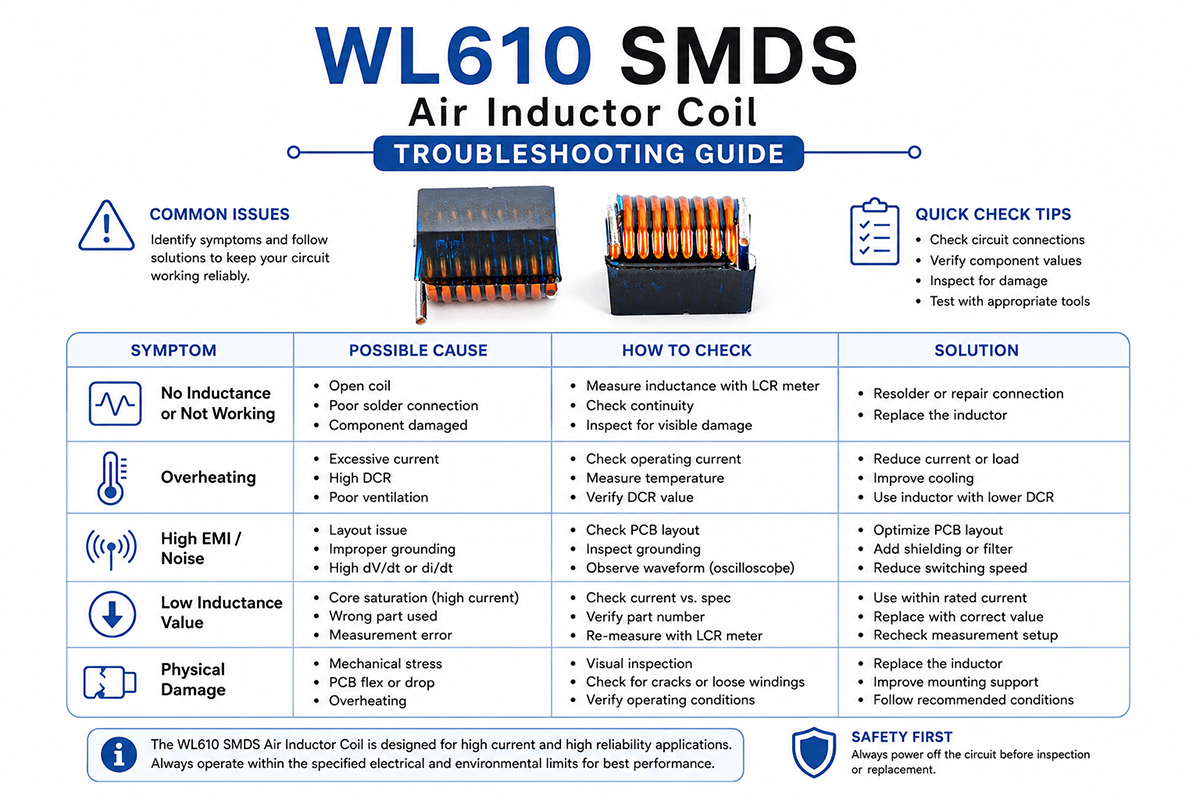
WL610 SMDS Air Inductor Coil Troubleshooting Guide

Drift of inductance

Cause: Mechanical deformation or temperature variation.

Solution: Use more temperature-stable parts with tight tolerance.

Compact Air Inductor Coil Overheat

Cause: Operating currents are higher than the rated value.

Solution: Decrease current rating and reduce DCR.

Bad quality signal

Cause: Low Q-factor or unsuitable frequency.

Solution: Use high-Q SMD air inductors with high self-resonant frequencies.

Compact Air Inductor Coil EMI interference

Cause: Bad PCB design or proximity.

Solution: Use distance between components and improve grounding.

Compact Air Inductor Coil Frequency shift

Cause: Presence of parasitic capacitance or tolerance of components.

Solution: Check resonance calculations and tolerance of components.

Compact Air Inductor Coil Defect of soldering

Cause: Unfavorable conditions of reflow soldering.

Solution: Use appropriate conditions for SMT soldering.

Compact Air Inductor Coil Open circuit

Cause: Mechanical damages.

Solution: Inspect and handle the inductor with care.


FAQs of Compact Air Inductor Coil

1. What is an SMD air coil inductor?

An SMD air inductor (air core inductor) is a SMD inductor with no magnetic material inside its body. Unlike other inductors, SMD air inductors have air core, which makes them highly reliable for high-frequency circuit applications and RF communications. This type of inductor is passive and wire-wound with surface-mount design.

2. Why you prefer the air core inductor instead of ferrite core inductor? What are the advantages?

Here are a few advantages:

No Saturation: Air core inductors will never saturate in contrast with ferrite core inductors. This means that they are able to withstand high currents without changing the inductance.

High Frequency Performance: Since air-core inductors do not have core losses, they are perfect for RF (Radio Frequency) applications.

High-Q: Air-core inductors have high Q (Quality), meaning that they have very low energy loss and work efficiently.

3. How to calculate the current rating of air core inductors?

Unlike inductors with ferrite core, the current ratings of air core inductors are determined not by the sudden decrease in inductance. Air core does not saturate magnetically, therefore, current ratings depend on temperature increase. Current ratings may become exceeded if the air core inductor gets broken.

4. What are the main strategies to manage the heat in these inductors?

Heat dissipation is crucial for proper performance of any inductor. Here are a few methods to achieve efficient heat dissipation:

PCB Design – Use large thermal pads connected to copper or ground plane acting as a heat sink.

Component Location – Place the inductor away from other sources of heat to avoid thermal overload.

Cooling – Natural convection or forced cooling (fan) can be employed.

Winding Design – Use correct wire thickness and spacing for efficient heat dissipation.

5. What are the common signs of an air core inductor going bad?

You can recognize faulty or low-quality air-core inductor if you notice such symptoms:

Overheating – If the inductor or PCB area near it becomes hot.

Signal Quality Issues – In RF applications the signal quality will be distorted or unstable.

Physical Damages – If the inductor got cracked or if there are any loose connections in windings.

6. Why my air core inductor has bad inductance performance?

This problem can be caused by:

Incorrect soldering – check the solder joints carefully if they are cracked or corroded since they significantly change the inductance.

Faulty windings – check your air core inductor visually and look for possible gaps between turns or overlaps.

DC Resistance – use multimeter and compare your results to the rated value. If the value is much higher than rated, this indicates that something is wrong with the wiring.

7. Can you use SMD air core inductor in DC-DC converter?

No, usually, you cannot. SMD Air core inductors provide small inductance values (less than 0.1 µH), making them inappropriate for power conversion. DC-DC converter requires higher inductance values for effective energy storage. Such inductors are mainly used for high frequency signal processing and filtering.

8. What is the difference between an air core inductor and an unshielded wire wound inductor?

Although, both these inductors can be unshielded, yet, their differences exist in design. Air core inductor contains no magnetic material inside and consists of bare windings. An unshielded wire wound inductor consists of copper winding and a core consisting of magnetic material, such as ferrite.

How to Choose SMD Air Inductor Coil

Selection of the proper SMD Air Inductor Coil requires taking both electrical and mechanical characteristics into account.

1. Choose the necessary inductance

Decide what inductance is required for the particular application of your electronic system. It ranges from nanohenries to microhenries.

2.Determine operating frequency

Air-coil inductors are especially preferable for high-frequency circuits. SMD air coils have high self-resonant frequency compared with their operating frequency.

3.Assess Q-Factor

The greater is Q factor the less is losses and the better circuit performance. High-Q SMD air-inductors are necessary for RF applications.

4. Verify current rating

Current rating should be greater than maximum current flowing through inductor.

5. Assess DC resistance

Less DCR leads to less energy losses and more energy savings in power-critical applications.

6.Select the package sizes

The package sizes should correspond to your PCB layout and automation process of assembly.

7. Consider temperature stability

For harsh environmental conditions it’s necessary to choose an inductor with high temperature stability.

8. Verify tolerances of inductance

If precise circuits are used, it’s necessary to choose inductors with tolerance $\pm$ 2% or $\pm$ 5 %.

9. Take into account environmental criteria

For international markets RoHS and REACH certification should be provided.

10. Select a reliable manufacturer

Experienced manufacturers can assist you in choosing appropriate inductors.

All this information can improve performance and reliability of your electronic system and help eliminate electromagnetic interference.

Tips to Avoid Common Design Errors

Don’t make these mistakes:

Choosing inductance independently of frequency of operation.

Neglecting self-resonant frequency.

Undervaluing current requirements.

Choosing parts with high DCRs.

Disregarding PCB design and parasitics.

Proximity of the coils to each other leading to magnetic coupling.

Not considering the impact of temperature.

Using high-Q inductors in RF applications.

Neglecting tolerance of inductance.

Selecting poor-quality suppliers.

Get A Free Quote Now

Contact Form

Related Products

Related News

Scroll to Top

Get A Free Quote Now !

Contact Form
If you have any questions, please do not hesitate to contact us.
Weilong Solenoid Company Culture
