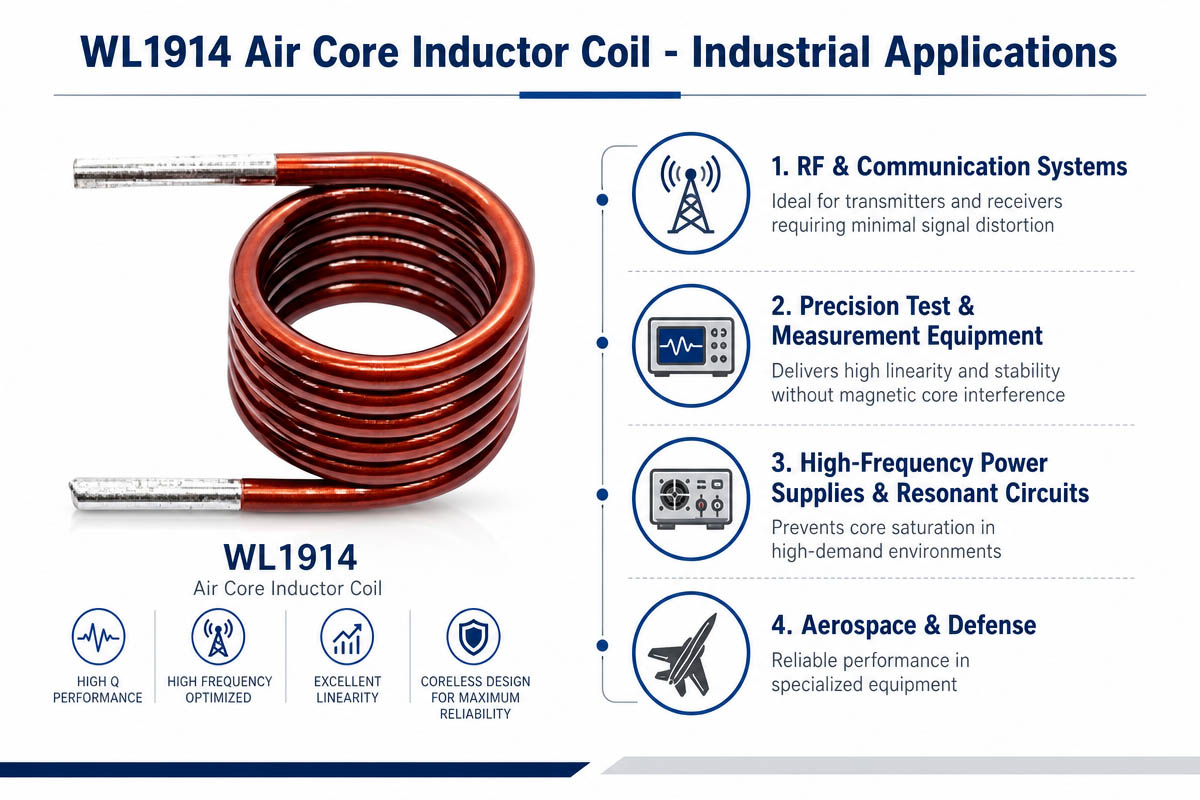
There are many practical applications for air core inductors in the fields of electronics, audio, communications, and automation systems. Since air core inductors have excellent inductance characteristics, such kinds of coils are mostly used in RF communications equipment, signal filters, antennas, etc. In audio systems, crossover circuits use air-core inductor coils to provide distortion-free sound transmission. Air core inductors are extensively used in medical electronics for precise signal performance.
These inductors also serve various sensing, control, and filtering applications in industrial electronic systems. Oscillators and tuning circuits in radio, TV, and communication equipment require the use of such inductors. These coils can be found in almost all electronic and consumer devices like televisions, radios, mobiles, PC boards, etc.
Why are air core coils getting so popular?
Air core coils are of increasing interest due to the high-frequency performance, small size, fast response, and low energy loss requirements of today’s electronic and industrial systems. Unlike regular iron-core inductors, air-core coils use air as the magnetic medium. This removes core losses and magnetic saturation problems.
Here are the main reasons why they are becoming more popular:
1. Outstanding High-Frequency Characteristics
Air core coils work very well in high-frequency circuits because they have
Very low iron loss
Low hysteresis loss loss
Lower eddy current generation
High-frequency inductance stability
This makes them perfect for:
RF Communications Systems
Wireless charging 5G devices
Antennae
Tesla’s coil
Signal filter
Iron core inductors tend to heat up and lose efficiency at high frequencies; air core coils do not.
2. No Magnetic Saturation
Conventional magnetic-core inductors can reach a point called magnetic saturation, after which the core cannot store any additional magnetic energy.
Air core coils do not have this problem at all. Air cannot be magnetically saturated.
Benefits are:
Enhanced linearity
Stable inductance
More precise signal transmission
Stable operation at various currents
This is particularly true in:
Electronics Precision
Sound equipment.
RF amplifiers.
Instruments of measurement
3. Rapid Electromagnetic Response
Air core coils are very fast at responding to current changes in the absence of a magnetic core slowing magnetic field changes.
This provides benefits in the following: the following:
High-speed switch circuits
High-speed communication.
Pulse electronics
Induction heating systems
Due to the need for fast electromagnetic response in modern electronics, the demand for air core technology is rising.
4. Less Production of Heat
Air core coils have no iron core and therefore reduce:
Eddy-current loss
Core heating Waste of energy
This increases:
System performance
Lifespan heat stability
In compact electronics and automotive systems, low heat is very valuable.
5. Compact and Lightweight Design
Air-core coils are usually:
Less lightweight, more customizable
This is consistent with trends in:
Miniaturized electronics
Wearable technology
Mobile medical equipment
Drones, aerospace electronics
Modern compact products require manufacturers to use light electromagnetic components.
6. Better Signal Purity
Air-core coils produce less magnetic distortion and interference.
This type of coil improves the signal quality for the:
Audio crossing systems
RF tuning
Television equipment.
Scientific instruments
Air core inductors are preferred, especially in high-end audio systems, because they produce a cleaner sound with less distortion.
7. Increasing Demand for Wireless Technology
The swift increase of
Charging without wires
Internet of Things gadgets
EV charging
NFC system
Intelligent devices
5G communications
has increased the demand for efficient, high-frequency inductors significantly.
Air core coils are one of the best choices for these applications.
8. OEM Applications Easy Customization
Air core coils offer a highly flexible design.
Different wire gauge
Flat wire structures
Custom value inductances
Various shapes and sizes.
They can be tailored by OEMs to meet specific industrial needs.
This flexibility is fueling adoption in custom electronics and industrial automation.
Common Applications of Air Core Coils
Electronics Consumer
Wireless charging
Smartphones, Tablets
Wearable
Industrial Equipment
Induction-heating
High-frequency converter
Sensor’s
Automotive
Wireless charging for EVs
Radar systems
EMC Filter
Communications
RF transmitters
Antennae
Amplifiers of the Signal
Audio Systems
top-class speakers
Crossovers Amplifiers
Principal Limitation of Air Core Coils
Air core coils are popular but have some disadvantages:
Less inductance than an iron-core coil
More peaks and valleys
Magnetic field concentration weaker
Hence, they are not suitable for low-frequency, heavy power applications like large transformers.
Future Trend of Air core Coils
As electronics continue to trend towards the following:
Increased frequencies
Smaller devices.
Faster switching
Wireless energy
Low-loss systems
Air core coils will also be more and more popular in the industrial and consumer markets.
Analysts expect demand in the fields of EVs, renewable energy, AI hardware, and wireless communication to grow at a rapid pace.